
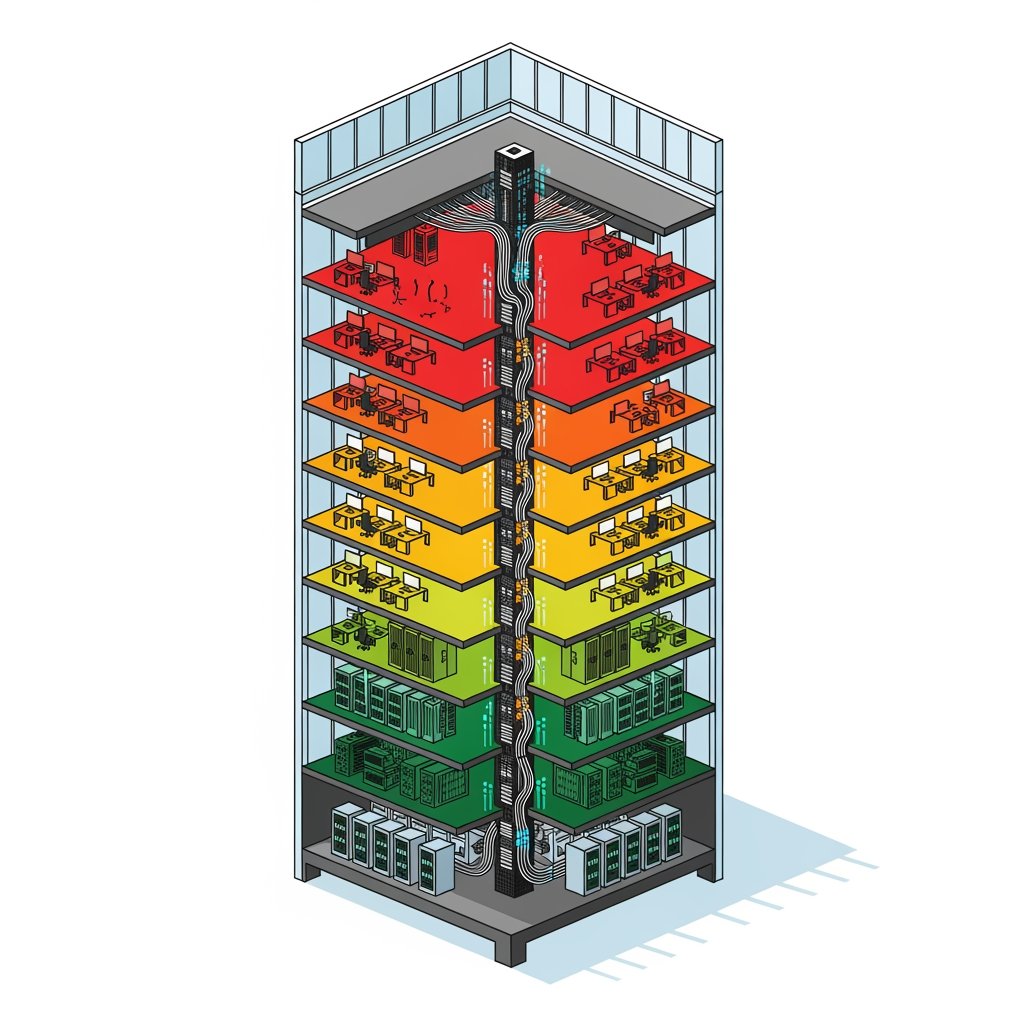

Of 189 enterprise software categories graded on a 0–10 scale for AI agent replacement risk, 44 scored an 8 or higher. Two scored a perfect 10. Only three scored zero. The median grade across the full dataset is 6. This is the Agent Replacement Index: a proprietary scoring of 189 distinct SaaS categories, covering more than $340 billion in annual software spending, designed to measure which segments of the enterprise software market face structural disruption from autonomous AI agents and which are positioned to compound their value because of it.
The categories that scored zero are the ones nobody writes trend pieces about: cloud backup, archival storage, business continuity infrastructure. The categories investors fund most aggressively are clustered in the 7–9 range. Content generation tools, meeting transcription software, cold email sequencers, help desk platforms, no-code app builders. These products provide a human a visual interface to perform a task that a foundational AI model now performs natively.
Gartner projects global AI spending will hit $2.52 trillion in 2026. IDC analysts state explicitly that pure seat-based SaaS pricing will be obsolete by 2028. The divergence is visible in public filings. Salesforce posted $11.2 billion in quarterly revenue and authorized a $50 billion buyback, while Atlassian reported a $47.7 million operating loss as investors price in core product disruption.
The Agent Replacement Index dataset and visualizations are free to cite, embed, and reference with attribution to WhatAreTheBest.com.
WhatAreTheBest.com is a SaaS comparison platform that actively tracks and scores more than 7,500 enterprise products across 1,200+ distinct software categories. Every product is evaluated using a proprietary six-category weighted methodology that measures pricing, feature depth, integration breadth, user satisfaction, market position, and vendor stability. That infrastructure, built over years of granular product-level analysis, provided the foundation for this research.
For the Agent Replacement Index, analysts isolated 189 core SaaS categories and graded each on a scale of 0 to 10. A score of 10 indicates a category whose core functionality will be fully replaced by autonomous AI agents within three to five years. A score of 0 indicates absolute structural immunity to AI replacement.
The grading framework weighs five vulnerability factors against five defensibility factors. On the vulnerability side: workflow dependency (how much the product relies on humans clicking through a rigid UI), interface complexity (whether a natural-language query can replace the dashboard), manual task frequency (the volume of repetitive actions the software automates), data portability (how easily a competitor or AI agent can extract the data), and integration commoditization (whether standard protocols like the Model Context Protocol make the product's API connectors redundant). On the defensibility side: system-of-record status (whether the software holds authoritative enterprise data), proprietary data moats (unique datasets that foundational models cannot scrape), network effects (whether more users make the product structurally stickier), compliance and regulatory requirements (whether probabilistic AI models can guarantee the deterministic accuracy required), and physical or hardware embedding (whether the software interfaces with the real world in ways AI cannot replicate).
The final 0–10 grade is derived by calculating net exposure: total vulnerability factor score minus total defensibility factor score, mapped onto the 0–10 scale where 10 indicates a category whose core value is almost entirely replaceable by autonomous AI within three to five years, and 0 indicates a category structurally immune to AI replacement in that horizon.
"Grading this by gut feel is how you end up with headlines saying AI will replace everything or nothing. We built a weighted scoring framework because we've already applied the same methodology to 7,500 individual products — you can't bullshit your way through that much data." — Albert Richer, Founder, WhatAreTheBest.com
The resulting dataset exposes which software categories rely on manual human coordination that AI agents are actively automating, and which categories function as irreplicable digital infrastructure that AI depends on rather than displaces.
The distribution itself tells the story. 67% of categories fall between grades 3 and 8. This is not a binary outcome. The dominant narrative positions AI as either killing all software or killing none. The data shows a bell curve weighted toward moderate-to-high vulnerability, with thick tails at both extremes. Three categories score zero (absolute immunity), two score 10 (full replacement in progress), and the vast contested middle is where execution and data architecture determine survival.
Grades were assigned by WhatAreTheBest.com's research team, led by founder Albert Richer, applying the factor framework above to each category individually. Scores were reviewed against the top-ranked products in each category from WhatAreTheBest.com's 7,500-product database before finalization.
The scoring framework is auditable. Below are three categories from different tiers of the index, with the full factor-by-factor breakdown that produces each grade.
Net exposure: 22 minus 42 = -20, mapping to grade 3. Moderate workflow vulnerability is overwhelmed by extreme System of Record status, deep proprietary data accumulation, and enterprise-wide integration embedding. AI replaces the data entry and dashboard layers, not the underlying customer database. The CRM survives because it owns the truth data that AI agents must connect to, not compete with.
Every vulnerability factor scores near maximum. Every defensibility factor scores near zero. The category's entire value proposition is a UI wrapper around the same capability that OpenAI, Anthropic, and Google provide natively. Native AI features in Microsoft Word and Google Docs deliver the identical function at zero marginal cost. There is no structural moat.
This is the contested middle in action. The workflow layer (visual rule builders, static journey mapping) is highly automatable by AI agents that execute campaigns using dynamic reasoning. But the proprietary customer behavioral data and the deeply embedded integrations with CRM and ad platforms create real switching costs. Incumbents with rich event data survive if they pivot to consumption-based, outcome-driven pricing. Those that cling to per-seat models while AI agents handle the execution will lose the renewal.
The categories graded 8, 9, or 10 share a common trait: their core value is a visual interface wrapped around a task that foundational AI models now perform natively. They lack proprietary data moats. They do not serve as systems of record. Their pricing models charge per human seat for work that increasingly requires no human at all.
AI Content & Copywriting Tools scored a perfect 10. The sole value proposition is generating text via a UI wrapper. That capability is entirely cannibalized by foundational models from OpenAI and Anthropic and by native AI features shipping inside Microsoft Word, Google Docs, and every major CMS. Standalone wrapper tools possess zero moats.
Transcription & Meeting Notes Tools also scored 10. Speech-to-text and meeting summarization is now a free feature natively embedded in Zoom, Microsoft Teams, and Google Meet. Content Marketing Platforms scored 9, Presentation & Slide Design Software scored 9, and Stock Media & Asset Libraries scored 9. Generative AI creates context-perfect, highly specific media on demand. The value proposition of searching a static library of generic stock images is collapsing.
The pattern holds across every content-adjacent category. Social Media Content Creation Tools scored 9, Screen Recording & Tutorial Creation Tools scored 8, and Document Scanning & OCR Software scored 9. Multimodal LLMs perform OCR natively, perfectly, and at a fraction of the cost of dedicated software. Every category in this cluster relies on a single capability that foundational models now include for free. McKinsey estimates generative AI will automate 60-70% of current knowledge work activities, and content creation sits squarely in the center of that estimate.
Sales Engagement & Outreach Platforms scored 9. AI agents autonomously generate hyper-personalized sequences, monitor responses, and execute multi-channel outreach end-to-end without static rules. Cold Email & Sales Sequencing Tools scored 9 for the same reasons. Landing Page & Funnel Builders scored 9: AI generates dynamic, personalized web pages in real time via code generation, rendering drag-and-drop visual builders unnecessary.
Email Marketing Software scored 8. The batch-and-blast model with basic audience segmentation is being replaced by autonomous AI that dynamically segments users based on real-time behavior and optimizes send times without human intervention. Social Media Management Tools scored 8. The workflow of scheduling posts, monitoring feeds, and aggregating basic analytics lacks system-of-record data lock-in and is highly automatable.
Help Desk & Ticketing Software scored 9. Gartner predicts 40% of enterprise applications will feature task-specific AI agents by 2026. AI agents now resolve 80%+ of Tier-1 support issues autonomously and directly trigger backend actions, completely bypassing the human ticketing UI. IT Helpdesk & Ticketing Systems also scored 9. Agents connect directly to Active Directory and IAM tools to resolve password resets and software access requests via chat.
Task Management & Punch List Tools scored 9. Simple checklists and individual to-dos are single-player, low-complexity workflows that AI completely cannibalizes. Time Tracking & Productivity Tools scored 9. AI natively observes operating system activity, calendar events, and code commits to autonomously log time. Appointment Scheduling & Booking Tools scored 9. AI agents read calendars and negotiate meeting times over email autonomously, bypassing the standalone booking page entirely.
No-Code & Low-Code App Builders scored 9. AI generates full-stack code via natural language prompts. The visual abstraction layer becomes entirely unnecessary when functional code can be produced on demand. AI Chatbots & Conversational AI scored 9. Custom bot builders are being replaced by foundational agentic frameworks that connect directly to APIs and vector databases without a wrapper UI. Workflow Automation Platforms scored 8. Agentic AI dynamically bridges APIs and formats data without requiring visual IF/THEN builders.
"I run a solo business that scores thousands of SaaS products, and I'm watching this in real time from the inside. The categories scoring 8 and 9 aren't theoretical — they're the tools I watched stop being useful to me over the last eighteen months. Content generation, meeting transcription, cold outreach automation — I don't open those apps anymore. I just talk to the model." — Albert Richer, Founder, WhatAreTheBest.com
Only three of the 189 categories graded scored zero. These three are not random. They reveal three structurally distinct things AI cannot replace. Cloud Backup & Recovery Software represents deterministic data replication: a probabilistic model cannot generate a byte-exact verified copy of existing information. Identity & Access Management Software represents cryptographic gating: AI agents do not replace IAM, they depend on it to function inside enterprise systems at all. Single Sign-On Solutions represents federated cryptographic authentication: SAML and OAuth handshakes require mathematical certainty that probabilistic models cannot provide. The pattern is consistent. AI's replacement reach is vast, but the handful of functions it cannot perform are functions whose entire value is certainty rather than intelligence.
On the opposite end of the index, 43 categories scored between 0 and 2. These are not the software products generating conference keynotes. They are the plumbing: backup infrastructure, financial ledgers, identity management, endpoint security, payroll engines. They share a structural characteristic that makes them functionally immune to AI replacement: they require deterministic certainty in environments where a probabilistic guess carries legal, financial, or physical consequences.
Cloud Backup & Recovery Software scored 0. You cannot use a language model to replace the physics of storing bytes. This is a deterministic, highly regulated infrastructural necessity. Archiving & Long-Term Storage Solutions scored 1 and IT Backup & Business Continuity Software scored 1. Both remain among the most defensible categories in the index, but their storage orchestration layer is commodity infrastructure rather than a cryptographic gating function.
Cloud Storage Services scored 1. AI relies entirely on this data layer to function. RMM & Endpoint Management Tools scored 1. Remote Desktop & Access Tools scored 1. Mobile Device Management Software scored 1. These systems require deep kernel access, network infrastructure, and physical device control that language models cannot replicate. Shipping, Fulfillment & 3PL Software scored 1. The deterministic constraints of moving physical boxes through legacy carrier API networks create a massive defensive moat.
"When we graded 189 software categories for AI replacement risk, only three scored zero. Every one of them was something nobody gets excited about — archival storage, backup infrastructure, the plumbing. The categories investors actually fund are clustered in the danger zone." — Albert Richer, Founder, WhatAreTheBest.com
Software bound by government tax codes and financial liability serves as the ultimate corporate system of record. Small Business Accounting Software scored 1. Tax Preparation & Compliance Software scored 1. Payroll & Contractor Payment Platforms scored 1. Payroll & Benefits Administration Software scored 1. These systems execute wage payments, handle highly sensitive PII, and manage benefits disbursements under strict regulatory frameworks. Probabilistic AI cannot replace a deterministic financial ledger.
HRIS scored 1. HR Compliance & Policy Management Tools scored 1 due to extreme corporate liability and the necessity for perfect data integrity. Workday generated $588 million in quarterly operating cash flow, demonstrating the immense financial durability of core HR and finance platforms that hold these system-of-record positions.
Subscription Billing & Recurring Revenue Tools scored 2. FP&A & Financial Forecasting Software scored 2. Cloud Bookkeeping Platforms scored 2. Every one of these categories is tied to payment gateways, revenue recognition laws, or general ledger compliance. AI automates the data entry layer on top of these systems. It does not replace the deterministic ledger underneath. CFOs consistently report that AI assists with scenario planning but cannot assume fiduciary liability, which is the core function these platforms protect.
AI agents actually increase the need for rigid corporate security. Identity & Access Management Software scored 0. IAM is the cryptographic gate every authenticated request passes through, including every request made by AI agents. As autonomous agents proliferate, IAM becomes more essential, not less. Single Sign-On Solutions also scored 0. SSO is pure cryptographic infrastructure: SAML assertions, OAuth tokens, federated trust. There is no UI for AI to absorb, no workflow to automate. Endpoint Security Platforms scored 1. GRC & Risk Management Platforms scored 1. Compliance & Audit Management Platforms scored 1. These categories are not threatened by AI. They are structurally required by it.
The 102 categories graded between 3 and 7 represent the most consequential battleground for SaaS operators and investors. These products hold valuable proprietary data but suffer from highly automatable workflow layers. Whether they survive depends entirely on management execution: how fast incumbents pivot from UI-based workflow tools to AI-native infrastructure.
CRM Software scored 3. The CRM database itself holds decades of proprietary customer history, creating massive switching costs. But CRM data entry, the manual workflow layer, is entirely automatable. Salesforce executed 2.4 billion Agentic Work Units in Q4, demonstrating a successful pivot from selling human seats to monetizing autonomous machine labor.
Marketing Automation Platforms scored 6. The underlying proprietary customer data provides defensibility, but the visual rule builder is becoming obsolete as AI agents execute campaigns using dynamic reasoning rather than static IF/THEN logic. CPQ Software scored 5. AI instantly generates dynamic quotes from historical data and margin requirements, but deep ERP integrations and strict financial compliance preserve a moderate moat.
Applicant Tracking Systems scored 6. AI agents screen resumes, schedule interviews, and communicate with candidates without the manual UI. But hiring compliance data provides partial defensibility. Performance Management Software scored 5. AI synthesizes Slack messages, code commits, and CRM data to auto-generate performance reviews, yet human judgment and compensation sensitivity prevent full replacement.
ServiceNow reported 20% subscription revenue growth specifically by tying automated workflows to backend IT infrastructure rather than standalone front-end interfaces. That is the playbook for middle-tier survival: become the infrastructure that AI agents rely on, not the interface they bypass.
The analytics tier tells a similar story. Business Intelligence & Dashboard Tools scored 7. AI natively generates insights from databases via natural language, eliminating complex dashboard building. But Embedded Analytics Platforms scored 5 because the infrastructure required to securely pipe data across tenant boundaries provides a structural moat that pure AI cannot replicate. The difference between a 5 and a 7 is not product quality. It is data architecture.
Ecommerce tools show the same pattern. Ecommerce Store Builders scored 6 because the storefront UI is replaceable by AI code generation, but the integration with inventory, tax calculation, and Shopping Cart & Checkout Platforms (scored 2) provides a transactional anchor. Forrester's 2026 commerce report confirms that platform consolidation is accelerating fastest in categories where the AI handles the storefront while the checkout remains deterministic infrastructure.
"The SaaS companies most at risk aren't the ones with the worst products. They're the ones whose entire value proposition is a nice interface over somebody else's data. If an AI agent can query the underlying database directly, the interface isn't a feature anymore — it's a tax." — Albert Richer, Founder, WhatAreTheBest.com
IDC research shows traditional user-based revenue models collapsing as AI agents become the primary users of business applications. Per-seat pricing was designed for human-operated software. AI agents break every assumption that model rests on. They do not consume seats. They consume compute cycles, API calls, and tokens. Charging per seat for an AI-augmented workflow is like billing per driver for a highway used mostly by autonomous vehicles.
The pricing shift is not theoretical. These are live production pricing tiers from the four largest customer platform vendors. Salesforce charges $2 per Agentforce conversation. HubSpot's Breeze Customer Agent bills $0.50 per resolved conversation. Intercom's Fin 2 charges $0.99 per successful resolution and reports a 51% average resolution rate out-of-the-box. When the AI resolves half of inbound volume autonomously, a company that previously paid for 10 support seats now pays for 5 seats plus a variable usage fee. The per-seat model mathematically breaks.
For operators: halt all new deployments of point solutions graded 8 or higher. Content generation, meeting transcription, manual lead routing, and basic task management are now free features natively included in Microsoft, Google, or core CRM subscriptions. Redirect that budget toward deepening integrations with core systems of record and investing in consumption-based infrastructure.
For investors: scrutinize how public cloud companies plan to monetize agentic activity. If a SaaS company reports flat human seat growth but exploding API call volume, they are successfully transitioning to an agentic infrastructure model. If they report declining seat growth without a corresponding spike in machine-to-machine consumption, their workflow is being cannibalized by foundational models. Atlassian narrowed its GAAP operating loss while managing AI disruption fears, but the market correctly perceives that collaborative multiplayer surfaces are stickier than single-player task boards.
"The bet every SaaS founder needs to make in 2026 is simple. Either your product owns proprietary data that didn't exist before you built it, or your product is a workflow that an AI agent can do better in eighteen months. There's no third category. The companies that still think there is will find out the hard way." — Albert Richer, Founder, WhatAreTheBest.com
The interactive table below contains every category in the Agent Replacement Index. Sort by grade to see the most vulnerable or most defensible. Search by name or keyword. Filter by grade range. Download the full dataset as an Excel spreadsheet for your own analysis.
| Category Name ▲ | Grade | Rationale |
|---|
This analysis evaluates 189 core enterprise SaaS categories using the Agent Replacement Index, a proprietary scoring framework developed by WhatAreTheBest.com. Each category is graded 0–10 based on a weighted assessment of five vulnerability factors (workflow dependency, UI complexity, manual task frequency, data portability, integration commoditization) and five defensibility factors (system-of-record status, proprietary data moats, network effects, compliance requirements, physical/hardware embedding). The grading methodology draws on product-level analysis of 7,500+ enterprise software products. External data sources include Gartner, IDC, SEC filings, official company earnings transcripts, and product announcements. The index is designed to be read in tiers rather than as a precise ordinal ranking. Categories were selected to represent the broadest commercially relevant SaaS segments while excluding highly niche vertical applications.
Download the full dataset (Excel)
Media inquiries: albert@whatarethebest.com