Identity & Access Management Software

Updated July 25, 2026

These are the specialized categories within Identity & Access Management Software. Looking for something broader? See all Cybersecurity, Privacy & Compliance Software categories.

Not sure which one is right for you?

Answer 4 quick questions and we'll match you with your best options

Find Your Best Match

How big is your team?

Just me
2 - 10
11 - 50
51 - 200
201 - 1,000
1,000+

What's your budget situation?

Free or open-source only
Free to start, pay later
Best value for money
Price isn't the main factor

What's your team's technical comfort level?

We want it to just work
We can handle some setup
We have developers who'll customize it

What's the ONE thing this tool must do well?

Step 1 of 4
Strata.io Identity Software

Strata.io is the ideal Identity & Access Management (IAM) solution for real estate professionals, unifying SSO and managing identities in a resilient manner. It caters to the unique needs of real estate agents, securing both human and AI agent identities in the digitized real estate market.

Best for Identity & Access Management Software for Real Estate Agents

Expert Take

Strata.io excels in providing a specialized IAM solution tailored for real estate professionals, ensuring secure management of both human and AI identities. Its focus on industry-specific needs and robust integration capabilities positions it as a leading product in its category.

Pros

  • Decouples identity from apps (No-code)
  • Co-author of SAML standard leadership
  • Supports legacy and modern IdPs
  • Transparent pricing model (per app/IDP)

Cons

  • Requires distributed orchestrator maintenance
  • Low volume of public reviews
  • Requires external IdP to function
  • Niche focus (Orchestration only)

Best for teams that are

  • Enterprises with hybrid clouds and legacy identity systems
  • Organizations managing multi-cloud identity orchestration

Skip if

  • Small agencies with simple, cloud-only IT environments
  • Individual agents or teams without complex infrastructure

Best for teams that are

  • Enterprises with hybrid clouds and legacy identity systems
  • Organizations managing multi-cloud identity orchestration

Skip if

  • Small agencies with simple, cloud-only IT environments
  • Individual agents or teams without complex infrastructure

Pros

  • Decouples identity from apps (No-code)
  • Air-gap architecture for security
  • Co-author of SAML standard leadership
  • Supports legacy and modern IdPs
  • Transparent pricing model (per app/IDP)

Cons

  • Requires distributed orchestrator maintenance
  • Low volume of public reviews
  • Additive cost to existing IdPs
  • Requires external IdP to function
  • Niche focus (Orchestration only)

Expert Take

Strata.io excels in providing a specialized IAM solution tailored for real estate professionals, ensuring secure management of both human and AI identities. Its focus on industry-specific needs and robust integration capabilities positions it as a leading product in its category.

2
9.0 / 10
Imprivata OneSign

Imprivata OneSign is an identity access management solution designed specifically for accountants and financial professionals. The appliance addresses the unique security and compliance requirements of the industry by providing streamlined access control and robust auditing capabilities.

Best for Identity & Access Management Software for Accountants

Expert Take

Imprivata OneSign excels in providing industry-specific identity and access management solutions tailored for accountants. Its strong focus on security and compliance, coupled with robust auditing capabilities, makes it a top choice in its category. However, the lack of transparent pricing and potential implementation complexity are notable tradeoffs.

Pros

  • No-click badge tap access
  • Deep Epic & EHR integration
  • DEA-compliant EPCS support
  • Virtual Desktop (VDI) optimization

Cons

  • High implementation cost
  • Opaque pricing structure
  • Limited reporting customization
  • Occasional Windows update conflicts

Best for teams that are

  • Healthcare organizations needing fast clinical access
  • Financial institutions requiring secure shared device access

Skip if

  • General office environments without shared devices
  • Small businesses needing a simple cloud SSO solution

Best for teams that are

  • Healthcare organizations needing fast clinical access
  • Financial institutions requiring secure shared device access

Skip if

  • General office environments without shared devices
  • Small businesses needing a simple cloud SSO solution

Pros

  • No-click badge tap access
  • Best in KLAS 2025 Winner
  • Deep Epic & EHR integration
  • DEA-compliant EPCS support
  • Virtual Desktop (VDI) optimization

Cons

  • High implementation cost
  • Opaque pricing structure
  • Complex initial deployment
  • Limited reporting customization
  • Occasional Windows update conflicts

Expert Take

Imprivata OneSign excels in providing industry-specific identity and access management solutions tailored for accountants. Its strong focus on security and compliance, coupled with robust auditing capabilities, makes it a top choice in its category. However, the lack of transparent pricing and potential implementation complexity are notable tradeoffs.

Saviynt Cloud Identity Security

Saviynt is an advanced Cloud Identity Security and Management solution designed for contractors. With Saviynt, contractors can securely access the applications, systems, and data they need, while businesses can maintain control and visibility. It's the #1 converged identity platform for this industry, providing compliance, risk mitigation, and efficient user management.

Best for Identity & Access Management Software for Contractors

Expert Take

Saviynt Cloud Identity Security is a leading solution in the Identity & Access Management space, particularly for contractors. Its comprehensive capabilities in access control and risk mitigation, combined with strong market credibility and a robust ecosystem, position it as a top choice. While it requires initial setup, its value in compliance and security justifies its premium positioning.

Pros

  • Converged IGA, PAM, and AAG platform
  • Deep integration with SAP and Oracle
  • Gartner Customers' Choice 4 years running
  • Modern, unified user interface

Cons

  • Steep learning curve for administrators
  • High total cost of ownership (TCO)
  • Inconsistent technical support quality
  • No public pricing transparency

Best for teams that are

  • Enterprises with complex compliance needs (SOX, HIPAA)
  • Companies requiring converged IGA and PAM capabilities

Skip if

  • Small teams wanting a quick, plug-and-play setup
  • Organizations with limited technical implementation resources

Best for teams that are

  • Enterprises with complex compliance needs (SOX, HIPAA)
  • Companies requiring converged IGA and PAM capabilities

Skip if

  • Small teams wanting a quick, plug-and-play setup
  • Organizations with limited technical implementation resources

Pros

  • Converged IGA, PAM, and AAG platform
  • FedRAMP Moderate Authorized security
  • Deep integration with SAP and Oracle
  • Gartner Customers' Choice 4 years running
  • Modern, unified user interface

Cons

  • Steep learning curve for administrators
  • High total cost of ownership (TCO)
  • Implementation often requires external partners
  • Inconsistent technical support quality
  • No public pricing transparency

Expert Take

Saviynt Cloud Identity Security is a leading solution in the Identity & Access Management space, particularly for contractors. Its comprehensive capabilities in access control and risk mitigation, combined with strong market credibility and a robust ecosystem, position it as a top choice. While it requires initial setup, its value in compliance and security justifies its premium positioning.

CyberArk Identity Security

CyberArk’s identity security platform is a robust solution for marketing agencies seeking to protect sensitive data from unauthorized access and cyber threats. It caters specifically to the industry’s need for secure access management, ensuring that only authorized individuals can access specific data. It is an ideal solution for agencies handling sensitive client information.

Best for Identity & Access Management Software for Marketing Agencies

Expert Take

CyberArk Identity Security excels in providing advanced security features tailored for marketing agencies, ensuring secure access management and proactive threat detection. Its comprehensive audit trails and 24/7 support further enhance its value, despite a complex setup process.

Pros

  • FedRAMP High authorization for government use
  • Unified platform for human and machine identities
  • Massive marketplace with 960+ integrations
  • CORA AI for automated threat detection

Cons

  • High Total Cost of Ownership (TCO)
  • Steep learning curve for administrators
  • Mixed reviews on technical support responsiveness
  • Documentation can be dense or fragmented

Best for teams that are

  • Highly regulated industries like finance and healthcare
  • Organizations needing to secure machine identities and secrets

Skip if

  • Small businesses needing only basic single sign-on (SSO)
  • Teams looking for a simple, consumer-grade user interface

Best for teams that are

  • Highly regulated industries like finance and healthcare
  • Organizations needing to secure machine identities and secrets

Skip if

  • Small businesses needing only basic single sign-on (SSO)
  • Teams looking for a simple, consumer-grade user interface

Pros

  • Leader in Gartner MQ for PAM (7 consecutive years)
  • FedRAMP High authorization for government use
  • Unified platform for human and machine identities
  • Massive marketplace with 960+ integrations
  • CORA AI for automated threat detection

Cons

  • High Total Cost of Ownership (TCO)
  • Complex deployment often requires professional services
  • Steep learning curve for administrators
  • Mixed reviews on technical support responsiveness
  • Documentation can be dense or fragmented

Expert Take

CyberArk Identity Security excels in providing advanced security features tailored for marketing agencies, ensuring secure access management and proactive threat detection. Its comprehensive audit trails and 24/7 support further enhance its value, despite a complex setup process.

5
9.1 / 10
Okta IAM

Okta's IAM is a robust identity and access management solution designed specifically for digital marketing agencies. It allows these businesses to securely manage user identities and access controls, making it easier to safeguard sensitive data and comply with privacy regulations. Its functionalities such as single sign-on (SSO), multi-factor authentication (MFA), and lifecycle management address the industry's need for secure, simplified access and user management.

Best for Identity & Access Management Software for Digital Marketing Agencies

Expert Take

Okta IAM is recognized as a leading identity and access management solution, particularly suited for digital marketing agencies. It offers comprehensive security features, seamless integrations, and strong market credibility, making it a top choice in its category.

Pros

  • Over 7,000 pre-built integrations (OIN)
  • Gartner Magic Quadrant Leader for 9 years
  • Comprehensive Adaptive MFA and Lifecycle Management
  • High end-user satisfaction for ease of access

Cons

  • History of significant security breaches (2022, 2023)
  • Modular pricing can become expensive
  • Complex initial implementation for advanced features
  • Support response times can vary

Best for teams that are

  • Enterprises requiring extensive pre-built app integrations
  • Organizations prioritizing a user-friendly experience

Skip if

  • Small businesses with very tight software budgets
  • Organizations requiring strictly on-premise infrastructure

Best for teams that are

  • Enterprises requiring extensive pre-built app integrations
  • Organizations prioritizing a user-friendly experience

Skip if

  • Small businesses with very tight software budgets
  • Organizations requiring strictly on-premise infrastructure

Pros

  • Over 7,000 pre-built integrations (OIN)
  • FedRAMP High and SOC 2 Type II certified
  • Gartner Magic Quadrant Leader for 9 years
  • Comprehensive Adaptive MFA and Lifecycle Management
  • High end-user satisfaction for ease of access

Cons

  • History of significant security breaches (2022, 2023)
  • Modular pricing can become expensive
  • Minimum annual contract of $1,500
  • Complex initial implementation for advanced features
  • Support response times can vary

Expert Take

Okta IAM is recognized as a leading identity and access management solution, particularly suited for digital marketing agencies. It offers comprehensive security features, seamless integrations, and strong market credibility, making it a top choice in its category.

IDI Real Estate Intelligence

IDI's Intelligence Platform is a game-changer for real estate professionals, specifically addressing their need to seamlessly connect with potential buyers and sellers. The software offers industry-leading identity and access management tools, enabling real estate firms to reach out to their target audience effectively and in real time.

Best for Identity & Access Management Software for Real Estate Agents

Expert Take

IDI Real Estate Intelligence is a specialized platform tailored for real estate professionals, offering advanced identity and access management capabilities. Its real-time data features and industry-specific focus make it a strong contender in its niche. However, the lack of transparent pricing and potential need for technical expertise are notable considerations.

Pros

  • Nearly 100% US adult coverage
  • No monthly minimums available
  • Mobile app for field access
  • SOC 2 & ISO 27001 certified

Cons

  • Strict credentialing (site inspections)
  • Not FCRA compliant for screening
  • No free tier for public
  • Complex interface for beginners

Best for teams that are

  • Real estate investors needing skip tracing to find property owners
  • Teams needing to locate assets or verify identities for due diligence

Skip if

  • Individual agents wanting a simple, instant mobile safety app
  • Companies looking for employee SSO or access control software

Best for teams that are

  • Real estate investors needing skip tracing to find property owners
  • Teams needing to locate assets or verify identities for due diligence

Skip if

  • Individual agents wanting a simple, instant mobile safety app
  • Companies looking for employee SSO or access control software

Pros

  • Nearly 100% US adult coverage
  • High skip tracing accuracy (90%+)
  • No monthly minimums available
  • Mobile app for field access
  • SOC 2 & ISO 27001 certified

Cons

  • Strict credentialing (site inspections)
  • Not FCRA compliant for screening
  • Pricing not publicly listed
  • No free tier for public
  • Complex interface for beginners

Expert Take

IDI Real Estate Intelligence is a specialized platform tailored for real estate professionals, offering advanced identity and access management capabilities. Its real-time data features and industry-specific focus make it a strong contender in its niche. However, the lack of transparent pricing and potential need for technical expertise are notable considerations.

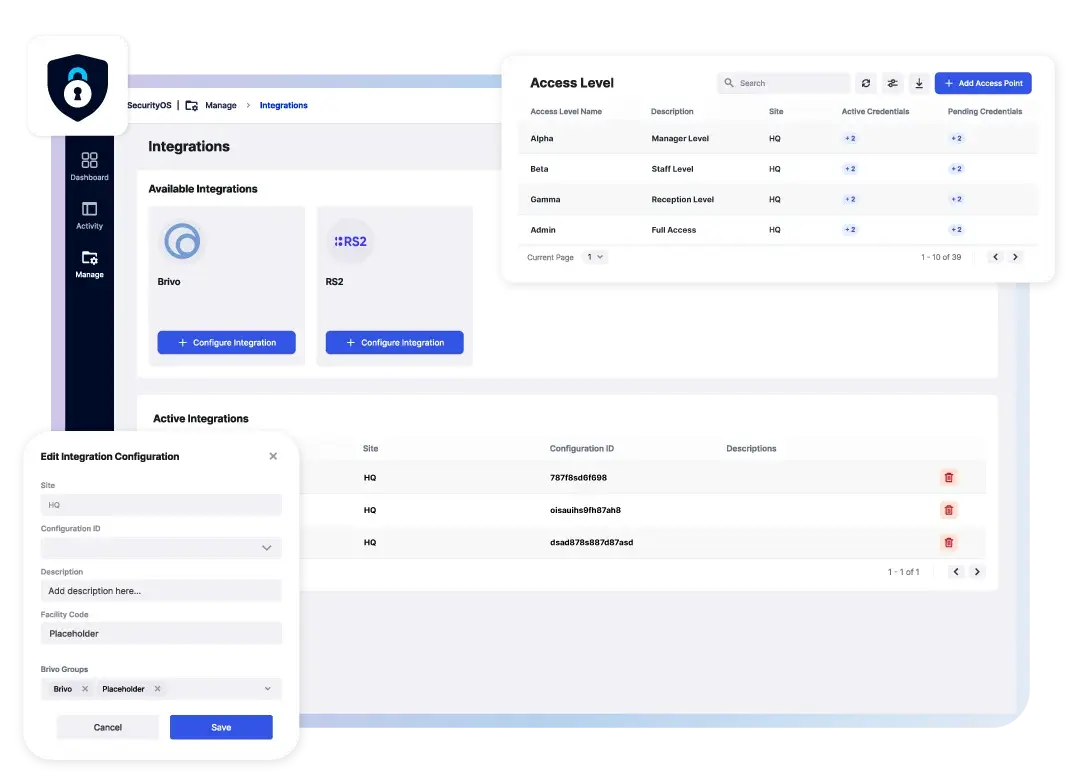
SecurityOS PIAM Solution

SecurityOS by FacilityOS is designed specifically for contractors seeking a secure and efficient way to manage physical access for visitors and contractors. The software streamlines the issuance, tracking, and management of temporary access, addressing the need for robust security measures in the contracting industry, while keeping operations smooth and efficient.

Best for Identity & Access Management Software for Contractors

Expert Take

SecurityOS PIAM Solution is tailored for contractors, offering robust security and efficient access management. Its focus on temporary access management and user-friendly interface makes it a standout in its niche. While it may require initial setup, its specialized features justify its premium positioning.

Pros

  • Automates temporary PACS credential provisioning
  • Seamless integration with Honeywell & Genetec
  • Real-time access visibility and auditing
  • User-friendly interface with high G2 ratings

Cons

  • Occasional connectivity and offline status issues
  • Higher price point than basic VMS
  • Requires existing PACS hardware to function
  • Mail module rated lower than competitors

Best for teams that are

  • Facility managers in manufacturing or industrial sectors
  • Sites requiring automated visitor compliance workflows

Skip if

  • IT teams seeking digital application access (SSO)
  • Remote-only companies without physical facilities

Best for teams that are

  • Facility managers in manufacturing or industrial sectors
  • Sites requiring automated visitor compliance workflows

Skip if

  • IT teams seeking digital application access (SSO)
  • Remote-only companies without physical facilities

Pros

  • Automates temporary PACS credential provisioning
  • SOC 2 Type 2 and ITAR compliant
  • Seamless integration with Honeywell & Genetec
  • Real-time access visibility and auditing
  • User-friendly interface with high G2 ratings

Cons

  • Occasional connectivity and offline status issues
  • Higher price point than basic VMS
  • Badge printing customization limitations
  • Requires existing PACS hardware to function
  • Mail module rated lower than competitors

Expert Take

SecurityOS PIAM Solution is tailored for contractors, offering robust security and efficient access management. Its focus on temporary access management and user-friendly interface makes it a standout in its niche. While it may require initial setup, its specialized features justify its premium positioning.

8
9.0 / 10
Splan PIAM

Splan PIAM is a highly effective SaaS solution for managing physical identity and access requests. It is tailored specifically for contractors, ensuring they can securely and efficiently manage employee access. It streamlines the process of onboarding new hires, managing access permissions, and securing facilities.

Best for Identity & Access Management Software for Contractors

Expert Take

Splan PIAM excels in providing a tailored solution for contractor identity and access management, with strong capabilities in onboarding automation and facility security. It is recognized for its integration ease and 24/7 support, although it may be more complex for smaller businesses. Its market credibility is supported by industry-specific features and third-party validations.

Pros

  • Unified PIAM and Visitor Management
  • Deep integrations with Lenel, Genetec, Okta
  • SOC 2 Type II and GDPR compliant
  • Used by NASA for enterprise security

Cons

  • Complex initial deployment process
  • Kiosk host lookup occasionally fails
  • Steep learning curve for admins
  • Requires custom configuration for complex sites

Best for teams that are

  • Large corporate campuses managing physical entry
  • Tech and education sectors with high visitor volume

Skip if

  • Companies needing digital software access control only
  • Small offices with minimal visitor or contractor traffic

Best for teams that are

  • Large corporate campuses managing physical entry
  • Tech and education sectors with high visitor volume

Skip if

  • Companies needing digital software access control only
  • Small offices with minimal visitor or contractor traffic

Pros

  • Unified PIAM and Visitor Management
  • AI-powered PacsGPT for natural language queries
  • Deep integrations with Lenel, Genetec, Okta
  • SOC 2 Type II and GDPR compliant
  • Used by NASA for enterprise security

Cons

  • Complex initial deployment process
  • Kiosk host lookup occasionally fails
  • Enterprise PIAM pricing is not public
  • Steep learning curve for admins
  • Requires custom configuration for complex sites

Expert Take

Splan PIAM excels in providing a tailored solution for contractor identity and access management, with strong capabilities in onboarding automation and facility security. It is recognized for its integration ease and 24/7 support, although it may be more complex for smaller businesses. Its market credibility is supported by industry-specific features and third-party validations.

9
9.0 / 10
Thales IAM Solution

Thales IAM is specifically tailored for marketing agencies to securely manage and authenticate user identities. The solution excels in providing robust security measures while ensuring seamless access to crucial data and applications, addressing the unique needs of marketing agencies that handle sensitive client data.

Best for Identity & Access Management Software for Marketing Agencies

Expert Take

Thales IAM Solution is a premium identity and access management software tailored for marketing agencies, offering robust security and seamless integration capabilities. Its recognition in the market and comprehensive feature set justify its positioning as a best-of-the-best product in its category.

Pros

  • Strong compliance (ISO 27001, SOC2, FIPS)
  • Broad MFA support including hardware tokens
  • Smart Single Sign-On capabilities
  • Over 1,000 pre-built integrations

Cons

  • UI features can be cumbersome
  • Support response varies for advanced issues
  • Integration setup can be complex
  • Fewer reviews than market leaders

Best for teams that are

  • Organizations prioritizing data encryption alongside access management
  • Enterprises requiring FIDO-supported hardware authentication

Skip if

  • SMBs looking for a simple, dashboard-based SSO solution
  • Companies wanting a purely developer-focused CIAM tool

Best for teams that are

  • Organizations prioritizing data encryption alongside access management
  • Enterprises requiring FIDO-supported hardware authentication

Skip if

  • SMBs looking for a simple, dashboard-based SSO solution
  • Companies wanting a purely developer-focused CIAM tool

Pros

  • Transparent all-inclusive pricing model
  • Strong compliance (ISO 27001, SOC2, FIPS)
  • Broad MFA support including hardware tokens
  • Smart Single Sign-On capabilities
  • Over 1,000 pre-built integrations

Cons

  • UI features can be cumbersome
  • Documentation unclear for complex scenarios
  • Support response varies for advanced issues
  • Integration setup can be complex
  • Fewer reviews than market leaders

Expert Take

Thales IAM Solution is a premium identity and access management software tailored for marketing agencies, offering robust security and seamless integration capabilities. Its recognition in the market and comprehensive feature set justify its positioning as a best-of-the-best product in its category.

Accutive IAM Solutions

Accutive's Identity and Access Management (IAM) Solutions provide robust security and seamless access control specifically designed for accountants. It addresses the industry's need for high-level data protection, regulatory compliance, and efficient user management.

Best for Identity & Access Management Software for Accountants

Expert Take

Accutive IAM Solutions stand out in the Identity and Access Management space with a focus on accounting professionals, offering robust security and compliance features. While the product excels in integration and support, it may present complexity for non-technical users, and pricing transparency is limited.

Pros

  • End-to-end IAM implementation services
  • Specialized in regulated industries
  • Includes CIAM and PAM capabilities
  • High customer satisfaction (5/5 stars)

Cons

  • Low market share visibility (0.00%)
  • Relies on third-party software vendors
  • Niche focus on financial services
  • Pricing transparency is limited

Best for teams that are

  • Financial firms needing expert IAM consulting and implementation
  • Enterprises needing custom integration for complex environments

Skip if

  • SMBs looking for a plug-and-play SaaS IAM product
  • Teams wanting a standalone software license without services

Best for teams that are

  • Financial firms needing expert IAM consulting and implementation
  • Enterprises needing custom integration for complex environments

Skip if

  • SMBs looking for a plug-and-play SaaS IAM product
  • Teams wanting a standalone software license without services

Pros

  • End-to-end IAM implementation services
  • Strong partner ecosystem (Thales, CyberArk)
  • Specialized in regulated industries
  • Includes CIAM and PAM capabilities
  • High customer satisfaction (5/5 stars)

Cons

  • Low market share visibility (0.00%)
  • Relies on third-party software vendors
  • Primarily service-based, not standalone SaaS
  • Niche focus on financial services
  • Pricing transparency is limited

Expert Take

Accutive IAM Solutions stand out in the Identity and Access Management space with a focus on accounting professionals, offering robust security and compliance features. While the product excels in integration and support, it may present complexity for non-technical users, and pricing transparency is limited.

Loading comparison data…

How We Rank Products

Our Evaluation Process

Products in the Identity & Access Management Software category are evaluated based on documented features like user authentication methods, access control mechanisms, and compliance with security standards. Pricing transparency is analyzed to ensure cost-effectiveness for various organizational needs. The software's compatibility with existing IT systems and potential for seamless integration are key considerations. Additionally, third-party customer feedback provides insight into user satisfaction and software performance in real-world scenarios.

Verification

  • Products evaluated through comprehensive research and analysis of features and user feedback.
  • Rankings based on an extensive review of industry specifications, customer ratings, and expert insights.
  • Selection criteria focus on security measures, user experience, and integration capabilities specific to identity and access management solutions.

Score Breakdown

0.0 / 10

About Identity & Access Management Software

Identity & Access Management Software: The Expert Guide

Identity & Access Management (IAM) Software is the digital infrastructure that governs the lifecycle of user identities and enforces policies regarding who can access specific resources, when, and for what purpose. It sits at the intersection of security, compliance, and operational efficiency, serving as the "control plane" that connects users (employees, customers, partners, and machines) to the applications and data they need. Relative to adjacent categories, IAM is broader than simple Single Sign-On (SSO) tools or Multi-Factor Authentication (MFA) utilities, which are merely features within the wider IAM spectrum. However, it is narrower than IT Service Management (ITSM), which manages the entirety of IT delivery, or Cybersecurity Suites, which cover endpoint and network defense. IAM specifically focuses on the identity as the security perimeter. This category includes both general-purpose platforms designed for enterprise-wide identity orchestration and vertical-specific tools tailored for highly regulated sectors like healthcare and financial services.

What Is Identity & Access Management Software?

At its core, Identity & Access Management Software solves the "right access" problem: ensuring the right individuals access the right resources at the right times for the right reasons. Without this software, organizations rely on fragmented, manual processes—spreadsheets of user accounts, sticky notes with passwords, and email chains for access requests—that create massive security gaps and operational bottlenecks. The fundamental function of IAM is to automate the relationship between a user's role and their digital privileges.

The software operates through three primary mechanisms: identification (verifying who the user is), authentication (verifying their credentials), and authorization (determining what they are allowed to do). Modern IAM platforms have evolved to handle complex scenarios beyond simple login. They manage the "joiner, mover, leaver" lifecycle: automatically provisioning accounts when an employee is hired, adjusting permissions when they get promoted or change departments, and—most critically—immediately revoking access when they leave. This lifecycle management is essential for preventing "permission creep," where long-tenured employees accumulate access rights they no longer need, creating a broad attack surface for bad actors.

Who uses IAM software? Historically, it was the domain of IT administrators managing internal employee access. Today, the user base has expanded dramatically. Compliance officers use IAM to generate audit trails for regulations like SOX, HIPAA, and GDPR. DevOps teams use IAM to manage "machine identities" (API keys, service accounts, and bots), which now outnumber human identities in many enterprises. Customer Experience (CX) teams leverage Customer Identity & Access Management (CIAM) to reduce friction during user registration and login. In essence, any organization with sensitive data, a workforce larger than a handful of people, or a digital customer base relies on IAM to maintain trust and order.

History of Identity & Access Management

The history of IAM is a narrative of moving from perimeter-based security to identity-based security. In the 1990s, the corporate network was a castle with a moat. If you were inside the building and plugged into the wall, you were trusted. Identity management was synonymous with on-premises directory services—essentially digital phonebooks that acted as a single source of truth for internal networks. These directories were static, heavy, and designed for a world where employees worked 9-to-5 on company-owned desktops.

The first major shift occurred in the early 2000s with the rise of web-based applications. Suddenly, the directory service wasn't enough. Employees needed access to external websites that didn't talk to the internal domain. This created the "password fatigue" era, where users maintained dozens of unique credentials. The industry responded with the first generation of web access management tools and federation standards like SAML (Security Assertion Markup Language), allowing disparate systems to trust each other's credentials.

The true explosion of the category began around 2010 with the advent of cloud computing and the Bring Your Own Device (BYOD) trend. The "castle and moat" model collapsed because applications (like CRM and HRIS) moved to the cloud, and users accessed them from coffee shops and mobile phones. Identity became the new perimeter. This era saw the rise of Identity-as-a-Service (IDaaS)—cloud-native platforms that decoupled identity from on-premise infrastructure. These vendors promised that a single cloud login could unlock everything, anywhere.

In recent years, the market has been defined by massive consolidation and the convergence of distinct sub-disciplines. Private equity firms and tech giants have acquired standalone leaders in Access Management (AM), Identity Governance and Administration (IGA), and Privileged Access Management (PAM) to create unified identity platforms. Buyer expectations have shifted in tandem. Ten years ago, a buyer simply wanted a tool to reset passwords without calling the helpdesk. Today, buyers demand "actionable intelligence"—systems that use machine learning to detect anomalous behavior (e.g., a login from an unusual location at 3 AM) and trigger automated remediation. The focus has moved from "who has access?" to "is this access currently safe?"

What to Look For

Evaluating IAM software requires a disciplined approach to separate glossy marketing from technical reality. The most critical criterion is interoperability. An IAM tool is only as good as the systems it connects to. You must look for a vendor with a vast, pre-built integration network (often called a catalog or marketplace) that covers not just major SaaS platforms but also the legacy on-premise applications that still run your core business operations. If a tool requires custom coding to connect to your ERP or proprietary database, your implementation costs will skyrocket.

Another vital factor is User Experience (UX) versus Security friction. High security often means high friction (e.g., complex MFA prompts), which drives users to find dangerous workarounds. Look for "adaptive" or "context-aware" authentication capabilities. These systems assess risk signals—device health, location, network reputation—and only challenge the user with MFA when the risk level is elevated. This allows for a frictionless experience during routine behavior while maintaining robust security for anomalies.

Red flags during evaluation include vendors who are vague about their "connectors." If a vendor claims they can connect to "anything via generic API," treat this as a warning sign. While technically true, building and maintaining generic API connections is a heavy burden on your internal team. Another red flag is a lack of granular reporting. If the system cannot easily answer "Who accessed the financial database on Tuesday between 2 PM and 4 PM?", it will fail you during a compliance audit.

When interviewing vendors, ask these key questions to reveal the maturity of their platform: "How does your system handle identity conflicts when data from HR differs from data in the directory?" "Can you demonstrate the workflow for a contractor who needs access for only 48 hours?" and "What is your Service Level Agreement (SLA) for authentication uptime, and does it include credit triggers for latency, not just outages?"

Industry-Specific Use Cases

Retail & E-commerce

In the retail sector, IAM faces the unique challenge of extreme seasonality and high employee turnover. Retailers must provision access for thousands of temporary staff during holiday peaks and de-provision them immediately afterward to prevent theft or data leakage. Unlike office workers, floor staff often share devices—Point of Sale (POS) terminals or inventory tablets. A standard "one user, one device" model fails here. Retail IAM solutions must support "kiosk mode" or fast user switching, enabling employees to tap a badge or use a short PIN to switch profiles instantly on a shared device. On the e-commerce side, Customer IAM (CIAM) is critical. The priority is minimizing friction at checkout while preventing account takeovers. Retailers look for CIAM tools that offer social login, progressive profiling (collecting customer data in small chunks over time), and fraud detection that analyzes behavioral biometrics (how a user types or swipes) to flag bots without solving CAPTCHAs.

Healthcare

Healthcare organizations operate under the strict mandate of HIPAA and high stakes for patient safety. Access delays can literally be life-threatening. Therefore, IAM in healthcare prioritizes speed and proximity. "Tap-and-go" authentication, where a clinician taps an ID badge and enters a short session code to access Electronic Health Records (EHR), is a standard requirement. Specific to this industry is the need for Electronic Prescribing of Controlled Substances (EPCS) compliance, which requires distinct, higher-assurance multi-factor authentication methods (like hard tokens or biometrics) for doctors signing prescriptions. Furthermore, healthcare IAM must manage complex affiliations; doctors are often not employees of the hospital but "affiliated physicians" who need deep access to patient records but limited access to administrative systems. Managing these non-employee identities without bloating the HR payroll system is a key evaluation priority [1].

Financial Services

For banks, insurers, and wealth management firms, the driving force is regulatory compliance and the prevention of insider threats. Regulations like the Digital Operational Resilience Act (DORA) in the EU and various banking standards globally mandate strict Separation of Duties (SoD). An IAM system in this sector must automatically flag toxic combinations of permissions—for example, preventing the same user from having the ability to both "create a vendor" and "approve a payment." If an IAM tool lacks robust SoD policy enforcement, it is non-viable for banking. Additionally, financial institutions deal with legacy mainframe systems that hold core banking data. An effective IAM solution here must bridge the gap between modern cloud apps and 40-year-old mainframes, often requiring specialized legacy connectors that generalist tools lack [2].

Manufacturing

The manufacturing sector is undergoing a convergence of Information Technology (IT) and Operational Technology (OT). Historically, factory floor systems (SCADA, PLCs) were air-gapped and didn't require digital identity management. Today, as factories become "smart," these machines are connected to the network. Manufacturing IAM must secure access not just for people, but for maintenance technicians accessing robotic controllers remotely. A critical use case is privileged remote access for third-party vendors (e.g., the robot manufacturer) who need to service equipment without traversing the corporate IT network. The evaluation priority here is the ability to enforce "Just-in-Time" (JIT) access, granting a vendor a specific window of time to access a specific machine, with session recording to audit exactly what commands were sent during the maintenance window [3].

Professional Services

Law firms, consultancies, and accounting firms sell their expertise and trust. Their IAM needs revolve around "ethical walls" and client confidentiality. A top-tier law firm representing two competing corporations in different lawsuits must ensure that the legal team for Client A cannot access any files related to Client B, even inadvertently. IAM software in this sector must support dynamic, attribute-based access controls (ABAC) that automatically update permissions based on case assignment. Furthermore, professional services firms frequently collaborate with clients via extranets. They need IAM tools that allow for seamless federation, letting corporate clients log in to the firm’s portal using their own corporate credentials (BYOI - Bring Your Own Identity), reducing the administrative burden of managing external user passwords.

Subcategory Overview

Identity & Access Management Software for Real Estate Agents

What makes IAM for real estate agents genuinely different from generic tools is the necessity to integrate with Multiple Listing Services (MLS) and physical access hardware. Generic IAM tools focus on cloud software; Real Estate IAM must bridge the digital and physical worlds. A critical workflow that only specialized tools handle well is the unified provisioning of MLS tokens and smart lockbox credentials. When a new agent joins a brokerage, they don't just need email; they need immediate, compliant access to regional MLS databases (which have strict, non-transferable identity rules) and the mobile credentials to physically unlock homes for showings.

The specific pain point driving buyers to this niche is the "agent-centric" rather than "employee-centric" operating model. Real estate agents are independent contractors who often bring their own devices and work across multiple brokerages or associations. General enterprise tools, designed for 9-to-5 employees on corporate devices, are too rigid and expensive for this high-turnover, mobile-first workforce. Specialized solutions offer federation that allows an agent to carry their identity and reputation across different franchise systems. For a detailed breakdown of tools that handle MLS integration and lockbox synchronization, read our guide to Identity & Access Management Software for Real Estate Agents.

Identity & Access Management Software for Insurance Agents

Insurance agents face a unique identity sprawl problem: they must access dozens of distinct insurance carrier portals to quote and bind policies. Generic IAM tools are great at Single Sign-On (SSO) for standard apps like Slack or Zoom, but they often fail to navigate the proprietary, legacy authentication screens of major insurance carriers. Specialized IAM for insurance agents is built with pre-configured "screen scraping" or specialized federation connectors that automatically log agents into carrier portals without manual password entry. This capability is distinct from standard SSO because carriers often do not support modern SAML standards for independent agents.

The workflow that defines this category is the "carrier password reset loop." An independent agent might work with 20 different carriers, each requiring a password change every 90 days. Without a specialized tool, the agent spends hours managing these credentials. The pain point driving this niche is regulatory compliance regarding "book of business" ownership. When an agent leaves an agency, the agency must immediately revoke access to all carrier portals to prevent the agent from poaching clients. Generic tools cannot easily reach into external carrier portals to revoke access; specialized tools manage this local credential vaulting effectively. To explore solutions that streamline carrier portal access, see our guide to Identity & Access Management Software for Insurance Agents.

Identity & Access Management Software for Contractors

This subcategory serves the construction and field service industries, where "access" is often physical gate entry rather than digital login. Unlike generic IAM which protects digital files, Contractor IAM focuses on site compliance and safety certification. A workflow unique to this niche is "credential-based site access." When a worker arrives at a construction turnstile, the system doesn't just check if they are an employee; it checks if their safety certifications (e.g., OSHA training, electrical license) are valid and unexpired. If a certification expired yesterday, the gate will not open today.

The pain point driving buyers here is liability management. General IAM tools do not track expiration dates of physical licenses or insurance certificates. Construction firms buy this niche software to ensure that every person on a job site—whether a direct employee or a third-party subcontractor—is legally compliant to be there, creating an audit trail that protects the firm in the event of an accident. Managing the transient nature of subcontractor crews, who may change daily, requires a flexible onboarding model that standard corporate IAM suites cannot support efficiently. For tools that bridge physical access with compliance tracking, check out Identity & Access Management Software for Contractors.

Identity & Access Management Software for Digital Marketing Agencies

Digital marketing agencies manage high-value assets that they do not own: their clients' social media accounts, ad spend budgets, and analytics dashboards. The specific differentiator here is the ability to grant access to these external platforms without revealing the underlying passwords to the agency staff. Generic IAM tools are designed for "one user, one account." Agencies need "many users, one account" functionality, where five creatives might need access to a single client Instagram handle. Specialized tools handle this via secure password vaulting and injection, allowing staff to log in without ever seeing the actual credentials.

The driving pain point is the risk of "client hijack." If a disgruntled social media manager leaves the agency and knows the passwords to a client's Twitter account, they can cause reputational damage that destroys the agency. Specialized IAM for agencies includes workflows for "blind access" and client-specific ethical partitioning, ensuring that a freelancer working on the Coca-Cola account cannot accidentally access Pepsi's ad manager. This granular delegation of third-party credentials is not a focus of standard enterprise IAM. For solutions that secure client assets and ad accounts, review Identity & Access Management Software for Digital Marketing Agencies.

Identity & Access Management Software for Accountants

Accounting firms operate with a highly seasonal workforce, bringing in tax specialists for 3-4 months a year. While retail also has seasonality, accountants require deep access to highly sensitive financial data (QuickBooks, tax prep software, bank feeds) that mandates higher security assurance than a retail POS. The unique workflow here is the "client-level engagement letter access." Specialized IAM tools for accountants integrate with practice management software to restrict access based on the specific engagement letter signed by the client. If a client has only paid for tax prep, the auditor cannot access the bookkeeping module.

The pain point is the extreme sensitivity of financial data combined with the need for rapid, temporary onboarding. A generic IAM tool might take days to fully provision a user with the right groups and permissions. Accounting-specific tools utilize template-based "seasonal personas" that grant access to specific tax year folders and revocation dates pre-set at the time of hiring. This "self-destructing" access prevents former seasonal staff from retaining access to client financial data post-tax season. To find tools optimized for tax season security, visit Identity & Access Management Software for Accountants.

Integration & API Ecosystem

The "plumbing" of an IAM system is its most critical feature. Integration is not merely about connecting to applications; it is about bidirectional synchronization of attributes. A robust API ecosystem allows the IAM platform to not only push data to an application (e.g., creating a user in Salesforce) but also receive signals back (e.g., locking a user out if Salesforce detects suspicious activity). Gartner emphasizes that integration complexity is a primary cause of IAM project failure, noting that "By 2025, 70% of new access management, governance, and administration implementations will fail to achieve the desired ROI due to integration complexities" [4]. Buyers must scrutinize the depth of "out-of-the-box" connectors. A connector that only handles "create user" is insufficient; you need deep connectors that handle "update user," "disable user," and "reconcile permissions."

Consider a 50-person professional services firm that integrates their IAM with an HR system (the source of truth) and a Project Management tool. In a poorly designed integration, when an employee is terminated in HR, the IAM system disables their email but fails to trigger a specific API call to the Project Management tool to reassign their active tasks. The result is "zombie tasks" assigned to a ghost user, causing project deadlines to slip and invoices to be delayed. A well-designed integration would not only revoke access but trigger a "transfer of ownership" workflow via API, reassigning open items to the manager automatically. This level of workflow orchestration distinguishes enterprise-grade platforms from basic SSO utilities.

Security & Compliance

Security in IAM is paradoxical: the tool used to secure the enterprise is itself a high-value target. If an attacker compromises the IAM admin console, they hold the keys to the entire kingdom. Therefore, the security architecture of the vendor is paramount. This includes certifications like SOC 2 Type II and ISO 27001, but also features like "immutable audit logs" which prevent even administrators from deleting evidence of their actions. The 2024 Verizon Data Breach Investigations Report notes that the human element, including the use of stolen credentials, was a component of 68% of breaches [5]. This statistic underscores that IAM software must protect users from themselves.

For example, a mid-sized healthcare provider might implement an IAM solution to meet HIPAA requirements. A compliance gap often occurs in "non-human" accounts. The organization secures all doctors with biometrics but leaves a service account (used by the backup server to talk to the database) with a static password that never rotates. An auditor discovers this "standing privilege," resulting in a failed audit and potential fines. A robust IAM tool would offer Privileged Access Management (PAM) features that automatically rotate this service account password every 24 hours, ensuring that even if the password is leaked, it is useless by the time an attacker tries to use it.

Pricing Models & TCO

IAM pricing has shifted from perpetual licenses to complex subscription models. The two dominant models are Per-User-Per-Month (PUPM) and Monthly Active Users (MAU). PUPM is predictable: you pay for every employee in your directory, regardless of whether they log in. MAU is usage-based: you pay only for users who actually sign in during a given month. Forrester analysts predict that the global IAM market will reach $27.5 billion by 2029, driven largely by these expanding subscription revenues [6]. However, Total Cost of Ownership (TCO) often hides in the add-ons: MFA credits (per SMS sent), API overage fees, and premium connector costs.

Let's look at a TCO scenario for a hypothetical 25-person startup vs. a 5,000-person enterprise. The startup might prefer an MAU model for their customer-facing app (CIAM) because their user base fluctuates; paying $0.05 per active user is cheaper than a flat fee. However, for their internal workforce, a PUPM model is safer. If they choose an MAU model for employees and hit a busy month where everyone logs in daily, costs could spike unpredictably. Furthermore, many vendors charge extra for "Lifecycle Management" (automated provisioning). A buyer might sign a contract for $5/user for SSO, only to realize that automating the onboarding process costs an additional $4/user, nearly doubling the bill. Always calculate TCO based on the full feature set, not just the base login capability.

Implementation & Change Management

Implementation is where the "rubber meets the road," and it is often bumpy. The technical deployment of IAM agents and connectors is usually the easy part; the hard part is data cleansing and cultural change. Before an IAM tool can automate access, the underlying data (job titles, department codes) must be clean. If HR lists someone as "Mgr, Sales" and the directory lists them as "Sales Manager," the automation rules will break. Industry experts at IDC highlight that integration complexity and "legacy debt" are persistent inhibitors to IAM success [7].

A concrete example of change management failure involves the rollout of Multi-Factor Authentication (MFA). A manufacturing firm deploys MFA to all 500 employees on a Monday morning without a pilot group. The factory floor workers, who are not allowed to carry mobile phones for safety reasons, suddenly cannot log in to the inventory tablets because the MFA code is being sent to their personal phones in their lockers. Production stops for 4 hours while IT scrambles to distribute hardware tokens. A proper implementation plan would have identified "user personas" (e.g., deskless workers) and assigned appropriate authentication methods (e.g., YubiKeys) before the global rollout, preventing operational paralysis.

Vendor Evaluation Criteria

When selecting a vendor, buyers must look beyond the feature checklist to the vendor's ecosystem stability and support structure. Evaluation criteria should prioritize the vendor's "Identity Fabric" approach—how well they play with others. Can they ingest risk signals from your Endpoint Protection platform? Can they export logs to your SIEM? A vendor that operates as a "walled garden" is a liability. According to Gartner, by 2026, 70% of identity and access management implementations will be driven by converged platforms that unify IGA, AM, and PAM capabilities [4].

Consider a scenario where a buyer evaluates two vendors: Vendor A has slightly better features but relies on community-supported plugins for critical integrations. Vendor B has fewer features but maintains officially supported, SLA-backed connectors for the buyer's ERP. The wise choice is Vendor B. If the ERP updates its API and breaks the connection, Vendor B is contractually obligated to fix it. With Vendor A, the buyer is left waiting for a forum volunteer to update the plugin. During the Proof of Concept (POC), force the vendor to demonstrate a "break-fix" scenario: ask them to break a connection and show you how the system alerts the admin and how to troubleshoot the logs.

Emerging Trends and Contrarian Take

Emerging Trends 2025-2026

The immediate future of IAM is dominated by Machine Identity Management and Agentic AI. As organizations deploy AI agents to perform tasks autonomously (e.g., an AI that negotiates supply chain contracts), these agents require their own identities. They are not humans, but they need permissions, and they operate at speeds humans cannot audit manually. Forrester predicts that machine identities will outnumber human identities by exponential factors, creating a new "identity sprawl" crisis [8]. Another trend is the move toward Identity Threat Detection and Response (ITDR). IAM is no longer just about configuring access; it is about active defense—detecting that a valid credential is being used in a malicious way (e.g., "impossible travel" where a user logs in from London and Tokyo within 5 minutes) and automatically locking the account.

Contrarian Take

The widely held belief is that "Identity is the new perimeter" and organizations should buy the most robust, feature-rich platform to secure it. The counterintuitive insight is that most mid-market organizations are over-engineering their identity stack and would achieve better security by simplifying. Many companies buy complex, enterprise-grade IGA (Governance) tools capable of managing thousands of roles, only to implement three basic roles (Admin, User, Guest). They spend six figures on software that sits 90% unconfigured because they lack the full-time staff to manage the complexity. For 80% of businesses, a "good enough" converged platform that automates basic onboarding and enforces MFA covers 99% of their actual risk profile. The relentless pursuit of "Zero Trust" perfection often leads to "Zero Adoption" because the systems become too complex for the IT team to maintain effectively.

Common Mistakes

Overbuying Capability vs. Maturity

The most frequent mistake buyers make is purchasing a "Ferrari" IAM system for a "sedan" maturity level. Organizations often buy expensive Identity Governance (IGA) modules to automate sophisticated recertification campaigns, only to realize their data is too messy to automate anything. They end up paying for premium features they cannot turn on for two years. Advice: Buy for your current maturity level plus 12 months, not for a theoretical future state five years out.

Ignoring the "Non-Human" Factor

Many implementation teams focus entirely on user experience for employees (SSO, self-service password reset) and forget a

Quick one question survey

Thanks for your input!
Your response has been recorded.