1. Home
  2. Cybersecurity, Privacy & Compliance
  3. ITSM & Service Desk Platforms

Category · Cybersecurity, Privacy & Compliance Software

ITSM & Service Desk Platforms

IT Service Management (ITSM) Platforms are essential for businesses seeking to streamline and automate their IT service processes. Designed for IT departments and service providers, these platforms manage service requests, incidents, and changes to ensure efficient IT operations.

4 rankings29 products scored6 criteria eachUpdated Jul 29, 2026
01

Top picks across ITSM & Service Desk Platforms

The highest scorer from each vendor across all 4 rankings. Six little boxes show each one against its ranking average, and the full review sits under each card.

1

ServiceNow

servicenow.com · ServiceNow ITSM #1 of 10 in IT Service Management (ITSM) Platforms for SaaS Companies

ServiceNow's implementation often costs 3-5x the license

Best forLarge enterprises needing deep ITIL workflows and customization.

From $100 per user/mo FedRAMP HighDoD IL5GenAI
Top of its ranking

Enterprise ITSM platform covering incident, problem, and change management with GenAI automation.

Standout factUsed by 85% of Fortune 500 companies, across 8,400+ organizations. cyntexa.com
Biggest catchImplementation often costs 3 to 5 times the annual license fee. rezolve.ai
85%Fortune 500 adoptioncyntexa.com
8,400+Organizations servedcyntexa.com
3-5x licenseImplementation cost multiplierrezolve.ai

By the numbers

85%Fortune 500 adoption
8,400+organizations served
4.4/5G2 rating

Source: cyntexa.com

True monthly cost

True cost, mid-size ServiceNow rollout

Standard license$100/agent/mo
Implementation, typical3-5x annual license
TotalVaries, quote-based

Third-party pricing estimate

Upside

  • Used by 85% of Fortune 500
  • FedRAMP High, DoD IL5 security
  • Now Assist GenAI automation

Catch

  • Implementation costs 3-5x license fee
  • Steep learning curve for new users
  • Opaque quote-based pricing
Pick it ifLarge enterprises needing deep ITIL workflows and customization.
Skip it ifSmall IT teams with limited budgets or no dedicated admin.
PricingFrom ~$100/agent/mo, quote-based pricing

Editor's takeServiceNow ITSM covers incident, problem, change, and request management with Now Assist GenAI features. It holds FedRAMP High and DoD IL5 authorization, rare among ITSM vendors. Implementation often costs 3 to 5 times the annual license fee.

How much does ServiceNow ITSM cost?

Pricing is quote-based. Estimates put the Standard plan around $100 an agent a month and Pro plans at $160 or more, per a third-party pricing guide.

Does ServiceNow ITSM meet government security standards?

Yes. Its National Security Cloud offering holds DoD Impact Level 5 provisional authorization, and its Government Community Cloud maintains FedRAMP High status.

The evidence: 6 criteria, 3 penalties
9.8
Product Capability & DepthLooked for: We evaluate the breadth of ITIL-aligned features, including incident, problem, and change management, as well as AI-driven automation capabilities.ServiceNow offers an exhaustive suite of ITSM modules including Incident, Problem, Change, and Request Management, bolstered by 'Now Assist' GenAI features that automate ticket resolution and summarization.servicenow.comservicenow.comsonary.com
9.9
Market Credibility & Trust SignalsLooked for: We assess market share, adoption by major enterprises, and recognition from industry analysts like Gartner.ServiceNow is the dominant market leader, used by 85% of the Fortune 500 and consistently named a Leader in the Gartner Magic Quadrant for ITSM.gartner.comcyntexa.comnewsroom.servicenow.com
8.8
Usability & Customer ExperienceLooked for: We look for user interface intuitiveness, ease of configuration, and the learning curve required for effective operation.While powerful, the platform is known for a steep learning curve and complexity that often requires dedicated administrators, though recent UI updates have improved the experience.servicenow.comg2.comservicenow.com
8.1
Value, Pricing & TransparencyLooked for: We evaluate pricing transparency, total cost of ownership, and accessibility for different business sizes.Pricing is opaque and quote-based, with high licensing fees (~$100+/user/mo) and implementation costs that can be 3-5x the annual license fee.servicenow.comrezolve.airezolve.ai
9.6
Integrations & Ecosystem StrengthLooked for: We look for the ability to connect with third-party tools via pre-built connectors, APIs, and a marketplace ecosystem.The platform features a massive ecosystem with the 'Integration Hub', offering pre-built spokes for major enterprise tools and robust API capabilities.servicenow.comtechwize.comexalate.com
9.9
Security, Compliance & Data ProtectionLooked for: We examine certifications and authorizations relevant to enterprise and government data security, such as FedRAMP and DoD levels.ServiceNow holds top-tier government security authorizations, including FedRAMP High and DoD Impact Level 5 (IL5), making it suitable for highly sensitive data.servicenow.comnewsroom.servicenow.comservicenow.com

Score adjustments−0.15 points in total

−0.05Implementation costs are significantly high, often reaching 3x to 5x the annual license fee.rezolve.ai · severity 75/100
−0.06Users consistently report a steep learning curve and find the platform complex to configure without specialized training.g2.com · severity 60/100
−0.04Pricing is opaque and not publicly listed, requiring a custom quote process that lacks transparency.rezolve.ai · severity 50/100
2

HaloITSM

usehalo.com #2 of 10 in IT Service Management (ITSM) Platforms for SaaS Companies

HaloITSM bundles unlimited assets into one flat price

Best forMid-sized organizations wanting modern, cost-effective ITSM without hidden fees.

From $49 per agent/mo all-inclusive pricingISO 27001SOC 2
#2 in its ranking

ITIL-aligned IT service management platform with all-inclusive pricing and unlimited assets.

Standout factPricing includes unlimited tickets, end-users, assets, reports, and mailboxes at no extra cost. assets.applytosupply.digitalmarketplace.service.gov.uk
Biggest catchThe Asset Discovery tool and Remote Control are paid add-ons outside the base price. infraon.io

Starting price

$49/agent/moAll-inclusive, unlimited assets and end-users

Compliance

✓ ISO 27001✓ SOC 2 Type 2

Source: usehalo.com

Upside

  • All-inclusive pricing, no hidden tiers
  • Unlimited assets and end-users included
  • Full ITIL-aligned suite built in

Catch

  • Asset Discovery costs extra
  • Documentation often outdated
  • Steeper learning curve to configure
Pick it ifMid-sized organizations wanting modern, cost-effective ITSM without hidden fees.
Skip it ifMassive enterprises needing modular architecture and extreme custom scalability.
PricingFrom $49/agent/mo, all-inclusive, no hidden tiers

Editor's takeHaloITSM breaks from typical ITSM pricing by including unlimited tickets, assets, and end-users in one flat rate. It still covers the full ITIL playbook, incident, problem, and change management, matching much of what ServiceNow offers. The tradeoff shows up in support materials though, since documentation can be outdated or missing for newer features.

Is HaloITSM pricing really all-inclusive?

Mostly. The base price starts around $49 per agent and includes unlimited tickets, assets, and end-users. Asset Discovery and Remote Control are separate paid add-ons though.

What security certifications does HaloITSM hold?

HaloITSM holds ISO 27001 and SOC 2 Type 2 compliance, with data hosted in encrypted AWS data centers.

The evidence: 6 criteria, 3 penalties
9.1
Product Capability & DepthLooked for: We evaluate the breadth of ITIL-aligned features, including incident, problem, change, and asset management capabilities available out-of-the-box.HaloITSM provides a comprehensive, ITIL-aligned suite covering Incident, Problem, Change, and Release management, plus a built-in Service Automation Framework (SAF) for standardizing service definitions.usehalo.comusehalo.comrezolve.ai
9.2
Market Credibility & Trust SignalsLooked for: We assess industry reputation, customer base size, high-profile partnerships, and third-party validation from review platforms.The platform is trusted by over 100,000 customers globally, holds major partnerships like McLaren Racing, and maintains high ratings across G2 and Capterra.itsm.toolsassets.applytosupply.digitalmarketplace.service.gov.ukhaloitsm.com
8.8
Usability & Customer ExperienceLooked for: We analyze user feedback regarding interface design, ease of implementation, and the quality of technical support.Users consistently praise the intuitive, modern interface and exceptional UK-based support, though some note a steeper learning curve for complex configurations compared to simpler tools.usehalo.comreddit.comreddit.com
9.6
Value, Pricing & TransparencyLooked for: We evaluate pricing structures for transparency, hidden costs, and overall value relative to feature access.HaloITSM disrupts the market with a single, all-inclusive pricing tier (approx. $49-$65/agent) that includes unlimited assets and end-users, avoiding the feature-gating common in competitors.usehalo.comg2.comassets.applytosupply.digitalmarketplace.service.gov.uk
9.0
Integrations & Ecosystem StrengthLooked for: We look for the breadth of native integrations with critical IT tools and the availability of APIs for custom connections.HaloITSM offers a vast library of native integrations including Microsoft 365, Azure DevOps, Jira, and remote support tools, supported by a robust REST API.usehalo.comusehalo.comlansweeper.com
9.4
Security, Compliance & Data ProtectionLooked for: We examine security certifications, data hosting standards, and compliance with global regulations like GDPR and SOC 2.The platform maintains top-tier security standards including ISO 27001 and SOC 2 Type 2 compliance, hosted on AWS with full encryption.usehalo.comusehalo.comassets.applytosupply.digitalmarketplace.service.gov.uk

Score adjustments−0.13 points in total

−0.06Users report that official documentation can be lackluster, outdated, or missing for new features, forcing reliance on support.reddit.com · severity 55/100
−0.05The high level of configurability creates a steeper learning curve compared to simpler alternatives like Freshservice.reddit.com · severity 45/100
−0.02While the core product is all-inclusive, specific modules like Asset Discovery and Remote Control are paid add-ons.infraon.io · severity 30/100
3

Parallels Mac Management

parallels.com · Parallels Mac Management for Microsoft SCCM #3 of 10 in IT Service Management (ITSM) Platforms for SaaS Companies

Parallels Mac Management for SCCM has been discontinued since 2022

Best forLegacy SCCM shops that deployed it before its 2022 discontinuation

discontinuedmacOS managementSCCM plug-in
#3 in its ranking

A discontinued SCCM plug-in that once let IT teams manage Mac devices from Microsoft's console.

Standout factParallels discontinued Mac Management as of December 2, 2022, ending support in any environment. forum.parallels.com
Biggest catchThe product is end of life and no longer supported or sold in any environment. forum.parallels.com
Dec 2, 2022End of life dateforum.parallels.com
0.6%Market mindsharepeerspot.com
$901/yr, 100 computersHistorical priceshi.com

What changed

0.6%market mindshare before discontinuation

Source: peerspot.com

In their words

“Parallels Device Management (formerly Parallels Mac Management) has been discontinued as of December 2, 2022.”

forum.parallels.com

Upside

  • Managed Macs from existing SCCM console
  • Supported Apple DEP zero-touch enrollment
  • Consolidated hardware and software inventory

Catch

  • Discontinued, unsupported since December 2022
  • Only 0.6% market mindshare
  • Occasional sluggish console performance
Pick it ifLegacy SCCM shops that deployed it before its 2022 discontinuation
Skip it ifAny organization starting new Mac management, since the product is end of life
PricingDiscontinued; historical subscription was $901/yr for 100 computers

Editor's takeParallels Mac Management once let Windows-trained IT teams manage Apple devices without learning new tools, using Active Directory discovery and native SCCM patch deployment. Parallels ended support for the product on December 2, 2022, and mindshare data put it at just 0.6% before discontinuation. Teams still running it should plan a migration, since no further security patches or updates are coming.

Is Parallels Mac Management for SCCM still available?

No. Parallels discontinued the product on December 2, 2022, and it is no longer supported or sold in any environment, according to the vendor's own forum notice.

What did the product do before discontinuation?

It extended Microsoft SCCM to manage Mac computers, supporting Apple's Device Enrollment Program, FileVault 2 encryption, and automated macOS patching from the same console used for Windows.

The evidence: 6 criteria, 1 penalty
9.5
Product Capability & DepthLooked for: Comprehensive endpoint management features allowing seamless integration of macOS devices into existing SCCM infrastructure.The product extends SCCM to discover Macs via Active Directory, gather hardware/software inventory, deploy OS X images, and automate patch management.download.parallels.comparallels.cn
9.8
Market Credibility & Trust SignalsLooked for: Strong market presence, positive peer reviews, and ongoing vendor support ensuring long-term deployment viability.While historically trusted by enterprise IT, the product holds a very low 0.6% market mindshare and was officially discontinued by the vendor in December 2022.peerspot.comforum.parallels.com
8.8
Usability & Customer ExperienceLooked for: An intuitive interface that allows Windows-trained administrators to manage Mac devices without requiring specialized macOS expertise.Users consistently praise the software for providing a single pane of glass and an easy-to-use plug-in experience within the familiar SCCM console.eweek.comg2.com
8.9
Value, Pricing & TransparencyLooked for: Clear pricing models that justify the cost of extending SCCM capabilities versus purchasing a separate MDM solution.Historically priced via subscription through resellers (e.g., $901 for 100 computers for 1 year), providing good ROI by leveraging existing infrastructure.shi.compeerspot.com
8.1
Apple Ecosystem IntegrationLooked for: Seamless support for native Apple deployment programs, security features, and mobile device management protocols.Deeply integrates with the Apple Device Enrollment Program (DEP) for zero-touch deployment, Apple VPP, and supports FileVault 2 encryption.alhosanime.comparallels.cn
9.3
Centralized Management & SecurityLooked for: Robust capabilities for enforcing compliance, distributing software, and managing patches from a single unified console.Enables configuration profile distribution, remote wipe/lock functionalities, and compliance tracking directly from the native SCCM console.parallels.comalhosanime.com

Score adjustments−0.10 points in total

−0.10The product has officially reached End of Life (EOL) as of December 2022 and is no longer supported or available for retail purchase, completely negating its viability for new enterprise deployments.forum.parallels.com · severity 95/100
4

iTSM Group

itsmgroup.com · iTSM HR Service Management #2 of 8 in IT Service Management (ITSM) Platforms for Staffing Agencies

iTSM Group is a ServiceNow Elite Partner, hides its pricing

Best forServiceNow customers needing specialized, unified HR service delivery workflows.

Quote only ServiceNow-basedenterprisecustom pricing
#2 in its ranking

ServiceNow-based HR service delivery platform with automated onboarding and a unified employee portal.

Standout factNamed ServiceNow Reseller Partner of the Year 2025 itsmgroup.com
Biggest catchPricing is opaque and enterprise implementation typically costs a lot. rezolve.ai
ServiceNow Elite PartnerPartner recognitionitsmgroup.com
Reseller Partner of the Year2025 awarditsmgroup.com

Company size fit

SoloSmallMidEnterprise

Built for organizations already on the ServiceNow platform

Before you request a quote

  • Already using or adopting ServiceNow
  • Need cross-functional HR, IT and Legal workflows
  • Have budget for enterprise implementation

Upside

  • ServiceNow Elite Partner status
  • Unified employee service center
  • Automated onboarding and offboarding

Catch

  • High implementation costs
  • Requires a custom pricing quote
  • Steep platform learning curve
Pick it ifServiceNow customers needing specialized, unified HR service delivery workflows.
Skip it ifSmall businesses wanting a simple, standalone HR ticketing tool.
PricingCustom quote, ServiceNow-based licensing

Editor's takeiTSM Group builds HR service delivery on top of ServiceNow, earning Elite Partner status and the 2025 Reseller Partner of the Year award. That foundation brings near-universal ERP and HRIS integration plus AI-powered virtual agents for employee self-service. The tradeoff is ServiceNow's own complexity and cost, since pricing stays behind a quote and implementation often needs specialized administrators.

Does iTSM Group work without ServiceNow?

No. The platform is built on ServiceNow's HR Service Delivery module, so it is meant for organizations already using or adopting that platform.

How much does iTSM Group's HR solution cost?

Pricing is not public. Costs vary based on ServiceNow modules, licensing and customization, requiring a sales quote.

The evidence: 6 criteria, 2 penalties
9.4
Product Capability & DepthLooked for: We evaluate the breadth of HR-specific features such as case management, onboarding automation, and employee self-service capabilities.The solution leverages the robust ServiceNow HR Service Delivery (HRSD) platform, offering enterprise-grade case management, automated onboarding/offboarding, and a unified employee service center.itsmgroup.comitsmgroup.comitsmgroup.com
9.3
Market Credibility & Trust SignalsLooked for: We look for partnership status, industry awards, and verified customer success stories to establish vendor reliability.iTSM Group is a ServiceNow Elite Partner and 2025 Reseller Partner of the Year, demonstrating high-level expertise and trust within the ecosystem.servicenow.comitsmgroup.comitsmgroup.com
8.8
Usability & Customer ExperienceLooked for: We assess the user interface quality, ease of navigation for employees, and the availability of self-service portals.The solution features a modern Employee Service Center for cross-departmental self-service, though the underlying platform's complexity can present a learning curve.itsmgroup.comitsmgroup.comitsmgroup.com
8.2
Value, Pricing & TransparencyLooked for: We look for clear public pricing, flexible licensing models, and transparency regarding implementation costs.Pricing is not publicly available and requires custom quotes; the solution involves significant investment in licensing and implementation services.itsmgroup.comrezolve.aiitsmgroup.com
9.5
Integrations & Ecosystem StrengthLooked for: We evaluate the ability to connect with existing ERP, HRIS, and IT systems to ensure seamless data flow.As a ServiceNow-based solution, it benefits from a massive ecosystem of pre-built integrations and the ability to connect with major ERP systems.servicenow.comitsmgroup.comitsmgroup.com
9.1
Support, Training & Onboarding ResourcesLooked for: We check for the availability of professional training, certification programs, and ongoing consulting support.iTSM Group is an accredited training house offering extensive workshops, official certifications, and organizational change management.servicenow.comitsmgroup.comitsmgroup.com

Score adjustments−0.11 points in total

−0.05Pricing is opaque and requires a custom sales quote; costs for enterprise implementation are typically high.rezolve.ai · severity 70/100
−0.06The underlying platform is complex and often requires specialized administrators or consultants for maintenance.g2.com · severity 55/100
5

Agentforce

salesforce.com · Agentforce IT Service Management #3 of 8 in IT Service Management (ITSM) Platforms for Staffing Agencies

Resolves tickets in Slack, but pricing starts at $2/conversation

Best forSalesforce customers wanting unified CRM and conversational IT service data.

From $2 per conversation enterpriseAI-poweredSalesforce
#3 in its ranking

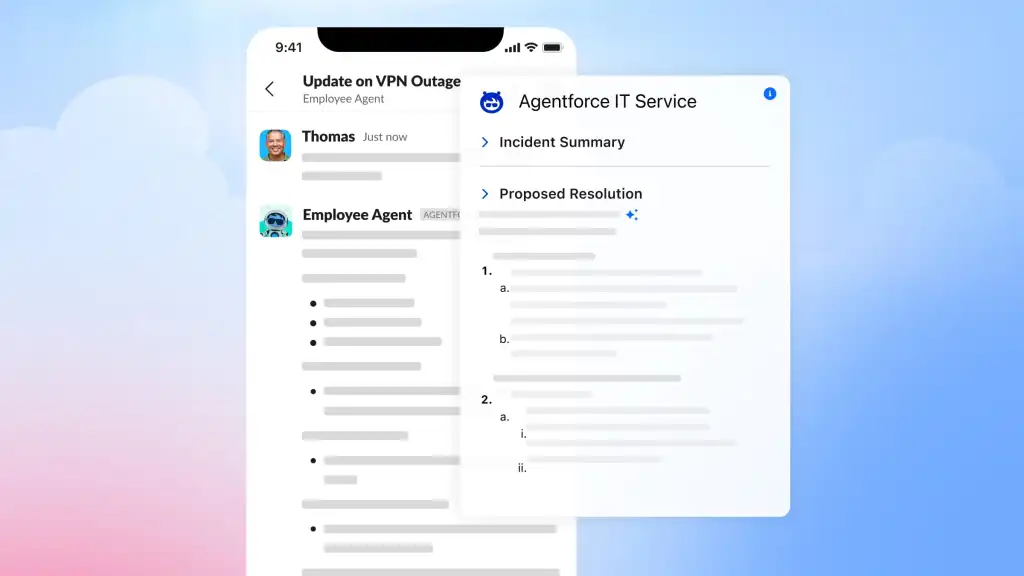
AI-driven ITSM platform inside Salesforce Service Cloud, resolving IT issues conversationally in Slack or Teams.

Standout factAgentforce launches with more than 100 prebuilt connectors to enterprise systems like Google, Microsoft, Workday, and Oracle NetSuite. apexhours.com
Biggest catchConsumption-based pricing starts at $2 per conversation, but Data Cloud credits and add-ons can make total cost hard to predict. winfomi.com
$2/conversationStarting pricewinfomi.com
100+Prebuilt connectorsapexhours.com
$125-$150/user/moEmployee add-on priceeesel.ai

Starting price

$2/conversationEmployee add-ons run $125-$150/user/mo for unmetered use

Standout number

100+prebuilt enterprise connectors at launch

Source: apexhours.com

Upside

  • Conversational resolution via Slack/Teams
  • 100+ pre-built enterprise connectors
  • Built on Einstein Trust Layer security

Catch

  • Steep learning curve for non-Salesforce admins
  • Complex pricing with potential hidden costs
  • Heavy reliance on clean CRM data
Pick it ifSalesforce customers wanting unified CRM and conversational IT service data.
Skip it ifNon-Salesforce shops wanting to avoid platform lock-in entirely.
PricingFrom $2/conversation, add-ons run $125-$150/user/mo

Editor's takeAgentforce lets employees resolve IT issues conversationally inside Slack or Teams instead of logging a ticket and waiting, per Apex Hours' review of the launch. It ships with more than 100 prebuilt connectors to systems like Workday, Okta, and Oracle NetSuite, and runs on the Einstein Trust Layer for data masking and guardrails. Pricing starts at $2 per conversation, but add-ons for unmetered employee use run $125 to $150 per user monthly, which can make total cost difficult to forecast.

How does Agentforce pricing work?

It starts with a consumption model at $2 per conversation, with volume discounts for high usage, according to a pricing breakdown by Winfomi. Add-ons for unmetered internal employee support cost $125 to $150 per user monthly, per Eesel AI's analysis, and Data Cloud usage can add further costs.

Does Agentforce require existing Salesforce data?

Effectiveness depends heavily on it. The system pulls on Salesforce CRM and Data Cloud data to give agents business context, so siloed or poor-quality data can cause operational issues, according to G2 reviewer feedback referenced in this evaluation.

6

Bright Pattern

brightpattern.com · BrightPattern ITSM Software #2 of 6 in IT Service Management (ITSM) Platforms for Recruitment Agencies

Bright Pattern saved Randstad $400K in one month

Best forService desks adding voice, SMS, and chat to existing ITSM tools

From $70 per agent/mo ISO 27001HIPAAno free plan
#2 in its ranking

Omnichannel contact center software automating ITSM tasks like password resets inside ServiceNow.

Standout factRandstad saved over $400,000 in IT costs within a month of adding Bright Pattern. youtube.com
Biggest catchReporting is described by some users as lacking granularity and customizability compared to larger competitors. selecthub.com
$400K/moRandstad IT savingsyoutube.com
7.5 monthsROI paybackbrightpattern.com
$70/agent/moStarting pricesoftwaresuggest.com

Standout number

$400KIT costs saved by Randstad in one month

Source: youtube.com

What changed

7.5 moROI payback vs 17.48 mo CCaaS average

Source: brightpattern.com

Upside

  • Automated ITSM incident creation
  • 7.5-month ROI payback
  • Deep ServiceNow and Ivanti integration

Catch

  • Reporting lacks deep granularity
  • Safari browser widget limitations
  • Smaller ecosystem than Genesys
Pick it ifService desks adding voice, SMS, and chat to existing ITSM tools
Skip it ifCompanies looking for a standalone ticketing system
PricingFrom $70/agent/mo (Voice Select)

Editor's takeBright Pattern automates high-volume IT tasks like password resets and incident creation directly inside ServiceNow and Ivanti, going beyond a standard contact center layer. Its documented 7.5-month ROI payback beats the CCaaS industry average of 17.48 months, and Randstad reported saving over $400,000 in IT costs within a month of deployment. Reporting granularity trails larger rivals like Genesys, and the Embedded Agent Desktop widget has a known compatibility issue in Safari.

Does Bright Pattern integrate with ServiceNow?

Yes. The integration enables automated record creation and activity history attachment directly to ServiceNow native objects.

How fast is the ROI on Bright Pattern?

The company reports an average payback period of 7.5 months, compared to a CCaaS industry average of 17.48 months.

The evidence: 6 criteria, 3 penalties
8.9
Product Capability & DepthLooked for: We look for advanced ITSM-specific automation like incident creation, password resets, and true omnichannel support beyond standard voice.Bright Pattern offers deep ITSM capabilities including automated incident creation, password resets, and CMDB interrogation, alongside broad omnichannel support for voice, chat, SMS, and social messengers.brightpattern.combrightpattern.combrightpattern.com
9.2
Market Credibility & Trust SignalsLooked for: We look for enterprise adoption, verified case studies with measurable results, and recognition from major industry analysts.The platform is trusted by over 500 customers including major enterprises like Randstad and Bank of America, with documented success stories showing significant cost savings and rapid deployment.youtube.comg2.com
8.8
Usability & Customer ExperienceLooked for: We look for ease of deployment, intuitive agent interfaces, and training requirements for non-technical staff.Users consistently report rapid deployment times and a user-friendly interface that allows agents to be trained in as little as 15 minutes, though some power users desire more UI configurability.brightpattern.comg2.comg2.com
8.7
Value, Pricing & TransparencyLooked for: We look for clear pricing structures, ROI evidence, and competitive total cost of ownership compared to legacy providers.Pricing is transparently listed on third-party sites starting around $70/agent, and the company provides detailed ROI comparisons showing a payback period significantly shorter than the industry average.brightpattern.comsoftwaresuggest.combrightpattern.com
9.1
Integrations & Ecosystem StrengthLooked for: We look for deep, certified integrations with major ITSM platforms like ServiceNow, BMC, and Ivanti that go beyond basic CTI.The product features certified, deep integrations with ServiceNow, Ivanti, and Microsoft Teams that enable bi-directional data flow and automated workflows, not just simple screen pops.brightpattern.comstore.servicenow.combrightpattern.com
9.5
Security, Compliance & Data ProtectionLooked for: We look for a comprehensive suite of certifications relevant to enterprise IT and healthcare, including ISO, SOC 2, and HIPAA.Bright Pattern holds an extensive list of major security certifications including ISO 27001, SOC 2 Type II, HIPAA, PCI DSS, and GDPR, making it suitable for highly regulated industries.prnewswire.combrightpattern.com

Score adjustments−0.20 points in total

−0.08Reporting capabilities are described by some users as lacking granularity and customizability compared to larger competitors.selecthub.com · severity 60/100
−0.07Some users report that email routing functionality can be confusing and lacks flexibility for complex strings.saasadviser.co · severity 50/100
−0.05Documented known issue where the Embedded Agent Desktop widget does not work in the Safari web browser due to cookie handling changes.help.brightpattern.com · severity 45/100
7

Unily

unily.com · Unily ITSM for Employee Experience #3 of 6 in IT Service Management (ITSM) Platforms for Recruitment Agencies

Unily surfaces ServiceNow tickets without leaving the intranet.

Best forEnterprises wanting a unified intranet for existing ITSM backends.

Quote only Gartner LeaderServiceNow integrationISO 27001
#3 in its ranking

An employee experience platform that unifies ITSM tickets, search, and comms in one intranet.

Standout factNamed a Leader in the 2024 Gartner Magic Quadrant for intranets. unily.com
Biggest catchPricing is completely undisclosed, and reviewers call it expensive. connecteam.com
50+native integrationsunily.com
4.5/5G2 ratingg2.com
1,000+enterprise users at named clientsg2.com

Adoption

50+native integrations, deployed from Feature Store

Source: unily.com

Compliance

✓ ISO 27001✓ SOC 2 Type II? HIPAA

Source: unily.com

Upside

  • Deep ServiceNow integration
  • Unified search across connected apps
  • Gartner and Forrester named Leader

Catch

  • No public pricing available
  • Expensive for small businesses
  • Rigid widget customization
Pick it ifEnterprises wanting a unified intranet for existing ITSM backends.
Skip it ifSmall businesses needing a standalone helpdesk, not a full intranet.
PricingContact for pricing, enterprise-only

Editor's takeUnily pulls ServiceNow tickets and knowledge base articles into a single intranet search. Gartner and Forrester both named it a Leader, and clients include McDonald's and Shell. Pricing stays entirely private, and reviewers note extra costs pile up for customization beyond the out-of-the-box widgets.

Does Unily replace a company's core ITSM ticketing system?

No. It integrates with tools like ServiceNow to surface tickets and knowledge articles in the intranet.

How much does Unily cost?

Pricing is not published. The vendor requires a custom quote, and reviewers describe it as expensive for smaller organizations.

The evidence: 6 criteria, 3 penalties
8.9
Product Capability & DepthLooked for: Capabilities for unifying IT service management with employee engagement, specifically unified search and ticketing integrations.Unily acts as a 'single pane of glass' by integrating with ITSM tools like ServiceNow to surface tickets and knowledge base articles directly in the intranet.unily.comunily.comunily.com
9.4
Market Credibility & Trust SignalsLooked for: Analyst recognition, enterprise adoption, and longevity in the employee experience market.Unily is a recognized Leader in major analyst reports (Gartner, Forrester) and serves massive global enterprises like Shell and McDonald's.unily.comg2.com
8.8
Usability & Customer ExperienceLooked for: User interface quality, ease of administration, and mobile accessibility for employees.Users generally praise the intuitive design and customer support, though some find the widget-based customization system rigid.unily.comg2.comg2.com
8.0
Value, Pricing & TransparencyLooked for: Public pricing availability, clear tier structures, and value for money feedback.Pricing is completely opaque with no public figures; reviews indicate it is expensive and geared strictly toward large enterprises.unily.comconnecteam.comg2.com
9.2
Integrations & Ecosystem StrengthLooked for: Depth of connectivity with ITSM tools, HR systems, and productivity suites.Unily offers over 50 native integrations including deep connectors for ServiceNow, Salesforce, and Microsoft 365.unily.comunily.comunily.com
9.5
Security, Compliance & Data ProtectionLooked for: Certifications like ISO 27001, SOC 2, and data residency options.Unily maintains top-tier security standards including ISO 27001 and SOC 2 Type II, with robust encryption and access controls.unily.comunily.comunily.com

Score adjustments−0.16 points in total

−0.04Pricing is not publicly available and requires contacting sales; reviews note it is expensive for smaller businesses.connecteam.com · severity 60/100
−0.07Users report that the proprietary 'widget' system is restrictive and limits customization flexibility.g2.com · severity 50/100
−0.05Some users describe the onboarding experience as challenging and note that initial setup can be complex.gartner.com · severity 45/100
8

SolarWinds Service Desk

solarwinds.com · SolarWinds ITSM Solutions #2 of 5 in IT Service Management (ITSM) Platforms for Startups

ITIL suite with built-in ITAM, plus per-device fees

Best forMid-to-large organizations needing strong IT asset management

From $39 per user/mo ITIL suiteITAM built-inISO 27001
#2 in its ranking

A cloud ITSM platform combining a full ITIL suite, IT asset management and AI-driven ticket automation.

Standout factIntegrates with over 200 cloud apps out of the box solarwinds.com
Biggest catchManaged devices cost an extra $0.30 to $0.70 a month each, on top of per-technician fees. techradar.com
$39/technician/moEssentials plan pricerezolve.ai
200+Pre-built integrationssolarwinds.com

Standout number

200+pre-built integrations included

Source: solarwinds.com

True monthly cost

Monthly cost example, 1 technician + 50 devices

Essentials technician fee$39
Device fees (50 x $0.30)$15
Total$54/mo

Device fees scale with managed device count

Upside

  • Full ITIL suite with built-in ITAM
  • Praised as easy to learn
  • 200+ out-of-the-box integrations

Catch

  • Per-device fees add up
  • Support called slow or generic
  • AI features need Premier tier
Pick it ifMid-to-large organizations needing strong IT asset management
Skip it ifSmall businesses looking for a lightweight or free help desk
PricingEssentials $39/technician/mo, plus $0.30-0.70/device/mo, 30-day trial

Editor's takeSolarWinds Service Desk bundles IT asset management directly into the ticketing workflow, a combination competitors often sell as separate products. It backs that with ISO 27001, SOC 2 Type II, and even FedRAMP-adjacent compliance, plus a library of 200-plus prebuilt integrations. Total cost is worth double-checking, since published per-technician pricing starts at $39 a month, but every managed device adds another $0.30 to $0.70 a month on top.

Does SolarWinds Service Desk charge per device?

Yes, on top of per-technician fees. Managed devices cost an extra $0.30 to $0.70 a month each depending on plan tier, according to a TechRadar review of the pricing.

Is SolarWinds Service Desk SOC 2 certified?

Yes. It holds ISO 27001 certification and SOC 2 Type II compliance, with data centers in the US, EU, and Australia, according to SolarWinds' own trust center.

The evidence: 5 criteria, 3 penalties
8.9
Product Capability & DepthLooked for: We evaluate the breadth of ITSM features, including ITIL alignment, asset management, and automation capabilities tailored for mid-to-large enterprises.SolarWinds Service Desk offers a comprehensive ITIL-ready suite covering incident, problem, change, and release management, integrated with robust IT Asset Management (ITAM) and a Configuration Management Database (CMDB).solarwinds.comsolarwinds.comsolarwinds.com
8.8
Market Credibility & Trust SignalsLooked for: We assess industry recognition, analyst reports, and historical reliability to gauge the vendor's standing in the market.SolarWinds is a recognized vendor in the Gartner Market Guide for ITSM Platforms and holds major security certifications, though its reputation still carries the weight of the 2020 Orion breach.blog.invgate.comsolarwinds.com
9.0
Usability & Customer ExperienceLooked for: We analyze user feedback regarding interface design, ease of setup, and day-to-day operational efficiency.Users consistently praise the platform for its intuitive, user-friendly interface and ease of setup compared to more complex enterprise competitors.solarwinds.comg2.comtechradar.com
8.5
Value, Pricing & TransparencyLooked for: We examine pricing structures, hidden costs, and the balance of features provided against the cost per user.Pricing is transparent with three clear tiers starting at $39/technician/month, but total cost of ownership increases with per-device fees for asset management.solarwinds.comrezolve.aitechradar.com
8.7
Security, Compliance & Data ProtectionLooked for: We evaluate the availability of pre-built integrations, API access, and the ability to connect with common enterprise tools.SolarWinds Service Desk offers over 200 pre-built integrations and an open REST API, facilitating connections with major tools like Jira, Slack, and Salesforce.solarwinds.comsolarwinds.comsolarwinds.com

Score adjustments−0.17 points in total

−0.08Numerous user reports cite poor technical support experiences, including generic responses and slow resolution times.reddit.com · severity 70/100
−0.04Additional monthly fees per managed device ($0.30-$0.70) can significantly increase the total cost of ownership for asset-heavy organizations.techradar.com · severity 50/100
−0.05The brand continues to face scrutiny and trust issues from some buyers due to the 2020 Orion supply chain breach, despite Service Desk being a separate product.reddit.com · severity 45/100
9

SysAid

sysaid.com · SysAid ITSM Software #3 of 5 in IT Service Management (ITSM) Platforms for Startups

SysAid holds four security certifications, but its UI feels dated.

Best forMid-sized companies wanting AI ticket automation and asset management.

From $79 per user/mo SysAid Copilot AI4 security certificationsclunky interface
#3 in its ranking

An AI-driven ITSM platform combining service desk automation with strong security certifications.

Standout factHolds four certifications: ISO 27001, 27017, 27018, and SOC 2 Type 2. invgate.com
Biggest catchUsers describe the admin interface as clunky and outdated. g2.com
2002foundedblog.invgate.com
$79/user/moestimated Help Desk pricesmartsuite.com
$108/user/moestimated full ITSM pricesmartsuite.com

Compliance

✓ ISO 27001✓ ISO 27017✓ ISO 27018✓ SOC 2 Type 2? HIPAA

Source: invgate.com

The thing people get wrong

A dated interface usually means fewer security certifications too

SysAid pairs a clunky interface with four separate security certifications

Source: g2.com

Upside

  • SysAid Copilot AI features
  • Four security certifications held
  • Cost-effective versus ServiceNow, ConnectWise

Catch

  • Interface feels outdated, clunky
  • Mobile app usability issues
  • Pricing is not publicly disclosed
Pick it ifMid-sized companies wanting AI ticket automation and asset management.
Skip it ifUsers demanding a strictly modern, polished interface.
PricingContact for pricing, reportedly $79-$108/user/mo

Editor's takeSysAid Copilot bakes generative AI into ticket summarization, categorization, and chat, layered onto core incident and asset management. It holds ISO 27001, 27017, 27018, and SOC 2 Type 2 certification. Reviewers still call the admin interface clunky and outdated, and pricing stays hidden behind a quote.

How much does SysAid cost?

Pricing is not public. Third-party estimates put Help Desk at $79 per user monthly and full ITSM at $108 per user monthly.

What security certifications does SysAid hold?

ISO 27001, ISO 27017, ISO 27018, and SOC 2 Type 2. It also supports GDPR compliance, AES-256 encryption, and multi-factor authentication.

The evidence: 6 criteria, 3 penalties
9.0
Product Capability & DepthLooked for: We evaluate the breadth of ITSM features, including incident management, asset tracking, and the depth of AI-driven automation capabilities.SysAid provides a comprehensive ITSM suite featuring incident, problem, and change management alongside robust asset management. Its standout 'SysAid Copilot' integrates generative AI for ticket summarization, categorization, and chatbots, while automation rules handle routing and dynamic forms.sysaid.comsysaid.comdocumentation.sysaid.com
9.3
Market Credibility & Trust SignalsLooked for: We assess the vendor's industry standing, years in operation, and adherence to recognized global standards.Founded in 2002, SysAid is a mature player in the ITSM market with a strong global presence. It holds multiple rigorous certifications including ISO 27001, ISO 27017, ISO 27018, and SOC 2 Type 2, demonstrating a high level of organizational maturity and trust.thedigitalprojectmanager.comblog.invgate.com
8.2
Usability & Customer ExperienceLooked for: We analyze user feedback regarding the interface design, ease of navigation, mobile app quality, and customer support responsiveness.While customer support is frequently praised, the user interface is often described as 'clunky' or 'outdated' by users. Additionally, the mobile application has received criticism for navigation difficulties and sluggish performance.g2.comrezolve.ai
8.7
Value, Pricing & TransparencyLooked for: We examine pricing transparency, cost-effectiveness relative to competitors, and flexibility of licensing models.SysAid does not publicly list pricing, requiring a quote process, but third-party estimates place it between $79-$108 per user/month. Reviews consistently highlight it as a cost-effective alternative to larger enterprise tools like ServiceNow.sysaid.compeerspot.comsmartsuite.com
8.8
Integrations & Ecosystem StrengthLooked for: We look for the availability of native integrations with key IT and business tools, API capabilities, and third-party connector support.The platform offers a solid range of integrations with major tools like Microsoft Teams, Azure DevOps, Jira, and Slack. It also supports Zapier for broader connectivity and provides an API for custom integrations.marketplace.microsoft.comzapier.com
9.6
Security, Compliance & Data ProtectionLooked for: We evaluate the product's adherence to security frameworks, data encryption standards, and privacy regulations relevant to ITSM.SysAid demonstrates top-tier security compliance with a comprehensive suite of certifications including ISO 27001, 27017, 27018, and SOC 2 Type 2. It supports GDPR compliance, AES-256 encryption, and Multi-Factor Authentication (MFA).invgate.comdocumentation.sysaid.com

Score adjustments−0.17 points in total

−0.06Users frequently describe the administrative interface as 'clunky', 'outdated', or 'complex', particularly for new users.g2.com · severity 60/100
−0.05The mobile application is reported to have usability issues, including poor icon sizing and sluggish performance.rezolve.ai · severity 50/100
−0.06Some users report that the reporting features can be inaccurate or lack the depth found in dedicated BI tools.g2.com · severity 45/100
02

Every ranking in ITSM & Service Desk Platforms

Each card shows the top three. The eye opens a quick look. Open a ranking for every product, the evidence and the comparison table.

1 ServiceNowMarket leader on AI and integrations, weakest on price transparency 9.2/10
Visit ↗
2 Bright PatternBright Pattern saved Randstad $400K in one month 8.8/10
Visit ↗
3 UnilyUnily surfaces ServiceNow tickets without leaving the intranet. 8.8/10
Visit ↗
See all 6 ranked
1 ServiceNowServiceNow's implementation often costs 3-5x the license 9.3/10
Visit ↗
2 HaloITSMHaloITSM bundles unlimited assets into one flat price 9.0/10
Visit ↗
3 Parallels Mac ManagementParallels Mac Management for SCCM has been discontinued since 2022 9.0/10
Visit ↗
See all 10 ranked
1 ServiceNowServiceNow holds 40% of ITSM share, implementation costs 3-5x. 9.1/10
Visit ↗
2 iTSM GroupiTSM Group is a ServiceNow Elite Partner, hides its pricing 9.0/10
Visit ↗
3 AgentforceResolves tickets in Slack, but pricing starts at $2/conversation 8.9/10
Visit ↗
See all 8 ranked
1 ServiceNowServiceNow leads ITSM, implementation runs 3 to 5x license cost 9.1/10
Visit ↗
2 SolarWinds Service DeskITIL suite with built-in ITAM, plus per-device fees 8.7/10
Visit ↗
3 SysAidSysAid holds four security certifications, but its UI feels dated. 8.7/10
Visit ↗
See all 5 ranked
03

About ITSM & Service Desk Platforms

What the category is, how it developed, and what to look for. Two minutes, or the long read.

This category covers software used to design, deliver, manage, and improve the delivery of information technology services to employees and customers across their full operational lifecycle: handling service requests, resolving incidents, managing changes to infrastructure, and tracking assets. It sits between Infrastructure Monitoring (which focuses on the health of servers and networks) and Enterprise Resource Planning (ERP) (which focuses on broader business resources). It includes both general-purpose platforms suitable for any internal IT function and vertical-specific tools built for high-compliance industries like healthcare and financial services.

Read the full category guide

What Is ITSM & Service Desk Platforms?

At its core, IT Service Management (ITSM) software solves the problem of "unstructured chaos" in technical support. Without these platforms, IT support relies on email chains, spreadsheets, and walk-up requests, leading to lost data, violated service agreements, and an inability to track systemic issues. ITSM platforms centralize these interactions into a "single pane of glass," allowing organizations to move from reactive firefighting to proactive service delivery.

The user base has expanded significantly beyond the traditional IT help desk. While IT administrators and technicians remain the primary power users, modern platforms are heavily utilized by HR for onboarding, Facilities for maintenance requests, and Legal for contract reviews—a trend known as Enterprise Service Management (ESM). For buyers, the value proposition has shifted from simple ticket tracking to workflow automation that reduces the "mean time to resolution" (MTTR) and lowers the Total Cost of Ownership (TCO) of corporate technology.

History of the Category

The modern ITSM landscape did not exist in a recognizable form until the early 1990s. Before this period, IT support was largely an ad hoc discipline dominated by mainframes and phone support, where "management" meant physical logbooks or rudimentary databases. The catalyst for the category’s creation was the British government’s release of the IT Infrastructure Library (ITIL) guidelines in the late 1980s and early 1990s. ITIL provided a standardized vocabulary—Incident, Problem, Change—that created a market gap for software capable of enforcing these specific processes.

Throughout the 1990s and early 2000s, the market was dominated by heavy, on-premise "legacy" suites. These systems were essentially large databases with rigid forms, designed for the "break/fix" model of IT. They were expensive to implement, required dedicated server hardware, and were notorious for their poor user experience. The buyer expectation was functional but low-bar: "give me a database to log calls."

The seismic shift occurred in the mid-2000s with the advent of the cloud. The emergence of Software-as-a-Service (SaaS) disrupted the incumbent on-premise giants by proving that complex process workflows could be delivered through a browser without a six-month installation period. This "platform revolution" forced the entire industry to pivot. Vendors could no longer just sell a ticketing tool; they had to sell an ecosystem that allowed customers to build their own applications on top of the IT data.

From 2015 to the present, the market has undergone massive consolidation and verticalization. Large generalist platforms acquired niche players in AI, asset discovery, and operations management, creating "end-to-end" suites that blur the line between ITSM and IT Operations Management (ITOM). Simultaneously, buyer expectations evolved from "system of record" to "system of intelligence." Today, a database is table stakes; buyers demand actionable intelligence, predictive analytics, and automated remediation. The rise of vertical SaaS has also carved out spaces for industry-specific ITSM tools that come pre-configured for regulatory environments like HIPAA or SOX, challenging the "one size fits all" philosophy of the previous decade.

What to Look For

Evaluating ITSM platforms requires looking past feature checklists, as most mature vendors now offer near-identical core functionality (e.g., incident management, knowledge bases, and portals). The true differentiators lie in usability, architecture, and maintainability.

Critical Evaluation Criteria:

  • Low-Code/No-Code Configurability: Can a non-technical service desk manager modify a workflow or add a field without writing scripts? If the platform requires a dedicated developer for minor changes, your Total Cost of Ownership (TCO) will balloon post-purchase.
  • ITIL Alignment vs. Flexibility: While adherence to ITIL frameworks is important, rigid adherence can stifle agility. Look for platforms that allow you to adopt ITIL processes (like Change Management) incrementally rather than forcing a "big bang" adoption of complex frameworks.
  • AI and Automation Reality: Ignore marketing hype. Test the "intelligence" by asking: Does the AI actually resolve the ticket (Tier 0 resolution), or does it just suggest a knowledge article that the user has already ignored? True value lies in the platform’s ability to automate backend provisioning (e.g., resetting a password in Active Directory) without human intervention.

Red Flags and Warning Signs:

  • "Module" Pricing: Be wary of vendors that quote a low base price but charge separately for essential modules like Asset Management, Change Management, or a Self-Service Portal. This "nickel-and-diming" strategy often hides the true cost of a functional system.
  • Legacy Code in Cloud Clothing: Some vendors have simply hosted their old on-premise software in the cloud and called it SaaS ("lift and shift"). These tools often suffer from slow update cycles and clunky interfaces. A true SaaS platform should have a single codebase for all customers and push seamless updates.
  • Proprietary Scripting Languages: If the platform relies on a proprietary coding language for customizations, you are locking yourself into a small pool of expensive talent. Standard languages (JavaScript, Python) are preferable for long-term maintainability.

Key Questions to Ask Vendors:

  • "Can you show me the exact steps to build a new workflow for employee onboarding, live in this demo?" (If they hesitate or say "we'll get back to you," it's too complex).
  • "How are upgrades handled? Will my customizations break when you push the next version?"
  • "What is the ratio of implementation cost to license cost for a typical customer of my size?"

Industry-Specific Use Cases

Retail & E-commerce

In the retail sector, ITSM is the backbone of the Point of Sale (POS) and logistics infrastructure. Unlike corporate offices where a laptop failure is an inconvenience, a POS failure in retail is a direct revenue stop. Retailers require platforms with robust Asset Management to track distributed hardware across hundreds of physical locations. Speed is the primary metric; the system must support high-volume, low-complexity ticket spikes during peak seasons (e.g., Black Friday). Integration with logistics and inventory systems is critical to ensure that IT support can distinguish between a software glitch and a supply chain error. Retailers also face significant turnover; thus, the platform must handle "high-velocity" onboarding and offboarding of seasonal staff without accruing excessive licensing costs.

Healthcare

Healthcare ITSM is defined by high stakes and strict regulation. The primary evaluation priority is compliance and security, specifically adherence to frameworks like HIPAA in the US. A unique requirement here is the support for "clinical engineering"—the management of IoT-connected medical devices (e.g., MRI machines, infusion pumps) alongside traditional IT assets. Standard ITSM tools often fail here; healthcare buyers need platforms that can map dependencies between a network switch and a life-critical patient monitoring system. [1] With the average cost of a healthcare data breach reaching nearly $9.8 million—the highest of any industry—the ITSM platform must have granular Role-Based Access Control (RBAC) to ensure that technicians only see data relevant to the ticket, not patient records.

Financial Services

For financial institutions, ITSM is a tool for risk management and auditability. The "Change Management" module is the most scrutinized component; every update to a trading platform or banking app must have an immutable audit trail to satisfy regulators (e.g., SOX, GLBA). Financial buyers prioritize "high availability" and disaster recovery workflows above all else. [2] The cost of a breach in this sector averages $6.08 million, and downtime can cost millions per hour in lost transaction fees. Consequently, these buyers often look for platforms that integrate deeply with "Governance, Risk, and Compliance" (GRC) tools, allowing them to map IT incidents directly to business risks.

Manufacturing

Manufacturing is currently undergoing a convergence of Information Technology (IT) and Operational Technology (OT). [3] With the market for this convergence projected to reach $133 billion by 2030, manufacturers need ITSM platforms that can "speak" the language of the factory floor. The unique challenge is predictive maintenance. Unlike a server that can be rebooted, a production line robot requires physical intervention. ITSM tools in this sector must integrate with industrial sensors (IIoT) to automatically generate work orders based on vibration or heat anomalies before a failure occurs. The evaluation priority is "uptime"; [4] for large enterprises, downtime can cost upwards of $23,750 per minute, making the speed of incident routing to on-floor engineers the critical KPI.

Professional Services

For law firms, consultancies, and agencies, time is literally money. ITSM in this sector focuses on Client Experience (CX) and mobility. Consultants are rarely at a desk; they need full mobile functionality to log issues from client sites. A unique consideration is the "billable" nature of support. If an IT issue prevents a consultant from working, that is lost revenue, not just lost productivity. [5] With billable utilization hovering around 69% for many firms, any downtime directly impacts the bottom line. These buyers prioritize "white-glove" service portals that look professional and align with the firm's brand, as well as tight integrations with project management and billing software to ensure that IT costs can be accurately allocated to client accounts where appropriate.

Subcategory Overview

IT Service Management (ITSM) Platforms for Recruitment Agencies

Recruitment agencies operate in a high-turnover, high-velocity environment where the "product" is people. This niche is genuinely different from generic ITSM because the volume of onboarding and offboarding requests is disproportionately higher than in standard businesses. A generic tool might treat a "new user" as a simple ticket, but for recruitment, this is a complex workflow involving background checks, CRM access provisioning, and external portal access. A workflow that only ITSM platforms for recruitment agencies handle well is the automated "contractor provisioning" cycle: creating temporary identities for placed candidates that automatically expire on their contract end date, ensuring security without manual oversight. The specific pain point driving buyers here is GDPR data subject access requests (DSARs). Recruitment agencies hold massive amounts of personal data; they need specialized ITSM workflows that can instantly retrieve or anonymize candidate data across systems upon request, a feature often lacking in generalist tools.

IT Service Management (ITSM) Platforms for Staffing Agencies

While similar to recruitment, staffing agencies face the unique challenge of managing a "dual workforce": internal recruiters and thousands of external field staff. ITSM platforms for staffing agencies must support "external-facing" service desks that allow temporary workers to reset passwords or request payslip access without consuming expensive "full agent" licenses. A workflow unique to this niche is the "mass deployment" of assets or access rights to hundreds of workers simultaneously for a new client project—something that would require hours of manual clicking in a generic tool. The driving pain point is license scalability. Staffing firms cannot afford to pay $100/month per user for a temporary worker who only needs to check a schedule; they require specialized pricing models that distinguish between "power users" (recruiters) and "light users" (staff).

IT Service Management (ITSM) Platforms for SaaS Companies

SaaS companies live and die by their uptime and development velocity. ITSM platforms for SaaS companies differentiate themselves through deep, native integration with DevOps tools like Jira, GitHub, and PagerDuty. Unlike general tools that separate "IT Support" from "Engineering," these platforms treat software bugs and customer incidents as interconnected entities. A workflow that only these tools handle well is the "Incident Swarming" process: automatically spinning up a Slack channel, inviting the relevant on-call developers based on the code service involved, and synchronizing chat logs back to the ticket. The specific pain point driving this purchase is the disconnect between Customer Success (CS) and Engineering. Generic tools create a "black hole" where CS reports a bug and never hears back; specialized tools provide bidirectional visibility so CS knows exactly when a fix is deployed.

IT Service Management (ITSM) Platforms for Startups

Startups require agility and low overhead, often lacking a dedicated IT manager. ITSM platforms for startups prioritize "zero-touch" implementation and Slack/Teams-first interfaces over rigorous ITIL compliance. The differentiator here is the "invisible service desk"—employees trigger requests via chat commands without ever logging into a portal. A workflow unique to this niche is the "all-in-one" onboarding: a single workflow that orders a laptop, creates a Google Workspace account, and invites the user to Slack channels, often using pre-built integrations that require no coding. The pain point driving buyers to this niche is complexity fatigue. Startups cannot afford the six-month implementation cycle of an enterprise tool; they need a solution that is operational in 24 hours to manage rapid growth and "shadow IT" sprawl.

Integration & API Ecosystem

In the modern enterprise, an ITSM platform that stands alone is a data silo. The true power of a Service Desk comes from its ability to act as the central nervous system, orchestrating actions across disparate tools. The standard requirement is a robust REST API, but the differentiator is the quality of pre-built "iPaaS" (Integration Platform as a Service) connectors. [6] With the average large enterprise now deploying over 230 different applications, the ITSM tool must be able to push and pull data from HR systems (Workday), Identity providers (Okta), and Development tools (Jira) without brittle custom code.

Expert Insight: Gartner's VP of Research, Saul Judah, notes that "A data and analytics governance program that does not enable prioritized business outcomes fails." [7] In the context of ITSM integrations, this means that integrations must not just move data (e.g., syncing user names) but drive outcomes (e.g., automatically revoking access upon termination).

Scenario: Consider a 50-person professional services firm using a general-purpose ITSM tool. They integrate it with their billing system to track consultant hours spent on client IT support. However, the integration is poorly designed: it syncs data only once every 24 hours and lacks error handling. When a consultant logs 4 hours of critical support for a client on the last day of the month, the sync fails due to a character limit mismatch in the "Description" field. The billing system generates the invoice without these 4 hours. The error isn't discovered until weeks later, requiring a manual credit memo and an awkward apology to the client, damaging trust and cash flow. A specialized tool with real-time, bi-directional validation would have flagged the error immediately to the consultant.

Security & Compliance

Security in ITSM is twofold: the security of the platform (SaaS vendor security) and the security provided by the platform (access governance). Buyers must verify SOC 2 Type II compliance, ISO 27001 certification, and data residency options if they operate in regulated jurisdictions like the EU (GDPR) or California (CCPA). Beyond certifications, the platform must support granular field-level encryption to protect sensitive data like passwords or PII.

Statistic: According to IBM's 2024 Cost of a Data Breach Report, the global average cost of a data breach has reached $4.88 million. [8] This underscores the critical need for ITSM platforms to act as a secure fortress, not just a ticketing bucket.

Scenario: A healthcare provider uses an ITSM platform to manage clinical engineering requests. A nurse submits a ticket regarding a malfunction in a patient monitoring system and inadvertently attaches a screenshot containing a patient's medical history and full name. A robust ITSM platform with Data Loss Prevention (DLP) features would automatically scan the attachment, detect the pattern of PII/PHI, and either redact the file or reject the upload, alerting the compliance officer. A basic platform would store that screenshot in plain text, accessible to any junior IT technician with ticket-viewing rights, constituting a major HIPAA violation that could lead to massive fines.

Pricing Models & TCO

ITSM pricing is notoriously opaque. The two dominant models are Per-Agent (you pay for the technicians working the tickets) and Per-Asset/Node (you pay for the devices you manage). While Per-Agent is more common for Service Desks, Per-Asset is typical for IT Asset Management (ITAM). The hidden killer in TCO is not the license fee, but the implementation and maintenance cost.

Expert Insight: Industry experts often cite the "3x Rule" for complex enterprise platforms: for every $1 spent on licensing, organizations should expect to spend $3 on implementation, customization, and ongoing maintenance over the life of the contract. [9]

Scenario: A 25-person IT team evaluates two vendors. Vendor A charges $80/agent/month ($24,000/year). Vendor B charges $50/agent/month ($15,000/year). On the surface, Vendor B saves $9,000. However, Vendor B is a "platform" requiring a dedicated administrator (salary: $90,000) to build workflows and manage updates. Vendor A is a low-code solution that the existing Help Desk Manager can configure in 2 hours a week. TCO Calculation (Year 1): Vendor A: $24,000 (License) + $5,000 (Training) = $29,000. Vendor B: $15,000 (License) + $90,000 (Admin Salary) + $20,000 (Consultant Implementation) = $125,000. The "cheaper" license is vastly more expensive in practice.

Implementation & Change Management

Implementation is where most ITSM projects fail. The failure is rarely technical; it is cultural. "Big Bang" implementations that attempt to launch Incident, Problem, Change, and Asset Management simultaneously often overwhelm users and support staff, leading to low adoption.

Statistic: Research by McKinsey consistently shows that 70% of digital transformation initiatives (including major ITSM rollouts) fail to meet their stated objectives. [10] This high failure rate is attributed largely to a lack of focus on people and processes.

Scenario: A manufacturing firm decides to roll out a strict ITIL-based Change Management process overnight. They configure the new ITSM tool to require a 15-field form and approval from a Change Advisory Board (CAB) for every server patch. The server engineers, used to agility, find the process bureaucratic and slow. They begin bypassing the tool, patching servers directly ("Shadow IT") to keep production running. Three months later, a bad patch crashes the ERP system. Because the engineers bypassed the ITSM tool, there is no record of the change, and the root cause analysis takes 4 days instead of 4 hours. The implementation failed not because the tool was broken, but because the process ignored the engineers' reality.

Vendor Evaluation Criteria

Selecting a vendor is a marriage, not a transaction. The evaluation must assess the vendor's roadmap, financial stability, and support ecosystem. Buyers should scrutinize the "Support" definitions in the contract—does "24/7 support" mean a live human or a chatbot? Also, evaluate the vendor's community: an active user forum often provides faster answers than official support channels.

Expert Insight: Gartner analysts warn against "Technology-centric approaches" that ignore stakeholder engagement. [11] In evaluation, this means buyers should ask: "Does this vendor partner with us to drive adoption, or do they just hand over the keys?"

Scenario: A mid-market retailer evaluates a leading ITSM vendor. During the Proof of Concept (POC), the vendor's sales engineer builds a custom "Store Opening" workflow that looks perfect. The retailer signs the contract. Post-signature, they realize that the custom workflow relied on a beta feature that was deprecated in the next release. The vendor's support team refuses to fix it because it was "custom configuration," not "core product." The retailer is left with a broken process and a 3-year contract. A proper evaluation would have included a clause requiring the vendor to support POC configurations for a set period.

Emerging Trends and Contrarian Take

Emerging Trends 2025-2026

  • AI Agents & Multi-Agent Systems: We are moving beyond simple chatbots to autonomous "Agents" that can execute complex tasks. [12] Gartner identifies "Multiagent Systems" as a top trend, where specialized AI agents (e.g., one for network, one for access control) collaborate to resolve incidents without human interaction.
  • Domain-Specific Language Models (DSLMs): General LLMs often hallucinate in technical contexts. The trend is toward smaller, purpose-built models trained specifically on IT logs, codebases, and error messages, providing higher accuracy for root cause analysis and script generation.
  • Platform Convergence: The boundaries between ITSM, ITOM (Operations Management), and SecOps (Security Operations) are dissolving. Buyers increasingly prefer a single platform that can detect a security threat (SecOps), map it to the affected business service (ITSM), and automate the server patch (ITOM) in one flow.

Contrarian Take

Buying for the "Future State" is the single biggest destroyer of ROI in ITSM.

Most organizations, especially in the mid-market, purchase enterprise-grade platforms (like ServiceNow or BMC) based on an aspirational vision of where they want to be in five years—fully automated, AI-driven, and perfectly ITIL-compliant. The reality is that 90% of these organizations never reach that maturity level. They end up paying a premium for a Ferrari but driving it like a Corolla, utilizing only the basic ticketing features while the advanced modules sit as "shelfware." A 500-person company would almost always get better ROI, faster adoption, and higher satisfaction by buying a tool that fits their current maturity level perfectly, rather than one that fits a future state they may never achieve. The "scalability" argument is often a trap; the cost of migrating tools in 5 years is usually far less than the wasted TCO of overbuying for 5 years.

Common Mistakes

1. Over-Engineering the Service Catalog Organizations often launch with a Service Catalog containing 200+ distinct request items (e.g., "Request a Monitor," "Request a Mouse," "Request a Cable"). This overwhelms users, who ultimately default to the generic "Submit an Issue" form. Start small with the top 10 most requested items and expand based on data.

2. Ignoring "Shadow IT" Discovery Many implementations focus solely on the assets IT knows about. [13] However, research indicates that companies leave $18 million in wasted SaaS spend on the table annually due to license waste and redundant apps. Failing to use the ITSM project as an opportunity to discover and catalog all software (including that purchased by marketing or HR) is a missed opportunity for massive cost savings.

3. Neglecting Knowledge Management (KCS) Buying a tool with AI capabilities is useless if you don't have a knowledge base. AI needs data to learn. A common mistake is treating Knowledge Management as an afterthought ("we'll write articles later"). It must be a "Knowledge-Centered Service" (KCS) where agents write articles as they resolve tickets. Without this, your self-service portal will be an empty shell.

Questions to Ask in a Demo

  • "Can you show me the backend view of the Self-Service Portal? How much HTML/CSS knowledge is required to change the branding or layout?"
  • "Demonstrate the process of an end-user resetting a password. Does it require an agent to click a button, or is it fully automated via API to Active Directory?"
  • "Show me your API documentation. Is it open to the public, or is it behind a login? Can I see the rate limits?"
  • "How does your licensing model handle 'approvers'? If a manager only needs to log in once a month to approve a laptop purchase, do they need a paid license?"
  • "Walk me through a 'major incident' workflow. How does the system facilitate communication between the Service Desk and the DevOps/SRE team?"

Before Signing the Contract

Final Decision Checklist:

  • Data Portability: Ensure the contract explicitly states that your data belongs to you and defines the format (SQL dump, CSV, JSON) in which it will be returned if you leave.
  • SLA Definitions: Check the Service Level Agreement (SLA) for the vendor's uptime. Does "99.9% uptime" include scheduled maintenance? If maintenance happens during your business hours, that's a deal-breaker.
  • Renewal Caps: Negotiate a cap on annual price increases (e.g., "price cannot increase by more than 3% or CPI, whichever is lower"). SaaS vendors often hike prices significantly at renewal.
  • Sandbox Environment: Ensure the contract includes a full "Sandbox" or test environment that mirrors production. You need a safe place to test workflows before deploying them.

Closing

Choosing an ITSM platform is one of the most consequential infrastructure decisions an IT leader will make. It dictates the daily workflow of your team and the quality of service your entire organization receives. Focus on your current reality, prioritize usability over feature bloat, and verify every claim with a hands-on test. If you have specific questions about your unique environment or need a sounding board for your shortlist, feel free to reach out.

Email: albert@whatarethebest.com

04

Research

Original reporting on this corner of the market.

All research

IT outage costs jumped 500% in a decade—now hitting $1.9M per hour

Feb 19, 2026

Support centers face 40% annual turnover—more than double the 16% industry average

May 21, 2026

Organizations only recover 57% of data after ransomware attacks hit 41% of systems

May 4, 2026
05

Questions people ask

Which ITSM & Service Desk Platforms is best?

ServiceNow holds the highest score in the category at 9.3, in IT Service Management (ITSM) Platforms for SaaS Companies. The right pick depends on the ranking that matches your use case, so start with the ranking list above.

Why are there 4 separate rankings?

Buyers in ITSM & Service Desk Platforms have different jobs, so each ranking is scoped to one of them and weights the six criteria for that job. The same product can hold different ranks in different rankings.

How are the scores produced?

Documentation, pricing pages, security pages and third-party reviews are reviewed against six criteria. Each criterion records what was found and links its sources. Penalties pull the score down and are shown with their evidence. Rank follows the score. Full methodology.

06

More in Cybersecurity, Privacy & Compliance

The whole group