
- Home
- All categories
- Marketing & Advertising Platforms
Software group
Marketing & Advertising Platforms
This guide covers the major subcategories of marketing and advertising platforms — from email marketing and marketing automation to SEO tools, social media management, paid media, content marketing, and customer journey orchestration. Each product is scored across 6 weighted categories with cited evidence.
01
Pick your category
19 categories, each with its own rankings. Open one to see them all.
Affiliate Marketing Software
Manages partner and affiliate relationships end-to-end — tracking referral clicks, attributing conversions, automating commission payouts, and providing fraud detection to scale revenue-sharing programs without manual oversight.
B2B Lead Generation & Marketing Automation
Purpose-built for B2B pipelines — combining intent data, account-based targeting, lead scoring, and multi-touch nurturing sequences to identify, qualify, and hand off high-value prospects to sales teams.
Brand Management & Reputation Tools
Maintains brand integrity and monitors public perception across the digital landscape — combining Brand Asset Management (BAM) for…
Campaign Orchestration Platforms
Coordinates complex, multi-channel marketing campaigns from a single command center — managing timelines, budgets, creative assets, and audience segments to ensure consistent messaging across every touchpoint.
Content Marketing Platforms
Manages the operational workflow of content creation — from briefing and collaboration through approvals and distribution — enabling…
Creative Workflow & Marketing Approval Tools
Streamlines the review and approval process for marketing assets — providing proofing, annotation, version control, and compliance sign-off workflows that eliminate email chains and reduce time-to-publish.
Customer Journey & Experience Orchestration Tools
Acts as a real-time decisioning layer that sits above execution channels — determining the next best action for…
Drip Campaign & Lead Nurturing Tools
Automates sequential, trigger-based email and messaging sequences designed to educate, engage, and convert leads over time — moving…
Ecommerce Email & Marketing Automation
Specialized for online retail — triggering lifecycle messages based on transactional events like abandoned carts, post-purchase follow-ups, and replenishment reminders to maximize Customer Lifetime Value (CLV).
Email & Marketing Automation for Small Businesses
All-in-one platforms designed for small teams — bundling email campaigns, basic automation, landing pages, and CRM-lite features into affordable packages that deliver value without enterprise-level complexity.
Email Marketing Software
Specializes in high-volume email delivery to subscriber lists — focusing on deliverability optimization, template design, A/B testing, list hygiene, and sender reputation management for newsletter-driven businesses.
Influencer Marketing Platforms
Discovers, vets, and manages relationships with content creators and influencers — handling campaign briefs, content approvals, performance tracking, and payment processing to scale earned media programs.
Landing Page & Funnel Builders
Creates high-converting standalone pages and multi-step funnels without developer involvement — offering drag-and-drop builders, A/B testing, and conversion optimization tools to maximize campaign ROI.
Marketing Attribution & Analytics Platforms
Measures the true impact of marketing spend across channels — using multi-touch attribution models, media mix modeling, and incrementality testing to answer which campaigns actually drive revenue.
Marketing Automation Platforms
Serves as the central execution engine for demand generation — automating lead scoring, nurturing sequences, campaign management, and CRM handoff to connect top-of-funnel marketing with bottom-of-funnel sales.
Omnichannel Marketing Automation Platforms
Unifies marketing execution across email, SMS, push, in-app, web, and social channels — ensuring consistent, personalized messaging regardless of where and how customers choose to engage.
Paid Media & Ad Campaign Management Tools
Manages advertising spend across search, social, display, and programmatic channels — automating bid optimization, audience targeting, creative rotation, and budget allocation to maximize return on ad spend (ROAS).
SEO Tools & Platforms
Provides the intelligence layer for organic search visibility — offering keyword research, site auditing, backlink analysis, rank tracking, and competitive benchmarking to drive sustainable, non-paid traffic growth.
Social Media Management Tools
Centralizes the planning, scheduling, publishing, and analytics of social media content across multiple platforms — enabling teams to…
02
Top picks in Marketing & Advertising
The highest scorer from each vendor across 70 rankings. Tap Quick look for the facts, the catch and the price without leaving this page.
03
Not sure which category? Start here
Find the line that sounds like you. One click opens the ranking to read first.
If you are
B2B company needing lead gen & pipeline acceleration
Open B2B Lead Generation & Marketing Automation
Also worth a look: Marketing Automation Platforms
If you are
Ecommerce/D2C brand focused on lifecycle & retention
Open Ecommerce Email & Marketing Automation
Also worth a look: Customer Journey & Experience Orchestration Tools
If you are
Growing business needing email campaigns & newsletters
Open Email Marketing Software
Also worth a look: Email & Marketing Automation for Small Businesses
If you are
Enterprise orchestrating campaigns across many channels
Open Omnichannel Marketing Automation Platforms
Also worth a look: Campaign Orchestration Platforms
If you are
Driving organic traffic & search visibility
Open SEO Tools & Platforms
Also worth a look: Content Marketing Platforms
If you are
Managing social presence & community engagement
Open Social Media Management Tools
Also worth a look: Influencer Marketing Platforms
If you are
Running paid ads across Google, Meta, & programmatic
Open Paid Media & Ad Campaign Management Tools
Also worth a look: Marketing Attribution & Analytics Platforms
If you are
Building landing pages & conversion funnels
Open Landing Page & Funnel Builders
Also worth a look: Drip Campaign & Lead Nurturing Tools
If you are
Scaling an affiliate or partner program
Open Affiliate Marketing Software
Also worth a look: Influencer Marketing Platforms
04
Marketing by Industry Use Case
What each kind of team should weigh first.
B2B TechnologyAccount-Based Marketing (ABM) and pipeline acceleration.Prioritize: ABM & pipeline acceleration
Ecommerce & D2CCustomer Lifetime Value (CLV) is the primary metric.Prioritize: Lifecycle marketing & CLV optimization
Financial ServicesCompliance and governance are non-negotiable.Prioritize: Compliance & trust-building
Professional ServicesThought leadership and referral management drive the sales cycle.Prioritize: Thought leadership & CRM integration
Local & SMBBudget constraints meet geo-complexity.Prioritize: Local SEO & reputation management
05
What Is Marketing & Advertising Platforms?
The short version, then the long read for anyone who wants it.
Marketing and Advertising Platforms represent the technological infrastructure that enables organizations to identify, engage, and convert audiences into customers. At its core, this software category solves the problem of scale in human communication. While a single merchant can personally build relationships with a dozen villagers, modern enterprises must maintain personalized, relevant dialogues with thousands or millions of individuals simultaneously. These platforms serve as the operational “nervous system” for growth, ingesting vast amounts of behavioral data to trigger the right message, on the right channel, at the precisely correct moment.
Read the full guide (3,174 words)
Who uses these platforms has evolved significantly. Once the exclusive domain of creative agencies and media buyers, these tools are now essential for Chief Marketing Officers (CMOs), revenue operations leaders, and demand generation specialists. In the current digital economy, they matter because they are the primary lever for revenue efficiency. As customer acquisition costs (CAC) rise and digital channels fragment, the ability to orchestrate complex campaigns without adding proportional headcount is the defining characteristic of high-growth companies. These platforms do not merely automate tasks; they govern the entire customer lifecycle, from the first anonymous ad impression to the years of post-purchase loyalty.
History of Marketing & Advertising Platforms
The evolution of this category is a story of convergence, fragmentation, and explosion. In the earliest days of the digital era, marketing technology was rudimentary, consisting largely of static email lists and basic display ad servers. The category truly emerged as a distinct software discipline in the early 2000s with the rise of “database marketing,” which transitioned into the first generation of marketing automation. This shift marked the move from “batch-and-blast” communications to logic-based nurturing.
A key milestone occurred around 2011, when the marketing technology landscape contained approximately 150 solutions. By 2025, this landscape had exploded to over 15,000 solutions—a growth of roughly 100x [1]. This period saw the “platformization” of marketing, where major enterprise software providers acquired specialized best-of-breed tools to build massive, all-in-one suites. However, buyer behavior evolved faster than these suites could adapt.
The democratization of cloud computing allowed for a counter-movement: the unbundling of the stack. By the mid-2020s, the market shifted again, driven by Artificial Intelligence. The release of accessible generative AI models triggered a new wave of innovation, creating a “hypertail” of custom apps and agents [1]. Today, the history of the category is being rewritten by the transition from “automation” (executing pre-defined rules) to “agentic” workflows, where software not only executes tasks but autonomously determines the best path to achieve a goal.
What to Look For
Evaluating Marketing & Advertising Platforms requires a departure from feature-checklist buying. In a market saturated with claims of “AI-powered” capabilities, buyers must rigorously assess the underlying architecture. The most critical evaluation criterion is data fluidity. A platform is only as powerful as the data it can ingest and activate. Look for “zero-copy” architecture or seamless integrations with cloud data warehouses, rather than platforms that require you to create yet another isolated data silo.
Another vital criterion is time-to-value. Legacy platforms often require six to twelve months of implementation before launching a single campaign. Modern best-in-class solutions should demonstrate value within weeks. Ask specifically about their API stability and the breadth of their partner ecosystem; a closed garden is a liability in a diversified channel environment.
Red flags and warning signs often appear during the contracting and demo phase. Be wary of vendors who refuse to show a live environment, relying instead on “warehoused” demo accounts that are perfectly populated with fake data. This often hides UI latency or workflow complexity [2]. Another major red flag is a lack of clarity regarding data ownership. If the vendor claims ownership of the metadata generated by your campaigns or makes it difficult to export your contact history upon termination, they are creating a hostage situation, not a partnership [3].
Industry-Specific Use Cases
B2B Technology
For B2B technology companies, the primary utility of these platforms is Account-Based Marketing (ABM) and pipeline acceleration. Unlike B2C transactional models, B2B cycles are long and involve complex buying committees. Here, the platform must serve as a unification layer between marketing and sales. The priority is not volume, but precision. Best-in-class platforms for this sector offer advanced intent data integration, identifying which accounts are researching solutions before they ever fill out a form. Lead scoring is insufficient; these organizations need “account scoring” that aggregates signals from multiple stakeholders. Evaluation should focus on how well the platform handles multi-threaded engagement—can it map leads to accounts automatically and trigger sales alerts when a target account shows high intent? With 70% of the buyer’s journey now completed before sales contact, the platform’s ability to deanonymize traffic and nurture accounts is paramount [4].
Ecommerce/D2C
In the Direct-to-Consumer (DTC) space, the marketing platform is the engine of Customer Lifetime Value (CLV). Acquisition costs have skyrocketed, making retention the only viable path to profitability. Ecommerce brands require platforms that excel in lifecycle marketing—specifically, the ability to trigger messages based on transactional events (e.g., abandoned cart, post-purchase education, replenishment reminders). The critical evaluation metric here is speed and volume; the system must handle high-throughput event data without latency. Furthermore, with the decline of third-party cookies, these platforms must facilitate the collection and activation of zero-party data (preferences explicitly shared by customers). Strategies such as “surprise and delight” campaigns and loyalty program integration are essential for increasing repurchase rates, which can boost profits by 25–95% with just a 5% increase in retention [5].
Financial Services
For banks, insurers, and wealth management firms, the non-negotiable requirement is compliance and governance. Marketing platforms in this sector must operate within strict regulatory frameworks (e.g., UDAAP, GDPR). The challenge is balancing hyper-personalization with privacy. Unlike retail, where demographic targeting is standard, financial institutions must ensure their AI models do not inadvertently violate fair lending laws by excluding protected classes [6]. Evaluation priorities include robust audit trails, approval workflows that mandate legal review before publishing, and on-premise or private cloud deployment options to secure sensitive financial data. Trust-building is the primary marketing goal, necessitating platforms that can deliver consistent, educational content across secure channels without overstepping privacy boundaries.
Professional Services
Law firms, consultancies, and agencies use marketing platforms primarily for thought leadership and referral management. The sales cycle is driven by expertise and reputation rather than product features. Consequently, the platform must support long-form content distribution (whitepapers, webinars) and sophisticated email nurturing that positions individual partners or consultants as subject matter experts. Unlike ecommerce, the volume of leads is lower, but the value per lead is astronomical. Integration with CRM is critical to ensure that marketing interactions provide context for partners who manage personal relationships with clients. The platform must facilitate “keep-in-touch” automations that feel personal and authentic, rather than robotic, to maintain top-of-mind awareness over multi-year relationship cycles [7].
Local/SMB
Small and mid-sized businesses (SMBs), particularly those with multiple locations, face the dual challenge of budget constraints and geo-complexity. Their marketing platforms must act as a force multiplier, allowing a small team to manage presence across Google Maps, Yelp, and social media for dozens or hundreds of locations simultaneously. The “killer feature” for this group is reputation management—automating review requests and centralizing responses. Trends in 2025 indicate a heavy reliance on local SEO and hyperlocal targeting to capture “near me” intent [8]. SMBs should prioritize all-in-one solutions that bundle email, social, and listings management to avoid the “subscription creep” of maintaining multiple disparate tools. The platform must be mobile-friendly, as many SMB operators manage marketing from the field [9].
Subcategory Overview
Content Marketing Platforms (CMP)
Content Marketing Platforms are the operational backbone for the planning, production, and governance of marketing content. Unlike a Content Management System (CMS) which stores and displays content, a CMP manages the workflow of creation—briefing, collaboration, approvals, and distribution. Buyers should prioritize dedicated Content Marketing Platforms over general marketing tools when their primary bottleneck is the chaotic production of assets across large, distributed teams, or when they need to enforce strict brand compliance before content ever reaches the market [10].
Email Marketing Software
Email Marketing Software specializes in the high-volume delivery of messages to subscriber lists, focusing on deliverability, template design, and list hygiene. While broad automation platforms include email, specialized email software is superior for organizations where the newsletter or direct promotional email is the primary revenue driver. Buyers should prioritize dedicated Email Marketing Software when they require granular control over sender reputation, intricate design capabilities without coding, and cost-effective scaling for massive subscriber bases [5].
Customer Journey Orchestration (CJO) Tools
Customer Journey Orchestration tools act as a real-time decisioning brain that sits above execution channels, determining the next best action for a customer based on live behavior. This differs from standard marketing automation, which typically executes linear, pre-set sequences. Buyers should prioritize Customer Journey Orchestration Tools when they need to synchronize experiences across disconnected silos—for example, ensuring a customer who complained on Twitter doesn’t receive a promotional email five minutes later [11].
Marketing Automation Platforms (MAP)
Marketing Automation Platforms are the execution engines designed to streamline repetitive tasks such as lead scoring, nurturing sequences, and campaign management. They serve as the central command for demand generation, connecting the gap between top-of-funnel marketing and bottom-of-funnel sales. Buyers should prioritize a dedicated Marketing Automation Platform when their primary goal is efficiency in lead management and aligning marketing qualified leads (MQLs) with sales workflows [12].
Brand Management & Reputation Tools
Brand Management tools focus on maintaining brand integrity and monitoring public perception across the digital landscape. This includes Brand Asset Management (BAM) for internal consistency and Reputation Management for external review monitoring. Buyers should prioritize dedicated Brand Management & Reputation Tools when they are managing multi-location businesses that rely on local reviews, or decentralized organizations where maintaining visual and tonal consistency is a major risk factor [13].
The Attribution Challenge: Multi-Touch Incrementality and the Death of Cookies
The “golden age” of easy tracking is over. For two decades, the third-party cookie was the bedrock of digital advertising, allowing marketers to follow users across the web with granular precision. However, with privacy regulations tightening and major browsers deprecating cookies, the industry faces a blackout of deterministic data. By 2025, marketing attribution has shifted from a deterministic science to a probabilistic one. The challenge is no longer just “who clicked what,” but proving incrementality—determining whether a conversion would have happened without the ad spend.
Marketers are increasingly turning to Media Mix Modeling (MMM) and “geo-lift” experiments to measure effectiveness. This approach uses statistical analysis of historical data to correlate spikes in spend with spikes in revenue, bypassing the need for user-level tracking. As noted in recent industry analysis, brands must transition to privacy-first, multi-touch attribution models and experiment with incrementality testing to stay competitive [14]. The reliance on “last-click” attribution is now widely regarded as a strategic error that undervalues brand building. The future belongs to platforms that can synthesize fragmented signals into a coherent view of performance without violating user privacy.
Marketing and Sales Alignment: Shared Data, Shared Metrics, Shared Goals
The historical friction between marketing (“we sent you leads!”) and sales (“the leads are weak!”) is a trillion-dollar inefficiency. Research indicates that misalignment costs businesses heavily, while strong alignment can drive significantly higher marketing revenue [15]. The solution is not cultural; it is structural. Marketing and Advertising Platforms are now the bridge that enforces alignment through shared data integrity.
Modern platforms integrate directly with CRMs to create a “single source of truth.” This allows for the implementation of Service Level Agreements (SLAs) within the software itself—for example, automatically routing a lead to sales only when it reaches a specific behavioral score, and alerting marketing if that lead isn’t contacted within 24 hours. The trend for 2025 is the adoption of “Revenue Operations” (RevOps), where marketing and sales tools are treated as a single ecosystem. HubSpot reports that the vast majority of salespeople consider their CRM effective in enhancing sales and marketing alignment [16]. Without shared metrics—specifically revenue targets rather than vanity metrics like “leads generated”—software remains a silo rather than a solution.
Privacy and Personalization: Navigating the New Landscape
Marketers face a paradox: consumers demand hyper-personalization but are increasingly hostile toward surveillance. The regulatory landscape (GDPR, CCPA, and the EU AI Act) has made traditional data harvesting risky and, in many cases, illegal. The strategic pivot for 2025 is the move toward Zero-Party Data—data that a customer intentionally and proactively shares with a brand. This includes preferences, purchase intentions, and personal context.
Platforms are evolving to facilitate this value exchange. Instead of inferring a customer’s needs through tracking pixels, brands use interactive experiences (quizzes, preference centers) to ask directly. This builds trust and ensures compliance. As noted in privacy research, marketers using AI tools that process personal data must be able to explain in clear and simple terms how that data is being used [17]. The penalties for failure are severe, not just in fines but in reputational damage. Privacy-first marketing is no longer a legal constraint; it is a competitive differentiator.
Content at Scale: Creation, Distribution, and Measurement
The “Content Supply Chain” has become a critical bottleneck. As channels proliferate (TikTok, LinkedIn, Email, Web), the demand for content exceeds human capacity. Generative AI has fundamentally altered this equation, enabling the creation of content at unprecedented scale. However, the challenge has shifted from production to quality and governance. Flooding channels with mediocre, AI-generated content is a recipe for brand erosion.
Leading platforms now incorporate “Brand Governance AI” that checks generated content against brand voice guidelines before it ever reaches a human editor. The focus is on modular content—creating core assets that can be atomized and personalized for different segments automatically. McKinsey research shows that the vast majority of companies set efficiency as a primary objective of their AI initiatives [18]. The platforms of 2026 will not just help you write; they will manage the entire lifecycle of an asset from ideation to performance analytics, ensuring that content strategy is driven by data, not guesswork.
Channel Strategy Evolution: Owned, Earned, Paid in 2026
The volatility of social media algorithms and the rising cost of paid media (CPM) have forced a strategic rebalancing. In 2026, the “rented land” of social media is viewed as unreliable. Smart organizations are shifting focus back to Owned Media—channels they control, such as websites, email lists, and proprietary communities. This is the only hedge against platform volatility.
Paid media is not dead, but its role has changed from “primary driver” to “amplifier.” It is used to distribute high-performing owned content rather than just push offers. Meanwhile, Earned Media (PR, word of mouth) is being revitalized by the creator economy. Brands are using platforms to manage influencer relationships as a scalable form of earned media. As highlighted in strategic reviews, owned media channels have always offered excellent opportunities, but as traditional advertising costs rise, owned media strategy matters more than ever [19]. The integrated platform must now seamlessly blend these three estates, using paid spend to ignite owned content that generates earned conversation.
Marketing Technology Sprawl: Consolidation vs. Best-of-Breed
The debate between buying an “all-in-one” suite (e.g., Salesforce, Adobe) versus a stack of “best-of-breed” point solutions is perennial. However, the dynamic has changed. Historically, suites were criticized for being “jacks of all trades, masters of none.” Today, the sheer volume of solutions—over 15,000—makes a pure best-of-breed approach operationally unmanageable for many. We are seeing a trend toward “Platform Ecosystems.”
In this model, companies choose a central “anchor” platform (like a CRM or major MAP) and plug in specialized apps for niche needs (like SMS or video). Integration capabilities (APIs) are now the deciding factor. While consolidation is happening among legacy providers, the “hypertail” of AI apps ensures that fragmentation will continue. As observed by Scott Brinker, while new AI natives continue to blossom, the previous generation is consolidating more [1]. Buyers must decide: do they value the simplicity of a single contract (Suite) or the innovation of specific tools (Best-of-Breed)? The market is favoring a hybrid approach: a strong core platform with an open API layer.
Emerging Trends and Contrarian Take
Emerging Trends 2025–2026:
The dominant trend is the shift from “copilots” (assistants) to AI Agents. These are autonomous software entities capable of executing multi-step workflows—such as researching a lead, drafting a personalized email, and updating the CRM—without human intervention. We are also seeing the rise of “Answer Engine Optimization” (AEO), where marketing platforms optimize content not just for search links, but to be cited by AI models like ChatGPT and Gemini [20].
Contrarian Take: When You DON’T Need a Platform.
The industry mantra is “more tech equals more growth.” The uncomfortable truth is that for many organizations, a sophisticated Marketing & Advertising Platform is a liability. If you do not have Product-Market Fit (PMF) or a documented, manual process that works, automation will only accelerate your failure. Spending heavily and not seeing ROI is the most common complaint among platform buyers [21]. If your messaging is unclear, an expensive platform will simply let you annoy more people, faster. Do not buy enterprise-grade software to fix a strategy problem.
Common Mistakes
- Overbuying Features (The “Shelfware” Syndrome): Buyers often purchase the “Enterprise” tier for features they might use in three years. Most teams use only a fraction of a platform’s capability. This leads to wasted budget and unnecessary complexity [22].
- Ignoring Change Management: Implementing a platform is not an IT project; it is a people project. Failing to train the team or update workflows leads to low adoption. If the sales team refuses to look at the “marketing intelligence” in the CRM, the investment is worthless.
- Data Neglect: Migrating dirty, duplicate, or incomplete data into a new platform is a fatal error. “Garbage in, garbage out” applies ruthlessly here. Without a data cleansing initiative before implementation, personalization is impossible.
- The Vanity Metrics Trap: focusing on metrics that look good (likes, opens) rather than revenue metrics (conversions, CAC, LTV). This leads to optimizing for the wrong outcomes [23].
Questions to Ask in a Demo
Do not let the vendor control the demo flow. Ask these specific questions to uncover the reality beneath the sales pitch:
- “Can you show me how to execute [Specific Task] live, right now, without switching screens?” (Tests true usability vs. slideware).
- “What happens to my data if we leave your platform? Can I export the relational metadata, or just flat CSVs?” (Tests vendor lock-in risk).
- “How does your platform handle identity resolution without third-party cookies?” (Tests future-proofing).
- “Can I speak to a customer who migrated from [Current Competitor] in the last 6 months?” (Validates migration claims).
- “What is the ratio of your support staff to customers?” (Tests post-sales service reality).
- “Is the AI functionality trained on my data publicly, or is it partitioned?” (Tests security and IP protection) [24].
Before Signing the Contract
The negotiation phase is where you secure your future flexibility. Use this checklist:
- Data Ownership Clause: Ensure the contract explicitly states that you own all data and the insights derived from it [25].
- Exit Transition: Negotiate a “transition assistance” period where the vendor must help you migrate off the platform if the contract ends.
- Price Protection: Cap renewal price increases (e.g., “no more than 5% uplift”) to avoid being held hostage once you are locked in.
- Hidden Costs: Clarify costs for API calls, extra seat licenses, data storage overages, and “premium” support. These are common traps [22].
- SLA Penalties: Ensure there are financial credits for downtime. If the platform goes down on Black Friday, “sorry” is not enough.
Closing
Selecting the right Marketing & Advertising Platform is one of the most consequential decisions a modern business leader will make. It determines your ability to speak to your market, understand your customers, and scale your revenue. Approach it with the rigor of an investor, not a consumer.
If you have specific questions about your tech stack or need a sounding board for your selection process, I invite you to reach out.
Email: albert@whatarethebest.com
06
Questions people ask
What’s the difference between marketing automation and email marketing software?
Email marketing software specializes in high-volume message delivery to subscriber lists, focusing on deliverability, template design, A/B testing, and list hygiene. Marketing automation platforms go further — they add lead scoring, multi-channel nurturing sequences, CRM integration, behavioral triggers, and campaign orchestration that connects top-of-funnel marketing with bottom-of-funnel sales handoff. If your primary channel is email newsletters and promotions, dedicated email software is sufficient and more cost-effective. If you need to score leads, trigger actions based on website behavior, and align marketing with sales workflows, you need marketing automation.
How do I choose between an all-in-one marketing suite and best-of-breed point solutions?
All-in-one suites (e.g., HubSpot, Salesforce Marketing Cloud) offer simplicity — a single contract, unified data, and consistent UI across channels. Best-of-breed tools offer deeper functionality in specific areas (e.g., a dedicated SEO platform will outperform the SEO module inside an all-in-one suite). The market is increasingly favoring a hybrid approach: choose a strong “anchor” platform for your core workflow (usually CRM or marketing automation) and plug in specialized tools for niche needs via APIs. The deciding factor is your team’s technical capacity — if you lack integration expertise, an all-in-one suite reduces operational risk. If you have a RevOps team that can manage integrations, best-of-breed delivers superior capabilities.
What should I budget beyond the platform subscription?
The subscription is typically 40–60% of your true cost. Factor in: implementation and onboarding fees (many enterprise platforms charge $5K–$50K+ for setup), data migration and cleansing (moving from another platform or spreadsheets), integration costs (connecting CRM, data warehouse, e-commerce platform), content creation (templates, copy, creative assets), staff training and certification, and ongoing optimization consulting. Also watch for contact-tier pricing that spikes as your database grows, per-channel fees (SMS costs extra on most platforms), and overage charges for email sends or API calls. Budget 1.5–2x the subscription cost for the first year to account for these hidden expenses.
How is AI changing marketing platforms in 2025, 2026?
AI is driving three fundamental shifts. First, the move from “copilots” (AI assistants that suggest actions) to “AI Agents” (autonomous entities that execute multi-step workflows without human intervention, such as researching a lead, drafting a personalized email, and updating the CRM). Second, the rise of “Answer Engine Optimization” (AEO), where platforms optimize content to be cited by AI models like ChatGPT and Gemini, not just ranked in traditional search. Third, “Brand Governance AI” that checks generated content against brand voice guidelines before publication, solving the quality problem of AI-generated content at scale. However, AI cannot replace strategy — if your messaging is unclear, AI will simply let you annoy more people, faster.
When should a small business invest in a marketing platform vs. doing marketing manually?
The trigger points are clear: when you’re sending more than 500 emails per month manually, when you can’t track which marketing activities drive actual sales, when leads are falling through the cracks because there’s no follow-up system, when you’re managing more than two social media accounts, or when you need to run campaigns across multiple channels simultaneously. However, there’s a critical prerequisite: you must have a documented, working manual process first. If you don’t know what messaging converts or which channels work, a platform will only automate confusion. Start with a simple, affordable tool (email marketing + basic automation) and scale up as your processes mature.

Marketing tools multiplied from 150 in 2011 to 15,384 applications by 2024

Automated campaigns generate 320% more revenue than manual execution

Creatives spend 70% of their work hours managing manual tasks across disconnected software

Customer acquisition costs rose 60% over the past 5 years across major industries
 S
S
#1 of 13 in Social Media Management Tools for Marketing Agencies
Semrush
semrush.comSemrush Social costs $29.99/mo atop $139.95 base
Social scheduling and competitor tracking add-on built into the Semrush SEO platform.
Best forSemrush users wanting unified SEO and social media tracking.
Not forSolo creators wanting a lightweight, standalone scheduling tool.
20Competitor profiles trackedsemrush.com
$29.99/moAdd-on pricepipedrive.com
$139.95/moBase plan pricepipedrive.com
True monthly cost
True monthly cost, Social Toolkit
Semrush base plan$139.95
Social Toolkit add-on$29.99
Total$169.94
Pro plan plus Social Toolkit
Six criteria vs category average
Dark tick = category average
Why it wins
- Tracks 20 competitor social profiles
- Unified SEO and social dashboard
- Built-in AI assistant and image editor
Where it slips
- Requires costly base subscription
- Add-on pricing frustrates buyers
- Steep learning curve for beginners
One factTracks up to 20 competitor social profiles at once. semrush.com
One catchRequires a Semrush plan starting at $139.95/mo plus a $29.99/mo add-on fee. pipedrive.com
paidAdd-on $29.99/mo, requires $139.95/mo base plan
The takeSemrush's social toolkit adds scheduling and competitor tracking on top of its SEO suite. It can monitor up to 20 competitor profiles across platforms. The catch is cost. The toolkit only works as a $29.99 add-on to a Semrush plan starting at $139.95 a month.
The evidence: 6 criteria, 1 penalty
9.6
Product Capability & DepthLooked for: We look for a robust suite of social media management tools encompassing scheduling, content creation, and analytics.The toolkit provides comprehensive features including cross-platform scheduling, an AI assistant for content generation, built-in image editing, automated queue management, and robust reporting capabilities.syntacticsinc.comsemrush.com
9.7
Market Credibility & Trust SignalsLooked for: We evaluate user ratings, industry reputation, and the scale of the company's existing customer base.Semrush is a highly established player in the digital marketing space, with millions of global users and consistently strong ratings across major B2B software review platforms like G2 and TrustRadius.mediashower.comseosly.com
9.5
Usability & Customer ExperienceLooked for: We assess the platform's ease of use, onboarding experience, and how efficiently users can manage cross-platform campaigns.Users appreciate having a unified dashboard for SEO and social media which simplifies their tech stack, but the sheer volume of features can create a steep learning curve for beginners.g2.comg2.com
9.6
Value, Pricing & TransparencyLooked for: We analyze the pricing structure, the availability of free trials, and the overall cost-to-value ratio.Semrush Social requires an active core Semrush subscription, which starts at $139.95/month, and adds an extra $29.99/month on top of that. This model is frequently criticized by smaller businesses.pipedrive.comg2.com
9.4
Platform Integrations & EcosystemLooked for: We examine the number of supported social networks and third-party integrations that streamline the publishing workflow.The toolkit connects seamlessly with all major social networks including TikTok and YouTube, and offers built-in Bitly integration for link shortening and UTM tracking.semrush.comsemrush.com
8.9
Competitive Intelligence & AnalyticsLooked for: We look for advanced tracking capabilities that allow brands to monitor competitor performance and uncover market trends.The Social Tracker tool allows users to track up to 20 competitor profiles, directly comparing audience growth, posting activity, top-performing content formats, and engagement metrics.semrush.comsyntacticsinc.com
Score adjustments−0.05 points in total
−0.05High barrier to entry: The social media toolkit is an add-on requiring an expensive base SEO subscription, making it cost-prohibitive as a standalone social tool.g2.com · severity 75/100
Can I buy the Semrush Social Media Toolkit alone?
No. It is an add-on for $29.99 a month on top of a standard Semrush plan, Pro, Guru, or Business, which starts at $139.95 a month.
How many competitors can it track?
Up to 20 profiles at once across platforms like Facebook, Instagram, YouTube, and Pinterest, comparing audience growth and engagement metrics, per Semrush documentation.
 A
A
#1 of 6 in Attribution Tools Integrated with Analytics Platforms
AdBeacon
adbeacon.comAdBeacon starts at $299/mo, skips Amazon Ads
First-party ad attribution platform with server-side tracking for Shopify and major ad networks.
Best forEcommerce brands wanting accurate cross-channel ad attribution.
Not forAmazon-heavy sellers needing direct post-click attribution.
$299/moStarting pricesmbguide.com
8.6/10Independent review scoresmbguide.com
30 daysFree trialadbeacon.com
Starting price
$299/moup to $50k tracked revenue, 30-day trial
The thing people get wrong
AdBeacon covers attribution for every major ad channel
It does not track direct post-click or post-view attribution for Amazon Ads.
Source: adbeacon.com
Six criteria vs category average
Dark tick = category average
Why it wins
- First-party data resists ad blockers
- All features included, no paywalls
- Interface modeled after Meta Ads
Where it slips
- No direct Amazon Ads attribution
- Starts at $299 per month
- Pricing scales with tracked revenue
One factDoes not track direct attribution for Amazon Ads. adbeacon.com
One catchEntry pricing starts at $299 a month for up to $50k tracked revenue. smbguide.com
trialFrom $299/mo, 30-day free trial
The takeAdBeacon tracks ad performance using first-party data and server-side APIs, bypassing cookie restrictions. It integrates with Shopify, WooCommerce, and major ad networks, plus Google Meridian for marketing mix modeling. It does not offer direct post-click attribution for Amazon Ads, and pricing starts at $299 a month.
The evidence: 6 criteria, 1 penalty
9.4
Product Capability & DepthLooked for: We evaluate the platform's core tracking capabilities, multi-touch attribution features, and ability to optimize advertising campaigns.AdBeacon offers a robust suite including real-time performance tracking, multi-touch attribution, and predictive data metrics. It leverages first-party data and integrates seamlessly with major ad platforms to provide actionable insights, budget optimization, and comprehensive creative dashboards. However, it lacks direct post-click attribution for Amazon Ads.sourceforge.netadbeacon.com
9.6
Market Credibility & Trust SignalsLooked for: We analyze verified user reviews, industry presence, and independent evaluations to determine the software's reliability and market reputation.AdBeacon maintains positive visibility on software review platforms like SMB Guide and G2, where it is frequently praised for accurate data tracking compared to native ad managers. Reviewers highlight its reliability for SMEs and agencies, though it lacks the massive enterprise footprint of some older legacy competitors.smbguide.comnationalpositions.com
9.2
Usability & Customer ExperienceLooked for: We assess the interface design, ease of onboarding, dashboard clarity, and the quality of customer support.AdBeacon features a modern, user-friendly interface modeled after Meta's UI, making it highly intuitive for media buyers. Users report that onboarding is straightforward with guided setups and highly customizable dashboards. The platform's support is highly rated, featuring a U.S.-based team that assists directly with marketing strategies.g2.comsmbguide.com
8.7
Value, Pricing & TransparencyLooked for: We review pricing structures, the presence of hidden fees, free trial availability, and overall cost-to-value ratio.AdBeacon provides dynamic, revenue-based pricing starting at $299/month for up to $50k in tracked revenue, including all features without paywalls. They offer a 30-day free trial and fixed-rate annual scaling plans. However, the lack of a permanent free plan and the $299 minimum entry point may deter early-stage startups.smbguide.comadbeacon.com
9.5
Integrations & Ecosystem StrengthLooked for: We examine how well the software connects with eCommerce platforms, advertising networks, and advanced data modeling ecosystems.AdBeacon integrates deeply with leading eCommerce platforms like Shopify, WooCommerce, and BigCommerce. It features native integrations with major advertising networks including Facebook, Google Ads, TikTok, and Pinterest, while utilizing Google's Meridian Marketing Mix Modeling (MMM) for advanced data correlation.discovermybusiness.cocapterra.com
9.4
Data Accuracy & Attribution MethodologyLooked for: We verify the underlying technology used to track conversions, handle privacy restrictions, and maintain data integrity.AdBeacon leverages first-party tracking scripts and server-side APIs to circumvent iOS privacy restrictions and ad blockers. It offers customizable attribution models (first-touch, last-touch, multi-channel) and maintains session continuity beyond 30 minutes, ensuring high accuracy in tying specific ad clicks to finalized revenue.adbeacon.comadbeacon.com
Score adjustments−0.06 points in total
−0.06The platform lacks direct post-click or post-view attribution tracking for Amazon Ads, limiting its utility for Amazon-heavy sellers who require granular conversion data.adbeacon.com · severity 45/100
Does AdBeacon track Amazon Ads?
No. AdBeacon does not track direct post-click or post-view attribution for Amazon Ads, according to the company's own integration documentation.
How much does AdBeacon cost?
Pricing starts at $299 a month for up to $50,000 in tracked revenue and scales from there, with a 30-day free trial, per a third-party review.
 H
H
#1 of 8 in SEO Tools & Platforms for Digital Marketing Agencies
Helium 10 Cerebro
helium10.comCerebro caps free searches at 2 a day
Reverse ASIN lookup tool that reveals competitor keywords and scores Amazon opportunity gaps.
Best forAmazon sellers reverse-engineering competitor listings for keyword gaps
Not forSellers only needing occasional, light keyword lookups
2M+Users worldwidedemandsage.com
$99-$129/moPlatinum plan pricekeywords.am
Before you rely on Cerebro daily
- Budget for Platinum plan ($99-$129/mo)
- Comfortable with a steep learning curve
- Need only 2 lookups a day
Six criteria vs category average
Dark tick = category average
Why it wins
- Reveals competitor ASIN keywords
- Proprietary Cerebro IQ Score
- Includes Freedom Ticket FBA course
Where it slips
- 2 searches/day on entry plan
- Steep learning curve for beginners
- Requires $99+/mo plan for real use
One factHelium 10 is used by more than 2 million Amazon sellers worldwide. demandsage.com
One catchEntry-level plans cap Cerebro at 2 searches a day with a 20-keyword limit. keywords.am
paidBundled in Helium 10, Platinum plan runs $99-$129 a month
The takeHelium 10 serves more than 2 million Amazon sellers worldwide, the largest user base among tools rated here. Its Cerebro tool reveals which keywords drive a competitor's traffic by reverse-engineering their ASIN. Meaningful daily use requires the Platinum plan at $99 to $129 a month, since entry tiers cap searches at 2 a day.
The evidence: 6 criteria, 2 penalties
9.5
Product Capability & DepthLooked for: We look for robust, accurate reverse ASIN lookup capabilities and extensive keyword data metrics tailored to Amazon sellers.Cerebro processes millions of reverse ASIN lookups, offering deep keyword intelligence, the proprietary Cerebro IQ Score, and seamless integration with Helium 10's Magnet for comprehensive search volume analysis.jordiob.comjordiob.com
9.3
Market Credibility & Trust SignalsLooked for: We look for verifiable user ratings, widespread industry adoption, and a strong overall marketplace reputation.Helium 10 is widely adopted, trusted by over 2 million users globally, and holds strong aggregate ratings across major software review platforms like G2 and Capterra.demandsage.comdemandsage.com
9.1
Usability & Customer ExperienceLooked for: We evaluate the platform's learning curve, interface intuitiveness, and user feedback regarding navigation.While exceptionally powerful, the tool presents a steep learning curve for beginners due to the vast array of features and complex naming conventions, often leading to initial overwhelm.panda-boom.comempireflippers.com
9.7
Value, Pricing & TransparencyLooked for: We assess the alignment between pricing tiers, feature caps, and the overall return on investment for Amazon sellers.Helium 10 requires expensive plans ($99-$129/mo Platinum) for meaningful daily Cerebro usage, as lower tiers severely cap lookups, forcing users to pay for bundled tools they may not need.keywords.amg2.com
9.5
Educational & Training EcosystemLooked for: We evaluate the quality, accessibility, and depth of onboarding and seller training provided with the software.Subscriptions include Freedom Ticket, an acclaimed 8-week, step-by-step Amazon FBA course created by industry experts, providing immense educational value to sellers.moonlitemoney.comhelium10.com
9.3
Competitive Intelligence AnalyticsLooked for: We analyze the tool's ability to extract actionable competitor data, reverse-engineer listings, and measure market gaps.Cerebro allows sellers to plug in competitor ASINs to instantly reveal targeted keywords, paid vs. organic distribution, and calculates a proprietary IQ score to identify low-competition opportunities.jordiob.comdemandsage.com
Score adjustments−0.10 points in total
−0.05The entry-level plans heavily restrict Cerebro usage (e.g., 2 lookups per day), essentially forcing a $99+/month upgrade for usable keyword research.keywords.am · severity 65/100
−0.05Users frequently report feeling overwhelmed by the sheer number of tools and non-intuitive naming conventions (e.g., Cerebro, Frankenstein).empireflippers.com · severity 45/100
How many free Cerebro searches does the entry plan allow?
The Seller plan caps Cerebro at 2 searches a day with a 20-keyword limit per search.
Does a Cerebro subscription include training?
Yes. Qualifying Helium 10 plans include Freedom Ticket, an 8-week Amazon FBA course valued at $997.
 V
V
#1 of 6 in Social Media Management Tools for Ecommerce Businesses
Vista Social
vistasocial.comVista Social undercuts Hootsuite, mobile app lags
Social media management platform with unified inbox, AI automations, and built-in listening.
Best forAgencies and small teams wanting affordable, all-in-one social tools.
Not forLarge enterprises needing dedicated employee advocacy features.
Starting price
$3/mofree plan also available
Six criteria vs category average
Dark tick = category average
Why it wins
- Supports 13+ networks, including Reddit
- Social listening built in, no upsell
- 4.8/5 on G2, 4.9/5 Capterra
Where it slips
- Mobile app lags behind desktop
- Steep learning curve for automation
- X posting now a $29/mo add-on
One factSupports 13+ networks including Bluesky, Threads, and Reddit. pangea.app
One catchThe mobile app changes formatting and lags behind the desktop. socialrails.com
freemiumFrom $3/mo, free plan available
The takeVista Social packs a unified inbox, social listening, and review management into low-cost plans starting at $3 a month. It supports more than 13 networks, including Bluesky and Reddit. The mobile app trails the desktop version, and legacy users now pay $29 a month extra for X posting.
The evidence: 6 criteria, 2 penalties
9.5
Product Capability & DepthLooked for: We look for a comprehensive suite of social media tools covering publishing, listening, and engagement across major and niche networks.Vista Social delivers a robust all-in-one platform with a unified inbox, visual calendar, and support for 13+ networks including Reddit, Bluesky, and TikTok. It uniquely integrates review management (Google, Yelp, TripAdvisor) and employee advocacy directly into its core offering.pangea.apppangea.app
9.8
Market Credibility & Trust SignalsLooked for: We evaluate user ratings, adoption by established brands, and overall market reputation as an indicator of reliability.With over 30,000 brands and agencies using the platform, Vista Social maintains excellent ratings (4.8/5 on G2, 4.9/5 on Capterra). The company is praised heavily for its responsive customer support, establishing strong trust despite limited venture funding history.checkthat.aipangea.app
9.3
Usability & Customer ExperienceLooked for: We assess the intuitiveness of the interface, ease of onboarding, and the quality of mobile and cross-platform accessibility.The desktop dashboard is highly praised for unifying multiple tools into a clean interface. However, users report a steep learning curve for advanced features and frequent complaints about the mobile app's formatting glitches and missing capabilities.socialrails.comg2.com
9.4
Value, Pricing & TransparencyLooked for: We analyze pricing tiers, feature availability per dollar, and the presence of hidden costs compared to industry standards.Vista Social offers exceptional value, starting with a generous free plan and low-cost entry tiers. It includes premium features like social listening and unified inboxes at base levels, dramatically undercutting legacy competitors like Hootsuite and Sprout Social.blackbearmedia.iosocialrails.com
8.9
AI & Automation CapabilitiesLooked for: We evaluate the platform's ability to automate workflows, generate content, and process incoming messages using artificial intelligence.The platform excels with its AI Assistant for caption generation and intent-based DM automation, which routes messages based on meaning rather than strict keywords. AI credits are capped on lower tiers, which can restrict heavy users.support.vistasocial.comsocialrails.com
9.2
Integrations & Ecosystem StrengthLooked for: We look for seamless connections with a wide array of social networks, design tools, CRM systems, and workflow applications.Vista Social connects smoothly with native design tools like Canva and file storage like Google Drive. It boasts Zapier and Make integrations for broader SaaS connectivity, though some power users desire deeper native CRM connections.todaytesting.comtodaytesting.com
Score adjustments−0.10 points in total
−0.04Removed native X (Twitter) posting for legacy lifetime deal users, moving it to a $29/month paid add-on due to API costs.pangea.app · severity 60/100
−0.06Subpar mobile application experience with formatting glitches, missing features, and slow media uploads compared to the desktop version.softwareadvice.com · severity 55/100
How many networks does Vista Social support?
More than 13, including Facebook, Instagram, TikTok, Bluesky, Threads, and Reddit, plus review management for Google, Yelp, and TripAdvisor, according to Vista Social's own documentation.
Is Vista Social's mobile app as good as desktop?
No. Reviewers report the mobile app changes formatting and makes information harder to check, unlike the fuller desktop dashboard, according to a SocialRails review.
 W
W
#2 of 8 in SEO Tools & Platforms for Digital Marketing Agencies
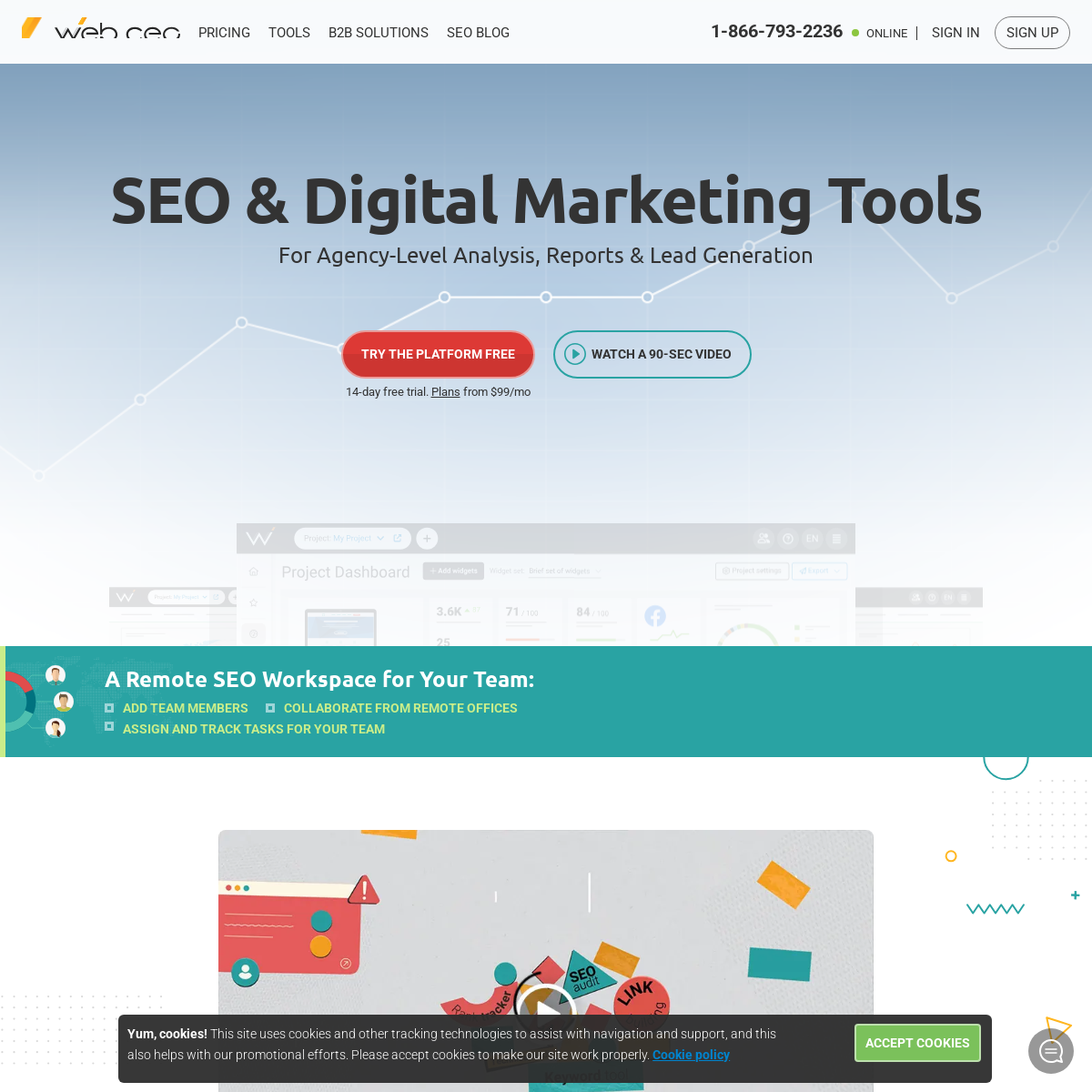
WebCEO
webceo.comWebCEO offers unlimited projects, but fees are hard to predict.
An agency-focused SEO platform with white-label reporting, 24 tools, and unlimited projects on one plan.
Best forDigital agencies wanting white-label reports and unlimited client projects.
Not forUsers needing the largest keyword databases available.
20+Years in marketseoraf.com
24SEO tools includedwebceo.com
Starting price
$4/1,000 rank queriesVariable scanning fee on Agency Unlimited plan
Six criteria vs category average
Dark tick = category average
Why it wins
- Full white-label tools on custom domains
- Unlimited projects on Agency Unlimited plan
- Praised customer support and training
Where it slips
- Scanning fees make billing hard to predict
- Smaller keyword database than rivals
- Interface design feels somewhat dated
One factWebCEO has operated in the SEO software market for over 20 years. seoraf.com
One catchVariable scanning fees on the Agency plan make monthly billing hard to predict. g2.com
freemiumFrom $37/month. Agency Unlimited plan adds variable scanning fees
The takeWebCEO has run for more than two decades and built its reputation on white-label tools agencies can host under their own domain. The Agency Unlimited plan allows unlimited projects and keywords, but adds scanning fees, priced at $4 per 1,000 rank queries. Reviewers note its keyword and backlink data is smaller than Semrush or Ahrefs.
The evidence: 6 criteria, 3 penalties
9.6
Product Capability & DepthLooked for: We evaluate the breadth of SEO tools, data accuracy, and feature completeness compared to market leaders.WebCEO offers a comprehensive suite including rank tracking, site audits, and backlink analysis, though its data pools are smaller than industry giants.webceo.comwebceo.comwebceo.com
9.3
Market Credibility & Trust SignalsLooked for: We assess the product's longevity, user base reputation, and standing within the professional SEO community.With over two decades in the market, WebCEO is a highly established player trusted specifically by agencies for its stability and white-label focus.searchenginejournal.comseoraf.comg2.com
9.2
Usability & Customer ExperienceLooked for: We look for intuitive interface design, ease of onboarding, and quality of customer support.Users praise the customer support and general ease of use, although the interface design is frequently described as somewhat dated.searchenginejournal.comg2.comseoraf.com
9.7
Value, Pricing & TransparencyLooked for: We analyze pricing structures, hidden costs, and the balance of features provided for the cost.While base pricing is competitive, the 'scanning fee' model for the agency plan introduces variable costs that can be difficult to predict.g2.comwebceo.com
9.4
White Label & Agency FeaturesLooked for: We evaluate features specifically designed for agencies, such as branding, reporting, and client management.WebCEO excels here with full white-label capabilities on custom domains, allowing agencies to present the tools as their own proprietary software.webceo.comwebceo.comprposting.com
9.5
Integrations & API CapabilitiesLooked for: We examine the strength of third-party data connections and API availability for custom workflows.Solid integrations with Google services and a functional API are available, though API access is restricted to higher-tier plans.webceo.comwebceo.comwebceo.com
Score adjustments−0.15 points in total
−0.04Variable scanning fees on the Agency Unlimited plan make monthly billing difficult to predict for some users.g2.com · severity 60/100
−0.07The keyword and backlink databases are reported to be smaller and less comprehensive than market leaders like Ahrefs or Semrush.seoraf.com · severity 50/100
−0.04Users frequently cite the interface design as feeling dated compared to modern SaaS competitors.seoraf.com · severity 40/100
What does WebCEO cost?
Plans start at $37 per month. The Agency Unlimited plan adds variable scanning fees, around $4 per 1,000 rank queries and 80 cents per 1,000 backlinks found.
Can agencies white-label WebCEO?
Yes. WebCEO lets agencies host tools and reports on their own custom domain with no WebCEO mentions, according to the company's website SEO reports page.
 A
A
#1 of 12 in SEO Tools & Platforms for Marketing Agencies
Ahrefs
ahrefs.comAhrefs has the biggest backlink index, but no free trial.
An SEO platform with a 35 trillion-link backlink index and AI brand-visibility tracking called Brand Radar.
Best forAgencies needing deep backlink data and competitor research
Not forSmall businesses on tight budgets needing simple client reports
28.7Bkeywords trackedahrefs.com
456.5Bindexed pagesaboutchromebooks.com
By the numbers
28.7Bkeywords tracked
456.5Bpages indexed
44%of Fortune 500 use Ahrefs
Source: ahrefs.com
Six criteria vs category average
Dark tick = category average
Why it wins
- 35 trillion-link backlink index
- Tracks brand mentions in ChatGPT
- Used by 44% of Fortune 500
Where it slips
- Credit system limits filtering
- No free trial
- Steep learning curve
One factBacklink index holds 35 trillion live external links sqmagazine.co.uk
One catchBasic actions like filtering a report can cost a credit, even on paid plans. blackhatworld.com
paidFrom $99/mo, no free trial on paid plans
The takeAhrefs runs the second most active web crawler after Google, feeding an index of 456.5 billion pages updated every 15 to 30 minutes. Brand Radar extends that data into AI search, tracking mentions across ChatGPT, Gemini, and Perplexity. The credit system charges for routine actions like filtering, which frustrates users even on paid tiers.
The evidence: 6 criteria, 2 penalties
9.6
Product Capability & DepthLooked for: We assess the breadth of SEO and marketing tools, including keyword research, backlink analysis, and emerging AI capabilities.Ahrefs offers a comprehensive suite powered by a massive index of 28.7 billion keywords and 35 trillion backlinks, recently expanded with 'Brand Radar' to track visibility across LLMs like ChatGPT and Perplexity.ahrefs.comahrefs.comsqmagazine.co.uk
9.8
Market Credibility & Trust SignalsLooked for: We look for adoption rates among major enterprises, crawler activity statistics, and reputation within the professional SEO community.Ahrefs is a dominant market leader, trusted by 44% of Fortune 500 companies and operating the second most active web crawler on the internet after Google.ahrefs.comaboutchromebooks.com
8.9
Usability & Customer ExperienceLooked for: We evaluate the interface design, ease of navigating complex data, and the quality of educational resources for users.Users consistently praise the clean, data-rich interface that simplifies complex SEO metrics, though beginners may face a steep learning curve due to the sheer volume of data.ahrefs.comg2.comg2.com
8.2
Value, Pricing & TransparencyLooked for: We analyze pricing tiers, hidden costs, usage limits, and the availability of free trials or entry-level options.While the tool offers immense value, the pricing is premium with no free trial, and the 'credit system' charges for basic report filtering, which has caused significant user friction.ahrefs.comblackhatworld.comsellingtobigcompanies.com
9.7
Data Infrastructure & Index QualityLooked for: We examine the size, freshness, and update frequency of the proprietary databases that power the platform's insights.Ahrefs operates a massive proprietary infrastructure with 456.5 billion indexed pages and updates its index every 15-30 minutes, providing near real-time data.aboutchromebooks.comahrefs.com
9.1
AI & Future Search ReadinessLooked for: We evaluate the platform's adaptation to AI Search (SGE, ChatGPT) and tools for Answer Engine Optimization (AEO).Ahrefs has proactively launched 'Brand Radar' to track mentions in LLMs and AI search engines, positioning itself as a leader in the shift from SEO to AEO.ahrefs.comahrefs.com
Score adjustments−0.08 points in total
−0.05The 'credit system' consumes usage quotas for basic actions like filtering reports or sorting columns, which users report depletes limits rapidly even on paid plans.blackhatworld.com · severity 75/100
−0.03Unlike major competitors, Ahrefs does not offer a free trial for its standard plans, requiring upfront payment to test the full feature set.sellingtobigcompanies.com · severity 45/100
Does Ahrefs offer a free trial?
No. Ahrefs discontinued its free trial for paid plans. It used to offer a 7-day trial, but pricing now starts at $99 a month with no trial, per review sources.
How big is Ahrefs' keyword database?
Ahrefs tracks 28.7 billion keywords across 217 locations, filtered from a larger pool of 110 billion keywords, according to Ahrefs' own comparison page.
 C
C
#2 of 4 in PPC & Ad Campaign Management Tools for Digital Marketing Agencies
Crush
trycrush.aiFlat $99 pricing beats agencies, Meta ads only
Autonomous AI platform that tests, scales, and kills Meta ad creatives to protect budget.
Best forStartup founders or small teams wanting Meta ad management on autopilot
Not forAdvanced media buyers wanting manual control, or agencies needing multi-platform PPC
4.5/5Trustpilot ratingtrustpilot.com
$99Monthly pricetrycrush.ai
$100M+Managed ad spend behind the tooltrycrush.ai
Starting price
$99/mo14-day refund, no long-term contract
In their words
“Everything I learned from $100M+ in ad spend, now automated for anyone running Meta ads.”
trycrush.aiSix criteria vs category average
Dark tick = category average
Why it wins
- Automated kill switch protects budget
- Flat $99/month pricing
- Competitor ad scraping
Where it slips
- Meta ads only
- No native multi-currency dashboard
- Shopify integration pending
One factBuilt by media buyers who managed over $100M in ad spend trycrush.ai
One catchPlatform is currently restricted to Meta ads, with no TikTok or Shopify integration yet. reddit.com
paid$99/mo flat rate, 14-day refund window
The takeCrush ranks first among 4 PPC tools for agencies with a 9.2 overall score. Its automated kill switch pauses underperforming ads by ROAS target, and pricing stays flat at $99 a month. The tradeoff is a narrow focus on Meta, with TikTok and Shopify support still listed as under investigation.
The evidence: 6 criteria, 2 penalties
9.3
Product Capability & DepthLooked for: Assessment of the core features, AI capabilities, and comprehensive ad management tools for performance marketersCrush provides end-to-end Meta ad automation, featuring competitor scraping, AI creative generation in multiple formats, and an automated 'kill switch' that pauses underperforming ads.trycrush.ai
9.5
Market Credibility & Trust SignalsLooked for: Verifiable customer reviews, founder expertise, and market reception within the digital advertising communityThe platform holds a 4.5/5 Trustpilot rating and is built by ex-IBM engineers and professional media buyers who have managed over $100M in ad spend.trustpilot.comtrycrush.ai
8.8
Usability & Customer ExperienceLooked for: Ease of use, dashboard interface functionality, and how seamlessly users can launch and edit ad campaignsUsers appreciate the simplified workflow and natural language editing for creatives, but international users face friction due to the lack of native multi-currency support.trustpilot.com
9.5
Value, Pricing & TransparencyLooked for: Clarity of pricing tiers, affordability compared to alternatives, and documented return on investment for usersCrush offers a highly transparent, flat $99/month pricing model with a 14-day refund policy, positioning itself as a cost-effective alternative to agency retainers.trycrush.aitrycrush.ai
9.6
Performance & Autonomous OptimizationLooked for: The effectiveness of the AI's real-time decision making, A/B testing structure, and ability to improve Return on Ad SpendThe AI actively monitors ad micro-metrics 24/7, autonomously scales winning creatives, and shifts optimization toward user-defined ROAS or CPA targets.reddit.com
8.9
Integrations & Platform EcosystemLooked for: Depth of direct connections with major ad networks, e-commerce platforms, and data synchronization capabilitiesDeeply integrated with Meta (Facebook/Instagram), but currently lacks live connections for TikTok ads and direct Shopify API product syncing.reddit.com
Score adjustments−0.10 points in total
−0.05Platform is currently restricted primarily to Meta ads, lacking immediate multi-channel deployment for platforms like TikTok.reddit.com · severity 50/100
−0.05Dashboard natively defaults to USD, forcing international users to calculate currency conversions manually to track their metrics.trustpilot.com · severity 45/100
How much does Crush cost?
Crush charges a flat $99 per month, according to its pricing page, with a 14-day refund if it is not a fit.
Does Crush support platforms beyond Meta?
Not yet. Evidence shows TikTok ads support and Shopify API integration are listed as under investigation, not active features.
 K
K
#1 of 8 in Marketing Automation Platforms for Marketing Agencies
Klaviyo
klaviyo.comKlaviyo syncs Shopify data to your inbox in under 200ms.
An ecommerce marketing platform combining email, SMS, and predictive AI built on Shopify's live store data.
Best forEcommerce brands on Shopify, WooCommerce, or BigCommerce
Not forB2B or service businesses without ecommerce store data
143,000+businesses using Klaviyobillionverify.com
350+third-party integrationsbusiness.com
Free vs paid
Free plan
$0- Up to 250 contacts
- Email and SMS access
Paid, active-profile billing
- 350+ integrations
- Predictive CLV and churn AI
- Sub-200ms Shopify sync
Source: mailsoftly.com
Six criteria vs category average
Dark tick = category average
Why it wins
- Sub-200ms Shopify data sync
- 350+ third-party integrations
- AI churn and CLV predictions
Where it slips
- Expensive past 10-20k contacts
- Steep learning curve
- Slow support on lower tiers
One factShopify commerce data syncs into Klaviyo in under 200 milliseconds shopify.com
One catchCosts rise significantly once a contact list exceeds 10,000 to 20,000 contacts. billionverify.com
freemiumFree up to 250 contacts, paid plans scale with active profiles
The takeKlaviyo's architecture is built around commerce data from the ground up, pulling product catalogs, order history, and browse behavior natively rather than bolting ecommerce features onto a generic email tool. Segments AI lets marketers describe an audience in plain language instead of building filter logic by hand. Pricing is the catch. Billing is based on active profiles, so costs climb fast once a list passes 10,000 to 20,000 contacts, even for rarely emailed subscribers.
The evidence: 6 criteria, 2 penalties
9.5
Product Capability & DepthLooked for: We evaluate the platform's core e-commerce marketing features, automation capabilities, and multi-channel campaign management.Klaviyo delivers exceptionally deep e-commerce marketing capabilities, featuring advanced conditional workflows, built-in predictive analytics, and a unified platform for both email and SMS campaigns tailored specifically for online retailers.billionverify.complivo.com
9.4
Market Credibility & Trust SignalsLooked for: We look for verifiable market adoption, trusted brand usage, public company status, and consistent aggregate review scores.Klaviyo is a publicly traded industry leader trusted by over 143,000 businesses globally, maintaining stellar user ratings across major B2B software review platforms like G2 and TrustRadius.billionverify.comwhop.com
8.8
Usability & Customer ExperienceLooked for: We assess the platform's ease of use, onboarding process, and the responsiveness and quality of its customer support.While the platform offers extensive documentation and a sleek interface, users consistently report a steep learning curve and slow, inconsistent customer support, especially on lower-tier plans.g2.comwhop.com
8.8
Value, Pricing & TransparencyLooked for: We analyze the pricing model for scalability, clarity of costs, and the overall return on investment for the features provided.Klaviyo offers a transparent but aggressive contact-based pricing model that becomes highly expensive at scale, forcing businesses to pay for all active profiles regardless of email sending frequency.mailsoftly.combillionverify.com
9.7
Integrations & Ecosystem StrengthLooked for: We evaluate the breadth, depth, and speed of integrations with major e-commerce platforms and third-party tools.Klaviyo features an unmatched, native integration with Shopify that syncs complex commerce data in sub-200 milliseconds, alongside over 350 other third-party app integrations.shopify.combusiness.com
9.3
Artificial Intelligence & Predictive AnalyticsLooked for: We examine the platform's use of machine learning to forecast customer behavior, optimize sending, and automate segmentation.Klaviyo leverages sophisticated AI to offer predictive metrics like Customer Lifetime Value (CLV) and churn risk, alongside generative AI tools like 'Segments AI' for natural language segment building.flatlineagency.comklaviyo.com
Score adjustments−0.12 points in total
−0.05Pricing scales aggressively based on 'active profiles,' forcing businesses to pay for contacts even if they don't frequently email them.mailsoftly.com · severity 70/100
−0.07Users consistently report a steep learning curve and limited, slow customer support on lower tiers, lacking dedicated post-onboarding account representatives.whop.com · severity 65/100
How fast does Klaviyo sync with Shopify?
Shopify's commerce data flows into Klaviyo in under 200 milliseconds, creating a single customer record that powers personalization across email, SMS, and other channels, according to Shopify's own partner blog.
Why does Klaviyo get expensive at scale?
Pricing is based on active profiles, so costs rise as a contact list grows even if those contacts are rarely emailed. Costs increase significantly once a list passes 10,000 to 20,000 contacts, per independent review sources.
 S
S
#1 of 7 in Marketing Automation Platforms for Contractors
Salesforce
salesforce.comSalesforce CRM starts at $25/user, scales to $100k+ setup.
CRM adapted for contractors, tracking leads, projects and job status inside Salesforce.
Best forGrowing construction firms needing deep customization and integrations.
Not forSolopreneurs wanting a simple, plug-and-play industry tool.
$25/user/moStarter Suite priceprojectmanagers.net
$10k-$100k+Implementation cost rangekelleyaustin.com
Starting price
$25/user/moStarter Suite; implementation costs extra
True monthly cost
True cost to launch
Starter Suite$25/user/mo
Implementation (typical)$10,000+
Total$10,000+ upfront
Varies by company size and complexity
Fit
Pick it if you are
- Companies needing deep customization and extensive third-party app integrations
- Teams wanting a scalable platform that grows from 'Starter' to Enterprise editions
- Growing construction firms anticipating complex data and customization needs
Skip it if you are
- Solopreneurs or very small crews wanting a simple, plug-and-play industry tool
- Businesses with zero budget for implementation or ongoing administration
- Those needing industry-specific features like takeoffs out of the box
Why it wins
- Starter Suite at $25/user
- Deep Procore integration
- Offline mobile field app
Where it slips
- Steep learning curve
- Implementation costs $10k+
- Lacks native RFIs
One factThe Starter Suite costs $25 per user per month. projectmanagers.net
One catchImplementation can cost $10,000 to over $100,000 depending on complexity. kelleyaustin.com
paidFrom $25/user/mo, Starter Suite. Implementation adds $10k or more.
The takeSalesforce CRM for Contractors connects sales and project data through deep integrations with Procore and Autodesk Construction Cloud. Entry pricing is competitive at $25 per user, but implementation and customization costs climb fast for full contractor workflows.
How much does Salesforce CRM for Contractors cost?
The Starter Suite is $25 per user monthly. Implementation typically costs $10,000 to over $100,000 depending on company size and complexity.
Does Salesforce integrate with Procore?
Yes. A dedicated integration syncs leads, opportunities, accounts and contacts between Salesforce and Procore automatically.
 W
W
#1 of 10 in Campaign Orchestration Tools with Behavioral Data
WebEngage
webengage.comWebEngage reaches 400M users, but hides pricing near $1,000.
An omnichannel journey builder covering 10+ channels with HIPAA and SOC 2 compliance.
Best forMid-market to enterprise teams wanting easy, visual journey building.
Not forB2B companies needing deep Salesforce ties or real-time data streaming.
400 million+Monthly active users engagedwebengage.com
850+Enterprise customerswebengage.com
Six criteria vs category average
Dark tick = category average
Why it wins
- Visual drag-and-drop journey builder
- Covers 10+ engagement channels
- HIPAA, SOC 2, ISO 27001 certified
Where it slips
- Pricing hidden, starts near $1,000/mo
- Dashboard can lag during high traffic
- Steep learning curve for beginners
One factWebEngage engages over 400 million monthly active users across 850+ enterprises. webengage.com
One catchPricing is not listed publicly and starts around $1,000 per month. getapp.com
Quote onlyContact for pricing, third-party sources cite about $1,000/month
The takeWebEngage builds customer journeys across 10-plus channels including WhatsApp, SMS, and push, and engages over 400 million monthly active users for more than 850 enterprises. It holds ISO 27001, SOC 2, and HIPAA compliance. Pricing is not published, with third-party sources citing a starting cost around $1,000 per month.
The evidence: 6 criteria, 3 penalties
9.4
Product Capability & DepthLooked for: We evaluate the breadth of campaign tools, channel support, and automation logic available for complex user journeys.WebEngage offers a visual Journey Designer supporting 10+ channels including WhatsApp, SMS, and Push, with advanced features like Relays for business-triggered workflows and hyper-personalization.webengage.comwebengage.comwebengage.com
9.6
Market Credibility & Trust SignalsLooked for: We assess the vendor's market presence, customer base size, and validation from reputable third-party reviews.WebEngage is trusted by over 850 enterprise customers globally, engages 400M+ monthly active users, and holds strong ratings on G2 (4.5/5) and Gartner Peer Insights.martechoutlook.comwebengage.comg2.com
8.7
Usability & Customer ExperienceLooked for: We examine the ease of use, interface design, and quality of customer support resources.Users praise the drag-and-drop Journey Designer for its intuitive visual interface, though some report a steep learning curve for advanced analytics and occasional dashboard lag.g2.comg2.com
9.3
Value, Pricing & TransparencyLooked for: We look for clear public pricing, flexible plan options, and alignment between cost and feature set.Pricing is not publicly listed on the official site; third-party sources indicate a starting price around $1,000/month, positioning it as an enterprise-focused solution rather than for SMBs.webengage.comwebengage.comgetapp.com
9.5
Integrations & Ecosystem StrengthLooked for: We evaluate the availability of pre-built connectors with major CDPs, analytics tools, and communication gateways.The platform integrates with major ecosystem players like Segment, Mixpanel, Amplitude, and AWS, and supports custom data ingestion via REST APIs.webengage.comsegment.comamplitude.com
9.7
Security, Compliance & Data ProtectionLooked for: We verify the presence of major security certifications and data protection standards relevant to enterprise software.WebEngage demonstrates exceptional security standards with ISO 27001 certification, SOC 2 compliance, GDPR readiness, and HIPAA compliance for healthcare data.webengage.comwebengage.comwebengage.com
Score adjustments−0.12 points in total
−0.05Users have reported dashboard performance lag and slow loading times during high-traffic periods or when processing large data sets.g2.com · severity 50/100
−0.03Pricing is not transparently listed on the vendor's website, and third-party sources indicate a high starting cost ($1,000/mo) which may exclude smaller businesses.getapp.com · severity 45/100
−0.04Some users report a steep learning curve for advanced features and reporting, requiring significant time to master.g2.com · severity 40/100
How much does WebEngage cost?
WebEngage does not publish pricing. Third-party sources like GetApp list a starting cost around $1,000 per month, positioning it as an enterprise-focused tool.
Is WebEngage HIPAA compliant?
Yes. WebEngage achieved full HIPAA compliance and also holds ISO 27001:2013 certification and SOC 2 compliance, according to its own security documentation.
Marketing by Industry Use Case
B2B Technology
Account-Based Marketing (ABM) and pipeline acceleration. Requires intent data integration, account scoring across buying committees, and multi-threaded engagement that maps leads to accounts and triggers sales alerts when target accounts show high intent.
What to weigh firstABM & pipeline acceleration
Marketing by Industry Use Case
Ecommerce & D2C
Customer Lifetime Value (CLV) is the primary metric. Platforms must excel in lifecycle marketing with transactional triggers (abandoned cart, post-purchase, replenishment). Zero-party data collection and loyalty program integration are essential as third-party cookies decline.
What to weigh firstLifecycle marketing & CLV optimization
Marketing by Industry Use Case
Financial Services
Compliance and governance are non-negotiable. Platforms must operate within UDAAP and GDPR frameworks, with robust audit trails, legal approval workflows, and private cloud deployment options. AI models must not violate fair lending laws.
What to weigh firstCompliance & trust-building
Marketing by Industry Use Case
Professional Services
Thought leadership and referral management drive the sales cycle. Requires long-form content distribution, sophisticated email nurturing, and CRM integration to maintain top-of-mind awareness over multi-year relationship cycles.
What to weigh firstThought leadership & CRM integration
Marketing by Industry Use Case
Local & SMB
Budget constraints meet geo-complexity. Platforms must act as force multipliers, managing presence across Google Maps, Yelp, and social media for multiple locations simultaneously. Reputation management and local SEO are the killer features.
What to weigh firstLocal SEO & reputation management
Other groups
Accounting & FinanceAI, Automation & Machine LearningBusiness Intelligence & AnalyticsCloud Storage, Backup & File ManagementCRM & SalesCustomer Support & SuccessCybersecurity, Privacy & ComplianceDesign, Creative & Media ProductionEcommerce & RetailField Service & OperationsHR & People ManagementProject Management & Productivity