SEO Tools & Platforms

Updated July 23, 2026

These are the specialized categories within SEO Tools & Platforms. Looking for something broader? See all Marketing & Advertising Platforms categories.

Not sure which one is right for you?

Answer 4 quick questions and we'll match you with your best options

Find Your Best Match

How big is your team?

Just me
2 - 10
11 - 50
51 - 200
201 - 1,000
1,000+

What's your budget situation?

Free or open-source only
Free to start, pay later
Best value for money
Price isn't the main factor

What's your team's technical comfort level?

We want it to just work
We can handle some setup
We have developers who'll customize it

What's the ONE thing this tool must do well?

Step 1 of 4
1
9.3 / 10
Cerebro

Cerebro is an advanced SEO tool for digital marketing agencies focusing on Amazon. It helps sellers reverse-engineer competitor ASINs to discover effective keywords, with its Cerebro IQ Score highlighting high-volume, low-competition opportunities. Ideal for both new and seasoned sellers, it enhances listing optimization and PPC strategies.

Best for SEO Tools & Platforms for Digital Marketing Agencies

Expert Take

Helium 10's Cerebro stands out as a gold standard in Amazon competitive intelligence. By allowing sellers to reverse-engineer competitor ASINs, it uncovers the exact organic and paid keywords driving market share. The proprietary Cerebro IQ Score brilliantly highlights high-volume, low-competition gaps for quick wins. Paired with the comprehensive Freedom Ticket training course, it empowers both new and veteran sellers to turn raw data into highly optimized listings and profitable PPC campaigns.

Pros

  • Deep reverse ASIN keyword tracking and analysis
  • Proprietary Cerebro IQ Score identifies low-competition gaps
  • Integrates seamlessly with Magnet for expanded search metrics

Cons

  • Overwhelming interface with a steep learning curve
  • Strict daily usage limits on entry-level subscription plans

Pros

  • Deep reverse ASIN keyword tracking and analysis
  • Proprietary Cerebro IQ Score identifies low-competition gaps
  • Includes the comprehensive Freedom Ticket FBA training course
  • Integrates seamlessly with Magnet for expanded search metrics

Cons

  • Expensive pricing for users only needing keyword research
  • Overwhelming interface with a steep learning curve
  • Strict daily usage limits on entry-level subscription plans

Expert Take

Helium 10's Cerebro stands out as a gold standard in Amazon competitive intelligence. By allowing sellers to reverse-engineer competitor ASINs, it uncovers the exact organic and paid keywords driving market share. The proprietary Cerebro IQ Score brilliantly highlights high-volume, low-competition gaps for quick wins. Paired with the comprehensive Freedom Ticket training course, it empowers both new and veteran sellers to turn raw data into highly optimized listings and profitable PPC campaigns.

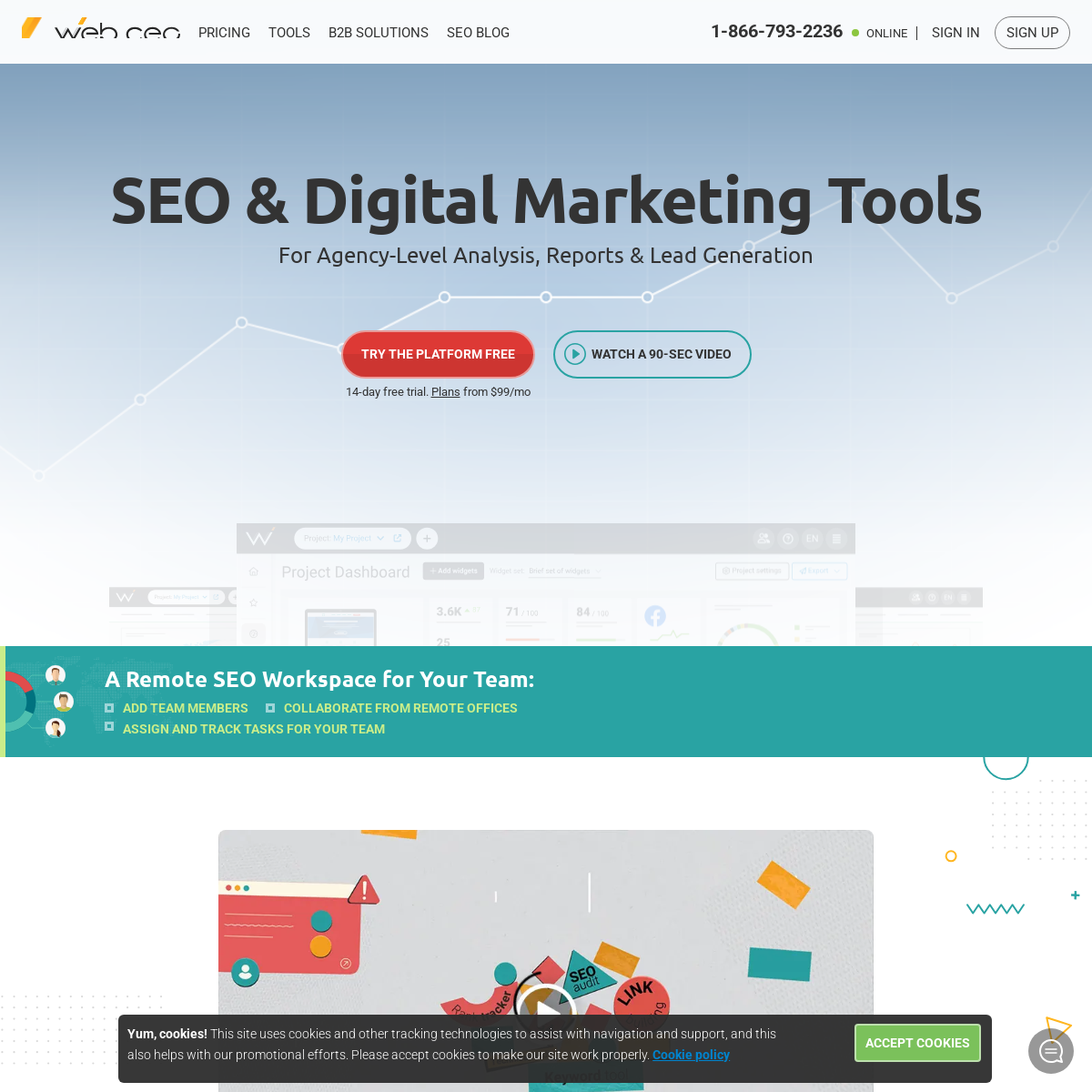
WebCEO SEO & Digital Marketing Tools

WebCEO is a comprehensive SEO platform specifically designed for digital marketing agencies. It provides a robust set of 24 SEO tools, including keyword research, link building, and rank tracking, which cater to the unique needs of SEO professionals and enable them to effectively manage and optimize their clients' online presence.

Best for SEO Tools & Platforms for Digital Marketing Agencies

Expert Take

WebCEO is a comprehensive SEO platform tailored for digital marketing agencies, offering a wide array of tools and client management features. Its capabilities are well-documented, and it provides value through features like white label reporting and multi-user functionality. While it excels in many areas, its interface complexity and limited backlink analysis are noted tradeoffs.

Pros

  • Full white-label tools on custom domains
  • Unlimited projects on Agency Unlimited plan
  • Lower base cost than major competitors
  • Comprehensive automated client reporting

Cons

  • Variable scanning fees cause billing uncertainty
  • Smaller data database than market leaders
  • Interface design feels somewhat dated
  • Steep learning curve for advanced features

Best for teams that are

  • Digital agencies needing white-label reports and lead gen widgets
  • Marketing teams requiring strong collaboration and task management

Skip if

  • Advanced users seeking highly specialized technical data
  • Freelancers who do not need client reporting features

Best for teams that are

  • Digital agencies needing white-label reports and lead gen widgets
  • Marketing teams requiring strong collaboration and task management

Skip if

  • Advanced users seeking highly specialized technical data
  • Freelancers who do not need client reporting features

Pros

  • Full white-label tools on custom domains
  • Unlimited projects on Agency Unlimited plan
  • Excellent customer support and training
  • Lower base cost than major competitors
  • Comprehensive automated client reporting

Cons

  • Variable scanning fees cause billing uncertainty
  • Smaller data database than market leaders
  • Interface design feels somewhat dated
  • API access restricted to specific plans
  • Steep learning curve for advanced features

Expert Take

WebCEO is a comprehensive SEO platform tailored for digital marketing agencies, offering a wide array of tools and client management features. Its capabilities are well-documented, and it provides value through features like white label reporting and multi-user functionality. While it excels in many areas, its interface complexity and limited backlink analysis are noted tradeoffs.

Ahrefs—AI Marketing Platform

Ahrefs is a powerful SEO tool that marketing agencies use to increase their visibility online. Its extensive AI and search databases provide in-depth data, comprehensive keyword research, and competitive analysis, making it ideal for the evolving needs of marketing agencies.

Best for SEO Tools & Platforms for Marketing Agencies

Expert Take

Ahrefs excels in providing comprehensive SEO tools tailored for marketing agencies, with robust capabilities in keyword research and competitive analysis. Its market credibility is supported by third-party recognition, and its user-friendly interface enhances customer experience. While pricing may be a consideration for smaller firms, the platform's value and transparency remain strong.

Pros

  • World's largest active backlink index (35T links)
  • Tracks brand visibility in ChatGPT & Gemini
  • Massive database of 28.7 billion keywords
  • Clean, professional UI for complex data

Cons

  • Strict credit limits on report filtering
  • No free trial for paid subscriptions
  • Daily rank tracking requires expensive add-on
  • Steep learning curve for beginners

Best for teams that are

  • Users needing powerful backlink analysis and deep prospecting features.
  • Professionals looking for comprehensive SEO and competitor data.

Skip if

  • Small businesses prioritizing simple, automated client reporting.
  • Users on a very tight budget needing basic entry-level tools.

Best for teams that are

  • Users needing powerful backlink analysis and deep prospecting features.
  • Professionals looking for comprehensive SEO and competitor data.

Skip if

  • Small businesses prioritizing simple, automated client reporting.
  • Users on a very tight budget needing basic entry-level tools.

Pros

  • World's largest active backlink index (35T links)
  • Tracks brand visibility in ChatGPT & Gemini
  • Trusted by 44% of Fortune 500 companies
  • Massive database of 28.7 billion keywords
  • Clean, professional UI for complex data

Cons

  • Strict credit limits on report filtering
  • No free trial for paid subscriptions
  • Daily rank tracking requires expensive add-on
  • High entry price for small businesses
  • Steep learning curve for beginners

Expert Take

Ahrefs excels in providing comprehensive SEO tools tailored for marketing agencies, with robust capabilities in keyword research and competitive analysis. Its market credibility is supported by third-party recognition, and its user-friendly interface enhances customer experience. While pricing may be a consideration for smaller firms, the platform's value and transparency remain strong.

4
9.1 / 10
Semrush SEO Toolkit

Semrush SEO Toolkit is an all-in-one digital marketing solution designed for ecommerce brands seeking comprehensive SEO, PPC, and social media insights. With its vast database of 43 trillion backlinks and 28.7 billion keywords, it empowers users with unparalleled competitive intelligence and extensive analysis capabilities, seamlessly integrating with Google tools for effortless campaign reporting.

Best for SEO Tools & Platforms for Ecommerce Brands

Expert Take

Semrush stands out as an unparalleled all-in-one digital marketing powerhouse. We love its expansive database featuring over 43 trillion backlinks and 28.7 billion keywords, which empowers users with unmatched competitive intelligence. Its generous daily reporting limits ensure marketing teams can run extensive analyses without fear of overage charges. The seamless integrations with Google ecosystem tools like Looker Studio make visualizing and reporting SEO and PPC campaigns effortless and high

Pros

  • Massive database with over 43 trillion backlinks and 21 billion keywords.
  • Generous daily reporting limits compared to credit-based competitor alternatives.
  • Seamless native data integration with Google Looker Studio and Google Analytics.

Cons

  • Steep learning curve and cluttered interface can overwhelm new users.
  • Traffic analytics data provides rough estimates that may differ from GA4.

Best for teams that are

  • Agencies and enterprise businesses needing a comprehensive suite.
  • Professionals requiring deep competitor analysis and keyword data.

Skip if

  • Solo bloggers or beginners with a highly limited budget.
  • Users solely looking for a simple, lightweight content editor.

Best for teams that are

  • Agencies and enterprise businesses needing a comprehensive suite.
  • Professionals requiring deep competitor analysis and keyword data.

Skip if

  • Solo bloggers or beginners with a highly limited budget.
  • Users solely looking for a simple, lightweight content editor.

Pros

  • Massive database with over 43 trillion backlinks and 21 billion keywords.
  • Generous daily reporting limits compared to credit-based competitor alternatives.
  • Comprehensive all-in-one suite covering SEO, PPC, and social media tools.
  • Seamless native data integration with Google Looker Studio and Google Analytics.

Cons

  • Highly expensive monthly fees for adding additional user seats to plans.
  • Steep learning curve and cluttered interface can overwhelm new users.
  • Traffic analytics data provides rough estimates that may differ from GA4.

Expert Take

Semrush stands out as an unparalleled all-in-one digital marketing powerhouse. We love its expansive database featuring over 43 trillion backlinks and 28.7 billion keywords, which empowers users with unmatched competitive intelligence. Its generous daily reporting limits ensure marketing teams can run extensive analyses without fear of overage charges. The seamless integrations with Google ecosystem tools like Looker Studio make visualizing and reporting SEO and PPC campaigns effortless and high

HVSEO for Insurance Companies

HVSEO offers a tailored SEO solution specifically for insurance companies, aiming to drive more leads and build trust. It focuses on the unique needs of insurance agents by identifying SEO strategies that produce real results, including an SEO audit and competitive gap analysis.

Best for SEO Tools & Platforms for Insurance Agents

Expert Take

HVSEO excels in providing tailored SEO solutions for insurance companies, addressing industry-specific needs with comprehensive audits and competitive analysis. While the lack of transparent pricing may be a drawback, its specialized focus and documented capabilities make it a top choice for insurance agents seeking effective SEO strategies.

Pros

  • Patented scientific SEO methodology
  • Specialized in YMYL sectors
  • Transparent sprint-based pricing
  • Founded by expert Kyle Roof

Cons

  • Limited to SEO services
  • Results take 3-6 months
  • High cost for deep audits
  • No PPC management offered

Best for teams that are

  • Insurance companies with a dedicated budget ($1,500+/mo) for expert services
  • Businesses looking for high-touch consulting rather than automated software

Skip if

  • Small independent agents with very limited marketing funds (<$500/mo)
  • DIYers looking for a software tool to manage SEO themselves

Best for teams that are

  • Insurance companies with a dedicated budget ($1,500+/mo) for expert services
  • Businesses looking for high-touch consulting rather than automated software

Skip if

  • Small independent agents with very limited marketing funds (<$500/mo)
  • DIYers looking for a software tool to manage SEO themselves

Pros

  • Patented scientific SEO methodology
  • Experience with major insurer Aviva
  • Specialized in YMYL sectors
  • Transparent sprint-based pricing
  • Founded by expert Kyle Roof

Cons

  • Limited to SEO services
  • Results take 3-6 months
  • TechBehemoths profile rated Average
  • High cost for deep audits
  • No PPC management offered

Expert Take

HVSEO excels in providing tailored SEO solutions for insurance companies, addressing industry-specific needs with comprehensive audits and competitive analysis. While the lack of transparent pricing may be a drawback, its specialized focus and documented capabilities make it a top choice for insurance agents seeking effective SEO strategies.

Moz Pro SEO Software

Moz Pro is an all-encompassing SEO solution specifically designed for digital marketing agencies. Its range of features, from keyword research to link building, helps agencies drive targeted traffic to their clients' websites, and run impactful SEO campaigns. Its scalability allows it to cater to both small and large agencies.

Best for SEO Tools & Platforms for Digital Marketing Agencies

Expert Take

Moz Pro is a leading SEO tool for digital marketing agencies, offering comprehensive features like keyword research and competitor analysis. Its scalability and detailed reporting provide significant value, although the learning curve may be steep for beginners. The product's credibility is supported by industry recognition.

Pros

  • Industry-standard Domain Authority (DA) metric
  • Exceptional educational resources (Moz Academy)
  • Beginner-friendly interface and workflow
  • Generous 30-day free trial available

Cons

  • Small keyword database (1.25B vs 28B+)
  • No organic traffic estimates for domains
  • No broken outbound link detection tool
  • Limited reporting on entry-level plans

Best for teams that are

  • Beginners and in-house marketers valuing ease of use
  • Teams wanting strong educational resources and community support

Skip if

  • Power users needing the largest keyword or backlink databases
  • Advanced SEOs needing frequent real-time data updates

Best for teams that are

  • Beginners and in-house marketers valuing ease of use
  • Teams wanting strong educational resources and community support

Skip if

  • Power users needing the largest keyword or backlink databases
  • Advanced SEOs needing frequent real-time data updates

Pros

  • Industry-standard Domain Authority (DA) metric
  • Massive link index of 44.8 trillion links
  • Exceptional educational resources (Moz Academy)
  • Beginner-friendly interface and workflow
  • Generous 30-day free trial available

Cons

  • Small keyword database (1.25B vs 28B+)
  • No organic traffic estimates for domains
  • Slower data updates than competitors
  • No broken outbound link detection tool
  • Limited reporting on entry-level plans

Expert Take

Moz Pro is a leading SEO tool for digital marketing agencies, offering comprehensive features like keyword research and competitor analysis. Its scalability and detailed reporting provide significant value, although the learning curve may be steep for beginners. The product's credibility is supported by industry recognition.

RivalMind SEO for Contractors

RivalMind's SEO Services for Contractors specifically targets the needs of businesses in the contracting industry. The tool is designed to attract qualified leads, enhance growth, and improve online visibility, crucial for contractors vying for attention in a crowded digital space.

Best for SEO Tools & Platforms for Contractors

Expert Take

RivalMind SEO for Contractors excels in providing industry-specific SEO strategies tailored for the contracting industry. Its focus on targeted lead generation and improving online visibility makes it a strong contender in its niche. While pricing transparency is limited, the offering of a free audit adds value by helping contractors assess their current SEO standing.

Pros

  • Specialized 5-pillar SEO strategy for contractors
  • Exceptional responsiveness (replies within hours)
  • Verified results for construction clients (Alpine Demolition)
  • Strong focus on Google Business Profile optimization

Cons

  • Niche content may require heavy client input
  • Minimum engagement ~$1,000/mo excludes micro-businesses
  • Standard SEO timeline (3-6 months for results)

Best for teams that are

  • Contractors seeking a full-service, outsourced SEO and digital agency.
  • Home service businesses needing complete website and SEO overhauls.

Skip if

  • Contractors wanting a cheap, DIY software tool to manage their own SEO.
  • Startups lacking the budget for professional agency retainer fees.

Best for teams that are

  • Contractors seeking a full-service, outsourced SEO and digital agency.
  • Home service businesses needing complete website and SEO overhauls.

Skip if

  • Contractors wanting a cheap, DIY software tool to manage their own SEO.
  • Startups lacking the budget for professional agency retainer fees.

Pros

  • Specialized 5-pillar SEO strategy for contractors
  • Transparent pricing from $900 to $7,500+/mo
  • Exceptional responsiveness (replies within hours)
  • Verified results for construction clients (Alpine Demolition)
  • Strong focus on Google Business Profile optimization

Cons

  • Niche content may require heavy client input
  • Minimum engagement ~$1,000/mo excludes micro-businesses
  • Services limited to USA-based companies only
  • Standard SEO timeline (3-6 months for results)

Expert Take

RivalMind SEO for Contractors excels in providing industry-specific SEO strategies tailored for the contracting industry. Its focus on targeted lead generation and improving online visibility makes it a strong contender in its niche. While pricing transparency is limited, the offering of a free audit adds value by helping contractors assess their current SEO standing.

Search Atlas SEO Platform

Search Atlas offers a holistic SEO solution specifically tailored for marketing agencies. It provides robust tools for content optimization, comprehensive site audits, competitor analysis, and more, meeting the unique needs of marketing professionals to boost organic traffic and sales.

Best for SEO Tools & Platforms for Marketing Agencies

Expert Take

Search Atlas SEO Platform is recognized for its comprehensive suite of SEO tools tailored for marketing agencies. It excels in providing in-depth content optimization, site audits, and competitor analysis, making it a valuable asset for boosting organic traffic. The platform's features are well-documented and supported by industry recognition, positioning it as a leading choice in its category.

Pros

  • OTTO AI automates technical SEO fixes
  • Base plan includes 2 user seats
  • Tracks brand visibility across multiple LLMs
  • Consolidates audit, content, and rank tools

Cons

  • Smaller keyword database than Semrush
  • Reports of UI bugs and glitches
  • Mixed reviews on support response times
  • Base price higher than budget tools

Best for teams that are

  • Content marketers needing AI-driven writing and optimization workflows.
  • Mid-sized agencies wanting to consolidate multiple SEO tools.

Skip if

  • Shopify store owners needing native integration without triple handling.
  • Users wanting completely manual control without AI generation limits.

Best for teams that are

  • Content marketers needing AI-driven writing and optimization workflows.
  • Mid-sized agencies wanting to consolidate multiple SEO tools.

Skip if

  • Shopify store owners needing native integration without triple handling.
  • Users wanting completely manual control without AI generation limits.

Pros

  • OTTO AI automates technical SEO fixes
  • Unlimited keyword rank tracking included
  • Base plan includes 2 user seats
  • Tracks brand visibility across multiple LLMs
  • Consolidates audit, content, and rank tools

Cons

  • Smaller keyword database than Semrush
  • Reports of UI bugs and glitches
  • Steeper learning curve for automation
  • Mixed reviews on support response times
  • Base price higher than budget tools

Expert Take

Search Atlas SEO Platform is recognized for its comprehensive suite of SEO tools tailored for marketing agencies. It excels in providing in-depth content optimization, site audits, and competitor analysis, making it a valuable asset for boosting organic traffic. The platform's features are well-documented and supported by industry recognition, positioning it as a leading choice in its category.

Semrush: Data-Driven Marketing Tools

Semrush is a comprehensive SaaS solution specifically designed for digital marketing agencies to maximize their SEO, PPC, content, and social media campaigns. It leverages artificial intelligence to provide data-driven insights, helping agencies make strategic decisions, improve their online visibility, and drive more traffic to their clients' websites.

Best for SEO Tools & Platforms for Digital Marketing Agencies

Expert Take

Semrush is a leading SEO tool for digital marketing agencies, offering comprehensive features and AI-driven insights. Its capabilities in keyword research, competitor analysis, and reporting are well-documented, making it a top choice for agencies aiming to enhance their digital marketing strategies.

Pros

  • Massive 26B+ keyword database
  • Free industry-recognized certifications
  • Publicly traded, stable company
  • Comprehensive competitor intelligence

Cons

  • Expensive add-ons (.Trends is $289/mo)
  • Difficult cancellation process
  • Only 1 user seat included
  • Traffic data is estimated, not exact

Best for teams that are

  • Digital agencies needing a comprehensive all-in-one suite
  • Professionals requiring extensive competitive intelligence

Skip if

  • Users on very tight budgets needing only basic keyword tools
  • Beginners easily overwhelmed by complex feature sets

Best for teams that are

  • Digital agencies needing a comprehensive all-in-one suite
  • Professionals requiring extensive competitive intelligence

Skip if

  • Users on very tight budgets needing only basic keyword tools
  • Beginners easily overwhelmed by complex feature sets

Pros

  • Massive 26B+ keyword database
  • Over 55 integrated marketing tools
  • Free industry-recognized certifications
  • Publicly traded, stable company
  • Comprehensive competitor intelligence

Cons

  • Expensive add-ons (.Trends is $289/mo)
  • Difficult cancellation process
  • Steep learning curve for beginners
  • Only 1 user seat included
  • Traffic data is estimated, not exact

Expert Take

Semrush is a leading SEO tool for digital marketing agencies, offering comprehensive features and AI-driven insights. Its capabilities in keyword research, competitor analysis, and reporting are well-documented, making it a top choice for agencies aiming to enhance their digital marketing strategies.

10
9.0 / 10
Yoast SEO

Yoast SEO is a dedicated SEO solution that is tailored for ecommerce brands. It provides extensive tools and features to help ecommerce brands rank higher in search results, boost website traffic, and improve online visibility. It offers detailed SEO analysis, readability checks, and regular technical updates to ensure your website stays optimized and competitive.

Best for SEO Tools & Platforms for Ecommerce Brands

Expert Take

Yoast SEO excels as a comprehensive SEO solution tailored for ecommerce brands, offering extensive features like SEO analysis, readability checks, and social media previews. Its integration capabilities and regular updates ensure ecommerce sites remain competitive. Despite potential cost concerns for small businesses, its value in enhancing online visibility and traffic is significant.

Pros

  • 13+ million active installations (Market Leader)
  • Intuitive 'Traffic Light' content analysis system
  • Includes access to Yoast Academy training
  • Automated technical SEO (Schema, Sitemaps)

Cons

  • Premium costs $99/year per single site
  • Free version contains ads and upsells
  • Only 1 focus keyword in free version
  • Frequent target for security exploits

Best for teams that are

  • WordPress and WooCommerce site owners needing basic on-page SEO.
  • Bloggers and creators wanting straightforward readability scores.

Skip if

  • E-commerce sellers not using WordPress or WooCommerce platforms.
  • Advanced technical SEOs needing broad competitor analysis tools.

Best for teams that are

  • WordPress and WooCommerce site owners needing basic on-page SEO.
  • Bloggers and creators wanting straightforward readability scores.

Skip if

  • E-commerce sellers not using WordPress or WooCommerce platforms.
  • Advanced technical SEOs needing broad competitor analysis tools.

Pros

  • 13+ million active installations (Market Leader)
  • Intuitive 'Traffic Light' content analysis system
  • Seamless integration with Elementor & Semrush
  • Includes access to Yoast Academy training
  • Automated technical SEO (Schema, Sitemaps)

Cons

  • Premium costs $99/year per single site
  • Free version contains ads and upsells
  • Only 1 focus keyword in free version
  • No built-in rank tracking (requires Wincher)
  • Frequent target for security exploits

Expert Take

Yoast SEO excels as a comprehensive SEO solution tailored for ecommerce brands, offering extensive features like SEO analysis, readability checks, and social media previews. Its integration capabilities and regular updates ensure ecommerce sites remain competitive. Despite potential cost concerns for small businesses, its value in enhancing online visibility and traffic is significant.

Loading comparison data…

How We Rank Products

Our Evaluation Process

SEO tools and platforms are evaluated based on documented features such as keyword analysis, backlink tracking, and site audit capabilities. Pricing transparency and scalability are important considerations, with attention to the integration capabilities with other marketing systems. Third-party feedback is analyzed to assess user satisfaction, focusing on the tool's effectiveness in improving search engine performance and its ease of use in professional settings.

Verification

  • Products evaluated through comprehensive research and analysis of user feedback and industry standards.
  • Selection criteria focus on key features such as keyword tracking, backlink analysis, and user experience metrics.
  • Comparison methodology analyzes customer feedback, expert reviews, and market performance to ensure informed recommendations.

Score Breakdown

0.0 / 10

About SEO Tools & Platforms

WHAT IS SEO TOOLS & PLATFORMS?

The category of SEO Tools & Platforms encompasses software solutions designed to manage the organic search performance of digital assets across their entire visibility lifecycle: from technical auditing and keyword research to content optimization, rank tracking, and reporting. This software sits firmly between the Content Management System (CMS), which handles the creation and publishing of content, and Digital Analytics platforms, which measure downstream user behavior. Unlike general marketing suites, SEO platforms are purpose-built to interpret search engine algorithms and provide actionable intelligence to improve rankings, traffic quality, and domain authority.

This category includes both point solutions—specialized tools focused on single tasks like backlink analysis, technical crawling, or rank tracking—and comprehensive enterprise platforms that unify these functions into a single workflow. According to Gartner, SEO platforms "offer tiered subscriptions for access to a comprehensive solution with on-site, off-site and technical SEO capabilities including traffic analysis, competitor insight, link building and content evaluation." [1]. These platforms are essential for translating the opaque logic of search engines (like Google, Bing, and emerging AI answer engines) into engineering and content tasks that marketing teams can execute.

Why does this category matter? For most businesses, organic search represents the largest share of web traffic but also the channel over which they have the least direct control. Paid media (PPC) offers immediate visibility for a fee, but SEO platforms provide the infrastructure to build sustainable, compounding asset value. They are used by technical SEOs to diagnose server-side rendering issues, by content marketers to identify gap opportunities in their topic clusters, and by CMOs to forecast the ROI of organic market share.

HISTORY OF THE CATEGORY

The evolution of SEO software mirrors the increasing complexity of the web itself. In the mid-to-late 1990s, the "wild west" of search required little more than keyword repetition and meta-tag manipulation. Early tools were essentially submission engines and basic rank checkers. Programs like WebPosition Gold (launched in 1997) allowed webmasters to track rankings and critique page optimization, but the focus was heavily on "tricking" primitive algorithms rather than building authority [2]. At this stage, the software was often desktop-based, operating locally rather than in the cloud.

The 2000s marked the shift toward data aggregation and the birth of modern SaaS SEO. As Google cemented its dominance with the PageRank algorithm (prioritizing links over keyword density), the market need shifted from submission to analysis. This era saw the founding of Moz (originally SEOmoz) in 2004, which transitioned from a consulting blog to a software provider, offering tools to analyze backlink profiles and domain authority [3]. The launch of Google Analytics and Google Webmaster Tools (now Search Console) around 2005-2006 provided the first reliable feedback loops between search engines and webmasters, forcing third-party software to evolve from guesstimation to API-integrated insights.

The 2010s introduced the era of the "Enterprise SEO Platform." As digital marketing budgets grew, large organizations required tools that could handle millions of pages and keywords. This period was defined by the rise of vertical SaaS platforms like BrightEdge, Conductor, and Searchmetrics, which promised to professionalize SEO into a predictable revenue channel. This decade also saw significant market consolidation. The gap between simple SMB tools and complex enterprise suites widened. Algorithm updates like Panda (2011) and Penguin (2012) penalized low-quality content and spammy links, forcing software vendors to build sophisticated content auditing and "toxic link" detection features [4]. Buyer expectations shifted drastically during this consolidation wave; "give me a database of rankings" was no longer sufficient. Buyers began demanding "give me actionable intelligence," requiring platforms to not just report on what happened, but to prescribe exactly what to do next to capture market share.

By the 2020s, the market began its current transition into the AI and "Zero-Click" era. The introduction of Google's BERT (2019) and subsequent AI integrations meant that SEO platforms had to process natural language and intent, not just strings of text. The current landscape is now being reshaped by Generative Engine Optimization (GEO), where platforms must optimize for AI agents and answer engines, not just traditional blue links [5].

WHAT TO LOOK FOR

Evaluating SEO platforms requires looking past feature checklists, as nearly every vendor claims to offer "keyword research" and "site audits." The differentiator lies in data quality, freshness, and the specific mechanism of data collection.

Data Source & Integrity: Does the vendor maintain their own proprietary crawler and index, or do they resell data from third-party APIs? Platforms that own their data (like Semrush, Ahrefs, or Moz) often provide faster updates and more historical fidelity than those that aggregate data from other providers. Ask specifically: "What percentage of your keyword database is refreshed monthly?" and "Do you clickstream data or scrape SERPs directly?" Clickstream data can offer better traffic estimates but may be less accurate for rank tracking in specific localities.

Workflow & "Actionability": A critical evaluation criterion is how the tool bridges the gap between insight and execution. Many legacy platforms are excellent at diagnosing problems (e.g., "You have 40,000 broken links") but poor at facilitating the fix. Look for platforms that integrate directly with task management systems like Jira, Asana, or Trello. Advanced enterprise platforms may even offer "edge SEO" capabilities, allowing you to deploy meta tag changes or redirects via a CDN (like Cloudflare) without touching the core codebase. If the tool only produces CSV exports, your team will drown in data without shipping changes.

Red Flags and Warning Signs:

  • The "Proprietary Metric" Black Box: Be wary of vendors who rely entirely on opaque, proprietary scores (e.g., "Visibility Score" or "Health Grade") without explaining the calculation. If a tool says your SEO Health increased by 10% but traffic dropped by 20%, the metric is a vanity number, not a business KPI.
  • Seat-Based Penalties: Watch out for strict per-seat pricing models that inhibit collaboration. SEO is cross-functional; if you have to pay an extra $500/month to give a developer read-only access to a site audit, adoption will suffer.
  • Lack of JS Rendering: In the modern web, many sites rely heavily on JavaScript (React, Angular, Vue). If the platform's crawler cannot execute JavaScript, it will fail to see the content as Google sees it, leading to fundamentally flawed audits.

Key Questions to Ask Vendors:

  • "Does your rank tracking support mobile-first indexing and specific geo-coordinates for local search?"
  • "How does your platform handle Share of Voice calculations for SERP features like Answer Boxes and Local Packs, not just organic links?"
  • "Can we segment reporting by page template (e.g., product pages vs. blog posts) automatically?"

INDUSTRY-SPECIFIC USE CASES

Retail & E-commerce

For retail and e-commerce, the primary SEO challenge is scale. A retailer with 50,000 SKUs faces unique problems regarding faceted navigation and crawl budget efficiency. Faceted navigation (filtering by size, color, brand) can generate millions of thin, duplicate URLs that dilute ranking power. Retail buyers must prioritize SEO platforms with advanced crawl logic that can identify and recommend canonicalization strategies for these parameter-heavy URLs [6].

Evaluation priority should be placed on Product Schema monitoring. The platform must be able to audit structured data at scale to ensure products are eligible for "Merchant Listings" in search results (showing price, availability, and review ratings). Furthermore, retailers need tools that integrate with inventory data; if a product goes out of stock, the SEO platform should flag the page for immediate remediation (e.g., redirection to a category page) to preserve link equity.

Healthcare

Healthcare SEO is governed by YMYL (Your Money or Your Life) standards and strict compliance regulations like HIPAA. Unlike retail, where the goal is volume, healthcare SEO prioritizes E-E-A-T (Experience, Expertise, Authoritativeness, and Trustworthiness). Platforms used in this sector must have features that analyze content for "trust signals," such as author biography schema and medical review citations [7].

A unique consideration for healthcare is Patient Privacy. SEO tools that integrate with analytics must be vetted to ensure they do not accidentally scrape or store Protected Health Information (PHI) from URL parameters or form submissions. Additionally, healthcare providers often manage hundreds of local listings for individual doctors and clinics. The chosen platform needs robust Local SEO capabilities to manage "Provider vs. Facility" listings on Google Business Profile, ensuring no conflict between a doctor's personal profile and the hospital's main location.

Financial Services

Financial services firms (banks, insurance, fintech) face the highest scrutiny for Security and Compliance. The SEO platform selection process often involves a rigorous InfoSec review. These buyers need platforms that support Single Sign-On (SSO) and granular role-based access control (RBAC) to ensure that a junior copywriter cannot accidentally de-index a critical banking portal. Similar to healthcare, Finance is a YMYL category, meaning the software must excel at auditing content for regulatory disclaimers and accuracy.

A specific need in finance is the management of content decay and compliance archival. Financial regulations often require that historical versions of advice content be tracked. Advanced SEO platforms for this sector should offer change tracking that logs exactly when an SEO element (like a title tag containing an interest rate) was changed, by whom, and what the previous value was, to satisfy audit trails.

Manufacturing

Manufacturing SEO focuses heavily on B2B Catalog Management and technical specifications. Manufacturers often deal with complex distributor networks and legacy ERP systems that output unoptimized, code-heavy pages. The SEO tool must be capable of crawling non-standard file types, such as indexing the contents of thousands of PDF technical sheets and CAD files, which are common entry points for engineers searching for parts [8].

A unique consideration is International SEO (Hreflang) management. Manufacturers often sell the same product across 30+ countries with slight regional variations. The platform must have specialized tools to visualize and validate Hreflang tag implementation to prevent the German version of a page from competing with the Austrian version in search results. Evaluation should focus on the tool's ability to handle multi-domain architectures typical of global industrial conglomerates.

Professional Services

For law firms, consultancies, and agencies, SEO is driven by Thought Leadership and Local Visibility. Unlike e-commerce, there are no product pages; the "product" is the expertise of the partners. Therefore, SEO tools for this sector must excel at Keyword Gap Analysis to identify questions potential clients are asking that competitors haven't answered.

Evaluation priority is often on Local Service Ads (LSA) integration and reputation management. For a law firm, a drop in review rating is an SEO emergency. The platform should offer unified review monitoring across Google, Yelp, and industry-specific directories (like Avvo or Clutch). Furthermore, because professional services often rely on "rainmakers," the tool should facilitate personal brand optimization, tracking the search visibility of individual partners alongside the firm's brand.

SUBCATEGORY OVERVIEW

SEO Tools & Platforms for Shopify Sellers

While general SEO tools can crawl a Shopify site, specialized tools for this niche address the platform's rigid architecture. Shopify's URL structure is notoriously inflexible (e.g., forced strings like /collections/ or /products/ in URLs), and its Liquid templating language can create unique technical debt. What makes this niche genuinely different is the need to handle the "collection-aware" URL duplicate content issue, where a single product exists at multiple URLs based on the user's navigation path. Specialized tools for this subcategory often include features to automatically edit theme code to fix canonical tags without requiring a developer. Learn more in our guide to SEO Tools & Platforms for Shopify Sellers.

SEO Tools & Platforms for Ecommerce Brands

Distinct from simple shop plugins, enterprise ecommerce SEO platforms are built to handle inventory volatility. A specific pain point that drives buyers here is "Out of Stock" management. General tools might crawl a site once a week, but an ecommerce brand needs real-time alerts when a high-traffic product goes out of stock so they can redirect the URL or update metadata instantly to preserve ranking signals. These tools also specialize in Programmatic SEO, helping brands automate the creation of thousands of landing pages (e.g., "Red Nike Shoes Size 10") without triggering spam filters. Explore our analysis of SEO Tools & Platforms for Ecommerce Brands.

SEO Tools & Platforms for Real Estate Agents

Real estate SEO is uniquely challenged by IDX (Internet Data Exchange) feeds. When an agent integrates an MLS feed, they instantly generate thousands of property pages that are identical to every other agent's site in the region. General SEO tools often flag this as massive duplicate content errors. Niche tools for real estate are designed to handle IDX integration intelligently, often providing features to append unique local data (like school district ratings or neighborhood guides) to listing pages to differentiate them. They also focus heavily on "Hyper-Local" map pack rankings which differ block-by-block. Read more about SEO Tools & Platforms for Real Estate Agents.

SEO Tools & Platforms for Marketing Agencies

Agencies face a workflow problem, not just a data problem. They need to manage 50+ diverse clients from a single login, often with whitelabeling requirements to present data as their own. The specific pain point driving this niche is Client Reporting scalability. Generic tools often require manual export/import to build reports, whereas agency-specific platforms offer automated, drag-and-drop reporting dashboards that merge data from Google Analytics, Search Console, and rank trackers into a branded PDF sent automatically to clients. They also require granular user permissions to prevent Client A from seeing Client B's data. Check out our guide to SEO Tools & Platforms for Marketing Agencies.

SEO Tools & Platforms for Insurance Agents

This subcategory deals with the intersection of strict compliance and intense local competition. Insurance agents often cannot alter the main corporate website significantly, so they rely on microsites or local landing pages. Tools in this niche focus on Citation Consistency across hundreds of directories (Yelp, YellowPages, BBB) which is a massive ranking factor for insurance queries like "car insurance agent near me." Unlike general tools, these often include compliance workflows to ensure that any response to a review or update to a business description is logged and pre-approved by corporate compliance officers. Discover more in our review of SEO Tools & Platforms for Insurance Agents.

Integration & API Ecosystem

The days of SEO tools operating in a silo are over. In a modern marketing stack, the SEO platform must function as the central intelligence node, feeding data into Business Intelligence (BI) tools, Content Management Systems (CMS), and ticketing systems. However, effective integration remains a major hurdle. According to Gartner's 2024 Marketing Technology Survey, martech utilization has dropped to just 49%, meaning organizations are paying for integrations and capabilities they effectively never use [9]. This low utilization is often due to the complexity of connecting disparate data sources.

Expert Insight: As noted by Ewan McIntyre, VP Analyst at Gartner, "The drop in martech investment doesn't signal a dulled appetite for technology, rather it reflects CMOs' diminishing influence over martech as other enterprise leaders, such as IT, take more control" [10]. This shift means SEO platforms are now scrutinized by IT departments for their API robustness.

Real-World Scenario: Consider a 50-person professional services firm that attempts to connect their SEO rank tracking data with their Looker Studio (formerly Data Studio) dashboard for executive reporting. A poorly designed integration might rely on a third-party connector that refreshes only once every 24 hours and breaks whenever the SEO tool updates its API schema. The result is that during a critical Monday morning partner meeting, the "Organic Traffic" widget displays an error message. A robust integration would offer a native, maintained data warehouse connector (e.g., to BigQuery or Snowflake) allowing the firm to blend SEO data with their Salesforce CRM data, proving that a specific blog post led to a closed deal three months later.

Security & Compliance

As SEO platforms move from passive scanning to active recommendations (and in some cases, automated implementation via edge computing), security becomes paramount. Enterprise buyers must demand ISO 27001 certification and SOC 2 Type II compliance. For industries like finance and healthcare, the platform's ability to mask PII (Personally Identifiable Information) in URL parameters is non-negotiable.

Expert Insight: Forrester's evaluation of SEO platforms emphasizes the importance of governance, noting that enterprise-grade solutions must offer "robust analytics" and secure collaboration tools to manage access rights across large, distributed teams [11].

Real-World Scenario: Imagine a multinational insurance company utilizing an SEO platform to audit their customer portal. If the SEO crawler is not configured with the correct exclusions, it might accidentally index session IDs or temporary URLs containing customer application data. If the SEO platform is not secure, this sensitive data could potentially be exposed in the tool's "crawled pages" report, accessible to an external agency partner. A secure platform would allow the enterprise to set strict "crawl blocklists" via regex and enforce Single Sign-On (SSO) so that access to these reports is instantly revoked when an employee leaves the company.

Pricing Models & TCO

Pricing in the SEO software market is undergoing a structural shift from "per-seat" models to "usage-based" or "credit-based" models, particularly with the rise of AI features. Traditionally, vendors charged a flat fee for a set number of users. However, this creates a perverse incentive where companies limit access to the tool to save money, thereby reducing its impact.

Expert Insight: Data suggests that companies utilizing usage-based pricing models grew revenue 38% faster than those relying strictly on seat-based models during recent years [12]. This trend is accelerating as AI features (like content generation) consume variable compute resources.

Real-World Scenario: Let's calculate the Total Cost of Ownership (TCO) for a 25-person marketing team. Model A (Seat-Based): The vendor charges $150/seat/month. To give access to all 25 members (writers, devs, SEOs), the cost is $3,750/month ($45,000/year). To save money, the company buys only 5 seats and forces 20 people to share logins, violating security protocols and ruining personalization. Model B (Usage/Credit-Based): The vendor charges a base fee of $1,000/month which includes unlimited seats, but charges "credits" for every 1,000 keywords tracked or AI article brief generated. The team spends $1,000 base + $1,500 in usage credits = $2,500/month. This model is cheaper and encourages widespread adoption, but requires strict governance to ensure a junior intern doesn't burn the entire quarter's credit budget running a massive, unnecessary site crawl.

Implementation & Change Management

The number one reason SEO software fails is not technical deficiency, but "shelfware"—software that is bought but never adopted. Successful implementation requires a structured change management program that maps the tool's features to existing workflows.

Expert Insight: A major challenge identified in industry surveys is the "skills gap," with 24% of SEO teams reporting a lack of advanced expertise to fully utilize their tools [13].

Real-World Scenario: A large retailer purchases an enterprise SEO platform to replace a patchwork of free tools. The implementation fails because they simply created accounts and emailed logins to the staff. The content team ignores the new tool because it's "too complex" and keeps using Google Docs. The developers ignore it because the ticket exports don't match their Jira fields. A successful implementation would involve a 30-day pilot where the SEO lead configures the tool's "Content Brief" templates to match the editorial team's exact requirements and sets up a bi-directional sync with Jira so developers see SEO tickets in their native environment. Training must be role-specific: writers learn only the content optimizer, while devs learn only the technical audit log.

Vendor Evaluation Criteria

When selecting a vendor, buyers must look beyond the sales deck and test the platform's limits. The critical evaluation criteria should focus on data latency (how old is the data?) and customer support tiers.

Expert Insight: In the Forrester Wave for SEO platforms, vendors are scored heavily on their "Product Vision" and "Execution Roadmap," specifically their ability to integrate AI and automation into workflows [14].

Real-World Scenario: A media publisher evaluating two vendors asks for a trial. Vendor A looks slick but reveals that their rank tracking data is updated weekly. Vendor B is clunkier but offers daily, fresh data. For a news publisher, Vendor A is useless because news cycles happen in hours, not weeks. The buyer must test this by publishing a new article and measuring how long it takes for both platforms to detect the new URL and its initial ranking. If a vendor takes 3 days to "see" a new page, they are disqualified for news/media use cases, regardless of how nice the dashboard looks.

EMERGING TRENDS AND CONTRARIAN TAKE

Emerging Trends 2025-2026: The Rise of Agentic SEO The most significant shift on the horizon is the move from optimization for search engines to optimization for AI Agents. As users increasingly rely on AI assistants (like ChatGPT, Gemini, or Claude) to perform tasks, the goal of SEO changes from "getting a click" to "being the answer." Forrester predicts that by 2026, "commercial AI agents" will enter the market to automate purchasing tasks [5]. SEO platforms are rapidly evolving into GEO (Generative Engine Optimization) tools, providing metrics on "Share of Model" (how often an LLM cites your brand) rather than just traditional rank position.

Contrarian Take: The Standalone SEO Platform is Dying The mid-market is overserved and paying for redundancy. As Digital Experience Platforms (DXPs) and CMS providers like HubSpot, Adobe, and Shopify increasingly build native, robust SEO capabilities directly into their cores, the necessity for a standalone, mid-tier SEO tool is vanishing. The future belongs to two extremes: simple, free plugins for small businesses, and massive, data-heavy enterprise intelligence layers for the Fortune 500. The "middle class" of SEO software—charging $500/month for data you can largely get for free in Google Search Console—will be squeezed out of existence within 5 years. Most businesses would get significantly higher ROI by taking that $6,000/year software budget and hiring a freelance editor to improve their actual content.

COMMON MISTAKES

Buying for "Features" Instead of "Workflows": Buyers often choose the tool with the longest feature list (e.g., "it has a log file analyzer!") without asking if their team has the capability to use it. If you don't have a technical SEO on staff who understands server logs, that feature is shelfware. Focus on the 20% of features your team will use 80% of the time.

Ignoring the "Seat Tax": Companies frequently underestimate the friction of seat-based pricing. They buy a license for the SEO Manager but not for the writers or developers. This creates a bottleneck where the SEO Manager has to export PDFs and email them around, slowing down execution. Always calculate the cost of full team access, not just admin access.

Over-Valuing "Proprietary" Metrics: Many buyers obsess over increasing a tool's proprietary "Domain Score" rather than business metrics. It is a mistake to report these third-party metrics to the C-suite. A "Health Score" of 99/100 means nothing if organic revenue is down. Use the tool to fix errors, not to chase vanity scores.

QUESTIONS TO ASK IN A DEMO

  • Data Freshness: "If I publish a new page right now, exactly how long will it take for your platform to report on its indexation status and ranking? Show me live."
  • Attribution: "How does your platform prove that an increase in 'Visibility Score' actually correlates to an increase in conversions for my specific industry?"
  • Credit Consumption: "Walk me through a specific workflow (e.g., keyword research for 100 terms). How many 'credits' does this consume? What happens to my workflow if I hit my credit limit mid-month? Is there a hard stop or an overage charge?"
  • Migration Support: "We have 5 years of historical ranking data in our current tool. Do you offer a managed migration service to import this history, or do we start from zero?"
  • API Access: "Is full API access included in the tier you are quoting, or is that an upsell? What are the rate limits?"

BEFORE SIGNING THE CONTRACT

Final Decision Checklist:

  • Data Ownership: Confirm that if you leave the platform, you can export all your historical data (rankings, audit history, keyword lists) in a usable format (CSV/SQL), not just locked PDFs.
  • SLA (Service Level Agreement): For enterprise contracts, ensure there is an SLA regarding crawler uptime and UI availability. If the tool is down during a critical Google Core Update, you are flying blind.
  • Pilot Clause: Negotiate a 60-day "opt-out" clause. Implementation realities often differ from sales demos. If the tool doesn't integrate with your custom CMS as promised within 60 days, you should have the right to break the contract.

Deal-Breakers to Watch For:

  • No SSO (Single Sign-On): For any company over 50 employees, lack of SSO is a security risk and a user provisioning nightmare.
  • Aggregated-Only Data: If the vendor cannot show you granular, URL-level data and only provides domain-level averages, walk away. You cannot fix what you cannot isolate.

CLOSING

Choosing the right SEO platform is less about finding the "best" tool and more about finding the one that fits your organization's operational maturity. The most powerful tool in the world is useless if your team cannot act on its data. Focus on integration, workflow adoption, and data integrity over shiny AI features.

If you have specific questions about mapping these tools to your unique tech stack, feel free to reach out.

Email: albert@whatarethebest.com

Quick one question survey

Thanks for your input!
Your response has been recorded.