


| Year | AI Adoption in Content Marketing (%) | Global Content Marketing Software Market (USD Billions) |
|---|---|---|
| 2023 | 65 | 9.5 |
| 2024 | 83 | 11 |
| 2025 | 90 | 12.5 |
| 2026 | 97 | 14 |
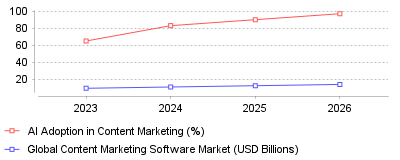
This data illustrates a meteoric rise in the adoption of artificial intelligence within content marketing over a concentrated four-year window, escalating from around 65 percent in 2023 to a projected 97 percent by 2026 [source]. Simultaneously, it highlights the corresponding financial growth of the content marketing platform industry, which is expected to expand from 9.5 billion to 14.0 billion dollars during the same timeframe [source].
On a micro level, this indicates that almost every individual content marketer is shifting from manual workflows to AI-assisted processes, particularly for ideation, drafting, and optimization. It means that professionals who do not utilize these platforms risk falling severely behind in output volume, as AI users report publishing up to 47 percent more content than non-users [source]. On a macro level, the marketing software industry is undergoing a structural transformation to natively embed generative models into their core architectures. Content marketing platforms are no longer just tools for scheduling or distribution; they are actively generating the assets, turning into indispensable intelligent assistants that lower the marginal cost of content creation.
This trend is incredibly important because it reveals a profound gap between content production volume and marketing budgets. Companies are demanding three to five times more content without proportional increases in their financial resources, essentially forcing reliance on AI tools to bridge this operational deficit [source]. Consequently, the standard for what constitutes high-quality content is rapidly shifting, as automated generation floods digital channels and makes human-reviewed, highly personalized content the new premium differentiator.
The primary catalyst for this shift was the public release and rapid maturation of advanced Large Language Models, which suddenly democratized enterprise-grade text and image generation. Additionally, the tightening macroeconomic environment of the last few years placed immense pressure on marketing departments to achieve higher returns on investment with stagnant or shrinking headcounts. Software vendors naturally responded to this pressure by rapidly acquiring or building AI-enabled features to defend their market share and justify platform subscription costs. Finally, the sheer efficiency of these tools, often saving marketers over three hours per day [source], created an organic and viral adoption loop where early adopters significantly outperformed their peers, effectively forcing an industry-wide pivot.
The integration of artificial intelligence into content marketing platforms has evolved from an experimental novelty to an absolute competitive necessity in less than three years. As adoption nears one hundred percent, the competitive advantage will no longer come from merely using AI, but from how uniquely and strategically human marketers can direct it. The prominent takeaway is that while AI scales content quantity exponentially, future marketing success will rely entirely on using these platforms to enhance human creativity, data analysis, and empathy rather than simply replacing human effort.
Enterprise software spending hit $15.92 billion in 2024 [1]. Buyers continue directing heavy capital toward these operational tools. DataHorizzon Research projects this market will reach $55.2 billion by 2033, expanding at a 13.3% compound annual growth rate [1]. Cloud deployments currently capture 60% of this total share [2]. North American buyers dominate current adoption, accounting for 45% of total revenue [1]. Large enterprises represent 70% of platform usage, though adoption among smaller firms is rising rapidly [2]. This specific technology category sits within the broad group of marketing software that dictates how brands communicate. Operational priorities shifted sharply over the past 24 months. Technology executives no longer prioritize sheer output over measurable engagement.
Most corporate writing never reaches a customer. Forrester data shows that 77% of business-to-business marketing organizations struggle with extreme asset waste [3]. SiriusDecisions previously calculated that up to 70% of produced files go completely unused by sales personnel [4]. This inefficiency causes severe financial damage. Large organizations lose an average of $2.5 million annually on mismanaged production processes [5]. Duplicate work, missed deadlines, and version control issues drive these exact losses. One enterprise marketer reported spending up to eight hours per week just locating internal documents [5]. Machine generation actually worsened this specific operational issue. Deloitte reports that 77% of employees feel artificial intelligence increased their daily workload [5]. Algorithmic drafting creates faster initial text but requires manual tagging, approval, and distribution downstream.
Gartner radically updated its evaluation criteria between 2023 and 2025. The analyst firm required vendors to generate at least $5 million in annual revenue to qualify for its 2024 market report [6]. Inclusion parameters mandated support for editorial planning, performance measurement, and collaborative workflows [7]. Optimizely, Sitecore, Sprinklr, and Storyteq emerged as category leaders during this period [8]. The core definition of modern publishing platforms now demands machine integration. By 2025, Gartner noted that artificial intelligence capabilities had become standard table stakes [9]. Every major vendor now offers synthetic generation beyond basic text optimization [9]. Integrated suites from larger companies are rapidly displacing standalone software tools [9]. HubSpot entered the leader quadrant in 2025 following the successful launch of its native content hub [10]. Optimizely maintained its strong position by embedding machine tools directly into the daily workflow of its users [10]. Storyteq differentiated its system through advanced data management and a proprietary knowledge graph [10]. In 2023, Gartner ranked Contently as a visionary platform due to its strong editorial planning support [11]. CoSchedule emerged as the sole challenger that year, focusing heavily on social media automation for midsize businesses [11]. Integration services represent the fastest-growing segment because legacy systems fail to communicate with modern tools [12].

External service providers experience these friction points acutely. Firms handling external brand management must maintain strict permission controls and client approval routing. Using specialized agency software allows these businesses to isolate brand assets while sharing layout templates. Marketing teams spend nearly 70% of their working hours navigating manual processes across disconnected systems [5]. Connected workflows can reduce asset creation time by up to 60% [5]. Resolving workflow delays remains mandatory for external agencies defending their retainer fees against automated alternatives. StoryChief, a startup providing software for multichannel publishing, gained rapid popularity among agencies specifically because it reduces manual labor across client blogs and newsletters [13]. Platform providers like Pepper Content also built creator marketplaces connecting brands with verified writers directly within the software [13]. By unifying communication within the tool, agencies avoid email chains that confuse external stakeholders. Skyword offers a similar feature called Skyword360, allowing users to hire and pay writers worldwide from one dashboard [8].
Compliance requirements now dictate technology roadmaps. The European Union activated the AI Act on August 1, 2024 [14]. This legislation classifies software systems by risk level and imposes strict documentation rules. Model providers face binding operational obligations beginning in August 2025 [14]. Transparency rules regarding synthetic asset generation follow shortly after in August 2026 [15]. Software providers must ensure that synthetic outputs remain detectable in a machine-readable format [16]. The European Parliament considers existing transparency requirements completely inadequate for copyright protection [17]. Legislators published a draft report in June 2025 proposing a central European licensing regime [17]. This system would allow creators to embed machine-readable signals into their work to block data ingestion [17]. The parliament suggested barring technology providers from operating within the European Union if they fail to provide an itemized list of protected source materials [17]. Software providers must retain marking techniques encoded directly in their model weights [18]. This mechanism prevents downstream users from stripping origin metadata from synthetic files [18].
American courts require proof of copying and substantial similarity to prove infringement [19]. The United States Copyright Office published a definitive legal report on January 29, 2025 [20]. The agency concluded that synthetic outputs cannot receive copyright protection. A human author must contribute expressive elements to qualify for legal ownership [21]. Providing text prompts to a generation engine does not constitute authorship [22]. Setting a seed value in an image generator does not guarantee visual consistency, disqualifying the output from legal protection [22]. If a marketer inputs a hand-drawn sketch and directs the software to make it photorealistic, they only own the copyright to the original sketch elements [22]. Any mechanical embellishment remains strictly public domain material. Brands face legal exposure if they publish synthetic assets without human modification. Competitors can legally duplicate synthetic imagery or text without facing infringement penalties. Enterprise marketing executives must now strictly document the exact ratio of human intervention in their publishing pipelines.
Adobe categorizes this entire operational lifecycle as a physical supply chain. Disconnected applications create data silos that prevent automated delivery [23]. Creative professionals report spending over 20 hours per week on design tasks [23]. Furthermore, 80% of large companies admit they lack end-to-end visibility over their campaign processes [23]. Internal bottlenecks delay campaign launches and burn out creative personnel. Moving assets from ideation to final distribution often takes weeks due to feedback loops [24]. Forrester research shows that organizations deploying integrated solutions achieve a 310% return on investment [25]. Personalization failures stem directly from outdated backend infrastructure. Amplience reports that 76% of consumers experience frustration when targeted messaging fails [26]. The linear assembly line cannot support real-time delivery [26]. When a data system identifies 100 audience segments, a creative team can typically only produce five visual variations [26]. This physical bottleneck breaks the entire strategy. Management systems process these requests dynamically by assembling fragments on the fly [26]. Without variation capabilities, data collection yields zero return.
Search behavior forces brands to adapt their delivery formats. Zero-click searches on Google grew from 56% to 69% in a single year following the rollout of artificial intelligence overviews [27]. Omnibound data shows that 82% of machine citations come from earned media rather than brand assets [27]. Marketers must optimize text for machine ingestion rather than human reading. Buyers feel overwhelmed by irrelevant messaging. Forrester reports that 65% of business buyers believe vendors supply too much material, while 59% consider the supplied files entirely useless [28]. The purchasing committee now includes an average of 13 individuals [29]. The number of vendor interactions rose from 17 in 2019 to 27 by 2021 [28]. Marketers responded by increasing production volume, creating utilization issues. Only 41% of surveyed organizations can track asset performance by audience segments [28]. A mere 34% can track consumption by subject topic [28]. Companies cannot differentiate between a prospect who reads an entire document and one who abandons it after 15 seconds [28]. This data void prevents optimization.
Financial returns validate the transition toward fully integrated platforms. Marketing automation generates $5.44 in revenue for every dollar spent [30]. Cropink analysis from 2025 demonstrates that automated campaigns generate 320% more revenue than manual execution [30]. Email marketing automation alone yields a $42 return on every invested dollar [30]. These metrics explain why 70% of marketing leaders increased their automation budgets in 2024 [30]. The financial impact extends far beyond simple cost savings. Forrester evaluated platform deployments and recorded a 333% return on investment for Writer over a three-year period [31]. A separate analysis of LivePerson deployments showed a 191% return [31]. Mid-sized manufacturers face operational constraints that make these tools essential. A $5 million firm typically employs one to three staff members [20]. These individuals compete against enterprise departments with agency support. Implementing software tools reduces their production time by 50% to 70% [20]. Tool investments averaging $3,600 annually can generate up to $400,000 in pipeline value [20].
Digital storefronts process extreme volumes of product data hourly. Managing thousands of item descriptions requires dedicated retail catalog systems to maintain accuracy across digital channels. Retailers must update pricing, specifications, and promotional text instantly. The retail automation market will expand from $21.19 billion in 2023 to $64.09 billion by 2032 [30]. McKinsey models show that the retail industry could capture up to $660 billion annually in new value through automation [32]. Kroger implemented a marketing platform that delivered a 30% revenue increase while lowering acquisition costs by 5% [30]. Consumer organizations lead commercial firms in intelligence achievement by a 10% margin [31]. Sales cycles slow adoption in the commercial sector, leaving massive growth potential untapped.
Global productivity depends heavily on these software improvements. McKinsey data proves that generation tools could add $2.6 trillion to $4.4 trillion annually to the global economy [33]. Approximately 75% of this estimated value falls across four corporate departments: customer operations, software engineering, research, and marketing [33]. Within the marketing sector specifically, these tools boost productivity by 5% to 15% of functional spending [34]. By 2024, 65% of surveyed organizations reported using these tools regularly, doubling the adoption rate recorded in 2023 [35]. Resource departments saw the largest cost decreases, but supply chain and marketing functions reported the most meaningful revenue increases [35]. Investment patterns highlight a clear misalignment between spending and economic opportunity. Consumer goods and financial services represent billions in untapped automation value [32]. Forrester analysts predict that software vendors will eventually scale back their aggressive autonomous plans due to execution failures [36]. Organizations will instead reconstruct their internal teams into operational hubs [36]. Marketers will shift entirely toward writing queries that assemble text blocks in real time based on buyer signals [36].
| Year | AI Adoption in Content Marketing (%) | Global Content Marketing Software Market (USD Billions) |
|---|---|---|
| 2023 | 65 | 9.5 |
| 2024 | 83 | 11 |
| 2025 | 90 | 12.5 |
| 2026 | 97 | 14 |
This data illustrates a meteoric rise in the adoption of artificial intelligence within content marketing over a concentrated four-year window, escalating from around 65 percent in 2023 to a projected 97 percent by 2026 [source]. Simultaneously, it highlights the corresponding financial growth of the content marketing platform industry, which is expected to expand from 9.5 billion to 14.0 billion dollars during the same timeframe [source].
On a micro level, this indicates that almost every individual content marketer is shifting from manual workflows to AI-assisted processes, particularly for ideation, drafting, and optimization. It means that professionals who do not utilize these platforms risk falling severely behind in output volume, as AI users report publishing up to 47 percent more content than non-users [source]. On a macro level, the marketing software industry is undergoing a structural transformation to natively embed generative models into their core architectures. Content marketing platforms are no longer just tools for scheduling or distribution; they are actively generating the assets, turning into indispensable intelligent assistants that lower the marginal cost of content creation.
This trend is incredibly important because it reveals a profound gap between content production volume and marketing budgets. Companies are demanding three to five times more content without proportional increases in their financial resources, essentially forcing reliance on AI tools to bridge this operational deficit [source]. Consequently, the standard for what constitutes high-quality content is rapidly shifting, as automated generation floods digital channels and makes human-reviewed, highly personalized content the new premium differentiator.
The primary catalyst for this shift was the public release and rapid maturation of advanced Large Language Models, which suddenly democratized enterprise-grade text and image generation. Additionally, the tightening macroeconomic environment of the last few years placed immense pressure on marketing departments to achieve higher returns on investment with stagnant or shrinking headcounts. Software vendors naturally responded to this pressure by rapidly acquiring or building AI-enabled features to defend their market share and justify platform subscription costs. Finally, the sheer efficiency of these tools, often saving marketers over three hours per day [source], created an organic and viral adoption loop where early adopters significantly outperformed their peers, effectively forcing an industry-wide pivot.
The integration of artificial intelligence into content marketing platforms has evolved from an experimental novelty to an absolute competitive necessity in less than three years. As adoption nears one hundred percent, the competitive advantage will no longer come from merely using AI, but from how uniquely and strategically human marketers can direct it. The prominent takeaway is that while AI scales content quantity exponentially, future marketing success will rely entirely on using these platforms to enhance human creativity, data analysis, and empathy rather than simply replacing human effort.