


Research into the equipment and asset maintenance software sector reveals a massive migration from schedule-based preventive maintenance to AI-powered predictive maintenance (PdM). Recent market surveys and financial projections indicate that the adoption of predictive tools has doubled, supported by heavy capital allocation toward Industrial AI and IoT integrations. This trend is incredibly inter
| Year | Predictive Maintenance (%) | Proactive Maintenance (%) |
|---|---|---|
| 2025 | 9 | 55 |
| 2026 | 18 | 45 |
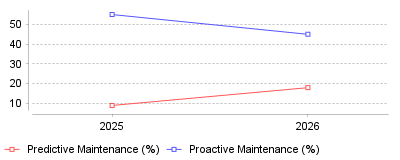
The data reveals a dramatic transition in the asset maintenance software category, where traditional preventive models are rapidly losing ground to data-driven predictive execution. According to a recent survey of senior manufacturing decision-makers, predictive maintenance adoption doubled from 9% to 18% over a single year, while proactive maintenance shares fell from 55% to 45% as strategies shifted [source]. Furthermore, the global predictive maintenance software and hardware market is expanding at an unprecedented rate, valued at $10.93 billion in 2024 and projected to reach $17.11 billion by 2026 [source][source].
On a micro level, maintenance teams are moving away from calendar-based servicing, which often results in over-maintaining healthy assets or entirely missing sudden equipment failures [source]. Instead, technicians are acting on real-time sensor data and software predictions, directly altering day-to-day workforce allocation and reducing unnecessary parts replacements [source]. On a macro industry scale, this signifies that Computerized Maintenance Management System (CMMS) software providers must rapidly integrate artificial intelligence and edge computing capabilities to remain competitive [source]. Facilities are actively reallocating capital to support this, with nearly 72% of organizations dedicating 16 to 30 percent of their maintenance budgets specifically to new operational technologies [source]. Consequently, the enterprise software landscape is transforming from basic work-order management interfaces into highly complex, predictive intelligence platforms.
Unplanned downtime is a catastrophic financial drain, costing industrial manufacturers approximately $50 billion annually with some sectors losing up to $2.3 million per hour of stoppage [source][source]. Implementing predictive maintenance software directly mitigates this risk by reducing unplanned machine downtime by up to 50% and cutting overall maintenance costs by roughly 34% [source]. For businesses operating on razor-thin margins, achieving full return on investment within just 12 to 18 months of implementing these predictive platforms provides a critical, undeniable competitive advantage.
The acceleration of this trend is likely driven by the recent convergence of highly accessible IoT sensors, localized edge computing, and breakthroughs in Generative AI. Historically, predictive maintenance was simply too expensive and technologically complex for anyone but the largest enterprise manufacturers, often requiring dedicated teams of data scientists to interpret machine signals. Today, modern maintenance software has democratized these capabilities by embedding AI directly into user-friendly applications that auto-generate repair plans and predict failure with over 90% accuracy [source]. Additionally, rising global labor shortages and a severe lack of skilled technicians have forced companies to rely on intelligent software to do the heavy lifting of diagnosing equipment health.
The equipment maintenance software industry has reached a definitive tipping point, evolving from reactive management into proactive, AI-driven asset intelligence. As the predictive maintenance market surges toward an estimated $70.73 billion by 2032, organizations that fail to adopt these data-driven platforms risk severe operational inefficiencies and crippling downtime [source]. The most prominent takeaway is that predictive maintenance software is no longer an experimental luxury for the elite; it is an urgent financial necessity that is rapidly becoming the universal baseline for asset management.
Industrial asset software spending will reach $17 billion by 2030 [1]. The market totaled $7.5 billion in 2024 [1]. Oil producers and discrete manufacturers represent 56% of this sector, making heavy industry the primary driver of software revenue [1]. The computerized maintenance segment generated $1.29 billion in 2024 and should reach $2.41 billion by 2030 [2].
Cloud deployments captured 62% of the market in 2025 [3]. Large enterprises control most software budgets due to their massive operational footprints and strict compliance requirements. However, small companies are expanding their budgets at a 14% annual rate [3]. North America leads regional adoption, holding 33% of global revenue in 2025 [4]. Organizations across the continent purchase digital tools to map complex machinery networks and assign labor hours to specific work orders.
Planned factory pauses cost money. Emergency repairs multiply that expense by a factor of five [5]. Unplanned downtime costs United States manufacturers $50 billion annually [6]. This total includes scrapped materials, idle workers, and delayed customer shipments. Equipment failures trigger 42% of this lost time, presenting a massive opportunity for operational correction [6]. The average financial impact reaches $260,000 per hour across all industries [7]. Factory managers must account for every minute a machine sits idle.
Automotive plants suffer severe losses during outages. Their financial damage hits $50,000 per minute when assembly conveyors stop [6]. Plant directors deploy production tracking software for factory floors to record error codes before primary motors burn out. Emergency labor compounds these manufacturing losses instantly. Callouts outside standard shifts cost double the standard technician rate [5]. Expedited shipping fees for heavy replacement parts further drain maintenance budgets.
Offshore oil organizations experience 27 days of unplanned downtime annually [8]. A 1% downtime rate translates to 3.65 days per year [8]. This minor percentage costs offshore facilities over $5 million in lost extraction revenue [8]. Unplanned downtime runs 35% more expensive per minute than scheduled outages [7]. When a pump fails without warning, procurement managers overpay for immediate logistics support.

Federal regulators enforce strict safety standards on factory floors. The Occupational Safety and Health Administration increased maximum penalties for serious violations to $16,550 in January 2025 [9]. Fines for willful violations jumped to $165,514 per infraction [9]. Inspectors arrive unannounced at industrial sites to review digital maintenance logs. Missing signature records invite maximum penalty assessments from federal auditors.
Fall protection standards triggered 6,307 citations during the 2024 fiscal year [10]. Hazard communication failures generated 2,888 violations [10]. Lockout procedures resulted in 2,443 penalties [10]. Operations managers must prove their technicians follow standard safety checklists during routine inspections. Pen and paper records expose organizations to unacceptable legal risks. Digital workflows force technicians to acknowledge safety protocols before unlocking equipment panels.
Environmental rules add parallel operational pressure to maintenance teams. The American Innovation and Manufacturing Act required a 40% reduction in hydrofluorocarbon production in 2024 [11]. The Environmental Protection Agency calculates these cuts from baseline averages gathered between 2011 and 2019 [11]. By 2036, domestic production must fall by 85% [12]. Hydrofluorocarbons act as powerful greenhouse gases when released into the atmosphere from leaking chillers.
Commercial buildings face strict bans starting in 2025. Property managers cannot install equipment containing restricted refrigerants [13]. Directors deploy digital compliance platforms to track chemical inventories across rooftop units. Companies managing national real estate portfolios install web-based tracking software for distributed locations to synchronize their compliance schedules. Missing these phase-down deadlines exposes property owners to federal enforcement actions and mandatory replacement costs.
Retirements drain institutional knowledge from the industrial sector daily. Forty-one percent of the maintenance workforce becomes eligible for retirement by 2028 [14]. Developing a competent technician takes three to five years of supervised field work [14]. Replacing an experienced mechanic costs operators $40,000 in recruiting fees and lost productivity [14]. Decades of diagnostic intuition walk out the door when veterans retire from the plant floor.
Labor statistics project 54,200 annual job openings for industrial mechanics through 2034 [15]. Overall employment will grow 13% over this decade [15]. The median annual wage reached $63,510 in May 2024 [15]. Top earners in this category make over $91,620 [15]. Plants must offer competitive wages to attract younger workers to physically demanding roles.
Aviation maintenance faces identical demographic constraints. Aircraft mechanic employment will expand 5% by 2033 [16]. This growth generates 13,100 job openings annually across commercial airlines [16]. Aviation technicians earn a median wage of $78,680 [16]. This higher pay reflects the certifications required to service commercial fleets under federal aviation rules.
Modern organizations invest in heavy asset tracking databases to store machine manuals digitally. Field crews use technician routing applications to send work orders to newer employees. Novice workers read historical fix data on mobile tablets. This digital history replaces the intuition lost to retirement. A junior mechanic can search a database to see how a senior colleague fixed a specific valve leak three years ago.
Public software vendors highlight this digital transition in their financial filings. Rockwell Automation reported a 10% year-over-year increase in its software business during the third quarter of fiscal 2025 [17]. The company secured contracts with Beam Therapeutics to automate cell therapy production [17]. Prometeon Tyre Group previously selected Rockwell's Fiix software as its maintenance platform to organize service schedules [18].
Independent firms are also expanding their product suites. IFS achieved a 19.4% market share in enterprise asset software, posting $550 million in revenue in 2024 [19]. MaintainX released direct purchase order connections with SAP in October 2024 to link floor repairs with accounting ledgers [20]. Tractian Technologies raised $120 million in Series C funding in December 2024 to scale its monitoring sensors [20].
Catching bearing wear saves motors. Predictive maintenance models reduce overall service costs by 18% to 25% [21]. Organizations implementing these sensors experience 30% to 50% reductions in unplanned downtime [21]. Proactive repairs cost four times less than emergency interventions on the exact same asset [5]. Vibration analysis tools detect micro-fractures in metal housings weeks before a total mechanical failure occurs.
Ninety-five percent of organizations running predictive programs report positive financial returns [5]. Twenty-seven percent achieve full financial payback within 12 months of installation [21]. A chemical plant deploying predictive models across 33 assets dropped its urgent repair rate from 43% to almost zero [22]. Thermal imaging cameras spot overheating electrical panels before wiring insulation melts and causes fires.
Facility managers balance tight budgets against occupant safety requirements. The International Facility Management Association ranks customer satisfaction and system uptime as top metrics for 2024 [23]. Maintenance costs for buildings are projected to surge 25% by 2028 compared to 2023 levels [24]. Aging building infrastructure demands constant capital injection to meet modern energy efficiency standards.
Unoptimized inventory creates silent financial leaks in facility basements. Schedulers who align work orders with parts availability reduce storage fees [24]. They prevent component obsolescence by tracking usage rates accurately. Typical wrench time for reactive maintenance sits between 25% and 35% [24]. Planned maintenance pushes this productive time to 65% because technicians spend less time searching for correct fan belts [24].
Small enterprises face different budget constraints than multinational operators. Local contractors purchase software tools designed for limited technician headcounts to manage daily service calls. These buyers bypass expensive vibration sensors in favor of basic calendar automation. Cloud systems reduce upfront capital requirements for these smaller teams by eliminating physical server hardware. Subscription models allow family-owned machine shops to digitize operations without requesting bank loans.
Mobile applications allow warehouse supervisors to scan barcodes directly from the aisles. Workers submit photo evidence of damaged forklift tines to the maintenance queue instantly. The software routes these requests to the parts department before the forklift returns to the charging station. This workflow reduces administrative delays and keeps logistics operations running smoothly during peak shipping seasons.
Between 2025 and 2030, analysts expect continued vendor consolidation. Software developers will embed artificial intelligence models directly into workflow dashboards. These models will read historical maintenance logs and suggest repair procedures to novice technicians based on symptom descriptions. Equipment manufacturers will pre-install internet sensors on all industrial machinery before shipping units to customers.
Regulatory scrutiny will accelerate the transition away from paper records. Environmental agencies will demand real-time emission reporting from factory chimneys. Facilities failing to produce digital audit trails will face immediate financial penalties. Organizations must treat maintenance software as a primary operational requirement rather than an optional administrative upgrade.
Research into the equipment and asset maintenance software sector reveals a massive migration from schedule-based preventive maintenance to AI-powered predictive maintenance (PdM). Recent market surveys and financial projections indicate that the adoption of predictive tools has doubled, supported by heavy capital allocation toward Industrial AI and IoT integrations. This trend is incredibly inter
| Year | Predictive Maintenance (%) | Proactive Maintenance (%) |
|---|---|---|
| 2025 | 9 | 55 |
| 2026 | 18 | 45 |
The data reveals a dramatic transition in the asset maintenance software category, where traditional preventive models are rapidly losing ground to data-driven predictive execution. According to a recent survey of senior manufacturing decision-makers, predictive maintenance adoption doubled from 9% to 18% over a single year, while proactive maintenance shares fell from 55% to 45% as strategies shifted [source]. Furthermore, the global predictive maintenance software and hardware market is expanding at an unprecedented rate, valued at $10.93 billion in 2024 and projected to reach $17.11 billion by 2026 [source][source].
On a micro level, maintenance teams are moving away from calendar-based servicing, which often results in over-maintaining healthy assets or entirely missing sudden equipment failures [source]. Instead, technicians are acting on real-time sensor data and software predictions, directly altering day-to-day workforce allocation and reducing unnecessary parts replacements [source]. On a macro industry scale, this signifies that Computerized Maintenance Management System (CMMS) software providers must rapidly integrate artificial intelligence and edge computing capabilities to remain competitive [source]. Facilities are actively reallocating capital to support this, with nearly 72% of organizations dedicating 16 to 30 percent of their maintenance budgets specifically to new operational technologies [source]. Consequently, the enterprise software landscape is transforming from basic work-order management interfaces into highly complex, predictive intelligence platforms.
Unplanned downtime is a catastrophic financial drain, costing industrial manufacturers approximately $50 billion annually with some sectors losing up to $2.3 million per hour of stoppage [source][source]. Implementing predictive maintenance software directly mitigates this risk by reducing unplanned machine downtime by up to 50% and cutting overall maintenance costs by roughly 34% [source]. For businesses operating on razor-thin margins, achieving full return on investment within just 12 to 18 months of implementing these predictive platforms provides a critical, undeniable competitive advantage.
The acceleration of this trend is likely driven by the recent convergence of highly accessible IoT sensors, localized edge computing, and breakthroughs in Generative AI. Historically, predictive maintenance was simply too expensive and technologically complex for anyone but the largest enterprise manufacturers, often requiring dedicated teams of data scientists to interpret machine signals. Today, modern maintenance software has democratized these capabilities by embedding AI directly into user-friendly applications that auto-generate repair plans and predict failure with over 90% accuracy [source]. Additionally, rising global labor shortages and a severe lack of skilled technicians have forced companies to rely on intelligent software to do the heavy lifting of diagnosing equipment health.
The equipment maintenance software industry has reached a definitive tipping point, evolving from reactive management into proactive, AI-driven asset intelligence. As the predictive maintenance market surges toward an estimated $70.73 billion by 2032, organizations that fail to adopt these data-driven platforms risk severe operational inefficiencies and crippling downtime [source]. The most prominent takeaway is that predictive maintenance software is no longer an experimental luxury for the elite; it is an urgent financial necessity that is rapidly becoming the universal baseline for asset management.