


| Date | CapCut Share (%) | Incumbents Share (%) |
|---|---|---|
| Jan 2023 | 4 | 96 |
| Oct 2024 | 42 | 58 |
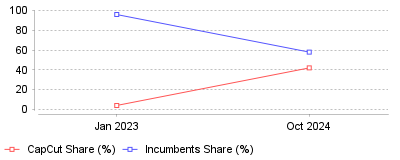
The data clearly demonstrates a rapid and aggressive market disruption within the video editing software sector, specifically showcasing CapCut's meteoric rise in both revenue and market share. Between January 2023 and October 2024, CapCut's revenue share among a group of top video editing apps skyrocketed from a mere 4% to 42%. This monumental shift effectively cannibalized the market hold of established legacy applications like Facetune, Splice, and Picsart [source].
On a micro-industry level, this trend signifies a transition away from traditional, highly technical editing environments and toward streamlined, template-driven mobile workflows. Professional-grade applications like Adobe Premiere Pro continue to hold the largest overall global market share at 35%, but they are increasingly being challenged at the top of the funnel by mobile platforms [source]. According to industry surveys, 26% of beginner creators now prefer CapCut, slightly edging out Premiere Pro's 24% among the same demographic [source]. Macro-economically, the video editing software market is experiencing explosive growth, projected to expand from roughly $3.09 billion in 2023 to over $5.13 billion by 2032 [source]. This expansion is fundamentally fueled by the creator economy, where the sheer volume of user-generated short-form video necessitates accessible, high-speed production tools rather than robust, on-premise rendering engines.
This industry evolution is crucial because it lowers the barrier to entry for millions of digital content creators. It democratizes video production and fundamentally alters the monetization strategies of software providers. As mobile editors introduce sophisticated generative AI features, the definition of professional editing is being rewritten to prioritize speed and social media integration over granular timeline control [source]. Consequently, the massive influx of paid subscribers transitioning from free tiers to premium subscriptions serves as a highly successful blueprint for the future profitability of freemium software models [source].
The primary catalyst for this shift is undeniably the global explosion of short-form social media ecosystems, most notably TikTok, Instagram Reels, and YouTube Shorts. Because CapCut was developed by ByteDance, it enjoys seamless, native integration with TikTok's algorithm [source]. This allows creators to rapidly deploy trending audio and video templates without friction. Furthermore, the rapid advancement of artificial intelligence and machine learning has allowed mobile applications to automate previously labor-intensive editing tasks, making advanced post-production accessible to absolute novices [source]. We can also speculate that the high subscription costs and steep learning curves associated with legacy desktop editors created a market vacuum; consumers craved powerful tools that did not require a heavy hardware investment or hours of technical tutorials [source].
The video editing software landscape is undergoing a permanent transformation, pivoting from complex desktop suites to agile, AI-enhanced mobile platforms. Legacy software providers must adapt to this new reality by simplifying their interfaces and expanding their cloud and AI capabilities, or risk losing the next generation of video creators entirely. A prominent takeaway from this data is that in the modern creator economy, software that optimizes for speed, automation, and native social media integration will invariably outpace tools that rely solely on technical depth and legacy brand recognition.
Symphony Technology Group acquired Avid Technology for $1.4 billion in August 2023. The private equity firm paid $27.05 per share in an all-cash transaction, representing a 32.1% premium over Avid's closing stock price before media outlets reported the potential sale [1]. Avid powers major broadcast networks and film studios globally. Every record nominated for Record of the Year at the 2022 Grammys used Avid Pro Tools, and films nominated for Best Editing at the 2022 Academy Awards relied on Avid Media Composer [2].
Financial structures dictate software development priorities. Before the acquisition, Avid transitioned its business model from perpetual licenses to recurring subscriptions. The company reported $154 million in annual recurring revenue by the second quarter of 2023 [3]. Investors favor subscription models for their predictable cash flows, but this shift forces production facilities to reclassify software purchases from capital expenditures to ongoing operating expenses. The broader audio and video editing software market generated $5.01 billion in 2023. Analysts project the sector will expand to $15.9 billion by 2032, a 13.69% compound annual growth rate [4].
North America accounts for 35% of this global market. The United States user base exceeds 2.3 million professionals [5]. Corporate video production drives much of this expansion, as organizations require internal training materials and social media advertising. This localized demand forces IT buyers to evaluate video editing and production software based on deployment speed and cross-department accessibility. Cloud-based systems currently hold 63% of the total software market, serving approximately 1.9 billion creators [5].
Giving away professional software secures long-term market dominance. Blackmagic Design acquired da Vinci Systems in 2009 when the software had just 900 users. The user base expanded to 5.47 million by 2023 [6]. Blackmagic Design distributes the standard DaVinci Resolve application for free. The company monetizes the platform through a single $295 fee for its Studio tier [6]. This pricing strategy captures freelance editors who subsequently carry the tool into corporate production environments.
Seventy-three percent of YouTube creators using the platform operate on the free tier [7]. Enterprise adoption follows this initial grassroots growth. The Associated Press transitioned its global news operation to DaVinci Resolve Studio in November 2025. The agency produces over 1,500 video projects every day across multiple continents [8].
Broadcasters operate under extreme time constraints. DaVinci Resolve includes a feature named Growing Transport Stream Editing, which allows journalists to cut live video feeds directly from asset management servers before file transfers complete [9]. Editors distribute finished clips within seconds of the raw footage arriving. Local rendering hardware struggles under these constant broadcast demands. AP deployed distributed cloud nodes to handle project rendering [8]. This infrastructure scales automatically during major news events and scales down when activity decreases.
Smaller media companies emulate these broadcast workflows. Managers upgrading video editing and production software for photography studios often choose DaVinci Resolve to process hybrid photo-video shoots. Avoiding monthly subscription fees preserves profit margins for independent studios facing variable client demand.

Sixty-two percent of organizations exceeded their cloud storage budgets in 2024. Wasabi Technologies surveyed 1,600 IT decision-makers and found that financial overruns worsened from 53% the previous year [10]. Egress fees cause significant financial strain. Media companies pay public cloud providers to store data, but they pay additional penalties to download or transfer those files across networks.
Data access fees, API calls, and network charges consume 49% of the average cloud storage bill. Actual storage capacity accounts for only 51% of the cost [10]. Moving raw footage between remote editors and centralized servers triggers these penalties constantly. High-definition projects generate massive file sizes. A single hour of 4K video occupies 40 to 80 gigabytes [5].
Unpredictable expenses damage operational efficiency. Fifty-six percent of organizations experience business delays because of data access fees [10]. Companies restrict file downloads to avoid triggering billing thresholds. Localized businesses face identical storage hurdles. Construction firms searching for video editing and production software for contractors prioritize local storage solutions. Uploading terabytes of drone inspection footage to public clouds incurs massive ingress and egress charges.
Software vendors respond by decoupling proprietary storage from their applications. Frame.io released Storage Connect for enterprise customers in late 2023. This feature allows users to route uploads directly to self-governed Amazon S3 buckets [11]. Bypassing third-party storage markups helps facilities control their infrastructure costs. Frame.io reached 4 million active users by April 2024 [12].
Legal exposure remains a severe operational risk for corporate studios. Copyright infringement lawsuits frequently target generative models trained on scraped internet data. Adobe released the Firefly Video Model to public beta in October 2024 after addressing these concerns directly. Adobe trained Firefly exclusively on licensed Adobe Stock assets and public domain content [13]. Users generated 13 billion images using Firefly tools between March 2023 and the video model's launch [14].
The company offers intellectual property indemnification for its enterprise customers. This contractual protection covers legal claims alleging that Firefly output violates third-party patents, copyrights, or trademark rights [15]. Risk mitigation accelerates corporate adoption. Human resources departments evaluating video editing and production software for staffing agencies demand legal guarantees. Using generative video for public recruitment campaigns carries unacceptable liability without explicit indemnification.
The video update introduced text-to-video capabilities directly into Premiere Pro. Editors use the Generative Extend feature to create new frames at the beginning or end of a physical video clip [16]. This solves minor timing errors without requiring costly reshoots. Artificial intelligence features address manual workflow bottlenecks across the entire production cycle. Users generate motion masks with single-click operations, and predictive algorithms track moving subjects across frames [17]. Global media companies report a 37% increase in production efficiency after implementing automated editing features [5].
Browser-based competitors capture market share through niche automation. VEED reached 10 million monthly active users and $45 million in annual recurring revenue by late 2025 [7]. The platform automates subtitle generation across 125 languages. Descript secured $100 million in funding for its text-based editing interface, though a September 2025 pricing overhaul alienated some legacy users by implementing strict media minute limits [7].
Rigid folder hierarchies limit post-production speed. Modern platforms replace traditional directories with dynamic metadata tags. Frame.io rebuilt its backend architecture for the V4 release in early 2024 [12]. The update introduced a system called Collections. Editors filter, group, and sort media files in real time based on active workflow requirements [12]. This structural change simplifies asset tracking across multiple departments.
Video production teams rely on cross-functional alignment. Integrating video timelines into broader design, creative and media production software stacks prevents version control errors. Graphic designers and audio engineers access the same centralized project files without duplicating media assets. Remote collaboration introduces severe security vulnerabilities into this shared environment. Forty-five percent of companies view data security as a primary concern during remote editing sessions [5].
Software vulnerabilities and cyberattacks affected 18% of media companies over the past year [5]. Security compliance raises underlying operating costs. Organizations must encrypt media files and adhere to local data residency laws. Seventy-five countries enacted or proposed data localization regulations by 2025 [18].
Cloud storage providers implement object lock immutability to block unauthorized deletion or ransomware encryption. Despite rising cyber threats, only 47% of surveyed cloud users actively employ this data protection feature [10]. Administrators cite interface complexity and accidental permanent storage costs as primary deterrents to enabling immutability.
Rendering times decreased by 50% following the industry adoption of AV1 encoding [19]. Hardware acceleration fundamentally changes post-production timelines. Editors previously spent 55% of their working hours on administrative tasks like logging media and syncing audio tracks [19]. Artificial intelligence automation targets these exact administrative delays. Fifty-four percent of editors state that artificial intelligence speeds up the initial assembly cut process [19].
Audio workflows experience identical automation trends. Forty percent of video creators use automated noise reduction tools during post-production [19]. Blackmagic Design updated DaVinci Resolve with Fairlight AI audio panning and Ultra NR noise reduction in April 2024 [20]. Adobe introduced interactive fade handles to Premiere Pro in May 2024 [21]. Editors drag clip boundaries to create custom audio transitions rather than manually plotting keyframes.
These minor interface adjustments yield significant operational savings when applied across thousands of video clips. The DaVinci Resolve software architecture isolates these tasks into specific workspaces. The Cut and Edit pages handle timeline assembly, the Fusion page provides visual effects, and the Color page manages color grading [20]. This segmentation allows specialists to work simultaneously on a single project file without overriding metadata.
Metered billing penalizes heavy software usage. Descript introduced a September 2025 pricing overhaul that implemented strict media minute limits and artificial intelligence credits [7]. Users reported their monthly bills jumping from $30 to $195 following these tier adjustments [7].
Adobe maintains 37 million paid Creative Cloud subscribers [22]. The company charges flat monthly fees but limits certain generative features through a credit system. Canva disrupted this pricing model by making the Affinity professional design suite entirely free in late 2025 [22]. Canva acquired Affinity to directly challenge Adobe's market share. Over one million users signed up for Affinity within four days of the announcement [22].
This maneuver mirrors the DaVinci Resolve growth strategy. Trading high subscription fees for massive user adoption creates severe pressure on legacy software developers. The shift back toward perpetual licenses or entirely free software tiers appeals to freelancers and enterprise procurement teams alike. Managing hundreds of individual software subscriptions creates unnecessary administrative overhead for corporate IT departments.
The video streaming platform market generated $129.79 billion in 2024. Market analysts project this sector will reach $616.42 billion by 2032 [23]. This expansion represents a compound annual growth rate of 21.5% [23]. Content volume scales proportionally with streaming revenue. Broadcasters depend on efficient post-production infrastructure to feed their subscription services. North America holds a 38.5% revenue share of the global streaming market [23].
Corporate video segments show the fastest software demand growth. Internal communications and marketing departments increase their editing requests by 6.3% annually [19]. Social media formats dictate technical requirements. Videos on mobile platforms generate 1200% more shares than text and image content combined [19]. Ninety-two percent of mobile users watch videos with the sound off [19]. This behavior forces editors to generate captions for every published asset.
Final Cut Pro retains over 50% market share in the professional macOS environment [19]. Consumer tools handle the remaining short-form content. CapCut commands 200 million monthly active users due to its direct social media integration [19]. The gap between high-end broadcast suites and consumer mobile editors continues to narrow. Artificial intelligence generation and cloud storage connectivity will determine which software platforms survive the next upgrade cycle.
| Date | CapCut Share (%) | Incumbents Share (%) |
|---|---|---|
| Jan 2023 | 4 | 96 |
| Oct 2024 | 42 | 58 |
The data clearly demonstrates a rapid and aggressive market disruption within the video editing software sector, specifically showcasing CapCut's meteoric rise in both revenue and market share. Between January 2023 and October 2024, CapCut's revenue share among a group of top video editing apps skyrocketed from a mere 4% to 42%. This monumental shift effectively cannibalized the market hold of established legacy applications like Facetune, Splice, and Picsart [source].
On a micro-industry level, this trend signifies a transition away from traditional, highly technical editing environments and toward streamlined, template-driven mobile workflows. Professional-grade applications like Adobe Premiere Pro continue to hold the largest overall global market share at 35%, but they are increasingly being challenged at the top of the funnel by mobile platforms [source]. According to industry surveys, 26% of beginner creators now prefer CapCut, slightly edging out Premiere Pro's 24% among the same demographic [source]. Macro-economically, the video editing software market is experiencing explosive growth, projected to expand from roughly $3.09 billion in 2023 to over $5.13 billion by 2032 [source]. This expansion is fundamentally fueled by the creator economy, where the sheer volume of user-generated short-form video necessitates accessible, high-speed production tools rather than robust, on-premise rendering engines.
This industry evolution is crucial because it lowers the barrier to entry for millions of digital content creators. It democratizes video production and fundamentally alters the monetization strategies of software providers. As mobile editors introduce sophisticated generative AI features, the definition of professional editing is being rewritten to prioritize speed and social media integration over granular timeline control [source]. Consequently, the massive influx of paid subscribers transitioning from free tiers to premium subscriptions serves as a highly successful blueprint for the future profitability of freemium software models [source].
The primary catalyst for this shift is undeniably the global explosion of short-form social media ecosystems, most notably TikTok, Instagram Reels, and YouTube Shorts. Because CapCut was developed by ByteDance, it enjoys seamless, native integration with TikTok's algorithm [source]. This allows creators to rapidly deploy trending audio and video templates without friction. Furthermore, the rapid advancement of artificial intelligence and machine learning has allowed mobile applications to automate previously labor-intensive editing tasks, making advanced post-production accessible to absolute novices [source]. We can also speculate that the high subscription costs and steep learning curves associated with legacy desktop editors created a market vacuum; consumers craved powerful tools that did not require a heavy hardware investment or hours of technical tutorials [source].
The video editing software landscape is undergoing a permanent transformation, pivoting from complex desktop suites to agile, AI-enhanced mobile platforms. Legacy software providers must adapt to this new reality by simplifying their interfaces and expanding their cloud and AI capabilities, or risk losing the next generation of video creators entirely. A prominent takeaway from this data is that in the modern creator economy, software that optimizes for speed, automation, and native social media integration will invariably outpace tools that rely solely on technical depth and legacy brand recognition.