


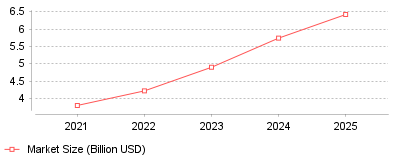
| Year | Market Size (Billion USD) |
|---|---|
| 2021 | 3.8 |
| 2022 | 4.22 |
| 2023 | 4.9 |
| 2024 | 5.74 |
| 2025 | 6.42 |
The data illustrates a consistent and rapid upward trajectory in the global market size for Digital Asset Management (DAM) and Brand Asset Management (BAM) platforms over the last five years. Moving from approximately $3.8 billion in 2021 to over $6.4 billion in 2025, the market has seen compound annual growth driven by heavy enterprise investment. This growth reflects a transition from passive digital storage solutions to active, intelligent systems that manage the entire content lifecycle [source].
At a micro level, this trend signifies a major operational shift for creative and marketing teams, who previously wasted up to 91 hours a week searching for assets or duplicating existing work [source]. By utilizing modern BAM platforms, these teams are transitioning to AI-tagged, centralized hubs that drastically reduce manual administrative tasks. At a macro industry level, software providers are shifting their focus toward building "orchestration layers" rather than mere storage repositories, integrating automated metadata, rights verification, and real-time asset syndication [source]. Cloud-based deployments are dominating this space, projected to capture nearly 80% of the market share by 2026 as distributed workforces become the standard [source]. Ultimately, brand management software has become a foundational enterprise infrastructure necessary for scaling global marketing efforts.
With the exponential growth of e-commerce and omnichannel marketing, maintaining brand consistency across multiple channels and distributed networks is a complex challenge. A centralized brand asset platform ensures that internal teams, franchise partners, and external distributors do not use outdated logos or off-brand content, which can dilute brand equity and customer trust. Furthermore, organizations utilizing organized, highly accessible assets can launch campaigns up to 35% faster, converting operational efficiency directly into accelerated revenue growth [source].
The initial catalyst for this rapid adoption was the widespread shift to remote and hybrid work models, which forced geographically dispersed marketing teams to abandon localized servers in favor of cloud-native collaboration tools. Simultaneously, the sheer volume of digital content required for modern personalized marketing, social media, and e-commerce simply outpaced the capabilities of manual file management. The integration of advanced artificial intelligence and machine learning provided the missing link, enabling platforms to offer automated tagging, semantic search, and predictive content recommendations that solve the metadata bottleneck [source]. Additionally, tightening data privacy regulations and the need for strict digital rights management have pushed enterprises toward platforms with built-in compliance and governance features.
The Brand Asset and Style Guide Platform sector is currently experiencing a dynamic renaissance, fueled by the dual necessities of omnichannel consistency and AI-powered automation. As digital touchpoints continue to multiply, brands that fail to adopt these sophisticated systems risk severe operational bottlenecks and disjointed customer experiences. The prominent takeaway is that modern brand asset platforms are no longer just passive storage solutions; they are intelligent, active engines that drive creative velocity and protect enterprise brand value worldwide.
Capital allocated to digital asset management platforms will reach $14.42 billion by 2031 [1]. This sector currently operates at a compound annual growth rate of 13.94%. Enterprise budgets are shifting away from localized file storage toward cloud orchestration layers. Administrators face strict data-sovereignty rules alongside demands for omnichannel commerce. Such pressures force software providers to rewrite product roadmaps. Within the broader category of systems handling media generation, these specialized identity repositories represent the fastest-growing segment. Buyers demand instant renditioning. They also expect semantic search capabilities. Vendors respond by automating metadata workflows.
Data volume accelerates every quarter. Nine out of ten global data bytes were generated within the past two years [2]. Corporations accumulate thousands of product images, video clips, and audio files. Archiving these resources creates immense server strain. Managing digital resources ranks among the highest priorities for modern marketing departments [3]. Marketing managers allocated 7.4% of total budgets toward content creation in previous operational cycles [3]. Wasting capital on duplicate file generation harms overall profitability.
Gartner estimates that 20% of commercial transactions will flow through automated interfaces by 2030 [1]. Organizations view central repositories as the backbone for personalized storefronts. Legacy software configurations fail to deliver assets at required speeds. Consequently, chief technology officers authorize rapid refresh cycles for aging infrastructure. Storage systems must evolve into dynamic media distributors to justify their procurement costs.
Infogain recently migrated 1.8 million digital files to a cloud-native platform [1]. The 50-terabyte transfer exposed a stark reality regarding enterprise file management. Cleaning and mapping metadata requires significantly more labor than basic software configuration. Services revenue for asset deployment will outpace standard software revenue growth through 2031 [1]. Enterprise clients routinely underestimate the friction involved in organizing decades of unstructured media.
Organizations struggle to control file distribution across disparate business units. Nearly 81% of companies deal with off-brand content in external campaigns [4]. Administrators find that basic folders fail to support agile marketing operations. Bynder noted a 38% year-over-year growth in total stored files across its client base in 2023 [5]. Asset delivery from the Bynder repository directly to corporate websites increased by 250% during the same period [5].
Maintaining cohesion becomes exponentially difficult when managing remote teams. This issue drives adoption of dedicated systems for managing corporate identity. Traditional storage networks lack version control mechanisms. Employees waste hours searching for approved logos. Studies show specialized asset tools save users 75% of the time previously spent hunting for media files [3]. When retrieval speeds improve, creative departments redirect their billing hours toward actual production tasks.
Software vendors attempt to solve these bottlenecks via artificial intelligence. Exact taxonomies determine whether a platform functions effectively. Without precise schemas, retrieval rates plummet. Duplicate files consume expensive server space. Hyland excels in identifying duplicate files through 3D relationship models [6]. Removing redundant storage saves immediate hardware costs and eliminates user confusion. Employees no longer wonder which version of a product photograph holds current regulatory approval.
Platform configuration directly impacts daily productivity. Administrators must implement strict access hierarchies. External agencies receive restricted permissions, preventing unauthorized file deletions. System integrations connect repositories to broader software environments. Deep connections between asset managers and product information systems eliminate data silos [7]. Content management platforms pull directly from centralized hubs. This architecture prevents disjointed messaging across regional web pages.
Annual recurring subscriptions now account for 80% of Wedia's corporate revenue [2]. The French software provider divested its service division to Datasolution to focus entirely on recurring licensing. This structural transition yielded operating margins above the 20% threshold by December 2023 [2]. Financial analysts predict rapid consolidation across this software vertical as independent providers achieve predictable cash flows.
Buyers reward technical capability with steep valuation premiums. Luxion acquired Digizuite for €45 million in August 2023 [2]. This purchase price represented a 50% premium over the target company's public market capitalization. Acquirers specifically target platforms possessing advanced image processing capabilities. Software architecture must support global scalability to attract institutional capital. Small providers lacking application programming interfaces face acquisition by larger enterprise holding companies.
Venture capital continues flowing into independent identity platforms. Frontify secured a $50 million Series C funding round led by Revaia in September 2021 [8]. The Swiss company used this capital injection to fund expansions into North American markets. Investors prioritize tools that connect global employees to centralized style rules. Emerging businesses establishing visual identity deploy these tools to prevent asset fragmentation during rapid headcount growth. By the time headcount exceeds fifty employees, manual governance becomes impossible.
Market leaders demonstrate strong revenue retention. Bynder surpassed $130 million in annual recurring revenue during 2024 [5]. Private equity firm Thomas H. Lee Partners previously executed a majority investment in the platform [5]. Profitability relies heavily on minimizing customer churn. Firms that integrate deeply into daily workflows experience minimal cancellation rates. This stickiness protects software vendors from macroeconomic volatility.
Enterprise spending shifts toward platforms solving concrete supply chain issues. Broad economic conditions force chief marketing officers to justify software expenditures. Tools that eliminate external agency fees demonstrate immediate value. In-house teams use templating features to generate localized graphics without hiring freelance designers. This operational shift transfers budget from service providers directly to software vendors.

Visual consistency directly influences consumer purchasing decisions. Companies maintaining strict visual guidelines achieve 33% higher revenue growth compared to competitors with fragmented identities [4]. Customers equate consistent messaging with product reliability. Fragmented materials degrade perceived quality and create hesitation during the final procurement stages.
Over a 24-year period, the top 40 global brands outperformed the MSCI World Index by 132% [9]. McKinsey data confirms that organizations prioritizing customer experience recognize double the revenue growth of industry laggards [10]. Identity management platforms facilitate this experience-led growth. By centralizing approved materials, marketing directors ensure every external touchpoint matches internal standards.
Sales velocity increases when field representatives possess immediate access to current collateral. Reps avoid distributing outdated spec sheets. For talent acquisition firms, deploying identical corporate messaging across job boards increases applicant conversion rates. Misaligned materials create friction during the buyer journey. Candidates lose trust when recruitment graphics contradict corporate web aesthetics.
Despite clear financial benefits, operational execution remains flawed across most commercial sectors. Half of surveyed organizations increased content production year-over-year in 2019 [4]. High production volumes outpace manual review capacities. Managers cannot individually approve every social media graphic. Software automation bridges this gap. Platforms apply permission controls to restrict unauthorized file manipulation before publication occurs.
A study focusing on middle-market businesses noted that 68% of companies report 10% to 20% revenue growth resulting from consistency initiatives [11]. European consumers rank consistency as their third primary purchase driver [11]. Brand equity compounds over time. Organizations that switch logos, colors, and tone frequently reset their equity accumulation. Consistent presentation shortens sales cycles because familiarity breeds trust.
Generative algorithms now determine competitive viability for software vendors. Bynder acquired EMRAYS in September 2023 to secure behavior analytics technology [12]. The integration of artificial intelligence reduces the hours employees spend locating files. Forrester Research noted that Bynder's smart filter systems simplify exact asset retrieval [5].
Storyteq earned recognition as a sector leader through aggressive automation deployments [13]. The company uses algorithms to replace manual tagging duties. Their system generates asset variations at scale, allowing marketers to adapt regional campaigns instantly. Acquia translates file keywords into 53 languages to maintain fidelity across global deployments [14]. This translation engine prevents miscategorization in non-English territories.
Analysts view these capabilities as mandatory inclusions rather than premium upgrades. Simple cloud storage no longer satisfies enterprise procurement teams. Buyers demand software that actively categorizes uploads without human intervention. Computer vision scripts analyze video frames to extract contextual metadata. The software recognizes faces, objects, and emotions within raw media. Wedia uses text extraction to index document contents automatically [2]. This deep indexing enables users to locate specific paragraphs within hundreds of stored PDFs.
Content marketing platforms overlap frequently with asset repositories. Gartner emphasizes that self-serve content libraries must facilitate global ingestion workflows [15]. Administrators flag duplicate, unauthorized, or unlicensed material based entirely on algorithmic flags. Manual audits are mathematically impossible for enterprises generating thousands of files weekly. Artificial intelligence performs continuous background audits to ensure compliance.
Vendors shift focus toward delivery optimization frameworks. Storyteq pulls customer insights directly into the content creation interface [13]. Users adjust pixel-perfect files for specific geographic audiences. This active enablement contrasts sharply with passive file storage. Modern systems push edited files back to the central repository while retaining the original core asset.
On-premise installations maintained a 59.76% market share in 2025 [1]. Cloud deployments will expand rapidly through the next decade as aging hardware reaches obsolescence. Legacy hardware limits application programming interface connectivity. Without open interfaces, platforms cannot synchronize with external commerce engines. Small and medium enterprises posted the fastest adoption rates, tracking at a 14.01% growth trajectory [1].
Sitecore focuses its architecture on mastering the complete content lifecycle [16]. The vendor built digital rights management directly into its central hub. Rights management protects companies from licensing violations. Using expired stock photography exposes corporations to significant financial penalties. Automated expiration triggers prevent employees from downloading restricted images after external vendor contracts conclude.
Global enterprises require distributed edge locations to guarantee fast download speeds. Content delivery networks cache files locally for international teams. Multinational organizations rely on this architecture to process large video formats without latency. British American Tobacco transformed its consumer delivery strategy by implementing global content systems [17]. The deployment generated a five-fold increase in subscription services. Repaying £5.6 billion in corporate borrowings required strict operational efficiency across all divisions [17].
Tencent increased its social advertising revenue by 28% to RMB 20 billion in 2021 by optimizing long-form video distribution [18]. Effective file architecture dictates monetization capacity. When networks lag, advertisers pull budgets. Fast rendering directly correlates with higher engagement metrics. Tencent maintained 94,000 employees during this period, necessitating massive internal file coordination protocols [18].
Governance protocols present the chief operational obstacle for most implementations. Proper taxonomy requires dedicated oversight. Enterprises frequently hire dedicated librarians to manage taxonomy logic. Software cannot fix broken internal processes. Clear nomenclature rules must precede technical deployment to prevent classification errors.
Different economic sectors experience distinct asset challenges. Technology companies update product screenshots weekly. Consumer retail brands process thousands of seasonal catalog images. These varying demands force platforms to modularize their offerings.
Financial service institutions prioritize compliance over speed. Banks must retain historical marketing campaigns to satisfy regulatory audits. Identity platforms serving this vertical feature unalterable audit trails. Every user action records a permanent timestamp. If a government agency questions a specific television advertisement, compliance officers can instantly retrieve the exact file alongside its approval signatures.
Technology developers focus heavily on interconnected architecture. Software vendors scaling their product lines embed asset libraries directly into their core applications. If a marketing team updates a banner graphic within the central repository, that change cascades automatically across fifty regional application interfaces. Caching servers ensure these updates render instantly without degrading software performance.
Service industries require localized customization tools. Franchise owners need access to corporate templates while retaining minor editing capabilities. The central office locks specific layers of a digital flyer, such as the primary logo and disclaimer text. Local administrators then alter the open layers, inserting regional store addresses. This controlled editing environment balances local agility with central compliance.
Blockchain integration will eventually secure file provenance. Analysts project blockchain business value will reach $3.1 trillion by 2030 [19]. Distributed ledgers offer immutable audit trails for digital assets. Tokenization enforces transfer restrictions and records every transaction perfectly. The World Economic Forum projects that asset tokenization will save global markets $15 billion annually in operational costs [19].
Artificial intelligence will shift from basic search enhancement toward generative asset creation. Platforms will synthesize custom graphics based on natural language prompts while adhering strictly to embedded style guides. This evolution lowers agency dependencies. Internal teams will produce high-fidelity collateral at zero marginal cost. Algorithms resolve compliance checks against local securities laws in milliseconds [19].
Software providers face immense pressure to deliver immediate usability. Lengthy onboarding cycles deter executive sponsors. Vendors must simplify interface designs while masking complex backend infrastructure. The market will favor platforms that function invisibly. End users reject systems demanding extensive technical training.
Administrators will prioritize system integrations over standalone functionality. Repositories must connect flawlessly with existing customer relationship management software. Salesforce added predictive scoring to Sales Cloud in 2024; identity platforms must similarly embed intelligence into native workflows. Siloed applications will suffer rapid attrition.
Organizations will mandate strict governance protocols for algorithmic outputs. Copyright concerns necessitate clear provenance tracking. Future software iterations will watermark synthetic media to ensure legal compliance. Regulatory shifts will dictate product development timelines. Security remains the primary barrier to total cloud adoption across legacy enterprise environments.
| Year | Market Size (Billion USD) |
|---|---|
| 2021 | 3.8 |
| 2022 | 4.22 |
| 2023 | 4.9 |
| 2024 | 5.74 |
| 2025 | 6.42 |
The data illustrates a consistent and rapid upward trajectory in the global market size for Digital Asset Management (DAM) and Brand Asset Management (BAM) platforms over the last five years. Moving from approximately $3.8 billion in 2021 to over $6.4 billion in 2025, the market has seen compound annual growth driven by heavy enterprise investment. This growth reflects a transition from passive digital storage solutions to active, intelligent systems that manage the entire content lifecycle [source].
At a micro level, this trend signifies a major operational shift for creative and marketing teams, who previously wasted up to 91 hours a week searching for assets or duplicating existing work [source]. By utilizing modern BAM platforms, these teams are transitioning to AI-tagged, centralized hubs that drastically reduce manual administrative tasks. At a macro industry level, software providers are shifting their focus toward building "orchestration layers" rather than mere storage repositories, integrating automated metadata, rights verification, and real-time asset syndication [source]. Cloud-based deployments are dominating this space, projected to capture nearly 80% of the market share by 2026 as distributed workforces become the standard [source]. Ultimately, brand management software has become a foundational enterprise infrastructure necessary for scaling global marketing efforts.
With the exponential growth of e-commerce and omnichannel marketing, maintaining brand consistency across multiple channels and distributed networks is a complex challenge. A centralized brand asset platform ensures that internal teams, franchise partners, and external distributors do not use outdated logos or off-brand content, which can dilute brand equity and customer trust. Furthermore, organizations utilizing organized, highly accessible assets can launch campaigns up to 35% faster, converting operational efficiency directly into accelerated revenue growth [source].
The initial catalyst for this rapid adoption was the widespread shift to remote and hybrid work models, which forced geographically dispersed marketing teams to abandon localized servers in favor of cloud-native collaboration tools. Simultaneously, the sheer volume of digital content required for modern personalized marketing, social media, and e-commerce simply outpaced the capabilities of manual file management. The integration of advanced artificial intelligence and machine learning provided the missing link, enabling platforms to offer automated tagging, semantic search, and predictive content recommendations that solve the metadata bottleneck [source]. Additionally, tightening data privacy regulations and the need for strict digital rights management have pushed enterprises toward platforms with built-in compliance and governance features.
The Brand Asset and Style Guide Platform sector is currently experiencing a dynamic renaissance, fueled by the dual necessities of omnichannel consistency and AI-powered automation. As digital touchpoints continue to multiply, brands that fail to adopt these sophisticated systems risk severe operational bottlenecks and disjointed customer experiences. The prominent takeaway is that modern brand asset platforms are no longer just passive storage solutions; they are intelligent, active engines that drive creative velocity and protect enterprise brand value worldwide.