


| Year | Spend (Billion USD) |
|---|---|
| 2021 | 7.4 |
| 2022 | 8.2 |
| 2023 | 9.1 |
| 2024 | 10 |
| 2025 | 11.2 |
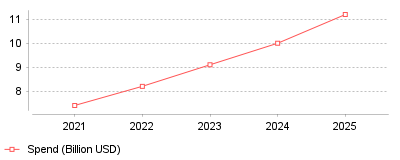
The data reveals a consistent, significant year-over-year increase in both U.S. and global affiliate marketing expenditures across recent years. Specifically, U.S. spending has climbed from $7.4 billion in 2021 to a projected $11.2 billion by 2025, mirroring global market growth that is expected to reach $17 billion in the same timeframe [source].
On a macro level, this trajectory indicates a foundational shift in digital advertising budgets toward performance-based models rather than traditional impression-based media. For the affiliate marketing software industry, this surging capital influx—evidenced by the $303.4 million raised specifically by software platforms in 2021 alone—means a dramatically expanding total addressable market [source]. Micro-level industry players, such as independent creators and emerging merchants, are consequently gaining access to more sophisticated, enterprise-grade tracking and payout tools. Furthermore, the 15.38% increase in broader industry funding by 2023 demonstrates sustained investor confidence in the technology platforms that actually facilitate these billions of dollars in daily transactions [source].
This sustained financial growth highlights the transition of affiliate marketing from a peripheral, secondary sales channel into a core revenue driver, now responsible for approximately 16% of global eCommerce sales [source]. As tens of billions of dollars flow through these networks globally, the importance of reliable, secure, and transparent affiliate software becomes paramount to prevent massive financial losses. With fraudulent clicks previously costing companies an estimated $3.4 billion in 2022, maintaining a robust tracking software infrastructure is no longer an optional luxury but a critical necessity for brand survival [source].
Several interconnected macroeconomic and digital factors have likely catalyzed this explosive growth in both software reliance and general marketing spend. The global pandemic permanently altered consumer behavior, heavily accelerating e-commerce adoption and forcing physical retail brands to rapidly diversify their online customer acquisition strategies. Additionally, the rising costs and diminishing algorithmic returns of traditional pay-per-click (PPC) and social media advertising have organically pushed marketers toward the lower-risk, highly scalable performance-based ROI that affiliate programs uniquely guarantee. Finally, worldwide search interest for affiliate marketing surged by 27% in 2020 and reached all-time highs in 2023, suggesting a massive influx of new creators entering the market who intrinsically require advanced software to properly manage their links, analytics, and dynamic payouts [source].
The continuous surge in both U.S. and global affiliate marketing spending underscores a permanent evolution in global digital commerce strategies. As the market rapidly approaches a $17 billion global valuation by 2025, the underlying B2B software platforms facilitating these dynamic networks will naturally remain the biggest financial beneficiaries of this structural capital reallocation [source]. Ultimately, the prominent takeaway for decision-makers is that modern brands must continue to invest heavily in high-quality affiliate software not only to protect their profit margins from click fraud, but also to maximize the reach and administrative efficiency of their growing affiliate partnerships.
Retailers spent $14.3 billion on affiliate networks during 2023 . Capital poured into platform providers as merchants shifted budgets away from pure impression-based advertising toward outcome-based acquisition channels. Private equity firms drove market consolidation over the past 24 months. Impact.com acquired Pressboard and SaaSquatch in rapid succession, while Partnerize integrated Pepperjam into its core infrastructure. This aggressive acquisition strategy eliminated mid-market competitors and left merchants negotiating with a concentrated group of enterprise vendors.
Financial metrics from public conglomerates reveal the scale of these operations. Publicis Groupe reported a 6.3% organic growth rate for 2023, heavily supported by performance channels managed through its CJ Affiliate subsidiary . Evaluating marketing and advertising platforms now requires procurement teams to separate partner marketing budgets from programmatic display spend. Network operators transitioned their business models from pure revenue-share agreements to fixed SaaS licensing fees combined with volume-based transaction pricing. This billing structure punishes merchants with high click volumes but low conversion rates.
Brands currently face operational friction when migrating between these consolidated platforms. Historical conversion data rarely maps cleanly between competing databases. Migration timelines stretch from 30 days to six months for enterprise catalogs. Retailers absorb significant downtime during these transitions, often pausing commission payouts and alienating high-performing publishers.
Apple implemented Link Tracking Protection in iOS 17, automatically stripping user-identifiable click parameters from Messages and Mail . This intervention degraded traditional pixel tracking capabilities overnight. Software vendors responded by forcing merchants to adopt server-to-server integrations. Unlike client-side pixels that rely on browser cookies, server-side connections pass conversion data directly from the merchant's server to the affiliate tracking platform via API.
Implementation requires dedicated engineering resources. Marketing teams cannot simply paste JavaScript tags into a tag manager. Developers must map server events, secure the data payloads, and manage API rate limits. The core architecture of modern affiliate marketing software demands these server-side connections to maintain attribution accuracy. Google Chrome's ongoing deprecation of third-party cookies further accelerates this technical migration.
Data loss remains a severe operational challenge. Merchants experience up to a 15% discrepancy between their internal analytics platforms and their affiliate network reporting . When transactions fail to record, publishers dispute their missing commissions. Network account managers spend hours manually validating order IDs against merchant databases to resolve these disputes.

Client retention dropped 14% across performance agencies last year as brands centralized their marketing operations . Account managers handling multiple brand portfolios require infrastructure that prevents data cross-contamination. Legacy affiliate networks force users to log in and out of discrete accounts to view different merchant dashboards. This creates administrative bottlenecks.
Agencies demand multi-tenant architectures. Account managers operating multi-client dashboards monitor aggregated click volumes and commission payouts from a single interface. Platform administrators can assign granular permission sets, ensuring that junior coordinators only access specific merchant reporting rather than the entire agency portfolio.
Centralized billing processes further complicate agency operations. When agencies fund publisher payouts on behalf of their clients, they must reconcile invoices across dozens of international tax jurisdictions. Specialized tools automate these clearinghouse functions. Vendors that fail to support parent-child account hierarchies lose agency contracts to competitors that streamline these financial workflows.
The Federal Trade Commission updated its Endorsement Guides in June 2023, establishing stricter requirements for material connection disclosures . Regulators explicitly banned buried disclosures and required visual tags to appear before users click affiliate links. Brands face $50,120 fines per violation for undisclosed sponsored content. This legal exposure forces compliance teams to audit thousands of external publisher domains actively.
Manual review scales poorly. Enterprise merchants rely on automated scanning tools integrated into their tracking software. These crawlers identify missing disclosure tags across social media posts and blog articles. Marketing departments using applications built for creator tracking configure alerts that automatically pause commission payouts when publishers violate disclosure rules.
European markets impose additional technical burdens. The European Commission enforces the Digital Markets Act, requiring strict user consent before processing tracking data . Affiliate tracking links must integrate with the merchant's Consent Management Platform. If a European consumer rejects tracking cookies, the affiliate software must drop the click ID, sacrificing the publisher's attribution to maintain legal compliance.
Ad fraud cost advertisers $84 billion globally in 2023 . Within the performance channel, bad actors deploy cookie stuffing scripts and automated botnets to claim unearned commissions. Malicious browser extensions silently drop tracking cookies on user devices without generating legitimate clicks. When those users eventually purchase items organically, the fraudster steals credit for the sale.
Network operators combat this activity through machine learning models. Algorithms analyze click-to-conversion timestamps. If a publisher registers 10,000 clicks in a millisecond, the system flags the activity as automated bot traffic. Security teams also monitor typosquatting campaigns, where affiliates bid on misspelled brand trademarks in search engines to intercept direct navigation traffic.
Financial clawbacks create friction between networks and merchants. When brands discover fraudulent orders weeks after issuing payouts, they demand refunds. Affiliate contracts typically limit clawback windows to 30 days. Software vendors now build escrow periods into their payout workflows, holding publisher funds until merchants validate the order quality and authorize the final release.
Traditional affiliate publishers operated content portals and coupon directories. Modern partner programs rely heavily on video creators and social media personalities. These new entrants reject traditional performance compensation. They demand flat fees for content creation alongside performance-based commissions.
This hybrid compensation model strains legacy tracking systems. Platform architectures built exclusively for cost-per-action billing struggle to process upfront placement fees. Brands seeking contract management solutions evaluate vendors based on their ability to execute hybrid payments automatically. The software must release a flat fee upon video publication, then track subsequent sales commissions through custom promo codes.
Promo code tracking bypasses link clicks entirely. Consumers watching a video rarely click the description link, preferring to type the creator's spoken code at checkout. Tracking software captures this code application via API and attributes the sale to the creator, even when no tracking cookie exists on the device.
Shopify reported gross merchandise volume of $235.9 billion in 2023 . Millions of independent merchants demand plug-and-play tracking solutions that require zero engineering support. Traditional enterprise platforms lost market share to agile startups that prioritized one-click platform installations.
Store owners access specialized software directly through administrator panels. Merchants relying on native store extensions avoid manual pixel placement. The application automatically maps inventory catalogs, configures conversion triggers, and formats product feeds. This reduces deployment times from several weeks to roughly fifteen minutes.
Inventory synchronization prevents payout errors. If a merchant runs out of a specific SKU, the tracking software must immediately notify connected affiliates to pull their promotional links. Broken links damage publisher search engine rankings and waste paid traffic. Real-time API connections ensure that publishers only advertise in-stock merchandise.
Enterprise software sales require completely different tracking architecture than consumer retail. B2B sales cycles span six to twelve months and involve multiple stakeholders. A simple last-click attribution model fails to capture the complexity of a partner introducing a corporate buyer to a SaaS vendor.
Partner relationship management systems manage these long sales cycles. Affiliates submit lead registration forms directly into the vendor's CRM instance. The tracking software locks that lead to the partner for a defined period, usually 90 days. If the internal sales team closes the deal within that window, the software calculates the partner's commission based on the final contract value.
Data normalization challenges plague these integrations. Salesforce data structures often conflict with affiliate software reporting fields. Operations teams spend extensive hours mapping custom fields to ensure that pipeline stages trigger the correct notification webhooks back to the referring partner.
Consumer journeys rarely involve a single promotional touchpoint. A shopper might discover a product via a creator's Instagram reel, search for reviews on an editorial site, and finally convert using a browser extension coupon. Legacy platforms award the entire commission to the last clicked link, enriching coupon sites while starving the content creators who initiated the discovery.
Multi-touch attribution models correct this imbalance. Advanced tracking systems ingest impression data across the entire conversion path. Brands requiring tools for direct-to-consumer storefronts configure custom splitting rules. They might allocate 30% of the commission to the first click, 20% to intermediate clicks, and 50% to the closing click.
Implementation reveals immediate financial impacts. McKinsey data demonstrates that personalized, multi-touch engagement models reduce customer acquisition costs by up to 50% . However, communicating complex fractional payouts to publishers causes friction. Affiliates accustomed to full payouts often abandon programs when they notice their commissions being divided among multiple referrers.
Global affiliate programs face severe regulatory scrutiny regarding cross-border payments. The US Internal Revenue Service requires platforms to collect W-8BEN forms from international publishers and W-9 forms from domestic partners. Tracking software must freeze payouts automatically if a publisher fails to submit current tax documentation.
Currency volatility further erodes publisher margins. Networks process billions of dollars across dozens of fiat currencies. European Central Bank data highlights processing delays and hidden conversion fees in cross-border wire transfers . Software vendors address this by partnering with dedicated payment gateways like Tipalti or Stripe Connect, shifting the foreign exchange risk away from the network operator.
Value-Added Tax calculations complicate European disbursements. Platforms must determine the tax residency of both the merchant and the publisher to apply the correct reverse-charge mechanisms. Failure to remit accurate tax data exposes merchants to severe corporate audits from regional tax authorities.
Amazon generated $46.9 billion in advertising revenue during 2023 . Retail media networks operated by Walmart, Target, and Instacart aggressively cannibalize traditional affiliate budgets. Brands reallocate funds toward these closed platforms because they offer deterministic, closed-loop reporting tied directly to point-of-sale data.
Independent tracking platforms counter this threat by expanding their publisher discovery databases. They index millions of creator profiles, comparing engagement rates and audience demographics. This allows merchants to bypass traditional retail networks and broker direct deals with niche publishers who own first-party audience relationships.
The Bureau of Labor Statistics notes that employment for marketing managers will grow 6% through 2032, driven heavily by the need to manage these fragmented digital acquisition channels . Human oversight remains necessary to negotiate custom insertion orders when automated marketplace bids become too expensive.
Machine learning models now dynamically adjust commission structures based on profit margins. Instead of offering a flat 10% on all sales, sophisticated tracking tools query the merchant's inventory database in real time. The software automatically increases commissions for overstocked items and drops payouts to zero for low-margin clearance goods.
Industry associations actively standardize these data exchanges. The Interactive Advertising Bureau released updated guidelines for performance marketing metrics to create uniformity across disparate tracking vendors . Standardized metrics allow merchants to plug multiple tracking solutions into their primary data warehouses without extensive data scrubbing.
Performance marketing networks will abandon legacy pixel tracking entirely within the next two years. Platforms failing to provide frictionless server-side APIs and multi-touch fractional commissioning will lose their enterprise contracts. Success requires vendor platforms to operate as invisible financial clearinghouses, securely routing data and payments without relying on fragile browser infrastructure.
| Year | Spend (Billion USD) |
|---|---|
| 2021 | 7.4 |
| 2022 | 8.2 |
| 2023 | 9.1 |
| 2024 | 10 |
| 2025 | 11.2 |
The data reveals a consistent, significant year-over-year increase in both U.S. and global affiliate marketing expenditures across recent years. Specifically, U.S. spending has climbed from $7.4 billion in 2021 to a projected $11.2 billion by 2025, mirroring global market growth that is expected to reach $17 billion in the same timeframe [source].
On a macro level, this trajectory indicates a foundational shift in digital advertising budgets toward performance-based models rather than traditional impression-based media. For the affiliate marketing software industry, this surging capital influx—evidenced by the $303.4 million raised specifically by software platforms in 2021 alone—means a dramatically expanding total addressable market [source]. Micro-level industry players, such as independent creators and emerging merchants, are consequently gaining access to more sophisticated, enterprise-grade tracking and payout tools. Furthermore, the 15.38% increase in broader industry funding by 2023 demonstrates sustained investor confidence in the technology platforms that actually facilitate these billions of dollars in daily transactions [source].
This sustained financial growth highlights the transition of affiliate marketing from a peripheral, secondary sales channel into a core revenue driver, now responsible for approximately 16% of global eCommerce sales [source]. As tens of billions of dollars flow through these networks globally, the importance of reliable, secure, and transparent affiliate software becomes paramount to prevent massive financial losses. With fraudulent clicks previously costing companies an estimated $3.4 billion in 2022, maintaining a robust tracking software infrastructure is no longer an optional luxury but a critical necessity for brand survival [source].
Several interconnected macroeconomic and digital factors have likely catalyzed this explosive growth in both software reliance and general marketing spend. The global pandemic permanently altered consumer behavior, heavily accelerating e-commerce adoption and forcing physical retail brands to rapidly diversify their online customer acquisition strategies. Additionally, the rising costs and diminishing algorithmic returns of traditional pay-per-click (PPC) and social media advertising have organically pushed marketers toward the lower-risk, highly scalable performance-based ROI that affiliate programs uniquely guarantee. Finally, worldwide search interest for affiliate marketing surged by 27% in 2020 and reached all-time highs in 2023, suggesting a massive influx of new creators entering the market who intrinsically require advanced software to properly manage their links, analytics, and dynamic payouts [source].
The continuous surge in both U.S. and global affiliate marketing spending underscores a permanent evolution in global digital commerce strategies. As the market rapidly approaches a $17 billion global valuation by 2025, the underlying B2B software platforms facilitating these dynamic networks will naturally remain the biggest financial beneficiaries of this structural capital reallocation [source]. Ultimately, the prominent takeaway for decision-makers is that modern brands must continue to invest heavily in high-quality affiliate software not only to protect their profit margins from click fraud, but also to maximize the reach and administrative efficiency of their growing affiliate partnerships.