


| Year | Average Response Rate (%) |
|---|---|
| 2019 | 24 |
| 2020 | 22 |
| 2021 | 20 |
| 2022 | 18 |
| 2023 | 16 |
| 2024 | 14 |
| 2025 | 12 |
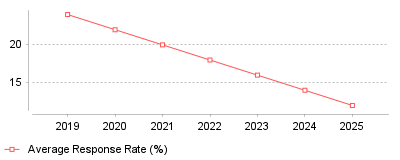
The data illustrates a rapid divergence in customer experience measurement approaches over the past few years: traditional email-based survey response rates are steadily collapsing, dropping from around 24% in 2019 to roughly 12% in 2025 [source]. Conversely, the global market for AI-driven speech and sentiment analytics has surged, growing from $2.82 billion in 2023 to an estimated $3.9 billion in 2025 as companies seek new ways to gather feedback [source].
On a micro level, this means that companies relying exclusively on post-interaction NPS or CSAT emails are basing their decisions on a shrinking and increasingly unrepresentative sample of their customer base. Non-respondents often skew toward "passives" or mild detractors, meaning that falling survey participation systematically inflates apparent satisfaction scores and blinds brands to real operational friction [source]. On a macro industry level, there is a fundamental transition toward "passive" or "unstructured" feedback mechanisms. Rather than interrogating customers with tedious questionnaires, organizations are adopting Natural Language Processing (NLP) and speech analytics to actively listen to everyday customer interactions across phone calls, chatbots, and social media [source]. This systemic shift allows businesses to capture the genuine emotions, nuances, and intents of their entire user base without adding unnecessary friction to the digital customer journey [source].
Understanding this transition is vital because relying on biased, low-response-rate survey data can lead to disastrous product investments and operational blind spots. AI-powered sentiment analysis captures unstructured interactions in real-time, removing the inherent human bias of manual survey coding and yielding instant, objective business intelligence. Furthermore, conversational AI and predictive analytics directly tie into revenue generation; predictive CX improvements can boost customer retention by up to 30%, making these advanced analytics a definitive competitive advantage over legacy measurement tools [source].
The root cause of the survey response collapse is undoubtedly widespread "survey fatigue," triggered by the simultaneous mass adoption of automated CSAT tools across virtually every consumer-facing industry. Customers are continuously bombarded with repetitive, mobile-hostile questionnaires after even the most trivial transactions, leading to a psychological block where ignoring survey requests has become the default behavior [source]. Additionally, consumers lack trust that their feedback will actually spark tangible product changes, removing any inherent incentive to participate. In response, the maturation of machine learning algorithms and the massive computing power of cloud architecture have made speech and text analytics highly accurate, scalable, and affordable. The pandemic also forced a mass migration to digital and voice channels, generating an unprecedented volume of recorded, unstructured conversational data just waiting to be mined by these new AI interpretation tools.
The era of relying solely on the five-star rating scale and long-form email questionnaires to measure customer satisfaction is rapidly drawing to a close. As response rates approach statistical insignificance, brands must pivot to AI-powered sentiment and speech analytics to accurately gauge broad consumer emotions. Ultimately, the most prominent takeaway for modern enterprises is that the best way to understand your customers today is not by asking them to fill out a form, but by actively and intelligently listening to the conversations they are already having.
Global spending on customer experience management reached $15.55 billion in 2025 [1]. Grand View Research projects this market will grow at a 15.2% compound annual growth rate through 2033, eventually hitting $47.72 billion [1]. Private equity firms drove early consolidation in the sector to capitalize on this trajectory. Thoma Bravo acquired Medallia for $6.4 billion in an all-cash transaction in 2021 [2]. SurveyMonkey rebranded to Momentive and expanded its product lines into enterprise feedback management before executing its own corporate restructuring [3]. Capital expenditures on software continue to accelerate while investments in human personnel fall.
The Bureau of Labor Statistics projects employment of customer service representatives will decline 5% between 2024 and 2034 [4]. The domestic workforce currently sits at 2.97 million people, with women comprising 66.2% of the roles [5]. Companies are actively reducing their reliance on these human agents, who earn a median hourly wage of $20.59 [4]. The lowest 10 percent of earners make less than $14.75 an hour, while the highest 10 percent earn more than $30.16 [4]. Despite the projected decline in total jobs, the industry will still see 341,700 openings annually just to replace workers abandoning the profession [4]. Organizations funnel their capital into customer support and success software to replace these exiting employees. This labor reduction creates an urgent operational hurdle. Fewer human interactions mean businesses have fewer natural opportunities to gauge consumer sentiment. They must extract data from automated touchpoints instead.
Asking buyers for feedback directly harms brand perception. The American Customer Satisfaction Index identified respondent exhaustion as a primary factor undermining enterprise data quality [6]. Exhausted consumers exhibit predictable behavioral patterns. They straightline their responses across rating scales. They abandon questionnaires midway through completion [6]. Respondents submit shorter, less thoughtful answers to open-ended questions when prompted too frequently. Response rates dropped significantly across all consumer sectors as buyers learned to ignore automated feedback requests.
This behavioral shift ruins measurement models. Forrester analyzed 98,000 consumers across 200 brands and 13 industries in 2024 [7]. Quality scores fell for a third consecutive year, hitting an all-time low. The average score dropped 3.9 points on a 100-point scale, surpassing the previous record decline of 3.6 points [8]. Nearly 40% of surveyed brands suffered significant downgrades in their ratings. Consumers reported frustration with broken digital interfaces and repetitive questioning.
Product managers cannot rely on post-interaction email blasts. They require software measuring user satisfaction natively within the application interface to capture sentiment without causing friction. Integrating these prompts into the digital workflow yields higher completion rates. Medallia recognized this technical limitation and spent $44 million to acquire Sense360, a platform designed to capture behavioral intelligence without relying entirely on direct user questioning [9]. Capturing the action replaces asking the question.
Incisiv and Talkdesk benchmarked 131 brands across 11 segments to measure retail performance in 2024 [10]. The findings revealed massive capability gaps between competitors. Retailers successfully personalized just 34% of the buyer journey [10]. Home furnishings companies achieved the highest maturity rate at 40%, while watch brands lagged far behind at 28% [10].
Virtual assistant integration surged from 38% in 2022 to 59% in 2024 [11]. Agents issuing automated recommendations grew by 80% over the same two-year span [11]. Automation requires strict oversight to prevent brand damage. Companies deploy customer satisfaction and experience measurement tools to monitor these artificial intelligence agents. If a bot fails to resolve an inquiry, management needs immediate notification.
Salesforce and Google announced a major expansion of their Agentforce platform in 2025 to address this automation trend [12]. The integration embeds Gemini reasoning models directly into the Service Cloud [12]. These models process text, images, and audio natively. Service Cloud added live voice translation and sentiment analysis to understand audio cues during calls [12]. Virtual agents can now connect with other bots for handoffs without human supervision. The partnership relies on Zero Copy architecture with Google Lakehouse, allowing agents to read enterprise data directly from the storage layer without migrating the files [13]. Wayfair deployed these integrated models to personalize their retail interactions at scale [13].
Top-performing artificial intelligence systems achieve satisfaction scores between 4.2 and 4.5 out of 5 [14]. Support managers must track automated interactions separately from human conversations. Blending these numbers obscures critical performance flaws. If a chatbot scores 2.1 while human agents average 4.8, the combined mathematical average masks the active damage caused by the automation software.
The Resolved on Automation Rate measures the exact percentage of inquiries completed without human intervention [15]. This metric determines the true financial return on software investments. A high automation rate reduces the total workload placed on human staff. However, aggressive automation timelines lead to poor experiences. Verint found that 68% of users suffered a negative interaction with a chatbot [16]. The primary cause of failure was the bot's inability to comprehend the core question [16].
Average Handling Time remains a standard evaluation criteria. Managers segment this data into three categories: completely automated resolutions, fully human resolutions, and hybrid interactions. Tracking sentiment shift through natural language processing allows teams to see exactly when a buyer becomes frustrated during a hybrid interaction [14]. If sentiment consistently drops the moment a bot attempts an upsell, administrators pull that specific prompt from the programming sequence.
The Consumer Financial Protection Bureau received 3.18 million complaints in 2024 [17]. This volume highlights severe operational failures across the banking sector. Credit and consumer reporting issues accounted for 85% of these submissions, totaling over 2.7 million individual filings [17]. Debt collection generated the second-highest volume.
Consumers cited missing funds, unexpected fees, and unauthorized account closures. Identity theft complaints rose significantly as buyers fought to remove fraudulent accounts from their records [18]. The Bureau forwarded 2.82 million of these complaints directly to 3,600 companies for mandatory responses [17]. Federal regulators require institutions to reply within 15 days [18]. Vehicle loans and leases accounted for 18,900 complaints in the report [19]. Repossession issues surged 99% compared to historical averages [19]. Buyers reported that financiers marked their accounts as late even when they submitted payments on time. Only 3% of these vehicle complaints resulted in monetary relief for the buyer [19].
Financial institutions cannot manage this compliance burden through manual tracking. Banks require sentiment tracking systems designed for financial institutions to intercept negative sentiment before it becomes a federal complaint. These systems analyze call center transcripts to detect frustration regarding debt collection or credit reporting errors. Catching an angry caller early saves the bank from federal auditing fees and reputation damage.
According to Forrester, organizations prioritizing consumer satisfaction achieved 41% faster revenue growth and 49% faster profit growth than their peers [8]. Multichannel banks stand to gain $114 million in incremental revenue for every one-point improvement in their Forrester Index score [20]. The financial imperative to resolve complaints quickly is absolute.
Grocers earned an average Net Promoter Score of 30.1 in 2023, the highest of any measured industry [21]. Qualtrics surveyed 10,000 U.S. consumers to calculate these figures across 351 companies and 22 industries [21]. Consumer payments ranked at the absolute bottom with a score of -6.1 [21]. The stark contrast between buying food and paying bills reflects the inherent emotional weight of the transaction.
Vendors often market their measurement systems as universal solutions. In practice, a bank cannot benchmark its performance against a supermarket. Industry-specific thresholds dictate success. A payment processor scoring a zero technically outperforms its direct peers, even though a zero indicates general dissatisfaction.
To accurately assess loyalty, experience measurement platforms with live reporting interfaces aggregate these scores daily. Relying on an annual benchmark survey leaves executives blind to sudden operational failures. If a software update breaks the checkout cart, live tracking alerts the engineering team before the daily score plummets.
Only the airline industry improved its consumer sentiment scores in 2024 [8]. The sector gained two points on the Forrester index while all other verticals declined [7]. Airlines achieved this by mapping the entire travel process rather than surveying passengers at random intervals.
Flight delays and cancellations cause emotional distress. Carriers historically surveyed passengers after the flight landed, which produced skewed results based entirely on the final outcome. Modern travel brands use experience software built for the travel sector to monitor sentiment at specific geographic waypoints. They track app interactions during check-in, text messages at the gate, and media screen usage during the flight.
Isolating these specific moments requires journey analytics programs that connect disparate data points into a linear timeline. If a passenger struggles with the mobile boarding pass but enjoys the inflight service, the system logs two distinct sentiment scores. This granularity allows operations teams to fix the boarding software without overhauling the flight crew training. Qualtrics benchmarked 354 companies to study these interaction points and found the car rental industry sank to the bottom of the travel sector at 52% [22]. Rental car agencies suffer from the same logistical complexities as airlines, but they fail to track the consumer path effectively.
A one-point improvement in satisfaction scores yields $619 million in annual incremental revenue for large retailers [20]. Home and auto insurers see a $366 million revenue boost from the same single-point increase [20]. Executives understand these economics, yet they struggle to execute effective measurement strategies. Just 3% of companies meet the criteria for true customer obsession [8].
Retention rates correlate directly with these scores. Organizations ranking high in sentiment metrics achieve 51% better retention than average companies [8]. The cost to acquire a new buyer far exceeds the cost to retain an existing one. Declining satisfaction rates force companies to spend more on marketing to replace defecting users.
Elite brands face similar struggles. Forrester identified 11 elite companies in 2024, including Chewy, Etsy, and Tesla [8]. Tesla secured its position through rapid issue resolution [8]. However, six of those elite organizations saw flat scores, and four suffered significant declines [23]. Elite brands evoked 25 positive emotions for every negative emotion in 2024, down from a ratio of 29-to-1 the previous year [8].
Emotion drives purchasing decisions more than pure functional efficiency. The average effectiveness of brand interactions fell to 64% in 2024, and the ease of interaction dropped to 66% [8]. Middle-class consumers drove this drop [7]. They pay higher prices due to inflation but perceive no added value in the service they receive.
Medallia acquired Stella Connect for $100 million to gain control over contact center quality management [24]. This acquisition integrated live coaching directly into the feedback loop. Managers could review a negative call transcript and immediately assign a training module to the responsible agent. Medallia also purchased Voci Technologies for $59 million to acquire speech-to-text transcription capabilities [24]. The software listens to phone calls and analyzes the speaker's tone and volume. If a caller raises their voice, the system flags the interaction for managerial review.
This closed-loop system is necessary because call centers operate under immense pressure. Human agents handle the most complex, emotionally charged interactions. Simple requests flow to self-service portals and artificial intelligence bots. When a customer finally reaches a human representative, they are usually frustrated. The Bureau of Labor Statistics notes that these roles require working
| Year | Average Response Rate (%) |
|---|---|
| 2019 | 24 |
| 2020 | 22 |
| 2021 | 20 |
| 2022 | 18 |
| 2023 | 16 |
| 2024 | 14 |
| 2025 | 12 |
The data illustrates a rapid divergence in customer experience measurement approaches over the past few years: traditional email-based survey response rates are steadily collapsing, dropping from around 24% in 2019 to roughly 12% in 2025 [source]. Conversely, the global market for AI-driven speech and sentiment analytics has surged, growing from $2.82 billion in 2023 to an estimated $3.9 billion in 2025 as companies seek new ways to gather feedback [source].
On a micro level, this means that companies relying exclusively on post-interaction NPS or CSAT emails are basing their decisions on a shrinking and increasingly unrepresentative sample of their customer base. Non-respondents often skew toward "passives" or mild detractors, meaning that falling survey participation systematically inflates apparent satisfaction scores and blinds brands to real operational friction [source]. On a macro industry level, there is a fundamental transition toward "passive" or "unstructured" feedback mechanisms. Rather than interrogating customers with tedious questionnaires, organizations are adopting Natural Language Processing (NLP) and speech analytics to actively listen to everyday customer interactions across phone calls, chatbots, and social media [source]. This systemic shift allows businesses to capture the genuine emotions, nuances, and intents of their entire user base without adding unnecessary friction to the digital customer journey [source].
Understanding this transition is vital because relying on biased, low-response-rate survey data can lead to disastrous product investments and operational blind spots. AI-powered sentiment analysis captures unstructured interactions in real-time, removing the inherent human bias of manual survey coding and yielding instant, objective business intelligence. Furthermore, conversational AI and predictive analytics directly tie into revenue generation; predictive CX improvements can boost customer retention by up to 30%, making these advanced analytics a definitive competitive advantage over legacy measurement tools [source].
The root cause of the survey response collapse is undoubtedly widespread "survey fatigue," triggered by the simultaneous mass adoption of automated CSAT tools across virtually every consumer-facing industry. Customers are continuously bombarded with repetitive, mobile-hostile questionnaires after even the most trivial transactions, leading to a psychological block where ignoring survey requests has become the default behavior [source]. Additionally, consumers lack trust that their feedback will actually spark tangible product changes, removing any inherent incentive to participate. In response, the maturation of machine learning algorithms and the massive computing power of cloud architecture have made speech and text analytics highly accurate, scalable, and affordable. The pandemic also forced a mass migration to digital and voice channels, generating an unprecedented volume of recorded, unstructured conversational data just waiting to be mined by these new AI interpretation tools.
The era of relying solely on the five-star rating scale and long-form email questionnaires to measure customer satisfaction is rapidly drawing to a close. As response rates approach statistical insignificance, brands must pivot to AI-powered sentiment and speech analytics to accurately gauge broad consumer emotions. Ultimately, the most prominent takeaway for modern enterprises is that the best way to understand your customers today is not by asking them to fill out a form, but by actively and intelligently listening to the conversations they are already having.