


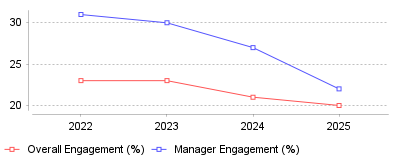
The data reveals a striking paradox in the employee experience sector: while organizational investments in continuous listening and pulse survey platforms are at an all-time high, actual employee engagement has plummeted to its lowest levels in years. This juxtaposition highlights a critical "action gap" where companies are gathering unprecedented amounts of real-time workforce feedback but are fa
| Year | Overall Engagement (%) | Manager Engagement (%) |
|---|---|---|
| 2022 | 23 | 31 |
| 2023 | 23 | 30 |
| 2024 | 21 | 27 |
| 2025 | 20 | 22 |
The data illustrates a stark divergence between the rapid adoption of multi-channel employee listening technology and actual workplace sentiment. Even as the global employee experience management market expands toward a projected $7.48 billion in 2025 [source], global employee engagement has simultaneously fallen to a staggering low of 20% [source]. Organizations are polling their workers with greater frequency than ever before, yet this continuous feedback loop is failing to translate into meaningful momentum or improved employee satisfaction.
On a macro level, the survey platform industry is hitting an inflection point where software features related to data collection have become heavily commoditized, shifting the competitive battleground toward predictive analytics and automated action planning. Despite 75% of organizations now measuring employee sentiment at least quarterly, only 51% of employees report seeing actual improvements resulting from their feedback [source]. At the micro level, this dynamic is severely impacting middle management and younger workers, with manager engagement plummeting from 31% to 22% over the last three years, effectively erasing the historical "engagement premium" that leaders once enjoyed [source]. The burden of executing post-survey action plans often falls on these exact managers, who are currently too stretched and burned out to act on the data they receive. Ultimately, this indicates that the pulse survey platforms of tomorrow must evolve beyond basic dashboards to become intelligent coaching tools that directly guide and alleviate managerial workloads.
The failure to close the gap between listening and action carries astronomical financial consequences, currently costing the global economy roughly $8.8 trillion annually in lost productivity, which equates to 9% of the worldwide gross domestic product [source]. When organizations repeatedly solicit feedback without enacting visible change, they actively damage leadership trust and generate severe survey fatigue. Companies that fail to adapt their listening strategies will continue to suffer from high turnover and active disengagement, particularly among Gen Z employees who have reported a massive 13-point drop since 2020 in feeling cared about by their supervisors [source].
This widespread disengagement is likely the unintended byproduct of how organizations scaled remote and hybrid work models during and after the pandemic. Desperate to keep a pulse on distributed workforces, human resource departments rapidly purchased software and accelerated their survey cadences without building the corresponding operational infrastructure required to enact change. Consequently, a massive bottleneck formed at the execution layer; human resource teams generated an abundance of insights but lacked the staffing and budget to follow through, leaving front-line managers ill-equipped to fix systemic issues. Furthermore, younger employees entering the workforce in this highly digitized, survey-heavy environment are experiencing a profound lack of genuine human mentorship. The reliance on digital pulse checks may have inadvertently replaced authentic, face-to-face management interactions, leaving workers feeling like data points rather than valued individuals.
As the market for employee listening tools continues to mature, the true differentiator for successful platforms will no longer be how much data they can collect, but how effectively they can mandate and track actionable interventions. Organizations must fundamentally transition from a mindset of "continuous listening" to one of "continuous actioning" if they wish to reverse the alarming drop in global engagement. The prominent takeaway is clear: technology can seamlessly identify workplace fractures, but without empowered managers and visible leadership accountability, those tools will only serve to document a culture's decline.
Silver Lake and Canada Pension Plan Investment Board finalized their acquisition of Qualtrics for $12.5 billion in June 2023 [1]. Completing this transaction removed the experience management vendor from SAP's public portfolio. Accel contributed $500 million to the buyout, joining other institutional investors like BDT & MSD Partners [2]. Within the broader human resources software sector, private equity firms actively pursue consistent subscription revenues. SAP originally purchased Qualtrics for $8 billion in 2018 just days before a planned public offering. Following a 2021 initial public offering, the software vendor briefly operated as an independent public entity before returning to private ownership. Corporate buyers increasingly demand integrated platforms rather than disjointed point solutions. To expand its cloud offerings with continuous performance modules, Oracle acquired French software developer TalentSoft [3]. Zoom purchased Workvivo in 2023 to embed internal communications directly into its video client [4]. Technology integration allows administrators to pull data directly from varied communication applications. Venture capital continues flowing into smaller competitors attempting to capture market share. BetterWorks secured $40 million in Series C funding in May 2024 to expand its performance platform [3]. Lightspeed Venture Partners led that investment round. Consolidation limits choices for enterprise buyers while standardizing the technical features available across the industry.
Global employee engagement fell to 20% in 2025. Disengaged workers cost the global economy $10 trillion annually in lost productivity [5]. This financial drain equals roughly 9% of global gross domestic product. Engagement declined for two consecutive years following a 2023 peak. Managers suffer the sharpest drop in workplace morale across all tracked demographics. Supervisor engagement plummeted from 31% in 2022 to just 22% in 2025 [6]. Individual contributor engagement dropped slightly to 19% over the exact same period. Thirty-four percent of global employees report they are thriving, while 56 percent are struggling and 9 percent are suffering [7]. Forty percent of employees experienced significant stress during their previous workday.
Supervisory roles previously offered a measurable engagement premium. That psychological advantage evaporated as corporate leadership increased administrative demands. Modern supervisors report 51% more responsibilities than they can successfully manage [8]. Middle management acts as the primary buffer between executive strategy and frontline execution. Apathetic supervisors transmit their frustration directly to their subordinates. Organizations with highly engaged leadership retain staff at much higher rates than their competitors. A lack of managerial support drives resignation trends worldwide. Regional differences compound this operational problem. South Asia experienced a five percent decline in workforce engagement during 2025 [6]. No geographic region reported an engagement increase last year.
Rising labor costs force executives to scrutinize retention metrics obsessively. Civilian worker compensation averaged $48.78 per hour in December 2025 [9]. Wages represent $33.45 of this total. Benefit costs account for the remaining $15.33. Private industry compensation grew 3.4% over the 12 months ending in December 2025. Union workers saw a larger increase of 4.0% compared to a 3.3% rise for non-union employees [10]. Quits stood at 3.0 million workers in early 2026, while layoffs remained at 1.7 million [11]. Regional disparities affect these baseline labor costs. Northeast employer costs hit $53.99 per hour, while Southern states averaged $41.21 per hour [12]. Paid leave averaged $4.59 per hour worked. Insurance costs averaged $4.55 per hour.
Replacing departed workers inflicts severe damage on corporate balance sheets. The average cost of employee turnover reached $45,236 per worker in 2024 [13]. Half of American companies brace for elevated turnover rates heading into 2026. Industry specifics dictate the exact financial penalty associated with resignations. Wholesale trade employers pay $53.03 per hour in total compensation [9]. Retail trade employers pay only $26.41 per hour. High turnover in retail destroys exceptionally narrow profit margins. Store managers need specialized communication software to keep hourly workers aligned. Administrators managing temporary staffing pools rely on mobile applications to distribute shift schedules. These distributed teams demand flexible scheduling to prevent costly attendance conflicts. Retention requires structural improvements rather than superficial office perks.
Frequent pulse surveys actively degrade workforce data quality. Organizations overwhelmed with questionnaires suffer a 27% drop in response rates quarter-over-quarter [14]. Traditional measurement tactics fail in production environments where product iterations happen daily. Administrators ask generic satisfaction questions that ignore specific departmental stressors. Employees abandon evaluation forms that require lengthy text inputs. Voice-assistant platforms observed an 18% drop in response rates due to repetitive surveying [15]. Excessive measurement destroys the exact insights it attempts to capture.
Human resources directors face a severe phenomenon known as change fatigue. Constant organizational shifts exhaust the global workforce. Change fatigue causes employee intent to stay to decline by 42% [16]. Worker performance drops 27% under relentless internal restructuring. Thirty-two percent of change-fatigued employees report being less productive, while 48% report being more tired at work [17]. Nearly 80% of corporate leaders report exhaustion among their staff. This apathy infects the measurement process entirely. Workers rush through monthly forms without providing accurate answers. Resignations also trigger a ripple effect across remaining staff. Employees are 7.7% more likely to leave their jobs after a team member is laid off [18]. This turnover contagion accelerates when leaders deploy tone-deaf surveys during periods of high stress.
Technology vendors attempt to solve this participation crisis with adaptive logic. Modern internal assessment systems use artificial intelligence to personalize follow-up questions. Adaptive software hides irrelevant fields based on previous inputs. Engineering directors at software development firms avoid repetitive questions through these dynamic forms. Reducing survey length preserves data integrity across the enterprise. Management must also communicate the results of these internal studies transparently. Workers ignore future surveys when executives fail to act on previous feedback.
Goal setting dictates how individuals perceive their organizational value. Employees feel motivated when performance reviews link individual targets to corporate strategy. Measurable goals improve workforce satisfaction [19]. Workers view the evaluation process as fair when managers update targets throughout the year. Annual performance reviews fail to capture rapid shifts in business priorities. Disconnected annual grading systems alienate high-performing contributors. A 2024 McKinsey survey of 1,200 global workers revealed that employees demand continuous feedback to remain engaged.
Software providers address this specific demand with integrated development features. Oracle launched an artificial intelligence feature named Oracle Grow in May 2024 [20]. This module sits directly within the broader Oracle ME platform. It provides centralized dashboards for monitoring skill progression alongside daily tasks. Feedback tools now incorporate learning management functions automatically. Employees expect continuous coaching rather than a single yearly grade.
Reward Gateway and Bonusly offer peer recognition features that tie directly into communication channels. Small gestures of appreciation improve team cohesion significantly. Operations managers at candidate sourcing agencies use these modules to reward recruiters for successful placements. Real-time praise prevents the isolation common in remote work environments. Recognizing achievement publicly reinforces desired corporate behaviors.
Natural language processing allows administrators to bypass formal surveys entirely. Passive listening tools extract textual data from daily communication platforms. Software integrates directly with Slack and Microsoft Teams via application programming interfaces [21]. Algorithms parse internal messages to identify emotional tone. Machine learning models categorize text as positive, negative, or neutral without human intervention. Continuous monitoring identifies burnout before productivity drops. System administrators track morale shifts following major corporate announcements immediately. If executives mandate a return to the office, sentiment analysis tools measure the immediate internal backlash. Sixty percent of companies now use artificial intelligence tools to analyze employee feedback [22].
Human analysts cannot process massive volumes of unstructured data without algorithmic assistance. The technology reads thousands of open text inputs instantly. Platforms like Perceptyx and Workday Peakon Employee Voice provide real-time analysis of these textual patterns [22]. Eighty-five percent of companies using these tools saw an improvement in satisfaction, achieving a 32% reduction in turnover rates. Bias remains a severe operational challenge during this process. Artificial intelligence systems learn exclusively from historical datasets. Algorithms misinterpret slang or cultural communication differences frequently. A mathematical model might flag a harmless sarcastic comment as a hostile interaction. Developers must conduct regular audits to ensure fair interpretation across diverse teams. Flawed sentiment data leads human resources departments to address nonexistent problems.
Passive communication tracking triggers legal scrutiny globally. The European Union Artificial Intelligence Act introduces strict compliance requirements for workplace software. Deploying algorithms to monitor employee emotions qualifies as a high-risk activity under this framework [23]. The General Data Protection Regulation mandates anonymization protocols. Employers must strip personally identifiable information before running text through sentiment models. The National Labor Relations Board monitors workplace surveillance practices carefully to protect worker rights. Educational technology companies must also navigate the Family Educational Rights and Privacy Act when handling staff training records [14].
Trust deficits emerge when workers discover undisclosed surveillance. Employees alter their communication habits if they suspect algorithmic monitoring. Staff members move sensitive conversations to encrypted personal devices to avoid corporate oversight. This evasive behavior creates a fractured communication environment. Transparency is non-negotiable for ethical software deployment. Corporate leaders must explicitly detail what data the system analyzes and how long it stores those records.
Compliance extends far beyond European borders. The California Consumer Privacy Act regulates data extraction for resident workers. Multinational corporations face overlapping regulatory jurisdictions constantly. Software vendors build regional data centers to ensure localized compliance. Cloud hosting providers must guarantee that European worker data never touches American servers. Legal risk limits the adoption of advanced sentiment analysis in highly regulated industries.
Deskless workers require completely different engagement strategies than corporate office staff. Retail associates, manufacturing operators, and logistics drivers lack access to desktop computers during their shifts. Traditional email-based surveys fail to reach these critical demographics entirely. Mobile-first application design solves this specific distribution problem. Platforms like Beekeeper and Flip cater exclusively to frontline communication needs [24]. Administrators push short notifications directly to personal smartphones.
High turnover plagues the retail sector specifically. Replacing a single cashier disrupts store operations and angers customers facing long lines. Providing shift flexibility acts as a primary retention tool for hourly workers. Applications that combine scheduling with direct feedback mechanisms improve morale. A store associate who can swap shifts easily feels respected by management. Retailers who open digital channels for feedback see noticeable increases in year-over-year retention [25]. Gathering data from the factory floor requires software optimized for spotty cellular connections.
Corporate technology stacks suffer from vendor sprawl. Human resources departments purchase specialized applications for performance reviews, wellness tracking, and peer recognition. Managing dozens of distinct contracts frustrates procurement officers. Data remains trapped in isolated databases when platforms fail to communicate. A fragmented technology stack prevents administrators from analyzing workforce trends accurately. Identifying a correlation between mandatory overtime and increased resignation rates requires merged datasets.
Enterprise software vendors push unified platforms to solve this data isolation. Workday launched a unified employee experience platform in January 2024 to consolidate these disparate functions [3]. Connecting learning management, sentiment analysis, and payroll data creates an accurate predictive model. Microsoft Teams integrated Qualtrics data directly into its interface in March 2024. Embedding feedback tools into daily workflows increases completion rates. Employees ignore external links sent via email, but they will click a survey embedded in their primary chat application. Seamless integration reduces friction for the end user.
Market analysts project the employee experience management sector will reach $11.71 billion by 2030 [20]. The global market generated $6.40 billion in 2023. This expansion represents a compound annual growth rate of 9.7%. North America commands the largest regional share of this specific software spending. Software licenses account for the majority of the generated revenue. The distinct employee engagement software segment was valued at $1.05 billion in 2024 and should reach $3.52 billion by 2032 [26].
Cloud deployments dominate new enterprise installations. Small enterprises prefer hosted software due to minimal hardware requirements. Companies in the Asia-Pacific region increased their software adoption by 47% between 2022 and 2024 [27]. Digital infrastructure matures rapidly across India and South Korea. Global competition for technical talent forces foreign corporations to invest heavily in retention software. Fast-growing startups like Remote.com, 15Five, and Lattice capture market share by offering specialized feedback modules [24].
Capital investment targets predictive retention features over the next 24 months. Algorithms will forecast resignation risks before employees submit formal notice. Venture capital firms poured over $3 billion into engagement startups between 2021 and 2024 [28]. These specialized investments fund mobile interfaces and behavioral science modules. Organizations recognize that financial compensation alone cannot prevent attrition long-term. Executives must treat workforce satisfaction as a core operational metric rather than a secondary human resources function.
The data reveals a striking paradox in the employee experience sector: while organizational investments in continuous listening and pulse survey platforms are at an all-time high, actual employee engagement has plummeted to its lowest levels in years. This juxtaposition highlights a critical "action gap" where companies are gathering unprecedented amounts of real-time workforce feedback but are fa
| Year | Overall Engagement (%) | Manager Engagement (%) |
|---|---|---|
| 2022 | 23 | 31 |
| 2023 | 23 | 30 |
| 2024 | 21 | 27 |
| 2025 | 20 | 22 |
The data illustrates a stark divergence between the rapid adoption of multi-channel employee listening technology and actual workplace sentiment. Even as the global employee experience management market expands toward a projected $7.48 billion in 2025 [source], global employee engagement has simultaneously fallen to a staggering low of 20% [source]. Organizations are polling their workers with greater frequency than ever before, yet this continuous feedback loop is failing to translate into meaningful momentum or improved employee satisfaction.
On a macro level, the survey platform industry is hitting an inflection point where software features related to data collection have become heavily commoditized, shifting the competitive battleground toward predictive analytics and automated action planning. Despite 75% of organizations now measuring employee sentiment at least quarterly, only 51% of employees report seeing actual improvements resulting from their feedback [source]. At the micro level, this dynamic is severely impacting middle management and younger workers, with manager engagement plummeting from 31% to 22% over the last three years, effectively erasing the historical "engagement premium" that leaders once enjoyed [source]. The burden of executing post-survey action plans often falls on these exact managers, who are currently too stretched and burned out to act on the data they receive. Ultimately, this indicates that the pulse survey platforms of tomorrow must evolve beyond basic dashboards to become intelligent coaching tools that directly guide and alleviate managerial workloads.
The failure to close the gap between listening and action carries astronomical financial consequences, currently costing the global economy roughly $8.8 trillion annually in lost productivity, which equates to 9% of the worldwide gross domestic product [source]. When organizations repeatedly solicit feedback without enacting visible change, they actively damage leadership trust and generate severe survey fatigue. Companies that fail to adapt their listening strategies will continue to suffer from high turnover and active disengagement, particularly among Gen Z employees who have reported a massive 13-point drop since 2020 in feeling cared about by their supervisors [source].
This widespread disengagement is likely the unintended byproduct of how organizations scaled remote and hybrid work models during and after the pandemic. Desperate to keep a pulse on distributed workforces, human resource departments rapidly purchased software and accelerated their survey cadences without building the corresponding operational infrastructure required to enact change. Consequently, a massive bottleneck formed at the execution layer; human resource teams generated an abundance of insights but lacked the staffing and budget to follow through, leaving front-line managers ill-equipped to fix systemic issues. Furthermore, younger employees entering the workforce in this highly digitized, survey-heavy environment are experiencing a profound lack of genuine human mentorship. The reliance on digital pulse checks may have inadvertently replaced authentic, face-to-face management interactions, leaving workers feeling like data points rather than valued individuals.
As the market for employee listening tools continues to mature, the true differentiator for successful platforms will no longer be how much data they can collect, but how effectively they can mandate and track actionable interventions. Organizations must fundamentally transition from a mindset of "continuous listening" to one of "continuous actioning" if they wish to reverse the alarming drop in global engagement. The prominent takeaway is clear: technology can seamlessly identify workplace fractures, but without empowered managers and visible leadership accountability, those tools will only serve to document a culture's decline.