


| Year | Reddit Revenue | Discord Revenue |
|---|---|---|
| 2021 | 485 | 310 |
| 2022 | 667 | 445 |
| 2023 | 804 | 575 |
| 2024 | 1300 | 725 |
| 2025 | 2200 | 879 |
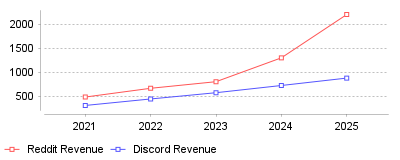
The core data reveals a profound financial metamorphosis within leading digital community platforms, highlighted by staggering revenue multiplication and a decisive transition toward net profitability over a five-year timeline. Reddit's annual revenue escalated aggressively from a modest $484.92 million in fiscal year 2021 to a commanding $2.2 billion by the end of fiscal year 2025, representing a massive 69 percent year-over-year growth rate from 2024 alone [source] [source]. Concurrently, Reddit’s Daily Active Uniques (DAUq) expanded from approximately 54.8 million in early 2021 to 121.4 million by the fourth quarter of 2025, proving that the platform's ability to extract capital grew at a significantly faster rate than its raw user acquisition [source] [source]. Beyond sheer top-line revenue, Reddit hit a monumental profitability milestone: after enduring an operating loss of $561 million in 2024—largely skewered by an $802 million stock-based compensation charge triggered by its initial public offering—the company executed a flawless operational turnaround to post $530 million in pure net income for the full year of 2025 [source] [source].
On the private market side, Discord mirrors this exact financial trajectory, climbing from roughly $310 million in revenue in 2021 to an estimated $879 million by 2024, alongside a rapidly growing base of 259.2 million projected monthly active users in 2025 [source] [source] [source]. Discord’s user engagement remains phenomenally entrenched, with the average active user spending an estimated 280.6 minutes per month on the application and the collective user base transmitting over four billion messages daily [source] [source]. This data conclusively demonstrates that the era of open community platforms operating as structurally unprofitable, venture-subsidized digital lounges has officially concluded, completely replaced by an era of stringent financial execution, massive cash flow generation, and highly diversified revenue extraction frameworks.
At a micro-industry level, these figures validate the immense commercial superiority of structured, intent-based digital communities over traditional algorithmic media feeds. Unlike conventional social media platforms where consumer intent must be inferred through passive scrolling and retention algorithms, platforms like Reddit allow users to explicitly declare their exact interests by joining highly specific, niched subreddits ranging from advanced personal finance tactics to granular skincare routines [source]. This explicitly declared intent has empowered Reddit to capture incredibly high Average Revenue Per User (ARPU) metrics, particularly in the domestic market where United States ARPU reached $10.79 in the fourth quarter of 2025, vastly outpacing the international ARPU of $2.31 and providing advertisers with unparalleled conversion efficiency [source]. Conversely, Discord has successfully validated a fan-funded, Platform-as-a-Service (PaaS) framework where revenue is heavily derived from voluntary Nitro premium subscriptions and localized Server Boosts rather than traditional digital display advertising [source]. Discord's flagship Nitro offering generated an impressive $207 million in 2023 alone, underscoring the willingness of core audiences to finance their own communities in exchange for enhanced communication features, customized profile cosmetics, and elevated streaming quality capabilities [source] [source].
Furthermore, at a macro-industry level, this widespread wave of monetization has birthed an entirely new sub-sector of independent, creator-led community platforms, most notably defined by the explosive rise of software suites like Skool and Circle [source] [source]. Skool, visibly endorsed and financially backed by prominent business influencers, charges a flat, predictable $99 monthly fee and allows online creators to retain one hundred percent of their group's subscription revenue, representing a stark and highly attractive contrast to legacy platforms like Patreon which suffer from stagnant creator payouts and rising platform take-rates [source] [source]. The broader macro implication is that the creator economy—an ecosystem valued at an estimated $250 billion in 2025—is rapidly migrating away from rented, unpredictable algorithmic audiences toward directly owned community platforms where monetization is tightly gated, mathematically predictable, and highly lucrative [source]. Finally, traditional financial benchmarks for software profitability are being completely shattered by this newly proven model; for example, Reddit achieved a breathtaking "Rule of 40" score of 115 in the fourth quarter of 2025, a figure derived from its 70 percent revenue growth combined with a 45 percent adjusted EBITDA margin, signaling unprecedented and nearly unmatched operating leverage in the technology sector [source] [source].
The financial maturation of community platforms is fundamentally critical because it essentially marks the end of the idealized free internet ethos and normalizes the aggressive commercial commoditization of authentic human interactions. For over a decade, digital message boards and chat servers were widely viewed by institutional investors as volatile, brand-unsafe environments that were fundamentally impossible to monetize at institutional scale without triggering massive, platform-killing user revolts. Reddit's astonishing ability to achieve a 91.2 percent gross margin and confidently authorize a $1 billion share repurchase program in 2025 permanently dismantles this archaic narrative, proving beyond a doubt that highly structured conversational data is one of the single most valuable enterprise assets in the modern digital economy [source].
This inherent value has been exponentially magnified by the artificial intelligence revolution, which relies entirely on massive repositories of high-quality, human-generated text to train and refine Large Language Models (LLMs). This unique dynamic allowed Reddit to seamlessly secure a massive $60 million annual data licensing deal with Alphabet's , effectively transforming its decades of historical forum archives into an immediate, ultra-high-margin revenue stream practically overnight [source]. Additionally, this trend establishes a crucial benchmark and blueprint for other late-stage private technology unicorns, such as Discord, which is widely anticipated to execute its own Initial Public Offering in early 2026 under the lead underwriting guidance of Goldman Sachs and JPMorgan Chase [source]. Discord's recent transition to operational profitability, evidenced by reporting positive adjusted EBITDA for five consecutive quarters as of April 2025, and its delicate, calculated integration of opt-in advertising through newly launched Sponsored Quests, will serve as a definitive litmus test for how Wall Street values community-centric software platforms in the modern AI era [source] [source]. Ultimately, the resounding financial success of these platforms dictates the future architecture of the broader social internet, shifting the balance of power away from passive content broadcasting mechanisms toward deeply interactive, firmly gated, and rigorously monetized digital communities.
The primary systemic catalyst for this aggressive pivot toward strict profitability was the massive macroeconomic shift following the absolute end of the Zero Interest Rate Policy (ZIRP) era, which forced historically unprofitable technology enterprises to immediately abandon growth-at-all-costs strategies in favor of demonstrating robust free cash flow generation. Prior to its highly scrutinized 2024 initial public offering, Reddit faced immense institutional pressure to structurally clean up its balance sheet, a mandate that directly led to the accelerated rollout of highly sophisticated, AI-driven ad-tech tools like Reddit Max; this automated campaign tool drastically lowered advertiser acquisition costs while simultaneously boosting direct conversion rates, unlocking entirely new tiers of enterprise ad spend [source] [source]. Concurrently, Discord had to strategically navigate the harsh financial realities of mobile distribution economics, where Apple and rigorously enforce strict 30 percent commission fees on all in-app subscriptions.
To successfully offset these debilitating margins without stifling growth, Discord implemented complex differential pricing models across its web and mobile platforms, and, perhaps more significantly, began slowly dismantling its long-held and much-publicized anti-advertising stance by introducing highly integrated, reward-based ad products such as digital Orbs and interactive Video Quests [source] [source]. Beyond raw macroeconomic pressures and app store taxation, a distinct and measurable shift in global consumer psychology has heavily influenced this specific trend, as internet users have grown increasingly fatigued, distrustful, and exhausted by highly produced, algorithmic short-form video feeds, actively seeking refuge in chronological, text-based, and highly authentic micro-communities. The explosive emergence of the artificial intelligence sector also played a speculative but undeniably massive role in this transformation; the sudden, insatiable demand from leading AI companies for vast, unpolluted datasets of conversational text transformed unstructured forum posts into liquid digital gold, providing these platforms with an unexpected and massive windfall of high-margin licensing revenue [source]. Finally, the rapid professionalization of the independent online creator—evolving from a casual content hobbyist into a sophisticated small business operator—created an immense, untapped demand for unified software suites, acting as the perfect catalyst for the widespread adoption of platforms like Skool and Circle that seamlessly blend community forums, educational course hosting, and integrated payment gateways into a single, cohesive user interface [source] [source].
The vast evolutionary arc of community and forum platforms over the past five years undeniably represents one of the most successful and dramatic business model transformations in the modern history of the social internet. By brilliantly leveraging a combination of intent-driven advertising networks, high-margin AI data licensing agreements, and highly diversified premium subscription tiers, platforms like Reddit and Discord have permanently shed their historical reputations as unprofitable cultural hubs to emerge as dominant, highly scalable financial engines. Bolstered by Reddit's monumental $1 billion share repurchase program authorization and Discord's steady march toward the $1 billion annual recurring revenue milestone, the sector has proven its immense resilience and underlying economic value [source]. The most prominent takeaway from this data is that as traditional social media algorithms continually degrade user trust and connection, authentic, structured digital communities have strategically positioned themselves as the most inherently valuable, sustainable, and rigorously monetized digital real estate of the upcoming decade, offering investors and creators alike an unprecedented convergence of deep, tribal user loyalty and spectacular operating leverage.
Global spending on digital forums reached $3.4 billion in 2024 [1]. DataHorizzon Research projects this sector will expand to $12.8 billion by 2033, driven by an 18.5% compound annual growth rate [1]. North America controls 38.2% of current sector revenue, fueled by technology enterprises shifting budgets away from public social media networks toward owned digital properties [2]. Small and medium enterprises are adopting these solutions rapidly, with projected segment growth of 13.8% through 2034 [2]. Organizations evaluating community and forum platforms must calculate software expenditures against direct support savings.
Enterprises implementing dedicated user hubs report a 19% improvement in client retention and a 23% reduction in support ticket volume [2]. Customer acquisition costs are rising across traditional digital advertising channels. Owned discussion environments offer a cost-effective alternative for product feedback and peer support. Technology firms use these systems for self-service technical troubleshooting, reducing human agent headcount.
Platform delivery methods lean heavily toward remote hosting. Cloud deployments accounted for 71.8% of total market revenue in early 2025 [2]. Buyers prefer cloud options because they eliminate local server maintenance and allow continuous feature updates. Retail applications generate the highest vertical revenue, but the software sector shows the fastest adoption rate. Companies require tight database connections to track user behavior across separate product modules.
Reddit reversed years of unprofitability in late 2024. The company generated $427.7 million in fourth-quarter revenue, representing a 71% year-over-year increase [3]. Net income reached $71.0 million during the quarter [3]. Gross margins expanded 420 basis points to hit 92.6% [3]. Daily active users grew 39% to reach 101.7 million, proving that anonymous discussion networks can scale without compromising unit economics [3].
Advertising remains the primary growth engine for public message boards. Reddit recorded $394.5 million in fourth-quarter advertising revenue, alongside $33.2 million from alternative channels like data licensing [3]. The firm signed data licensing arrangements valued at $203.0 million in early 2024, capitalizing on artificial intelligence developers seeking training text [4]. This revenue diversification model highlights a structural change in how text-based networks monetize historical archives.
Private operators face similar pressure to demonstrate positive cash flow. Discord hit $725 million in annual recurring revenue at the end of 2024, growing 20% from the previous year [5]. The chat network serves 200 million monthly active users globally [6]. Discord historically relied on its Nitro subscription product, which generated an estimated $304 million annually by mid-2025 [7]. Subscriptions are now approaching saturation among early adopters.
Investors mandate higher average revenue per user. Discord extracts approximately $3.50 per user annually, significantly trailing Snap at $10 and Reddit at $6 [8]. To close this gap, Discord introduced opt-in advertising formats called Quests in late 2024. Sponsored challenges generated an estimated $600 million across various ad products over the year [7]. Secondary market trading in 2025 valued Discord between $7.6 billion and $8.6 billion, a steep discount from its 2021 primary funding valuation of $15.2 billion [6].

Traffic metrics reward the wrong behaviors. Generative search tools are actively intercepting users before they reach brand-owned forums. Platforms face visibility drops as search queries bypass official channels entirely [9]. Bot traffic from web crawlers now exceeds human traffic on some networks by a factor of ten [9]. Community administrators must reconfigure their infrastructure to prevent automated agents from scraping premium content without attribution.
Vendor acquisitions reflect this urgency. IgniteTech acquired Khoros in May 2025 to overhaul the aging platform [10]. Khoros serves over 2,000 global brands but lacked modern automation capabilities [11]. Within four weeks of the acquisition, IgniteTech executed a complete operational reset and launched Aurora AI [12]. The upgraded software includes protective layers designed to block unauthorized search engine scraping while keeping authorized text visible to specific partner bots [13].
Response times dictate member retention. IgniteTech added automated response drafting to Khoros Communities, shrinking reply delays from hours to minutes [10]. Intelligent routing mechanisms analyze context and detect sarcasm before assigning severe complaints to human agents [9]. Technology leaders evaluating community and forum platforms for SaaS companies frequently prioritize automated moderation tools over basic formatting options.
Salesforce dominated the enterprise sector by merging discussion boards with core client records. The vendor generated $37.9 billion in total revenue during fiscal year 2025 [14]. Operating margins reached 33%, and free cash flow surged 31% to $12.4 billion [14]. Experience Cloud acts as the external facing portal for Salesforce clients, linking customer profiles directly to public support threads.
Adoption of these connected portals accelerated sharply. Active domains running Salesforce web components increased 252% between early 2024 and 2025, jumping from 8,152 to 28,733 [14]. The launch of Agentforce drove this massive spike. Autonomous agents processed 380,000 conversations on the vendor's own support site, achieving an 84% resolution rate [14]. Only 2% of these queries escalated to human operators [14].
HubSpot responded with operational upgrades tailored to service teams. The company released Help Desk Analyze and Summary tabs in November 2024 [15]. These interfaces aggregate 365 days of team performance data, exposing blind spots in ticket resolution speeds [15]. HubSpot also deployed automated assignment properties for unassigned tickets, ensuring complex user queries do not languish in empty queues [16]. Synchronizing community posts with native support desks is now mandatory for mid-market software vendors.
European regulators activated strict moderation mandates in early 2024. The Digital Services Act establishes a severe compliance framework for online intermediaries, marketplaces, and social platforms [17]. Small private networks remain exempt, but hosting services that store information for public audiences face heavy scrutiny [17]. Violations trigger maximum penalties of 6% of an operator's annual worldwide turnover [18].
Procedural requirements generate heavy administrative overhead. Article 14 requires providers to document all moderation restrictions plainly in their terms of service [18]. Article 15 mandates public annual reports detailing specific moderation activities, forcing administrators to overhaul their internal dashboard extraction methods [18]. Users now possess formal rights to appeal moderation decisions and demand explanations for restricted content [19]. Dedicated channels must prioritize requests from official trusted flaggers [19].
Global platforms face conflicting legal obligations. The European directive incentivizes aggressive takedowns of potentially illegal material to avoid financial ruin [20]. Texas and Florida recently enacted state laws prohibiting viewpoint-discriminatory moderation practices [20]. Administrators must navigate this geographical tension by siloing European data protocols from American speech protections. This legal friction prevents single-policy approaches and increases legal consultation fees.
Data reliability is deteriorating. Community managers rely on email digests and engagement metrics to prove platform value, but privacy features corrupt these statistics. HubSpot implemented aggressive bot filtering in 2024 to block false opens triggered by Apple Mail Privacy Protection and corporate firewalls [21]. While intended to clean datasets, this filtering caused click-through rates for some clients to plunge from 2.0% on alternative systems to 0.04% natively [21].
Marketers struggle to secure executive funding without clear attribution. Seventy-three percent of chief marketing officers face internal pressure to generate growth with reduced budgets [22]. Administrators cannot easily correlate forum participation with subscription renewals or lifetime value. These measurement gaps push teams toward deploying project management and productivity tools alongside analytics plugins to manually track member journeys from registration to revenue.
Technical architecture decisions dictate future limitations. Discourse remains a popular open-source option, generating over 35.8 million monthly views across hosted networks [23]. Discourse uses Ruby on Rails and Ember.js to deliver infinite scrolling interfaces [24]. However, Discourse provides only core forum functionality out of the box [25]. Organizations must build custom application programming interfaces to connect Discourse records with central revenue databases.
Market consolidation will accelerate. Standalone discussion boards lack the behavioral tracking features modern executives demand. By 2025, 71% of enterprise programs expect to use predictive scoring to identify churning members and trigger proactive outreach [26]. Independent software vendors will either merge with larger marketing clouds or specialize in highly regulated vertical niches like healthcare.
User expectations regarding format are shifting. Members ignore traditional paginated forums. Micro-communities deliver 2.3 times higher engagement than large public groups [27]. Administrators will launch temporary pop-up groups dedicated to specific product rollouts rather than maintaining permanent, generalized discussion boards [28]. Short-term groups concentrate activity and prevent the appearance of an abandoned message board.
Software budgets will prioritize deflection. Every forum interaction that prevents a formal support request saves measurable dollars. Organizations that treat their user bases as volunteer support staff will outperform peers in operating efficiency. Successful deployments depend entirely on integrating these external discussions directly into internal agent workflows.
| Year | Reddit Revenue | Discord Revenue |
|---|---|---|
| 2021 | 485 | 310 |
| 2022 | 667 | 445 |
| 2023 | 804 | 575 |
| 2024 | 1300 | 725 |
| 2025 | 2200 | 879 |
The core data reveals a profound financial metamorphosis within leading digital community platforms, highlighted by staggering revenue multiplication and a decisive transition toward net profitability over a five-year timeline. Reddit's annual revenue escalated aggressively from a modest $484.92 million in fiscal year 2021 to a commanding $2.2 billion by the end of fiscal year 2025, representing a massive 69 percent year-over-year growth rate from 2024 alone [source] [source]. Concurrently, Reddit’s Daily Active Uniques (DAUq) expanded from approximately 54.8 million in early 2021 to 121.4 million by the fourth quarter of 2025, proving that the platform's ability to extract capital grew at a significantly faster rate than its raw user acquisition [source] [source]. Beyond sheer top-line revenue, Reddit hit a monumental profitability milestone: after enduring an operating loss of $561 million in 2024—largely skewered by an $802 million stock-based compensation charge triggered by its initial public offering—the company executed a flawless operational turnaround to post $530 million in pure net income for the full year of 2025 [source] [source].
On the private market side, Discord mirrors this exact financial trajectory, climbing from roughly $310 million in revenue in 2021 to an estimated $879 million by 2024, alongside a rapidly growing base of 259.2 million projected monthly active users in 2025 [source] [source] [source]. Discord’s user engagement remains phenomenally entrenched, with the average active user spending an estimated 280.6 minutes per month on the application and the collective user base transmitting over four billion messages daily [source] [source]. This data conclusively demonstrates that the era of open community platforms operating as structurally unprofitable, venture-subsidized digital lounges has officially concluded, completely replaced by an era of stringent financial execution, massive cash flow generation, and highly diversified revenue extraction frameworks.
At a micro-industry level, these figures validate the immense commercial superiority of structured, intent-based digital communities over traditional algorithmic media feeds. Unlike conventional social media platforms where consumer intent must be inferred through passive scrolling and retention algorithms, platforms like Reddit allow users to explicitly declare their exact interests by joining highly specific, niched subreddits ranging from advanced personal finance tactics to granular skincare routines [source]. This explicitly declared intent has empowered Reddit to capture incredibly high Average Revenue Per User (ARPU) metrics, particularly in the domestic market where United States ARPU reached $10.79 in the fourth quarter of 2025, vastly outpacing the international ARPU of $2.31 and providing advertisers with unparalleled conversion efficiency [source]. Conversely, Discord has successfully validated a fan-funded, Platform-as-a-Service (PaaS) framework where revenue is heavily derived from voluntary Nitro premium subscriptions and localized Server Boosts rather than traditional digital display advertising [source]. Discord's flagship Nitro offering generated an impressive $207 million in 2023 alone, underscoring the willingness of core audiences to finance their own communities in exchange for enhanced communication features, customized profile cosmetics, and elevated streaming quality capabilities [source] [source].
Furthermore, at a macro-industry level, this widespread wave of monetization has birthed an entirely new sub-sector of independent, creator-led community platforms, most notably defined by the explosive rise of software suites like Skool and Circle [source] [source]. Skool, visibly endorsed and financially backed by prominent business influencers, charges a flat, predictable $99 monthly fee and allows online creators to retain one hundred percent of their group's subscription revenue, representing a stark and highly attractive contrast to legacy platforms like Patreon which suffer from stagnant creator payouts and rising platform take-rates [source] [source]. The broader macro implication is that the creator economy—an ecosystem valued at an estimated $250 billion in 2025—is rapidly migrating away from rented, unpredictable algorithmic audiences toward directly owned community platforms where monetization is tightly gated, mathematically predictable, and highly lucrative [source]. Finally, traditional financial benchmarks for software profitability are being completely shattered by this newly proven model; for example, Reddit achieved a breathtaking "Rule of 40" score of 115 in the fourth quarter of 2025, a figure derived from its 70 percent revenue growth combined with a 45 percent adjusted EBITDA margin, signaling unprecedented and nearly unmatched operating leverage in the technology sector [source] [source].
The financial maturation of community platforms is fundamentally critical because it essentially marks the end of the idealized free internet ethos and normalizes the aggressive commercial commoditization of authentic human interactions. For over a decade, digital message boards and chat servers were widely viewed by institutional investors as volatile, brand-unsafe environments that were fundamentally impossible to monetize at institutional scale without triggering massive, platform-killing user revolts. Reddit's astonishing ability to achieve a 91.2 percent gross margin and confidently authorize a $1 billion share repurchase program in 2025 permanently dismantles this archaic narrative, proving beyond a doubt that highly structured conversational data is one of the single most valuable enterprise assets in the modern digital economy [source].
This inherent value has been exponentially magnified by the artificial intelligence revolution, which relies entirely on massive repositories of high-quality, human-generated text to train and refine Large Language Models (LLMs). This unique dynamic allowed Reddit to seamlessly secure a massive $60 million annual data licensing deal with Alphabet's , effectively transforming its decades of historical forum archives into an immediate, ultra-high-margin revenue stream practically overnight [source]. Additionally, this trend establishes a crucial benchmark and blueprint for other late-stage private technology unicorns, such as Discord, which is widely anticipated to execute its own Initial Public Offering in early 2026 under the lead underwriting guidance of Goldman Sachs and JPMorgan Chase [source]. Discord's recent transition to operational profitability, evidenced by reporting positive adjusted EBITDA for five consecutive quarters as of April 2025, and its delicate, calculated integration of opt-in advertising through newly launched Sponsored Quests, will serve as a definitive litmus test for how Wall Street values community-centric software platforms in the modern AI era [source] [source]. Ultimately, the resounding financial success of these platforms dictates the future architecture of the broader social internet, shifting the balance of power away from passive content broadcasting mechanisms toward deeply interactive, firmly gated, and rigorously monetized digital communities.
The primary systemic catalyst for this aggressive pivot toward strict profitability was the massive macroeconomic shift following the absolute end of the Zero Interest Rate Policy (ZIRP) era, which forced historically unprofitable technology enterprises to immediately abandon growth-at-all-costs strategies in favor of demonstrating robust free cash flow generation. Prior to its highly scrutinized 2024 initial public offering, Reddit faced immense institutional pressure to structurally clean up its balance sheet, a mandate that directly led to the accelerated rollout of highly sophisticated, AI-driven ad-tech tools like Reddit Max; this automated campaign tool drastically lowered advertiser acquisition costs while simultaneously boosting direct conversion rates, unlocking entirely new tiers of enterprise ad spend [source] [source]. Concurrently, Discord had to strategically navigate the harsh financial realities of mobile distribution economics, where Apple and rigorously enforce strict 30 percent commission fees on all in-app subscriptions.
To successfully offset these debilitating margins without stifling growth, Discord implemented complex differential pricing models across its web and mobile platforms, and, perhaps more significantly, began slowly dismantling its long-held and much-publicized anti-advertising stance by introducing highly integrated, reward-based ad products such as digital Orbs and interactive Video Quests [source] [source]. Beyond raw macroeconomic pressures and app store taxation, a distinct and measurable shift in global consumer psychology has heavily influenced this specific trend, as internet users have grown increasingly fatigued, distrustful, and exhausted by highly produced, algorithmic short-form video feeds, actively seeking refuge in chronological, text-based, and highly authentic micro-communities. The explosive emergence of the artificial intelligence sector also played a speculative but undeniably massive role in this transformation; the sudden, insatiable demand from leading AI companies for vast, unpolluted datasets of conversational text transformed unstructured forum posts into liquid digital gold, providing these platforms with an unexpected and massive windfall of high-margin licensing revenue [source]. Finally, the rapid professionalization of the independent online creator—evolving from a casual content hobbyist into a sophisticated small business operator—created an immense, untapped demand for unified software suites, acting as the perfect catalyst for the widespread adoption of platforms like Skool and Circle that seamlessly blend community forums, educational course hosting, and integrated payment gateways into a single, cohesive user interface [source] [source].
The vast evolutionary arc of community and forum platforms over the past five years undeniably represents one of the most successful and dramatic business model transformations in the modern history of the social internet. By brilliantly leveraging a combination of intent-driven advertising networks, high-margin AI data licensing agreements, and highly diversified premium subscription tiers, platforms like Reddit and Discord have permanently shed their historical reputations as unprofitable cultural hubs to emerge as dominant, highly scalable financial engines. Bolstered by Reddit's monumental $1 billion share repurchase program authorization and Discord's steady march toward the $1 billion annual recurring revenue milestone, the sector has proven its immense resilience and underlying economic value [source]. The most prominent takeaway from this data is that as traditional social media algorithms continually degrade user trust and connection, authentic, structured digital communities have strategically positioned themselves as the most inherently valuable, sustainable, and rigorously monetized digital real estate of the upcoming decade, offering investors and creators alike an unprecedented convergence of deep, tribal user loyalty and spectacular operating leverage.