1. Home
  2. Marketing & Advertising
  3. Drip Campaign & Lead Nurturing Tools

Category · Marketing & Advertising Platforms

Drip Campaign & Lead Nurturing Tools

Lead nurturing and drip campaign tools help organizations build automated communication flows that guide prospects through the buyer journey with timely, relevant messaging rather than sporadic outreach or manual follow up. These platforms centralize campaign logic, behavioral triggers, segmentation, and personalized sequences that keep leads engaged while reducing workload for marketing and sales teams.

3 rankings16 products scored6 criteria eachUpdated Aug 31, 2026
01

Top picks across Drip Campaign & Lead Nurturing Tools

The highest scorer from each vendor across all 3 rankings. Six little boxes show each one against its ranking average, and the full review sits under each card.

1

EZ Texting

eztexting.com #1 of 6 in Drip Campaign Tools for Ecommerce

230,000+ businesses served, but credits expire in 12 months.

Best forSmall businesses and beginners needing easy, compliant SMS marketing.

From $19 per month 10DLC complianceAI ComposeHubSpot integration
Top of its ranking

SMS marketing platform with AI Compose, Shutterstock images, and automated 10DLC compliance.

Standout factEZ Texting has served over 230,000 businesses since 2004 and won a 2025 TrustRadius Buyer's Choice Award. g2.com
Biggest catchUnused messaging credits expire after 12 months, and additional team seats cost $10 per month each. textbolt.com
230,000+Businesses servedg2.com
$19-25/moStarting priceeztexting.com
$10/moExtra seat costbusiness.com

Adoption

230,000+businesses served since 2004

Source: g2.com

The thing people get wrong

Unused SMS credits roll over indefinitely

Unused credits expire after 12 months, which can waste budget for seasonal senders

Source: textbolt.com

Upside

  • AI Compose plus 20M+ Shutterstock images
  • Free 10DLC and TCPA compliance tools
  • Deep native HubSpot integration

Catch

  • Credits expire after 12 months
  • $10/month per extra team seat
  • Not HIPAA compliant
Pick it ifSmall businesses and beginners needing easy, compliant SMS marketing.
Skip it ifHealthcare providers requiring HIPAA-compliant messaging.
PricingFrom $19-25/month, additional seats $10/month each

Editor's takeEZ Texting's two-decade track record, serving over 230,000 businesses since 2004, backs the strongest market credibility score in the category, reinforced by a 2025 TrustRadius Buyer's Choice Award. Built-in AI Compose and a 20-million-image Shutterstock library speed up campaign creation, and it handles 10DLC registration and TCPA compliance automatically. The costs to watch: unused credits expire after 12 months, and each additional team seat adds $10 a month.

How much does EZ Texting cost?

Plans start around $19 to $25 per month for 500 messages, using a credit system where SMS costs 1 credit and MMS costs 3. Additional team seats cost $10 per month each, and unused credits expire after 12 months.

Does EZ Texting handle SMS compliance automatically?

Yes. All plans include automatic opt-in mechanisms, opt-out handling, and free 10DLC (A2P) registration, though the platform is explicitly not HIPAA compliant.

The evidence: 6 criteria, 2 penalties
8.7
Product Capability & DepthLooked for: We evaluate the breadth of SMS marketing features, automation capabilities, and multimedia tools tailored for small to mid-sized businesses.EZ Texting offers a robust suite of tools including two-way conversational texting, AI-powered message composition, drip campaigns, and a built-in Shutterstock media library. It supports mass SMS/MMS, granular contact segmentation, and list-growth tools like QR codes and keywords.business.comtextbolt.com
9.4
Market Credibility & Trust SignalsLooked for: We assess the platform's history, user base size, verified customer reviews, and industry recognition to determine market reliability.Founded in 2004, EZ Texting has established itself as an industry veteran, serving over 230,000 businesses. It holds over 1,000 5-star reviews across major software review platforms and recently won a 2025 Buyer's Choice Award from TrustRadius.g2.comeztexting.com
8.9
Usability & Customer ExperienceLooked for: We analyze the intuitiveness of the interface, ease of onboarding, and overall user satisfaction regarding campaign management.The platform is widely praised for its clean, minimalist design that allows non-technical users to set up mass text campaigns in minutes. While ease of use is a major highlight, some users have reported occasional friction with contact management and delayed customer support responses.g2.combusiness.com
9.5
Value, Pricing & TransparencyLooked for: We examine the pricing structure, credit systems, hidden fees, and overall return on investment for various messaging volumes.Plans start at an affordable $20-$25/month for 500 messages, utilizing a credit system (1 credit for SMS, 3 for MMS). However, costs escalate for teams due to a $10/month per-user fee, and a strict policy where unused credits expire after 12 months.textbolt.combusiness.com
9.2
Integrations & Ecosystem StrengthLooked for: We review the availability and depth of native connections with CRMs, marketing automation tools, and overall API accessibility.EZ Texting features robust native integrations with major platforms like HubSpot, Constant Contact, and Mailchimp. The HubSpot integration is particularly strong, allowing automated workflows and 1:1 texting directly from the CRM, though other connections require Zapier.ecosystem.hubspot.combusiness.com
8.8
Security, Compliance & Data ProtectionLooked for: We check for built-in regulatory compliance tools, 10DLC registration, and data security measures required for SMS marketing.The platform inherently handles complex telecom regulations by including automatic opt-in mechanisms, STOP keyword handling, and age verification tools. It processes 10DLC (A2P) registration at no extra cost, though it is explicitly not HIPAA compliant.textbolt.comtextbolt.com

Score adjustments−0.10 points in total

−0.05Unused messaging credits expire after 12 months and adding team members incurs a $10/month per user fee.textbolt.com · severity 65/100
−0.05Users have reported sluggish response times from customer support when troubleshooting technical issues.trustpilot.com · severity 45/100
2

Salesforce Agentforce

salesforce.com · Salesforce Automated Lead Nurturing #1 of 5 in Nurturing Tools Integrated with CRM

Agentforce reasons through outreach, caps emails at 1,800 daily

Best forEnterprises with dedicated admins wanting AI agents grounded in Salesforce data.

From $125 per user/mo Agentforce AIData Cloudautonomous agents
Top of its ranking

Autonomous AI lead nurturing agents that plan and adapt outreach using unified Salesforce data.

Standout factThe Atlas Reasoning Engine lets agents plan, evaluate outcomes, and refine actions without a fixed script. salesforce.com
Biggest catchAgents can send only 1,800 emails a day through Gmail, a hard limit that restricts high-volume outbound campaigns. help.salesforce.com
$125/user/moAdd-on pricezenml.io
1,800 (Gmail)Daily email limithelp.salesforce.com
77%Reported failure rateoliv.ai

Starting price

$125/user/moAdd-on plus consumption-based Flex Credits

The thing people get wrong

Agentforce works out of the box like standard automation

Reports cite a 77% first-deployment failure rate without prompt tuning and clean data

Source: oliv.ai

Upside

  • Atlas engine plans and adapts outreach
  • Grounded in unified Salesforce Data Cloud
  • Ranked #1 global software company by G2

Catch

  • Daily email limit of 1,800 via Gmail
  • Reported 77% first-deployment failure rate
  • Pricing adds variable Flex Credit costs
Pick it ifEnterprises with dedicated admins wanting AI agents grounded in Salesforce data.
Skip it ifSmall businesses with limited budgets or no Salesforce CRM investment.
PricingAdd-on priced around $125/user/mo plus consumption-based Flex Credits

Editor's takeSalesforce's Agentforce lead nurturing ranks first among nurturing tools built for CRM. Its 9.6 AI reasoning score reflects the Atlas engine planning and adapting outreach, not following scripts. Reports cite a 77% first-deployment failure rate, and pricing adds $125 per user monthly plus variable Flex Credits.

How much does Salesforce Agentforce cost for lead nurturing?

The add-on is priced around $125 per user per month, plus consumption-based Flex Credits that bill per conversation. Exact enterprise pricing requires a Salesforce quote.

Is Salesforce Agentforce hard to set up?

Reports describe it as not plug-and-play, requiring prompt tuning and clean data. One analysis cited a 77% failure rate for initial B2B deployments.

The evidence: 4 criteria, 3 penalties
8.6
Usability & Customer ExperienceLooked for: We look for ease of setup and adoption, particularly for advanced AI features that often require technical configuration.While powerful, the system is reported as 'not plug-and-play,' often requiring significant prompt tuning, data cleanup, and technical expertise to implement successfully, with some users citing high failure rates for initial deployments.salesforce.comoliv.aireddit.com
8.4
Value, Pricing & TransparencyLooked for: We look for clear, predictable pricing models that align cost with value delivery.Pricing is complex and expensive, involving base licenses, per-user add-ons ($125+/mo), and consumption-based 'Flex Credits' ($2/conversation), creating a high Total Cost of Ownership (TCO) that can be unpredictable.salesforce.comzenml.iosalesforce.com
9.6
AI Intelligence & Autonomous ReasoningLooked for: We look for AI that can plan, reason, and adapt to prospect behavior rather than just following a linear script.The Atlas Reasoning Engine distinguishes this product by enabling agents to generate plans, evaluate outcomes, and refine actions autonomously, offering a level of 'agency' that surpasses traditional automation.salesforce.comsalesforce.comsalesforceben.com
9.4
Ecosystem Integration & Data UnificationLooked for: We look for seamless connectivity with CRM data, email, and third-party tools to inform nurturing decisions.Native integration with Data Cloud allows agents to access unified customer profiles (email, web, CRM data) for highly contextualized outreach, though this creates a heavy dependency on the Salesforce ecosystem.compliance.salesforce.comeesel.aihelp.salesforce.com

Score adjustments−0.22 points in total

−0.10Agentforce Lead Nurturing agents have a strict hard limit of sending only 1,800 emails per day (via Gmail) or 9,800 (via Exchange), which significantly restricts scalability for high-volume outbound campaigns.help.salesforce.com · severity 75/100
−0.08Implementation is reported as complex and 'not plug-and-play,' with high failure rates cited due to strict data quality requirements, the need for prompt tuning, and chat-based UX limitations.oliv.ai · severity 70/100
−0.04The pricing model is opaque and layered, requiring base Enterprise licenses plus expensive add-ons ($125+/user/mo) and variable consumption costs (Flex Credits), leading to unpredictable Total Cost of Ownership.zenml.io · severity 60/100
3

Drip

drip.com · Drip: Marketing Automation #2 of 6 in Drip Campaign Tools for Ecommerce

Drip skips a free plan, live chat needs $99/mo

Best forEcommerce stores wanting advanced, behavior-based automated workflows.

From $39 per month Shopify integrationdynamic segmentationecommerce
#2 in its ranking

Ecommerce marketing automation platform with deep Shopify sync and real-time dynamic segmentation.

Standout factDrip syncs historical purchase data and lifetime value directly from Shopify and WooCommerce. apps.shopify.com
Biggest catchLive chat support is gated to customers on plans of $99 a month or more. forbes.com
4.4/5G2 ratingg2.com
$39/moStarting pricedrip.com

Before you sign up

  • Selling on Shopify or WooCommerce
  • Want a free-forever plan
  • Need live chat support under $99/mo

Starting price

$39/moup to 2,500 contacts, live chat support requires $99+/mo plans

Upside

  • Visual workflow builder is intuitive
  • Deep Shopify and WooCommerce data sync
  • Real-time dynamic segmentation

Catch

  • No free-forever plan available
  • Live chat gated to $99+ plans
  • Pricing scales quickly with list size
Pick it ifEcommerce stores wanting advanced, behavior-based automated workflows.
Skip it ifNon-ecommerce B2B companies or simple batch-and-blast senders.
PricingFrom $39/month, no free-forever plan

Editor's takeDrip pulls historical purchase data and lifetime value straight from Shopify and WooCommerce. That depth powers segments that update in real time as customers act, scoring 9.4 in ecommerce integrations. The tradeoff shows in support, since live chat stays locked behind plans priced at $99 a month or higher.

Does Drip have a free plan?

No. Drip offers only a 14-day free trial, with paid plans starting at $39 a month for up to 2,500 contacts.

Does Drip include live chat support?

Only on higher tiers. Live chat requires a plan costing $99 a month or more, so smaller accounts get email support only.

The evidence: 6 criteria, 3 penalties
9.0
Product Capability & DepthLooked for: We evaluate the breadth of marketing automation features, including workflow builders, channel support (Email, SMS), and content creation tools.Drip offers a robust visual workflow builder, dynamic segmentation, and multi-channel support including email, onsite popups, and SMS, specifically tailored for ecommerce growth.drip.comdrip.comdrip.com
8.8
Market Credibility & Trust SignalsLooked for: We assess the brand's reputation, user base size, review sentiment on major platforms, and adoption by notable companies.Drip is a well-established player in the ecommerce space, trusted by thousands of brands, with generally positive reviews highlighting its automation power, despite some concerns over support accessibility.g2.comsender.net
8.7
Usability & Customer ExperienceLooked for: We examine the ease of use of the interface, quality of onboarding resources, and accessibility of customer support channels.While the visual builder is highly praised for its intuitive design, the customer experience is impacted by a gated support model where live chat is restricted to higher-tier plans.drip.comsender.netforbes.com
8.2
Value, Pricing & TransparencyLooked for: We analyze pricing structures, free trial/plan availability, and hidden costs relative to the features provided.Drip operates on a subscriber-based pricing model starting at $39/mo with no free-forever plan, which can be more expensive than competitors for small lists, though it offers high value for automation.drip.commailmodo.comneo.space
9.4
Ecommerce Integrations & EcosystemLooked for: We look for deep, native integrations with major ecommerce platforms that allow for real-time data syncing and trigger-based actions.Drip excels with deep native integrations for Shopify and WooCommerce, syncing historical data, order events, and lifetime value to fuel automation.drip.comwoocommerce.comapps.shopify.com
9.2
Automation & Segmentation PowerLooked for: We evaluate the granularity of segmentation logic and the flexibility of automation triggers based on user behavior.The platform offers advanced dynamic segmentation that updates in real-time based on user actions, allowing for highly personalized customer journeys.drip.comtechjockey.com

Score adjustments−0.15 points in total

−0.06Live chat support is gated and only available to customers on plans costing $99/month or more, leaving smaller customers with only email support.forbes.com · severity 60/100
−0.04Unlike key competitors such as Mailchimp and Klaviyo, Drip does not offer a free-forever plan, only a limited 14-day trial.sender.net · severity 50/100
−0.05Users report a steep learning curve for newcomers to marketing automation due to the advanced nature of the features.sender.net · severity 45/100
4

Zoho Campaigns

zoho.com · Zoho Campaigns Drip Marketing #3 of 6 in Drip Campaign Tools for Ecommerce

6,000 free emails a month, but accounts can suspend fast

Best forCompanies already on Zoho CRM wanting seamless data sync.

Free tier From $4 per month free planZoho CRM integrationISO 27001
#3 in its ranking

Email drip marketing tied to Zoho CRM with a generous free tier and strict deliverability rules.

Standout factThe Forever Free plan includes 6,000 emails a month for 2,000 contacts sender.net
Biggest catchUsers report aggressive account suspensions for spam trap hits or high bounce rates, often with little warning. help.zoho.com
6,000/moFree plan email limitsender.net
75,000+Businesses in Zoho Onezoho.com
$4/moStarting paid pricemailmodo.com

Free vs paid

Forever Free

$0
  • 6,000 emails/mo
  • 2,000 contacts

Standard from

$4/mo
  • More contacts and emails
  • Advanced automation

Source: sender.net

The thing people get wrong

Zoho Campaigns accounts are safe as long as you follow basic spam rules

Users report accounts can be suspended abruptly for bounce rates or spam trap hits, with a difficult reinstatement process

Source: help.zoho.com

Upside

  • Deep native Zoho CRM integration
  • Free plan with 6,000 emails monthly
  • Strict SPF/DKIM boosts deliverability

Catch

  • Aggressive account suspension policy
  • Slow, scripted customer support
  • Template builder can be buggy
Pick it ifCompanies already on Zoho CRM wanting seamless data sync.
Skip it ifSales reps needing individual, one-on-one personalized emails.
PricingFree up to 6,000 emails/mo, paid from $4/mo

Editor's takeZoho Campaigns syncs two ways with Zoho CRM, pushing campaign engagement data back into deal and contact records automatically. Its Forever Free plan covers 6,000 emails a month for 2,000 contacts, and paid tiers start around $4 monthly, both well under Mailchimp pricing. Zoho enforces strict SPF and DKIM rules and, per user reports on its own community forum, can suspend accounts abruptly for bounce rates or spam trap hits, and support often relies on scripted replies.

Is Zoho Campaigns free to use?

Yes. The Forever Free plan includes 6,000 emails monthly for up to 2,000 contacts, with paid plans starting around $4 a month for more volume.

Can Zoho Campaigns suspend my account?

Yes. Zoho actively monitors for spam trap hits and high bounce rates, and users on its own community forum report suspensions with little warning.

The evidence: 6 criteria, 3 penalties
8.7
Product Capability & DepthLooked for: We evaluate the sophistication of drip automation, workflow triggers, and personalization features available for nurturing leads.Zoho Campaigns offers a drag-and-drop workflow builder with advanced triggers like field updates, open/click behavior, and e-commerce activity, though it lacks the cross-channel orchestration found in Zoho Marketing Automation.zoho.comzoho.comviragoventures.zohodesk.com
9.2
Market Credibility & Trust SignalsLooked for: We assess the vendor's reputation, user base size, and adherence to industry standards for data protection and reliability.As part of the massive Zoho ecosystem serving over 75,000 businesses, the product has high credibility, reinforced by strict GDPR compliance and anti-spam enforcement.pcmag.comzoho.comhelp.zoho.com
8.6
Usability & Customer ExperienceLooked for: We analyze user feedback regarding the interface design, ease of building workflows, and quality of customer support.While the interface is generally considered intuitive for basic tasks, users report significant friction with the template editor bugs and slow, 'playbook-style' customer support.zoho.comreddit.comreddit.com
9.5
Value, Pricing & TransparencyLooked for: We examine the pricing structure, free tier availability, and hidden costs relative to the features provided.Zoho Campaigns offers an aggressive value proposition with a generous 'Forever Free' plan and paid tiers that are significantly cheaper than major competitors.zoho.comsender.netmailmodo.com
9.3
Integrations & Ecosystem StrengthLooked for: We evaluate how well the product connects with CRM systems, e-commerce platforms, and the broader software ecosystem.The integration with Zoho CRM is deep and seamless, allowing for two-way data sync and CRM-triggered workflows, supported by a wide range of third-party connectors.zoho.comzoho.comboostedcrm.com
8.8
Security, Compliance & DeliverabilityLooked for: We assess the platform's tools for email authentication (SPF/DKIM) and its policies for maintaining high deliverability rates.Zoho enforces strict authentication protocols and public domain restrictions to ensure high deliverability, though this can lead to aggressive account policing.help.zoho.comeasydmarc.com

Score adjustments−0.21 points in total

−0.08Users frequently report aggressive account suspensions for 'spam trap hits' or high bounce rates, often with little warning and a difficult reinstatement process.help.zoho.com · severity 75/100
−0.06Customer support is described by multiple users as slow and reliant on scripts ('playbook support'), leading to unresolved technical issues.reddit.com · severity 60/100
−0.07The email template builder is reported to be buggy and unstable, with users experiencing issues saving work or formatting emails.reddit.com · severity 50/100
5

Klaviyo

klaviyo.com · Klaviyo Flows #2 of 5 in Drip Campaign Tools with Automation Workflows

Klaviyo bills for every contact, even unsent ones

Best forHigh-growth e-commerce merchants needing predictive analytics and deep data integration

From $20 per month no free planShopify integrationpredictive AI
#2 in its ranking

E-commerce automation platform syncing Shopify data in milliseconds to trigger personalized email and SMS flows.

Standout factKlaviyo serves over 167,000 customers and syncs Shopify data in milliseconds. investors.klaviyo.com
Biggest catchActive Profiles billing charges for every contact you can message, even ones you never emailed that month. agencyjr.com
167,000+Customersinvestors.klaviyo.com
350+App integrationsklaviyo.com
60+Flow templatesklaviyo.com

Standout number

350+app integrations, synced in near real-time

Source: klaviyo.com

The thing people get wrong

You only pay for contacts you actually email

Active Profiles billing charges for every contact you can message, even ones you never emailed that month

Source: agencyjr.com

Upside

  • Deep real-time Shopify integration
  • 60+ pre-built flow templates
  • Predictive AI for churn and CLV

Catch

  • Expensive scaling with Active Profiles
  • Slow customer support response
  • No phone support on standard plans
Pick it ifHigh-growth e-commerce merchants needing predictive analytics and deep data integration
Skip it ifNon-e-commerce businesses or small budgets that can't absorb scaling costs
PricingFrom $20/mo, Active Profiles pricing scales with contact list size

Editor's takeKlaviyo's millisecond Shopify sync and 60+ pre-built flow templates give data-rich e-commerce brands automation depth that lighter tools cannot match. Predictive analytics for churn risk and customer lifetime value come built in, though they require at least 500 orders and 180 days of history to activate. The Active Profiles billing model, which charges for every contact you could message rather than just those emailed, is the clearest reason costs climb as a list grows.

How does Klaviyo's Active Profiles pricing work?

It charges based on every contact you could message, whether or not you emailed them that month, which is why costs rise faster than usage-based competitors as a list grows.

Does Klaviyo's predictive AI work for every store?

No. Predictive features like churn risk and CLV require at least 500 customers with completed orders and 180 days of order history to activate.

The evidence: 6 criteria, 3 penalties
9.4
Product Capability & DepthLooked for: We evaluate the sophistication of automation triggers, branching logic, and pre-built templates available for immediate use.Klaviyo offers over 60 pre-built flow templates with advanced branching logic, including conditional splits based on real-time behavior and predictive data.klaviyo.comklaviyo.comflowium.com
9.6
Market Credibility & Trust SignalsLooked for: We assess market adoption, public company status, and verified user base size to determine industry reliability.Klaviyo is a public company (NYSE: KVYO) serving over 167,000 customers globally, including major enterprise brands like TaylorMade and Reebok.investors.klaviyo.coms203.q4cdn.com
8.2
Usability & Customer ExperienceLooked for: We examine the ease of setup, learning curve for non-technical users, and quality of customer support channels.While the visual builder is intuitive, users report a steep learning curve for advanced features and frustration with slow support response times on lower-tier plans.klaviyo.comcampaignrefinery.comomnisend.com
8.0
Value, Pricing & TransparencyLooked for: We analyze pricing structures, hidden costs, and value retention as contact lists scale.Pricing is based on 'Active Profiles' and scales aggressively; while transparent, costs increase significantly as lists grow, often becoming expensive for small businesses.klaviyo.comagencyjr.comsender.net
9.8
Integrations & Ecosystem StrengthLooked for: We verify the depth of native integrations with e-commerce platforms and the breadth of the third-party app ecosystem.Klaviyo offers best-in-class native integration with Shopify and a massive ecosystem of over 350 pre-built apps, syncing data in near real-time.klaviyo.comklaviyo.comapps.shopify.com
8.9
Predictive Analytics & AI CapabilitiesLooked for: We investigate the availability and accuracy of AI-driven insights like churn prediction, send-time optimization, and CLV forecasting.Klaviyo provides out-of-the-box predictive analytics for churn risk and expected date of next order, though it requires a minimum of 500 customers to function.help.klaviyo.comhelp.klaviyo.commavlers.com

Score adjustments−0.16 points in total

−0.07Customer support is frequently criticized for slow response times and limited availability (no 24/7 live chat for all, no phone support).omnisend.com · severity 65/100
−0.04The 'Active Profiles' billing model charges for all contacts in the account, not just those emailed, leading to higher costs than competitors for similar usage.sender.net · severity 60/100
−0.05Users report a steep learning curve for non-technical staff when setting up advanced flows and segmentation.campaignrefinery.com · severity 45/100
6

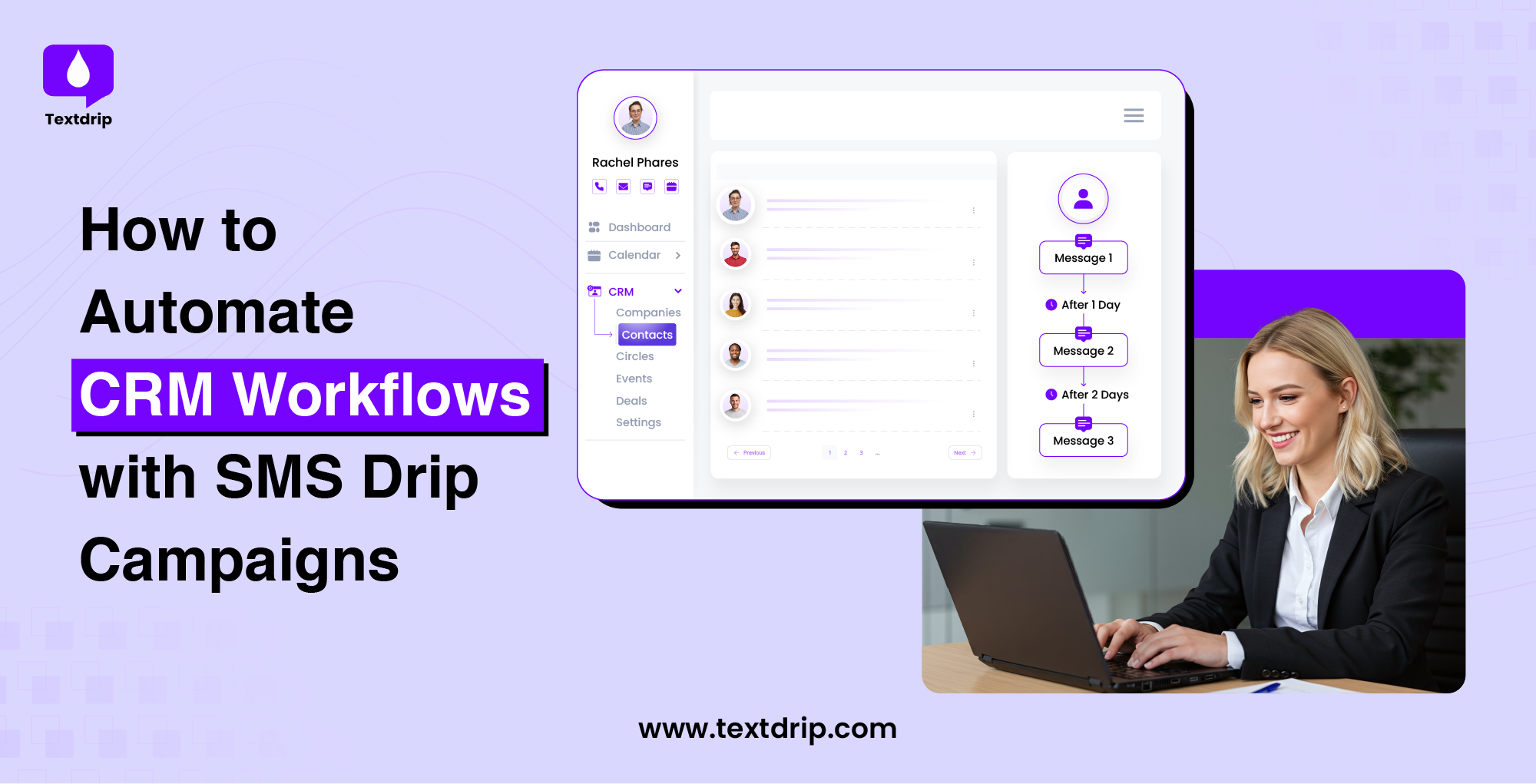
Textdrip

textdrip.com · Textdrip CRM Automation #3 of 5 in Drip Campaign Tools with Automation Workflows

Scrubs landlines before you text, but refunds aren't offered

Best forReal estate, insurance, and solar agents managing high-volume texting.

Free tier From $20 per month 10DLC compliantno refundsSMS automation
#3 in its ranking

SMS drip automation with a built-in Landline Remover and A2P 10DLC compliance tools.

Standout factRated 4.9 out of 5 on both Capterra and Software Advice textdrip.com
Biggest catchAll services are billed in advance and are non-refundable, with no prorated refunds for cancellations. textdrip.com
4.9/5Capterra ratingtextdrip.com
$19.99/moStarting pricetextdrip.com
8,000+Zapier integrationszapier.com

What reviewers say

Capterra
4.9/5
Software Advice
4.9/5

Source: textdrip.com

Plans

Spark Starter$19.99/mo
Growth Gear$34.99/mo

Source: textdrip.com

Upside

  • Built-in Landline Remover tool
  • Automated SMS drip campaigns
  • Strong A2P 10DLC compliance support

Catch

  • Strict no-refund policy
  • Mobile app bugs on Samsung devices
  • Credits expire upon cancellation
Pick it ifReal estate, insurance, and solar agents managing high-volume texting.
Skip it ifBusinesses wanting a primary email platform or full-stack CRM.
PricingSpark Starter $19.99/mo, Growth Gear $34.99/mo

Editor's takeTextdrip's Landline Remover checks numbers for DNC status, invalid entries, or landlines before a campaign sends, directly protecting 10DLC compliance and deliverability. Plans start at $19.99 monthly for the Spark Starter tier, and the platform holds a 4.9 out of 5 rating on both Capterra and Software Advice. All charges are non-refundable per its own policy, and Google Play reviews document keyboard and notification bugs on Samsung devices.

Does Textdrip offer refunds?

No. Its refund policy states all services are billed in advance and non-refundable, with no prorated refunds for cancellations.

What does Textdrip's Landline Remover do?

It checks contact lists for do-not-call status, invalid numbers, or landlines before sending, at roughly $0.0019 per check, to improve SMS deliverability and compliance.

The evidence: 6 criteria, 3 penalties
8.7
Product Capability & DepthLooked for: We evaluate the breadth of automation features, campaign management tools, and specialized SMS capabilities available for sales workflows.Textdrip offers robust SMS automation with drip campaigns, AI text generation, spin syntax, and a unique 'Landline Remover' tool to clean contact lists.textdrip.comtextdrip.comtextdrip.com
9.2
Market Credibility & Trust SignalsLooked for: We assess user ratings across major review platforms, compliance certifications, and the vendor's reputation for reliability.The platform holds high ratings across review sites and emphasizes strict adherence to 10DLC regulations, signaling a strong commitment to compliance and deliverability.textdrip.comtextdrip.com
8.9
Usability & Customer ExperienceLooked for: We look for ease of setup, interface intuitiveness, and the quality of the mobile experience for agents on the go.Users praise the clean desktop interface and ease of scheduling, though the mobile app has reported interface issues specifically with Samsung keyboards.textdrip.complay.google.complay.google.com
8.5
Value, Pricing & TransparencyLooked for: We analyze pricing structures, hidden costs, refund policies, and the overall ROI for small to mid-sized businesses.Pricing is competitive starting at $19.99/mo, but the strict no-refund policy and non-refundable credits reduce flexibility for users who may need to cancel.textdrip.comtextdrip.comtextdrip.com
9.4
Compliance & DeliverabilityLooked for: We examine features dedicated to regulatory compliance (10DLC, TCPA) and tools that ensure messages actually reach the inbox.Textdrip differentiates itself with built-in 10DLC registration support and a proprietary Landline Remover tool that scrubs lists to prevent failed delivery attempts.textdrip.comtextdrip.com
8.8
Integrations & EcosystemLooked for: We evaluate the platform's ability to connect with other CRMs, marketing tools, and data sources via native integrations or API.The platform connects with over 8,000 apps via Zapier and offers specific integrations for Salesforce and VanillaSoft, facilitating smooth data flow.textdrip.comzapier.comtextdrip.com

Score adjustments−0.14 points in total

−0.04Strict no-refund policy states that all services are non-refundable and no prorated refunds are given for canceled subscriptions.textdrip.com · severity 60/100
−0.05Mobile app users on Samsung devices report significant interface bugs, including the keyboard covering the text box and missing notifications.play.google.com · severity 50/100
−0.05The mobile app lacks advanced features found on the desktop version, such as in-depth analytics and full customization options.g2.com · severity 45/100
7

CRM.io

crm.io · CRM.io Automation for Lead Nurturing #2 of 5 in Nurturing Tools Integrated with CRM

CRM.io bundles 50+ apps and 120M contacts for $15

Best forStartups wanting 50+ integrated business apps at ultra-low cost.

From $15 per user/mo low-cost suiteB2B databaseRPA automation
#2 in its ranking

AI-powered CRM bundling a 120M+ B2B contact database and RPA automation into one low-cost suite.

Standout factFor $14.99 per user, CRM.io's 500apps suite includes 50 apps and a 120M+ B2B contact database. softwaresuggest.com
Biggest catchUsers report the platform is slow and laggy in daily use. g2.com
120M+B2B contact database sizecrm.io
50+Apps included in suitesoftwaresuggest.com

Starting price

$14.99/user/moincludes access to 50+ apps in the 500apps suite

Standout number

120M+verified B2B contacts in the built-in database

Source: crm.io

Upside

  • 50+ apps for about $15/user
  • Built-in 120M+ B2B database
  • Robotic process automation included

Catch

  • Platform reported as slow
  • Steep learning curve for beginners
  • Confusing suite vs standalone pricing
Pick it ifStartups wanting 50+ integrated business apps at ultra-low cost.
Skip it ifEnterprises needing high-speed performance and rock-solid stability.
PricingFrom $14.99/user/mo for 50+ apps in the 500apps suite, standalone plans from $39/mo

Editor's takeCRM.io's pitch is volume. For roughly $15 a user it bundles a CRM, a 120M-contact B2B database, and robotic process automation that would normally cost extra elsewhere. G2 reviewers confirm the low price but also flag consistent slowness, a tradeoff the vendor itself acknowledges is being worked on.

What's included in CRM.io's low-cost plan?

The $14.99/user 500apps suite includes CRM.io plus 50 other business apps, a 120M+ B2B contact database, lead enrichment, and robotic process automation for repetitive tasks.

Is CRM.io reliable at scale?

User reviews on G2 describe the platform as slow, though reviewers note the low cost offsets this and that the team is improving performance over time.

The evidence: 6 criteria, 2 penalties
8.9
Product Capability & DepthLooked for: We evaluate the breadth of lead management features, specifically looking for AI-driven automation, database integration, and multi-channel nurturing capabilities.CRM.io integrates advanced capabilities like an AI Agent for voice/text commands, built-in RPA for task automation, and a massive 120M+ B2B database directly into the CRM.crm.ioplay.google.com
8.8
Market Credibility & Trust SignalsLooked for: We assess the vendor's track record, user base size, and parent company stability to ensure long-term reliability.CRM.io is part of the 500apps 'Infinity Suite', which claims over 90,000 businesses as users and positions itself as a comprehensive ecosystem for growing companies.500apps.comb2saas.com
8.6
Usability & Customer ExperienceLooked for: We check for ease of setup, interface intuitiveness, and system performance based on real user feedback.Users generally find the interface intuitive and user-friendly, though there are documented complaints about the platform being slow or laggy during operation.b2saas.comg2.com
9.4
Value, Pricing & TransparencyLooked for: We analyze the pricing structure, hidden costs, and the feature-to-cost ratio compared to competitors.The product offers exceptional value through the 500apps 'Infinity Suite' model, providing access to 50+ apps for a low per-user monthly fee.softwaresuggest.comtechimply.com
9.1
Lead Intelligence & Data EnrichmentLooked for: We examine the product's ability to find, verify, and enrich lead data without requiring third-party integrations.CRM.io distinguishes itself with a built-in database of over 120 million B2B contacts and native lead enrichment tools, eliminating the need for separate data subscriptions.crm.iocrm.io
9.0
Automation & Workflow EfficiencyLooked for: We look for advanced automation capabilities like RPA, visual workflow builders, and AI-driven sequence management.The platform features robust automation including Robotic Process Automation (RPA) for repetitive tasks and AI-driven sales cadences for multi-channel outreach.crm.iocrm.io

Score adjustments−0.10 points in total

−0.06Users have reported that the platform can be slow and laggy, impacting the user experience.g2.com · severity 60/100
−0.04New users may face a learning curve due to the overwhelming number of features available in the suite.b2saas.com · severity 40/100
8

Oracle Eloqua

oracle.com · Oracle Lead Nurturing #3 of 5 in Nurturing Tools Integrated with CRM

Oracle Eloqua leads Gartner's Magic Quadrant 12 years running

Best forLarge enterprises with complex, multi-step B2B nurture campaigns.

From $2,000 per month enterpriseHIPAA500+ integrations
#3 in its ranking

Enterprise marketing automation platform with visual Campaign Canvas, predictive scoring and 500+ integrations.

Standout factOracle Eloqua has been a Gartner Magic Quadrant Leader for 12 consecutive years. blogs.oracle.com
Biggest catchBasic plans start around $2,000 a month, with Standard reaching $4,000. interruptmedia.com
12 yearsGartner Magic Quadrant Leader streakblogs.oracle.com
500+Prebuilt integrationsoracle.com

Plans

Standard$4,000/mo

Source: interruptmedia.com

Connects to

SalesforceMicrosoft DynamicsOracle CX SalesHIPAA Add-on500+ total

Source: oracle.com

Upside

  • Visual Campaign Canvas for complex flows
  • Predictive lead scoring on profile and engagement
  • HIPAA compliance add-on available

Catch

  • Starts around $2,000 per month
  • Steep learning curve reported
  • Support quality has reportedly declined
Pick it ifLarge enterprises with complex, multi-step B2B nurture campaigns.
Skip it ifSmall businesses with limited budgets and simple needs.
PricingFrom about $2,000/month, Standard tier near $4,000/mo

Editor's takeOracle Eloqua has held Leader status in Gartner's Magic Quadrant for 12 straight years. Its Campaign Canvas and predictive scoring handle nurture logic that overwhelms simpler tools. Getting there costs real money, with Basic plans starting near $2,000 a month.

How long has Oracle Eloqua led the market?

Oracle has been named a Gartner Magic Quadrant Leader for B2B Marketing Automation Platforms for 12 consecutive years, through 2024.

How much does Oracle Eloqua cost?

Basic plans start around $2,000 a month, with Standard tiers near $4,000. Pricing requires a custom quote for full enterprise features.

The evidence: 5 criteria, 3 penalties
9.1
Product Capability & DepthLooked for: We evaluate the sophistication of automation workflows, lead scoring precision, and multi-channel orchestration capabilities for complex B2B cycles.Oracle Eloqua features a visual 'Campaign Canvas' for complex multi-step workflows and predictive lead scoring that combines profile and engagement data. It supports advanced segmentation and dynamic content, though some users note form management can be rigid.oracle.comoracle.comdocs.oracle.com
9.3
Market Credibility & Trust SignalsLooked for: We assess industry recognition, analyst rankings, and longevity in the enterprise marketing automation space.Oracle Eloqua has been named a Leader in the Gartner Magic Quadrant for B2B Marketing Automation Platforms for over 12 consecutive years. It is a veteran solution widely adopted by large enterprises for its stability and scalability.blogs.oracle.cominterruptmedia.com
8.2
Usability & Customer ExperienceLooked for: We examine the user interface design, ease of learning, and quality of customer support services.Users consistently report a steep learning curve and describe the interface as 'dated' compared to modern competitors. Recent reviews also highlight a decline in support quality, with some enterprise customers citing a loss of 'white glove' service.oracle.comg2.comg2.com
8.6
Value, Pricing & TransparencyLooked for: We analyze pricing structures, entry costs, and contract transparency relative to enterprise value.Pricing is premium, typically starting around $2,000 to $4,000 per month, making it prohibitive for smaller businesses. It offers high value for large enterprises but requires long-term contracts and negotiation for volume.oracle.cominterruptmedia.comcrozdesk.com
9.2
Security, Compliance & Data ProtectionLooked for: We look for the breadth of pre-built integrations and the robustness of the API for connecting with the wider martech stack.The platform boasts over 500 prebuilt integrations via the Oracle Cloud Marketplace. It features native integrations for major CRMs like Salesforce and Microsoft Dynamics, supported by a robust API for custom connections.oracle.comdocs.oracle.comblogs.oracle.com

Score adjustments−0.14 points in total

−0.06Users consistently report a steep learning curve, noting the platform is complex and difficult to master without significant training.g2.com · severity 60/100
−0.05Long-term customers have reported a decline in support quality, citing a loss of personalized 'white glove' service and unresponsiveness.gartner.com · severity 50/100
−0.03The high starting price (approx. $2,000/month) and premium-only model create a significant barrier to entry for non-enterprise organizations.interruptmedia.com · severity 45/100
02

Every ranking in Drip Campaign & Lead Nurturing Tools

Each card shows the top three. The eye opens a quick look. Open a ranking for every product, the evidence and the comparison table.

Best Drip Campaign Tools for Ecommerce

6 productsUpdated Aug 2026
1 EZ Texting230,000+ businesses served, but credits expire in 12 months. 9.0/10
Visit ↗
2 DripDrip skips a free plan, live chat needs $99/mo 8.8/10
Visit ↗
3 Zoho Campaigns6,000 free emails a month, but accounts can suspend fast 8.8/10
Visit ↗
See all 6 ranked
1 DripDrip syncs Shopify and WooCommerce data for segmentation 8.8/10
Visit ↗
2 KlaviyoKlaviyo bills for every contact, even unsent ones 8.8/10
Visit ↗
3 TextdripScrubs landlines before you text, but refunds aren't offered 8.8/10
Visit ↗
See all 5 ranked
1 Salesforce AgentforceAgentforce reasons through outreach, caps emails at 1,800 daily 8.9/10
Visit ↗
2 CRM.ioCRM.io bundles 50+ apps and 120M contacts for $15 8.8/10
Visit ↗
3 Oracle EloquaOracle Eloqua leads Gartner's Magic Quadrant 12 years running 8.8/10
Visit ↗
See all 5 ranked
03

About Drip Campaign & Lead Nurturing Tools

What the category is, how it developed, and what to look for. Two minutes, or the long read.

This category covers software designed to automate the delivery of sequential, behavior-triggered communications to prospects and customers throughout their lifecycle: engaging cold leads, accelerating pipeline velocity, onboarding new users, and retaining existing accounts. It sits distinctly between Email Marketing (which focuses on broadcast/batch-and-blast communications) and CRM (which focuses on recording transactional data and sales interactions). While it often overlaps with broader "Marketing Automation" platforms, Drip Campaign & Lead Nurturing Tools are specifically defined by their ability to orchestrate multi-step workflows based on "if/then" logic, time delays, and user engagement signals.

Read the full category guide

What Is Drip Campaign & Lead Nurturing Tools?

Unlike simple autoresponders that send a linear sequence of emails regardless of recipient behavior, this category includes sophisticated decision engines that adapt the path of communication based on real-time data—such as website visits, email clicks, or CRM field updates. It encompasses both general-purpose platforms suitable for B2B tech and professional services, and vertical-specific tools tailored for high-volume B2C sectors like retail and e-commerce. The scope extends beyond mere message delivery to include lead scoring, audience segmentation, and cross-channel synchronization, ensuring that the right message reaches the right stakeholder at the precise moment of intent.

For buyers, the critical distinction lies in the tool's ability to manage state—knowing where a prospect is in the buying journey and suppressing or elevating them accordingly—rather than just managing a list.

History of the Category

The lineage of modern drip campaign tools traces back to the gap left by early Contact Management Systems (CMS) and the first generation of email blasting tools in the 1990s. In 1992, Unica launched one of the first enterprise marketing management systems, pioneering the concept that marketing could be an engineered, repeatable process rather than a series of ad-hoc creative acts [1]. However, the internet user base was too small to support widespread automation until the late 90s.

The true category definition began in 1999 with the launch of Eloqua. Originally conceived as a chat/messaging tool, Eloqua pivoted to focus on lead management and automated follow-up, fundamentally creating the "Marketing Automation" category to serve complex B2B sales cycles that required more than a monthly newsletter [2]. This era marked the shift from "database marketing"—static queries of customer lists—to "behavioral marketing," where actions like visiting a pricing page could trigger a response.

The mid-2000s saw the democratization of these tools. HubSpot (2006), Marketo (2006), and Pardot (2007) entered the market, moving the technology from on-premise server rooms to the cloud [3]. This transition was critical; cloud delivery allowed vendors to track web activity via tracking pixels, a capability that on-premise software struggled to implement effectively. The ability to link an email click to a website visit and subsequently score that lead was the technological leap that separated "Drip Tools" from "Email Service Providers" (ESPs).

The 2010s were defined by massive market consolidation, turning standalone tools into suites. In 2012, Oracle acquired Eloqua for $871 million. In 2013, Salesforce acquired ExactTarget (which had just acquired Pardot) for $2.5 billion, effectively integrating B2B and B2C nurturing capabilities under one CRM roof [4]. Adobe followed suit, acquiring Marketo in 2018 for $4.75 billion. This wave of acquisitions signaled that lead nurturing was no longer a satellite function but a core component of the enterprise revenue stack. Today, the market has bifurcated again: while the giants remain, a new wave of vertical-specific SaaS has emerged to handle the specialized nurturing needs of e-commerce and niche industries, challenging the "all-in-one" philosophy.

What to Look For

Evaluating drip campaign software requires looking past the glossy "visual builders" that every vendor demonstrates. The visual appeal of a drag-and-drop editor is often inversely correlated with the underlying power of the data model.

Critical Evaluation Criteria:

  • Data Model Flexibility: Can the tool handle "one-to-many" data relationships? For example, if a customer purchases three different products, can the system trigger three separate, concurrent nurture tracks without overwriting the data of the previous purchase? Many entry-level tools flatten data into a single contact record, making it impossible to nurture a customer for multiple distinct product lines simultaneously.
  • Latency and Throughput: In B2B, a 15-minute delay in sending a whitepaper is acceptable. In e-commerce, a 15-minute delay in a password reset or cart recovery email can kill the conversion. Ask specifically about the "time-to-inbox" for behavioral triggers during peak loads (e.g., Black Friday).
  • Suppression Logic: A robust tool must excel at not sending emails. Look for "global suppression" features that automatically pull a lead out of a top-of-funnel nurture track the moment an Opportunity is created in the CRM. If this requires complex manual rule-writing, it will break.

Red Flags and Warning Signs:

  • "All-in-One" Bloat: Be wary of vendors selling a CRM, Helpdesk, and CMS in the same package as the nurturing tool, unless they can prove the nurturing engine is best-of-breed. Often, the "drip" feature in these suites is a glorified autoresponder lacking branching logic.
  • Opaque IP Warming Policies: If a vendor claims you can start sending 50,000 emails a day immediately on a dedicated IP, they are setting you up for deliverability failure. A credible vendor will mandate a warm-up schedule [5].

Key Questions to Ask Vendors:

  • "How does your system handle 'race conditions'—if a user triggers two conflicting workflows simultaneously, which one wins?"
  • "Can I trigger workflows based on changes to a field value (e.g., Lead Score increases by 10 points) rather than just the value itself?"
  • "Do you support 'event properties' in your segmentation? (e.g., specifically targeting users who bought a 'Red' shirt, not just users who performed the 'Buy' event)."

Industry-Specific Use Cases

Retail & E-commerce

For retailers, drip campaigns are less about "nurturing" and more about "revenue recovery" and "lifecycle maximization." The evaluation priority here is deep integration with inventory and point-of-sale data. Unlike B2B, where the sales cycle is months long, e-commerce cycles are measured in minutes. Tools must support high-velocity triggers like Price Drop Alerts and Back in Stock notifications. A critical capability is the "dynamic product feed," which pulls live pricing and image data into the email at the moment of open, not the moment of send. If a customer opens a cart abandonment email three days later and the item is out of stock, the email should dynamically update to show a related in-stock item.

Specific needs include Cart Abandonment logic that suppresses the email if a purchase occurs via a different channel (e.g., mobile app) within the window. According to Baymard Institute, the average cart abandonment rate hovers around 70% [6], making the reliability of this specific workflow a direct revenue driver. Retailers should also look for "replenishment" logic—calculating the average usage rate of a consumable product (like shampoo) and triggering a reminder email exactly when the customer is predicted to run out.

Healthcare

Healthcare organizations face a unique constraint: HIPAA compliance. Drip tools in this sector must sign a Business Associate Agreement (BAA) and often need to operate in a way that separates Protected Health Information (PHI) from marketing data. Nurturing sequences here are often educational "care pathways." For example, a patient scheduling a knee replacement might enter a 6-week pre-op drip sequence with nutritional advice and preparation checklists. [7].

A unique consideration is "blind" triggering. Marketing teams may need to trigger emails based on a diagnosis code in the Electronic Health Record (EHR) without actually storing that diagnosis code in the marketing platform. The integration must be able to receive an opaque ID or token that triggers "Campaign A" without the marketing tool knowing that "Campaign A" is for "Diabetes Management," thus minimizing data exposure risk.

Financial Services

Trust and regulatory compliance (FINRA, SEC, GDPR) drive this sector. Use cases heavily focus on Client Onboarding and KYC (Know Your Customer) collection. When a client opens an account, a drip sequence must chase them for document uploads (ID proofs) without being annoying. This requires "smart retries"—checking if the document was uploaded before sending the reminder.

Advisors also use drip tools to maintain "share of mind" without manual effort. A key feature to look for is content compliance approval workflows, where a central compliance officer must approve a template before any local agent can activate it for their book of business. This prevents rogue messaging that could result in fines. Additionally, security protocols like audit logs for every email sent are non-negotiable [8].

Manufacturing

Manufacturing sales cycles are long, complex, and often indirect (via distributors). Lead nurturing tools here must support Channel Partner Enablement. Manufacturers often use drip campaigns to nurture the distributor rather than the end-user, sending product spec updates, training materials, and pricing changes to keep their channel partners engaged. [9].

Another specific workflow is the "Post-Trade Show" sequence. Manufacturers collect thousands of badge scans at expos; the tool must be able to ingest these lists, de-duplicate them against the CRM, and route them to appropriate regional sales engineers based on complex territory assignments. Integration with ERP systems (like SAP or Oracle) is often required to trigger nurturing based on warranty registrations or service contract expirations.

Professional Services

Law firms, consultancies, and agencies sell expertise, not products. Their drip campaigns focus on Thought Leadership and Event Nurturing. The goal is to establish authority over time so that when the client has a crisis or need, the firm is top-of-mind. Statistics show that 55% of decision-makers use thought leadership to vet organizations [10].

Evaluation priorities include high-quality plain-text email rendering. Unlike retail, professional services emails should look like they were typed personally by a partner, not designed by a marketing team. "On-behalf-of" sending capabilities are crucial, where the email technically comes from the marketing automation platform but appears to be sent personally from the specific partner or consultant who owns the relationship.

Subcategory Overview

Drip Campaign Tools with Automation Workflows

This subcategory represents the "brain" of the operation. Unlike basic autoresponders that send Email 1 -> Email 2 -> Email 3, these tools utilize a visual canvas to map complex, branching customer journeys. What makes this niche genuinely different is the decision logic. These platforms can evaluate boolean conditions in real-time (e.g., "Has the user visited the pricing page more than twice in the last 7 days?").

A workflow only this tool handles well is the "Split-Path Testing" nurture. You can send 50% of leads down "Path A" (aggressive sales pitch) and 50% down "Path B" (educational soft sell), then automatically merge the winner back into the main track. Buyers move toward this niche when they hit the "linear wall"—the realization that treating every lead the same is burning their list. For a deeper analysis of these capabilities, see our guide to drip campaign tools with automation workflows.

Drip Campaign Tools for Ecommerce

This niche is defined by its data schema. General purpose tools have "Contacts" and "Companies." Ecommerce tools have "Customers," "Orders," and "Products." This distinction is vital. A general tool struggles to trigger an email based on "User bought a product from Category: Shoes AND Size: 10." Ecommerce-specific tools ingest the store's entire catalog and transaction history natively.

The pain point driving buyers here is revenue attribution. General tools track "opens" and "clicks." Ecommerce tools track "Revenue generated per email." They can execute workflows like "Win-Back," identifying customers who haven't purchased in 90 days and automatically generating a dynamic discount code that expires in 48 hours. To explore tools built for this specific data model, read our guide on drip campaign tools for ecommerce.

Nurturing Tools Integrated with CRM

This category focuses on the alignment between marketing and sales. These tools often exist as native add-ons or deeply integrated partners to major CRMs like Salesforce or Microsoft Dynamics. The differentiator is the bi-directional sync. Marketing activity (email opens, clicks) flows into the Sales CRM view, and Sales activity (log a call, change deal stage) triggers Marketing actions.

Only these tools handle the "Sales-to-Marketing Handoff" effectively. For example, if a Sales Rep marks a lead as "Not Ready" in the CRM, this tool instantly pulls that lead into a "Long-Term Nurture" track, ensuring they aren't dropped. Buyers choose this niche to solve the "black hole" problem where leads sent to sales disappear forever. For solutions that bridge this gap, check our reviews of nurturing tools integrated with CRM.

Integration & API Ecosystem

In the modern stack, a drip tool that cannot talk to other systems is an island of lost data. A robust API ecosystem is not just about having "plugins"; it's about the throughput and reliability of those connections. According to Gartner, complexity is the top barrier to martech adoption, often stemming from poor integration capabilities [11].

Expert Insight: A common failure point is the API call limit. Most platforms tier their API limits based on pricing plans. If you are syncing 50,000 contacts from your CRM to your marketing tool daily, and your limit is 20,000 calls, your sync will fail silently halfway through, leaving your data in an inconsistent state.

Real-World Scenario: Consider a mid-sized professional services firm of 50 people using a separate CRM and Project Management tool. They set up a drip campaign to ask for reviews 30 days after a project is marked "Complete." However, the integration was designed as a one-way push. When a project manager reopened a project due to a client complaint, the "Complete" status remained in the drip tool because the "re-open" event wasn't mapped. The result: the client received a "Hope you loved our work!" email while actively disputing a bill. This illustrates why bi-directional, real-time state management is non-negotiable for integration.

Security & Compliance

With regulations like GDPR, CCPA, and HIPAA, the security architecture of your drip tool is a legal liability. It is insufficient to simply ask "Is it secure?" You must audit the Right to be Forgotten workflow. When a user requests data deletion, does the tool delete them from the active mailing list and the backup archives? Does it push that deletion request back to your CRM?

Expert Insight: "Data residency" is becoming a critical deal-breaker. European regulations often require that data on EU citizens be hosted on servers physically located within the EU. Forrester notes that privacy regulations are reshaping data management strategies globally, making compliance a strategic imperative rather than just a legal box to check.

Real-World Scenario: A financial services company using a US-based drip tool for European clients was fined because they couldn't prove that the data processing occurred on EU soil. Furthermore, they lacked an audit trail to prove a specific user had opted in. The tool they chose didn't store the metadata of the sign-up (IP address, timestamp, form source) alongside the email address. Without that "proof of consent," they were defenseless against a GDPR complaint. Always verify that your tool logs the context of the consent, not just the contact info.

Pricing Models & TCO

Pricing in this category is notoriously opaque. The headline price is rarely the Total Cost of Ownership (TCO). Most models are based on "Contact Tiers" (e.g., up to 10,000 contacts) or "Email Volume" (e.g., up to 50,000 sends/month). The trap lies in the definition of a "Contact." Does the vendor count unsubscribed or bounced contacts against your tier limit? Many do, forcing you to pay for dead data unless you manually purge it.

Expert Insight: Be wary of "Overage Fees." If you exceed your email sending limit during a holiday spike, some vendors charge a premium rate for every extra 1,000 emails that can be 3x-5x the standard rate. Additionally, features like Dedicated IPs often carry a hefty monthly surcharge, sometimes $200-$500/month on top of the license fee.

Real-World Scenario: A fast-growing SaaS company with 25,000 leads signed a contract for $500/month. They didn't realize the contract counted "Marketable Contacts" differently from "Total Database." They had 100,000 historical leads they wanted to keep for archival purposes but not email. The vendor's pricing model counted all database records. Their bill jumped to $2,000/month simply for storing inactive rows. A proper TCO calculation must include storage of inactive records, overage buffers, and the cost of necessary add-ons like "Advanced Reporting."

Implementation & Change Management

The number one reason for drip campaign failure is not software bugs, but "content starvation." Organizations buy a powerful tool capable of complex 12-step journeys but only have enough content for two emails. Implementation plans must front-load content creation.

Expert Insight: IP Warming is a critical implementation step often ignored. You cannot switch vendors on Friday and send 1 million emails on Monday. You must ramp up volume over 4-8 weeks to build reputation with ISPs [5]. Ignoring this results in your domain being blacklisted, a disaster that can take months to fix.

Real-World Scenario: A manufacturing firm migrated from a legacy on-premise system to a modern cloud drip tool. They migrated 50,000 "hard bounce" emails because they didn't clean their data first. They sent a blast on Day 1. The high bounce rate (>10%) triggered spam filters at Google and Outlook immediately. Their domain reputation tanked, and for the next three weeks, even their transactional invoices were going to spam. Implementation is 80% data hygiene and warming, 20% software configuration.

Vendor Evaluation Criteria

When creating a shortlist, look beyond the feature matrix. Support responsiveness is your lifeline. Test their support before you buy. Submit a technical ticket about API documentation during your trial and measure the time and quality of the response. Do you get a generic link to a knowledge base, or a specific answer from an engineer?

Expert Insight: According to the MarTech Replacement Survey, marketing automation platforms are the most frequently replaced tool in the stack [12]. This churn is driven by teams over-buying complexity they cannot manage. Vendor evaluation should prioritize "Time to Value." Ask the vendor: "What is the average time from contract signing to the first live campaign launch for a team of our size?"

Real-World Scenario: A retail brand evaluated Vendor A (Enterprise Leader) and Vendor B (Mid-Market Challenger). Vendor A had "AI Predictive Sending," but required a 6-month implementation with a certified consultant. Vendor B lacked the AI feature but offered a 1-click Shopify integration. The retailer chose Vendor B, launched in 2 weeks, and captured $50k in abandoned cart revenue before Vendor A would have even finished the kickoff call. Speed of execution often trumps theoretical feature superiority.

Emerging Trends and Contrarian Take

Emerging Trends 2025-2026: The era of linear "if/then" nurture tracks is ending. We are moving toward AI Agentic Workflows. Instead of hard-coding "Wait 3 days, Send Email 2," marketers will define a goal ("Book a Demo") and an AI agent will dynamically decide the channel, timing, and content for each individual lead based on real-time signals. Gartner predicts that by 2026, 80% of B2B sales interactions will occur in digital channels powered by AI [13]. Another shift is the move from "Lead-Based" to "Buying-Group-Based" nurturing, acknowledging that B2B decisions are made by committees, not individuals.

Contrarian Take: Most mid-market businesses are over-nurturing and under-qualifying. The industry obsession with "nurture tracks" has created a zombie workforce of marketers building 12-step email sequences that nobody reads. The contrarian truth is that Signal-Based Marketing beats Nurture Tracks. Instead of trapping a lead in a 6-month educational drip, businesses would get higher ROI by simply monitoring for high-intent signals (like visiting the pricing page or legal terms page) and having a human sales rep reach out immediately. The "set it and forget it" promise of drip campaigns is a lie; if you aren't optimizing it weekly, it's likely decaying your brand value by sending irrelevant noise.

Common Mistakes

Over-Engineering the First Campaign: Buyers often try to map out a "perfect" master flowchart with 20 branches before launching a single email. This leads to "analysis paralysis." Start with a simple linear sequence and add complexity only when data justifies it.

Ignoring the "Unsubscribe" Experience: Most teams treat the unsubscribe page as an afterthought. However, a frustrating unsubscribe process (e.g., requiring a login to unsubscribe) generates spam complaints. High spam complaint rates (above 0.1%) can get your sending domain suspended. Make unsubscribing easier than signing up.

The "Data Silo" Trap: Purchasing a drip tool that doesn't sync bi-directionally with your CRM is a fatal error. If a sales rep closes a deal, but the drip tool doesn't know, the customer will receive a "Why haven't you bought yet?" email the next day. This destroys credibility instantly.

Questions to Ask in a Demo

  • Deliverability: "Do you use shared or dedicated IPs for my tier? If shared, how do you police 'bad neighbor' clients who might ruin the IP's reputation?"
  • Data: "How do you handle 'soft bounces' versus 'hard bounces'? At what point does your system automatically stop emailing a bouncing address?"
  • API: "What is the maximum number of API calls allowed per minute? What happens if we exceed it—do calls queue or fail?"
  • Support: "Is support based in-house or outsourced? What are the support hours in my specific time zone?"
  • Scalability: "If my database doubles in size next year, what does the pricing curve look like? Show me the renewal price now."

Before Signing the Contract

Final Decision Checklist:

  • Data Exit Strategy: Ensure the contract states you own your data and defines the format (CSV/SQL) in which you can export it if you leave.
  • SLA (Service Level Agreement): Negotiate an uptime guarantee. "99% uptime" sounds good but allows for 3.65 days of downtime a year. Push for 99.9%.
  • IP Warming Period: Ensure the contract start date accounts for the 4-week warming period where you cannot fully utilize the tool. Ask for a discounted "ramp" period.
  • Hidden Limits: Check for caps on "Email Previews" (testing how emails look in different clients) or "User Seats." These are often restricted in lower tiers.

Common Negotiation Points: Vendor pricing is often elastic at the end of the quarter. Ask for the "onboarding fee" to be waived or converted into additional support hours. Lock in renewal caps (e.g., "price cannot increase by more than 5% upon renewal") to avoid predatory hikes once you are locked in.

Closing

Selecting the right Drip Campaign & Lead Nurturing tool is a balance between your current operational maturity and your future ambitions. Do not buy for where you hope to be in five years; buy for what your team can execute today, with a clear path to scale. If you have specific questions about your tech stack or need a sounding board for your decision, feel free to reach out.

Email: albert@whatarethebest.com

04

Research

Original reporting on this corner of the market.

All research

Marketing tools multiplied from 150 in 2011 to 15,384 applications by 2024

May 19, 2026

Automated campaigns generate 320% more revenue than manual execution

May 14, 2026

Creatives spend 70% of their work hours managing manual tasks across disconnected software

Apr 26, 2026
05

Questions people ask

Which Drip Campaign & Lead Nurturing Tools is best?

EZ Texting holds the highest score in the category at 9.0, in Drip Campaign Tools for Ecommerce. The right pick depends on the ranking that matches your use case, so start with the ranking list above.

Why are there 3 separate rankings?

Buyers in Drip Campaign & Lead Nurturing Tools have different jobs, so each ranking is scoped to one of them and weights the six criteria for that job. The same product can hold different ranks in different rankings.

How are the scores produced?

Documentation, pricing pages, security pages and third-party reviews are reviewed against six criteria. Each criterion records what was found and links its sources. Penalties pull the score down and are shown with their evidence. Rank follows the score. Full methodology.

06

More in Marketing & Advertising

The whole group