


The data highlights a significant transformation in IT Helpdesk & Ticketing Systems driven by generative AI adoption over the past few years. It shows how AI integration is rapidly bridging the efficiency gap, drastically reducing Mean Time to Resolve (MTTR) metrics and autonomously handling a majority of routine support queries. This is highly interesting because it shifts the focus from traditio
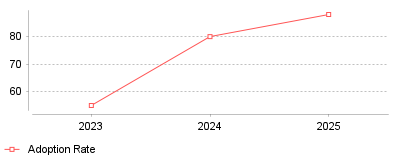
| Year | Adoption Rate |
|---|---|
| 2023 | 55 |
| 2024 | 80 |
| 2025 | 88 |
This trend illustrates the rapidly growing divide between IT service desks that have adopted generative AI and those that still rely on traditional manual processes. Recent data reveals that organizations implementing GenAI have seen their average incident resolution times (MTTR) plummet from roughly 32.5 hours to just 22.5 hours, while AI-native autonomous agents are now successfully resolving 65% of initial support queries without any human intervention [source][source].
At a micro level, this data means that individual IT agents are spending significantly less time on repetitive tasks, such as password resets or basic ticket categorization, allowing them to shift their focus toward complex problem-solving and proactive root-cause analysis [source]. For the broader ITSM industry, this establishes an entirely new competitive baseline where delayed response times and bloated service desk queues are no longer deemed acceptable by the modern workforce. The widening performance gap is effectively creating a two-tiered industry: AI-enabled organizations that can scale their support efficiently, and legacy-bound organizations facing escalating labor costs and user frustration. Furthermore, it indicates that the traditional role of a reactive IT support agent is effectively dying, evolving instead into an AI-augmented service engineer tasked with governing AI knowledge bases rather than answering basic queries [source].
This shift is critically important because it directly impacts both the operational expenditure and the overall digital experience within enterprise environments. A reduction in MTTR by nearly 10 hours per incident translates to massive financial savings; for instance, a team handling 5,000 incidents annually can reclaim tens of thousands of productivity hours, yielding hundreds of thousands of dollars in cost efficiencies [source]. Additionally, as organizations increasingly depend on uninterrupted cloud and digital infrastructure, faster resolution times directly correlate to minimized operational downtime, fewer service level agreement (SLA) breaches, and much higher organizational resilience [source].
The primary catalyst for this trend is the rapid commercialization and sophisticated integration of Large Language Models (LLMs) into mainstream IT ticketing platforms over the last 24 months. Helpdesk systems have swiftly moved beyond rudimentary keyword-matching chatbots to context-aware AI assistants that are capable of understanding nuance, analyzing historical incident data, and executing complex user intents [source]. Furthermore, IT budgets have been constrained by macroeconomic pressures, forcing CIOs to seek technology-driven efficiency gains and intelligent automation rather than simply expanding their human headcount. Finally, a cultural shift towards deep self-service among users—who increasingly expect instant, frictionless resolutions akin to modern consumer-grade apps—has pressured IT departments to implement robust, "always-on" autonomous agents that do not sleep [source].
The integration of generative AI within IT Helpdesk and Ticketing Systems is no longer an experimental luxury but a core operational necessity. As AI continues to securely and autonomously resolve upwards of 65% of routine queries, the daily focus of the IT service desk will permanently shift from repetitive triage to advanced systems governance and infrastructure optimization. The prominent takeaway is that organizations failing to adopt AI-native ticketing workflows will face an insurmountable efficiency gap, suffering from higher operational costs and drastically inferior resolution times compared to their AI-enabled peers.
Global IT spending will reach $5.72 trillion in 2025 [1]. Software purchases drive this macroeconomic expansion. Within these enterprise budgets, the IT ticketing systems category commands significant capital investment. The global service management market reached $10.5 billion in 2023 and will grow to $22.1 billion by 2028 [2].
North American markets generate the highest regional revenue. The North American IT services sector achieved a $1,220 billion valuation in 2024 [3]. Cloud infrastructure dominates this geography. Cloud deployments accounted for 62.8% of the total regional market share [3]. Organizations demand flexible hosting environments to support remote personnel.
Two software providers control enterprise deployments. ServiceNow reported $2.86 billion in subscription revenue during the fourth quarter of 2024 [4]. The company closed 2024 with 2,109 customers spending more than $1 million in annual contract value [4]. Atlassian followed with $3.5 billion in 2023 revenue [5]. These vendors execute core operational mandates. They track hardware assets, map software dependencies, and coordinate incident resolution.
Operating a service desk requires intense capitalization.
Labor expenses dictate baseline profitability. Support desks spend most budgets on personnel compensation. Facilities, telecommunications, and software licensing represent fractional costs. MetricNet data highlights extreme variance across different communication channels. Voice interactions cost $17.19 per ticket on average [6]. Chat resolutions average $15.72 per transaction [6].
Outsourced providers structure pricing around user counts. Basic monitoring costs between $37 and $100 per user monthly [7]. Premium services charge between $125 and $220 for identical headcounts [7]. A 40-employee company spends approximately $5,000 monthly for continuous coverage.
Companies seeking cost control often implement escalation tiers. The three-tier model intercepts simple inquiries at the lowest compensation level. This structure prevents system engineers from resetting passwords. Establishing defined tiers reduces average resolution times from 4.2 hours to 2.8 hours [8]. Organizations achieve a 72% first-call resolution rate when using hierarchical escalation, compared to 45% for flat teams [8].

Meta recorded personnel departures 17.5 times higher than the sector average in 2023 [9].
Technology upgrades fail without stable personnel. Support centers face 40% annual turnover [10]. This attrition exceeds the broader industry average of 16% [11]. Agent departures create immediate liabilities. Domestic businesses spend $12,000 to replace one agent [10]. This figure includes recruitment expenses, onboarding requirements, and lost productivity.
Turnover rates vary by facility size. Call centers with more than 200 seats experience twice the attrition of offices with fewer than 50 seats [12]. Agents in massive facilities handle continuous queues. They manage concurrent chats and field consecutive calls without administrative breaks.
Tenure does not guarantee retention. Aura Workforce Analytics found that most sector exits occur among personnel with ten or more years of experience [9]. Meta and Microsoft led this senior attrition. When veteran technicians leave, they remove institutional memory. This knowledge drain lowers resolution metrics.
System upgrades often degrade customer service.
Most organizations replace their support platform every five years [13]. They outgrow legacy features or react to pricing changes. The transition phase spans eight to sixteen weeks. Enterprise migrations require up to 24 weeks when teams move large ticket archives [13].
Data loss remains a critical transition hazard. Only 35% of migration teams execute validation scripts before decommissioning legacy systems [13]. Integration failures cause 45% of deployment delays. Support technicians suffer a 20% to 30% productivity drop during the initial weeks following a system cutover [13].
Administrators who evaluate cybersecurity and privacy tools face integration hurdles during these database migrations. Custom interfaces break. Identity protocols fail. IT leaders must schedule software replacements during quiet periods. Running parallel systems for two weeks reduces post-migration incidents by 70% compared to hard cutoffs [13].
Context dictates software configuration.
Mobility dictates software selection for field services. Electricians, plumbers, and technicians operate from mobile devices. When configuring a ticketing platform for construction contractors, administrators prioritize offline synchronization. Field workers lose cellular connectivity in concrete basements or remote sites. The application must queue data locally and transmit updates upon network reconnection.
Response metrics dominate hiring operations. Recruiters lose placements if internal systems fail during interview scheduling. A helpdesk deployment for recruitment agencies requires direct integration with applicant databases. When an agent receives a reset request, the software should automatically link the ticket to the recruiter's active pipeline. This contextual data reduces resolution time [14].
Technology environments demand deep interconnectivity. Developers generate complex server requests. Implementing service desk software for SaaS companies involves connecting issue trackers with code repositories. Freshservice benchmark data shows that integrating external applications improves resolution speed by 23% [15]. Technicians resolve tickets faster when they view code commits alongside incident reports.
Workforce management generates massive overhead. Onboarding requests overwhelm standard queues. A dedicated IT support platform for staffing agencies must automate credential provisioning. When an agency places 50 temporary workers at a warehouse, the IT department cannot manually create 50 email accounts. Automated workflows execute these routine tasks without human intervention.
Tracking performance often harms actual productivity.
Managers rely on standardized metrics to evaluate personnel. The HDI report identifies response time and customer satisfaction as the primary North American metrics [16]. Technicians focus on clearing queues quickly to maintain acceptable averages. This speed incentive sometimes conflicts with resolution quality.
The volume metric illustrates this tension. The optimal target hovers around eight tickets per hour [16]. However, not all tickets require equal effort. A password reset takes seconds, while a database restoration demands hours. Evaluating employees strictly on volume penalizes senior engineers who handle complex escalations.
Ticket costs present similar analytical hazards. A higher cost does not inherently signal operational failure. If a helpdesk automates its simplest requests, the remaining tickets represent complex problems that require expensive labor. Consequently, the average cost per manual ticket rises while the departmental budget shrinks. MetricNet explicitly warns that comparing internal costs to industry benchmarks is misleading if cost structures differ [16].
IT environments suffer from software bloat.
Service management has evolved into a massive integration challenge. Organizations historically purchased separate platforms for human resources, facilities, and technical support. Today, market forces push companies toward consolidated architectures. Forrester notes that separating from a primary vendor requires immense capital [17].
Replacing a central platform resembles a corporate divorce. Companies lose historical data, workflow investments, and custom integrations. Recovering transition costs takes a minimum of three years [17]. Despite these switching penalties, technology leaders consolidate tools to eliminate licensing redundancies. Consolidating operations onto a single platform improves visibility across departments.
Centralized platforms carry financial risks. As organizations expand platform usage across sales and service departments, licensing costs multiply rapidly [17]. Budget managers must distribute these software costs back to the business units. Without this financial distribution, the IT department appears unnecessarily expensive on corporate ledgers.
Compliance penalties force strict categorization.
Security directly impacts ticket routing. When an employee reports a phishing email, standard procedures fail to capture the organizational risk. A breach involving employee information requires immediate escalation to compliance officers [18]. The Ponemon Institute notes an increase in data breaches involving personnel data.
Organizations integrate their ticketing software with monitoring tools to accelerate threat response. IBM research shows that deploying security AI saves organizations $1.76 million per incident compared to manual operations [18]. When a firewall detects an anomaly, the monitoring tool automatically generates a high-priority ticket in the support queue.
This automated ticketing requires precise configuration. If security tools generate tickets for every port scan, alert fatigue overwhelms the support staff. Engineers ignore critical warnings hidden among automated alerts. The configuration database must correlate incoming alerts with asset vulnerabilities to prioritize human review accurately.
Distributed workforces break local hardware support.
Remote employment permanently altered support logistics. Technicians can no longer walk across the office floor to repair a malfunctioning laptop. HDI reports that a majority of organizations now handle support tickets outside of normal business hours [19]. Specifically, 29% maintain 24-hour support centers to accommodate distributed teams [19].
Shipping logistics complicate asset management. When a remote employee damages a company computer, the IT department must coordinate overnight shipping for a replacement device. The ticketing system tracks the physical tracking numbers, procurement costs, and software imaging status in a single record. This logistical overhead increases the average resolution time for hardware incidents.
Asynchronous communication replaces live troubleshooting. Instead of calling a helpdesk, remote workers submit tickets via corporate chat applications like Microsoft Teams or Slack. Submitting issues through collaboration channels reduces resolution times by 45% compared to email submissions [15]. Technicians receive immediate context and can launch remote screen-sharing sessions directly from the chat interface.
Automation offsets flat headcount budgets.
Forty-one percent of support teams plan to deploy AI technologies in 2025 [19]. Only 19% currently operate these tools in production environments. Industry leaders mandate AI integration to maintain profitability. In the fourth quarter of 2024, ServiceNow recorded a 150% sequential increase in transactions for its Now Assist product [4]. The company released 150 generative features during the same period.
Machine learning directly influences resolution velocity. Technicians spend hours reading historical logs. AI tools condense long email chains into diagnostic histories. Freshservice reported that generative assistance improved response times by 26.5% and accelerated ticket resolution by 34.5% [15].
Self-service portals intercept basic queries before they reach human agents. Password resets and access requests represent the majority of inbound volume. Routing these requests through conversational interfaces reduces labor costs. Employees favor this autonomy. According to Harvard Business Review research cited by the Service Desk Institute, 81% of users attempt to solve problems independently before contacting a live agent [18].
The era of relational databases is ending.
Relational databases restrict system visibility. Older systems map configuration items using static tables. When a server fails, technicians manually trace dependencies to identify affected applications. This delay prolongs outages and increases downtime costs.
Vendors now replace static tables with dynamic graphs. ServiceNow and Atlassian introduced graph structures to represent IT assets continuously [20]. These models track relationships between hardware modules, software licenses, and cloud instances in real time.
Forrester predicts this architectural change will automate operational decisions [20]. AI agents will read the network to predict security vulnerabilities before catastrophic failures occur. This transition from static forms to intelligent nodes defines the next decade of service management.
The data highlights a significant transformation in IT Helpdesk & Ticketing Systems driven by generative AI adoption over the past few years. It shows how AI integration is rapidly bridging the efficiency gap, drastically reducing Mean Time to Resolve (MTTR) metrics and autonomously handling a majority of routine support queries. This is highly interesting because it shifts the focus from traditio
| Year | Adoption Rate |
|---|---|
| 2023 | 55 |
| 2024 | 80 |
| 2025 | 88 |
This trend illustrates the rapidly growing divide between IT service desks that have adopted generative AI and those that still rely on traditional manual processes. Recent data reveals that organizations implementing GenAI have seen their average incident resolution times (MTTR) plummet from roughly 32.5 hours to just 22.5 hours, while AI-native autonomous agents are now successfully resolving 65% of initial support queries without any human intervention [source][source].
At a micro level, this data means that individual IT agents are spending significantly less time on repetitive tasks, such as password resets or basic ticket categorization, allowing them to shift their focus toward complex problem-solving and proactive root-cause analysis [source]. For the broader ITSM industry, this establishes an entirely new competitive baseline where delayed response times and bloated service desk queues are no longer deemed acceptable by the modern workforce. The widening performance gap is effectively creating a two-tiered industry: AI-enabled organizations that can scale their support efficiently, and legacy-bound organizations facing escalating labor costs and user frustration. Furthermore, it indicates that the traditional role of a reactive IT support agent is effectively dying, evolving instead into an AI-augmented service engineer tasked with governing AI knowledge bases rather than answering basic queries [source].
This shift is critically important because it directly impacts both the operational expenditure and the overall digital experience within enterprise environments. A reduction in MTTR by nearly 10 hours per incident translates to massive financial savings; for instance, a team handling 5,000 incidents annually can reclaim tens of thousands of productivity hours, yielding hundreds of thousands of dollars in cost efficiencies [source]. Additionally, as organizations increasingly depend on uninterrupted cloud and digital infrastructure, faster resolution times directly correlate to minimized operational downtime, fewer service level agreement (SLA) breaches, and much higher organizational resilience [source].
The primary catalyst for this trend is the rapid commercialization and sophisticated integration of Large Language Models (LLMs) into mainstream IT ticketing platforms over the last 24 months. Helpdesk systems have swiftly moved beyond rudimentary keyword-matching chatbots to context-aware AI assistants that are capable of understanding nuance, analyzing historical incident data, and executing complex user intents [source]. Furthermore, IT budgets have been constrained by macroeconomic pressures, forcing CIOs to seek technology-driven efficiency gains and intelligent automation rather than simply expanding their human headcount. Finally, a cultural shift towards deep self-service among users—who increasingly expect instant, frictionless resolutions akin to modern consumer-grade apps—has pressured IT departments to implement robust, "always-on" autonomous agents that do not sleep [source].
The integration of generative AI within IT Helpdesk and Ticketing Systems is no longer an experimental luxury but a core operational necessity. As AI continues to securely and autonomously resolve upwards of 65% of routine queries, the daily focus of the IT service desk will permanently shift from repetitive triage to advanced systems governance and infrastructure optimization. The prominent takeaway is that organizations failing to adopt AI-native ticketing workflows will face an insurmountable efficiency gap, suffering from higher operational costs and drastically inferior resolution times compared to their AI-enabled peers.