AI Chatbots & Conversational AI

Updated July 25, 2026

These are the specialized categories within AI Chatbots & Conversational AI. Looking for something broader? See all AI, Automation & Machine Learning Tools categories.

Not sure which one is right for you?

Answer 4 quick questions and we'll match you with your best options

Find Your Best Match

How big is your team?

Just me
2 - 10
11 - 50
51 - 200
201 - 1,000
1,000+

What's your budget situation?

Free or open-source only
Free to start, pay later
Best value for money
Price isn't the main factor

What's your team's technical comfort level?

We want it to just work
We can handle some setup
We have developers who'll customize it

What's the ONE thing this tool must do well?

Step 1 of 4
Hyro's Conversational AI

Hyro's Conversational AI for Healthcare is a powerful solution specifically designed to address the limitations of traditional patient communication methods in health systems. The HIPAA-compliant AI software can be utilized across multiple channels, enhancing patient access and engagement even in the event of staffing shortages.

Best for AI Chatbots & Virtual Assistants for Medical Offices

Expert Take

Hyro's Conversational AI excels in the healthcare sector by addressing communication challenges with HIPAA-compliant solutions, enhancing patient engagement, and supporting multichannel integration. Its specialization in healthcare and adaptability to staffing shortages make it a leading choice for medical offices.

Pros

  • Deploys in 3 days without training data
  • Resolves 85% of calls automatically
  • Triple C Responsible AI framework
  • Zero maintenance knowledge graph architecture

Cons

  • High starting price excludes small practices
  • Dashboard UI requires UX improvements
  • Assistant changes can face review delays

Best for teams that are

  • Large health systems and hospitals with high call volumes
  • Organizations using Epic EHR needing seamless integration

Skip if

  • Users seeking a simple, free, or low-cost chatbot
  • Organizations not needing enterprise-grade security

Best for teams that are

  • Large health systems and hospitals with high call volumes
  • Organizations using Epic EHR needing seamless integration

Skip if

  • Users seeking a simple, free, or low-cost chatbot
  • Organizations not needing enterprise-grade security

Pros

  • Deploys in 3 days without training data
  • Resolves 85% of calls automatically
  • Deep Epic and Salesforce integrations
  • Triple C Responsible AI framework
  • Zero maintenance knowledge graph architecture

Cons

  • High starting price excludes small practices
  • Dashboard UI requires UX improvements
  • Assistant changes can face review delays
  • Limited customization compared to dev tools

Expert Take

Hyro's Conversational AI excels in the healthcare sector by addressing communication challenges with HIPAA-compliant solutions, enhancing patient engagement, and supporting multichannel integration. Its specialization in healthcare and adaptability to staffing shortages make it a leading choice for medical offices.

EliseAI for Housing and Healthcare

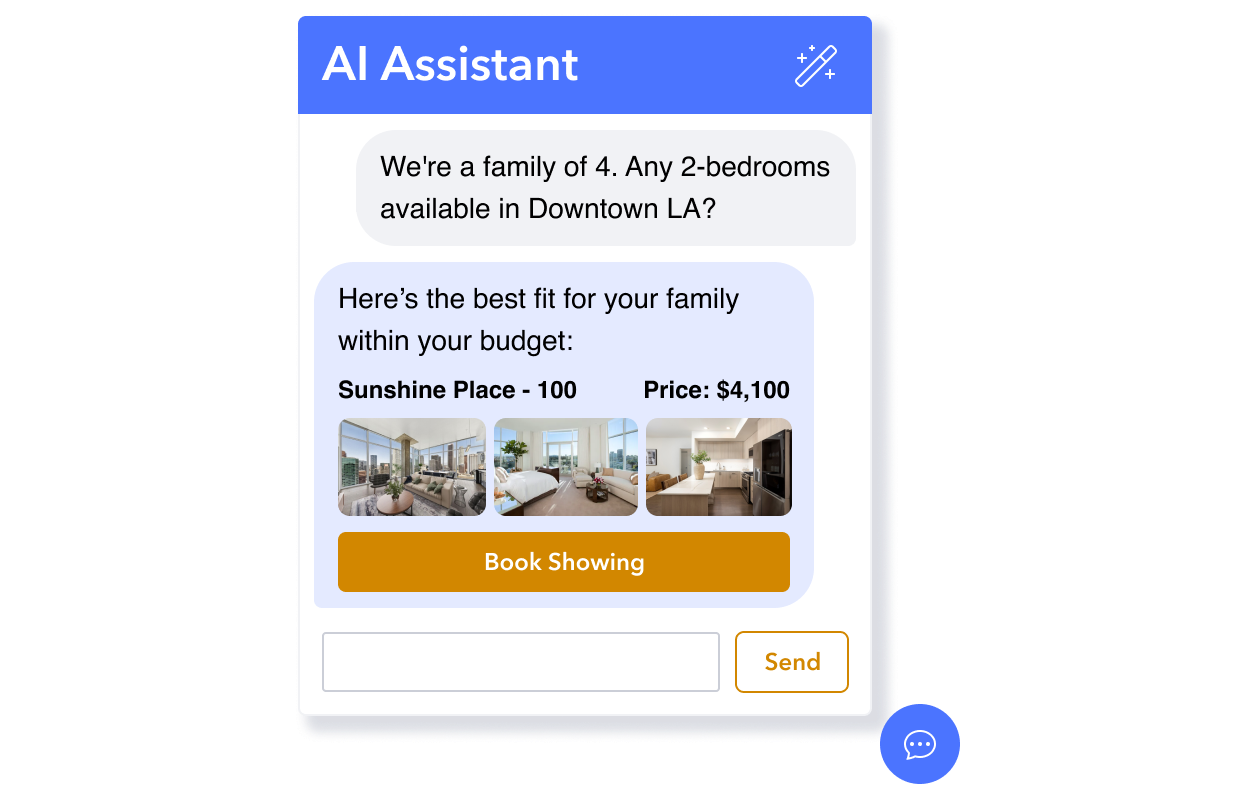
EliseAI is a unique AI-powered platform specifically designed for property management and healthcare sectors. It uses advanced AI techniques to automate routine tasks and provide conversational AI support, making property management and healthcare services more efficient and responsive to customer needs.

Best for AI Chatbots & Virtual Assistants for Rental Agencies

Expert Take

EliseAI excels in providing industry-specific AI automation for property management and healthcare. Its capabilities in conversational AI and task automation make it a valuable tool for enhancing efficiency and customer experience. The product's integration capabilities and market credibility are supported by third-party validations.

Pros

  • Automates 95% of routine inquiries 24/7
  • Deep bi-directional integrations with PMS/EHRs
  • SOC 2 Type II and HIPAA compliant
  • Backed by $250M Series E funding

Cons

  • VoiceAI can sound robotic to some users
  • Limited customization for complex workflows
  • Pricing transparency is limited (custom quotes)
  • Risk of user frustration without human fallback

Best for teams that are

  • Large multifamily housing operators and enterprise portfolios
  • Companies requiring deep integration with major property management systems

Skip if

  • Small independent landlords with few units
  • Single-family home owners with low inquiry volume

Best for teams that are

  • Large multifamily housing operators and enterprise portfolios
  • Companies requiring deep integration with major property management systems

Skip if

  • Small independent landlords with few units
  • Single-family home owners with low inquiry volume

Pros

  • Automates 95% of routine inquiries 24/7
  • Omnichannel support including VoiceAI and SMS
  • Deep bi-directional integrations with PMS/EHRs
  • SOC 2 Type II and HIPAA compliant
  • Backed by $250M Series E funding

Cons

  • VoiceAI can sound robotic to some users
  • Limited customization for complex workflows
  • Setup requires significant integration effort
  • Pricing transparency is limited (custom quotes)
  • Risk of user frustration without human fallback

Expert Take

EliseAI excels in providing industry-specific AI automation for property management and healthcare. Its capabilities in conversational AI and task automation make it a valuable tool for enhancing efficiency and customer experience. The product's integration capabilities and market credibility are supported by third-party validations.

3
8.8 / 10

CrafterQ AI Chatbot is specifically designed for HVAC companies to improve customer interaction and streamline administrative tasks. The AI chatbot automates customer support, scheduling, and quoting tasks, freeing up time for businesses to focus on their core services.

Best for AI Chatbots & Virtual Assistants for HVAC Companies

Expert Take

CrafterQ AI Chatbot excels in providing industry-specific solutions for HVAC companies, with strong capabilities in automating customer interactions and administrative tasks. It offers significant value through its specialized features and 24/7 support, although it requires technical integration and potential staff training.

Pros

  • Prevents hallucinations via data-bounded AI
  • Integrates with Jobber & ServiceTitan
  • Photo/video upload for quotes
  • Multi-language support (Spanish/French)

Cons

  • Currently in waitlist/pre-launch phase
  • No public pricing transparency
  • Requires integration for full value

Best for teams that are

  • Home service businesses needing strict control over AI answers (data-bounded)
  • Companies wanting to automate 24/7 booking, quotes, and service area checks

Skip if

  • Users who find enterprise-grade guardrails and governance overly complex
  • Businesses not needing specific features like service area verification

Best for teams that are

  • Home service businesses needing strict control over AI answers (data-bounded)
  • Companies wanting to automate 24/7 booking, quotes, and service area checks

Skip if

  • Users who find enterprise-grade guardrails and governance overly complex
  • Businesses not needing specific features like service area verification

Pros

  • Prevents hallucinations via data-bounded AI
  • Integrates with Jobber & ServiceTitan
  • 24/7 lead capture & scheduling
  • Photo/video upload for quotes
  • Multi-language support (Spanish/French)

Cons

  • Currently in waitlist/pre-launch phase
  • No public pricing transparency
  • Requires integration for full value
  • Newer product vs legacy tools

Expert Take

CrafterQ AI Chatbot excels in providing industry-specific solutions for HVAC companies, with strong capabilities in automating customer interactions and administrative tasks. It offers significant value through its specialized features and 24/7 support, although it requires technical integration and potential staff training.

4
8.9 / 10
ChiroAI

ChiroAI is a dedicated virtual assistant for chiropractic practices, providing in-depth answers to common queries. It's designed to streamline patient interactions and manage patient inquiries efficiently, a need specific to the chiropractic industry.

Best for AI Chatbots & Virtual Assistants for Chiropractors

Expert Take

ChiroAI stands out as a specialized AI chatbot tailored for chiropractic practices, offering significant efficiency improvements in patient interaction management. Its market credibility is supported by its niche focus, although limited external validation restricts higher scores in trust categories. Usability is strong, but the lack of disclosed pricing impacts transparency.

Pros

  • Free for all US chiropractors
  • Generates blogs & social content
  • Backed by ChiroHealthUSA network
  • Instant answers to clinical queries

Cons

  • May not achieve 100% accuracy
  • Requires human verification of facts
  • Not a replacement for legal advice
  • Generic chat interface limitations

Best for teams that are

  • ChiroHealthUSA providers seeking clinical and business guidance.
  • US-based chiropractors needing coding and compliance support.

Skip if

  • Practitioners located outside the United States.
  • Clinicians who are not ChiroHealthUSA providers.

Best for teams that are

  • ChiroHealthUSA providers seeking clinical and business guidance.
  • US-based chiropractors needing coding and compliance support.

Skip if

  • Practitioners located outside the United States.
  • Clinicians who are not ChiroHealthUSA providers.

Pros

  • Free for all US chiropractors
  • Specialized compliance & coding guidance
  • Generates blogs & social content
  • Backed by ChiroHealthUSA network
  • Instant answers to clinical queries

Cons

  • May not achieve 100% accuracy
  • Requires human verification of facts
  • Limited to training data knowledge
  • Not a replacement for legal advice
  • Generic chat interface limitations

Expert Take

ChiroAI stands out as a specialized AI chatbot tailored for chiropractic practices, offering significant efficiency improvements in patient interaction management. Its market credibility is supported by its niche focus, although limited external validation restricts higher scores in trust categories. Usability is strong, but the lack of disclosed pricing impacts transparency.

Oracle AI Agents for Healthcare

Oracle's AI Agents for Healthcare are designed specifically for the medical sector, providing AI-powered virtual health assistance. The software helps answer patient queries, provides health guidance and reminders, and tracks their health status. It offers valuable support for healthcare professionals, helping them manage patient interactions more efficiently.

Best for AI Chatbots & Virtual Assistants for Medical Offices

Expert Take

Oracle AI Agents for Healthcare excel in providing AI-powered virtual assistance tailored for the medical sector. The product is backed by Oracle's strong market presence and offers comprehensive features that enhance patient care and clinic efficiency. While enterprise pricing may limit accessibility for smaller clinics, the product's capabilities and support for healthcare professionals position it as a top choice in its category.

Pros

  • Executes orders via voice commands
  • Deep bidirectional Oracle EHR integration
  • Supports 30+ medical specialties
  • Military-grade OCI security

Cons

  • Optimized primarily for Oracle EHR
  • No transparent public pricing
  • Mobile app stability complaints
  • Requires Oracle Cloud infrastructure

Best for teams that are

  • Providers currently using Oracle Health (Cerner) EHR
  • Ambulatory clinics seeking ambient clinical documentation

Skip if

  • Administrative staff needing non-clinical automation
  • Small practices without an electronic health record system

Best for teams that are

  • Providers currently using Oracle Health (Cerner) EHR
  • Ambulatory clinics seeking ambient clinical documentation

Skip if

  • Administrative staff needing non-clinical automation
  • Small practices without an electronic health record system

Pros

  • Executes orders via voice commands
  • Deep bidirectional Oracle EHR integration
  • Saves 20-40% documentation time
  • Supports 30+ medical specialties
  • Military-grade OCI security

Cons

  • Optimized primarily for Oracle EHR
  • No transparent public pricing
  • Mobile app stability complaints
  • Enterprise-focused implementation
  • Requires Oracle Cloud infrastructure

Expert Take

Oracle AI Agents for Healthcare excel in providing AI-powered virtual assistance tailored for the medical sector. The product is backed by Oracle's strong market presence and offers comprehensive features that enhance patient care and clinic efficiency. While enterprise pricing may limit accessibility for smaller clinics, the product's capabilities and support for healthcare professionals position it as a top choice in its category.

6
8.9 / 10
Sider AI

Sider AI is designed for chiropractors seeking a streamlined AI experience, consolidating top AI models like ChatGPT, Claude, and Gemini into a single browser sidebar. Its unique Group Chat feature allows simultaneous model querying for efficient research and decision-making.

Best for AI Chatbots & Virtual Assistants for Chiropractors

Expert Take

Sider AI acts as a universal command center, embedding the world's best AI models directly into your browser. Instead of juggling separate subscriptions for ChatGPT, Claude, and Gemini, Sider consolidates them into a single, intuitive sidebar. We love its unique Group Chat feature, which allows you to query multiple models simultaneously to compare reasoning and outputs side-by-side, drastically speeding up comprehensive research and workflows.

Pros

  • Access to 20+ premium AI models
  • Group chat compares multiple AI outputs
  • Cross-platform browser and app support

Cons

  • Hidden caps on Unlimited plans
  • Tracks user search history
  • UI feels cluttered with features

Best for teams that are

  • Students and researchers needing document summarization.
  • Professionals analyzing long PDFs or web pages efficiently.

Skip if

  • Chiropractic practices needing a patient-facing appointment bot.
  • Clinics looking for healthcare-compliant EHR integrations.

Best for teams that are

  • Students and researchers needing document summarization.
  • Professionals analyzing long PDFs or web pages efficiently.

Skip if

  • Chiropractic practices needing a patient-facing appointment bot.
  • Clinics looking for healthcare-compliant EHR integrations.

Pros

  • Access to 20+ premium AI models
  • Sidebar eliminates constant tab switching
  • Group chat compares multiple AI outputs
  • Cross-platform browser and app support

Cons

  • Hidden caps on Unlimited plans
  • Tracks user search history
  • Unused monthly credits expire
  • UI feels cluttered with features

Expert Take

Sider AI acts as a universal command center, embedding the world's best AI models directly into your browser. Instead of juggling separate subscriptions for ChatGPT, Claude, and Gemini, Sider consolidates them into a single, intuitive sidebar. We love its unique Group Chat feature, which allows you to query multiple models simultaneously to compare reasoning and outputs side-by-side, drastically speeding up comprehensive research and workflows.

Agentic AI Chatbot for Hospitals

The Agentic AI Chatbot is a robust SaaS solution designed specifically for hospitals and clinics. It focuses on enhancing patient experience, streamlining workflows, and improving service accessibility. It's powered by Microsoft Copilot, making it an intelligent and reliable choice for medical professionals who seek to leverage emerging technology to optimize their services.

Best for AI Chatbots & Virtual Assistants for Medical Offices

Expert Take

The Agentic AI Chatbot for Hospitals is a specialized SaaS solution that excels in enhancing patient experience and streamlining medical workflows. Its integration with Microsoft Copilot provides a robust AI foundation, making it a reliable choice for healthcare environments. The product's focus on the medical sector ensures it meets specific industry needs, supporting its positioning as a best-of-the-best solution.

Pros

  • Omnichannel support (Voice, WhatsApp, Web)
  • Multilingual in 38+ languages
  • HIPAA compliant security
  • Proactive 'Agentic' capabilities

Cons

  • No public pricing information
  • Lack of named client case studies
  • Generic marketing language

Best for teams that are

  • Hospitals requiring multilingual support (38+ languages)
  • Facilities integrated with the Microsoft Azure ecosystem

Skip if

  • Those avoiding cloud-based infrastructure solutions
  • Users seeking a simple, non-agentic rule-based bot

Best for teams that are

  • Hospitals requiring multilingual support (38+ languages)
  • Facilities integrated with the Microsoft Azure ecosystem

Skip if

  • Those avoiding cloud-based infrastructure solutions
  • Users seeking a simple, non-agentic rule-based bot

Pros

  • Omnichannel support (Voice, WhatsApp, Web)
  • Multilingual in 38+ languages
  • Integrates with Epic and Cerner
  • HIPAA compliant security
  • Proactive 'Agentic' capabilities

Cons

  • No public pricing information
  • Lack of named client case studies
  • Generic marketing language
  • Requires Azure/Cloud infrastructure

Expert Take

The Agentic AI Chatbot for Hospitals is a specialized SaaS solution that excels in enhancing patient experience and streamlining medical workflows. Its integration with Microsoft Copilot provides a robust AI foundation, making it a reliable choice for healthcare environments. The product's focus on the medical sector ensures it meets specific industry needs, supporting its positioning as a best-of-the-best solution.

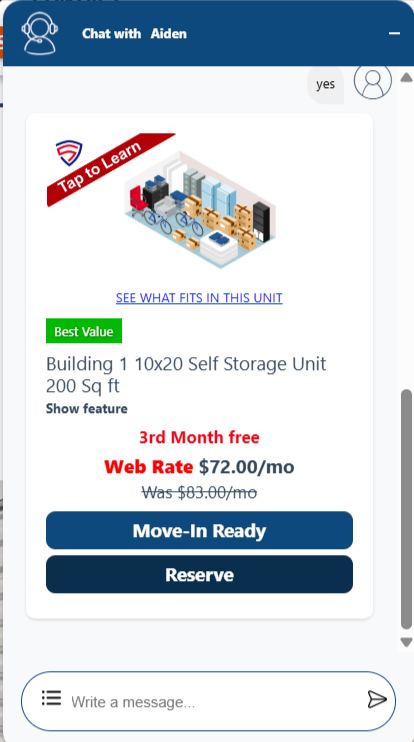
Aiden Chat AI Virtual Assistant

Aiden Chat is a powerful AI-driven virtual assistant specifically designed for rental agencies. By learning customer preferences, it delivers personalized unit suggestions, accelerating the rental process and enhancing customer service experiences. Its voice chat feature provides an extra layer of convenience, enabling customers to engage and get support anytime.

Best for AI Chatbots & Virtual Assistants for Rental Agencies

Expert Take

Aiden Chat AI Virtual Assistant is tailored for rental agencies, offering AI-driven recommendations and a voice chat feature that enhances customer service. Its design and capabilities position it as a premium solution in its niche, although pricing transparency is limited.

Pros

  • 24/7 automated lead capture
  • Multilingual support for diverse tenants
  • Captures abandoned chats to save leads
  • Voice chat capabilities included

Cons

  • Pricing not publicly available
  • Requires demo for access
  • Limited standalone product reviews

Best for teams that are

  • Self-storage facility operators and owners
  • Storage businesses needing after-hours rental automation

Skip if

  • Residential apartment property managers
  • HOA managers or commercial office leasing agents

Best for teams that are

  • Self-storage facility operators and owners
  • Storage businesses needing after-hours rental automation

Skip if

  • Residential apartment property managers
  • HOA managers or commercial office leasing agents

Pros

  • 24/7 automated lead capture
  • Seamless PMS integration (SiteLink, Sentinel)
  • Multilingual support for diverse tenants
  • Captures abandoned chats to save leads
  • Voice chat capabilities included

Cons

  • Pricing not publicly available
  • Requires demo for access
  • Brand name overlaps with other AIs
  • Limited standalone product reviews

Expert Take

Aiden Chat AI Virtual Assistant is tailored for rental agencies, offering AI-driven recommendations and a voice chat feature that enhances customer service. Its design and capabilities position it as a premium solution in its niche, although pricing transparency is limited.

Dahreply AI Healthcare Chatbot

Dahreply AI Healthcare Chatbot is an AI-powered solution specifically designed to automate administrative tasks in medical offices. It handles FAQs, triages requests, and manages appointment bookings, thereby reducing front desk staff workload and enhancing patient experience.

Best for AI Chatbots & Virtual Assistants for Medical Offices

Expert Take

Dahreply AI Healthcare Chatbot excels in providing healthcare-specific automation, enhancing patient experience through efficient task management. Its market credibility is supported by industry-specific capabilities and third-party validations. While it offers substantial value, potential integration challenges and the need for technical understanding are noted.

Pros

  • Supports 'Manglish', Bahasa Malaysia, and Mandarin
  • Automated 24/7 appointment booking and reminders
  • Backed by publicly listed Agmo Group
  • Affordable entry pricing at RM39/month

Cons

  • Struggles with complex or ambiguous queries
  • Limited deep customization options
  • Reporting features can be basic
  • Requires human handover for complex issues

Best for teams that are

  • Clinics and pharmacies in Southeast Asia (Malaysia)
  • Practices relying on WhatsApp for patient engagement

Skip if

  • Providers needing deep clinical EHR integration
  • Businesses not utilizing social media channels

Best for teams that are

  • Clinics and pharmacies in Southeast Asia (Malaysia)
  • Practices relying on WhatsApp for patient engagement

Skip if

  • Providers needing deep clinical EHR integration
  • Businesses not utilizing social media channels

Pros

  • Supports 'Manglish', Bahasa Malaysia, and Mandarin
  • Automated 24/7 appointment booking and reminders
  • PDPA compliant with private cloud options
  • Backed by publicly listed Agmo Group
  • Affordable entry pricing at RM39/month

Cons

  • Struggles with complex or ambiguous queries
  • Limited deep customization options
  • Reporting features can be basic
  • Primary focus is regional (Malaysia)
  • Requires human handover for complex issues

Expert Take

Dahreply AI Healthcare Chatbot excels in providing healthcare-specific automation, enhancing patient experience through efficient task management. Its market credibility is supported by industry-specific capabilities and third-party validations. While it offers substantial value, potential integration challenges and the need for technical understanding are noted.

Ginger Desk for Chiropractors

Ginger Desk's medical virtual assistants are designed specifically for chiropractors, to enhance practice efficiency and streamline patient interactions. The AI-driven platform handles scheduling and patient queries, freeing up valuable time for professionals to focus on patient care.

Best for AI Chatbots & Virtual Assistants for Chiropractors

Expert Take

Ginger Desk excels in providing AI-driven virtual assistant services tailored for chiropractors, enhancing practice efficiency and patient interaction. While it offers strong capabilities and usability, the lack of upfront pricing transparency and language limitations slightly affect its overall score.

Pros

  • HIPAA and PIPEDA compliant workflows
  • Pre-trained in chiropractic EMR software
  • Costs ~25% of in-house staff
  • Founded by a medical practitioner

Cons

  • Pricing requires a discovery call
  • Live phone answering is an extra cost
  • Standard hours limited to Mon-Fri

Best for teams that are

  • Chiropractors needing trained, human virtual medical assistants.
  • Clinics looking to lower overhead without hiring in-house.

Skip if

  • Practices seeking fully automated, AI-driven software bots.
  • Clinicians outside of the United States and Canada.

Best for teams that are

  • Chiropractors needing trained, human virtual medical assistants.
  • Clinics looking to lower overhead without hiring in-house.

Skip if

  • Practices seeking fully automated, AI-driven software bots.
  • Clinicians outside of the United States and Canada.

Pros

  • HIPAA and PIPEDA compliant workflows
  • "VA Buddy" system ensures no downtime
  • Pre-trained in chiropractic EMR software
  • Costs ~25% of in-house staff
  • Founded by a medical practitioner

Cons

  • Pricing requires a discovery call
  • Live phone answering is an extra cost
  • No bookkeeping services offered
  • Standard hours limited to Mon-Fri

Expert Take

Ginger Desk excels in providing AI-driven virtual assistant services tailored for chiropractors, enhancing practice efficiency and patient interaction. While it offers strong capabilities and usability, the lack of upfront pricing transparency and language limitations slightly affect its overall score.

Loading comparison data…

How We Rank Products

Our Evaluation Process

Our Evaluation Process

For AI chatbots and virtual assistants, we evaluate the quality of natural language understanding, orchestration, and handoff between bot and human agents. We examine how easily teams can design conversation flows, connect to back-end systems, and update knowledge over time without heavy engineering support. We also weigh analytics, training workflows, and guardrails that keep responses accurate and on-brand. At the Level 3 overview, we highlight the platforms that rise to the top across Level 4 use cases—such as customer support bots, sales assistants, and internal helpdesk agents—to represent the best-of-the-best options for conversational automation.

Verification

Categories are organized around core conversational AI use cases and deployment patterns. Our hierarchy reflects how CX, support, and operations teams evaluate chatbot and assistant platforms. Selections at this level are distilled from more granular Level 4 assessments across different industries and channels.

Verification

  • Products evaluated through comprehensive research and analysis of user feedback and expert insights.
  • Rankings based on an analysis of features, specifications, and aggregate customer ratings.
  • Selection criteria focus on chatbot responsiveness, accuracy, and user satisfaction metrics.

Score Breakdown

0.0 / 10

About AI Chatbots & Conversational AI

Defining AI Chatbots & Conversational AI

This category covers intelligent software systems designed to simulate human dialogue and execute workflows through natural language interfaces across the entire customer and employee lifecycle: from initial inquiry and qualification to complex troubleshooting, transaction processing, and ongoing account support. It sits distinctly between scripted automation tools (which rely on rigid decision trees and button clicks) and human agent services (which provide empathy and high-level judgment). Unlike simple notification systems or static FAQ pages, this category includes both general-purpose platforms capable of orchestration across multiple departments and vertical-specific tools purpose-built for industries with high compliance or technical requirements, such as healthcare, legal, and field services.

1. What Is AI Chatbots & Conversational AI?

At its core, AI Chatbots and Conversational AI represent the shift from interface-driven computing (clicking buttons) to intent-driven computing (stating a goal). These systems utilize Natural Language Understanding (NLU) and Large Language Models (LLMs) to decipher the intent behind unstructured human input—whether text or voice—and determine the appropriate action to take without requiring the user to learn a specific command syntax.

The core problem this software solves is the scalability of personalized interaction. Traditional customer service and internal support channels face a linear relationship between volume and cost: helping more people requires hiring more staff. Conversational AI breaks this linearity by automating high-volume, repetitive cognitive tasks—such as scheduling, data retrieval, and basic triage—allowing organizations to service thousands of concurrent users instantly. It matters because it is the only viable mechanism for modern enterprises to meet 24/7 service expectations without bankrupting their operational budgets. Users range from small medical practices automating patient intake to global financial institutions handling millions of fraud alerts and transaction queries daily.

2. History: From Rules to Reasoning

While the theoretical roots of chatbots trace back to mid-century experiments like ELIZA, the commercial category of Conversational AI as we recognize it began to take shape in the 1990s and early 2000s. This era was defined by the gap between the exploding volume of web traffic and the limited capacity of call centers. Early solutions were essentially "interactive FAQs"—rigid, rule-based scripts (IVR trees) that frustrated users more often than they helped them. They functioned less as intelligence and more as a crude sorting mechanism to deflect calls away from expensive human agents.

The 2010s marked the first major wave of market consolidation and technological shifts, driven by the proliferation of smartphones and the introduction of consumer voice assistants like Siri and Alexa. This era forced a transition from on-premise, server-heavy installations to agile cloud-based architectures. However, the market remained fragmented. Buyers largely purchased "dumb" bots that required extensive manual training and keyword tagging. The expectation was "give me a database I can query with keywords."

The paradigm shifted violently in the early 2020s with the mainstreaming of Generative AI and Transformer models. The market moved from vertical SaaS providers offering "chat widgets" to massive platform plays by tech giants acquiring specialized AI firms—such as Microsoft's acquisition of Nuance for $19.7 billion [1]. This consolidation wave signaled that conversational interfaces were no longer just support tools but critical infrastructure layers. Today, buyer expectations have evolved from "give me a database" to "give me actionable intelligence." Organizations now demand systems that can not only answer questions but also perform actions—resetting passwords, processing refunds, or updating medical records—autonomously.

3. What to Look For

Evaluating conversational AI requires looking past the "magic" of generative text and focusing on operational reliability. The most critical evaluation criterion is containment rate with resolution. Many vendors boast high containment rates (chats that don't reach a human), but if the user simply gave up in frustration, that is not a success. You must look for tools that track "resolution rate"—where the user explicitly confirms their issue is solved.

A major red flag is a vendor that cannot explain their hallucination guardrails. If a vendor claims their LLM-based bot "never makes mistakes" without explaining the specific grounding mechanisms (such as RAG - Retrieval Augmented Generation) they use to restrict the AI to your knowledge base, walk away. Another warning sign is opaque pricing models that blend "platform fees" with "AI consumption credits," making it impossible to forecast costs as you scale.

Key questions to ask vendors include:

  • "Does your system learn from unresolved conversations automatically, or does it require manual review and retraining by our team?"
  • "Can you demonstrate a live API call to a legacy system (like an on-prem ERP) during a conversation flow, and what happens if that system times out?"
  • "Do you offer indemnification for copyright or data privacy breaches caused by the AI's generated output?"

4. Industry-Specific Use Cases

Retail & E-commerce

In retail, the primary driver is conversion optimization and post-purchase anxiety reduction. Unlike B2B sectors where the focus is on long-term support, retail bots must handle "micro-moments" of decision-making. High-performing retailers use conversational AI to act as personal shoppers, using visual search capabilities and purchase history to recommend products. Evaluation priorities here must focus on speed and visual integration—can the bot display a carousel of products within the chat window, and can it process a checkout without redirecting the user? Juniper Research forecasts global retail spend via chatbots will reach $72 billion by 2028 [2], underscoring that this is a revenue channel, not just a cost center. Unique considerations include handling seasonal spikes; a system that crashes during Black Friday is useless.

Healthcare

Healthcare conversational AI prioritizes triage accuracy and patient data privacy (HIPAA) above all else. The workflow differs significantly from retail; efficiency is secondary to safety. Tools here are used for "digital front door" strategies: symptom checking, provider search, and appointment scheduling. A critical evaluation metric is the system's ability to recognize emergency signals (e.g., keywords indicating stroke or heart attack) and immediately escalate to human intervention. Research indicates that appropriately tuned AI triage systems can match clinician consensus in over 90% of cases [3], but the liability of the remaining 10% necessitates rigorous human-in-the-loop protocols. Buyers must verify that the vendor signs a Business Associate Agreement (BAA) and has specific protocols for PII redaction before data hits the LLM.

Financial Services

For banking and insurance, the use case centers on secure transaction execution and fraud detection. Unlike a retail bot that might suggest a shirt, a finance bot must authenticate a user before revealing a balance or processing a wire transfer. This requires deep integration with Identity and Access Management (IAM) systems. A major differentiator in this sector is the ability to handle "money workflows" with zero latency. With AI-driven fraud attempts accounting for nearly 42.5% of all detected fraud in some sectors [4], the conversational layer often acts as a first line of defense, analyzing language patterns for signs of social engineering or coercion. Evaluation must focus on audit trails: every decision the bot makes must be explainable to regulators.

Manufacturing

Manufacturing utilizes conversational AI for supply chain visibility and maintenance operations. The user here is often an internal employee or a B2B supplier rather than a consumer. Chatbots in this sector serve as interfaces for complex ERP systems (like SAP or Oracle), allowing a floor manager to query "Where is the shipment of Part X?" or "When was Machine Y last serviced?" without logging into a desktop terminal. The unique consideration here is connectivity; these tools often need to function in environments with poor data signals or integrate with legacy SCADA systems. Generative AI is increasingly used to interpret unstructured vendor communications to predict delays [5]. The priority is reducing downtime and inventory holding costs.

Professional Services

Law firms, accounting practices, and consultancies use AI to automate client intake and knowledge management. The workflow involves gathering structured data from unstructured client narratives—turning a 20-minute rambling story about a car accident into a structured case file. This differs from customer support because the output is a legal or financial document, not just an answer. Firms using these tools see significant reductions in non-billable administrative hours. For example, law firms are deploying AI to automate the initial 11+ hours often spent manually onboarding a single client [6]. Evaluation priorities include the ability to cite sources (grounding) to prevent "hallucinated" legal precedents and strict confidentiality controls to preserve attorney-client privilege.

5. Subcategory Overview

AI Chatbots & Virtual Assistants for Chiropractors

Chiropractic practices face a unique operational cadence: high volumes of recurring appointments, frequent rescheduling, and a need to educate patients on care plans between visits. Generic chatbots often fail here because they lack the specific workflow logic for "care plan adherence"—tracking whether a patient has visited 3 times this week versus 1 time. Specialized tools in this niche are designed to integrate directly with chiropractic EHRs (Electronic Health Records) like ChiroTouch to automate the "reactivation" of dormant patients. One workflow that only these specialized tools handle well is the SOAP note intake process, where the bot gathers pain levels and symptoms from the patient pre-visit and drafts the subjective portion of the clinical note for the doctor [7]. This specific pain point—the burden of documentation eating into treatment time—drives buyers toward our guide to AI Chatbots & Virtual Assistants for Chiropractors rather than generic alternatives.

AI Chatbots & Virtual Assistants for Medical Offices

While similar to chiropractic needs, medical office assistants must handle a broader diversity of insurance verification and triage complexities. A generic bot might schedule an appointment, but it rarely understands the nuance of "insurance eligibility checks" that must happen before the slot is confirmed to avoid claim denials. Specialized tools for medical offices focus heavily on the insurance verification workflow, autonomously logging into payer portals to verify coverage and co-pays before the patient walks in. The driving pain point here is revenue cycle leakage caused by front-desk administrative errors. Buyers looking to solve this specific administrative burden should consult AI Chatbots & Virtual Assistants for Medical Offices to find tools that integrate seamlessly with medical billing systems.

AI Chatbots & Virtual Assistants for HVAC Companies

The HVAC industry operates on a "break-fix" and "seasonal maintenance" cycle that creates massive spikes in call volume during extreme weather. Generic tools crash or provide generic "we are open" responses when a customer is panicking about a broken furnace in a blizzard. Specialized HVAC bots distinguish themselves by integrating with field service management software (like ServiceTitan) to handle emergency dispatching. They can qualify a lead based on equipment age and urgency, then book a specific technician based on their geolocation and skill set. The specific pain point driving this purchase is missed revenue during peak season—when phones are ringing off the hook and human dispatchers cannot keep up. For tools that handle complex dispatch logic, see AI Chatbots & Virtual Assistants for HVAC Companies.

AI Chatbots & Virtual Assistants for Rental Agencies

Rental agencies deal with a high volume of repetitive inquiries regarding availability, pet policies, and tour scheduling. Unlike general real estate tools, rental-specific bots must handle the pre-screening workflow to ensure a prospect meets income and credit criteria before a leasing agent wastes time on a tour. A generic bot might schedule a tour for anyone; a specialized tool acts as a 24/7 leasing agent that qualifies leads against Fair Housing regulations and specific property criteria. The pain point driving buyers here is leasing agent burnout from showing units to unqualified leads. Agencies looking to automate this qualification funnel should explore AI Chatbots & Virtual Assistants for Rental Agencies.

6. Deep Dive Sections

Integration & API Ecosystem

The true power of a conversational AI platform is rarely the "chat" itself, but its ability to act as an orchestration layer between your disparate business systems. Without robust integrations, a chatbot is just a conversational dead end. Gartner predicts that by 2026, conversational AI deployments will reduce contact center agent labor costs by $80 billion [8], but this figure assumes the AI can actually resolve tasks, not just answer FAQs. In practice, consider a mid-sized professional services firm with 50 employees using Salesforce for CRM, Jira for project tracking, and QuickBooks for invoicing. If they deploy a generic chatbot without deep API hooks, a client asking "What is the status of my project and how much do I owe?" receives a generic "Please contact your account manager." However, with a properly integrated system using RAG (Retrieval Augmented Generation), the bot queries the Jira API for the project status and the QuickBooks API for the outstanding balance, synthesizes the answer ("Your audit is 80% complete, and the current invoice of $5,000 is due tomorrow"), and offers a payment link. When evaluating vendors, demand to see their API documentation and look for "pre-built connectors" vs. "custom webhooks." The latter often implies thousands of dollars in consulting fees to set up.

Security & Compliance

Security in conversational AI has moved beyond simple encryption to complex issues of data residency and LLM governance. With regulations like the EU AI Act and updated HIPAA guidelines, you are responsible for where your data "thinks." Forrester predicts that ungoverned use of generative AI in commercial applications could cost B2B companies more than $10 billion by 2026 due to regulatory fines and legal settlements [9]. A concrete scenario involves a healthcare provider using a chatbot for patient intake. If the vendor uses a public LLM (like a standard GPT-4 API) without a "zero-data retention" agreement, patient names and conditions could theoretically be used to train future models, a massive HIPAA violation. You must verify that the vendor has SOC 2 Type II certification and offers Private Cloud or Bring Your Own Key (BYOK) encryption options. Ask specifically: "Is our data used to train your base models?" If the answer is vague, it is a security risk.

Pricing Models & TCO

The market is currently shifting from simple per-seat pricing (legacy SaaS) to consumption-based pricing (per conversation or per token). This shift can be dangerous for TCO (Total Cost of Ownership) if not modeled correctly. McKinsey notes that high performers in AI often spend significant budget not just on the software, but on the customization and data transformation required to make it work [10]. Let's calculate TCO for a 25-person support team. A legacy tool might charge $50/agent/month ($15,000/year). A modern AI platform might charge a $5,000 platform fee plus $0.15 per "resolved conversation." If you handle 10,000 tickets a month, that AI bill becomes $1,500/month plus platform fees—roughly $23,000/year. On paper, the AI is more expensive. However, if that AI deflects 40% of tickets, you might avoid hiring two additional support agents (saving $100k+). The trap is uncontained volatility: if a bot gets stuck in a loop or users spam it, consumption costs can skyrocket. Buyers should negotiate caps on consumption billing or "per-resolution" pricing rather than "per-interaction" pricing to align incentives.

Implementation & Change Management

Implementation is where most projects fail—not because of the software, but because of the data. A chatbot is only as smart as the documentation it reads. If your internal knowledge base is outdated, the AI will confidently provide outdated answers. McKinsey reports that the transition from pilot to scale is a "work in progress" for most, with data quality being a primary barrier [11]. Consider a manufacturing firm deploying a bot for machine maintenance. They simply point the AI at their SharePoint folder containing 10 years of PDF manuals. The bot begins instructing technicians to use a procedure that was deprecated in 2019 because the 2019 manual was still in the folder. A successful implementation requires a "data hygiene" phase before a single line of code is configured. Change management must also address the "human in the loop." Support agents often fear replacement; successful rollouts frame the AI as a "Co-pilot" that handles the boring reset-password tasks so humans can focus on complex problem-solving.

Vendor Evaluation Criteria

Beyond feature checklists, evaluate the vendor's financial stability and product roadmap. The AI market is volatile; many startups will be acquired or fold in the next 24 months. Gartner emphasizes that by 2026, over 80% of enterprises will have used generative AI APIs or models, up from less than 5% in 2023 [12]. This explosion means you are likely evaluating vendors who didn't exist three years ago. A practical evaluation scenario: Ask the vendor for their Service Level Agreement (SLA) on uptime and latency. For a financial services bot, a 5-second delay while the AI "thinks" is unacceptable. Test their support yourself—submit a ticket to their helpdesk during the trial and measure the response time. If they are slow to help you before you buy, they will be absent after you sign.

7. Emerging Trends and Contrarian Take

Emerging Trends 2025-2026: The market is rapidly moving toward Agentic AI—systems that don't just talk but autonomously plan and execute multi-step workflows across different software without human intervention. We are also seeing a shift toward "Small Language Models" (SLMs) that are industry-specific, cheaper to run, and less prone to hallucination than massive generalist models.

Contrarian Take: Most businesses would get more ROI from cleaning their data than buying any AI platform. The uncomfortable truth is that the mid-market is currently over-served by expensive AI tools they aren't ready to use. Vendors sell the dream of a "magic brain," but if your customer data is fragmented across three different spreadsheets and a legacy CRM, no AI can fix that. Companies often spend $50,000 on an AI platform only to use it as a glorified rigid decision tree because their underlying data infrastructure is too messy to support true intelligence. Fix your data pipeline first; the AI is just the interface.

8. Common Mistakes

The most frequent mistake buyers make is "boiling the ocean"—trying to automate every possible customer interaction on Day 1. This leads to complex, fragile systems that fail publicly. A better approach is to automate the top 5 distinct inquiry types (e.g., "Where is my order?", "Reset password") which often account for 40-60% of volume, and strictly route everything else to humans.

Another critical error is ignoring the "Uncanny Valley" of text. Companies often try to make their bot sound overly human with slang or fake empathy. Research shows this backfires; customers prefer a bot that clearly identifies itself as a machine and efficiently solves the problem over one that pretends to be a human and fails. Finally, neglecting continuous testing is fatal. AI models drift; a bot that worked perfectly in January might start hallucinating in March due to a model update or new data. You need a permanent "AI Ops" role to monitor conversation quality.

9. Questions to Ask in a Demo

  • "Can you show me the backend logs of a failed conversation and how I would diagnose what went wrong?"
  • "What happens to our custom data and training models if we cancel our contract? Do we retain ownership?"
  • "How does your pricing model account for 'looping' conversations where the user repeats themselves due to bot error?"
  • "Show me exactly how to upload a new knowledge base article and how long it takes to reflect in the bot's answers."
  • "Do you support 'human handoff' with full context context transfer, so the user doesn't have to repeat themselves to the agent?"

10. Before Signing the Contract

Before you sign, scrutinize the Data Usage capabilities. Ensure the contract explicitly states that your proprietary data will not be used to train the vendor's foundation models that are sold to your competitors. Check the Exit Clause: if you leave, can you export your conversation history and analytics in a usable format (JSON/CSV)?

Negotiate the consumption caps. If your marketing team launches a campaign that drives 50,000 users to your site overnight, you don't want a surprise bill for $10,000 in AI tokens. Ask for a "soft cap" that alerts you rather than a "hard cap" that shuts off the bot. Finally, verify indemnification. As generative AI copyright laws evolve, ensure your vendor protects you if their model inadvertently plagiarizes protected content.

Closing

Navigating the noise of the AI market is difficult, but getting it right can transform your business operations. If you have specific questions about your use case or need a sounding board for your evaluation strategy, feel free to reach out.

Email: albert@whatarethebest.com

Quick one question survey

Thanks for your input!
Your response has been recorded.