


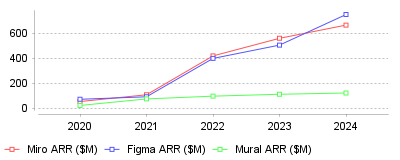
| Year | Miro ARR ($M) | Figma ARR ($M) | Mural ARR ($M) |
|---|---|---|---|
| 2020 | 57 | 75 | 26 |
| 2021 | 111 | 95 | 78 |
| 2022 | 420 | 400 | 100 |
| 2023 | 560 | 506 | 115 |
| 2024 | 665 | 749 | 125 |
This data illustrates the exponential Annual Recurring Revenue (ARR) and user growth of leading visual collaboration platforms like Figma, Miro, and Mural from 2020 to 2024 [source]. It highlights a massive industry expansion where top players grew their revenues by over 10x in a four-year span [source].
At a micro level, teams are no longer using online whiteboards merely as digital sticky notes, but as central hubs for product development, agile planning, and cross-functional execution [source]. At a macro level, the visual collaboration and whiteboard market has solidified itself as a multi-billion dollar enterprise software category [source]. Companies are shifting their IT budgets toward platforms that integrate seamlessly with existing ecosystems like Jira, Slack, and Microsoft Teams [source]. This revenue concentration among heavyweights like Figma and Miro indicates that comprehensive innovation workspaces are winning out over single-purpose point solutions [source].
This trend is critical because it redefines how distributed and hybrid workforces operate, moving collaboration from synchronous video calls to asynchronous, visually driven canvases [source]. It demonstrates that investor confidence and enterprise spending remain strong for productivity tools that can prove measurable ROI through workflow consolidation [source]. Furthermore, the rapid growth signifies that visual communication is becoming as foundational to modern business as email or text-based messaging [source].
The initial catalyst was undoubtedly the COVID-19 pandemic, which forced a sudden transition to remote work and created an immediate need for virtual brainstorming solutions [source]. However, the sustained growth post-pandemic is driven by the aggressive integration of Artificial Intelligence (AI) [source]. These platforms have introduced AI capabilities that automatically cluster ideas, generate mind maps, and translate rough sketches into refined diagrams, dramatically reducing manual effort [source]. Additionally, the strategic shift toward product-led growth (PLG) freemium models allowed these tools to organically penetrate large enterprises before converting them to high-value contracts [source].
The online whiteboard category has evolved far beyond its humble origins, transforming into a vital enterprise infrastructure powered by AI and deep workflow integrations [source]. As platforms like Figma and Miro continue to absorb adjacent productivity functions, their dominance and revenue will likely expand further. The prominent takeaway is that in the era of hybrid work, visual collaboration is no longer a luxury—it is an operational necessity.
Global demand for digital whiteboards continues to climb as distributed teams require persistent places to work. Sales in the visual collaboration platform sector reached $1.17 billion in 2026 [1]. Forecasters project this total will hit $5.11 billion by 2035, reflecting a 17.79% compound annual growth rate [1]. A separate analysis models the broader software category growing from $9.31 billion in 2024 to $25.63 billion by 2032 [2].
The United States Bureau of Labor Statistics reported that 42% of domestic employees engaged in hybrid schedules during 2024 [1]. This labor pattern secures these visual platforms as permanent corporate infrastructure. Buyers classify online whiteboard and brainstorming tools as necessary operational expenses. The category sits firmly within broader project management and productivity tools budgets. Visual collaboration represents the fastest-growing application type within the $78 billion enterprise communication sector [3].
Large enterprises drove 61% of total usage in 2024, proving the technology has matured past small startup applications [1]. Adoption rates remain high across various departments. Software companies, financial institutions, and government agencies all rely on infinite canvases to map complex processes. Technology leaders now evaluate these applications based on measurable financial returns rather than remote work novelty.
Information technology departments face severe overspending issues. The average corporate network contains 342 discrete applications [4]. Unmanaged purchases constitute 48% of these software deployments [4]. Employees adopt independent visual canvases without consulting central administration. This decentralized purchasing creates severe administrative problems.
BetterCloud research indicates 80% of employees use unauthorized applications during business hours [5]. This behavior creates massive financial drag across organizations. Subscription spending averages $1,370 per employee annually, representing a 55% jump since 2021 [5]. Teams frequently introduce their own collaboration software without informing their security directors [5].
Organizations waste an average of $9.8 million annually on unused software licenses [6]. Workers only log into 54% of their provisioned accounts [6]. Small and medium businesses alone lose $135,000 every year on redundant tools [7]. Enterprise environments add roughly 21 new applications to their networks every month [6].
Operational efficiency drops when teams fragment their communication across multiple platforms. Employees switch between applications 1,200 times per day [7]. Each transition consumes roughly 9.5 minutes of focused attention [7]. For software businesses analyzing product architecture, tracking decisions across five different drawing tools delays critical engineering updates. Engineers waste hours searching for technical diagrams stored in forgotten trial accounts.

Miro dismissed 18% of its staff in late 2024 [8]. The reduction eliminated 275 positions at the visual collaboration provider [8]. Executives framed the cuts as necessary restructuring following years of rapid hiring. Market pressures forced management to prioritize profitability over simple user acquisition.
The company maintains a massive market presence despite the staff reduction. Miro reached $665 million in annual recurring revenue in 2024 [9]. Growth stabilized at 5.6% year-over-year [9]. The platform serves 95% of Fortune 100 organizations and holds a $17.5 billion valuation [9]. Active users exceed 60 million globally [10].
Mural experienced a similar deceleration during the same period. Annual recurring revenue hit $125 million in 2024 [11]. The company grew by 8.7% that year, dropping steeply from a 200% expansion rate recorded in 2021 [11]. Enterprise clients account for the majority of their income. The company reported having multiple customers paying over $1 million annually [11].
Canva took an aggressive expansion route into the corporate sector. The Australian firm achieved $4 billion in annual recurring revenue by the end of 2025 [12]. Monthly active users reached 265 million [12]. Business accounts generate over $500 million of that total revenue [12]. Management acquired Affinity in March 2024 to compete directly against specialized design software providers [13].
Lucid Software crossed $300 million in annual recurring revenue in April 2025 [14]. The provider serves more than 100 million individual accounts [14]. Lucid recently acquired airfocus to integrate product roadmapping directly into its visual workspace [14].
Digital canvases present unique security vulnerabilities for large organizations. Workers routinely paste financial projections and strategic models onto shared boards. Administrators must control where servers store this unstructured information. Thirty percent of organizations cite data privacy as their primary reason for restricting visual collaboration tools [1].
European regulations force strict data location rules upon software buyers. Conceptboard provides specialized hosting for organizations requiring General Data Protection Regulation compliance [15]. The German vendor offers ISO 27001 certification and permits customers to run the software on private servers [15]. Public administration departments often reject standard cloud solutions in favor of these regional safeguards.
Miro introduced regional data residency to satisfy international laws. Enterprise administrators can restrict their production and backup data to servers located strictly in Europe or Australia [16]. This localized compute infrastructure prevents regulated information from crossing international borders. Customers can avoid compliance penalties while maintaining full access to the software suite.
Financial services require precise audit trails for all communication. Unblu designed its visual workspace to meet SOC 2 Type 2 standards [17]. Bankers use the encrypted platform to sketch portfolio strategies securely. Fast-moving deal evaluation workflows at investment firms demand identical protections to prevent insider trading leaks. Acquisitions fail when unauthorized users access confidential integration plans stored on public whiteboards.
Generic whiteboards fail to resolve specialized professional workflows. Niche software developers now build dedicated digital canvases for distinct sectors. Broad applications require too much manual configuration for complex tasks.
Planera secured $5.4 million to reinvent project planning across construction sites [18]. General contractors use the software's visual whiteboard to build complex schedules. The system automatically calculates critical path methods and resource loads behind the scenes [18]. Managers gain the simplicity of sticky notes while retaining mathematical scheduling precision.
Venture investors use specialized visual applications to map founder connections and market trends. Secure platforms accelerate due diligence tracking in early-stage investing by organizing qualitative research visually. Teams trace complex ownership structures through digital diagrams rather than reading static documents. Analysts identify portfolio conflicts faster when viewing data on an infinite canvas.
Cloud infrastructure visualization requires precise technical mapping. Lucidscale automatically generates diagrams from Amazon Web Services and Microsoft Azure data [19]. Engineers view live server relationships without drawing individual database icons. The software replaces manual drafting with automated data pulls.
Artificial intelligence alters how employees interact with digital canvases. Roughly 72% of visual collaboration deployments during 2024 featured machine learning elements [1]. Gartner forecasts that these tools will influence 30% of all corporate meeting experiences [20]. Intelligent features convert raw meeting notes into structured workflow diagrams automatically.
Microsoft revealed Team Copilot at its Build 2024 conference [21]. The digital assistant functions as an active participant inside group chats and Planner boards [21]. The software tracks agenda time limits, summarizes discussions, and assigns tasks automatically [21]. Microsoft notes that employees feel artificial intelligence becomes useful after saving just 11 minutes of manual effort [22].
Canva maintains an active partnership with OpenAI and Anthropic to power its generation tools [12]. The company acquired MangoAI to advance its automated video creation capabilities [12]. Users generate images from text prompts directly on their boards. Generative features reduce the time required to format presentations.
Miro introduced clustering algorithms that group similar ideas during strategy sessions [23]. The platform analyzes text on hundreds of digital sticky notes and organizes them by theme. Facilitators bypass the tedious process of sorting manual feedback. These integrations shift the software from a simple drawing tool to an active analysis engine.
Technology directors want fewer software invoices on their desks. Flexera surveys show 35% of organizations report increasing application waste annually [24]. The drive toward application consolidation favors massive technology bundles over single-feature applications. Chief financial officers actively cancel duplicate subscriptions during annual reviews.
Microsoft includes basic digital whiteboarding at no extra cost within its Office 365 packages [25]. Standalone vendors must prove their specific features justify a secondary contract. The bundled application captures casual users who only need occasional drawing tools. Dedicated platforms must target complex enterprise workflows to survive.
Mural defends its market share by focusing on structured workshop templates and professional facilitation tools [11]. The company targets executive offsites where poor meeting outcomes cost thousands of dollars. Canva courts executives with advanced brand management controls [26]. Competitors adapt their platforms to integrate deeply with existing developer tools like Jira.
The market will split into two distinct usage patterns over the next three years. Routine brainstorming will occur inside existing video conferencing applications. Strategic planning, system architecture, and compliance-heavy workflows will remain inside dedicated visual platforms.
| Year | Miro ARR ($M) | Figma ARR ($M) | Mural ARR ($M) |
|---|---|---|---|
| 2020 | 57 | 75 | 26 |
| 2021 | 111 | 95 | 78 |
| 2022 | 420 | 400 | 100 |
| 2023 | 560 | 506 | 115 |
| 2024 | 665 | 749 | 125 |
This data illustrates the exponential Annual Recurring Revenue (ARR) and user growth of leading visual collaboration platforms like Figma, Miro, and Mural from 2020 to 2024 [source]. It highlights a massive industry expansion where top players grew their revenues by over 10x in a four-year span [source].
At a micro level, teams are no longer using online whiteboards merely as digital sticky notes, but as central hubs for product development, agile planning, and cross-functional execution [source]. At a macro level, the visual collaboration and whiteboard market has solidified itself as a multi-billion dollar enterprise software category [source]. Companies are shifting their IT budgets toward platforms that integrate seamlessly with existing ecosystems like Jira, Slack, and Microsoft Teams [source]. This revenue concentration among heavyweights like Figma and Miro indicates that comprehensive innovation workspaces are winning out over single-purpose point solutions [source].
This trend is critical because it redefines how distributed and hybrid workforces operate, moving collaboration from synchronous video calls to asynchronous, visually driven canvases [source]. It demonstrates that investor confidence and enterprise spending remain strong for productivity tools that can prove measurable ROI through workflow consolidation [source]. Furthermore, the rapid growth signifies that visual communication is becoming as foundational to modern business as email or text-based messaging [source].
The initial catalyst was undoubtedly the COVID-19 pandemic, which forced a sudden transition to remote work and created an immediate need for virtual brainstorming solutions [source]. However, the sustained growth post-pandemic is driven by the aggressive integration of Artificial Intelligence (AI) [source]. These platforms have introduced AI capabilities that automatically cluster ideas, generate mind maps, and translate rough sketches into refined diagrams, dramatically reducing manual effort [source]. Additionally, the strategic shift toward product-led growth (PLG) freemium models allowed these tools to organically penetrate large enterprises before converting them to high-value contracts [source].
The online whiteboard category has evolved far beyond its humble origins, transforming into a vital enterprise infrastructure powered by AI and deep workflow integrations [source]. As platforms like Figma and Miro continue to absorb adjacent productivity functions, their dominance and revenue will likely expand further. The prominent takeaway is that in the era of hybrid work, visual collaboration is no longer a luxury—it is an operational necessity.