


| Year | Revenue Billions USD | YoY Growth Percentage |
|---|---|---|
| 2021 | 1.45 | 49.2 |
| 2022 | 2.11 | 45 |
| 2023 | 2.52 | 19.4 |
| 2024 | 2.76 | 9.8 |
| 2025 | 2.98 | 7.8 |
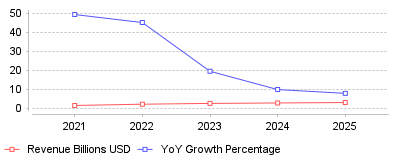
The data illustrates a clear transition in the document workflow category, where traditional electronic signature platforms are experiencing a dramatic growth deceleration. For instance, DocuSign saw its year-over-year revenue growth plummet from nearly 50 percent in 2021 to under 8 percent in fiscal year 2025 [source]. Concurrently, the adoption of generative AI tools for contract review has skyrocketed, with legal professional AI usage surging from 19 percent in 2023 to 79 percent by late 2024 [source]. Similarly, 94 percent of procurement executives now use generative AI on a weekly basis, representing a massive 44-point increase over the previous year [source].
On a micro level, this means that legal, sales, and procurement teams are fundamentally changing how they interact with agreements. They are no longer satisfied with software that merely digitizes a signature on a static PDF; they now require intelligent systems capable of reading, extracting, and analyzing dense contractual language. An AI system can completely review a standard Non-Disclosure Agreement in just 26 seconds, a task that traditionally requires roughly 92 minutes of a human lawyer's time [source]. On a macro industry level, the Contract Lifecycle Management (CLM) market is undergoing a massive evolutionary leap. Providers of simple workflow and signature routing tools are rapidly becoming commoditized. To survive, vendors must pivot toward deep machine learning and generative AI integrations that actively participate in the drafting and negotiation phases.
This technological evolution is critical because poor contract management has historically been a massive financial drain on modern enterprises. Research indicates that organizations lose an estimated 9 percent of their annual revenue due to ineffective contract oversight, missed renewal deadlines, and unfavorable auto-extensions [source]. AI-powered CLM tools directly plug this revenue leakage by providing real-time risk scores, automated compliance verification, and proactive alerts for key milestones. By automating up to 82 percent of routine administrative tasks, these tools transform legal departments from sluggish operational bottlenecks into highly efficient strategic advisors [source].
The initial explosion in simple document workflow tools was necessitated by the sudden shift to remote work during the 2020 pandemic, which digitized the final execution step of contracting. However, as the sheer volume of these digital agreements ballooned across dispersed teams, manual contract review quickly became an unsustainable operational bottleneck. Legal professionals found themselves spending hours every day just doing manual document archaeology to find non-standard clauses [source]. The subsequent mainstream breakthrough of Large Language Models (LLMs) over the last two years provided the exact capability needed to solve this problem, allowing machines to finally parse complex legal syntax and apply corporate playbooks instantly.
The document workflow industry has decisively advanced past basic electronic signatures into the sophisticated era of intelligent, AI-driven contract lifecycle management. As standard document digitization becomes a universal baseline, the new competitive frontier lies in deploying artificial intelligence to eradicate tedious review cycles and prevent costly revenue leakage. The prominent takeaway for businesses is that adopting AI contract tools is no longer a futuristic luxury, but an immediate operational necessity to accelerate deal cycles and maintain a competitive cost structure.
Fifty percent of initial platform deployments fail. Gartner researchers documented this failure rate for organizations installing contract software [1]. Contract software spending reached $2.6 billion in 2025. Analysts project the sector will hit $5.7 billion by 2034 [2]. Market valuation grows at a 9.20% annual rate. North America controls a 35% share of this spending. Regional sales reached $640 million in 2025 [3]. Business commerce relies entirely on formal agreements. Sixty to eighty percent of enterprise transactions require legal documentation [3]. This volume forces companies to buy administrative tools. Technology promises efficiency. Software vendors sell automated routing. Buyers expect immediate financial returns. Reality often disappoints them. Projects fail because teams lack clear objectives. Managers buy software before fixing broken internal processes. Formal administration requires a structured approach across six specific phases [4]. Teams initiate drafting. They negotiate terms. Stakeholders review the text. Administrators execute the final version. Managers track ongoing obligations. Analysts run performance reports. Software targets inefficiencies at each distinct phase.
Bad processes erase profit margins. Ineffective oversight costs companies 9.2% of their annual revenue [1]. Capital projects suffer worse losses. Capital ventures lose up to 15% of total project value to defective administration [1]. Missing documents create direct financial exposure. Seventy-one percent of commercial businesses lose track of at least 10% of their active agreements [5]. Recreating these files consumes human labor. Creating a standard document costs $6,900 from authoring to signature [5]. High-risk negotiations cost $49,000 per instance. Labor expenses drive these totals higher. Average labor costs sit near $100 per hour across corporate departments [6]. Missing renewal dates locks companies into unfavorable terms. Unclaimed vendor rebates expire quietly. Over time, these minor lapses compound into massive revenue leakage. World Commerce & Contracting found that 40% of total financial leakage stems directly from poor document administration [1]. When organizing file sharing setups for software developers, technical directors prioritize automated alerts. Systems flag upcoming expiration dates. Account executives renegotiate terms before critical deadlines pass.

DocuSign purchased Lexion for $165 million in May 2024 [7]. Allan Thygesen led the cash transaction to acquire artificial intelligence capabilities. Gaurav Oberoi, Emad Elwany, and James Baird joined DocuSign as senior engineers. They previously built Lexion at the Allen Institute for AI [8]. The acquisition targets a specific operational problem. Static files trap vital data. Lexion built algorithms that convert standard text into searchable databases. The startup also built a plugin for Microsoft Word [7]. This add-on assists attorneys during live negotiations. The system manages document intakes through external communication channels. Employees submit requests via Slack or Microsoft Teams [9]. Competitors reacted fast to this consolidation. Conga released an updated product in June 2024 [2]. Their software extracts text directly from standard tables. Workday integrated Evisort artificial intelligence into its native platform. A healthcare provider used Workday to cut turnaround times from days to hours [10]. An energy company reduced manual workload by 80% with the same software [10]. Vendors buy smaller startups to acquire natural language processing algorithms.
European regulators enacted the Digital Operational Resilience Act. DORA took effect on January 17, 2025 [11]. Financial institutions must manage external vendor risks strictly. The law covers banks, insurance companies, and investment firms [12]. It also governs external technology providers. Organizations face tight compliance deadlines. Article 15 requires technical standards for anomaly monitoring [13]. Contracts must include specific audit clauses. Financial entities need termination rights embedded in all vendor agreements [11]. Missing these clauses invites severe financial penalties. Lead overseers fine critical providers up to 1% of their daily worldwide turnover [11]. The law shares extraterritorial enforcement characteristics with earlier privacy mandates. Tracking these obligations manually fails inside large banks. Financial companies apply digital drafting platforms used by counsel to monitor compliance automatically. Senior management must oversee risk exposure actively. Article 5 places direct accountability on corporate boards [13]. Security threats evolve constantly. Vendors test quantum-resistant encryption to protect sensitive commercial agreements [14].
Corporate attorneys waste hours on administrative tasks. Lawyers spend 25% to 40% of their schedules on non-legal work [1]. This misallocation costs $27 million in lost productivity annually for large enterprises. Human review takes 92 minutes per document [1]. Software algorithms complete the same review in 26 seconds. Crete United reduced negotiation cycles by 80% after adopting automated tools [15]. Bank of Queensland cut per-loan packet expenses by 83% [15]. Payworks saved 9,300 labor hours annually by dropping processing time from 45 minutes to 7.5 minutes [15]. New York City Public Schools reduced turnaround times by 77% and recovered 400,000 labor hours [15]. Automation changes basic corporate workflows. Teams stop reading boilerplate text. They focus entirely on custom clauses and risk mitigation. Machine learning models train on millions of legal clauses. They recognize non-standard terms instantly. They suggest approved fallback language. Administrators build clause libraries to standardize corporate language [4]. Generative models summarize dense legal text for business users.
Buyout shops require precise deal documentation. Private equity firms execute hundreds of non-disclosure agreements monthly. Deal teams hand off paperwork to implementation teams after signing. Inadequate handovers cause immediate operational failures [6]. Misunderstood commitments destroy acquired value. Buyout professionals need instant access to historical terms. When upgrading their file coordination software tailored for buyout shops, partners demand advanced search functions. Language models scan old agreements to locate specific indemnification clauses. Searching takes seconds instead of days. Two decades ago, finance departments managed most commercial agreements. One in three finance teams owned this function directly. That ratio dropped to one in ten by 2025 [6]. Legal departments took control as regulatory complexity increased. Legal teams draft documents to avoid risk. They rarely structure terms to generate maximum financial returns. Artificial intelligence gives finance leaders visibility into legal agreements. Real-time insights allow treasurers to optimize capital allocation.
Procurement processes overlap heavily with document management. The global source-to-pay software market reached $5.7 billion in 2024 [16]. Analysts project this sector will hit $14.2 billion by 2033. Compound annual growth tracks at 10.2% [16]. Supply chain directors face mounting pressure to optimize corporate spending. Cloud platforms offer end-to-end automation for purchasing cycles. North American buyers lead this adoption wave. Mature infrastructure supports rapid software deployment. European buyers prioritize sustainability tracking. Environmental requirements demand continuous vendor monitoring. Buyers embed strict diversity rules into supplier agreements [14]. Manual verification fails when dealing with thousands of suppliers. Applications monitor supplier performance against these criteria actively. Algorithms flag agreements that need updating when sustainability rules change. Tracking these metrics prevents public relations disasters.
Medical research generates massive paperwork volumes. The clinical trial recruitment market reached $5.7 billion in 2024 [17]. Projections show growth to $11.6 billion by 2033 [17]. Pharmaceutical companies require specialized management services. Strict eligibility criteria limit participant pools. Regulatory agencies demand perfect data integrity. Sponsors buy specialized software to manage site selection and patient monitoring. Trial administrators handle sensitive medical data under tight security rules. Document workflows must support global participant pools. Asian markets show particularly high growth rates. Expanding patient populations in China and India drive regional spending to $1.1 billion [17]. Software platforms reduce participant dropout rates. Timely completion of medical trials depends entirely on administrative efficiency.
Platform connectivity dictates software value. Contract repositories fail to solve operational bottlenecks alone. Applications integrate directly with existing customer relationship management software. They connect to enterprise resource planning databases. Agiloft embedded artificial intelligence into its core platform to automate these connections [18]. Information flows seamlessly between sales dashboards and legal archives. Agentic artificial intelligence takes independent action to complete administrative tasks [18]. Algorithms identify a missing signature and email the client automatically. Workday earned an ISO 42001 certification for responsible artificial intelligence deployment [19]. Evisort achieved this standard before their acquisition by Workday. Enterprise buyers demand these external validations. Trust dictates software adoption in legal environments. When algorithms make routing decisions, security engineers must verify the underlying logic.
Software buyers face a choice between custom workflows and standardized templates. Custom configurations match existing corporate habits. They require coding and long implementation cycles. Standardized templates deploy quickly. They force employees to abandon familiar routines. Researchers found that 84% of organizations expect to adopt standardized contract templates by 2025 [20]. Custom contracts requiring external advisors cost upwards of $150,000 to execute [20]. Standard templates drop this execution cost to $6,000. Organizations standardizing their clauses see immediate cost reductions. Legal departments upload approved language into central clause libraries. Sales representatives drag and drop these approved paragraphs into new agreements. This process bypasses legal review entirely. The software blocks any manual text edits to preserve legal integrity.
Corporate departments operate in strict isolation. Sales teams want faster deal cycles. Finance directors need accurate revenue forecasting. Procurement officers seek bargaining power. Legal teams want fewer compliance fires [4]. Traditional workflows pit these departments against each other. A sales representative pushes for rapid signatures. The legal reviewer blocks the deal to check liability clauses. Friction delays revenue recognition. Centralized software systems attempt to bridge these gaps. Contract lifecycle management eliminates scattered email chains. Stakeholders view the same document simultaneously. Automated approval routing prevents unauthorized edits. Electronic signature tools serve as the foundation for modern workflows. Market adoption reached saturation in many Western countries. Vendors now focus on international expansion. European markets require Qualified Electronic Signatures. Providers integrate with local trusted service entities. DocuSign uses Swisscom for its European operations [21]. Data residency laws force software companies to host servers in specific countries. Platform flexibility determines vendor success in international deployments.
Legal technology spending expands rapidly across all sectors. Gartner predicts these tools will consume 12% of in-house budgets by 2025 [2]. This represents a massive jump from 2.6% in 2017. Buyers want structured data. Static files trap vital corporate information [22]. Natural language processing converts this text into searchable databases. Contract intelligence improves capital allocation directly. World Commerce & Contracting reported that finance-connected agreements boost corporate margins by 5.4% [6]. Automation forces structural changes across corporate departments. Artificial intelligence identifies expired discounts. It tracks rate escalations automatically. Software recovers unclaimed vendor rebates. Companies using these tools outperform their peers financially. The market rewards operational discipline.
| Year | Revenue Billions USD | YoY Growth Percentage |
|---|---|---|
| 2021 | 1.45 | 49.2 |
| 2022 | 2.11 | 45 |
| 2023 | 2.52 | 19.4 |
| 2024 | 2.76 | 9.8 |
| 2025 | 2.98 | 7.8 |
The data illustrates a clear transition in the document workflow category, where traditional electronic signature platforms are experiencing a dramatic growth deceleration. For instance, DocuSign saw its year-over-year revenue growth plummet from nearly 50 percent in 2021 to under 8 percent in fiscal year 2025 [source]. Concurrently, the adoption of generative AI tools for contract review has skyrocketed, with legal professional AI usage surging from 19 percent in 2023 to 79 percent by late 2024 [source]. Similarly, 94 percent of procurement executives now use generative AI on a weekly basis, representing a massive 44-point increase over the previous year [source].
On a micro level, this means that legal, sales, and procurement teams are fundamentally changing how they interact with agreements. They are no longer satisfied with software that merely digitizes a signature on a static PDF; they now require intelligent systems capable of reading, extracting, and analyzing dense contractual language. An AI system can completely review a standard Non-Disclosure Agreement in just 26 seconds, a task that traditionally requires roughly 92 minutes of a human lawyer's time [source]. On a macro industry level, the Contract Lifecycle Management (CLM) market is undergoing a massive evolutionary leap. Providers of simple workflow and signature routing tools are rapidly becoming commoditized. To survive, vendors must pivot toward deep machine learning and generative AI integrations that actively participate in the drafting and negotiation phases.
This technological evolution is critical because poor contract management has historically been a massive financial drain on modern enterprises. Research indicates that organizations lose an estimated 9 percent of their annual revenue due to ineffective contract oversight, missed renewal deadlines, and unfavorable auto-extensions [source]. AI-powered CLM tools directly plug this revenue leakage by providing real-time risk scores, automated compliance verification, and proactive alerts for key milestones. By automating up to 82 percent of routine administrative tasks, these tools transform legal departments from sluggish operational bottlenecks into highly efficient strategic advisors [source].
The initial explosion in simple document workflow tools was necessitated by the sudden shift to remote work during the 2020 pandemic, which digitized the final execution step of contracting. However, as the sheer volume of these digital agreements ballooned across dispersed teams, manual contract review quickly became an unsustainable operational bottleneck. Legal professionals found themselves spending hours every day just doing manual document archaeology to find non-standard clauses [source]. The subsequent mainstream breakthrough of Large Language Models (LLMs) over the last two years provided the exact capability needed to solve this problem, allowing machines to finally parse complex legal syntax and apply corporate playbooks instantly.
The document workflow industry has decisively advanced past basic electronic signatures into the sophisticated era of intelligent, AI-driven contract lifecycle management. As standard document digitization becomes a universal baseline, the new competitive frontier lies in deploying artificial intelligence to eradicate tedious review cycles and prevent costly revenue leakage. The prominent takeaway for businesses is that adopting AI contract tools is no longer a futuristic luxury, but an immediate operational necessity to accelerate deal cycles and maintain a competitive cost structure.