


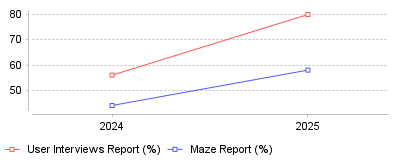
| Year | User Interviews Report (%) | Maze Report (%) |
|---|---|---|
| 2024 | 56 | 44 |
| 2025 | 80 | 58 |
This trend demonstrates the explosive, data-backed adoption of artificial intelligence tools within user experience research workflows over the last year. Industry surveys indicate that the percentage of UX researchers utilizing AI has jumped dramatically, with the User Interviews State of User Research report showing an increase from 56 percent in 2024 to 80 percent in 2025 [source]. Similarly, Maze reported that AI adoption crossed from experimental to essential, growing to 58 percent in 2025 and 69 percent by 2026 [source].
On a micro level, individual researchers are moving away from manual, repetitive tasks like interview transcription, thematic coding, and basic sentiment analysis to focus on interpretation. By leveraging AI features built directly into modern platforms, practitioners can reclaim hours previously lost to administrative work, as 74 percent of teams now use AI for data analysis [source]. On a macro level, the UX research industry is fundamentally transitioning from an output-driven discipline to a strategic, outcomes-focused one. As AI platforms accelerate the time-to-insight, product development cycles are shrinking, empowering cross-functional teams to iterate more frequently and democratize research. This maturation of the market suggests that human researchers are not being replaced, but rather elevated to act as strategic interpreters who apply human empathy and business judgment to AI-generated patterns.
The rapid integration of AI is crucial because it resolves the longstanding tension between product speed and research rigor. In an increasingly competitive digital landscape, companies can no longer afford to delay product launches for weeks of manual usability testing, nor can they risk shipping without validation. AI-driven UX platforms allow organizations to maintain high research standards without becoming a bottleneck, ultimately shifting the priority from "time to market" to "time to right" [source]. Furthermore, this shift establishes a new baseline for industry skills, requiring researchers to become proficient in algorithmic critical thinking to remain competitive in a rapidly evolving job market.
The sudden spike in AI adoption across UX platforms is likely the result of multiple converging factors, chief among them the widespread availability and integration of advanced Large Language Models into existing enterprise software. Secondly, tightening economic conditions and tech industry layoffs have forced smaller research teams to handle an increasing demand for insights, necessitating tools that act as a force multiplier to prevent burnout. We can speculate that the initial skepticism surrounding AI's ability to interpret human nuance faded rapidly as embedded platforms proved their reliability in handling tedious data processing safely. Finally, the shift from standalone generative chatbots to workflow-specific AI agents within familiar research platforms dramatically lowered the friction of adoption for busy professionals.
The trajectory of UX research and testing platforms is unmistakably tied to the advancement of artificial intelligence, transforming the discipline from a slow, manual process into a rapid, strategic function. As adoption rates approach market saturation, the competitive advantage will no longer come from merely using AI, but from exercising superior human judgment to contextualize algorithmic findings. A prominent takeaway is that organizations prioritizing AI-augmented continuous research will drastically reduce their insight turnaround times, ensuring they deliver market-leading user experiences while leaving slower competitors behind.
Silver Lake and the Canada Pension Plan Investment Board completed their acquisition of Qualtrics for $12.5 billion in June 2023 [1]. This privatization marked the largest transaction in the design software sector that year. SAP previously acquired Qualtrics for $8 billion in 2018 before taking it public. The massive premium paid by private equity highlights the structural value of customer experience data. Thoma Bravo executed a similar play five months earlier. The firm purchased UserTesting for $1.3 billion [2]. Thoma Bravo immediately merged UserTesting with UserZoom. These megadeals ended the era of independent testing platforms. Consolidation now dictates market dynamics. Buyers demand unified suites rather than isolated applications.
This consolidation forces software buyers to reevaluate their annual spend. Fragmented technology stacks inflate operating expenses. Evaluating UX research and user testing platforms requires looking past feature lists to assess corporate stability. Private equity ownership often shifts vendor focus toward enterprise contracts and mandatory multi-year commitments. As vendors merge, product teams lose pricing leverage. The market demands efficiency, but vendor consolidation reduces the number of competitive bids available during procurement cycles. Startups attempting to disrupt these incumbents must raise significant capital. Maze secured a $40 million Series B round led by Felicis to build out unmoderated testing capabilities [3]. Sprig raised $30 million to expand its concept validation tools [4]. The battle for market share now requires heavy capital deployment to build integrated suites.
Fifty percent of enterprise organizations reduced their technology costs by consolidating vendors in 2024. Media companies provide a clear operational example. One publishing house cut its analytics spend by 40% after migrating from three separate tools to a unified testing suite [5]. Consolidation lowers subscription fees directly. It also reduces context switching for employees. Teams frequently synchronize these testing suites with standard project management and productivity tools to streamline task assignments and defect tracking.
Financial returns validate this software expenditure. Forrester measured the impact of design software investments across enterprise organizations. Every $1 invested in user experience returns an average of $100 [6]. This ratio represents a 9,900% return. Companies achieve this by avoiding development rework. Engineering time remains one of the most expensive corporate resources. Fixing a software error after release costs significantly more than addressing it during the prototype phase. Identifying a navigation flaw before writing code saves thousands of dollars in developer salaries.
Nucleus Research examined organizations deploying Qualtrics software to measure operational impact. They found an average benefit of $6.3 million in cost savings and $1.2 million in new revenue per organization [7]. Customer satisfaction metrics concurrently rose between 7% and 12% year over year. The global design market reflects this proven value. The sector is currently valued at $5.5 billion. Analysts project this figure will surpass $12 billion by 2030, growing at a 14.5% compound annual growth rate [8]. Software costs constitute a major portion of this spending. Executives demand hard metrics to justify budget allocations. Vendors responded by embedding quantitative analytics directly into qualitative testing platforms.
More data does not equal better product decisions. Bad data actively destroys product value and engineers build features for fictional users. Participant fraud shifted from a minor nuisance to an organized enterprise threat over the past two years. Survey fraud rates exceeded 46% in unmoderated market studies recently [9]. Bad actors use automation scripts to complete qualification screeners. They claim financial incentives without providing real feedback. This industrial approach to survey completion corrupts the insight pipeline. Teams build application features based on automated bot preferences rather than genuine human needs.
Generative models accelerate this operational problem. Participants use AI software to answer survey prompts automatically. They generate plausible anecdotes using language models to pass open-ended screening questions. A recent UX Studio report noted that 83% of researchers encounter inauthentic respondents during live testing sessions [10]. Bot response rates routinely reach 60% in quantitative surveys. Researchers waste valuable hours analyzing fabricated experiences. The financial drain includes both the wasted incentive payouts and the salaried time spent cleaning polluted data sets.
Relying on applications that handle participant sourcing requires strict vetting protocols. Security teams now mandate device reputation checks for all external survey links. They monitor IP intelligence to flag sophisticated fraud rings masking their locations. Platforms must detect when a user claims to be a hospital administrator in London but connects via a datacenter in another country. User Interviews audited its participant pool to measure this vulnerability. The company analyzed over 6 million users to detect systematic misrepresentation. They found that confirmed fraudulent sessions accounted for less than 0.3% of their total volume [11]. Achieving this low error rate requires constant technical vigilance. Vendors layer behavioral signals with manual human reviews. Some platforms automatically flag copied text. AI models detect anomalies in typing speed to block automated scripts. The battle against synthetic respondents requires equal technological sophistication from platform vendors.

Product managers face impossible delivery timelines. They must validate interface ideas before authorizing engineering sprints. Recruiting real humans takes days and delays production schedules. This operational friction birthed the synthetic user market. Synthetic users are software personas generated from existing consumer data. They mimic human responses to design prototypes using predictive language models. A Stanford University study demonstrated that synthetic agents replicate human feedback with 85% accuracy [10]. Teams use these bots for immediate prototype feedback. They identify glaring navigation errors instantly without paying human incentives.
However, synthetic users cannot feel frustration. They lack emotional resonance and unpredictable human irrationality. Nielsen Norman Group analysts strongly criticize replacing human testing with AI personas entirely. They argue that testing without humans invalidates the core purpose of user experience design. The consensus among enterprise analysts positions synthetic testing as a preliminary supplement. It works well for structural interface audits. It fails completely at assessing emotional product resonance or complex workflow comprehension.
Organizations must establish clear internal policies regarding synthetic data. They must demarcate where bot feedback ends and human validation begins. Adopting platforms designed for product teams speeds up early prototype validation. These platforms often incorporate basic synthetic tests into their preliminary workflows. They allow teams to run smoke tests on simple onboarding flows. Once the obvious interface errors disappear, teams recruit live participants. This hybrid approach maximizes budget efficiency. It reserves human testing dollars for complex workflow validation.
Quantitative data shows what users do. Qualitative data explains why they do it. Historically, companies purchased separate software to answer these two questions. Product analytics tools tracked click events. Usability testing tools recorded human frustration. This bifurcation created massive operational blind spots. Product managers saw high abandonment rates in their analytics dashboards. They could not understand the underlying cause without launching a separate qualitative study.
Modern platforms erase this boundary. Market leaders now merge behavioral analytics with qualitative feedback mechanisms. Sprig built its $24 million recurring revenue business by embedding contextual surveys directly into the product experience [4]. When a user abandons a checkout flow, the software triggers an immediate micro-survey. This approach captures in-the-moment sentiment. It yields significantly higher response rates than traditional email surveys. This convergence allows teams to diagnose behavioral anomalies instantly.
Session replay technology bridges the gap further. Platforms record the actual screen movements of live users. They track mouse hesitation. They flag rage clicks automatically. Researchers combine these session replays with direct user feedback. The integration provides undeniable evidence of interface failure. Stakeholders rarely argue with video evidence of a user failing to navigate a core feature. This unified approach accelerates executive decision-making. It removes subjective opinions from product design debates.
Managing customer insights at an enterprise scale requires dedicated infrastructure. Small companies conduct research informally. Large organizations require standardized protocols. This necessity created the Research Operations discipline. ResearchOps teams do not conduct interviews. They build the systems that allow others to conduct interviews safely. They manage vendor contracts. They maintain participant databases. They ensure legal compliance across all testing activities.
Testing platforms evolved to serve these administrative professionals. Administrative controls now dictate software procurement. ResearchOps managers demand granular permission settings. They require centralized insight repositories. An insight repository acts as a searchable library of past research. It prevents different departments from conducting the same study twice. Eliminating redundant research saves thousands of dollars annually. It also prevents participant fatigue.
Global accessibility stands out as a primary operational requirement. Platforms must support multiple languages. They must comply with regional accessibility standards like the Web Content Accessibility Guidelines. Approximately 96.3% of top websites currently fail baseline accessibility checks [6]. Inclusive design requires testing with diverse participant pools. Research software must accommodate screen readers. It must support participants with motor impairments. Vendors that ignore accessibility lose enterprise contracts immediately.
Consumer research relies on volume. Business research relies on precision. Recruiting a panel of frequent online shoppers takes hours. Sourcing verified chief information security officers takes weeks. Enterprise software companies face unique operational hurdles when testing new products. Their target users possess specialized knowledge and limited free time. Standard incentive payouts fail to attract these high-value participants.
Testing platforms historically struggled to verify professional credentials. A participant might claim to manage enterprise cloud deployments to qualify for a $150 incentive. If the participant lies, the resulting feedback corrupts the product roadmap. Specialized recruitment networks emerged to solve this specific bottleneck. These networks bypass traditional email databases. They integrate directly with professional platforms to verify employment history. They confirm active job titles before allowing participants to view screener questions.
The cost of acquiring B2B feedback reflects this difficulty. Customer acquisition costs for specialized research participants often exceed $300 per session. Companies offset this expense by treating research as a customer relationship function. A 2024 Forrester study revealed that organizations using integrated analytics saw a 25% improvement in their acquisition efficiency [12]. They interview existing high-value clients rather than anonymous panel members. This strategy requires testing platforms to integrate seamlessly with customer relationship management software. The software must prevent researchers from over-contacting key accounts. Maintaining this delicate balance defines successful enterprise research operations.
Eighty percent of researchers incorporated AI into their daily workflows by early 2025 [13]. This adoption rate represents a 24-point increase from the prior year. The primary operational use case involves qualitative data synthesis. A standard user interview lasts 72 minutes. Manually transcribing and coding these video sessions takes hours of dedicated focus. Software platforms deployed language models to automate this specific bottleneck.
Enterprise platforms extract insights rapidly from unstructured video. Utilities featuring automated transcription generate accurate text summaries instantly. These systems identify thematic patterns across dozens of recorded interviews. They highlight recurring pain points automatically. They clip video segments containing specific emotional reactions. This reduces the time between raw data collection and executive stakeholder presentation. Researchers spend less time typing notes. They spend more time advising product leadership on strategic direction.
Gartner predicts that human employees augmented by AI will perform 75% of all knowledge work by 2030 [13]. The user research software sector reflects this rapid transition. Maze reported that 69% of product teams used AI for study generation in 2025 [14]. The software drafts interview guides. It configures unmoderated survey questions based on broad research goals. It generates executive summaries from raw data. The technology accelerates the mechanical aspects of research preparation. It does not replace the strategic interpretation of human behavior.
The European Union adopted the AI Act in 2024. This legislation explicitly prohibits specific interface designs and data practices. Article 5 targets dark patterns that manipulate user behavior or distort economic choices [15]. The Digital Services Act and the Digital Markets Act contain similar punitive provisions. Regulators now scrutinize how technology companies collect user consent. They penalize software interfaces that intentionally obfuscate opt-out mechanisms. Research teams must test their interfaces against these strict standards.
Compliance constraints extend to the research process itself. Feeding customer interviews into public AI models violates standard privacy agreements. Audio recordings contain personally identifiable information. Faces, full names, and workplace details routinely appear in live usability sessions. Uploading this confidential data to a commercial language model breaks GDPR requirements. Companies face financial penalties for mishandling this participant data.
Enterprise vendors responded by building private processing environments. Market leaders achieve SOC 2 compliance to secure lucrative enterprise contracts. They enforce strict data deletion protocols and localized hosting options. Researchers must verify that their software vendors do not train shared algorithms on private customer data. Procurement departments demand explicit vendor agreements. They require customized data processing addendums before deploying any AI analysis tool. Responsible data practices form the absolute foundation of enterprise tool selection [16].
Agentic AI will drive 30% of enterprise software revenue by 2035 [13]. This Gartner projection signals a permanent shift in software architecture. Platforms will evolve from passive repositories to active research agents. A product manager will instruct the system to analyze checkout abandonment rates. The platform will autonomously recruit five matching participants. It will conduct structured chat interviews. It will synthesize the findings and present a dashboard overnight.
This automation compresses testing cycles significantly. Companies that conduct regular usability testing retain 10.8% more revenue over a three-year period [8]. Faster testing leads to faster product iteration. Faster iteration secures market share. The competitive gap between design-led companies and operational laggards continues to widen. Design-mature organizations outperform their industry peers in shareholder returns by a factor of three.
Total revenue for user research platforms will compound steadily over the next decade. UserTesting recorded a 36% revenue increase in the quarter before its private acquisition, hitting $47.6 million [17]. Subscription models dominate the sector entirely. Economic pressures force companies to minimize product failures. Testing software becomes mandatory insurance against development mistakes. High renewal rates attract ongoing private equity interest. Consolidation will persist as larger entities absorb niche AI startups. The next five years will reward platforms that balance automated efficiency with rigorous human authenticity.
| Year | User Interviews Report (%) | Maze Report (%) |
|---|---|---|
| 2024 | 56 | 44 |
| 2025 | 80 | 58 |
This trend demonstrates the explosive, data-backed adoption of artificial intelligence tools within user experience research workflows over the last year. Industry surveys indicate that the percentage of UX researchers utilizing AI has jumped dramatically, with the User Interviews State of User Research report showing an increase from 56 percent in 2024 to 80 percent in 2025 [source]. Similarly, Maze reported that AI adoption crossed from experimental to essential, growing to 58 percent in 2025 and 69 percent by 2026 [source].
On a micro level, individual researchers are moving away from manual, repetitive tasks like interview transcription, thematic coding, and basic sentiment analysis to focus on interpretation. By leveraging AI features built directly into modern platforms, practitioners can reclaim hours previously lost to administrative work, as 74 percent of teams now use AI for data analysis [source]. On a macro level, the UX research industry is fundamentally transitioning from an output-driven discipline to a strategic, outcomes-focused one. As AI platforms accelerate the time-to-insight, product development cycles are shrinking, empowering cross-functional teams to iterate more frequently and democratize research. This maturation of the market suggests that human researchers are not being replaced, but rather elevated to act as strategic interpreters who apply human empathy and business judgment to AI-generated patterns.
The rapid integration of AI is crucial because it resolves the longstanding tension between product speed and research rigor. In an increasingly competitive digital landscape, companies can no longer afford to delay product launches for weeks of manual usability testing, nor can they risk shipping without validation. AI-driven UX platforms allow organizations to maintain high research standards without becoming a bottleneck, ultimately shifting the priority from "time to market" to "time to right" [source]. Furthermore, this shift establishes a new baseline for industry skills, requiring researchers to become proficient in algorithmic critical thinking to remain competitive in a rapidly evolving job market.
The sudden spike in AI adoption across UX platforms is likely the result of multiple converging factors, chief among them the widespread availability and integration of advanced Large Language Models into existing enterprise software. Secondly, tightening economic conditions and tech industry layoffs have forced smaller research teams to handle an increasing demand for insights, necessitating tools that act as a force multiplier to prevent burnout. We can speculate that the initial skepticism surrounding AI's ability to interpret human nuance faded rapidly as embedded platforms proved their reliability in handling tedious data processing safely. Finally, the shift from standalone generative chatbots to workflow-specific AI agents within familiar research platforms dramatically lowered the friction of adoption for busy professionals.
The trajectory of UX research and testing platforms is unmistakably tied to the advancement of artificial intelligence, transforming the discipline from a slow, manual process into a rapid, strategic function. As adoption rates approach market saturation, the competitive advantage will no longer come from merely using AI, but from exercising superior human judgment to contextualize algorithmic findings. A prominent takeaway is that organizations prioritizing AI-augmented continuous research will drastically reduce their insight turnaround times, ensuring they deliver market-leading user experiences while leaving slower competitors behind.