


| Year | Adoption Rate (%) |
|---|---|
| 2022 | 50 |
| 2023 | 55 |
| 2024 | 78 |
| 2025 | 90 |
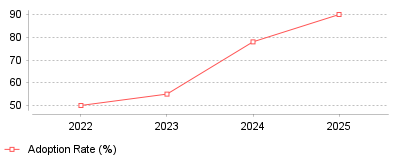
Recent data indicates that artificial intelligence adoption across IT service management (ITSM) and ticketing platforms has surged from 55% in 2023 to an estimated 90% by 2025, correlating directly with skyrocketing ticket deflection metrics [source]. Rather than relying on human agents to manually route and resolve every work order, platforms are increasingly leveraging AI copilots to autonomously resolve up to 80% of routine Tier-1 inquiries instantly [source].
On a micro level, this transformation dictates that individual support agents and IT personnel are no longer burdened with repetitive tasks like password resets, routine status inquiries, or basic troubleshooting workflows. Instead, human technicians are being elevated to handle highly complex, emotionally sensitive, or mission-critical escalations that genuinely require strategic intervention. On a macro industry scale, the ticketing platform market is undergoing a complete paradigm shift where vendors are evaluated heavily on their AI's autonomous resolution capabilities and data integration, rather than traditional interface features. Consequently, companies deploying these advanced AI-driven platforms are experiencing up to a 50% reduction in average resolution times, fundamentally altering the economics and operational velocity of global customer service and internal IT support [source].
This trend is critically important because traditional support models were becoming financially unsustainable and severely prone to human burnout due to continuously rising digital workload volumes [source]. By successfully deflecting over half of incoming requests through AI-powered self-service, organizations can securely scale their operations globally without requiring a proportional increase in expensive headcount [source]. Furthermore, achieving near-instantaneous, accurate resolutions radically improves end-user satisfaction and employee experience, effectively evolving the IT service desk from a reactive corporate cost center into a proactive, value-driving enterprise asset [source].
The explosive growth of this autonomous resolution trend was primarily triggered by rapid advancements in Large Language Models (LLMs) and natural language processing, which finally endowed virtual agents with the cognitive ability to accurately parse complex user intent and contextual metadata. Prior to these algorithmic breakthroughs, rigid, rule-based chatbots frequently frustrated users, leading to high human escalation rates and widespread end-user resistance. Additionally, the tightening macroeconomic environment and tech sector realignments over the past two years forced CIOs to relentlessly pursue operational efficiency and maximize software ROI [source]. We can also speculate that the broad normalization of remote work and digital-first commerce permanently conditioned consumers to expect instant, 24/7 self-service resolutions, creating a perfect demand environment for sophisticated AI ticketing platforms.
In conclusion, the aggressive integration of autonomous AI agents within work order and ticketing management platforms definitively marks the end of the traditional, manual support queue. The prominent takeaway for business leaders is that organizations failing to adopt AI-assisted triage and resolution tools will rapidly face severe competitive disadvantages regarding both operational margins and customer satisfaction levels. Ultimately, the future of work order management lies in "zero-touch" service models, where the vast majority of technical issues are predicted, intelligently triaged, and autonomously solved before a human agent ever accesses a dashboard [source].
Grand View Research values the field service management software sector at $4.43 billion, projecting a 13.3% compound annual growth rate to reach $11.78 billion by 2030 [1]]. Capital expenditure reflects this upward trajectory. Organizations actively replace outdated tracking systems with platforms that centralize asset data and field technician routing. A 2025 Verdantix survey found that 83% of corporate real estate leaders plan to increase computerized maintenance management system spending. This represents a steep climb from the 63% of leaders who planned increases the prior year [2].
This investment surge responds directly to operational pressures across the commercial sector. Rising material costs and chronic labor shortages force maintenance teams to extract more efficiency from fewer workers. Platform vendors compete fiercely to provide solutions that convert reactive emergency repairs into predictable, automated workflows. Verdantix identified Planon, MaintainX, IBM, Limble, Infraspeak, Nuvolo, ServiceNow, and Facilio as current market leaders based on their mobile capability and hardware integration [2].
Software packages account for 81.3% of all category revenue, vastly outpacing standalone implementation services [1]. North America dominates this enterprise spending with a 26.5% global market share. The Asia Pacific region exhibits the fastest expansion rate at 19.4% [1]. Fortune Business Insights models an even more aggressive growth curve, projecting the total market will expand from $6.14 billion in 2026 to $13.79 billion by 2034 [3]. This capital influx funds continuous software development, specifically targeting algorithmic routing and automated inventory procurement.
On-premise software installations rapidly lose market share to cloud-based alternatives. Data Bridge Market Research predicts the cloud deployment segment will dominate the field service market with a 68.31% share by 2025 [4]. Cloud architectures offer lower upfront capital costs and native scalability. More importantly, cloud systems enable remote mobile access for field technicians operating outside corporate firewalls. Technicians require immediate access to service manuals and customer histories while standing in front of broken equipment.
Legacy on-premise systems trap valuable operational data in localized servers. This localized architecture prevents corporate directors from analyzing portfolio-wide performance metrics. When a multinational manufacturer upgrades to a cloud platform, regional supervisors gain instant visibility into global parts inventory. This real-time visibility prevents unnecessary local part purchases when a neighboring facility holds surplus stock. The transition to cloud infrastructure serves as the mandatory foundation for any future artificial intelligence deployments.

Decades of deferred upkeep created a $112 billion maintenance backlog across U.S. higher education institutions [5]. University administrators routinely delay capital improvements to balance annual operating budgets. This specific financial strategy compounds physical deterioration over time. Clearing these accumulated deficits now costs facility departments $140 per square foot [5]. According to the Pacific Partners Consulting Group, every $1 in deferred maintenance generates $4 in future capital renewal requirements [5]. Moody's Ratings projects that colleges and universities need between $750 billion and $950 billion over the next decade just to repair existing infrastructure [6]. Institutions report a 36% shortfall in the capital required simply to maintain current building conditions [7].
Labor availability accelerates this physical decay. Half of all facilities professionals identify qualified worker shortages as their primary operational obstacle [5]. Without sufficient staff, preventative inspections give way entirely to emergency triage. Managers addressing university infrastructure repairs increasingly rely on automated ticketing software to prioritize critical failures over routine service requests. A leaking campus pipe demands immediate attention regardless of scheduled preventative tasks. Age demographics further threaten institutional knowledge across campuses. Current data shows 20% of facilities leaders are over 55, while less than 9% are under 25 [7].
Technician dispatches carry steep costs. The first-time fix rate tracks how often a field worker resolves a customer issue during their initial visit. Aberdeen Group data places the industry average at 80%. Top-performing service organizations achieve 88% or higher, while market laggards hover around 63% [8]. Falling below the 80% threshold triggers severe financial penalties for service providers. Unresolved tickets require follow-up visits that cost between $200 and $300 per truck roll [8]. A company averaging 400 service calls per day with a 63% success rate executes 100 more daily return trips than a competitor operating at 88% [8].
Workforce attrition complicates corporate efforts to improve these specific metrics. The U.S. Bureau of Labor Statistics projects a 12% increase in demand for climate control technicians by 2024 [9]. Software vendors attempt to bridge this persistent skill gap with remote diagnostic capabilities. Dispatchers directing climate control service crews now push mobile schematics and inventory counts directly to field tablets. Technicians who review service logs before arriving on-site diagnose problems accurately and order correct replacement parts on the first attempt. Mean time between visits increased 32% year-over-year among operators using advanced triage tools [10]. This indicates that initial repairs last significantly longer when workers access proper documentation.
Customer satisfaction scores tie directly to initial repair success. ZenTrades reports that 24% of clients experiencing a positive first encounter remain loyal to a service provider for an average of two years [11]. Firms achieving a 70% fix rate retain 86% of their customer base [11]. Top-tier maintenance crews complete repairs in 3.7 days on average. Typical teams require 5.9 days to close identical tickets [12]. This speed disparity creates a measurable operational advantage that translates directly into contract renewals.
CBRE manages thousands of dispersed retail locations, illustrating the distinct mathematical challenges of multi-site operations. Retailers operate on thin profit margins that penalize excessive maintenance spend. JLL Technologies data shows 55.7% of facility leaders expected 2024 to bring increased workload pressure [13]. Operational data reveals 42.6% of managers operated below ideal staffing levels [13]. Companies managing portfolios of 1,000 to 10,000 properties lack the scale to absorb sudden material price shocks [14]. Inflationary pricing on raw materials forces retail operators to delay scheduled asset replacements and stretch the functional lifespan of existing equipment.
Property networks demand strict vendor oversight to control runaway costs. An administrative team logging residential tenant defect reports must balance emergency plumbing failures against contract cleaning schedules. Directors coordinating regional branch upkeep deploy centralized ticketing software to restrict independent spending by individual store managers. Centralized tracking prevents regional supervisors from overpaying local contractors. Because retail properties face less stringent safety regulations than industrial manufacturing plants, retail brands frequently push preventative maintenance into the elective category to preserve cash flow [14].
Vendors sell intelligence, but buyers struggle with initial deployment. The operational shift toward connected machinery relies on seamless data transfers between physical sensors and cloud platforms. Field service software implementation faces significant technical hurdles. Gartner reports 42% of implementation delays stem directly from data integration failures and cybersecurity risks [15]. Cloud-based software modules frequently fail to communicate with legacy enterprise resource planning systems installed a decade ago.
Security threats parallel these integration challenges. The average manufacturing organization experiences 49 targeted cyberattacks per week aimed specifically at their connected field devices [16]. Despite these persistent technical hurdles, the potential financial rewards drive continued corporate investment. McKinsey projects the industrial internet of things market will reach $500 billion by 2025 [17]. Hardware components account for $215 billion of that total projection [17]. Physical hardware installations generate the exact telemetry data required for algorithmic task routing.
Algorithm-driven scheduling radically alters standard operating procedures. McKinsey analysis demonstrates that predictive maintenance algorithms reduce unplanned machine downtime by 70% to 75% [18]. These same algorithmic schedules extend physical asset lifespans by 20% to 40% [18]. This proactive approach reduces total maintenance expenses by up to 30% [18]. A connected platform overseeing commercial tower maintenance monitors boiler vibrations and electrical current fluctuations. When a remote sensor detects mechanical anomalies, the software automatically generates a digital work order. The system then dispatches a local technician before complete mechanical failure occurs.
Customer expectations accelerate this technological transition across heavy industry. Unplanned mechanical outages cost modern industrial plants over $100,000 per hour in lost production [18]. Companies increasingly replace calendar-based preventative checks with immediate condition-based interventions. Rather than replacing an industrial air filter every three months, maintenance teams replace it only when internal airflow drops below a calculated threshold. This precise intervention preserves spare parts inventory. It also keeps human technicians focused on active equipment degradation rather than arbitrary visual inspections.
Commercial cleaning contractors face the highest employee attrition rates in the entire facility sector. The janitorial industry averages a 200% annual employee turnover rate [19]. Replacing an entire field workforce twice a year consumes management time and heavily erodes profit margins. Inconsistent staffing levels directly impact client retention rates across commercial portfolios. Sweptworks estimates that 55% of commercial cleaning businesses lose active contracts due to inadequate service delivery caused by staffing gaps [19].
Service firms counter this operational instability through aggressive digitization. A manager scheduling sanitation staff uses mobile applications to distribute translated task lists and track geographic arrival times. Clear digital instructions reduce new hire anxiety and standardise daily outputs. Servicon successfully reduced its employee turnover to 72.4% in 2024 by integrating structured digital training programs and transparent performance dashboards [20]. Retaining trained workers remains the most reliable method for preserving profit margins in low-margin service categories.
City governments face intense public scrutiny over facility hygiene and infrastructure safety. Public works departments increasingly outsource routine maintenance to private service contractors to control municipal budgets. A 2023 municipal filing from the City of Oceanside, California, illustrates this specific outsourcing transition. The city awarded a $1.27 million contract to Prizm Janitorial Services for park and beach restroom maintenance [21].
Public contracts mandate specific software usage for quality control and accountability. When local citizens report hygiene issues or request extra cleaning, the public works department enters the data into a centralized quality control program. This software generates an immediate digital ticket. Regional supervisors receive the dispatch automatically. They then deploy additional employees to resolve the localized emergency without interrupting scheduled daily routes [21]. Municipalities demand these transparent digital audit trails to justify taxpayer expenditures and monitor daily contractor compliance.
ServiceNow's fourth-quarter 2025 earnings report confirms broad enterprise demand for autonomous workflows. The company posted $3.47 billion in subscription revenue. This figure represents a 21% year-over-year increase [22]. Net income reached $401 million, while adjusted earnings per share hit $0.92 to surpass analyst forecasts. Total remaining performance obligations grew 26.5% to $28.2 billion [22]. This massive volume of committed future revenue signals sustained corporate investment in platform modernization. The company's artificial intelligence product crossed $600 million in annual contract value [23]. Management closed 244 software transactions exceeding $1 million in net new value during the single quarter [23].
Financial metrics highlight a structural shift toward machine-assisted routing. Software buyers increasingly reject standalone applications in favor of unified platforms. These platforms connect customer service requests directly to field dispatch grids. Gartner projects that 33% of all enterprise software applications will feature agentic artificial intelligence by 2028 [24]. These autonomous agents will read incoming defect reports and query inventory databases for required parts. They will then assign the nearest qualified technician entirely without human intervention.
Capital markets continue to reward software vendors that successfully reduce field service labor dependencies. The introduction of hybrid pricing models fundamentally alters how organizations procure corporate software. These models combine traditional per-seat user licensing with consumption-based artificial intelligence usage fees. ServiceNow explicitly credited this new pricing strategy for its accelerated deal velocity in early 2025 [23]. Buyers now pay for completed automated tasks rather than strictly paying for employee logins.
Hardware costs will dictate the actual pace of predictive maintenance adoption. Software platforms scale easily, but physical facilities require massive capital investments in sensor technology to feed analytical engines. Companies must retrofit existing HVAC units, conveyor belts, and plumbing systems with internet-connected monitors before algorithms can predict their failure. As the initial cost of connected sensors falls, smaller regional operators will adopt the predictive capabilities currently reserved for multinational corporations. The service sector faces a multi-year transition away from manual calendar schedules toward immediate, condition-based field interventions.
| Year | Adoption Rate (%) |
|---|---|
| 2022 | 50 |
| 2023 | 55 |
| 2024 | 78 |
| 2025 | 90 |
Recent data indicates that artificial intelligence adoption across IT service management (ITSM) and ticketing platforms has surged from 55% in 2023 to an estimated 90% by 2025, correlating directly with skyrocketing ticket deflection metrics [source]. Rather than relying on human agents to manually route and resolve every work order, platforms are increasingly leveraging AI copilots to autonomously resolve up to 80% of routine Tier-1 inquiries instantly [source].
On a micro level, this transformation dictates that individual support agents and IT personnel are no longer burdened with repetitive tasks like password resets, routine status inquiries, or basic troubleshooting workflows. Instead, human technicians are being elevated to handle highly complex, emotionally sensitive, or mission-critical escalations that genuinely require strategic intervention. On a macro industry scale, the ticketing platform market is undergoing a complete paradigm shift where vendors are evaluated heavily on their AI's autonomous resolution capabilities and data integration, rather than traditional interface features. Consequently, companies deploying these advanced AI-driven platforms are experiencing up to a 50% reduction in average resolution times, fundamentally altering the economics and operational velocity of global customer service and internal IT support [source].
This trend is critically important because traditional support models were becoming financially unsustainable and severely prone to human burnout due to continuously rising digital workload volumes [source]. By successfully deflecting over half of incoming requests through AI-powered self-service, organizations can securely scale their operations globally without requiring a proportional increase in expensive headcount [source]. Furthermore, achieving near-instantaneous, accurate resolutions radically improves end-user satisfaction and employee experience, effectively evolving the IT service desk from a reactive corporate cost center into a proactive, value-driving enterprise asset [source].
The explosive growth of this autonomous resolution trend was primarily triggered by rapid advancements in Large Language Models (LLMs) and natural language processing, which finally endowed virtual agents with the cognitive ability to accurately parse complex user intent and contextual metadata. Prior to these algorithmic breakthroughs, rigid, rule-based chatbots frequently frustrated users, leading to high human escalation rates and widespread end-user resistance. Additionally, the tightening macroeconomic environment and tech sector realignments over the past two years forced CIOs to relentlessly pursue operational efficiency and maximize software ROI [source]. We can also speculate that the broad normalization of remote work and digital-first commerce permanently conditioned consumers to expect instant, 24/7 self-service resolutions, creating a perfect demand environment for sophisticated AI ticketing platforms.
In conclusion, the aggressive integration of autonomous AI agents within work order and ticketing management platforms definitively marks the end of the traditional, manual support queue. The prominent takeaway for business leaders is that organizations failing to adopt AI-assisted triage and resolution tools will rapidly face severe competitive disadvantages regarding both operational margins and customer satisfaction levels. Ultimately, the future of work order management lies in "zero-touch" service models, where the vast majority of technical issues are predicted, intelligently triaged, and autonomously solved before a human agent ever accesses a dashboard [source].