


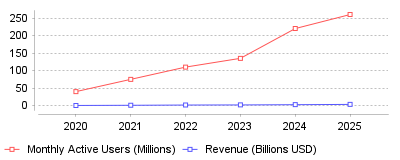
| Year | Monthly Active Users (Millions) | Revenue (Billions USD) |
|---|---|---|
| 2020 | 40 | 0.5 |
| 2021 | 75 | 1 |
| 2022 | 110 | 1.7 |
| 2023 | 135 | 2 |
| 2024 | 220 | 2.7 |
| 2025 | 260 | 3.5 |
The data illustrates a massive acceleration in user adoption and revenue generation for cloud-first, accessible layout platforms like Canva, which grew from 40 million monthly active users in 2020 to 260 million by 2025 [source]. Concurrently, Canva's acquisition of Serif and subsequent transition to a "free forever" model for its professional layout and publishing suite, Affinity, drove an unprecedented 1 million sign-ups in less than a week [source].
For the micro industry, this signals a major disruption in how professional and amateur designers access publishing tools, heavily undercutting the barrier to entry for high-quality software. Traditional legacy providers, primarily Adobe with its ~70% market share and subscription-heavy model [source], are now facing an aggressive user acquisition strategy designed to break their market lock-in [source]. Competitors are leveraging massive mainstream user bases to subsidize professional-grade software, capturing edge users who suffer from widespread subscription fatigue [source]. On a macro level, it indicates that future value in the software market is moving away from selling individual tool licenses and toward owning comprehensive, cross-functional ecosystems [source].
This trend is crucial because it effectively democratizes high-end desktop publishing software, removing the financial gatekeeping that has historically defined the creative industry. By offering professional tools like Affinity Publisher for free and monetizing only through optional AI or enterprise team features [source], challengers are forcing a fundamental economic shift from rent-seeking models to value-added ecosystem plays. It directly empowers over 60 million students and educators globally, giving them frictionless access to professional layout workflows without prohibitive recurring costs [source].
This shift is likely a direct response to rising user frustration over escalating software subscription costs, particularly within established ecosystems where creatives are forced to rent their tools indefinitely [source]. As generative AI technologies dramatically lower the barrier to entry for basic content creation, layout platforms must find more radical ways to attract and retain professional users. Exceptional financial performance—such as Canva reaching $3.5 billion in revenue in 2025 [source]—provides the immense capital needed to acquire tools like Affinity for $380 million and deploy them as permanent loss leaders [source]. Furthermore, the modern era of remote work and digital-first education has amplified the necessity for collaborative, accessible design environments over isolated, expensive desktop applications.
The layout and publishing design software category is undergoing a monumental transition, catalyzed by the explosive financial growth of freemium, cloud-first ecosystems. As challengers aggressively expand their footprint by making professional publishing tools universally free, traditional subscription models face an existential threat to their market dominance. The prominent takeaway is that future market leadership in layout software will belong to organizations that prioritize seamless community collaboration and broad ecosystem lock-in over selling individual software licenses.
Global digital publishing generated $163.89 billion in 2025. This sector will grow at an 11.6% annual rate through 2030 [1]. Smartphone adoption and content digitisation drive this expansion across multiple formats. Regional markets show similar upward trajectories. The European creative software market will reach $3.64 billion by 2030, maintaining a 6.5% growth rate [2]. Remote work models force organizations to adopt cloud-based tools for distributed teams. Cloud deployments held a 64.5% market share in 2023, as companies required scalable infrastructure to manage substantial data volumes associated with internet streaming [2].
Capital investment flows toward workflow automation tools within this sector. Creative Force secured $8.9 million in Series A funding to expand its European operations across the United Kingdom, France, and the Nordics [2]. Investors target platforms that reduce repetitive tasks. Media publishers face strict performance metrics. Pages taking longer than three seconds to load suffer a 53% abandonment rate on mobile devices [1]. Modern layout software must output optimized code to prevent these latency issues, connecting content delivery networks directly to the editing interface.
Vendor revenue confirms widespread industry adoption. Adobe reported $21.51 billion in fiscal year 2024 revenue, marking an 11% year-over-year increase [3]. The company generated $12.68 billion specifically from its Creative cloud products. Net new annual recurring revenue for Digital Media exceeded $2 billion during the same period. Document Cloud revenue reached $843 million in the fourth quarter alone, growing 17% [3]. Adobe generated $8.06 billion in operating cash flows over the year, demonstrating the profitability of subscription-based design software.
This financial performance rests on deep enterprise penetration. Adobe controls 69.5% of the core graphics market [4]. An Adobe enterprise customer spending $10 million annually represents a completely different commercial profile than a small business paying monthly subscription fees [4]. The company expanded its freemium funnel to capture earlier-stage users. Adobe reported 80 million freemium monthly active users, a segment growing at 50% year-over-year [4]. These free users feed into a subscription catalog with high lifetime value, supported by specialized applications for typography, vector graphics, and video formatting. To maintain this market valuation, Adobe repurchased 17.5 million shares during fiscal year 2024 [3].

Canva reached $4 billion in annual recurring revenue by late 2025. This metric represents a 35% growth rate [5]. The Australian company now supports 265 million monthly active users and 31 million paid subscribers [6]. B2B software sales explain this rapid trajectory. Enterprise subscriptions grew 100% year-over-year, generating $500 million from organizations purchasing 25 or more seats [5]. Over 95% of Fortune 500 companies now maintain active Canva accounts [7].
This expansion alters software procurement habits. Casual users and marketing departments increasingly favor simpler alternatives to professional suites. Modern publishing tools focus on quick execution. Features like brand kits allow non-designers to produce formatted documents rapidly. The visual suite category, which includes documents and whiteboards, handles 38.5 million designs daily [8]. Teams operating tight production schedules rely on these accessible tools. For example, formatting photo albums and client proofs requires software that balances aesthetic control with rapid output, avoiding steep learning curves. Canva's freemium conversion model proves highly effective here, converting roughly 11.7% of its free users into paying customers [4].
Pricing strategies reflect aggressive global ambitions. Canva introduced lower-priced subscription tiers in Pakistan, Uruguay, Morocco, and Jamaica to accelerate international adoption [6]. This strategy pushed the company's secondary share market valuation to $42 billion [8]. Dedicated segments also show heavy adoption; the education cohort added between $150 million and $220 million in annual recurring revenue, reaching 100 million verified teachers and students [8].
High production volume rarely guarantees business value. Organizations spend an average of $1.09 million annually on content marketing, yet only 29% of software executives rate their strategy as effective [9]. This disconnect highlights a persistent operational failure. Marketing departments optimize for search traffic rather than commercial intent. They publish thousands of articles that fail to generate pipeline revenue. Using internal design platforms for tech brands helps unify brand identity, but the underlying distribution strategy often remains flawed.
Inaccurate data compounding poor software integrations costs companies $12.9 million annually [10]. Disconnected systems force staff to re-enter information manually across different interfaces. Media companies suffer immediate financial penalties from these bottlenecks. Outdated publishing infrastructure causes severe latency issues. Editors spend excessive time formatting layouts instead of refining text. Nearly 47% of marketers fail to track return on investment for published materials [9]. Programs measured entirely on traffic volume optimize exclusively for traffic volume, ignoring down-funnel financial impact.
Firms produce content for search algorithms rather than human buyers. As search engines deploy artificial intelligence to answer queries directly, organic click-through rates decline. Only 40.3% of United States Google searches resulted in clicks to any website in March 2025 [9]. This shift destroys distribution models built entirely on informational keywords.
HubSpot experienced a 50% decline in organic visits during a single month in December 2024 [9]. This event demonstrates the vulnerability of high-volume production models. Conversely, Zapier achieved a $5 billion valuation built on content-first growth, documenting a 454% return on investment across 70,000 programmatic pages designed for buyer intent [9]. Conversion metrics emphasize the cost of bad strategy. Leads generated through organic search convert from marketing-qualified to sales-qualified at a 51% rate, compared to a 13% overall average [11]. Despite this quality gap, companies ignore customer expansion content. Between 40% and 50% of new revenue at top software companies comes from existing customers, yet almost no content budgets target this segment [9].
April 2024 marked a critical regulatory change for digital content. The Department of Justice issued a final rule updating Title II of the Americans with Disabilities Act [12]. This mandate establishes Web Content Accessibility Guidelines 2.1 Level AA as the technical standard for state and local government websites. The requirement explicitly covers digital documents, including PDF files, presentations, and spreadsheets.
Public entities face strict compliance deadlines. Governments serving populations over 50,000 must meet these standards by April 2026. Smaller municipalities have until April 2027 [13]. A recent interim rule extended certain dates, but the core obligations remain intact [14]. This regulation forces a massive operational shift. Content creators must tag reading structures, add alternative text to images, and verify color contrast ratios before publication. Healthcare organizations receiving federal funding face a similar deadline in May 2026 under Department of Health and Human Services regulations [14].
Failing to remediate documents carries severe legal risks. Over 8,800 ADA lawsuits were filed in 2024, with digital accessibility cases increasing 7% from the prior year [15]. Retail and e-commerce companies attract 30% of these claims, frequently citing missing alternative text and inaccessible PDF documents [15]. Public universities, courts, and regional agencies maintain thousands of legacy files that now require immediate updates [16].
Corporate environments face similar pressures from private litigation. Teams creating candidate onboarding packets and employee handbooks must select software that natively exports compliant tags to avoid legal exposure. Exceptions to the federal rule remain narrow. Archived documents and pre-existing third-party content may escape immediate remediation. However, any file actively used by the public must conform to the new standards [14]. A state posting a PDF version of a business license application in 2020 must update that file if citizens still use it after the compliance date.
Federal agencies enforce digital accessibility aggressively. The Department of Justice filed a complaint against MedStar Health in January 2024 for ADA violations related to digital services for patients [15]. Service Oklahoma reached a settlement the same month regarding an inaccessible mobile application. The agreement forces the state agency to achieve WCAG 2.1 Level AA compliance across all digital properties [15].
Financial penalties accompany these enforcement actions. Kent Hospital in Rhode Island paid a $35,000 settlement for denying effective communication to a deaf patient, requiring new digital accessibility policies [15]. Private litigation compounds this financial risk. Plaintiffs file thousands of lawsuits targeting specific digital barriers, including missing alternative text on images and inaccessible checkout sequences [17]. Software buyers now mandate accessibility export functions during the procurement process. If a layout tool cannot generate a tagged PDF, government agencies legally cannot purchase it.
Employment data reveals a sharp contraction in specialized layout roles. The Bureau of Labor Statistics projects a 12% decline in desktop publisher jobs between 2024 and 2034 [18]. Only 400 annual openings are expected during this decade, driven entirely by workers retiring or transferring to other occupations. Median annual pay for these roles sat at $53,620 in May 2024, with the lowest ten percent earning under $34,650 [18].
Technology consolidation causes this labor shift. Organizations hire fewer dedicated publishers because adjacent roles absorb these responsibilities. Graphic designers, web developers, and copy editors now execute layout tasks using intuitive software interfaces [18]. The historical division of labor—where writers drafted text and specialists arranged elements—no longer exists in modern media production.
Cloud architectures accelerate this transition. Centralized asset management tools allow distributed teams to assemble content concurrently. Writers edit text directly within the final layout view. These unified workspaces eliminate sequential handoffs. Consequently, the distinct profession of the desktop publisher has become economically unviable for most modern enterprises. Short-term, on-the-job training lasting one month replaces formal degree requirements for software operation [18].
Artificial intelligence fundamentally changes asset creation. Software vendors integrate predictive generation directly into core layout platforms. Adobe Firefly annual recurring revenue exceeded $250 million, with generative credit consumption growing 45% quarter-over-quarter [4]. Users rely on these tools to produce background images, expand crop borders, and generate typography styles from text prompts. Human-written content generates 5.44 times more traffic over five months than unedited AI content, indicating that generation tools work best for design assets rather than final copy [11].
Canva logged over 24 billion AI uses by early 2026 [8]. The company integrated its platform with external models like ChatGPT, facilitating 26 million conversations between users and the design application [6]. These integrations represent a new acquisition channel. Instead of navigating to a dedicated design application, users generate initial layouts within a chat interface and export the results to a publishing suite for final refinement. Tools like Magic Write, Magic Design, and Magic Edit consolidate generative functions into a single interface [7].
Multichannel publishing requires a fundamental change in data architecture. Brands must create content once and format it dynamically for various platforms. Contentstack notes that surfacing content on multiple channels presents unique consistency challenges [19]. Modern organizations solve this through structured content modeling. Writers input text into a headless content management system rather than a fixed layout file. The system stores this text as pure data, separate from its visual presentation.
This separation enables scalable reuse. A single product description feeds simultaneously into a printed catalog, a mobile application, and a responsive website. The layout software queries the headless system via API, pulling the exact text required for that specific medium. This process eliminates manual copying and pasting between different application windows. Marketing automation tools then schedule the final post deliveries and track key performance indicators [19].
Retail publishers face unique content challenges. Connecting product catalogs to consumer-facing layouts requires specialized middleware. Product Information Management software centralizes product data, enabling efficient organization and distribution of specifications and media assets [20]. These platforms feed directly into layout applications to populate catalogs automatically.
Manual updates create unacceptable commercial risks. Syndicating product data to multiple sales channels demands a single approved version of product content [21]. Layout software must interface via API with these databases. When a price changes in the central repository, th
| Year | Monthly Active Users (Millions) | Revenue (Billions USD) |
|---|---|---|
| 2020 | 40 | 0.5 |
| 2021 | 75 | 1 |
| 2022 | 110 | 1.7 |
| 2023 | 135 | 2 |
| 2024 | 220 | 2.7 |
| 2025 | 260 | 3.5 |
The data illustrates a massive acceleration in user adoption and revenue generation for cloud-first, accessible layout platforms like Canva, which grew from 40 million monthly active users in 2020 to 260 million by 2025 [source]. Concurrently, Canva's acquisition of Serif and subsequent transition to a "free forever" model for its professional layout and publishing suite, Affinity, drove an unprecedented 1 million sign-ups in less than a week [source].
For the micro industry, this signals a major disruption in how professional and amateur designers access publishing tools, heavily undercutting the barrier to entry for high-quality software. Traditional legacy providers, primarily Adobe with its ~70% market share and subscription-heavy model [source], are now facing an aggressive user acquisition strategy designed to break their market lock-in [source]. Competitors are leveraging massive mainstream user bases to subsidize professional-grade software, capturing edge users who suffer from widespread subscription fatigue [source]. On a macro level, it indicates that future value in the software market is moving away from selling individual tool licenses and toward owning comprehensive, cross-functional ecosystems [source].
This trend is crucial because it effectively democratizes high-end desktop publishing software, removing the financial gatekeeping that has historically defined the creative industry. By offering professional tools like Affinity Publisher for free and monetizing only through optional AI or enterprise team features [source], challengers are forcing a fundamental economic shift from rent-seeking models to value-added ecosystem plays. It directly empowers over 60 million students and educators globally, giving them frictionless access to professional layout workflows without prohibitive recurring costs [source].
This shift is likely a direct response to rising user frustration over escalating software subscription costs, particularly within established ecosystems where creatives are forced to rent their tools indefinitely [source]. As generative AI technologies dramatically lower the barrier to entry for basic content creation, layout platforms must find more radical ways to attract and retain professional users. Exceptional financial performance—such as Canva reaching $3.5 billion in revenue in 2025 [source]—provides the immense capital needed to acquire tools like Affinity for $380 million and deploy them as permanent loss leaders [source]. Furthermore, the modern era of remote work and digital-first education has amplified the necessity for collaborative, accessible design environments over isolated, expensive desktop applications.
The layout and publishing design software category is undergoing a monumental transition, catalyzed by the explosive financial growth of freemium, cloud-first ecosystems. As challengers aggressively expand their footprint by making professional publishing tools universally free, traditional subscription models face an existential threat to their market dominance. The prominent takeaway is that future market leadership in layout software will belong to organizations that prioritize seamless community collaboration and broad ecosystem lock-in over selling individual software licenses.