Sales Training & Coaching Platforms

Updated July 28, 2026

These are the specialized categories within Sales Training & Coaching Platforms. Looking for something broader? See all Field Service & Operations Software categories.

Not sure which one is right for you?

Answer 4 quick questions and we'll match you with your best options

Find Your Best Match

How big is your team?

Just me
2 - 10
11 - 50
51 - 200
201 - 1,000
1,000+

What's your budget situation?

Free or open-source only
Free to start, pay later
Best value for money
Price isn't the main factor

What's your team's technical comfort level?

We want it to just work
We can handle some setup
We have developers who'll customize it

What's the ONE thing this tool must do well?

Step 1 of 4
Richardson Sales Training | Sell Forward

Richardson Sales Training is a comprehensive SaaS solution specifically designed for the Call Center and Inside Sales industry. With over 40 years of experience, it offers cutting-edge tools for sales training, driving meaningful change and boosting sales performance.

Best for Sales Training Platforms for Call Center and Inside Sales

Expert Take

Richardson Sales Training excels as a specialized solution for the Call Center and Inside Sales industry, leveraging over 40 years of experience. Its comprehensive training methodologies and flexible delivery options make it a top choice for enterprises seeking to enhance sales performance. The product's credibility is further supported by its tailored approach and industry recognition.

Pros

  • Integrates Challenger and Consultative methodologies
  • Accelerate platform embeds in CRM
  • Documented 22:1 ROI for clients
  • Addresses buyer indecision specifically

Cons

  • High cost barrier for small teams
  • No public pricing transparency
  • Administrative backend can be complex
  • Requires significant implementation effort

Best for teams that are

  • Global enterprise teams needing customized, scalable sales curriculum
  • Sellers managing complex B2B deals with multiple decision-makers

Skip if

  • Simple transactional B2C sales models (e.g., retail, direct-to-consumer)
  • Teams looking for generic, off-the-shelf video courses

Best for teams that are

  • Global enterprise teams needing customized, scalable sales curriculum
  • Sellers managing complex B2B deals with multiple decision-makers

Skip if

  • Simple transactional B2C sales models (e.g., retail, direct-to-consumer)
  • Teams looking for generic, off-the-shelf video courses

Pros

  • Integrates Challenger and Consultative methodologies
  • Accelerate platform embeds in CRM
  • Analytics link behavior to revenue
  • Documented 22:1 ROI for clients
  • Addresses buyer indecision specifically

Cons

  • High cost barrier for small teams
  • No public pricing transparency
  • Administrative backend can be complex
  • eLearning lacks industry customization
  • Requires significant implementation effort

Expert Take

Richardson Sales Training excels as a specialized solution for the Call Center and Inside Sales industry, leveraging over 40 years of experience. Its comprehensive training methodologies and flexible delivery options make it a top choice for enterprises seeking to enhance sales performance. The product's credibility is further supported by its tailored approach and industry recognition.

Cardone Sales Training University

Cardone University is a comprehensive sales training platform designed specifically for enterprise sales teams. It delivers Grant Cardone's renowned sales training curriculum, tailored to address the unique challenges and needs of enterprise sales, including negotiating large deals, managing complex sales cycles, and building high-performing teams.

Best for Sales Training Platforms for Enterprise Sales Teams

Expert Take

Cardone Sales Training University is a premium sales training platform tailored for enterprise sales teams, offering a comprehensive curriculum by renowned expert Grant Cardone. Its extensive content and interactive learning tools make it a top choice for organizations seeking to enhance their sales capabilities.

Pros

  • Massive library with 8,000+ segments
  • 24/7 access on all devices
  • Includes certification and testing
  • Strong focus on closing skills

Cons

  • Strict no-refund policy on digital
  • High price point for full access
  • Content can be repetitive
  • Requires buy-in to '10X' style

Best for teams that are

  • Sales teams in high-volume, transactional B2C industries
  • Individuals wanting motivation-heavy, video-based content

Skip if

  • Enterprise B2B teams with complex, consultative sales cycles
  • Experienced professionals finding basic tactics redundant

Best for teams that are

  • Sales teams in high-volume, transactional B2C industries
  • Individuals wanting motivation-heavy, video-based content

Skip if

  • Enterprise B2B teams with complex, consultative sales cycles
  • Experienced professionals finding basic tactics redundant

Pros

  • Massive library with 8,000+ segments
  • Used by Fortune 500 companies
  • 24/7 access on all devices
  • Includes certification and testing
  • Strong focus on closing skills

Cons

  • Strict no-refund policy on digital
  • High price point for full access
  • Aggressive sales tactics reported
  • Content can be repetitive
  • Requires buy-in to '10X' style

Expert Take

Cardone Sales Training University is a premium sales training platform tailored for enterprise sales teams, offering a comprehensive curriculum by renowned expert Grant Cardone. Its extensive content and interactive learning tools make it a top choice for organizations seeking to enhance their sales capabilities.

Pclub.io Sales Training

Pclub.io offers a robust sales training and skill transformation platform, specifically designed for B2B revenue teams in the mid-market account executive sector. This software helps teams improve their skills and grow revenue by providing comprehensive training modules and reinforcement services.

Best for Sales Training Platforms for Mid Market Account Executives

Expert Take

Pclub.io Sales Training stands out as a specialized platform for B2B revenue teams, offering targeted training and reinforcement services. Its focus on mid-market account executives ensures relevance and depth, while its enterprise pricing model reflects its premium positioning. The platform's credibility is supported by its documented capabilities and industry relevance.

Pros

  • Instructors are top 1% verified sales practitioners
  • Includes AI-powered role-play simulations for practice
  • Role-specific paths for SDRs, AEs, and CSMs
  • Strong documented ROI on commission and win rates

Cons

  • Interface can be clunky and hard to navigate
  • No dedicated mobile app for on-the-go learning
  • Monthly subscriptions are non-refundable

Best for teams that are

  • SaaS AEs and SDRs seeking tactical, expert-led on-demand video courses
  • Mid-market AEs looking to upskill for enterprise-level roles

Skip if

  • Non-tech industries where SaaS-specific tactics may not apply
  • Teams requiring a unified, custom proprietary methodology implementation

Best for teams that are

  • SaaS AEs and SDRs seeking tactical, expert-led on-demand video courses
  • Mid-market AEs looking to upskill for enterprise-level roles

Skip if

  • Non-tech industries where SaaS-specific tactics may not apply
  • Teams requiring a unified, custom proprietary methodology implementation

Pros

  • Instructors are top 1% verified sales practitioners
  • Includes AI-powered role-play simulations for practice
  • Highly actionable, tactical content with no fluff
  • Role-specific paths for SDRs, AEs, and CSMs
  • Strong documented ROI on commission and win rates

Cons

  • Interface can be clunky and hard to navigate
  • No dedicated mobile app for on-the-go learning
  • Monthly subscriptions are non-refundable
  • High annual cost ($997) for individual budgets

Expert Take

Pclub.io Sales Training stands out as a specialized platform for B2B revenue teams, offering targeted training and reinforcement services. Its focus on mid-market account executives ensures relevance and depth, while its enterprise pricing model reflects its premium positioning. The platform's credibility is supported by its documented capabilities and industry relevance.

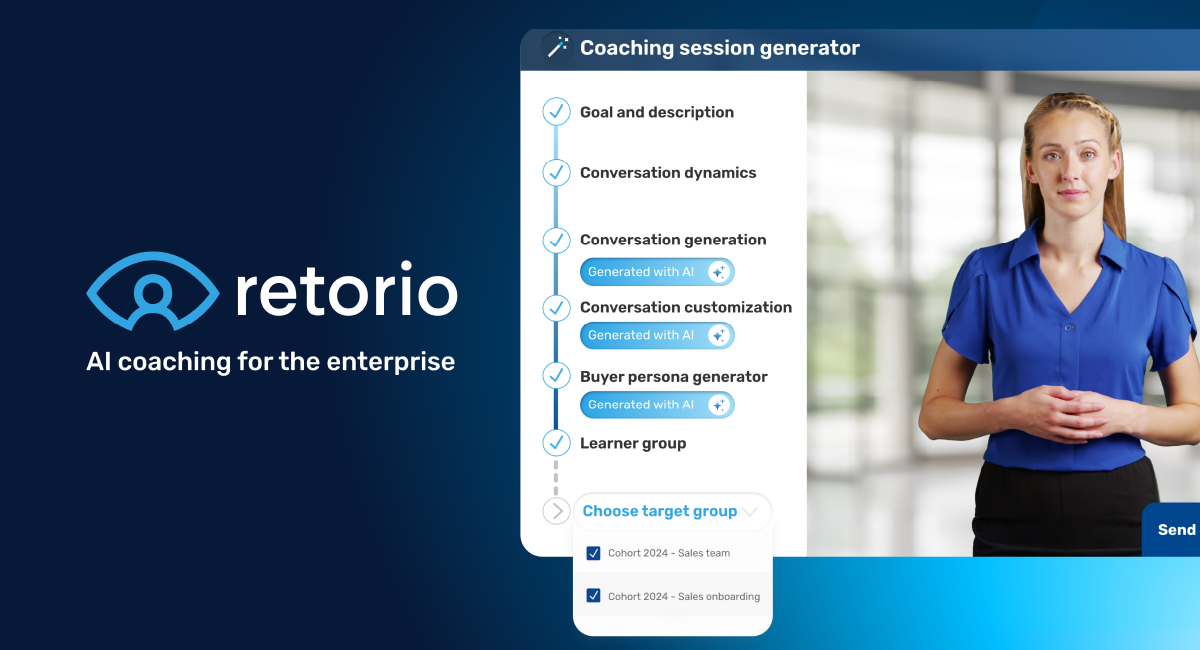
Retorio AI Sales Coaching

Retorio is a cutting-edge AI-powered sales coaching platform specifically designed for field service and operations industry. It provides unique features such as custom role plays and virtual client personas, enabling sales professionals to simulate and analyze conversations, thus helping them to enhance their selling skills and be ready for diverse client interactions.

Best for Sales Coaching Platforms with Video and Role Play Features

Expert Take

Retorio AI Sales Coaching stands out in the sales coaching platform category with its innovative use of AI for role plays and virtual client personas. It is tailored for the field service industry, offering unique conversation analysis features that enhance sales skills. Despite requiring some initial training, it provides significant value to sales teams.

Pros

  • Multimodal analysis of verbal and non-verbal cues
  • Fully GDPR and EU AI Act compliant
  • Fast content creation (under 20 minutes)
  • Strong ROI claims (7-15x first year)

Cons

  • Pricing is opaque and quote-based
  • Avatar realism has room for improvement
  • Low public review volume vs competitors
  • Requires video interaction (camera/mic)

Best for teams that are

  • Teams focusing on behavioral and soft skill development
  • High-volume hiring and onboarding for customer-facing roles

Skip if

  • Users uncomfortable with video or facial analysis
  • Sales leaders focused solely on script adherence

Best for teams that are

  • Teams focusing on behavioral and soft skill development
  • High-volume hiring and onboarding for customer-facing roles

Skip if

  • Users uncomfortable with video or facial analysis
  • Sales leaders focused solely on script adherence

Pros

  • Multimodal analysis of verbal and non-verbal cues
  • Fully GDPR and EU AI Act compliant
  • Scientifically validated 'Big 5' personality framework
  • Fast content creation (under 20 minutes)
  • Strong ROI claims (7-15x first year)

Cons

  • Pricing is opaque and quote-based
  • Avatar realism has room for improvement
  • Low public review volume vs competitors
  • Niche focus on soft skills/behavior
  • Requires video interaction (camera/mic)

Expert Take

Retorio AI Sales Coaching stands out in the sales coaching platform category with its innovative use of AI for role plays and virtual client personas. It is tailored for the field service industry, offering unique conversation analysis features that enhance sales skills. Despite requiring some initial training, it provides significant value to sales teams.

Claap Sales Training Software

Claap's AI-powered sales training software is specifically designed to centralize resources and automate skill development in short ramp transactional sales. By leveraging video, personalized coaching, and AI-curated calls, it addresses the industry's need for efficient and effective sales training, particularly in field service companies.

Best for Sales Training Platforms for Short Ramp Transactional Sales

Expert Take

Claap Sales Training Software excels in providing AI-driven, personalized sales training solutions tailored for short ramp transactional sales. It offers a comprehensive platform with centralized resources and automated skill development, making it a top choice for field service companies. Despite the lack of a free plan, its enterprise pricing model supports its premium positioning.

Pros

  • Native AI scoring for MEDDIC/SPIN
  • Significantly cheaper than Gong/Chorus
  • Seamless HubSpot & Salesforce sync
  • Interactive 'Just-in-Time' learning tools

Cons

  • Video processing delays on long files
  • AI struggles with overlapping speakers
  • Support response times can be slow
  • Learning curve for advanced features

Best for teams that are

  • Remote teams needing asynchronous video collaboration and coaching
  • Managers who want to coach based on recorded meeting highlights and clips

Skip if

  • Organizations requiring a structured LMS for formal certification paths
  • Companies looking for real-time, live call guidance software

Best for teams that are

  • Remote teams needing asynchronous video collaboration and coaching
  • Managers who want to coach based on recorded meeting highlights and clips

Skip if

  • Organizations requiring a structured LMS for formal certification paths
  • Companies looking for real-time, live call guidance software

Pros

  • Native AI scoring for MEDDIC/SPIN
  • Significantly cheaper than Gong/Chorus
  • SOC 2 Type II & GDPR compliant
  • Seamless HubSpot & Salesforce sync
  • Interactive 'Just-in-Time' learning tools

Cons

  • Video processing delays on long files
  • AI struggles with overlapping speakers
  • Support response times can be slow
  • Upload limits on lower-tier plans
  • Learning curve for advanced features

Expert Take

Claap Sales Training Software excels in providing AI-driven, personalized sales training solutions tailored for short ramp transactional sales. It offers a comprehensive platform with centralized resources and automated skill development, making it a top choice for field service companies. Despite the lack of a free plan, its enterprise pricing model supports its premium positioning.

Hyperbound is a unique SaaS solution designed to streamline sales training for SDR and BDR teams. Leveraging AI, it analyzes top performing sales calls to generate roleplays, thereby improving consistency and reducing ramp-up time. This is particularly beneficial for industry professionals who need to quickly onboard new sales reps and maintain high sales performance standards.

Best for Sales Training Platforms for SDR and BDR Teams

Expert Take

Hyperbound AI Sales Coaching excels in leveraging AI to enhance sales training for SDR and BDR teams. Its innovative roleplay creation and analytics capabilities position it as a leader in sales training platforms. While its enterprise pricing model may limit visibility, its depth in product capability and market credibility justify its premium status.

Pros

  • Unlimited AI roleplays without per-minute fees
  • Simulated autodialer for high-volume practice
  • SOC 2 Type II & ISO 27001 certified
  • Multilingual support in 25+ languages

Cons

  • No screen-sharing for demo practice
  • Occasional audio latency/lag reported
  • Pricing not publicly transparent
  • Web-only calls (no phone line dialing)

Best for teams that are

  • SDR teams needing realistic, high-volume practice for cold calls and objection handling
  • Managers wanting to scale coaching with AI-driven scoring and instant feedback

Skip if

  • Field sales professionals requiring training on body language or in-person cues
  • Teams wanting video-based avatars (platform is voice-focused/audio-only)

Best for teams that are

  • SDR teams needing realistic, high-volume practice for cold calls and objection handling
  • Managers wanting to scale coaching with AI-driven scoring and instant feedback

Skip if

  • Field sales professionals requiring training on body language or in-person cues
  • Teams wanting video-based avatars (platform is voice-focused/audio-only)

Pros

  • Unlimited AI roleplays without per-minute fees
  • Simulated autodialer for high-volume practice
  • Custom bots generated from ICP in <2 mins
  • SOC 2 Type II & ISO 27001 certified
  • Multilingual support in 25+ languages

Cons

  • No screen-sharing for demo practice
  • Occasional audio latency/lag reported
  • Pricing not publicly transparent
  • Steep learning curve for some users
  • Web-only calls (no phone line dialing)

Expert Take

Hyperbound AI Sales Coaching excels in leveraging AI to enhance sales training for SDR and BDR teams. Its innovative roleplay creation and analytics capabilities position it as a leader in sales training platforms. While its enterprise pricing model may limit visibility, its depth in product capability and market credibility justify its premium status.

ASLAN Contact Center Sales Training

The Contact Center Sales Training by ASLAN provides a comprehensive one-day workshop that empowers call center teams with the right mindset and skills for identifying customer needs and proposing solutions. Its targeted training approach is designed specifically for the call center and inside sales industry, focusing on the unique challenges and requirements of this field.

Best for Sales Training Platforms for Call Center and Inside Sales

Expert Take

ASLAN Contact Center Sales Training excels in providing industry-specific training tailored for call centers and inside sales teams. Its focused approach and immediate applicability set it apart as a premium offering in its category. However, the lack of pricing transparency and the brevity of the workshop are notable tradeoffs.

Pros

  • Proven 'Other-Centered' methodology for unreceptive buyers
  • Transparent pricing for workshops ($5k-$18k)
  • High ROI with documented case studies (e.g., 50% churn cut)
  • Strong focus on emotional intelligence and soft skills

Cons

  • In-person training can be expensive and time-consuming
  • Content sharing restricted to attendees only
  • Not a 'quick fix' solution for immediate results
  • Heavy reliance on proprietary frameworks

Best for teams that are

  • Inside sales and call center teams facing high prospect resistance
  • Organizations wanting instructor-led workshops focused on 'Other-Centered' selling

Skip if

  • Teams seeking a purely automated, self-paced video library solution
  • Transactional sales environments where speed matters more than relationship

Best for teams that are

  • Inside sales and call center teams facing high prospect resistance
  • Organizations wanting instructor-led workshops focused on 'Other-Centered' selling

Skip if

  • Teams seeking a purely automated, self-paced video library solution
  • Transactional sales environments where speed matters more than relationship

Pros

  • Proven 'Other-Centered' methodology for unreceptive buyers
  • AI-powered role-play and coaching via ASLAN+
  • Transparent pricing for workshops ($5k-$18k)
  • High ROI with documented case studies (e.g., 50% churn cut)
  • Strong focus on emotional intelligence and soft skills

Cons

  • In-person training can be expensive and time-consuming
  • Content sharing restricted to attendees only
  • Requires significant cultural shift to be effective
  • Not a 'quick fix' solution for immediate results
  • Heavy reliance on proprietary frameworks

Expert Take

ASLAN Contact Center Sales Training excels in providing industry-specific training tailored for call centers and inside sales teams. Its focused approach and immediate applicability set it apart as a premium offering in its category. However, the lack of pricing transparency and the brevity of the workshop are notable tradeoffs.

8
8.9 / 10
HubSpot Academy

HubSpot Academy is an ideal solution for call center and inside sales teams looking to upskill their workforce. The platform provides practical courses and comprehensive certifications to improve their understanding and execution of key business skills, thereby enhancing their sales performance.

Best for Sales Training Platforms for Call Center and Inside Sales

Expert Take

HubSpot Academy is recognized for its comprehensive suite of sales training courses tailored for call centers and inside sales teams. Its strong market credibility is supported by industry certifications and a wide range of practical and theoretical training options. The platform's usability and value are enhanced by its free access to courses, though certification costs may apply.

Pros

  • 100% free with unlimited access
  • Mobile app allows learning on-the-go
  • Courses updated for latest industry trends
  • Wide range of marketing & sales topics

Cons

  • Heavily focused on HubSpot ecosystem
  • Content can be too basic for experts
  • Practical exercises may require paid software
  • No official academic accreditation

Best for teams that are

  • Startups and SMBs with limited or zero training budget
  • Teams adopting the Inbound Sales methodology and HubSpot CRM

Skip if

  • Advanced enterprise teams needing bespoke, company-specific coaching
  • Sales leaders seeking interactive, AI-driven roleplay simulations

Best for teams that are

  • Startups and SMBs with limited or zero training budget
  • Teams adopting the Inbound Sales methodology and HubSpot CRM

Skip if

  • Advanced enterprise teams needing bespoke, company-specific coaching
  • Sales leaders seeking interactive, AI-driven roleplay simulations

Pros

  • 100% free with unlimited access
  • Industry-recognized certifications for resumes
  • Mobile app allows learning on-the-go
  • Courses updated for latest industry trends
  • Wide range of marketing & sales topics

Cons

  • Heavily focused on HubSpot ecosystem
  • Content can be too basic for experts
  • Course time estimates often inaccurate
  • Practical exercises may require paid software
  • No official academic accreditation

Expert Take

HubSpot Academy is recognized for its comprehensive suite of sales training courses tailored for call centers and inside sales teams. Its strong market credibility is supported by industry certifications and a wide range of practical and theoretical training options. The platform's usability and value are enhanced by its free access to courses, though certification costs may apply.

Sandler Channel Sales Training

Sandler's solution offers targeted training for the channel sales industry, honing in on sales, leadership, and customer service. The training programs are designed to address the unique challenges of channel and partner sales, giving professionals the tools they need to excel in this complex field.

Best for Sales Training Platforms for Channel and Partner Sales

Expert Take

Sandler Channel Sales Training stands out as a premier solution in the sales training platforms for channel and partner sales category. It offers industry-specific training with a proven methodology and flexible learning options. The product is backed by experienced trainers and covers a wide range of topics, making it highly valuable for professionals in this field.

Pros

  • Proven 7-step 'Sandler Submarine' methodology
  • Blended learning with LMS and live coaching
  • Documented 50% increase in quota attainment
  • Global network of 200+ training centers

Cons

  • Pricing is opaque and requires consultation
  • Methodology can feel rigid or aggressive
  • Requires significant time commitment to master
  • May not fit all cultural sales norms

Best for teams that are

  • Sales teams needing a structured selling methodology
  • Organizations wanting to standardize sales language

Skip if

  • Buyers looking for a software platform or LMS
  • Markets where direct US-style selling is ineffective

Best for teams that are

  • Sales teams needing a structured selling methodology
  • Organizations wanting to standardize sales language

Skip if

  • Buyers looking for a software platform or LMS
  • Markets where direct US-style selling is ineffective

Pros

  • Proven 7-step 'Sandler Submarine' methodology
  • Specialized 'Making Channel Sales Work' curriculum
  • Blended learning with LMS and live coaching
  • Documented 50% increase in quota attainment
  • Global network of 200+ training centers

Cons

  • Pricing is opaque and requires consultation
  • Methodology can feel rigid or aggressive
  • LMS interface reported as dated/clunky
  • Requires significant time commitment to master
  • May not fit all cultural sales norms

Expert Take

Sandler Channel Sales Training stands out as a premier solution in the sales training platforms for channel and partner sales category. It offers industry-specific training with a proven methodology and flexible learning options. The product is backed by experienced trainers and covers a wide range of topics, making it highly valuable for professionals in this field.

Sandler Sales Training

Sandler Training provides an effective SaaS solution for mid-market account executives, focusing on honing their sales skills. The platform offers a comprehensive set of training resources, tools, and techniques to empower sales professionals, directly addressing the need for constant skill development and sales strategy refinement in the competitive mid-market segment.

Best for Sales Training Platforms for Mid Market Account Executives

Expert Take

Sandler Sales Training is recognized for its comprehensive approach to sales skill development, specifically targeting mid-market account executives. Its methodologies are well-documented and respected in the industry, contributing to its status as a leader in sales training. While pricing transparency is limited, the platform's depth and focus on strategy development justify its premium positioning.

Pros

  • Deep integration with HubSpot and Salesforce
  • Proven, distinct 'Sandler Selling System' methodology
  • Blended learning reinforces retention effectively
  • Global network of 250+ training centers

Cons

  • Pricing is not transparent publicly
  • Can be expensive for individual learners
  • Methodology may feel aggressive to some
  • Live session availability varies by location

Best for teams that are

  • B2B sellers needing a structured, consultative methodology to qualify deals
  • Organizations wanting to reduce buyer remorse and build long-term relationships

Skip if

  • Sellers who prefer high-pressure closing tactics over consultative dialogue [cite: 6]
  • Teams looking for a quick fix rather than a complete system overhaul

Best for teams that are

  • B2B sellers needing a structured, consultative methodology to qualify deals
  • Organizations wanting to reduce buyer remorse and build long-term relationships

Skip if

  • Sellers who prefer high-pressure closing tactics over consultative dialogue [cite: 6]
  • Teams looking for a quick fix rather than a complete system overhaul

Pros

  • Deep integration with HubSpot and Salesforce
  • Proven, distinct 'Sandler Selling System' methodology
  • Massive library of on-demand resources
  • Blended learning reinforces retention effectively
  • Global network of 250+ training centers

Cons

  • Pricing is not transparent publicly
  • Can be expensive for individual learners
  • Methodology may feel aggressive to some
  • Long-term contracts can feel repetitive
  • Live session availability varies by location

Expert Take

Sandler Sales Training is recognized for its comprehensive approach to sales skill development, specifically targeting mid-market account executives. Its methodologies are well-documented and respected in the industry, contributing to its status as a leader in sales training. While pricing transparency is limited, the platform's depth and focus on strategy development justify its premium positioning.

Loading comparison data…

How We Rank Products

Our Evaluation Process

Products in the Customer Portals for Field Service Companies category are evaluated based on documented features like customization options and integration capabilities. Pricing transparency is crucial, as is the software's compatibility with existing field service management systems. Third-party customer feedback is considered to assess user satisfaction and real-world performance. This evaluation helps business buyers make informed decisions tailored to their operational needs.

Verification

  • Products evaluated through comprehensive research and analysis of user reviews and industry standards.
  • Rankings based on a thorough examination of features, customer feedback, and expert ratings.
  • Selection criteria focus on key factors such as user experience, integration capabilities, and customer support effectiveness.

Score Breakdown

0.0 / 10

About Sales Training & Coaching Platforms

What Is Sales Training & Coaching Platforms?

The Sales Training and Coaching Platforms category covers software designed to assess, develop, and reinforce the skills and behaviors of sales professionals throughout their tenure—from onboarding new hires to upskilling seasoned enterprise account executives. Unlike broad Learning Management Systems (LMS) that serve the entire organization, these platforms are purpose-built for the revenue function. They focus on measuring sales readiness—the ability of a seller to effectively engage a buyer—rather than just tracking course completion. Key functions include curriculum management, video-based role-play and practice, conversation intelligence analysis for coaching moments, and just-in-time microlearning delivered within the sales workflow.

This category sits distinctly between Customer Relationship Management (CRM) systems (which record what happened) and Sales Engagement Platforms (which automate how outreach happens). While CRM focuses on pipeline data and Engagement platforms focus on activity volume, Sales Training & Coaching Platforms focus on interaction quality and rep competency. It is narrower than the broader "Sales Enablement" category, which often includes content management and asset distribution, though it is frequently a core component of a unified enablement suite. The category includes both general-purpose coaching tools applicable to any sales methodology and vertical-specific solutions tailored for highly regulated industries like financial services or complex technical fields like manufacturing.

Who uses these platforms? The primary users are sales representatives (SDRs, AEs, AMs), who use them to practice pitches, learn product details, and receive feedback. However, the true power users are Sales Managers and Enablement Leaders. For managers, these platforms provide the "game tape" and structured frameworks necessary to coach effectively without sitting on every call. For Enablement leaders, they provide the analytics to prove that training initiatives are actually impacting revenue, moving the conversation from "did they watch the video?" to "did their win rate improve?"

History of the Category

To understand the current state of Sales Training & Coaching Platforms, one must look at the technological gap that emerged in the late 1990s. As the first wave of Sales Force Automation (SFA) and CRM tools gained traction, organizations digitized their rolodexes and pipeline reporting. However, a critical void remained: the human element of selling. While companies could now track how many calls were made, they had no digital infrastructure to improve what was said on those calls. Throughout the 1990s and early 2000s, sales training remained a largely analog, event-based activity—typically an expensive, annual off-site kickoff where consultants delivered binders of methodology that were largely forgotten within weeks.

The mid-2000s saw the initial attempt to bridge this gap with general corporate Learning Management Systems (LMS). However, sales teams quickly rejected these tools. Built for compliance and HR workflows, traditional LMS platforms were clunky, desktop-bound, and ill-suited for the fast-paced, mobile nature of sales. They focused on long-form courses and certification boxes rather than skill application. This friction created the demand for a specialized category: "Sales Readiness" or "Sales Enablement" software that prioritized video, speed, and peer-to-peer learning over static slides.

The proliferation of mobile devices in the early 2010s accelerated this vertical SaaS movement. Sales reps needed "just-in-time" learning accessible on tablets and smartphones between client meetings. Vendors responded with mobile-first architectures that allowed reps to record practice pitches in their cars and receive asynchronous feedback from managers. This shifted the paradigm from "training as an event" to "coaching as a continuous process." According to [1], this era marked a decisive move away from using CRM purely for reporting, as organizations realized that automating a broken sales process merely accelerated failure.

Recent years have been defined by massive market consolidation and the integration of Artificial Intelligence. Standalone coaching tools have increasingly been acquired by or merged with broader Sales Enablement and Revenue Intelligence platforms. The buyer expectation has evolved from "give me a repository for training videos" to "give me actionable intelligence." Today, the most advanced platforms do not just host content; they analyze live sales calls using conversation intelligence, identify skill gaps automatically, and prescribe specific microlearning modules to close those gaps without human intervention. This evolution reflects a broader shift in the industry: treating sales not just as an art, but as a science that can be measured, coached, and optimized at scale.

What to Look For

Evaluating Sales Training & Coaching Platforms requires a skeptical eye, as the market is flooded with vendors promising "AI-driven transformation" that often amounts to little more than a video library. The most critical evaluation criterion is workflow integration. A platform that requires sellers to leave their daily environment (CRM, email, or Slack/Teams) to log in to a separate portal will suffer from low adoption. Look for "just-in-time" capabilities that surface training content contextually—for example, popping up a negotiation battlecard when a rep moves an opportunity to the "Proposal" stage in the CRM.

Another vital criterion is the feedback mechanism. The best platforms facilitate "asynchronous coaching," allowing reps to practice pitches via video and managers to leave time-stamped comments. However, look closely at the AI capabilities here. Does the AI actually grade the pitch on pace, filler words, and keyword usage effectively, or is it a gimmick? True expert systems should be able to benchmark a rep's performance against the top performers in your specific organization, not just generic industry standards.

Red flags during evaluation often appear in the implementation plan. If a vendor cannot demonstrate a clear path to "content readiness," walk away. Many buyers purchase these platforms only to realize they have no effective content to put in them, leaving the tool empty for months. A vendor that sells software without offering templates, playbooks, or a content migration strategy is selling you a car without an engine. Additionally, beware of hidden pricing structures. Some platforms charge extra for "storage" of video files or "transcription minutes" for coaching intelligence. These costs can balloon rapidly as your team adopts the tool.

Key questions to ask vendors include: "How does your platform prove ROI beyond course completion rates?" (You want answers tied to ramp time, quota attainment, or win rates). "Can you show me the mobile experience for a field rep in an area with poor connectivity?" (Offline mode is critical for field sales). And crucially, "How does your system handle legacy content?" If the answer involves manual re-uploading of thousands of assets, your implementation timeline just tripled.

Industry-Specific Use Cases

While the core need for sales training is universal, the application varies wildly across sectors. A "one-size-fits-all" platform often fails because it ignores the regulatory, operational, and cultural nuances of specific industries.

Retail & E-commerce

In retail and e-commerce, the sales force is often distributed, deskless, and subject to high turnover rates. The priority here is speed and accessibility. Training platforms must be mobile-first, designed for personal devices (BYOD), and focused on microlearning—bite-sized content (1-3 minutes) that a floor associate can consume during downtime. [2] notes that modern shoppers often have more information than associates due to online research; therefore, training must focus on product mastery and "endless aisle" technologies to add value in-store. Evaluation priorities should focus on gamification to drive engagement among younger demographics and robust analytics to track compliance across hundreds of store locations.

Healthcare

For healthcare and life sciences, the stakes of sales training are legal and ethical, not just financial. Sales reps are often discussing complex medical devices or pharmaceuticals where misinformation can lead to patient harm or massive lawsuits. Consequently, the platform must support rigorous compliance tracking and validation. It is not enough to watch a video; reps must pass validated assessments to be "certified" to sell a specific product. [3] highlights that training must cover regulatory frameworks like HIPAA and the Sunshine Act. Platforms here must integrate with legal approval workflows to ensure that the training content itself is compliant before it reaches the rep.

Financial Services

Similar to healthcare, Financial Services (wealth management, insurance, banking) operates under strict regulatory scrutiny (FINRA, SEC). However, the sales cycle here is often relationship-driven and trust-based. Training platforms must excel in audit trails—providing an immutable record of exactly what training a rep received and when. [4] emphasizes that data security is paramount; a breach of training data involving client strategies could be catastrophic. Unique considerations include the ability to push rapid regulatory updates to the field and instantly verify acknowledgement. Managers need dashboards that flag "at-risk" reps who have not completed mandatory anti-money laundering (AML) or ethical selling modules.

Manufacturing

Manufacturing sales often involve complex, highly configurable products and long sales cycles. A unique challenge here is the extended enterprise—manufacturers often sell through third-party dealer networks or distributors. The training platform must be secure enough to allow external partners access to product training without exposing sensitive internal data. [5] points out that sales readiness in this sector often requires 3D product visualizations and technical specification training that goes beyond simple video. The ability to handle large technical files and offline access for reps visiting remote industrial sites is a critical evaluation priority.

Professional Services

In law, consulting, and accounting firms, "selling" is often done by senior partners who do not view themselves as salespeople. The terminology and approach of the platform must be adapted to "business development" and "client engagement" rather than aggressive sales tactics. The focus is on methodology adoption—teaching a consultative approach like The Challenger Sale or SPIN Selling. [6] suggests that training here must demonstrate how to deliver human insight and strategic value, as basic services become automated. Evaluation should prioritize peer-to-peer learning features, allowing partners to share "war stories" and successful case studies, as this peer validation drives adoption more effectively than top-down mandates.

Subcategory Overview

Sales Training Platforms for Enterprise Sales Teams

Enterprise sales environments consist of large, geographically dispersed teams often navigating complex matrix organizations. What distinguishes this niche is the requirement for hierarchical complexity and massive scalability. Unlike general tools, these platforms must support multi-layered permission structures (e.g., regional managers seeing only their region, global directors seeing all) and integrate with legacy enterprise tech stacks (custom ERPs, SSO, HRIS). A workflow unique to this group is the "global-to-local" content cascade, where headquarters releases a master training program that regional teams can localize for language and cultural nuance without breaking the core message. The pain point driving buyers here is the inability to maintain consistency across borders; global enterprises buy these tools to ensure a rep in Tokyo and a rep in New York articulate the value proposition identically. For a deeper look at these large-scale solutions, refer to our guide to Sales Training Platforms for Enterprise Sales Teams.

Sales Training Platforms for Mid Market Account Executives

Mid-market sales teams typically prioritize speed, agility, and "time-to-first-deal." They lack the vast dedicated enablement staff of enterprises, so their platforms must be intuitive and administration-light. This niche differs by focusing on rapid onboarding automation. A workflow these tools handle exceptionally well is the "bootcamp in a box"—automated sequences of training that unlock day-by-day for new hires, tracking their ramp time against specific revenue milestones. The specific pain point driving buyers here is the high cost of rep turnover and slow ramp times; mid-market leaders buy these tools to get AEs productive in 3 months instead of 6. They need tools that come with pre-built templates and playbooks rather than empty shells requiring custom configuration. You can explore these agile solutions further in our breakdown of Sales Training Platforms for Mid Market Account Executives.

Sales Coaching Platforms with Video and Role Play Features

This subcategory is defined by its focus on asynchronous skill verification. While general platforms deliver content, these tools require the rep to demonstrate competence. The core differentiator is the "virtual role-play" engine, where reps record themselves handling objections or delivering a pitch, and AI or managers score the performance. A workflow unique to this niche is the "stand and deliver" certification, where a rep cannot progress to speaking with live leads until they have passed a video role-play assessment with a minimum score. The pain point here is the "knowing-doing gap"—managers know their reps consumed the training, but don't know if they can use it until they burn a lead. These platforms bridge that gap. Learn more about these practice-focused tools in our review of Sales Coaching Platforms with Video and Role Play Features.

Sales Training Platforms for SDR and BDR Teams

Sales Development Reps (SDRs) and Business Development Reps (BDRs) operate in a high-volume, high-rejection environment. Platforms for this niche focus intensely on micro-skill development—specifically opening hooks, objection handling, and email copywriting. Unlike AE platforms that teach deal strategy, SDR tools focus on the first 30 seconds of a conversation. A unique workflow here is "call library curation," where the tool automatically snippets the best cold calls from top performers and serves them to new hires as models. The driving pain point is "burnout and rejection"; managers buy these tools to provide constant, granular reinforcement and motivation to junior staff who face high attrition rates. For tools specifically designed for prospecting teams, see our guide to Sales Training Platforms for SDR and BDR Teams.

Sales Training Platforms for Channel and Partner Sales

Managing external partners (resellers, distributors, VARs) presents a unique challenge: you cannot mandate training the same way you do for employees. These platforms distinguish themselves through portal-based architecture and incentive management. They must be secure enough to partition data (so Partner A doesn't see Partner B's data) and engaging enough to make voluntary learners participate. A workflow only these tools handle well is "market development fund (MDF) access tied to certification"—where partners only unlock marketing budget or higher margin tiers after completing specific training modules. The specific pain point is "brand dilution"; manufacturers buy these tools to ensure third-party sellers aren't misrepresenting their products. Explore solutions for extended networks in our section on Sales Training Platforms for Channel and Partner Sales.

Integration & API Ecosystem

In the modern sales stack, a training platform that stands alone is a platform that gets ignored. Integration is not just about Single Sign-On (SSO); it is about the bidirectional flow of data between learning and performance. A robust API ecosystem allows the training platform to pull performance data from the CRM (e.g., "Win Rate," "Deal Size") and correlate it with training activity. According to a study by Bain & Co, 70% of companies fail to effectively integrate their sales plays into their revenue technology, including CRM, limiting their growth potential [7]. This statistic highlights the critical risk of data silos.

Example Scenario: Consider a 50-person professional services firm. They use Salesforce for CRM, Slack for communication, and a separate project management tool. If they implement a sales training platform that doesn't integrate deeply with Salesforce, they cannot trigger remedial training based on deal stages. For instance, if a rep moves a deal to "Negotiation" but has historically discounted too heavily, a well-integrated system would automatically trigger a "Negotiation Mastery" module via Slack. Without this integration, the intervention relies on a manager noticing the issue manually—which, in a busy firm, rarely happens. The "break" occurs when training data lives in a vacuum, preventing leadership from calculating the ROI of their enablement spend.

Security & Compliance

Security is no longer a checkbox; it is a deal-breaker, particularly when call recording and coaching are involved. Sales coaching platforms often ingest thousands of hours of audio containing sensitive client data. Buyers must look for SOC 2 Type II compliance, GDPR adherence, and specific features like PII (Personally Identifiable Information) redaction. The IBM Cost of a Data Breach Report 2024 notes that the average global cost of a data breach has reached $4.88 million, with highly regulated industries like finance facing costs upwards of $6.08 million [8].

Example Scenario: A mid-sized healthcare software provider records sales calls for coaching purposes. During a demo, a prospect inadvertently shares patient health information (PHI). If the sales coaching platform lacks automated PII/PHI redaction, that recording becomes a HIPAA violation the moment it is stored on the vendor's cloud. A secure platform would automatically detect and scrub that audio segment before it is archived. Buyers must verify not just encryption (data at rest), but processing integrity—how the AI handles data while analyzing it.

Pricing Models & TCO

Pricing in this category typically follows a SaaS per-user/per-month model, but the Total Cost of Ownership (TCO) is often hidden in the details. While "seat price" might range from $30 to $150 depending on features, the real costs lie in implementation, content creation, and premium features like "Conversation Intelligence" which may charge by the minute of transcribed audio. Additionally, some vendors charge significant fees for "admin" or "manager" seats, distinct from "learner" seats.

Example Scenario: A 25-person sales team evaluates a platform with a quoted price of $50/user/month. * Base License: 25 users * $50 * 12 months = $15,000/year. * Implementation Fee: One-time setup and onboarding fee = $5,000. * Content Services: The team lacks internal instructional designers, so they pay the vendor for "content migration" and custom templates = $7,500. * Manager Access: 3 Managers require "Coaching Licenses" at $100/mo = $3,600/year. * True Year 1 TCO: $31,100. This calculation reveals that the "sticker price" was less than half the actual first-year investment. Buyers must model these hidden variables, specifically asking about storage limits and premium AI feature costs.

Implementation & Change Management

The most common cause of failure for Sales Training Platforms is not software bugs, but rejection by the sales team. Salespeople are notoriously protective of their time; if a tool feels like "homework" or administrative bloat, they will ignore it. Effective implementation requires a structured Change Management strategy. Research by Prosci indicates that projects with excellent change management effectiveness are 6 times more likely to meet objectives than those with poor change management [9].

Example Scenario: A manufacturing company introduces a new sales coaching app to its veteran dealer network. The "Head Office" simply emails login credentials and a link to a mandatory 2-hour course. Result: 10% login rate. The veteran dealers, who have sold successfully for decades, view the tool as insulting and intrusive. A successful implementation would have involved a pilot group of influential dealers (champions), a "what's in it for me" marketing campaign highlighting how the tool helps close deals faster (not just "learn product specs"), and a phased rollout starting with highly useful, bite-sized mobile content that solves immediate field problems.

Vendor Evaluation Criteria

When selecting a vendor, buyers must look beyond the feature list to the partnership potential. Does the vendor have experience in your specific growth stage? A platform built for a steady-state Fortune 500 company will suffocate a hyper-growth startup. Gartner defines sales training service providers as companies that improve skills to maximize sales success, distinguishing between those who provide content/methodology and those who provide the technical platform [10]. Buyers must be clear if they are buying a tool (empty vessel) or a solution (tool + methodology).

Example Scenario: A fast-growing SaaS company evaluates two vendors. Vendor A has every feature imaginable but a 6-month roadmap for custom configuration. Vendor B has fewer features but offers "out of the box" SaaS sales playbooks and a dedicated Customer Success Manager (CSM) who has been a Sales Enablement practitioner. For the SaaS company, Vendor B is the superior choice because the evaluation criteria prioritized "time to value" and "domain expertise" over "feature density." The red flag for Vendor A was the lack of consultative support during the pre-sales process.

Emerging Trends and Contrarian Take

Emerging Trends (2025-2026): The immediate future of Sales Training & Coaching is the move toward AI-Augmented Role Play and Revenue Enablement Convergence. We are moving past "static video libraries" to interactive AI agents that can verbally role-play with reps, simulating a skeptical buyer, and providing instant, objective feedback on tone, pace, and objection handling. Furthermore, the line between "Sales Training" and "Revenue Intelligence" is blurring; platforms are increasingly combining call recording, coaching, and deal inspection into a single pane of glass.

Contrarian Take: The mid-market is mostly wasting its money on standalone coaching platforms. For companies with fewer than 50 reps, the ROI of a complex, dedicated training platform is often negative compared to the simple discipline of hiring strong frontline managers. The industry over-indexes on "technology as a coach" because it scales, but under-indexes on "manager as a coach" because it is hard. Most small to mid-sized teams would get a better revenue lift from investing in manager development than from buying another piece of shelfware that automates bad coaching.

Common Mistakes

Overbuying Features: Buyers often get dazzled by advanced features (like AI psychometric profiling) that their organization is not mature enough to use. If you don't have a defined sales process, AI cannot optimize it. Start with the basics: content management and simple coaching workflows.

The "Field of Dreams" Fallacy: Assuming "if we build it, they will come." They won't. Sales reps will not voluntarily log into a training portal unless it helps them close a deal today. Failing to market the platform internally and incentivize adoption is a fatal error.

Ignoring the "Forgetting Curve": Implementing a massive "bootcamp" event without a reinforcement strategy. Research suggests that without reinforcement, 87% of training knowledge is lost within 30 days. Buying a platform that supports event-based training rather than continuous reinforcement is a waste of budget.

Questions to Ask in a Demo

  • "Can you show me exactly how a rep finds a specific piece of content while they are on a call, in 3 clicks or less?"
  • "Show me the backend analytics—not the vanity metrics like 'logins,' but the correlation between training completion and quota attainment."
  • "How does your AI specifically handle false positives in call transcription for our industry's technical jargon?"
  • "What is the experience for a manager who has 5 minutes between meetings to review a rep's call? Show me the 'speed review' workflow."
  • "If we leave your platform in two years, in what format can we export our data and coaching history?"
  • "Does the mobile app support offline mode for all content types, including video and interactive SCORM files?"

Before Signing the Contract

Final Decision Checklist: Ensure you have a dedicated internal owner for the platform (Enablement Manager). If this is a "side desk" project for a VP of Sales, it will fail. Verify that the integration with your CRM is bi-directional and real-time. Confirm that the vendor's support SLA matches your team's working hours.

Negotiation Points: Push for a "ramp" clause in seat licensing—pay only for the seats you deploy as you roll out, rather than 100% upfront. Negotiate the "Sandbox" environment; you need a safe place to test new content without disrupting the live sales team. Finally, ask for a cap on annual price increases to protect your budget as you scale.

Deal-Breakers: Lack of SSO (Single Sign-On) is a security risk and an adoption killer. A proprietary content format that locks you into their vendor ecosystem is a major long-term risk. If the vendor cannot provide three references from your specific industry who have renewed their contract at least once, proceed with extreme caution.

Closing

Navigating the Sales Training & Coaching landscape is complex, but getting it right creates a compounding revenue advantage. If you have questions about specific vendors or need help building your shortlist, feel free to reach out.

Email: albert@whatarethebest.com

Quick one question survey

Thanks for your input!
Your response has been recorded.