


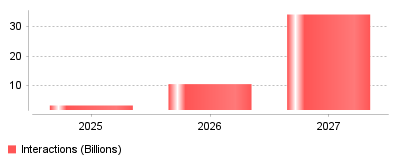
Recent data reveals a seismic shift in Business and Account Management Software, moving beyond "co-pilot" assistance to fully autonomous "agentic" AI. A pivotal study projects that the number of customer interactions automated by AI agents will skyrocket by over 1,000% between 2025 and 2027, driven by the adoption of standardized protocols like the Model Context Protocol (MCP). This trend indicates that software is no longer just organizing data for account managers but is actively executing complex relationship management tasks without human intervention. ```json { "trends":
| Year | Interactions (Billions) |
|---|---|
| 2025 | 3.3 |
| 2026 | 10.5 |
| 2027 | 34 |
The data highlights a massive acceleration in the deployment of autonomous AI "agents" within business and account management workflows. Specifically, research indicates that the volume of customer interactions handled entirely by AI agents is set to grow from 3.3 billion in 2025 to over 34 billion by 2027, representing a 1,000% increase [1]. Concurrently, the Customer Success Platform market is experiencing robust double-digit growth, projected to expand from $2.45 billion in 2024 to $2.92 billion in 2025 [2].
This trend signifies a fundamental transition in the B2B software landscape from "generative" assistance (creating drafts or summaries) to "agentic" execution (performing multi-step tasks independently). While previous software iterations acted as "co-pilots" requiring human oversight, the new wave of account management software utilizes standard protocols to resolve queries, manage renewals, and execute sales motions autonomously [3]. For the industry, this means the role of the Account Manager is shifting toward high-level strategy, as routine relationship maintenance is increasingly offloaded to software that can integrate deeply with marketing and support systems [4]. Furthermore, this aligns with a broader preference for "rep-free" experiences, where 61% of B2B buyers now prefer digital self-service over interacting with a human salesperson [5].
The scalability provided by AI agents is critical for businesses facing economic pressure to do more with less. By 2025, it is predicted that 80% of B2B sales interactions will occur in digital channels, making the ability to automate these touchpoints a requirement for competitive survival rather than a luxury [6]. Additionally, the ability of agents to access specific tooling and data streamlines integration costs, allowing enterprises to scale customer success efforts without a linear increase in headcount [1].
The sudden surge is largely attributed to the maturation of technical standards, specifically the adoption of the Model Context Protocol (MCP), which standardizes how AI models interact with external data and tools [7]. Prior to this, integrations were fragmented and costly; MCP has acted as a catalyst, simplifying the connection between AI agents and complex enterprise systems like CRMs and support tickets [8]. Additionally, the relentless demand for ROI has pushed companies to move beyond "chatty" AI bots to systems that can actually complete work, driving the market toward these results-oriented agentic solutions [9].
We are witnessing the end of the "human-dependent" era of account management software and the beginning of the "autonomous" era. Companies that integrate agentic AI will likely see a dramatic reduction in operational costs and an increase in capability, as these agents take over billions of interactions by 2027. The takeaway for buyers is clear: software selection should now prioritize "agentic" capabilities and MCP compatibility to ensure future-proof automation strategies [1].
The global landscape for business and account management software is undergoing a structural transformation driven by the convergence of "Agentic AI," vertical-specific specialization, and acute labor shortages in key administrative sectors. As organizations migrate from generic systems to highly specialized platforms, the market for business management software is projected to grow substantially, with estimates suggesting an increase of USD 421 billion between 2024 and 2029 at a compound annual growth rate (CAGR) of 12.8% [1], [2]. Similarly, the vertical-specific software market is expected to expand from USD 150.25 billion in 2024 to USD 430.12 billion by 2033, driven by the demand for industry-tailored workflows that generic Enterprise Resource Planning (ERP) systems cannot effectively manage [3].
This report analyzes the operational challenges and technological trends reshaping the CRM & Sales Software sector. It examines how automation is shifting from passive data analysis to active autonomous agents, the operational friction caused by poor software adoption, and the specific implications for industries ranging from field services to professional accounting.
A dominant trend in the 2024-2025 software market is the shift away from "horizontal" SaaS (Software as a Service) toward "vertical" SaaS. While horizontal solutions offer broad functionality for diverse industries, they often lack the specialized compliance, workflow, and terminology requirements of specific sectors. The vertical software market is projected to grow at a CAGR of 12.5% through 2033, as businesses increasingly reject one-size-fits-all tools in favor of platforms that address niche operational realities [3].
For trade industries, generic CRM tools often fail to address the complexities of dispatch, inventory management, and on-site invoicing. Operational efficiency in these sectors relies on mobile-first solutions that integrate field service management (FSM) with back-office accounting. Trends indicate a massive shift toward predictive maintenance and AI-driven dispatching [4], [5].
For example, Account Management Software for HVAC Companies now increasingly incorporates IoT (Internet of Things) integration to monitor equipment health remotely, allowing for proactive service calls before system failure occurs [6]. Similarly, Account Management Software for Plumbers and Account Management Software for Electricians are adopting mobile-first field tools that allow technicians to capture photos, generate estimates, and process payments on-site, syncing instantly with central ledgers to reduce administrative lag [7].
In the construction and exterior services sector, Account Management Software for Roofing Companies and Account Management Software for Landscapers are utilizing satellite imagery and aerial measurement integrations to automate estimation processes, a feature absent in standard business software. This verticalization extends to Account Management Software for Cleaning Companies and Account Management Software for Moving Companies, where scheduling logistics and crew assignment algorithms are critical operational components that generalist software cannot adequately optimize.
In the professional services sector, the operational challenge lies in revenue recognition, retainer management, and utilization tracking. Account Management Software for Consulting Firms and Account Management Software for Business Consultants are integrating project management directly with billing cycles to prevent revenue leakage—a common issue when billable hours are tracked separately from client accounts.
Marketing and creative sectors face unique retention challenges. Account Management Software for Marketing Agencies and Account Management Software for Digital Marketing Agencies are evolving to include automated reporting dashboards that prove ROI to clients in real-time. This shift from manual monthly reporting to automated transparency is critical for client retention in a high-churn industry [8].
The healthcare vertical faces strict regulatory requirements (HIPAA) and a distinct need for patient engagement over pure "sales" management. Account Management Software for Medical Offices is trending toward patient self-service portals and telehealth integration [9]. Simultaneously, the market for Account Management Software for Veterinarians is seeing consolidation, with cloud-based adoption growing as clinics seek to modernize patient records and appointment reminders in a market valued at over USD 818 million in 2024 [10].
Despite the proliferation of advanced Business & Account Management Software, organizations face significant hurdles in realizing value. Research indicates that CRM implementation failure rates remain alarmingly high, estimated between 47% and 63% [11].
The primary cause of failure is often cited not as technological, but behavioral. Approximately 50% to 70% of CRM projects fail to meet their objectives due to poor user adoption and resistance to change [12]. Employees often view new account management systems as administrative burdens rather than productivity enhancers. When software requires extensive manual data entry, compliance drops, leading to "shadow IT" where employees revert to spreadsheets or unapproved tools.
For industries with high client volumes, such as retail and insurance, this friction is costly. Account Management Software for Retail Stores and Account Management Software for Insurance Agents must prioritize user experience (UX) to ensure frontline staff can access customer data instantly without navigating complex menus.
Poor data quality costs businesses an estimated $15 million annually in losses [13]. As businesses layer multiple specialized tools, data silos emerge. An organization might use separate Account Management Software for Ecommerce Brands and financial reporting tools, leading to discrepancies in inventory and revenue data. The challenge for 2025 is achieving a "single source of truth" through robust API integrations.
This is particularly relevant for Account Management Software for Ecommerce Businesses, where real-time synchronization between front-end sales channels (Shopify, Amazon) and back-end inventory management is the only defense against overselling and fulfillment errors.
The most significant technological shift in business software for 2025 is the transition from Generative AI (creating content) to Agentic AI (executing tasks). Unlike chatbots that simply answer queries, AI agents can autonomously perform multi-step workflows [14], [15].
Agentic AI is reshaping how key accounts are managed by automating complex logic chains. For example, an AI agent could detect a drop in product usage by a key client, autonomously generate a re-engagement email, schedule a check-in for the account manager, and prepare a usage report—all without human intervention [16].
This capability is transforming high-touch industries. Account Management Software for Financial Advisors and Account Management Software for Real Estate Agents are beginning to utilize agents to nurture leads and manage portfolio reviews, tasks that previously required significant manual overhead. Research suggests that B2B sales organizations using these AI-embedded technologies could reduce time spent on prospecting and meeting prep by over 50% by 2026 [17].
The integration of AI allows for predictive account management. Instead of reacting to a client churn event, software can now flag "at-risk" accounts based on behavioral patterns (e.g., reduced login frequency, support ticket spikes) [13]. Account Management Software for Property Managers uses similar predictive logic to anticipate maintenance issues or lease non-renewals, shifting the operational model from firefighting to strategic planning.
A critical driver for software adoption in the accounting and financial sectors is a severe labor shortage. The American Institute of CPAs (AICPA) reports that 75% of CPAs reached retirement age by 2019, creating a massive vacuum in the workforce [18]. Furthermore, the number of accounting graduates dropped by 7.4% in 2022, the steepest decline in over 30 years [19].
This demographic reality is forcing firms to automate. Account Management Software for Accountants and Account Management Software for Tax Consultants are no longer just tools for efficiency; they are essential for survival. Firms are adopting AI to handle data entry, reconciliation, and initial audit tasks that were previously performed by junior staff [20]. Despite this necessity, a gap remains: while 85% of accounting professionals are intrigued by AI, only 37% of firms are actively investing in training their teams to use it [21], [22].
As business software becomes increasingly cloud-based, data sovereignty—the concept that data is subject to the laws of the country in which it is located—is becoming a critical procurement criterion, particularly in Europe. By 2025, it is predicted that 40% of major enterprises will mandate data-sovereignty controls from their cloud providers [23]. This trend impacts global providers of Account Management Software for Consulting Firms and other cross-border sectors, requiring them to offer localized data storage options to remain compliant with regulations like GDPR and NIS2 [24].
There is a decisive shift in IT spending from Capital Expenditure (CapEx) to Operational Expenditure (OpEx). Organizations prefer the flexibility of SaaS subscriptions over heavy upfront infrastructure investments [25]. This economic model lowers the barrier to entry for small businesses, allowing niche players like local tradespeople to access enterprise-grade Account Management Software for Roofing Companies or Plumbers that was previously unaffordable.
The business and account management software market is defined by a dual narrative of rapid technological advancement and human-centric operational challenges. While "Agentic AI" and vertical specialization offer unprecedented efficiency, businesses must navigate high implementation failure rates and a talent crunch in key financial roles. The organizations that succeed in 2025 will be those that view software not merely as a database, but as an active, autonomous partner in their daily operations.
Recent data reveals a seismic shift in Business and Account Management Software, moving beyond "co-pilot" assistance to fully autonomous "agentic" AI. A pivotal study projects that the number of customer interactions automated by AI agents will skyrocket by over 1,000% between 2025 and 2027, driven by the adoption of standardized protocols like the Model Context Protocol (MCP). This trend indicates that software is no longer just organizing data for account managers but is actively executing complex relationship management tasks without human intervention. ```json { "trends":
| Year | Interactions (Billions) |
|---|---|
| 2025 | 3.3 |
| 2026 | 10.5 |
| 2027 | 34 |
The data highlights a massive acceleration in the deployment of autonomous AI "agents" within business and account management workflows. Specifically, research indicates that the volume of customer interactions handled entirely by AI agents is set to grow from 3.3 billion in 2025 to over 34 billion by 2027, representing a 1,000% increase [1]. Concurrently, the Customer Success Platform market is experiencing robust double-digit growth, projected to expand from $2.45 billion in 2024 to $2.92 billion in 2025 [2].
This trend signifies a fundamental transition in the B2B software landscape from "generative" assistance (creating drafts or summaries) to "agentic" execution (performing multi-step tasks independently). While previous software iterations acted as "co-pilots" requiring human oversight, the new wave of account management software utilizes standard protocols to resolve queries, manage renewals, and execute sales motions autonomously [3]. For the industry, this means the role of the Account Manager is shifting toward high-level strategy, as routine relationship maintenance is increasingly offloaded to software that can integrate deeply with marketing and support systems [4]. Furthermore, this aligns with a broader preference for "rep-free" experiences, where 61% of B2B buyers now prefer digital self-service over interacting with a human salesperson [5].
The scalability provided by AI agents is critical for businesses facing economic pressure to do more with less. By 2025, it is predicted that 80% of B2B sales interactions will occur in digital channels, making the ability to automate these touchpoints a requirement for competitive survival rather than a luxury [6]. Additionally, the ability of agents to access specific tooling and data streamlines integration costs, allowing enterprises to scale customer success efforts without a linear increase in headcount [1].
The sudden surge is largely attributed to the maturation of technical standards, specifically the adoption of the Model Context Protocol (MCP), which standardizes how AI models interact with external data and tools [7]. Prior to this, integrations were fragmented and costly; MCP has acted as a catalyst, simplifying the connection between AI agents and complex enterprise systems like CRMs and support tickets [8]. Additionally, the relentless demand for ROI has pushed companies to move beyond "chatty" AI bots to systems that can actually complete work, driving the market toward these results-oriented agentic solutions [9].
We are witnessing the end of the "human-dependent" era of account management software and the beginning of the "autonomous" era. Companies that integrate agentic AI will likely see a dramatic reduction in operational costs and an increase in capability, as these agents take over billions of interactions by 2027. The takeaway for buyers is clear: software selection should now prioritize "agentic" capabilities and MCP compatibility to ensure future-proof automation strategies [1].