Subscription Billing & Recurring Revenue Tools

These are the specialized categories within Subscription Billing & Recurring Revenue Tools. Looking for something broader? See all Accounting & Finance Software categories.

1

Recurly Subscription Management

Best for Subscription Billing Platforms for Usage-Based Pricing Models

Score
9.9 / 10
Recurly Subscription Management

Recurly is an ideal solution for businesses with usage-based pricing models, offering a robust subscription management and recurring billing platform. It integrates seamlessly with leading ERP, CRM, and payment gateways, addressing the needs for streamlined billing and financial management in this industry.

Best for Subscription Billing Platforms for Usage-Based Pricing Models

Expert Take

Recurly excels in providing a comprehensive subscription management platform tailored for usage-based pricing models. Its integration capabilities with major ERP, CRM, and payment gateways, along with detailed financial analytics, make it a top choice for businesses seeking robust billing solutions. While it may present a learning curve for beginners, its extensive features and adaptability justify its premium positioning.

Pros

  • Recovers ~70% of failed transactions
  • Supports 20+ global payment gateways
  • PCI Level 1 & SOC 2 compliant
  • Native NetSuite & Salesforce integrations
  • Advanced revenue recognition automation

Cons

  • Starter plan lacks backup payments
  • Expensive for mid-market volume
  • Transaction fees on top of sub
  • Reporting customization can be limited
  • Gateway failover has technical limits

Best for teams that are

  • Subscription-first businesses focused on churn reduction
  • B2C or DTC brands with high transaction volumes
  • Mid-market companies with standard recurring billing models

Skip if

  • Complex usage-based or metered pricing models
  • B2B enterprises with highly customized contracts
  • Teams needing deep usage analytics and granular reporting

Best for teams that are

  • Subscription-first businesses focused on churn reduction
  • B2C or DTC brands with high transaction volumes
  • Mid-market companies with standard recurring billing models

Skip if

  • Complex usage-based or metered pricing models
  • B2B enterprises with highly customized contracts
  • Teams needing deep usage analytics and granular reporting

Pros

  • Recovers ~70% of failed transactions
  • Supports 20+ global payment gateways
  • PCI Level 1 & SOC 2 compliant
  • Native NetSuite & Salesforce integrations
  • Advanced revenue recognition automation

Cons

  • Starter plan lacks backup payments
  • Expensive for mid-market volume
  • Transaction fees on top of sub
  • Reporting customization can be limited
  • Gateway failover has technical limits

Expert Take

Recurly excels in providing a comprehensive subscription management platform tailored for usage-based pricing models. Its integration capabilities with major ERP, CRM, and payment gateways, along with detailed financial analytics, make it a top choice for businesses seeking robust billing solutions. While it may present a learning curve for beginners, its extensive features and adaptability justify its premium positioning.

2
Score
9.8 / 10
2
9.8 / 10
BillingPlatform

BillingPlatform is a specialized solution designed to manage and scale complex subscription models, making it well suited for businesses in the Consumer Subscription Services industry. It offers a flexible, cloud-based platform that simplifies the process of handling recurring billing, invoicing, and revenue recognition.

Best for Subscription Billing Platforms for Consumer Subscription Services

Expert Take

BillingPlatform excels in managing complex subscription models with its flexible, cloud-based platform. It supports global currencies and provides real-time reporting, making it a top choice for consumer subscription services. Its comprehensive capabilities and industry recognition position it as a best-of-the-best solution.

Pros

  • Leader in Gartner & Forrester reports
  • Supports complex usage & hybrid billing
  • Native Salesforce & NetSuite integrations
  • PCI Level 1 & HIPAA compliant
  • Highly configurable data model

Cons

  • Long, complex implementation cycles
  • Steep learning curve for users
  • Slow non-production environment performance
  • High total cost of ownership
  • Reliance on professional services

Best for teams that are

  • Large enterprises with complex, hybrid, or usage-based billing models
  • Companies needing a highly customizable platform for quote-to-cash

Skip if

  • Small businesses or startups looking for a plug-and-play solution
  • Teams with limited technical resources for complex implementation

Best for teams that are

  • Large enterprises with complex, hybrid, or usage-based billing models
  • Companies needing a highly customizable platform for quote-to-cash

Skip if

  • Small businesses or startups looking for a plug-and-play solution
  • Teams with limited technical resources for complex implementation

Pros

  • Leader in Gartner & Forrester reports
  • Supports complex usage & hybrid billing
  • Native Salesforce & NetSuite integrations
  • PCI Level 1 & HIPAA compliant
  • Highly configurable data model

Cons

  • Long, complex implementation cycles
  • Steep learning curve for users
  • Slow non-production environment performance
  • High total cost of ownership
  • Reliance on professional services

Expert Take

BillingPlatform excels in managing complex subscription models with its flexible, cloud-based platform. It supports global currencies and provides real-time reporting, making it a top choice for consumer subscription services. Its comprehensive capabilities and industry recognition position it as a best-of-the-best solution.

3
Score
9.8 / 10
Zuora Billing Software

Zuora Billing is a top-tier SaaS solution specifically designed for subscription-based businesses. It provides a dynamic platform to manage recurring payments, unify revenue streams, and monetize services, addressing the industry's need for efficient revenue management and customer retention.

Best for Subscription Billing Platforms for Consumer Subscription Services

Expert Take

Zuora Billing Software excels in managing complex billing scenarios for subscription-based businesses. Its robust features in pricing flexibility, revenue recognition, and global tax management make it a leader in its category. However, its high-end pricing and setup complexity may not suit smaller businesses.

Pros

  • 50+ out-of-the-box pricing models
  • Native Salesforce & NetSuite integrations
  • ISO 27001 & PCI DSS Level 1
  • Scales to 300k+ invoices/hour
  • Advanced usage-based billing logic

Cons

  • Entry pricing starts ~$75k/year
  • Steep learning curve for users
  • No transparent public pricing
  • Complex, lengthy implementation process
  • UI can be non-intuitive

Best for teams that are

  • Large enterprises with complex, high-volume recurring revenue models
  • Companies needing advanced revenue recognition (ASC 606) and compliance

Skip if

  • Early-stage startups or small businesses due to high cost and complexity
  • Teams needing a quick, self-service setup without implementation partners

Best for teams that are

  • Large enterprises with complex, high-volume recurring revenue models
  • Companies needing advanced revenue recognition (ASC 606) and compliance

Skip if

  • Early-stage startups or small businesses due to high cost and complexity
  • Teams needing a quick, self-service setup without implementation partners

Pros

  • 50+ out-of-the-box pricing models
  • Native Salesforce & NetSuite integrations
  • ISO 27001 & PCI DSS Level 1
  • Scales to 300k+ invoices/hour
  • Advanced usage-based billing logic

Cons

  • Entry pricing starts ~$75k/year
  • Steep learning curve for users
  • No transparent public pricing
  • Complex, lengthy implementation process
  • UI can be non-intuitive

Expert Take

Zuora Billing Software excels in managing complex billing scenarios for subscription-based businesses. Its robust features in pricing flexibility, revenue recognition, and global tax management make it a leader in its category. However, its high-end pricing and setup complexity may not suit smaller businesses.

4

Ordway Billing & Revenue Automation

Best for Subscription Billing Platforms with Revenue Recognition Automation

Score
9.7 / 10
Ordway Billing & Revenue Automation

Ordway is a comprehensive platform designed for SaaS, cloud, and fintech businesses, tackling their unique billing and revenue management needs. It automates complex billing and revenue recognition processes, streamlines subscription management, and simplifies invoicing, making it a powerful tool for rapidly scaling businesses in these sectors.

Best for Subscription Billing Platforms with Revenue Recognition Automation

Expert Take

Ordway excels in automating billing and revenue processes for SaaS and fintech businesses, offering scalability and robust reporting. Its market credibility is bolstered by third-party integrations and recognition. While pricing transparency is limited, its capabilities and customer experience remain strong.

Pros

  • Automated ASC 606 revenue recognition
  • Flexible hybrid billing models
  • Strong Salesforce & NetSuite integrations
  • SOC 2 Type 2 compliant
  • Startup-friendly pricing tier available

Cons

  • Custom reporting can be difficult
  • Occasional UI glitches after updates
  • Integration setup may require effort
  • Enterprise pricing not public

Best for teams that are

  • Scaling B2B SaaS and cloud companies with complex, hybrid, or usage-based billing
  • Finance teams requiring automated ASC 606 revenue recognition and multi-entity support
  • Businesses outgrowing manual spreadsheets but not ready for heavy enterprise ERPs

Skip if

  • Small businesses or early-stage startups with simple billing needs and limited budgets
  • Companies needing a mobile app for billing management or simple B2C e-commerce
  • Teams wanting a plug-and-play solution without configuration for complex logic

Best for teams that are

  • Scaling B2B SaaS and cloud companies with complex, hybrid, or usage-based billing
  • Finance teams requiring automated ASC 606 revenue recognition and multi-entity support
  • Businesses outgrowing manual spreadsheets but not ready for heavy enterprise ERPs

Skip if

  • Small businesses or early-stage startups with simple billing needs and limited budgets
  • Companies needing a mobile app for billing management or simple B2C e-commerce
  • Teams wanting a plug-and-play solution without configuration for complex logic

Pros

  • Automated ASC 606 revenue recognition
  • Flexible hybrid billing models
  • Strong Salesforce & NetSuite integrations
  • SOC 2 Type 2 compliant
  • Startup-friendly pricing tier available

Cons

  • Custom reporting can be difficult
  • Occasional UI glitches after updates
  • Integration setup may require effort
  • Enterprise pricing not public

Expert Take

Ordway excels in automating billing and revenue processes for SaaS and fintech businesses, offering scalability and robust reporting. Its market credibility is bolstered by third-party integrations and recognition. While pricing transparency is limited, its capabilities and customer experience remain strong.

5

Recharge Subscriptions for Ecommerce

Best for Subscription Billing Platforms for SaaS Companies

Score
9.7 / 10
Recharge Subscriptions for Ecommerce

Recharge is a dominant SaaS subscription billing platform, trusted by 71% of subscriptions on Shopify stores. Its strengths lie in its flexibility, allowing you to start, scale, and manage your subscription business effortlessly. The platform is tailored to address the unique needs of SaaS companies, providing an efficient platform for recurring payments and subscriptions.

Best for Subscription Billing Platforms for SaaS Companies

Expert Take

Recharge Subscriptions for Ecommerce is a leading platform in the subscription billing space, particularly for Shopify stores. It offers robust capabilities for managing recurring payments, with strong market credibility and a user-friendly experience. The platform's integration with Shopify and its flexible features make it a top choice for SaaS companies.

Pros

  • Powers 20,000+ merchants with high reliability
  • Robust API for headless and custom builds
  • Deep integrations with Klaviyo and Gorgias
  • No-code customer portal reduces support tickets
  • Advanced churn prevention with 'Flows' feature

Cons

  • High starting price of $99/month
  • Transaction fees of 1.25% + 19¢ apply
  • Advanced features locked behind $499/mo plan
  • Reports of legacy code bugs
  • Support response times can be slow

Best for teams that are

  • E-commerce merchants selling physical subscription products
  • Shopify or BigCommerce stores looking to add recurring billing
  • DTC brands wanting to increase LTV through subscribe and save models

Skip if

  • SaaS companies selling digital software subscriptions
  • Businesses not using Shopify, BigCommerce, or similar platforms
  • Companies needing a standalone billing system for complex B2B contracts

Best for teams that are

  • E-commerce merchants selling physical subscription products
  • Shopify or BigCommerce stores looking to add recurring billing
  • DTC brands wanting to increase LTV through subscribe and save models

Skip if

  • SaaS companies selling digital software subscriptions
  • Businesses not using Shopify, BigCommerce, or similar platforms
  • Companies needing a standalone billing system for complex B2B contracts

Pros

  • Powers 20,000+ merchants with high reliability
  • Robust API for headless and custom builds
  • Deep integrations with Klaviyo and Gorgias
  • No-code customer portal reduces support tickets
  • Advanced churn prevention with 'Flows' feature

Cons

  • High starting price of $99/month
  • Transaction fees of 1.25% + 19¢ apply
  • Advanced features locked behind $499/mo plan
  • Reports of legacy code bugs
  • Support response times can be slow

Expert Take

Recharge Subscriptions for Ecommerce is a leading platform in the subscription billing space, particularly for Shopify stores. It offers robust capabilities for managing recurring payments, with strong market credibility and a user-friendly experience. The platform's integration with Shopify and its flexible features make it a top choice for SaaS companies.

6

BillingPlatform's Usage-Based Billing

Best for Subscription Billing Platforms for Usage-Based Pricing Models

Score
9.7 / 10
BillingPlatform's Usage-Based Billing

BillingPlatform is a SaaS solution designed specifically for businesses that require advanced usage-based billing models. Its unparalleled flexibility allows businesses to apply intricate pricing rules, automate invoicing, and generate detailed reports, thus making it an ideal choice for businesses with complex billing needs.

Best for Subscription Billing Platforms for Usage-Based Pricing Models

Expert Take

BillingPlatform's Usage-Based Billing is recognized for its advanced capabilities in handling complex billing models, making it a top choice for businesses with intricate pricing needs. Its flexibility, automation, and integration capabilities are well-documented, supporting its position as a premium product in its category.

Pros

  • Built-in mediation for raw usage data
  • Leader in 2024 Gartner Magic Quadrant
  • Supports complex hybrid billing models
  • PCI Level 1 and SOC 2 certified
  • Native integration with Salesforce and NetSuite

Cons

  • Slow performance in non-production environments
  • Pricing is quote-based and opaque
  • Steep learning curve for implementation
  • Limited debugging tools for errors
  • Complex configuration for simple use cases

Best for teams that are

  • Large enterprises with complex, hybrid monetization models
  • Global companies requiring multi-currency and multi-lingual support
  • Industries like telecom, utilities, and media with high volumes

Skip if

  • Early-stage startups with simple billing requirements
  • Teams needing rapid, self-service implementation without support
  • Businesses with low transaction volumes or simple pricing

Best for teams that are

  • Large enterprises with complex, hybrid monetization models
  • Global companies requiring multi-currency and multi-lingual support
  • Industries like telecom, utilities, and media with high volumes

Skip if

  • Early-stage startups with simple billing requirements
  • Teams needing rapid, self-service implementation without support
  • Businesses with low transaction volumes or simple pricing

Pros

  • Built-in mediation for raw usage data
  • Leader in 2024 Gartner Magic Quadrant
  • Supports complex hybrid billing models
  • PCI Level 1 and SOC 2 certified
  • Native integration with Salesforce and NetSuite

Cons

  • Slow performance in non-production environments
  • Pricing is quote-based and opaque
  • Steep learning curve for implementation
  • Limited debugging tools for errors
  • Complex configuration for simple use cases

Expert Take

BillingPlatform's Usage-Based Billing is recognized for its advanced capabilities in handling complex billing models, making it a top choice for businesses with intricate pricing needs. Its flexibility, automation, and integration capabilities are well-documented, supporting its position as a premium product in its category.

7

BillingPlatform Subscription Management

Best for Subscription Billing Platforms for SaaS Companies

Score
9.7 / 10
BillingPlatform Subscription Management

BillingPlatform is a robust SaaS solution designed to manage recurring revenue streams and user-based pricing. The platform is tailored to the needs of SaaS companies, offering regular feature upgrades and a flexible, intuitive interface to streamline subscription and billing processes.

Best for Subscription Billing Platforms for SaaS Companies

Expert Take

BillingPlatform excels in managing recurring revenue for SaaS companies with its flexible and intuitive interface. It is recognized for regular feature upgrades and tailored solutions for subscription-based models. Despite limited pricing transparency and integrations, it remains a top choice for its comprehensive capabilities.

Pros

  • Supports hybrid, usage-based, and subscription billing models
  • Leader in Forrester Wave and Gartner Magic Quadrant
  • Native revenue recognition (ASC 606) and CPQ
  • High security standards including HIPAA and PCI Level 1
  • Highly configurable without requiring custom code

Cons

  • Complex and time-consuming implementation process
  • Slow performance reported in non-production environments
  • No public pricing; high average contract value
  • Steep learning curve for advanced configurations
  • Geared primarily toward large enterprises, not SMBs

Best for teams that are

  • Enterprises with highly complex, hybrid, or usage-based billing models
  • Companies wanting a flexible, no-code platform to configure unique logic
  • Large organizations needing to consolidate diverse revenue streams

Skip if

  • Small businesses or startups with standard subscription needs
  • Companies looking for a simple, out-of-the-box solution
  • Businesses needing a Merchant of Record solution

Best for teams that are

  • Enterprises with highly complex, hybrid, or usage-based billing models
  • Companies wanting a flexible, no-code platform to configure unique logic
  • Large organizations needing to consolidate diverse revenue streams

Skip if

  • Small businesses or startups with standard subscription needs
  • Companies looking for a simple, out-of-the-box solution
  • Businesses needing a Merchant of Record solution

Pros

  • Supports hybrid, usage-based, and subscription billing models
  • Leader in Forrester Wave and Gartner Magic Quadrant
  • Native revenue recognition (ASC 606) and CPQ
  • High security standards including HIPAA and PCI Level 1
  • Highly configurable without requiring custom code

Cons

  • Complex and time-consuming implementation process
  • Slow performance reported in non-production environments
  • No public pricing; high average contract value
  • Steep learning curve for advanced configurations
  • Geared primarily toward large enterprises, not SMBs

Expert Take

BillingPlatform excels in managing recurring revenue for SaaS companies with its flexible and intuitive interface. It is recognized for regular feature upgrades and tailored solutions for subscription-based models. Despite limited pricing transparency and integrations, it remains a top choice for its comprehensive capabilities.

8

Recurly Subscription & Billing

Best for Subscription Billing Platforms for SaaS Companies

Score
9.7 / 10
Recurly Subscription & Billing

Recurly offers a robust platform specifically designed to manage subscriptions and recurring billing for both B2B and B2C SaaS companies. It provides the essential tools required to grow their customer base, manage complex billing structures, and minimize churn, addressing the unique needs of the subscription-based SaaS industry.

Best for Subscription Billing Platforms for SaaS Companies

Expert Take

Recurly is a comprehensive subscription billing platform tailored for SaaS companies, offering flexible billing models and robust dunning management. It integrates with multiple payment gateways and provides valuable analytics, making it a top choice for managing recurring revenue. However, it may require technical expertise and lacks support for all currencies.

Pros

  • Recovered $1.2B in revenue (2023)
  • Supports 30+ payment gateways
  • PCI-DSS Level 1 & SOC 2 compliant
  • Native Salesforce & NetSuite integrations
  • Handles 140+ currencies globally

Cons

  • Reporting features can be rigid
  • Expensive for small businesses
  • Opaque pricing for upper tiers
  • Complex usage-based billing setup
  • Limited non-admin user access

Best for teams that are

  • Mid-market to enterprise companies with high transaction volumes
  • Subscription box businesses requiring hybrid checkout for physical goods
  • Companies prioritizing advanced churn reduction and revenue recovery

Skip if

  • Early-stage startups with low revenue due to higher costs
  • Businesses needing a Merchant of Record solution
  • Simple B2B SaaS with very basic flat-rate pricing needs

Best for teams that are

  • Mid-market to enterprise companies with high transaction volumes
  • Subscription box businesses requiring hybrid checkout for physical goods
  • Companies prioritizing advanced churn reduction and revenue recovery

Skip if

  • Early-stage startups with low revenue due to higher costs
  • Businesses needing a Merchant of Record solution
  • Simple B2B SaaS with very basic flat-rate pricing needs

Pros

  • Recovered $1.2B in revenue (2023)
  • Supports 30+ payment gateways
  • PCI-DSS Level 1 & SOC 2 compliant
  • Native Salesforce & NetSuite integrations
  • Handles 140+ currencies globally

Cons

  • Reporting features can be rigid
  • Expensive for small businesses
  • Opaque pricing for upper tiers
  • Complex usage-based billing setup
  • Limited non-admin user access

Expert Take

Recurly is a comprehensive subscription billing platform tailored for SaaS companies, offering flexible billing models and robust dunning management. It integrates with multiple payment gateways and provides valuable analytics, making it a top choice for managing recurring revenue. However, it may require technical expertise and lacks support for all currencies.

9
Score
9.7 / 10
Stripe Usage-Based Billing

Stripe's Usage-Based Billing is an ideal solution for businesses seeking a fast, flexible and code-free billing system. Its powerful features like real-time metering, credit management, and flexible pricing models cater specifically to AI service providers and other industries with usage-based pricing needs.

Best for Subscription Billing Platforms for Usage-Based Pricing Models

Expert Take

Stripe Usage-Based Billing stands out as a leading solution in the subscription billing platforms category, particularly for usage-based pricing models. Its comprehensive features, including real-time metering and flexible pricing, cater to the needs of AI service providers and other industries. The platform's scalability and extensive API support further enhance its appeal, making it a top choice for businesses seeking a robust billing solution.

Pros

  • 99.999% historical uptime reliability
  • Includes 100M usage events per month
  • Supports up to 100k events/second (V2)
  • Native Salesforce and NetSuite integrations
  • Handles complex graduated and tiered pricing

Cons

  • 0.7% fee on recurring billing volume
  • Standard API limited to 1,000 events/sec
  • Support often cited as slow/automated
  • Native reporting lacks deep SaaS analytics
  • Complex setup for non-technical users

Best for teams that are

  • Startups and businesses already using Stripe for payments
  • Companies with simple usage models like per-unit or tiered pricing
  • Teams with developer resources to manage API integrations

Skip if

  • Enterprise B2B companies with complex, custom negotiated contracts
  • Businesses requiring high-volume real-time event ingestion
  • Non-technical teams needing a no-code billing solution

Best for teams that are

  • Startups and businesses already using Stripe for payments
  • Companies with simple usage models like per-unit or tiered pricing
  • Teams with developer resources to manage API integrations

Skip if

  • Enterprise B2B companies with complex, custom negotiated contracts
  • Businesses requiring high-volume real-time event ingestion
  • Non-technical teams needing a no-code billing solution

Pros

  • 99.999% historical uptime reliability
  • Includes 100M usage events per month
  • Supports up to 100k events/second (V2)
  • Native Salesforce and NetSuite integrations
  • Handles complex graduated and tiered pricing

Cons

  • 0.7% fee on recurring billing volume
  • Standard API limited to 1,000 events/sec
  • Support often cited as slow/automated
  • Native reporting lacks deep SaaS analytics
  • Complex setup for non-technical users

Expert Take

Stripe Usage-Based Billing stands out as a leading solution in the subscription billing platforms category, particularly for usage-based pricing models. Its comprehensive features, including real-time metering and flexible pricing, cater to the needs of AI service providers and other industries. The platform's scalability and extensive API support further enhance its appeal, making it a top choice for businesses seeking a robust billing solution.

10
Score
9.7 / 10
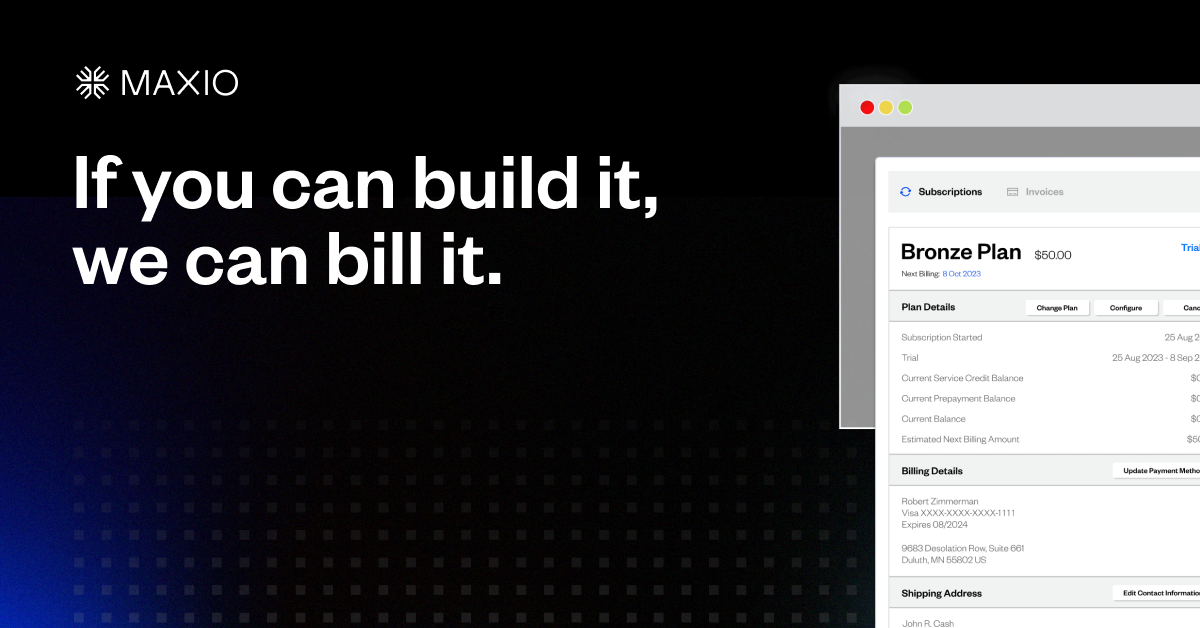
Maxio Billing for B2B SaaS

Maxio's subscription billing software is a specialized solution for B2B SaaS companies looking to automate their invoicing and subscription management. It is designed to streamline the billing process and provide key metrics to help companies track their financial health and understand customer behavior.

Best for Subscription Billing Platforms for B2B Invoiced Subscriptions
Expert Take

Maxio Billing excels in automating invoicing and subscription management for B2B SaaS companies. Its specialized focus on this niche, combined with robust automation features, positions it as a leading solution in its category. However, the lack of transparent pricing and limited integrations are notable considerations.

Pros

  • Native ASC 606 revenue recognition
  • Handles complex usage-based billing
  • SOC 1, SOC 2 & ISO 27001 certified
  • Bi-directional Salesforce & HubSpot sync
  • Transparent pricing for mid-market

Cons

  • Reporting interface can be rigid
  • Support response times vary
  • Implementation can be complex
  • Occasional slow platform performance
  • Expensive for early-stage startups

Best for teams that are

  • B2B SaaS companies managing sales-negotiated contracts
  • Finance teams requiring built-in ASC 606 revenue recognition
  • Scaling companies ($1M-$100M ARR) needing financial metrics

Skip if

  • B2C companies with high-volume, low-value transactions
  • Simple e-commerce or physical goods businesses
  • Early-stage startups with simple, standard pricing

Best for teams that are

  • B2B SaaS companies managing sales-negotiated contracts
  • Finance teams requiring built-in ASC 606 revenue recognition
  • Scaling companies ($1M-$100M ARR) needing financial metrics

Skip if

  • B2C companies with high-volume, low-value transactions
  • Simple e-commerce or physical goods businesses
  • Early-stage startups with simple, standard pricing

Pros

  • Native ASC 606 revenue recognition
  • Handles complex usage-based billing
  • SOC 1, SOC 2 & ISO 27001 certified
  • Bi-directional Salesforce & HubSpot sync
  • Transparent pricing for mid-market

Cons

  • Reporting interface can be rigid
  • Support response times vary
  • Implementation can be complex
  • Occasional slow platform performance
  • Expensive for early-stage startups

Expert Take

Maxio Billing excels in automating invoicing and subscription management for B2B SaaS companies. Its specialized focus on this niche, combined with robust automation features, positions it as a leading solution in its category. However, the lack of transparent pricing and limited integrations are notable considerations.

How We Rank Products

Our Evaluation Process

Products in the Subscription Billing & Recurring Revenue Tools category are evaluated based on their documented features, such as billing automation and revenue management capabilities. Compatibility with existing business systems and integrations with third-party tools are key considerations. Pricing transparency and the availability of tiered pricing models are assessed to determine cost-effectiveness. Additionally, third-party customer feedback provides insights into user satisfaction and real-world performance, contributing to the evaluation process.

Verification

  • Products evaluated through comprehensive research and analysis of subscription billing features and user experiences.
  • Rankings based on a thorough analysis of customer reviews, industry ratings, and expert feedback in recurring revenue tools.
  • Selection criteria focus on key factors such as pricing models, integration capabilities, and customer support responsiveness.

Score Breakdown

0.0 / 10

About Subscription Billing & Recurring Revenue Tools

What Is Subscription Billing & Recurring Revenue Tools?

This category covers software used to manage ongoing client and customer accounts across their full operational lifecycle: orchestrating recurring charges, automating invoice generation, managing complex contract amendments, handling dunning (collections) for failed payments, and ensuring recognized revenue aligns with delivery. It sits between CRM (which captures the initial sale) and the General Ledger/ERP (which records the final financial truth). It includes both general-purpose platforms capable of handling diverse business models and vertical-specific tools built for industries like media, healthcare, and IoT.

At its core, Subscription Billing and Recurring Revenue software solves the "dynamic relationship" problem. Unlike traditional commerce, where a transaction is a one-time event, recurring revenue businesses must manage a living contract that changes over time—upgrades, downgrades, pauses, usage spikes, and renewals. Legacy ERP systems, designed for shipping physical widgets with static SKUs, often fail to handle the dimension of time in revenue management. This software category fills that gap, ensuring that a business can scale from 100 to 100,000 subscribers without expanding its finance team linearly.

Who uses it? While originally the domain of SaaS startups and telecom giants, today it is critical for any organization shifting from one-time sales to "as-a-service" models. This includes manufacturers selling equipment uptime (servitization), healthcare providers offering concierge memberships, and media companies managing hybrid ad-subscription models. It matters because it is the operational engine of the subscription economy; without it, revenue leakage (money earned but not collected) and involuntary churn (customers lost due to payment failures) destroy unit economics.

History of the Category

The modern Subscription Billing category emerged not from the mainframes of the 1970s, but from a glaring functional gap that appeared in the late 1990s and early 2000s. During this period, the first wave of Application Service Providers (ASPs)—the precursors to SaaS—attempted to bill customers on a recurring basis. They discovered that existing ERP systems (like SAP or Oracle of that era) were rigid, "order-based" systems. They could handle "Ship 1 Unit of Product X for $100," but they struggled with "Bill Customer Y $20/month for 12 months, but prorate the first month, and add usage fees for storage in month three."

Through the 2000s, as the "Subscription Economy"—a term later popularized by industry thought leaders—began to take hold, businesses initially resorted to building home-grown billing engines on top of payment gateways. This worked for simple flat-rate pricing but crumbled under complexity. When a customer wanted to upgrade mid-month, the engineering team had to manually calculate the proration or write code to handle the logic. This diverted expensive engineering resources away from product development to back-office maintenance.

The 2010s marked the maturity of the category, driven by the explosion of B2B SaaS and the shift of software delivery from on-premise licensing to cloud subscriptions. A wave of vertical-specific SaaS solutions emerged, challenging the "build it yourself" mentality. Concurrently, market consolidation began shaping the landscape. Major financial technology players realized that processing payments was a commodity, but managing the logic of the payment was high-value. This led to acquisitions where payment processors bought billing platforms to move up the value chain.

Today, the market has evolved from "give me a database to store credit cards" to "give me actionable intelligence." Modern buyers expect these tools to not only process bills but to act as the financial system of record for revenue recognition (ASC 606 compliance) and to use AI to predict churn before it happens. The focus has shifted from simple automation to revenue optimization—using data to determine the perfect pricing tier or the optimal time to retry a failed credit card.

What to Look For

Evaluating subscription billing software requires a shift in mindset from "feature checklist" to "workflow flexibility." The most critical evaluation criterion is model agility. Can the system handle the pricing model you plan to launch in two years, not just the one you have today? If you currently bill a flat monthly fee but plan to introduce a usage-based component (e.g., pricing per gigabyte or per active user), the system must support hybrid billing logic without requiring custom code.

Revenue Retention Capabilities are equally vital. In the subscription world, the silent killer is involuntary churn—when a customer’s card fails due to expiration or false fraud flags. Look for "smart dunning" features. Basic tools simply retry the card every day for three days. Advanced platforms use machine learning to analyze millions of transactions and determine that retrying a specific Debit Visa on Friday afternoon has a 15% higher success rate than retrying it on Tuesday morning. This capability alone can recover 2-5% of revenue that would otherwise be lost.

Red flags during evaluation often appear in the API documentation. If the vendor's API is rigid or lacks webhooks for critical events (like "subscription_canceled" or "invoice_payment_failed"), your ability to trigger downstream actions in your software or CRM will be crippled. Another warning sign is a lack of "shadow" or "test" environments. You must be able to test new pricing logic in a sandbox that mirrors your production data exactly; vendors that do not offer robust sandboxing are too risky for enterprise scale.

Key questions to ask vendors:

  • "How does your system handle mid-cycle upgrades and downgrades? Walk me through the exact proration calculation and how it appears on the invoice."
  • "Can you support 'parent-child' account hierarchies where a parent organization pays for usage accrued by multiple subsidiaries?"
  • "What is your 'lock-in' policy? If we leave, how do we export our tokenized credit card data to a new provider?" (This is critical; if they hold your payment tokens hostage, you cannot leave without asking every customer to re-enter their credit card).

Industry-Specific Use Cases

Retail & E-commerce

In retail, subscription billing is often synonymous with "subscribe and save" models or curated box subscriptions. The critical differentiator here is the tight integration required with physical inventory and logistics. Unlike software, if a billing event occurs, a physical good must ship. Therefore, the billing tool must sync in real-time with the Warehouse Management System (WMS). If a payment fails, the shipment must be automatically held. Retailers also face "subscription fatigue," making flexibility paramount. Tools for this sector must offer customers self-service options to "skip a month" or "swap a product" easily. According to industry data, 27% of subscribers would cancel if unable to pause or skip orders, making these self-service retention features not just a convenience, but a revenue safeguard [1].

Healthcare

The healthcare sector, particularly Direct Primary Care (DPC) and concierge medicine, has unique regulatory hurdles. Subscription billing tools here must be HIPAA-compliant, ensuring that any patient data associated with the billing record is encrypted and auditable. Unlike a Netflix subscription, healthcare billing often involves "patient payment plans" for high-deductible costs or hybrid models where a membership fee is paid by the patient, but specific procedures are billed to insurance. The billing system must handle these split-payer scenarios. Furthermore, privacy rules mandate that billing communications (emails/texts) do not reveal sensitive health information (PHI), requiring a platform with granular control over notification templates [2].

Financial Services

For wealth management firms, tax professionals, and audit firms, the shift from hourly billing to monthly retainers requires specialized handling. The priority here is trust and auditability. Clients in this sector require consolidated invoicing that may combine a recurring retainer with ad-hoc advisory fees. The billing system must support "Evergreen" contracts with built-in annual price escalators (e.g., increasing fees by CPI automatically). Additionally, compliance with financial regulations often requires a strict separation of duties and an immutable audit trail of who changed a billing term and when. High-value transactions often bypass credit cards due to fees, so the platform must natively support ACH and SEPA bank transfers with automated reconciliation [3].

Manufacturing

Manufacturers are transitioning from selling assets (CapEx) to selling "uptime" or "outcomes" (OpEx)—a trend known as Servitization. This creates a massive data ingestion challenge. A compressor manufacturer selling "compressed air as a service" needs a billing engine that can ingest streams of IoT data (telemetry) from the machine, rate that usage (e.g., $0.05 per cubic meter), and invoice it alongside a base service fee. This requires a "mediation" layer that sits between the device and the billing system to clean and aggregate usage data. Traditional ERPs cannot handle this high-velocity metering, driving manufacturers toward specialized billing platforms that bridge the "Manufacturing Gap" between physical sensors and financial ledgers [4].

Professional Services

Marketing agencies, legal firms, and consultancies often struggle with "scope creep" in retainer models. Specialized billing tools for this sector bridge the gap between project management and finance. They track hours burned against a retainer cap and automatically trigger "overage" billing or notify the account manager when a threshold is reached. Unlike generic tools, these platforms often need to generate "statement of work" (SOW) style invoices that detail exactly what deliverables were completed for the recurring fee. The workflow distinguishing this niche is the "rollover" logic—determining whether unused hours in Month A expire or roll over to Month B, a configuration that generic billing tools often lack [5].

Subcategory Overview

Subscription Billing Platforms for SaaS Companies SaaS billing is distinct because the product is digital, instant, and often deeply integrated into the customer's daily workflow. What makes this niche different is the requirement for automated provisioning. When a payment clears, the billing system must instantly trigger the application to unlock features or add seats via API. The specific workflow only these tools handle well is the "self-service seat expansion," where a user adds 5 licenses inside the app, and the billing system automatically calculates the prorated charge for the remainder of the month without sales intervention. Buyers gravitate here to solve the pain point of "revenue leakage" from unbilled user expansion. For a deeper analysis of these metrics-driven tools, read our guide to Subscription Billing Platforms for SaaS Companies.

Subscription Billing Platforms for B2B Invoiced Subscriptions This subcategory serves companies selling high-value contracts (ACV $50k+) to other businesses. The differentiator is the move away from "credit card first" logic to "invoice/Net-30" logic. These tools excel at generating complex, compliant PDF invoices that meet the procurement requirements of Fortune 500 buyers (e.g., requiring PO numbers, specific line-item formatting). A workflow unique to this niche is the Contract-to-Cash cycle, managing complex negotiations where every customer has unique terms, discount schedules, and renewal dates. Buyers choose these tools when their sales teams are bottlenecked by manual invoice generation. To understand how to manage complex B2B lifecycles, see our guide to Subscription Billing Platforms for B2B Invoiced Subscriptions.

Subscription Billing Platforms for Consumer Subscription Services High volume and low latency define this category. Unlike B2B tools that might process 500 invoices a month, these platforms must handle 500,000 transactions. The differentiator is churn management at scale. These tools have the most advanced "card updater" features (automatically updating expired card details via Visa/Mastercard networks) and dunning logic. The specific workflow they master is the "gift subscription" lifecycle—managing the complexity of a purchaser buying a 12-month gift for a recipient, and then converting that recipient into a paid subscriber when the gift expires. The driving pain point is high B2C churn rates. For high-volume strategies, explore our guide to Subscription Billing Platforms for Consumer Subscription Services.

Subscription Billing Platforms with Revenue Recognition Automation This is the domain of the CFO and Controller. While other tools focus on collecting cash, these tools focus on recognizing revenue in compliance with ASC 606 and IFRS 15. The differentiator is a decoupled ledger that tracks "performance obligations." Even if a customer pays $12,000 upfront, these tools ensure the General Ledger only sees $1,000/month. The workflow only they handle is multi-element arrangements—automatically allocating revenue across bundled hardware, software, and training based on standalone selling prices (SSP). Buyers move here when spreadsheets can no longer pass audit. To ensure financial compliance, review our guide to Subscription Billing Platforms with Revenue Recognition Automation.

Subscription Billing Platforms for Media and Digital Content Media billing tools are built for speed and access control. They must authorize access to content (a paywall) in milliseconds. The distinction is the support for hybrid monetization: combining ad-supported tiers, pay-per-view (transactional), and recurring subscriptions for the same user. A unique workflow is "metered access" (e.g., 3 free articles per month before a paywall hits), which requires tight coupling between the billing engine and the content management system (CMS). Media companies choose these tools to solve the pain of rigid paywalls that reduce readership. For monetization strategies in publishing and streaming, see our guide to Subscription Billing Platforms for Media and Digital Content.

Deep Dive: Integration & API Ecosystem

The "Integration" of a billing system is not merely a technical detail; it is the central nervous system of a recurring revenue business. In a modern stack, the billing engine must push data to the General Ledger (for accounting), pull data from the CRM (for deal closings), and sync with the Provisioning System (for product access). When these connections fail, the cost is not just frustration—it is measured in trillions. IBM estimates that bad data quality costs the U.S. economy $3.1 trillion annually [6]. In the context of billing, "bad data" means invoices sent to the wrong contacts or revenue recognized in the wrong period.

Consider a 50-person professional services firm. They use Salesforce for sales, QuickBooks for accounting, and Jira for project management. They implement a billing tool that claims "seamless integration." However, the integration is one-way: when a deal closes in Salesforce, the billing tool generates an invoice. But when the client pays the invoice, the billing tool fails to update Salesforce. The account manager, seeing an "unpaid" status in Salesforce, calls the client to demand payment—a payment the client made three days ago. This scenario creates embarrassment, erodes trust, and wastes hours of reconciliation time. A robust integration architecture uses bi-directional syncs and "idempotency" keys to ensure data is consistent across all systems, preventing duplicate charges even if a network error occurs during a transaction.

According to Gartner, "Integration is the second most common reason for project failure in ERP and billing implementations," highlighting that buyers often underestimate the complexity of connecting legacy data silos. Expert consultants advise verifying pre-built connectors not just by their existence, but by their depth: Does the connector support custom fields? Does it sync in real-time or batch overnight?

Deep Dive: Security & Compliance

Security in subscription billing goes far beyond "using SSL." It involves the custodianship of the most sensitive data a customer possesses: their financial credentials. The stakes are existential. According to IBM’s 2024 report, the average cost of a data breach has reached an all-time high of $4.88 million [7]. For a subscription business, a breach doesn't just mean a fine; it means the potential mass cancellation of recurring revenue streams as customers are forced to reissue cards.

A critical concept here is PCI-DSS Compliance (Payment Card Industry Data Security Standard). A recurring billing tool should ideally offer PCI Level 1 compliance, which is the highest standard. However, the nuance lies in tokenization. In a real-world scenario, a mid-sized e-commerce retailer might process payments directly on their server to customize the checkout experience. If hacked, the raw credit card numbers are exposed. A secure billing tool uses hosted payment pages or iframe elements to send card data directly to the gateway, bypassing the merchant’s server entirely. The merchant receives a "token"—a string of random characters that represents the card. Even if the merchant's database is stolen, the hackers get useless tokens, not credit card numbers.

Beyond theft, compliance involves data sovereignty. With regulations like GDPR (Europe) and CCPA (California), businesses must know exactly where billing data resides. A SaaS company expanding to Germany must ensure their billing provider can host data within the EU. Failure to do so can result in fines of up to 4% of global revenue, a risk that far outweighs the cost of a premium billing solution.

Deep Dive: Pricing Models & TCO

Pricing for subscription billing software is notoriously opaque and complex. The Total Cost of Ownership (TCO) is rarely just the license fee. The most common model is a hybrid of a platform fee (fixed monthly cost) plus a revenue share (percentage of transaction volume). This revenue share typically ranges from 0.5% to 1.5% of billing volume, on top of gateway processing fees.

Let’s walk through a TCO calculation for a hypothetical SaaS company with $5 million in Annual Recurring Revenue (ARR).

  • Provider A offers a flat fee of $2,000/month with no revenue share. Annual cost: $24,000.
  • Provider B offers a lower platform fee of $500/month but charges 0.8% of revenue. Annual cost: $6,000 (platform) + $40,000 (0.8% of $5M) = $46,000.
While Provider B looks cheaper upfront to a startup, it becomes significantly more expensive as the company scales. This "success tax" is a major trap for growing companies.

Furthermore, pricing optimization is a lever of immense power. Research from McKinsey indicates that a mere 1% improvement in pricing can translate to an 11% increase in operating profit [8]. This means the ROI of a billing tool isn't just in time saved; it's in the ability to execute sophisticated pricing strategies (like tiered pricing or grand-fathering legacy rates) that drive that 1% improvement. If a cheap billing tool forces you to stick to simple flat-rate pricing because it can't handle complexity, it is effectively costing you 11% of your potential profit.

Deep Dive: Implementation & Change Management

Implementing a new billing system is open-heart surgery for a business. It requires touching the flow of money, which means the tolerance for error is zero. The timeline for implementation varies drastically by size. According to Netsuite and industry surveys, small businesses typically implement ERP/billing systems in 3-9 months, while large enterprises often take 6-18 months [9]. The "Big Bang" approach—switching everything overnight—is successful in only about 21% of cases; the majority of successful implementations use a phased approach.

Consider a scenario where a legacy media company with 50,000 subscribers moves from a homegrown mainframe system to a modern cloud billing platform. The technical migration of data is the easy part. The hard part is Change Management. The sales team, used to promising "special deals" and writing them on napkins, must now input structured data into a CPQ (Configure, Price, Quote) system. The finance team, used to manual spreadsheet reconciliation at month-end, must now trust an automated ledger. Resistance from these human elements causes more project delays than API bugs.

A specific operational risk during implementation is the "mapping" of legacy data. If 5,000 customers are on a "Legacy Gold Plan" that no longer exists in the new catalog, how are they migrated? Are they grand-fathered? Forced to upgrade? Mapped to the nearest equivalent? Poor decisions here lead to billing errors, customer support floods, and potential legal issues regarding contract adherence.

Deep Dive: Vendor Evaluation Criteria

When selecting a vendor, buyers must look beyond the glossy marketing of "AI-powered dashboards" and scrutinize the vendor's completeness of vision versus their ability to execute—a framework popularized by Gartner. "Vision" refers to the vendor's roadmap: Are they preparing for the future of usage-based billing, or are they stuck in the subscription models of 2015? "Execution" is their current stability: Do they have documented uptime of 99.99%? Do they have a support team in your time zone?

A concrete example of evaluation involves scalability testing. A rapidly growing B2C app might have 10,000 users today but expects 1 million next year. They should ask the vendor for reference customers handling similar volumes. If the vendor's largest customer has only 50,000 subscribers, that vendor is a risk. Similarly, the ecosystem is a critical criterion. Does the vendor have a pre-built integration with your specific tax compliance software (e.g., Avalara or Vertex)? If not, you are looking at a custom integration project costing $20,000-$50,000.

Gartner analysts advise focusing on "composability"—the ability of the billing tool to act as a module within a larger stack, rather than a monolith that tries to do everything poorly. The best vendors today are those that play well with others, offering deep APIs that allow you to use a specialized CPQ tool on the front end and a specialized General Ledger on the back end, with the billing engine humming quietly in the middle.

Emerging Trends and Contrarian Take

Looking toward 2025-2026, the dominant trend is the rise of AI Agents in FinOps. We are moving past "predictive analytics" (telling you a customer might churn) to "autonomous action" (an AI agent automatically offering a discount code to a high-risk customer based on their usage pattern, without human intervention). Another shift is Pricing-as-Infrastructure. Pricing logic is moving out of the billing UI and into code repositories, allowing developers to version-control pricing changes just like software updates [10].

Contrarian Take: The mid-market is radically overserved and overpaying. Many $10M-$50M ARR companies are buying "Enterprise" billing platforms with six-figure implementation costs to solve problems that a well-configured "Merchant of Record" (MoR) platform could solve for a fraction of the complexity. There is a prevalent myth that you "graduate" to a massive billing platform when you hit a certain revenue number. The reality is that modern, developer-first payment platforms have added so much billing logic (tax, dunning, revenue recognition) that for 80% of businesses, the standalone billing platform is becoming redundant. The standalone billing category may eventually be squeezed out of existence, consolidated into the payment layer below or the ERP layer above.

Common Mistakes

One of the most expensive mistakes buyers make is overbuying for "Zombie Features." Companies often purchase expensive enterprise tiers for features they "might need in 3 years," like multi-currency capabilities for a global expansion that hasn't been planned yet. By the time they actually expand, the technology or the market has changed. It is smarter to buy for the next 12-18 months of needs, not the 5-year fantasy.

Another critical error is ignoring the "Dunning" experience. Many businesses set up their billing tool and forget it. They use the default, aggressive dunning emails: "YOUR PAYMENT FAILED. PAY NOW." This robotic approach increases churn. Successful teams treat dunning as a marketing channel, customizing the messaging to be helpful rather than accusatory, and offering options to update payment methods easily.

Finally, underestimating data migration is a classic pitfall. Migrating credit card tokens from one vault to another is not a simple CSV export; it involves complex security protocols and coordination between the old and new vendors. This process can take weeks, during which you cannot process payments. Failing to plan for this "blackout period" can be disastrous for cash flow.

Questions to Ask in a Demo

  • "Show me the API logs. How do I debug a failed transaction? Can I see the raw response from the gateway?" (This tests transparency and developer-friendliness).
  • "Does your platform support 'shadow' accounting? Can I run a new pricing model in the background to see what revenue would have been without actually charging customers?"
  • "What is your exact process for 'grandfathering' pricing? Show me how to increase the price for new customers while keeping the old price for existing ones forever."
  • "Do you act as the Merchant of Record, handling the sales tax liability, or am I still liable for filing taxes in every jurisdiction where I have customers?"
  • "If I have a customer with 5 subscriptions and 2 add-ons, can I present them with a single consolidated invoice? Show me what that PDF looks like."

Before Signing the Contract

Before the final signature, ensure you have a clear Data Portability Clause. You need a guarantee, in writing, that if you leave the vendor, they will transfer your customer credit card tokens to a new PCI-compliant provider within a specific timeframe (e.g., 30 days) and at a specified cost (or free). Some vendors use this as a hostage negotiation tactic during renewal.

Check the Service Level Agreement (SLA) for uptime. For a billing system, 99.5% uptime is unacceptable—that allows for nearly 4 hours of downtime a month, potentially during your biggest billing run. Push for 99.9% or higher, with financial penalties (service credits) for breaches.

Finally, negotiate the Revenue Share Cap. If the pricing model includes a % of revenue, ensure there is a cap. As you scale from $10M to $100M, paying 1% of revenue becomes unjustifiable. A cap ensures that your success doesn't become a penalty.

Closing

Navigating the landscape of Subscription Billing & Recurring Revenue tools is a high-stakes endeavor. The right choice serves as a silent, efficient engine of growth; the wrong one becomes a tax on every dollar you earn. If you have specific questions about your unique use case or need an unbiased sounding board for your evaluation, I invite you to reach out.

Email: albert@whatarethebest.com