1. Home
  2. HR & People Management
  3. Onboarding & Employee Orientation Platforms

Category · HR & People Management Software

Onboarding & Employee Orientation Platforms

Onboarding & Employee Orientation Platforms are essential tools for HR professionals and organizations looking to streamline the integration of new employees into their workforce. These SaaS solutions are designed to automate and enhance the onboarding process, from sending welcome packets and managing compliance documentation to providing training modules and facilitating introductions to company culture.

5 rankings39 products scored6 criteria eachUpdated Jul 25, 2026
01

Top picks across Onboarding & Employee Orientation Platforms

The highest scorer from each vendor across all 5 rankings. Six little boxes show each one against its ranking average, and the full review sits under each card.

1

symplr

symplr.com · symplr Healthcare Operations Platform #1 of 9 in Onboarding Platforms for Healthcare and Hospital Staff

symplr dominates hospital ops, pricing stays opaque

Best forLarge health systems needing enterprise credentialing, provider data, and compliance tools.

From $6,500 per year HITRUST r2SOC 2 Type IIquote-based pricing
Top of its ranking

Healthcare operations platform unifying 28 apps for credentialing, workforce, and compliance in one system.

Standout factsymplr is used in 9 of 10 U.S. hospitals and by over 400 U.S. health plans. symplr.com
Biggest catchPricing is not published; third-party estimates put entry costs near $6,500 per year. selecthub.com
9 of 10U.S. hospitals using symplrsymplr.com
28Apps unifiedprnewswire.com
$6,500/yearEstimated starting priceselecthub.com

Adoption

9 of 10U.S. hospitals using symplr

Source: symplr.com

Standout number

28apps unified into one platform

Source: prnewswire.com

Upside

  • Unifies 28 apps into one platform
  • Used in 9 of 10 U.S. hospitals
  • HITRUST r2 and SOC 2 certified

Catch

  • Interface clutter from unused features
  • Pricing requires direct negotiation
  • Steep learning curve for admins
Pick it ifLarge health systems needing enterprise credentialing, provider data, and compliance tools.
Skip it ifSmall medical practices with simple workflows and limited budgets.
PricingEnterprise pricing available, estimated to start near $6,500/year.

Editor's takesymplr consolidates 28 separate healthcare applications, covering credentialing, workforce, and compliance in one system. It is used in 9 of 10 U.S. hospitals and holds HITRUST r2 and SOC 2 Type II certification. Pricing is not published, and third-party estimates put entry costs near $6,500 per year.

How much does symplr cost?

Pricing is not published and requires contacting sales for a custom quote. Third-party estimates suggest entry-level pricing starts around $6,500 per year.

How many hospitals use symplr?

symplr is used in 9 of 10 U.S. hospitals and by more than 400 U.S. health plans, making it one of the most widely deployed healthcare operations platforms.

The evidence: 6 criteria, 3 penalties
9.3
Product Capability & DepthLooked for: We evaluate the breadth of features, unification of disparate workflows, and the ability to replace multiple point solutions in healthcare operations.symplr offers a massive unified platform comprising 28 interconnected applications that cover workforce management, provider credentialing, quality, safety, and spend management, specifically designed to consolidate fragmented hospital systems.symplr.comsymplr.comprnewswire.com
9.7
Market Credibility & Trust SignalsLooked for: We look for market share dominance, adoption rates among major health systems, and industry recognition or awards.symplr holds a dominant market position, being used by 9 out of 10 U.S. hospitals and over 400 health plans, and has received multiple industry awards including 'Best Managed Company'.symplr.comsymplr.com
8.6
Usability & Customer ExperienceLooked for: We assess user interface design, ease of navigation, implementation support, and user feedback regarding workflow efficiency.While the base platform is described as clean, users report clutter from unused features and implementation processes that sometimes overlook end-user input.symplr.comg2.comg2.com
8.2
Value, Pricing & TransparencyLooked for: We look for clear public pricing, transparent contract terms, and evidence of return on investment (ROI).Pricing is largely opaque and requires negotiation, typical for enterprise software, though some sources suggest starting prices around $6,500/year. The focus is heavily on ROI and cost savings.symplr.comselecthub.comg2.com
9.0
Integrations & Ecosystem StrengthLooked for: We look for cloud infrastructure quality, API availability, and interoperability with major EHRs and third-party systems.The platform is built on AWS cloud infrastructure and supports critical healthcare integrations including HL7 ADT/ORU for EHRs and ERP systems.symplr.comprnewswire.comsymplr.com
9.5
Security, Compliance & Data ProtectionLooked for: We examine certifications (HITRUST, SOC 2), HIPAA compliance, and data security measures critical for healthcare operations.symplr maintains top-tier security with HITRUST r2 certification and SOC 2 Type II compliance across 35 products, demonstrating a rigorous commitment to data protection.symplr.comsymplr.comsymplr.com

Score adjustments−0.12 points in total

−0.05Users report interface clutter due to visible but inaccessible features when the full package is not purchased, leading to confusion.g2.com · severity 50/100
−0.05Documented feedback indicates that implementation processes have occasionally overlooked end-user input, resulting in alignment issues during go-live.g2.com · severity 45/100
−0.02Pricing is not transparently listed for enterprise modules, requiring potential buyers to contact sales for quotes.g2.com · severity 30/100
2

AnswerNet

answernet.com · AnswerNet Employee Onboarding #1 of 8 in Onboarding Platforms for Call Centers and Support Teams

AnswerNet pairs 24/7 live agents with its own LMS

Best forCompanies wanting to outsource IT helpdesk support for new hires

Quote only SOC 2PCI-DSSmanaged service
Top of its ranking

Outsourced onboarding helpdesk combining 24/7 human support with the SplendtasticLMS training platform.

Standout factAnswerNet added over 100 agents to scale support for client Ring. answernet.com
Biggest catchPricing is not public. Every deal needs a custom quote. answernet.com
100+Agents added for Ringanswernet.com
since 1998Years in businessanswernet.com
30+Contact centersanswernet.com

Compliance

✓ SOC 2 Type II✓ PCI-DSS? HIPAA

Source: answernet.com

Standout number

100+agents added to scale support for client Ring

Source: answernet.com

Upside

  • 24/7 live helpdesk support
  • SOC 2 Type II and PCI-DSS certified
  • Proprietary SplendtasticLMS for training

Catch

  • No public pricing
  • Agent quality varies by reviewer report
  • Not a standalone SaaS platform
Pick it ifCompanies wanting to outsource IT helpdesk support for new hires
Skip it ifHR teams wanting a DIY software platform, not a managed service
PricingCustom quote only. No published rate card.

Editor's takeAnswerNet blends a live, 24/7 helpdesk with its own SplendtasticLMS training software, a hybrid few onboarding competitors offer. It holds SOC 2 Type II and PCI-DSS certification and proved it can scale fast, adding over 100 agents for client Ring. The tradeoffs are no public pricing and mixed reviews on agent consistency.

Is AnswerNet a software platform or a service?

Both. It combines a proprietary Learning Management System, SplendtasticLMS, with live, 24/7 human helpdesk agents, unlike pure SaaS onboarding tools that rely only on automation.

Does AnswerNet publish pricing?

No. Pricing for onboarding services is not listed publicly and scales with business needs, so buyers must request a custom quote before signing up.

The evidence: 6 criteria, 2 penalties
8.7
Product Capability & DepthLooked for: We evaluate the breadth of onboarding features, including workflow automation, training delivery, and human support integration.AnswerNet combines outsourced live helpdesk agents with their proprietary 'SplendtasticLMS' to deliver a hybrid onboarding experience featuring role-based training paths, compliance tracking, and 24/7 human support for technical and HR inquiries.answernet.comanswernet.comanswernet.com
9.2
Market Credibility & Trust SignalsLooked for: We look for industry certifications, years in business, client volume, and verifiable case studies from reputable brands.AnswerNet is a well-established provider with over 25 years of experience, 10,000+ clients, and major certifications like SOC 2 Type II, backed by significant case studies such as Ring (Amazon).callcentrehelper.comanswernet.comanswernet.com
8.9
Usability & Customer ExperienceLooked for: We assess the ease of interaction for end-users (new hires) and the responsiveness of the support provided.The service emphasizes 'human connection' with 24/7 availability and multilingual support, ensuring new hires can get help anytime, though some user reviews note variability in agent quality.answernet.comanswernet.comanswernet.com
8.5
Value, Pricing & TransparencyLooked for: We look for clear, public pricing structures and transparent contract terms.Pricing is customized based on business needs with no public rate card for onboarding services, which is standard for BPO but less transparent than pure SaaS competitors.answernet.comanswernet.com
9.5
Security, Compliance & Data ProtectionLooked for: We evaluate adherence to critical security standards like SOC 2, HIPAA, and PCI-DSS.AnswerNet demonstrates exceptional security maturity with SOC 2 Type II certification, PCI-DSS compliance, and HIPAA compliance capabilities, utilizing secure AWS infrastructure.callcentrehelper.comanswernet.comanswernet.com
9.3
Scalability & Support InfrastructureLooked for: We assess the provider's ability to handle volume spikes and support large enterprise needs.With over 30 contact centers and a proven track record of rapidly adding hundreds of agents for major clients like Ring, the infrastructure is highly scalable.answernet.comanswernet.comanswernet.com

Score adjustments−0.08 points in total

−0.05Some customer reviews indicate inconsistency in agent quality, with service experiences varying depending on the specific representative assigned.trustpilot.com · severity 50/100
−0.03Pricing for the employee onboarding service is not publicly available and requires a custom quote, creating friction for potential buyers comparing solutions.answernet.com · severity 45/100
3

ScreenSteps

screensteps.com · ScreenSteps Contact Center Platform #2 of 8 in Onboarding Platforms for Call Centers and Support Teams

ScreenSteps cut one BPO's training time by 75%

Best forContact centers wanting live decision trees instead of memorization-based training.

From $10 per user/mo SOC 2decision treesbrowser extension
#2 in its ranking

A knowledge platform for contact centers using interactive guides instead of static documentation.

Standout factA BPO case study cut new-agent time-to-proficiency from 60 days to 15, a 75% drop. screensteps.com
Biggest catchThere is no native multi-language support for single articles; teams must duplicate content to translate. help.screensteps.com
75%Training time reductionscreensteps.com
9.6/10G2 support scoreg2.com

What changed

75%reduction in new-agent time-to-proficiency

Source: screensteps.com

What reviewers say

G2
4.7/5

Source: g2.com

Upside

  • Cuts training time by up to 75%
  • SOC 2 Type II certified
  • G2 support score of 9.6

Catch

  • No native multi-language articles
  • Limited formatting customization
  • No real-time co-authoring
Pick it ifContact centers wanting live decision trees instead of memorization-based training.
Skip it ifTeams wanting a traditional LMS or long-form video courses.
PricingFrom $10/user/mo (Answer plan), enterprise pricing on request

Editor's takeScreenSteps replaces memorization with its Find and Follow framework of interactive decision trees. A documented case study cut one BPO's training time from 60 days to 15, a 75% drop. The tradeoff is a narrower feature set, with no real-time co-authoring and no native multi-language articles.

How much does ScreenSteps reduce training time?

One documented case study showed a 75% reduction in new-agent time-to-proficiency, dropping from 60 days to 15 days.

How is ScreenSteps priced?

Standard plans start at $10 per user per month for the Answer plan and $20 for the Guide plan. Enterprise pricing is not public and requires a quote.

The evidence: 6 criteria, 3 penalties
8.9
Product Capability & DepthLooked for: Features specifically designed for contact center workflows, such as decision trees, call flows, and contextual guidance.ScreenSteps offers specialized "Zero Memorization" features including interactive decision trees, call flows, and a browser extension (Sidekick) that overlays guides directly onto web applications.screensteps.comscreensteps.comscreensteps.com
9.2
Market Credibility & Trust SignalsLooked for: Evidence of adoption by reputable organizations, verified reviews, and proven results in the contact center industry.The platform is SOC 2 Type II certified and features documented case studies showing significant reductions in training time for BPOs and credit unions, supported by high user ratings on G2.callcentrehelper.comscreensteps.comblog.screensteps.com
9.3
Usability & Customer ExperienceLooked for: Ease of use for agents and authors, quality of customer support, and interface intuitiveness.Users consistently praise the intuitive interface and exceptional support, with specific mentions of the "Sidekick" extension improving agent workflow efficiency.screensteps.comg2.comg2.com
8.7
Value, Pricing & TransparencyLooked for: Clear pricing structures, transparent terms, and demonstrated return on investment.Pricing is transparently listed for standard plans ($10-$20/user/month), with custom pricing for enterprise, and case studies demonstrate clear ROI through reduced training costs.screensteps.comsoftwarefinder.comscreensteps.com
9.1
Security, Compliance & Data ProtectionLooked for: Certifications and features necessary for handling sensitive contact center data (PII, etc.).ScreenSteps is SOC 2 Type II certified and supports Single Sign-On (SSO) via SAML, ensuring enterprise-grade security for sensitive operations.screensteps.comblog.screensteps.comhelp.screensteps.com
9.0
Support, Training & Onboarding ResourcesLooked for: Availability of training materials, implementation services, and methodology coaching.ScreenSteps provides extensive resources including the "Find & Follow" framework coaching, implementation services, and a comprehensive learning center.screensteps.comscreensteps.comg2.com

Score adjustments−0.20 points in total

−0.09Lack of native multi-language support for single articles; requires duplicating articles or sites for translations.help.screensteps.com · severity 65/100
−0.06Limited customization and formatting options for documentation output compared to competitors.research.com · severity 45/100
−0.05Absence of real-time co-authoring features for simultaneous document editing.research.com · severity 40/100
4

Delightree

delightree.com · Delightree Franchise Management #1 of 7 in Onboarding Platforms for Franchise and Multi-Location Businesses

Delightree cut franchisee onboarding time by 50%

Best forFranchises with frontline workers needing mobile-first SOPs and training

Quote only franchisemobile-firstAI search
Top of its ranking

Franchise operations platform bundling SOPs, training, and task management for multi-unit brands at a flat rate.

Standout factHawaii Fluid Art onboarded franchisees 50% faster after adopting Delightree. delightree.com
Biggest catchReporting features are limited, making it hard to pull data across locations. g2.com
2,000+Locations using Delightreedelightree.com
300+Franchise networks supporteddelightree.com
50% fasterFranchisee onboarding speed increasedelightree.com

By the numbers

2,000+locations using Delightree
300+franchise networks supported
50%faster franchisee onboarding

Source: delightree.com

What changed

50%faster franchisee onboarding, Hawaii Fluid Art case study

Source: delightree.com

Upside

  • Unlimited users per location
  • AI-powered knowledge base search
  • Mobile-first for frontline staff

Catch

  • Reporting features lack depth
  • Rigid workflow customization
  • No native CRM functionality
Pick it ifFranchises with frontline workers needing mobile-first SOPs and training
Skip it ifCorporate offices needing complex benefits or payroll administration
PricingFlat rate per location, unlimited users, contact for quote

Editor's takeDelightree bundles SOPs, training, and task management into one mobile-first platform built for deskless franchise workers. Hawaii Fluid Art onboarded franchisees 50% faster and scaled past 200 locations using the tool. It skips native CRM by design, and users note reporting is a weaker spot than the operational core.

How does Delightree pricing work?

Delightree charges a flat fee per franchise location with unlimited users included, avoiding per-seat costs that punish growth. Exact rates require contacting the company.

Does Delightree include CRM functionality?

No. Delightree positions itself as a franchisee management system without a CRM, intentionally leaving that function to dedicated CRM tools rather than duplicating it.

The evidence: 6 criteria, 3 penalties
8.9
Product Capability & DepthLooked for: We evaluate the breadth of operational tools, specifically looking for task management, SOP digitization, and audit capabilities tailored for multi-unit franchises.Delightree serves as an all-in-one operations platform featuring AI-powered search, digital SOPs, task management, and audits, though it explicitly excludes native CRM features to focus on operations.delightree.comdelightree.comyoutube.com
9.0
Market Credibility & Trust SignalsLooked for: We assess the vendor's industry standing, customer base size, and endorsements from established franchise brands.Founded in 2020, the company supports over 300 franchise networks and 2,000+ locations, with public endorsements from brands like Hawaii Fluid Art and Beem Light Sauna.delightree.comdelightree.com
9.3
Usability & Customer ExperienceLooked for: We analyze user feedback regarding ease of use, interface design, and the quality of customer support.Users consistently praise the modern, mobile-first interface and describe the support team as 'outstanding' and highly responsive.delightree.comapps.apple.comg2.com
8.7
Value, Pricing & TransparencyLooked for: We examine the pricing model for flexibility, transparency, and hidden costs associated with scaling.Delightree employs a flat-rate per-location pricing model that includes unlimited users, avoiding per-seat costs that punish growth.delightree.comdelightree.comdelightree.com
9.2
Franchise Scaling & OnboardingLooked for: We evaluate tools specifically designed to accelerate new location openings and streamline franchisee onboarding.The 'Location Launcher' feature and structured onboarding workflows have proven to reduce opening times and accelerate franchisee readiness.delightree.comdelightree.com
9.1
Frontline Engagement & Mobile AccessLooked for: We assess how well the platform serves deskless workers through mobile apps, notifications, and ease of access.The platform is designed as a mobile-first solution for frontline workers, resulting in high engagement rates and improved task completion.suprsend.comg2.com

Score adjustments−0.17 points in total

−0.07Users have reported that reporting features can be limited, making it difficult to pull data or track progress across multiple locations seamlessly.g2.com · severity 50/100
−0.06Some users experience a lack of flexibility in customizing certain workflows to align with unique operational needs.g2.com · severity 45/100
−0.04Occasional glitches or sync issues have been reported by users, causing minor hiccups in daily checklist usage.g2.com · severity 35/100
5

GoCo

goco.io · GoCo HR Solutions for Franchises #2 of 7 in Onboarding Platforms for Franchise and Multi-Location Businesses

GoCo syncs any payroll provider, now owned by Intuit

Best forMulti-location franchises needing centralized HR without switching payroll.

From $5 per user/mo payroll syncIntuit-ownedmulti-location HR
#2 in its ranking

An HR platform for franchises that syncs with any payroll provider and standardizes multi-location workflows.

Standout factIntuit completed its acquisition of GoCo on May 9, 2025. hk.marketscreener.com
Biggest catchReporting tools are described by users as basic compared to enterprise rivals. g2.com
$5/user/moStarting priceselectsoftwarereviews.com
May 2025Acquisition date by Intuithk.marketscreener.com

Plans

Starting$5/user/mo

Source: peoplemanagingpeople.com

In their words

“Intuit Inc. (NasdaqGS:INTU) completed the acquisition of GoCo.io, Inc. on May 9, 2025.”

hk.marketscreener.com

Upside

  • Syncs with any existing payroll provider
  • Acquired by Intuit for added stability
  • Automates multi-location HR workflows

Catch

  • Reporting tools lack advanced depth
  • Support relies on self-help links
  • Mobile app has limited functionality
Pick it ifMulti-location franchises needing centralized HR without switching payroll.
Skip it ifFranchisors needing to onboard franchisees rather than employees.
PricingFrom $5/user/mo, Professional tier ~$9/user plus $49 base fee.

Editor's takeGoCo's Payroll Sync lets franchises keep an existing provider like ADP or Paychex while running HR through GoCo. Intuit completed its acquisition of the company on May 9, 2025, adding financial backing to its 4.7-star G2 rating. Pricing starts around $5 per employee a month, though reporting tools stay basic next to enterprise HRIS suites.

Does GoCo require switching payroll providers?

No. Its Payroll Sync feature keeps data current with existing providers like ADP or Paychex, so franchises do not need to switch systems.

Who owns GoCo now?

Intuit completed its acquisition of GoCo on May 9, 2025, according to a market filing, adding enterprise-level financial backing.

The evidence: 6 criteria, 3 penalties
8.9
Product Capability & DepthLooked for: We evaluate the breadth of HRIS features specifically for franchise operations, including onboarding, document management, and workflow automation.GoCo offers a robust 'all-in-one' platform featuring 'Magic Docs' for digital document management, automated workflows for standardization, and embedded payroll options.goco.iogoco.iogoco.io
9.4
Market Credibility & Trust SignalsLooked for: We assess the vendor's financial stability, user base size, and industry recognition relevant to long-term franchise partnerships.GoCo was acquired by Intuit in 2025, significantly boosting its financial backing, and holds strong ratings (4.7/5) on major review platforms.hk.marketscreener.comg2.com
9.1
Usability & Customer ExperienceLooked for: We look for ease of use for non-technical franchise managers and the quality of support resources.Users consistently praise the modern, intuitive interface and 'Magic Docs' feature, though some recent reviews note support sometimes relies on self-help links.goco.iooutsail.cob2breviews.com
8.8
Value, Pricing & TransparencyLooked for: We analyze pricing structures for scalability across franchise locations and transparency of costs.Pricing is competitive, starting around $5 per employee per month plus a base fee, with a transparent modular structure.goco.ioselectsoftwarereviews.compeoplemanagingpeople.com
9.2
Multi-Location Compliance & StandardizationLooked for: We evaluate features specifically designed to handle the complexity of managing multiple franchise units and varying state laws.GoCo provides specific workflows to standardize processes across locations while allowing local flexibility, along with multi-state compliance tools.goco.iogoco.iogoco.io
9.0
Payroll Flexibility & SyncLooked for: We look for the ability to integrate with existing payroll providers often mandated by franchise agreements.GoCo offers a unique 'Payroll Sync' that allows franchises to keep their existing payroll provider (like ADP or Paychex) while using GoCo for HR.goco.iooutsail.co

Score adjustments−0.17 points in total

−0.07Users frequently cite the reporting functionality as 'basic' or 'inadequate' for advanced data insights compared to enterprise competitors.g2.com · severity 55/100
−0.05Some users report frustration with customer support relying on self-help links rather than hands-on resolution for complex issues.b2breviews.com · severity 45/100
−0.05Reviewers note limited mobile functionality and restricted capabilities for modifying employee time-off on mobile devices.g2.com · severity 40/100
6

Click Boarding

clickboarding.com · Click Boarding Onboarding Software #2 of 9 in Onboarding Platforms for Healthcare and Hospital Staff

Click Boarding cut one client's HR workload by 50%.

Best forHealthcare systems needing a compliance-focused onboarding layer over existing HRIS.

From $3,200 per year SOC 2GDPRhealthcare
#2 in its ranking

Mobile-first onboarding platform for healthcare, with SOC 2 and automated compliance tasks.

Standout factCulinary Staffing cut its HR workload by 50% and eliminated manual processes using Click Boarding. clickboarding.com
Biggest catchPricing is not public; third-party estimates put the starting cost around $3,200 a year. selecthub.com
50%HR workload reduction, documented caseclickboarding.com
$3,200/yrEstimated starting priceselecthub.com
9.6/10Security score

Standout number

50%HR workload cut, documented client case

Source: clickboarding.com

Starting price

$3,200/yrthird-party estimate; official pricing is quote-only

Upside

  • Cut one client's HR workload 50%
  • SOC 2 Type 2 and GDPR compliant
  • Mobile-first design for new hires

Catch

  • Pricing not public, quote-only
  • Admin workflow editing called complex
  • Third-party HR integrations can be tricky
Pick it ifHealthcare systems needing a compliance-focused onboarding layer over existing HRIS.
Skip it ifSmall businesses or teams wanting a full all-in-one HRIS replacement.
PricingEstimated from $3,200/year per user, quote required

Editor's takeClick Boarding automates the credentialing-heavy onboarding process healthcare hiring requires, and one client, Culinary Staffing, reported cutting HR workload by half after implementation. Security runs deep with SOC 2 Type 2 certification, GDPR compliance, and built-in automatic data pruning for retention policies. Pricing is not published, with third-party estimates starting around $3,200 per user annually, and some administrators find editing workflow forms difficult to get right.

How much time can Click Boarding save on HR onboarding?

One documented case, Culinary Staffing, reported a 50% reduction in HR workload and the elimination of manual onboarding processes after implementing Click Boarding.

How much does Click Boarding cost?

Pricing is not public. Third-party analysis estimates a starting cost around $3,200 per user annually, though an exact quote requires contacting sales.

The evidence: 4 criteria, 3 penalties
8.9
Usability & Customer ExperienceLooked for: We analyze the user interface design, mobile accessibility for new hires, and administrative ease of use.The platform is praised for its mobile-first design that simplifies the experience for new hires, although some administrators find the backend workflow editing complex.clickboarding.comresearch.comselecthub.com
8.2
Value, Pricing & TransparencyLooked for: We look for transparent public pricing, clear ROI indicators, and flexible contract terms suitable for the target market.Pricing is not publicly transparent on the vendor site; third-party sources suggest a starting price around $3,200 annually, likely a minimum contract value.clickboarding.comselecthub.comclickboarding.com
9.6
Security, Compliance & Data ProtectionLooked for: We evaluate certifications like SOC 2, GDPR compliance, and features like role-based access control and data encryption.Click Boarding demonstrates exceptional strength in security with SOC 2 Type 2 certification, GDPR compliance, and built-in features for data pruning and multi-factor authentication.clickboarding.comclickboarding.comclickboarding.com
9.0
Integrations & Ecosystem StrengthLooked for: We examine the breadth and depth of pre-built connectors with major HRIS, ATS, and payroll systems.The platform offers robust integrations with major players like ADP, UKG, and iCIMS, facilitating seamless data flow between recruitment and core HR systems.clickboarding.compartners.workable.comresearch.com

Score adjustments−0.18 points in total

−0.06User reviews indicate that integrating with certain third-party HR systems can sometimes be complex or problematic.selecthub.com · severity 60/100
−0.07Users have reported that customization options for workflows and templates can be limited compared to highly bespoke needs.research.com · severity 50/100
−0.05Some administrators find the process of editing forms and process flows to be difficult and prone to errors.g2.com · severity 45/100
7

Zipline

getzipline.com · Retail Operations Software | Zipline #1 of 6 in Onboarding Platforms for Retail and Store Associates

Zipline posts an NPS of 89, but mobile app glitches

Best forMulti-location retailers prioritizing store execution and brand consistency.

Quote only SSOmobile appno free plan
Top of its ranking

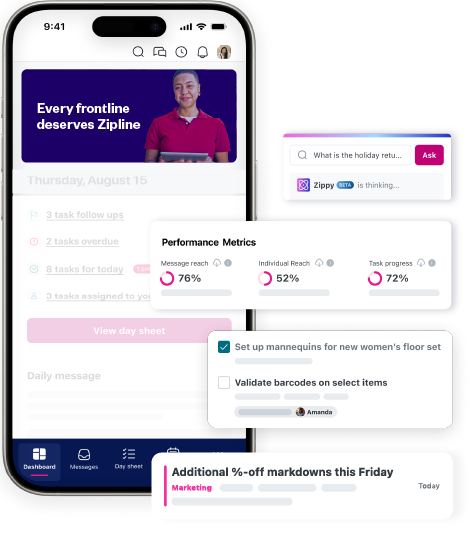
Retail operations platform unifying frontline communication, task management, and store execution tracking.

Standout factReports a Net Promoter Score of 89, versus a SaaS average near 41. taqtics.co
Biggest catchRecent mobile app updates caused login loops and glitches for some users. apps.apple.com
89Net Promoter Scoretaqtics.co
130+Retailers using Ziplinegetzipline.com
~$3/user/moEstimated starting pricetaqtics.co

Standout number

89Net Promoter Score, vs ~41 SaaS avg

Source: taqtics.co

In their words

“The latest update is having major glitching issues. I am having issues with the 'work use only' screen which continuously pops up.”

apps.apple.com

Upside

  • NPS of 89, elite satisfaction
  • Pink Bubble live support team
  • Integrates with UKG, Legion, Tableau

Catch

  • Recent mobile login glitches
  • No public pricing listed
  • Reporting customization is limited
Pick it ifMulti-location retailers prioritizing store execution and brand consistency.
Skip it ifNon-retail industries outside Zipline's store-focused design.
PricingCustom quotes; third-party estimates start near $3/user/month.

Editor's takeZipline reports a Net Promoter Score of 89, a figure the vendor's own data calls far above the SaaS average of 41. Its 'Pink Bubble' live support and integrations with UKG, Legion, and Tableau reinforce that trust. Recent updates have introduced friction. Reviewers describe login loops and glitches in the mobile app that frontline workers rely on daily.

What is Zipline's Net Promoter Score?

89, according to third-party review data, well above the roughly 41 average reported for SaaS products generally.

Is Zipline's mobile app reliable?

Recent updates have caused documented login loops and glitches for some users, according to App Store reviews, even though the desktop interface is rated highly.

The evidence: 6 criteria, 3 penalties
9.0
Product Capability & DepthLooked for: We evaluate the breadth of retail-specific features like task management, communication targeting, and audit capabilities.Zipline offers a comprehensive suite combining targeted frontline communications, task management, store audits, and an AI-powered knowledge base into a single platform.getzipline.comgetzipline.comgetzipline.com
9.6
Market Credibility & Trust SignalsLooked for: We look for industry adoption, customer retention rates, and verified third-party satisfaction scores.Zipline boasts an exceptional Net Promoter Score (NPS) of 89 and serves major retailers like Sephora, L.L.Bean, and American Eagle.taqtics.cogetzipline.com
8.7
Usability & Customer ExperienceLooked for: We assess the intuitiveness of the interface for frontline workers and the stability of mobile applications.While the desktop interface is praised for ease of use, recent mobile app updates have caused login loops and glitches for some users.taqtics.coapps.apple.com
8.5
Value, Pricing & TransparencyLooked for: We look for clear public pricing, flexible terms, and demonstrated return on investment.Pricing is not publicly listed and requires a quote, though third-party sources estimate starts around $3/user/month.getzipline.comg2.comtaqtics.co
8.9
Integrations & Ecosystem StrengthLooked for: We check for native integrations with critical retail systems like WFM, LMS, and BI tools.The platform integrates with major workforce management and BI tools like UKG, Legion, Tableau, and Power BI.getzipline.comtaqtics.cogetzipline.com
9.4
Support, Training & Onboarding ResourcesLooked for: We evaluate the availability and quality of customer support, training materials, and implementation assistance.Zipline is renowned for its 'Pink Bubble' live support and comprehensive training, receiving high praise for responsiveness.getzipline.comtaqtics.co

Score adjustments−0.14 points in total

−0.06Recent mobile app updates have caused significant stability issues, including login loops and freezing, frustrating daily users.apps.apple.com · severity 60/100
−0.06Users report that reporting and task management customization options can be restricted, lacking advanced analytics found in some competitors.taqtics.co · severity 45/100
−0.02Pricing is opaque with no public figures available; costs are determined only after consultation.g2.com · severity 30/100
8

YOOBIC

yoobic.com · YOOBIC Retail Employee Onboarding #2 of 6 in Onboarding Platforms for Retail and Store Associates

350+ brands trust it, but needs 1,000+ employees to qualify.

Best forLarge retail chains with 1,000-plus employees needing mobile-first training.

Quote only deskless workforce appgamified microlearning37 languages
#2 in its ranking

Mobile-first onboarding and training app for deskless retail teams, gamified like social media.

Standout factYOOBIC serves over 350 global brands and more than 1 million frontline employees across 80-plus countries. info.yoobic.com
Biggest catchSales teams report a minimum requirement of 1,000 employees or 100 store locations, excluding smaller retailers. connecteam.com
350+Global brands servedinfo.yoobic.com
1,000,000+Frontline employees using YOOBICinfo.yoobic.com
4.6 / 5 (163 reviews)G2 ratingg2.com

By the numbers

350+global brands
1,000,000+frontline employees
80+countries

Source: info.yoobic.com

Before you request a demo

  • 1,000+ employees or 100+ locations
  • Deskless, mobile-first retail team
  • Need weekend support coverage

Upside

  • 350+ global brands, 1M+ employees
  • Gamified microlearning, 37 languages
  • 4.6/5 rating across 163 G2 reviews

Catch

  • Minimum 1,000 employees to qualify
  • Web admin interface feels messy
  • No weekend customer support
Pick it ifLarge retail chains with 1,000-plus employees needing mobile-first training.
Skip it ifSmall businesses below the 1,000-employee or 100-location minimum.
PricingNot published. Effectively enterprise-only, requiring 1,000+ employees or 100+ locations.

Editor's takeYOOBIC earns its rank on frontline engagement, using battles, badges, and leaderboards to make mobile training stick for deskless retail staff, backed by adoption from Lacoste and Levi's. Scale is the gate here. The 1,000-employee or 100-location sales minimum rules out smaller retailers regardless of how well the mobile app performs.

How many employees does YOOBIC require?

Sales teams indicate a minimum of 1,000 employees or 100 store locations, which effectively excludes small and mid-sized retailers from onboarding.

How many languages does YOOBIC support?

The app translates into 37 languages, making it usable for global frontline teams operating across many countries and markets.

The evidence: 6 criteria, 3 penalties
9.1
Product Capability & DepthLooked for: We evaluate the breadth of onboarding features, specifically automation, content delivery methods, and language support for diverse retail teams.YOOBIC offers a comprehensive suite including automated onboarding paths, AI-powered assistants (NEO), and gamified microlearning, supporting over 37 languages for global deployment.yoobic.comyoobic.comconnecteam.com
9.4
Market Credibility & Trust SignalsLooked for: We look for adoption by major industry players, verified user reviews, and proven scale in the retail sector.The platform is trusted by over 350 global brands including Lacoste, Levi's, and Timberland, with a strong 4.6/5 rating on G2 from over 160 reviews.trustradius.comg2.cominfo.yoobic.com
8.8
Usability & Customer ExperienceLooked for: We assess the ease of use for both frontline workers on mobile and administrators on the web interface.While the mobile app is highly praised for its intuitive, social-media-like design, the web interface for admins is criticized for being cluttered and inconsistent.connecteam.comconnecteam.comg2.com
8.3
Value, Pricing & TransparencyLooked for: We examine pricing visibility, accessibility for different business sizes, and contract flexibility.Pricing is opaque and quote-based, with significant minimum requirements that effectively exclude small businesses.yoobic.comconnecteam.comfindpmsoftware.com
9.3
Frontline Engagement & GamificationLooked for: We look for features specifically designed to motivate deskless workers, such as gamification, social feeds, and microlearning.YOOBIC excels here with a 'social' feel, offering battles, badges, leaderboards, and bite-sized training that fits into the flow of work.yoobic.comyoutube.comyoobic.com
8.9
Enterprise Scalability & ComplianceLooked for: We evaluate the platform's ability to handle complex organizational structures, compliance tracking, and large-scale deployments.Designed for large enterprises, it offers deep compliance tracking, real-time visibility into store execution, and integrations with major systems like SAP and Salesforce.yoobic.comfindpmsoftware.cominfo.yoobic.com

Score adjustments−0.15 points in total

−0.05Strict minimum requirements (1,000 employees or 100 locations) effectively exclude small and mid-sized businesses.connecteam.com · severity 75/100
−0.05The web interface for administrators is reported as 'messy,' 'overwhelming,' and inconsistent with the mobile app design.connecteam.com · severity 50/100
−0.05Customer support availability is limited, with reports of no weekend support and slow response times for some inquiries.connecteam.com · severity 45/100
9

Creative IT

creativeit.com · Onboarding Software for Remote Teams | Creative IT #3 of 8 in Onboarding Platforms for Call Centers and Support Teams

Ships pre-configured laptops, but pricing needs a call

Best forRemote-first companies needing physical device logistics and IT setup.

Quote only HIPAA compliantdevice logisticsquote-only pricing
#3 in its ranking

Remote Operating System combining HR onboarding, device shipping, and managed IT support.

Standout factShips devices preloaded with apps, settings, and security standards directly to new hires creativeit.com
Biggest catchPricing is not publicly available and requires a sales consultation before any quote. creativeit.com
<3 minutesSupport response timecloudtango.net
HIPAA, CMMC, SOC 2, FTC SafeguardsCompliance standards coveredcreativeit.com
Flat-rate managed servicePricing modelcreativeit.com

What Creative IT ships and manages

  • Pre-configured laptop shipped to new hire
  • Remote wipe and endpoint monitoring
  • Self-serve online pricing

Support

Email
💬Chat
unknown
Phone
👥Community
unknown

Reported response times under 3 minutes

Upside

  • Ships pre-configured devices to new hires
  • Automated HIPAA and CMMC compliance tracking
  • Flat-rate managed service pricing

Catch

  • No self-serve signup available
  • Pricing not publicly listed
  • Support focus is primarily US-based
Pick it ifRemote-first companies needing physical device logistics and IT setup.
Skip it ifTeams needing only software for HR forms, not hardware logistics.
PricingCustom flat-rate quote, requires discovery call

Editor's takeCreative IT's Remote Operating System goes beyond digital onboarding forms by actually shipping a pre-configured laptop, secured and loaded with company apps, directly to a new hire's door. It bundles compliance tracking for HIPAA, CMMC, and SOC 2 alongside active endpoint monitoring and remote wipe. There is no self-serve pricing; buyers schedule a discovery call, and clients on CloudTango report response times under 3 minutes for support issues.

Can Creative IT ship equipment to remote employees?

Yes. It configures and ships Mac, PC, and mobile devices directly to remote team members, fully secured and ready to use out of the box.

Is Creative IT pricing available online?

No. Pricing is not publicly listed and requires a discovery call, though the company uses a flat-rate managed service model for predictability.

The evidence: 6 criteria, 3 penalties
8.7
Product Capability & DepthLooked for: We look for comprehensive onboarding features that bridge digital workflows with physical equipment provisioning for remote teams.Creative IT's 'Remote Operating System' uniquely combines digital onboarding (forms, access) with physical logistics (shipping pre-configured laptops), offering a depth rarely found in standalone SaaS tools.creativeit.comcreativeit.comcreativeit.com
9.2
Market Credibility & Trust SignalsLooked for: We look for verified client testimonials, industry partnerships, and a proven track record in the MSP and SaaS space.The company holds strong client testimonials citing exceptional responsiveness and reliability, backed by Microsoft Partner status and specific compliance expertise (HIPAA, CMMC).cloudtango.netcreativeit.com
8.9
Usability & Customer ExperienceLooked for: We look for intuitive interfaces and responsive support that simplifies complex IT and HR processes for users.The 'Remote Operating System' is designed to be a centralized self-service hub, and the accompanying managed support is rated highly for speed and helpfulness.creativeit.comcreativeit.comcloudtango.net
8.5
Value, Pricing & TransparencyLooked for: We look for clear, transparent pricing models that offer predictable costs for growing remote teams.Creative IT uses a flat-rate managed service model which offers predictability, but specific pricing is not public and requires a discovery call.creativeit.comcreativeit.comcreativeit.com
9.4
Logistics & Device ManagementLooked for: We look for capabilities that handle the physical aspects of remote work, such as shipping, tracking, and retrieving hardware.This is the product's standout feature, offering end-to-end management of physical devices including shipping, retrieval, and inventory tracking alongside digital setup.creativeit.comcreativeit.comcreativeit.com
9.0
Security, Compliance & Data ProtectionLooked for: We look for robust security measures and compliance tools tailored for distributed and regulated industries.The platform includes built-in compliance tracking for standards like HIPAA and CMMC, plus active endpoint security measures like remote wipe and encryption.creativeit.comcreativeit.comcreativeit.com

Score adjustments−0.15 points in total

−0.04Pricing is not publicly available and requires a sales consultation, which reduces transparency for buyers comparing SaaS options.creativeit.com · severity 60/100
−0.07The product is not a standalone self-serve SaaS but part of a broader managed service engagement, which may be a barrier for teams seeking only software.creativeit.com · severity 50/100
−0.04Potential for brand confusion exists with similarly named IT companies in the UK and Ireland, complicating independent research.uk.trustpilot.com · severity 40/100
10

Apploi

apploi.com · Apploi Healthcare Onboarding #3 of 9 in Onboarding Platforms for Healthcare and Hospital Staff

Apploi cut one client's agency spend by $230k a month, but slows down at high application volume

Best forHealthcare facilities that need automated credentialing alongside hiring and onboarding.

healthcare hiringonboarding softwarecredentialing
#3 in its ranking

Healthcare hiring and onboarding platform with automated license and credential verification.

Standout factOne healthcare client reduced monthly staffing agency spend by $230,000 after switching to Apploi. apploi.com
Biggest catchUsers report system slowness when processing high volumes of applications. selecthub.com

Best for

  • Facilities needing automated credential verification
  • Teams using PointClickCare
  • Organizations tracking agency spend reduction

Six criteria vs category average

Product Capability & Depth
8.8
Market Credibility & Trust Signals
9.3
Usability & Customer Experience
8.6
Value, Pricing & Transparency
8.5
Compliance & Credentialing
9.5
Integrations & Ecosystem
9.0

Dark tick = category average

Upside

  • Automated license and credential verification
  • Exclusive PointClickCare partnership
  • Six consecutive years on the Inc. 5000 list

Catch

  • System slows down at high application volume
  • Limited candidate filtering tools
  • Pricing not published, requires a sales call
Pick it ifHealthcare facilities that need automated credentialing alongside hiring and onboarding.
Skip it ifOrganizations processing very high application volumes that need guaranteed fast performance.
PricingCustom quote based on facility type and size, no public pricing.

Editor's takeApploi focuses on the regulatory side of healthcare hiring, automating license checks that generic applicant tracking tools skip. Its exclusive PointClickCare partnership plugs directly into senior care workforce systems. One client cut agency spend by $230,000 a month, though the platform can slow down under heavy application volume.

What does Apploi automate for healthcare hiring?

Apploi automates license and credential verification, including expiration alerts, for roles like CNAs and nurses.

Does Apploi publish its pricing?

No, pricing is customized by facility type and size and requires a quote.

The evidence: 6 criteria, 3 penalties
8.8
Product Capability & DepthLooked for: We look for specialized features that handle the complex documentation and workflow needs of healthcare onboarding.Apploi provides digital onboarding packets, automated workflows, and mobile-friendly forms specifically designed to collect I-9s and healthcare-specific documentation remotely.apploi.comapploi.comselecthub.com
9.3
Market Credibility & Trust SignalsLooked for: We look for sustained industry growth, awards, and adoption by reputable healthcare facilities.Apploi has achieved the Inc. 5000 list for six consecutive years and is trusted by over 9,000 healthcare facilities, signaling exceptional market stability.apploi.comapploi.com
8.6
Usability & Customer ExperienceLooked for: We look for an intuitive interface that simplifies complex processes for both administrators and new hires.Users generally find the platform easy to use and mobile-friendly, though there are documented reports of system slowness during high-volume usage.selecthub.comapploi.com
8.5
Value, Pricing & TransparencyLooked for: We look for clear ROI evidence and transparent pricing models suitable for healthcare organizations.Apploi uses a quote-based pricing model without public pricing, but offers significant documented ROI through reduced agency spend and faster hiring.apploi.comapploi.comapploi.com
9.5
Compliance & CredentialingLooked for: We look for automated tools that manage license verification and regulatory compliance specifically for healthcare.The platform excels with automated primary source verification, expiration alerts, and expanded credentialing for various roles including CNAs and nurses.apploi.comapploi.com
9.0
Integrations & EcosystemLooked for: We look for seamless connections with major EHR, payroll, and background check providers.Apploi features an exclusive partnership with PointClickCare and integrates with major systems like UKG, ADP, and background check provider Accurate.apploi.comapploi.com

Score adjustments−0.15 points in total

−0.05Users have reported slow system performance, particularly when processing high volumes of applications.selecthub.com · severity 50/100
−0.06Reviews indicate limitations in the ability to efficiently filter and sort through unqualified candidates.selecthub.com · severity 45/100
−0.04Some users have experienced inconsistent functionality with the in-app messaging system.selecthub.com · severity 40/100
02

Every ranking in Onboarding & Employee Orientation Platforms

Each card shows the top three. The eye opens a quick look. Open a ranking for every product, the evidence and the comparison table.

1 AnswerNetAnswerNet pairs 24/7 live agents with its own LMS 8.9/10
Visit ↗
2 ScreenStepsScreenSteps cut one BPO's training time by 75% 8.9/10
Visit ↗
3 Creative ITShips pre-configured laptops, but pricing needs a call 8.8/10
Visit ↗
See all 8 ranked
1 DelightreeDelightree cut franchisee onboarding time by 50% 8.9/10
Visit ↗
2 GoCoGoCo syncs any payroll provider, now owned by Intuit 8.9/10
Visit ↗
3 FranConnectFranConnect backs 1,500 brands, migration turns messy 8.7/10
Visit ↗
See all 7 ranked
1 symplrsymplr dominates hospital ops, pricing stays opaque 9.0/10
Visit ↗
2 Click BoardingClick Boarding cut one client's HR workload by 50%. 8.9/10
Visit ↗
3 ApploiApploi cut one client's agency spend by $230k a month,… 8.8/10
Visit ↗
See all 9 ranked
1 Apps365Apps365 keeps onboarding data inside your own SharePoint tenant 8.8/10
Visit ↗
2 HR CloudHR Cloud protects data in biometric-locked server cages 8.8/10
Visit ↗
3 iCIMSiCIMS holds rare ISO 27701 certification, but UI feels dated 8.8/10
Visit ↗
See all 9 ranked
1 ZiplineZipline posts an NPS of 89, but mobile app glitches 8.9/10
Visit ↗
2 YOOBIC350+ brands trust it, but needs 1,000+ employees to qualify. 8.9/10
Visit ↗
3 AtobiStarts near $2/user, but the app can run slow 8.7/10
Visit ↗
See all 6 ranked
03

About Onboarding & Employee Orientation Platforms

What the category is, how it developed, and what to look for. Two minutes, or the long read.

This category covers software used to manage the transition of new hires from "candidate" to "productive employee" across their initial operational lifecycle: provisioning access, completing regulatory paperwork, delivering culture and compliance training, and facilitating social integration. It sits between Applicant Tracking Systems (which focus on recruitment and offer management) and Core HR/HCM systems (which focus on long-term employee record keeping and payroll). It includes both general-purpose platforms designed for broad corporate use and vertical-specific tools built for high-compliance or high-volume industries like healthcare, retail, and manufacturing.

Read the full category guide

What Is Onboarding & Employee Orientation Platforms?

At its core, this software solves the "productivity gap"—the costly period between an offer acceptance and the moment an employee generates value. For Human Resources, it automates the administrative burden of tax forms (I-9, W-4) and policy acknowledgments. For hiring managers, it structures the crucial first 90 days, ensuring that equipment provisioning, goal setting, and team introductions happen systematically rather than haphazardly. The users are distinct but interconnected: HR administrators configure workflows to ensure compliance; hiring managers track progress and assign role-specific tasks; and new hires access a self-service portal to navigate their entry into the organization.

The strategic importance of this category has shifted from simple digitization of paper forms to retention engineering. With research indicating that a significant percentage of new hires decide whether to stay or leave within their first month [1], these platforms serve as the primary mechanism for cementing organizational culture and reducing early-stage attrition.

History of the Category

The evolution of Onboarding & Employee Orientation Platforms mirrors the broader shift in enterprise software from "systems of record" to "systems of engagement." In the 1990s and early 2000s, onboarding did not exist as a distinct software category. It was a fragmented manual process: IT managed provisioning via helpdesk tickets, HR managed paperwork via filing cabinets or basic ERP modules, and training happened in physical classrooms. The "software" involved was often little more than a payroll database where a new record was created after the manual work was done.

The first major shift occurred with the rise of cloud computing and the digitization of recruitment in the mid-2000s. As Applicant Tracking Systems (ATS) moved to the cloud, a functional gap emerged: the ATS handled the candidate until the offer letter, and the Core HR system picked up at the first paycheck. The chaotic interim period—"pre-boarding"—became the birthing ground for specialized onboarding solutions. Early vendors focused heavily on compliance and forms automation, selling the promise of "paperless HR." This era was defined by the transition from on-premise servers to SaaS, allowing new hires to complete paperwork from home before their first day [2].

By the 2010s, the market began to consolidate and mature. Large Human Capital Management (HCM) providers began acquiring niche onboarding startups to close the loop between recruiting and talent management. However, a second wave of innovation was driven by the "War for Talent." Buyer expectations evolved from "give me a database to store I-9s" to "give me a tool to stop new hires from quitting." This shifted the focus toward "experience-driven" onboarding—platforms that emphasized social connection, mentorship matching, and culture content over pure administration. Today, the market is characterized by a split between massive, all-in-one HCM suites that treat onboarding as a feature, and specialized "best-of-breed" platforms that offer deep, vertical-specific functionality for complex industries [3].

What to Look For

Evaluating onboarding platforms requires a distinct mindset shift from evaluating other HR tools. Unlike payroll (which must be accurate) or time-tracking (which must be precise), onboarding software must be engaging while remaining compliant. If the user experience is poor, adoption drops, and the "ghosting" rate—where hires accept offers but never show up—increases.

Critical Evaluation Criteria

First, assess the depth of pre-boarding capabilities. The most critical risk period is the window between offer acceptance and the start date. Superior platforms provide a secure portal where new hires can sign documents, order equipment, and view welcome videos before Day 1. Look for systems that allow "drip-feeding" content to avoid overwhelming the user. If a vendor requires an active corporate email address to access the portal, this is a failure point for pre-boarding, as many new hires won't have credentials yet.

Second, evaluate cross-departmental workflow orchestration. Onboarding is rarely an HR-only activity; it requires IT to ship laptops, facilities to issue badges, and managers to schedule 1:1s. A robust platform acts as a traffic controller, triggering tasks in other systems (e.g., creating a ticket in IT service management software) when a new hire is added. If the tool relies solely on email notifications to other departments without API triggers or integration, it will not scale.

Red Flags and Warning Signs

Be wary of vendors that describe their product primarily as a "document repository." While document management is essential, a modern onboarding platform must be a process engine. Another red flag is the lack of mobile-responsive design. For industries like retail or manufacturing, where candidates may not own desktops, a mobile-hostile interface is a dealbreaker. Additionally, watch out for "hard-coded" workflows. If changing a task from "Day 1" to "Day 3" requires a support ticket to the vendor rather than a drag-and-drop admin change, the system is likely too rigid for modern agility.

Key Questions to Ask Vendors

  • "How does your system handle 're-boarding' for internal promotions or cross-border transfers, not just new hires?"
  • "Can we trigger different workflows based on metadata like location, department, or employment type (e.g., contractor vs. full-time) without manual intervention?"
  • "Show us the exact view a new hire sees on a mobile device when completing an I-9 form."
  • "What is your specific mechanism for handling counter-signatories on documents (e.g., a manager must sign after the employee)?"

Industry-Specific Use Cases

Retail & E-commerce

In retail, the onboarding challenge is defined by high volume, high turnover, and seasonality. The primary goal is speed to productivity. Retailers often hire hundreds of temporary staff for holiday seasons, meaning the onboarding software must handle bulk processing and rapid identity verification without crashing. Unlike corporate environments, retail associates rarely have corporate email addresses prior to starting and may never sit at a desk. Therefore, the software must be "mobile-first," allowing new hires to complete training and forms on personal smartphones via SMS links rather than email logins [4].

Evaluation priorities for retail include automated scheduling integration. The onboarding tool must speak directly to workforce management systems to ensure that a new hire cannot be scheduled for a shift until their safety training and compliance paperwork are 100% complete. This "compliance gate" prevents costly labor law violations. Additionally, content delivery must be "micro-learning" focused—short, 3-minute videos on loss prevention or POS usage that can be consumed on the floor, rather than hour-long e-learning courses [5].

Healthcare

Healthcare onboarding is dominated by credentialing and privileges. The stakes are legal and patient safety-related, not just administrative. A hospital cannot allow a nurse or doctor to touch a patient until their licenses, malpractice insurance, and board certifications are verified. Consequently, generic onboarding platforms often fail here because they lack "primary source verification" integration. Healthcare-specific platforms connect directly to databases (like state nursing boards) to automatically validate license status [6].

Unique considerations include complex role-based variance. The onboarding workflow for a radiologist is vastly different from that of a cafeteria worker or a visiting physician. The software must support highly granular logic to serve different packets of forms and training modules (e.g., HIPAA, bloodborne pathogens) based on the specific clinical role. Furthermore, "privileging" workflows—where a committee reviews a doctor's qualifications—must be digital and auditable within the system [7].

Financial Services

For financial services, the overriding driver is regulatory compliance (SEC, FINRA, etc.). Onboarding software in this sector must handle specific forms like the U4 (Uniform Application for Securities Industry Registration) and track "outside business activities" to prevent conflicts of interest. The system must create an immutable audit trail of exactly when a policy was presented and when it was acknowledged, often requiring "WORM" (Write Once, Read Many) compliant storage integration [8].

A key evaluation priority is the pre-clearance of personal trading accounts. Onboarding tools for wealth management or investment banking often need to integrate with compliance engines that monitor employee trading. Additionally, the software must manage "garden leave" and non-compete periods for senior hires, ensuring they do not access sensitive data or contact clients before legally permitted. The speed of "time to seat" is also critical; every day a broker is not registered is lost revenue, so automated submission of data to regulators like FINRA is a major differentiator [9].

Manufacturing

Manufacturing onboarding focuses on safety and physical site access. Similar to retail, the workforce is often deskless, but the training requirements are far more rigorous due to OSHA regulations. Onboarding platforms here must manage "blended learning"—tracking online safety modules alongside in-person practical assessments (e.g., proving capability to operate a forklift). A generic tool that only tracks digital course completion is insufficient; the system must allow a supervisor to check off a physical skills assessment on a tablet on the factory floor [10].

Unique considerations include site-specific logic. A manufacturer with 20 plants might have 20 different safety protocols or union requirements. The software must be able to deploy a "global" standard while allowing local plant HR managers to append site-specific requirements. Furthermore, integration with physical access control systems (badge readers) is common; a worker's badge should not open the door to the chemical storage area until their HazMat training is recorded as complete in the onboarding system [11].

Professional Services

In law firms, consultancies, and agencies, the product is the people. Therefore, onboarding is focused on knowledge network integration and billable utilization. The software needs to accelerate "time to competency" by connecting new hires with mentors and subject matter experts immediately. Unlike other industries where standardization is key, professional services onboarding is often highly personalized, involving bios, practice area introductions, and client-specific conflict checks [12].

A specific workflow this niche handles well is client-ready profile generation. Data collected during onboarding (skills, certifications, past project experience) often flows directly into "pitch deck" systems or resource management tools used to assign staff to client projects. If the onboarding tool doesn't capture this granular skills data, the firm loses money because they cannot effectively bill the new hire. Additionally, the system must handle rigorous "independence checks" to ensure a new partner's past financial interests don't conflict with current firm audit clients [13].

Subcategory Overview

Onboarding Platforms for Franchise and Multi-Location Businesses

This niche caters to organizations where the "employer" entity might vary by location, such as fast-food chains or automotive service franchises. What makes Onboarding Platforms for Franchise and Multi-Location Businesses genuinely different is their ability to handle multi-tenant architecture with brand consistency. A parent brand (Franchisor) needs to enforce global brand standards (e.g., "Welcome to Burger King" videos) while the local owner (Franchisee) needs control over local tax forms, wage rates, and scheduling. Generic tools struggle to allow this "parent-child" permission structure where data is siloed between franchisees but aggregated for the franchisor.

One workflow only this specialized tool handles well is the mass update of brand content across disparate legal entities. If the corporate headquarters updates the "Food Safety Manual," they can push this content to 5,000 independently owned locations instantly, tracking acknowledgment centrally without accessing the local owners' payroll data. The specific pain point driving buyers here is joint-employer liability. Franchisors want to provide training tools without stepping over the legal line of managing the franchisee's employees directly; these platforms are architected to maintain that legal separation [14].

Onboarding Platforms for Call Centers and Support Teams

This subcategory focuses intensely on rapid proficiency and system simulations. Call centers often have turnover rates exceeding 40%, meaning onboarding is a constant, high-volume machine. Onboarding Platforms for Call Centers and Support Teams differ from generic tools by integrating directly with Quality Assurance (QA) and Learning Management Systems (LMS) to track "speed to competency." It is not enough to mark a form as "signed"; the system tracks how quickly an agent can navigate the CRM during a mock call.

A unique workflow is the "nesting" phase management. After classroom training, agents move to a transition phase where they take live calls with supervision. Specialized platforms track performance metrics during this specific phase to gate the employee from moving to full production status. Buyers choose this niche to solve the pain point of training ramp time. Generic tools track paperwork; these tools track how fast an agent stops costing the company money and starts resolving tickets [15].

Onboarding Platforms for Manufacturing and Warehouse Staff

As noted in the industry section, this niche is defined by safety compliance and physical verification. Onboarding Platforms for Manufacturing and Warehouse Staff distinguish themselves with kiosk mode and QR code access. Because warehouse workers do not have laptops, these platforms are designed to run on shared tablets in a breakroom or via personal mobile devices without complex login hurdles (often using employee ID badges or QR codes).

One workflow unique to this niche is equipment certification tracking tied to access control. The system manages the lifecycle of a forklift license—alerting the floor manager 30 days before expiration and automatically scheduling the recertification practical exam. The pain point driving buyers here is regulatory fines and liability. A generic onboarding tool might store a PDF of a license, but it won't actively prevent an unqualified worker from clocking into a hazardous role, whereas specialized tools often integrate with shift scheduling to prevent exactly that [16].

Onboarding Platforms for Healthcare and Hospital Staff

This category deals with the most complex compliance matrix of any industry. Onboarding Platforms for Healthcare and Hospital Staff are different because they include automated primary source verification (PSV). They do not just ask a doctor to upload their license; the software bots out to the state medical board's database to verify the license is active and free of sanctions.

A specialized workflow is the management of "privileging" packets. Hospitals must grant specific clinical privileges (e.g., "allowed to perform cardiac surgery") based on evidence. This software assembles the evidence packet for the credentialing committee review, a workflow completely foreign to corporate onboarding tools. The driving pain point is revenue cycle leakage. If a provider is not properly credentialed and onboarded, the hospital cannot bill insurance for their services. Delays in onboarding directly equal lost revenue, pushing buyers toward specialized tools that accelerate this specific process [6].

Onboarding Platforms for Retail and Store Associates

Speed and volume define this niche. Onboarding Platforms for Retail and Store Associates are optimized for zero-training user interfaces. The UX is designed to be as intuitive as a social media app because store managers—who are often teenagers themselves—do not have time to train new hires on how to use the HR software.

A critical workflow is the automated distribution of uniform and inventory requests relative to store location. When a new hire is added to "Store 402," the system checks inventory for that specific location's uniform sizes and triggers a replenishment order if needed, ensuring the employee has a shirt on Day 1. The primary pain point is manager administrative burden. Retail store managers are measured on sales, not HR admin. They buy these tools to automate the "paper chase" so they can get back to the sales floor [4].

Integration & API Ecosystem

The effectiveness of an onboarding platform is often determined by its "connective tissue"—how well it pushes and pulls data from the rest of the tech stack. In a modern enterprise, onboarding sits at the nexus of the Applicant Tracking System (ATS), Core HR/Payroll, Identity and Access Management (IAM), and Learning Management Systems (LMS). A failure in integration leads to "swivel chair" data entry, where HR staff manually retype data from the onboarding tool into payroll, introducing error rates that can affect employee pay.

According to Gartner, organizations that successfully integrate onboarding with other HR applications can improve employee performance by up to 20% due to reduced administrative friction [17]. However, integration is also a primary failure point. McKinsey research on digital transformations highlights that data mapping inconsistencies (e.g., "Contractor" in one system vs. "Contingent Worker" in another) are a leading cause of project delays [18].

Real-World Scenario: Consider a 50-person professional services firm. They buy a modern onboarding platform to impress new consultants. They intend to connect it to their Project Management tool (e.g., Asana) and their Billing system (e.g., QuickBooks). The goal: when a new consultant signs their offer, they are automatically set up as a "billable resource" in the project tool. The Break: The integration was "one-way" only. When the start date changed in the onboarding tool due to a delay, the API did not push the update to the Project Management tool. The resource was assigned to a client project starting Monday, but they didn't actually start until Wednesday. The project manager burned budget on a "ghost" resource, and the invoice to the client had to be manually corrected, damaging client trust. A robust bi-directional API with error handling would have caught the date mismatch and flagged it.

Security & Compliance

Security in onboarding platforms is non-negotiable because these systems house the "Crown Jewels" of identity data: Social Security Numbers, bank account details, home addresses, and passport scans. Compliance is bifurcated into data privacy (how the data is stored/processed) and employment law (what forms are presented). The landscape is complicated by conflicting regional regulations, such as GDPR in Europe versus state-level laws like CCPA in California.

Experts at Forrester warn that "security by obscurity" is no longer viable; platforms must adhere to rigorous standards. A key distinction often missed by buyers is the difference between SOC 2 Type II and GDPR compliance. As noted by compliance experts, SOC 2 is a voluntary standard focusing on security controls (common in US SaaS), while GDPR is a legal framework for privacy rights (mandatory for EU data) [19]. A platform can be SOC 2 compliant but still fail GDPR requirements if it doesn't allow for the "Right to be Forgotten."

Real-World Scenario: A US-based tech company hires a remote developer in Germany. They use a standard US onboarding platform. The platform collects the new hire's data and stores it on servers in Ohio. The Risk: This transfer of data from the EU to the US without specific safeguards (like Standard Contractual Clauses or the Data Privacy Framework) is a violation of GDPR. Six months later, the developer leaves and requests their data be deleted. The US platform, designed for SEC record-keeping rules (which require retaining data for years), refuses to delete the record. The company is now liable for a GDPR fine because their vendor selection failed to account for the conflict between US retention laws and EU privacy rights.

Pricing Models & TCO

Pricing in this category has shifted from perpetual licenses to SaaS models, but the unit of measure varies significantly. The two dominant models are Per-Employee-Per-Month (PEPM) (based on total company headcount) and Per-Onboard (based on the number of new hires processed). A PEPM model is predictable but can be expensive for low-turnover companies. A Per-Onboard model is cost-effective for stable companies but punitive for high-turnover industries like retail.

Research from Bain & Company indicates that hybrid pricing models are gaining traction, where a base fee covers the platform and usage fees apply to premium features like AI-driven insights [20]. However, the "hidden" costs of Total Cost of Ownership (TCO) often shock buyers. A study by Deel suggests that hidden costs—such as integration maintenance and manual data reconciliation—can outweigh the software license fees [21].

TCO Scenario: A retail chain with 500 employees and 50% turnover (250 new hires/year). Vendor A (PEPM): Charges $5 per active employee/month. Calculation: 500 employees * $5 * 12 months = $30,000/year. Vendor B (Per-Onboard): Charges $50 per new hire packet. Calculation: 250 hires * $50 = $12,500/year. The Trap: On the surface, Vendor B is cheaper. However, Vendor B charges $5,000 for "implementation" and $2,000 for "SSO integration." Vendor A includes these. Furthermore, Vendor B charges for "offboarding" as a separate transaction ($20/exit). With 250 exits/year, that adds $5,000. Adjusted Vendor B Cost: $12,500 (hires) + $5,000 (setup) + $2,000 (integration) + $5,000 (exits) = $24,500 year 1. The gap narrows. If turnover spikes to 70%, Vendor B suddenly becomes more expensive than Vendor A. Buyers must model their turnover variability, not just current headcount.

Implementation & Change Management

Implementation is where the promise of software meets the reality of organizational inertia. It is not just installing code; it is re-engineering how people work. The failure rate of digital transformations is notoriously high; McKinsey research consistently cites that 70% of transformation programs fail to achieve their goals [22]. In onboarding, failure looks like "shadow processes"—HR managers bypassing the new software to use their old spreadsheets because the new tool is "too hard."

Gartner analysts note that successful implementations prioritize "change adoption" over "feature deployment." This means identifying internal champions and planning for the "dip" in productivity that occurs when users learn a new system. A common pitfall is the "Big Bang" launch, where the system is rolled out to all departments simultaneously without piloting.

Real-World Scenario: A manufacturing firm implements a new mobile-first onboarding app. The HQ team loves it. They roll it out to the factory floor on Monday. The Failure: They didn't account for the fact that the factory Wi-Fi is spotty in the breakroom where onboarding happens. The app times out repeatedly. Supervisors, frustrated by the delay, revert to paper forms to get workers on the line. The data never makes it into the system. By Friday, the implementation is effectively dead. A proper change management process would have involved a "site readiness assessment" (testing Wi-Fi) and a pilot with one shift before the full rollout.

Vendor Evaluation Criteria

When selecting a vendor, buyers must look beyond the demo sizzle. The most critical, yet overlooked, criterion is the vendor's product roadmap and financial stability. In a consolidating market, smaller vendors are often acquired. If a vendor is acquired by a legacy ERP giant, innovation often stalls. Evaluation should focus on the "Partnership Profile"—does the vendor have a Customer Success Manager (CSM) ratio that supports your size?

Forrester suggests evaluating vendors based on their "ecosystem gravity"—how many pre-built integrations they have with your specific tech stack (e.g., "Do you have a certified connector for Netsuite 2024.1?"). A "Yes, we have an open API" is not the same as "We have a managed connector."

Scenario: A buyer evaluates Vendor X and Vendor Y. Vendor X has a sleek interface but is a Series B startup. Vendor Y is an established player but looks dated. The buyer chooses Vendor X. Six months later, Vendor X runs out of cash and is acquired by a competitor who sunsets the product. The buyer is forced to migrate again in under a year. The evaluation missed the "financial health" criterion. A stronger evaluation would have asked for audited financials or backing details.

Emerging Trends and Contrarian Take

Emerging Trends 2025-2026

04

Research

Original reporting on this corner of the market.

All research

80% of global organizations will deploy digital adoption platforms by 2027 to fight skills shortages

May 1, 2026

78% of AI power users actively seek outside employment opportunities

May 23, 2026

Supervisor engagement plummeted 51% more responsibilities than they can manage

Apr 19, 2026
05

Questions people ask

Which Onboarding & Employee Orientation Platforms is best?

symplr holds the highest score in the category at 9.0, in Onboarding Platforms for Healthcare and Hospital Staff. The right pick depends on the ranking that matches your use case, so start with the ranking list above.

Why are there 5 separate rankings?

Buyers in Onboarding & Employee Orientation Platforms have different jobs, so each ranking is scoped to one of them and weights the six criteria for that job. The same product can hold different ranks in different rankings.

How are the scores produced?

Documentation, pricing pages, security pages and third-party reviews are reviewed against six criteria. Each criterion records what was found and links its sources. Penalties pull the score down and are shown with their evidence. Rank follows the score. Full methodology.

06

More in HR & People Management

The whole group