Ecommerce & Retail Software

These are the specialized categories within Ecommerce & Retail Software. Looking for something broader? Return to Home.

1

Booqable Rental POS

Best for Retail POS Software for Rental Agencies

Score
9.9 / 10
1
9.9 / 10
Booqable Rental POS

Booqable is a dedicated POS system built specifically for rental businesses. It streamlines the rental process by managing orders, tracking equipment, and enhancing in-store customer experience, addressing unique industry needs such as inventory tracking, rental scheduling, and customer management.

Best for Retail POS Software for Rental Agencies

Expert Take

Booqable Rental POS is tailored for rental businesses, offering specialized features like inventory tracking and rental scheduling. Its industry-specific capabilities and integration options make it a standout in its category, though it requires an internet connection and some learning curve.
Pros

  • Seamless Shopify & WordPress integration
  • Built-in mobile barcode scanner
  • Intuitive, user-friendly interface
  • Transparent pricing with free trial
  • Robust Zapier automation ecosystem

Cons

  • Mobile app lacks full desktop features
  • API access requires expensive plan
  • Limited built-in accounting tools
  • Support response slower on weekends
  • Multi-location costs extra

Best for teams that are

  • Small to medium rental businesses in events, cameras, or bikes
  • Companies needing an integrated online rental website builder
  • Users wanting a modern, easy-to-use interface for bookings

Skip if

  • Large enterprises with complex construction fleets
  • Businesses requiring advanced maintenance or repair modules
  • Operations needing deep ERP or complex accounting integrations

Best for teams that are

  • Small to medium rental businesses in events, cameras, or bikes
  • Companies needing an integrated online rental website builder
  • Users wanting a modern, easy-to-use interface for bookings

Skip if

  • Large enterprises with complex construction fleets
  • Businesses requiring advanced maintenance or repair modules
  • Operations needing deep ERP or complex accounting integrations

Pros

  • Seamless Shopify & WordPress integration
  • Built-in mobile barcode scanner
  • Intuitive, user-friendly interface
  • Transparent pricing with free trial
  • Robust Zapier automation ecosystem

Cons

  • Mobile app lacks full desktop features
  • API access requires expensive plan
  • Limited built-in accounting tools
  • Support response slower on weekends
  • Multi-location costs extra

Expert Take

Booqable Rental POS is tailored for rental businesses, offering specialized features like inventory tracking and rental scheduling. Its industry-specific capabilities and integration options make it a standout in its category, though it requires an internet connection and some learning curve.

2

Easy Gym POS Software

Best for Retail POS Software for Gyms

Score
9.9 / 10
Easy Gym POS Software

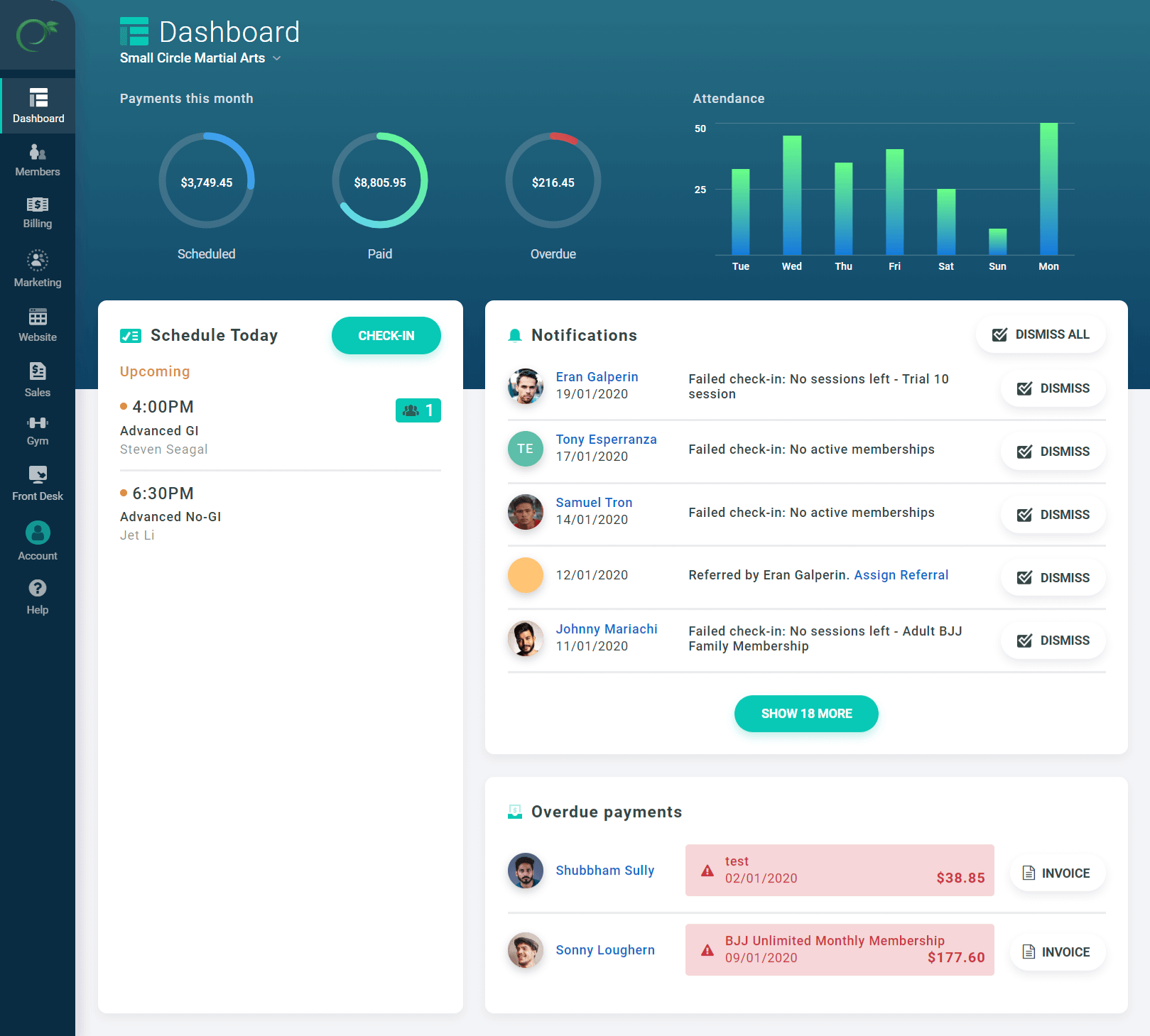
Easy Gym POS Software is a specialized point-of-sale solution designed to manage and track financial transactions for the gym industry. This SaaS solution offers feature-rich modules that streamline membership management, payment processing, and sales reporting, addressing the unique financial needs and challenges that come with running a fitness center.

Best for Retail POS Software for Gyms

Expert Take

Easy Gym POS Software excels as a specialized solution for the gym industry, offering comprehensive features tailored to fitness centers. Its integration capabilities and 24/7 support enhance usability, while flexible pricing adds value. The product's market credibility is supported by its dedicated focus on gym-specific needs.

Pros

  • Transparent pricing with no contracts
  • Integrates with Stripe, Square & Authorize.net
  • Specialized martial arts belt tracking
  • Intuitive, user-friendly interface
  • No additional platform transaction fees

Cons

  • No dedicated mobile app for staff
  • Basic marketing automation features
  • Family pricing setup can be complex
  • Reporting less robust than enterprise tools
  • Limited integrations vs. market leaders

Best for teams that are

  • Martial arts schools needing belt and skill progression tracking
  • Small to medium gyms wanting a modern, user-friendly interface
  • Studios needing integrated website and marketing tools

Skip if

  • Enterprise gyms requiring highly complex custom reporting
  • Businesses needing extensive third-party integrations

Best for teams that are

  • Martial arts schools needing belt and skill progression tracking
  • Small to medium gyms wanting a modern, user-friendly interface
  • Studios needing integrated website and marketing tools

Skip if

  • Enterprise gyms requiring highly complex custom reporting
  • Businesses needing extensive third-party integrations

Pros

  • Transparent pricing with no contracts
  • Integrates with Stripe, Square & Authorize.net
  • Specialized martial arts belt tracking
  • Intuitive, user-friendly interface
  • No additional platform transaction fees

Cons

  • No dedicated mobile app for staff
  • Basic marketing automation features
  • Family pricing setup can be complex
  • Reporting less robust than enterprise tools
  • Limited integrations vs. market leaders

Expert Take

Easy Gym POS Software excels as a specialized solution for the gym industry, offering comprehensive features tailored to fitness centers. Its integration capabilities and 24/7 support enhance usability, while flexible pricing adds value. The product's market credibility is supported by its dedicated focus on gym-specific needs.

3

SAMPro Construction Inventory Software

Best for Inventory & Order Management Systems for Contractors

Score
9.9 / 10
SAMPro Construction Inventory Software

SAMPro by Data-Basics is a construction-specific inventory management software that offers real-time inventory tracking, automated alerts, and re-stocking PO generation. Its unlimited data storage and scalability make it an ideal solution for contractors dealing with large volumes of equipment, materials, and tools.

Best for Inventory & Order Management Systems for Contractors

Expert Take

SAMPro Construction Inventory Software excels in providing specialized inventory management solutions tailored for contractors. Its real-time tracking and automated features are well-documented, and its scalability and unlimited data storage are significant advantages. While pricing transparency is limited, the product's capabilities and industry focus justify its premium positioning.

Pros

  • Advanced serialized lot control
  • Integrated BOM and sub-assemblies
  • Offline 'store and forward' mobile sync
  • 50+ years of industry experience
  • Seamless job costing integration

Cons

  • Dated user interface design
  • Steep learning curve for new users
  • High initial implementation cost
  • Mobile app receives mixed reviews
  • Complex setup for small teams

Best for teams that are

  • Large specialty contractors (MEP) with service depts
  • Enterprises needing a unified construction ERP
  • Firms managing complex service vehicle inventory

Skip if

  • Small contractors with simple project workflows
  • Firms not requiring full field service automation
  • Businesses with limited implementation budgets

Best for teams that are

  • Large specialty contractors (MEP) with service depts
  • Enterprises needing a unified construction ERP
  • Firms managing complex service vehicle inventory

Skip if

  • Small contractors with simple project workflows
  • Firms not requiring full field service automation
  • Businesses with limited implementation budgets

Pros

  • Advanced serialized lot control
  • Integrated BOM and sub-assemblies
  • Offline 'store and forward' mobile sync
  • 50+ years of industry experience
  • Seamless job costing integration

Cons

  • Dated user interface design
  • Steep learning curve for new users
  • High initial implementation cost
  • Mobile app receives mixed reviews
  • Complex setup for small teams

Expert Take

SAMPro Construction Inventory Software excels in providing specialized inventory management solutions tailored for contractors. Its real-time tracking and automated features are well-documented, and its scalability and unlimited data storage are significant advantages. While pricing transparency is limited, the product's capabilities and industry focus justify its premium positioning.

4

Duda eCommerce Builder

Best for E-commerce Store Builders for Ecommerce Brands

Score
9.9 / 10
Duda eCommerce Builder

Duda is a highly customizable and scalable eCommerce website builder, perfect for eCommerce brands looking to cut down production time while maintaining brand quality. Its robust features are specifically tailored to alleviate common pain points in the industry, such as production time, personalization, and scalability.

Best for E-commerce Store Builders for Ecommerce Brands

Expert Take

Duda eCommerce Builder excels in providing a customizable and scalable platform tailored for eCommerce brands. Its focus on reducing production time while maintaining brand quality makes it a strong contender in the eCommerce store builder category. The platform's capabilities are supported by its integration options and industry recognition.

Pros

  • Industry-leading Core Web Vitals performance
  • Comprehensive white-labeling for agencies
  • Granular client permission controls
  • Server-side rendering for better SEO
  • No transaction fees on native plans

Cons

  • eCommerce requires paid monthly add-on
  • Smaller app ecosystem than Shopify
  • Native store lacks some POS features
  • Migration between store types is manual
  • Higher cost for single-site users

Best for teams that are

  • Agencies and freelancers building websites for multiple clients
  • Businesses needing white-label tools and client management features
  • Users prioritizing site speed and Core Web Vitals performance

Skip if

  • Individual DIYers looking for the cheapest single-site solution
  • Merchants needing a massive third-party app marketplace
  • Users who want full code access to the backend

Best for teams that are

  • Agencies and freelancers building websites for multiple clients
  • Businesses needing white-label tools and client management features
  • Users prioritizing site speed and Core Web Vitals performance

Skip if

  • Individual DIYers looking for the cheapest single-site solution
  • Merchants needing a massive third-party app marketplace
  • Users who want full code access to the backend

Pros

  • Industry-leading Core Web Vitals performance
  • Comprehensive white-labeling for agencies
  • Granular client permission controls
  • Server-side rendering for better SEO
  • No transaction fees on native plans

Cons

  • eCommerce requires paid monthly add-on
  • Smaller app ecosystem than Shopify
  • Native store lacks some POS features
  • Migration between store types is manual
  • Higher cost for single-site users

Expert Take

Duda eCommerce Builder excels in providing a customizable and scalable platform tailored for eCommerce brands. Its focus on reducing production time while maintaining brand quality makes it a strong contender in the eCommerce store builder category. The platform's capabilities are supported by its integration options and industry recognition.

5

Ecwid Ecommerce Shopping Cart

Best for Shopping Cart & Checkout Platforms for Ecommerce Businesses

Score
9.9 / 10
Ecwid Ecommerce Shopping Cart

Ecwid is a versatile ecommerce solution designed for businesses of all sizes. It provides an easy-to-use platform for launching an online store without any technical skills. It's perfect for both new ecommerce sites or adding an online store to an existing website, addressing the need for flexibility in the ecommerce industry.

Best for Shopping Cart & Checkout Platforms for Ecommerce Businesses

Expert Take

Ecwid stands out as a versatile ecommerce solution with strong usability and integration capabilities. Its market credibility is supported by third-party validations and recognitions. While the platform offers a range of features suitable for various business sizes, some limitations in customization and advanced feature costs are noted.

Pros

  • Embeds seamlessly into any existing website
  • Zero transaction fees on all plans
  • PCI DSS Level 1 Certified security
  • Multichannel selling on Social & Marketplaces
  • Automated tax calculations included

Cons

  • Instant Site builder lacks drag-and-drop
  • Phone support restricted to high tiers
  • Product variations require Business plan
  • Smaller app market than Shopify
  • SEO customization is somewhat limited

Best for teams that are

  • Small businesses wanting to add a store to an existing website
  • Merchants focusing on social media selling and multi-channel reach
  • Beginners needing a free or low-cost entry point

Skip if

  • Large enterprises with complex scalability needs
  • Users requiring advanced SEO features and URL customization
  • Businesses needing deep design flexibility without coding

Best for teams that are

  • Small businesses wanting to add a store to an existing website
  • Merchants focusing on social media selling and multi-channel reach
  • Beginners needing a free or low-cost entry point

Skip if

  • Large enterprises with complex scalability needs
  • Users requiring advanced SEO features and URL customization
  • Businesses needing deep design flexibility without coding

Pros

  • Embeds seamlessly into any existing website
  • Zero transaction fees on all plans
  • PCI DSS Level 1 Certified security
  • Multichannel selling on Social & Marketplaces
  • Automated tax calculations included

Cons

  • Instant Site builder lacks drag-and-drop
  • Phone support restricted to high tiers
  • Product variations require Business plan
  • Smaller app market than Shopify
  • SEO customization is somewhat limited

Expert Take

Ecwid stands out as a versatile ecommerce solution with strong usability and integration capabilities. Its market credibility is supported by third-party validations and recognitions. While the platform offers a range of features suitable for various business sizes, some limitations in customization and advanced feature costs are noted.

6

Rithum Commerce Operations

Best for Marketplace Management Software for Retail Stores

Score
9.9 / 10
Rithum Commerce Operations

Rithum is a robust solution designed for retailers looking to launch and manage third-party marketplaces. It offers full control over sellers, their offerings, and order fulfillment, addressing the need for customization and control in the retail industry. It leverages AI technology for a fully automated, error-free pricing strategy.

Best for Marketplace Management Software for Retail Stores

Expert Take

Rithum Commerce Operations stands out in the marketplace management software category for its comprehensive control features, AI-driven pricing automation, and robust third-party integrations. It is recognized for its ability to empower retailers with significant customization and operational efficiency, making it a top choice for retail stores.

Pros

  • Connects to 420+ global marketplaces
  • Unified dropship and marketplace management
  • SOC 2 Type II certified security
  • Processes $50B+ in annual GMV
  • Direct ERP integrations (SAP, NetSuite)

Cons

  • Reports of significant post-merger price hikes
  • Support quality criticized in recent reviews
  • Onboarding can be slow and complex
  • No public pricing transparency
  • Interface described as clunky by some

Best for teams that are

  • Mid-to-large brands managing listings across many channels like Amazon and Walmart
  • Retailers requiring complex dropship network management and logic
  • Companies needing to synchronize inventory across hundreds of global channels

Skip if

  • Small businesses unable to afford high onboarding fees and long contracts
  • Sellers needing a primary inventory system (it requires an external data feed)
  • Merchants seeking a simple, low-cost tool for a single marketplace

Best for teams that are

  • Mid-to-large brands managing listings across many channels like Amazon and Walmart
  • Retailers requiring complex dropship network management and logic
  • Companies needing to synchronize inventory across hundreds of global channels

Skip if

  • Small businesses unable to afford high onboarding fees and long contracts
  • Sellers needing a primary inventory system (it requires an external data feed)
  • Merchants seeking a simple, low-cost tool for a single marketplace

Pros

  • Connects to 420+ global marketplaces
  • Unified dropship and marketplace management
  • SOC 2 Type II certified security
  • Processes $50B+ in annual GMV
  • Direct ERP integrations (SAP, NetSuite)

Cons

  • Reports of significant post-merger price hikes
  • Support quality criticized in recent reviews
  • Onboarding can be slow and complex
  • No public pricing transparency
  • Interface described as clunky by some

Expert Take

Rithum Commerce Operations stands out in the marketplace management software category for its comprehensive control features, AI-driven pricing automation, and robust third-party integrations. It is recognized for its ability to empower retailers with significant customization and operational efficiency, making it a top choice for retail stores.

7

everstox 3PL Fulfillment & Logistics

Best for Shipping, Fulfillment & 3PL Software for Marketing Agencies

Score
9.8 / 10
everstox 3PL Fulfillment & Logistics

everstox offers a powerful B2C and B2B fulfillment solution, integrated with multi-carrier shipping services. It's specifically designed to meet the challenging needs of marketing agencies dealing with high volumes of products, offering seamless logistics, stock control, and order handling.

Best for Shipping, Fulfillment & 3PL Software for Marketing Agencies

Expert Take

everstox provides a robust fulfillment solution tailored for marketing agencies, excelling in logistics management and integration capabilities. Its real-time analytics and multi-carrier shipping support enhance operational efficiency, making it a top choice for high-volume product handling.

Pros

  • Access to 70+ warehouse locations globally
  • Unified software for multi-carrier management
  • Real-time data syncing with ERPs/Shops
  • Includes claims management for carrier issues
  • Award-winning logistics solution (K5, EGA)

Cons

  • Minimum volume of ~2,500 orders/month
  • Custom pricing for growth/enterprise plans
  • Tool customization limitations reported by users
  • Focused primarily on EU/US markets
  • Setup fees may apply (implied by custom quotes)

Best for teams that are

  • High-growth brands expanding into European or US markets
  • Merchants needing a flexible, data-driven network of 3PLs
  • Businesses wanting a single dashboard for multi-3PL management

Skip if

  • Companies seeking a standalone WMS for their own facility
  • Small local sellers not needing an international network
  • Brands wanting a single direct relationship with one warehouse

Best for teams that are

  • High-growth brands expanding into European or US markets
  • Merchants needing a flexible, data-driven network of 3PLs
  • Businesses wanting a single dashboard for multi-3PL management

Skip if

  • Companies seeking a standalone WMS for their own facility
  • Small local sellers not needing an international network
  • Brands wanting a single direct relationship with one warehouse

Pros

  • Access to 70+ warehouse locations globally
  • Unified software for multi-carrier management
  • Real-time data syncing with ERPs/Shops
  • Includes claims management for carrier issues
  • Award-winning logistics solution (K5, EGA)

Cons

  • Minimum volume of ~2,500 orders/month
  • Custom pricing for growth/enterprise plans
  • Tool customization limitations reported by users
  • Focused primarily on EU/US markets
  • Setup fees may apply (implied by custom quotes)

Expert Take

everstox provides a robust fulfillment solution tailored for marketing agencies, excelling in logistics management and integration capabilities. Its real-time analytics and multi-carrier shipping support enhance operational efficiency, making it a top choice for high-volume product handling.

8

Recharge Subscriptions for Ecommerce

Best for Subscription & Membership Commerce Platforms for Ecommerce Businesses

Score
9.8 / 10
Recharge Subscriptions for Ecommerce

Recharge is a powerful SaaS solution designed specifically to handle subscription and recurring payment needs of ecommerce businesses. It enables streamlined management of subscription models, providing flexibility, automation, and customer retention tools that directly address industry-specific needs.

Best for Subscription & Membership Commerce Platforms for Ecommerce Businesses

Expert Take

Recharge Subscriptions for Ecommerce excels in managing complex subscription models with flexibility and automation. It integrates smoothly with ecommerce platforms and offers advanced analytics for customer insights. Despite limited third-party integrations, its robust capabilities make it a top choice for ecommerce businesses.

Pros

  • Market leader with 20k+ brands
  • Deep Klaviyo & headless integrations
  • Advanced bundle & flow features
  • Robust API & Developer SDKs
  • Smart churn prevention tools

Cons

  • Expensive for small businesses
  • Transaction fees on all plans
  • Legacy code causes UI glitches
  • Support can be slow/automated
  • Complex setup for advanced features

Best for teams that are

  • Shopify and BigCommerce merchants scaling subscription revenue
  • DTC brands requiring robust "Subscribe & Save" functionality
  • Businesses needing advanced analytics to reduce customer churn

Skip if

  • Merchants not using Shopify, BigCommerce, or custom builds
  • Early-stage hobbyists with very low transaction volume
  • Businesses needing complex B2B usage-based billing logic

Best for teams that are

  • Shopify and BigCommerce merchants scaling subscription revenue
  • DTC brands requiring robust "Subscribe & Save" functionality
  • Businesses needing advanced analytics to reduce customer churn

Skip if

  • Merchants not using Shopify, BigCommerce, or custom builds
  • Early-stage hobbyists with very low transaction volume
  • Businesses needing complex B2B usage-based billing logic

Pros

  • Market leader with 20k+ brands
  • Deep Klaviyo & headless integrations
  • Advanced bundle & flow features
  • Robust API & Developer SDKs
  • Smart churn prevention tools

Cons

  • Expensive for small businesses
  • Transaction fees on all plans
  • Legacy code causes UI glitches
  • Support can be slow/automated
  • Complex setup for advanced features

Expert Take

Recharge Subscriptions for Ecommerce excels in managing complex subscription models with flexibility and automation. It integrates smoothly with ecommerce platforms and offers advanced analytics for customer insights. Despite limited third-party integrations, its robust capabilities make it a top choice for ecommerce businesses.

9
9.8 / 10
Kibo OMS

Designed specifically for marketing agencies, Kibo's OMS provides real-time data and enhanced visibility into inventory and order management. Its composable, modular nature allows for tailored scaling to fit the needs of any sized agency, addressing the industry's need for a flexible, comprehensive solution.

Best for Inventory & Order Management Systems for Marketing Agencies

Expert Take

Kibo OMS is designed for marketing agencies, offering real-time data and enhanced visibility into inventory and order management. Its modular and composable nature allows for tailored scaling, making it a flexible solution. Despite the lack of public pricing, its capabilities and integration options position it as a premium product in its category.

Pros

  • Leader in Forrester Wave OMS 2025
  • Pricing based on order lines (not GMV)
  • Intelligent order routing engine
  • Real-time inventory visibility across channels
  • Composable API-first MACH architecture

Cons

  • Releases may cause regression issues
  • Support response times can be slow
  • Strict API batch limits (12k items)
  • High entry cost (~$117k avg contract)
  • Requires developer resources for full potential

Best for teams that are

  • Mid-to-large retailers with complex omnichannel needs like BOPIS and ship-from-store
  • Brands seeking a headless, composable commerce architecture for flexibility
  • Enterprises requiring unified inventory visibility across multiple fulfillment nodes

Skip if

  • Small businesses with simple fulfillment workflows and limited IT budgets
  • Companies needing out-of-the-box reporting without manual configuration
  • Startups looking for a quick, plug-and-play inventory solution

Best for teams that are

  • Mid-to-large retailers with complex omnichannel needs like BOPIS and ship-from-store
  • Brands seeking a headless, composable commerce architecture for flexibility
  • Enterprises requiring unified inventory visibility across multiple fulfillment nodes

Skip if

  • Small businesses with simple fulfillment workflows and limited IT budgets
  • Companies needing out-of-the-box reporting without manual configuration
  • Startups looking for a quick, plug-and-play inventory solution

Pros

  • Leader in Forrester Wave OMS 2025
  • Pricing based on order lines (not GMV)
  • Intelligent order routing engine
  • Real-time inventory visibility across channels
  • Composable API-first MACH architecture

Cons

  • Releases may cause regression issues
  • Support response times can be slow
  • Strict API batch limits (12k items)
  • High entry cost (~$117k avg contract)
  • Requires developer resources for full potential

Expert Take

Kibo OMS is designed for marketing agencies, offering real-time data and enhanced visibility into inventory and order management. Its modular and composable nature allows for tailored scaling, making it a flexible solution. Despite the lack of public pricing, its capabilities and integration options position it as a premium product in its category.

10
9.8 / 10
Pimcore PIM

Pimcore's Product Information Management (PIM) solution is tailored for marketing agencies in need of a powerful, centralized platform to manage and harmonize product data across multiple channels. Its efficient digital transformation capabilities can meet the dynamic demands of the e-commerce and retail industry, addressing the specific needs for seamless data management and distribution.

Best for Product Information Management (PIM) Tools for Marketing Agencies

Expert Take

Pimcore PIM is a robust solution tailored for marketing agencies, offering centralized data management and multi-channel distribution capabilities. Its flexibility in data modeling and real-time collaboration features make it a strong contender in the PIM space, though it requires technical expertise and lacks transparent pricing.

Pros

  • Unified PIM, DAM, MDM & CDP platform
  • Free open-source Community Edition available
  • API-first headless architecture with GraphQL
  • Scalable to millions of SKUs
  • No vendor lock-in with open source

Cons

  • Steep learning curve for non-technical users
  • Requires developer expertise for setup
  • Complex admin interface
  • Longer implementation timelines
  • Paid support limited to Enterprise editions

Best for teams that are

  • Enterprises requiring a highly flexible, open-source platform
  • IT teams needing PIM, MDM, DAM, and CMS in one solution
  • Developers capable of managing complex customizations

Skip if

  • Small businesses with limited technical resources
  • Teams looking for a simple, out-of-the-box SaaS tool
  • Organizations without a dedicated development team

Best for teams that are

  • Enterprises requiring a highly flexible, open-source platform
  • IT teams needing PIM, MDM, DAM, and CMS in one solution
  • Developers capable of managing complex customizations

Skip if

  • Small businesses with limited technical resources
  • Teams looking for a simple, out-of-the-box SaaS tool
  • Organizations without a dedicated development team

Pros

  • Unified PIM, DAM, MDM & CDP platform
  • Free open-source Community Edition available
  • API-first headless architecture with GraphQL
  • Scalable to millions of SKUs
  • No vendor lock-in with open source

Cons

  • Steep learning curve for non-technical users
  • Requires developer expertise for setup
  • Complex admin interface
  • Longer implementation timelines
  • Paid support limited to Enterprise editions

Expert Take

Pimcore PIM is a robust solution tailored for marketing agencies, offering centralized data management and multi-channel distribution capabilities. Its flexibility in data modeling and real-time collaboration features make it a strong contender in the PIM space, though it requires technical expertise and lacks transparent pricing.

How We Rank Products

Our Evaluation Process

Products in the Ecommerce & Retail Software category are evaluated based on their documented features such as inventory management, payment processing, and marketing tools. Pricing transparency is assessed to help buyers understand the cost implications of each option. Compatibility with existing business systems and integrations with third-party applications are crucial factors. Additionally, third-party customer feedback is reviewed to provide insights into user satisfaction and practical performance in diverse business environments.

Verification

  • Categories organized through extensive research and analysis of ecommerce trends.
  • Category structure developed based on rigorous examination of industry best practices and consumer preferences.
  • Organization methodology employs comprehensive market research to establish clear category hierarchies and relationships.

Score Breakdown

0.0 / 10

About Ecommerce & Retail Software

What Is Ecommerce & Retail Software?

Ecommerce and Retail Software represents the operational nervous system of modern trade. At its core, this category encompasses the digital infrastructure required to facilitate the buying and selling of goods and services across digital and physical channels. While often reduced to the concept of a "shopping cart," enterprise-grade commerce software solves a far more complex set of problems: the orchestration of inventory, the processing of complex transactions, the management of customer data, and the synchronization of logistics across a fragmented supply chain.

Fundamentally, this software bridges the gap between a brand's backend operations—supply chain, warehousing, and finance—and the frontend customer experience. It is used by a spectrum of entities ranging from direct-to-consumer (D2C) startups to multinational B2B manufacturers and omnichannel retailers. The operational imperative for this software is not merely to capture an order, but to ensure the profitability of that order by optimizing fulfillment logic, minimizing inventory distortion, and maximizing customer lifetime value (CLV). In an era where customer acquisition costs (CAC) have risen significantly, the efficiency of the commerce stack is often the deciding factor between a profitable retail operation and one that bleeds margin through operational inefficiencies.

History of Ecommerce & Retail Software

The evolution of ecommerce software is a timeline of increasing abstraction and decoupling. The category emerged not with the World Wide Web, but with the early foundations of digital data exchange. In the 1960s and 1970s, Electronic Data Interchange (EDI) laid the groundwork, allowing businesses to exchange documents like purchase orders and invoices electronically. However, the true precursor to modern ecommerce appeared in 1979, when Michael Aldrich invented electronic shopping by connecting a modified television to a transaction-processing computer via a telephone line [1]. This established the fundamental architecture of client-server commerce.

The 1990s marked the "Monolithic Era." Following the lifting of the National Science Foundation's ban on commercial internet use in 1991, and the first secure online transaction (a Sting CD) in 1994, the market saw the rise of on-premise, licensed software [2]. These early platforms were rigid, all-encompassing systems where the frontend display layer was hard-coded to the backend database. Upgrading these systems was a multi-year, multi-million dollar capital expenditure (CapEx) ordeal.

The mid-2000s introduced the SaaS (Software as a Service) revolution. This shifted the buying model from CapEx to OpEx (operating expense), democratizing access to enterprise-grade tools. This era also saw the pivotal introduction of flat-fee shipping memberships in 2005, which fundamentally altered consumer expectations regarding logistics speed and cost [3]. By 2010, mobile commerce began to dictate architecture, forcing platforms to move from desktop-first to responsive designs.

The current era, beginning roughly around 2015-2016 and accelerating through the 2020s, is defined by "Headless" and "Composable" commerce. This architectural shift decouples the frontend presentation layer from the backend commerce engine, connected via APIs (Application Programming Interfaces). This evolution was driven by the need for speed and the proliferation of touchpoints beyond the browser—such as mobile apps, voice assistants, and IoT devices. The COVID-19 pandemic acted as a massive accelerant, compressing five years of digital transformation into months, forcing retailers to adopt unified inventory visibility to survive lockdowns and supply chain disruptions.

What to Look For

Evaluating ecommerce software requires looking beyond the feature list to the underlying architecture and ecosystem. The most critical evaluation criterion for modern buyers is extensibility. No single platform can natively handle every requirement of a complex business. Therefore, buyers must assess the quality of the platform's APIs. Are they well-documented? Do they have rate limits that will throttle performance during peak traffic (like Black Friday)? A platform with a robust, open API layer allows you to swap out components—like a search engine or tax calculator—without dismantling the entire system.

Another critical factor is Inventory Visibility and Latency. In an omnichannel environment, the platform must serve as the "single source of truth" for inventory. You must ask vendors about the latency of inventory updates. If a product sells out in a physical store, how many minutes (or seconds) does it take for that data to reflect on the website? High latency leads to "overselling"—accepting orders for out-of-stock items—which destroys customer trust and increases support costs.

Red Flags are often found in the fine print of the contract and the architecture. Be wary of "All-in-One" suites that claim to offer best-in-class solutions for every function (CMS, email marketing, shipping, POS). Rarely is a vendor the market leader in all these categories simultaneously. Often, the peripheral modules are underpowered compared to specialized point solutions. Another red flag is proprietary coding languages or non-standard frameworks that lock you into a small pool of specialized developers, driving up the total cost of ownership (TCO).

Key Questions to Ask Vendors:

  • What is your API rate limit, and what happens when we exceed it during a flash sale?
  • Can you demonstrate the workflow for a "split shipment" where one order is fulfilled from two different locations?
  • How does the platform handle multi-currency reconciliation at the database level, not just the display level?
  • What is the process for rolling back a failed deployment, and how long does it take?

Industry-Specific Use Cases

D2C Brands

Direct-to-Consumer (D2C) brands operate with a unique set of pressures, primarily centered on Customer Acquisition Costs (CAC) and Lifetime Value (LTV). For these businesses, the commerce platform is not just a transaction engine; it is the primary brand touchpoint. D2C brands prioritize experience-led commerce, requiring software that supports rich media, video, and storytelling without compromising page load speed. A critical evaluation priority is the flexibility of the frontend—often leading these brands toward headless architectures that allow for highly custom user interfaces.

Operational efficiency in D2C revolves around the post-purchase experience. Since they ship individual parcels rather than bulk pallets, D2C brands require software with deep integrations into parcel carriers and returns management systems. The ability to bundle products dynamically (e.g., "Build Your Own Box") to increase Average Order Value (AOV) is a specific functional need. Furthermore, ownership of customer data is paramount; D2C brands avoid platforms that obfuscate customer details, as their business model relies on direct retargeting and community building to offset rising ad costs [4].

B2B Wholesale

B2B commerce is characterized by complexity rather than high-volume impulse buying. The market size for B2B ecommerce is projected to dwarf B2C, reaching over $36 trillion by 2026, yet the software requirements are fundamentally different [5]. B2B buyers do not pay "sticker price." Consequently, B2B software must support complex pricing tiers, where Customer A sees a different price than Customer B for the same SKU, based on negotiated contracts or volume discounts. The platform must handle "punchout" catalogs, allowing buyers to browse inventory within their own procurement systems (e.g., Ariba or Coupa).

Workflow automation is another unique B2B necessity. Corporate buyers often require approval workflows where a procurement manager must sign off on orders above a certain threshold. B2B platforms must mirror this organizational hierarchy, allowing for parent-child account structures and permission-based purchasing. Unlike D2C's focus on speed of checkout, B2B prioritizes accuracy, credit limit management, and the ability to pay via invoice or ACH rather than credit card [6].

Omnichannel Retailers

For retailers with both physical stores and an online presence, the "Holy Grail" is Unified Commerce. The distinct challenge here is inventory visibility. Consumers expect to buy online and pick up in-store (BOPIS) or buy in-store and have the item shipped to their home (Endless Aisle). This requires the commerce software to have a real-time, bi-directional sync with the Point of Sale (POS) system and the Warehouse Management System (WMS). If the ecommerce platform cannot "see" store inventory in near real-time, the retailer risks canceling BOPIS orders, which is a major driver of customer churn.

Evaluation priorities for omnichannel retailers include "distributed order management" (DOM) capabilities. The software must possess the logic to route orders intelligently. For example, if a customer in New York orders a shirt, the system should determine whether it is cheaper and faster to ship from the New Jersey warehouse or fulfill it from the Manhattan flagship store. This "ship-from-store" capability turns retail outlets into mini-fulfillment centers, requiring software that provides store associates with intuitive picking and packing tools [7].

Marketplace Sellers

Merchants whose primary volume comes from third-party platforms like Amazon, Walmart, or eBay have a distinct software stack focused on channel syndication and repricing. Their core problem is not building a beautiful website, but managing data feeds. They require software that can take a single product catalog and map it to the varying requirements of dozens of marketplaces (e.g., Amazon requires "ASINs" while eBay has different categorization). A critical feature for this group is automated repricing, which adjusts prices in real-time based on competitor activity to win the "Buy Box"—an algorithmic battleground where milliseconds matter.

Fulfillment complexity is also unique for marketplace sellers. They often utilize hybrid fulfillment models, such as Amazon FBA (Fulfillment by Amazon) for some stock and FBM (Fulfillment by Merchant) for others. The software must track inventory across these disparate pools to prevent stockouts, which result in severe penalties from marketplaces. Profitability analytics are also crucial, as the software must calculate net margin after factoring in the complex and variable commission fees of each marketplace [8].

Subscription Businesses

The subscription economy is predicted to reach $1.5 trillion by 2033, driven by a shift from ownership to access [9]. For these businesses, the critical metric is churn reduction. Subscription software must differentiate between "voluntary churn" (a customer choosing to cancel) and "involuntary churn" (payment failure due to expired cards or bank declines). High-performing subscription tools include automated "dunning" management—smart retrying of failed cards—and account updater services that automatically refresh card details.

Flexibility is the key evaluation criterion. Rigid subscription logic leads to cancellation. Customers today demand the ability to "skip a month," "swap a product," or "change frequency" without contacting support. Software that forces a binary "subscribe or cancel" choice experiences significantly higher churn. Additionally, the platform must handle complex recurring billing logic, such as prorated charges when a customer upgrades their plan mid-cycle, or "subscribe and save" discounts applied to mixed carts of one-time and recurring items [10].

Subcategory Overview

Product Information Management (PIM) Tools

PIM software serves as the central repository for product data, collecting technical specifications, media, and marketing copy from various sources to ensure consistency across all sales channels. Merchants with large SKU counts or complex product attributes that need to be syndicated to multiple channels should prioritize dedicated Product Information Management (PIM) Tools when product data complexity exceeds the basic catalog capabilities of the commerce platform, or when managing multiple languages and regional catalogs becomes unmanageable in spreadsheets.

Marketplace Management Software

This category acts as a middleware layer that connects a merchant's inventory to third-party marketplaces (Amazon, eBay, Walmart), handling listing creation, inventory synchronization, and order import. Buyers should prioritize specialized Marketplace Management Software when a significant portion of revenue comes from third-party channels and manual inventory updates are leading to stockouts or account health warnings due to fulfillment delays.

Shipping, Fulfillment & 3PL Software

These tools automate the physical logistics of ecommerce, from rate shopping across carriers (UPS, FedEx, DHL) to generating shipping labels and tracking codes. Buyers need dedicated Shipping, Fulfillment & 3PL Software when shipping volume scales beyond manual label creation, or when using a multi-carrier strategy to negotiate better rates, as general ecommerce platforms often lack the sophisticated logic to handle complex shipping rules or international customs documentation.

Retail POS & Point of Sale Software

POS software is the interface used to process face-to-face transactions in physical retail locations, syncing sales and inventory data with the backend systems. Retailers should prioritize a modern, cloud-based Retail POS & Point of Sale solution over legacy registers when they need to bridge the gap between digital and physical channels, ensuring that a sale in-store immediately updates the online stock availability to prevent overselling.

Ecommerce Store Builders

Store builders are all-in-one platforms that provide the visual interface, hosting, and checkout infrastructure required to launch an online storefront without deep technical coding. Buyers should choose a dedicated Ecommerce Store Builder when they lack a large in-house engineering team and need a managed, secure environment (SaaS) to handle traffic spikes and PCI compliance, rather than building a custom solution from scratch.

Platform vs. Headless Commerce

The debate between monolithic platforms and headless commerce is fundamentally a trade-off between simplicity and flexibility. Traditional monolithic platforms bundle the frontend (the "head") and the backend (the "body") into a single, tightly coupled codebase. This structure is efficient for launching quickly but becomes restrictive as a brand scales. "Headless commerce" involves decoupling these layers, where the backend commerce engine (managing pricing, inventory, checkout) communicates with a separately built frontend via APIs. This allows brands to change their customer-facing interface without risking the stability of their operational backend.

The performance implications of this architectural shift are measurable and significant. According to recent data, businesses implementing headless commerce report a 20% decrease in website load times on average [11]. In the high-stakes environment of digital retail, speed is currency; research consistently confirms that a mere 1-second improvement in page load time can increase conversions by 2% [11]. For a mid-market retailer generating $50 million online, that singular second is worth $1 million in revenue.

However, headless is not a universal remedy. It introduces a "complexity tax." While a monolith provides a pre-integrated environment, a headless architecture requires the merchant to manage multiple systems—CMS, frontend framework, commerce engine—and the connections between them. For many mid-sized businesses without a mature engineering team, headless can be overkill, replacing a unified headache with a distributed one. Composable commerce may cost more initially but allows for long-term cost control by preventing vendor lock-in [12]. The decision to decouple should be driven by a specific business need—such as a unique mobile experience or complex international requirements—rather than technical trend-chasing.

Inventory Accuracy and Availability

Inventory accuracy is the bedrock of customer trust, yet it remains the retail industry's "trillion-dollar secret." "Inventory distortion"—the combined cost of out-of-stocks (lost sales) and overstocks (markdowns)—is a staggering financial drain. In 2024, the total cost of inventory distortion globally is projected to reach $1.7 trillion [13]. This distortion is not merely an inconvenience; it is an existential threat to margin. When a customer attempts to purchase an item that the system claims is in stock, only to receive a cancellation email later, the damage to brand loyalty is often permanent.

The root cause of this distortion often lies in the latency of data between the physical warehouse and the digital storefront. In legacy systems, inventory batches might update once every hour or overnight. In an era of high-velocity algorithmic trading and social commerce drops, this lag leads to "ghost inventory"—items that exist digitally but not physically. Addressing this requires a move toward real-time inventory visibility systems that push updates via webhooks instantly as orders are placed or stock is received.

Furthermore, the problem is exacerbated by "phantom inventory" in physical stores—items that the system thinks are on the shelf but are actually in a dressing room, stolen, or misplaced. Research indicates that retailers deploying AI and machine learning for inventory management are achieving sales growth 2.3 times higher than competitors clinging to traditional methods [14]. The modern commerce stack must, therefore, not just count items, but intelligently predict their location and availability probability.

The Total Cost of Ownership (TCO)

One of the most common pitfalls in selecting commerce software is fixating on the licensing fee while ignoring the submerged bulk of the Total Cost of Ownership (TCO) iceberg. The TCO includes not just the platform subscription, but transaction fees, app/plugin subscriptions, implementation costs, maintenance, hosting, and the internal labor required to manage the system. Crucially, the implementation costs for enterprise commerce platforms often range from 3 to 5 times the annual license cost [15].

A hidden killer of TCO is "technical debt." When a business customizes a rigid platform to fit its needs, it creates a maintenance burden. Every future upgrade requires checking and fixing these customizations, which can cost tens of thousands of dollars per update cycle. In contrast, SaaS platforms absorb the cost of upgrades and security patches, but often charge higher transaction fees or tiered pricing based on Gross Merchandise Value (GMV). Businesses must model their TCO over a 3-5 year horizon, factoring in growth. A platform that is cheap at $5M GMV might become prohibitively expensive at $50M GMV due to revenue-sharing models.

Additionally, integration costs are often underestimated. Connecting the commerce platform to an ERP (Enterprise Resource Planning) system, WMS, and marketing stack is rarely "plug-and-play." Third-party integrations typically account for roughly 5% of the total 3-year TCO, but if these integrations are brittle and break frequently, the operational cost of downtime can skyrocket [16]. Smart buyers negotiate caps on GMV-based price increases and scrutinize the costs of "sandbox" environments and API calls.

International Expansion Considerations

Taking a brand global involves far more than translating the website's language. It introduces a labyrinth of regulatory, tax, and logistical complexities that the software must handle. The global cross-border ecommerce market is surging, expected to reach nearly $4.81 trillion by 2032 [17]. However, capturing this growth requires navigating distinct hurdles. One of the most significant is the role of the Merchant of Record (MoR). Selling internationally means complying with local tax laws (like VAT in Europe or GST in Australia/Canada). Specialized software or MoR services can automatically calculate, collect, and remit these taxes, shielding the brand from legal liability.

Localization goes beyond currency. It involves payment methods—shoppers in the Netherlands prefer iDEAL, while those in Brazil might use Boleto. If the commerce software assumes "credit card" is the universal standard, conversion rates in these regions will plummet. Furthermore, cross-border logistics require "Landed Cost" calculation—displaying the total price including duties, taxes, and shipping at checkout. Presenting a customer with a surprise customs fee upon delivery is a guaranteed way to ensure they never return.

Regulatory compliance is another minefield. The EU's GDPR and various local consumer protection laws dictate how data must be handled. The European Accessibility Act and other regulations impose strict fines for non-compliance [18]. Modern commerce software must support localized data residency and consent management to operate legally in these jurisdictions. Brands often underestimate the operational drag of managing multiple localized storefronts; therefore, "multi-store architecture"—managing distinct regional experiences from a single backend interface—is a vital feature for global expansion.

Post-Purchase Experience

The ecommerce journey does not end at checkout; in fact, the post-purchase phase is where customer loyalty is won or lost. A critical component of this is returns management. Return rates have climbed significantly, with 2024/2025 data indicating average return rates in ecommerce hovering between 16.9% and 24.5% depending on the category [19] [20]. For fashion apparel, this number can skyrocket to 30-40%. Retailers viewing returns solely as a "logistics cost" miss the bigger picture: a transparent and easy return policy is a major conversion driver.

Advanced post-purchase software transforms returns from a cost center into a retention engine. By offering instant credit or easy exchanges (e.g., "return for a different size") rather than just refunds, brands can retain revenue. Data shows that 92% of customers are more likely to purchase again if the return process is easy [21]. Furthermore, the "Where is my Order?" (WISMO) inquiry remains the highest volume ticket for support teams. Proactive communication—branded tracking pages and SMS updates—drastically reduces these costs while keeping the customer engaged with the brand ecosystem.

This phase also connects directly to retention statistics. It is well-established that acquiring a new customer costs significantly more than retaining an existing one. Brands using effective post-purchase content and communication see 15-30% higher customer retention [22]. The software stack must therefore integrate the returns portal, the shipping tracker, and the CRM to create a unified view of the customer's post-purchase sentiment.

Composable Commerce Reality

Composable commerce is the next logical step after headless, breaking the backend itself into modular "Packaged Business Capabilities" (PBCs). Instead of a single platform handling search, cart, and promotions, a composable approach lets a business select a "best-of-breed" search vendor (like Algolia), a specialized cart engine, and a distinct promotion engine, stitching them together via APIs. Gartner predicts that by 2024, non-composable SaaS applications will be considered "legacy" technology [23].

The "Reality" check, however, is crucial. While composable offers theoretical agility, it demands a high level of digital maturity. It shifts the burden of integration and orchestration onto the merchant. For a massive enterprise, this allows for competitive differentiation—building a unique checkout flow that no competitor can copy. But for a mid-market company, it can result in a "Franken-stack"—a disjointed set of tools that don't talk to each other properly, leading to data silos and inflated maintenance costs. The reality is that 9 out of 10 organizations report that composable commerce meets or exceeds ROI expectations, but this success is heavily skewed toward organizations with robust IT resources [11].

The trend is moving toward "Composable for the Common Man"—pre-composed solutions where vendors offer a bundle of best-of-breed tools that are already integrated. This offers the flexibility of composable without the integration nightmare. Buyers must honestly assess their internal technical capability: do you have the team to act as the "system integrator" for your own commerce stack? If not, a more integrated platform (or a pre-composed solution) is likely the safer, more profitable choice.

Emerging Trends and Contrarian Take

Emerging Trends 2025-2026: Agentic Commerce

The most significant shift on the horizon is the rise of Agentic Commerce. We are moving from an era where humans browse websites to one where AI agents act on their behalf. By 2026, autonomous AI agents are expected to handle routine or low-risk purchases, negotiating prices and executing transactions without human intervention [24]. This fundamentally changes the requirements of ecommerce software; platforms will need to be "machine-readable," exposing structured data that AI agents can easily parse and transact with. Trust becomes the new currency, as consumers will only delegate purchasing power to agents and platforms that demonstrate robust security and transparency [25].

Contrarian Take: The Return of the Monolith

While the industry buzzes about headless and composable architectures, a silent counter-trend is emerging: the validation of the "modern monolith." For 95% of businesses—specifically the mid-market—the complexity of managing a distributed, microservices-based architecture is a distraction from their core business of selling products. The maintenance overhead, the "API tax," and the need for specialized DevOps teams can erode the theoretical benefits. A tightly integrated, modern platform that "just works" often provides a better ROI than a theoretical "perfect" stack that requires a team of engineers to keep running. You probably don't need the same tech stack as Amazon; you need one that allows your marketing team to launch a landing page without calling a developer.

Common Mistakes

Overbuying and Feature Bloat

One of the most pervasive mistakes is purchasing software based on a "fantasy" future state rather than current reality. Buyers often insist on enterprise-grade features—like multi-warehouse routing or advanced B2B workflows—that they are not operationally ready to use. This leads to paying for a "Ferrari" to drive in a school zone. It increases complexity and TCO without delivering value.

Underestimating Data Migration

Replatforming projects notoriously fail during data migration. Retailers assume that moving data from Platform A to Platform B is a simple mapping exercise. It is not. Data structures differ; customer password hashes often cannot be migrated (forcing all customers to reset passwords, which kills conversion), and historical order data may not fit the new schema. 40% of companies struggle with ensuring data accuracy across their product information, and poor data quality is a leading cause of project delays [26].

Ignoring Change Management

Implementation is not just a technical challenge; it is a human one. If the warehouse team finds the new fulfillment interface clunky, they will revert to manual workarounds, destroying the data accuracy the software was meant to provide. Successful software adoption requires as much investment in training and process alignment as in the code itself.

Questions to Ask in a Demo

  • On Performance: "Can you show me your API response time latency during peak loads (like Black Friday) for the last two years?"
  • On Scalability: "What are the hard limits on API calls per second, and what is the overage cost if we exceed them?"
  • On Integration: "Don't just tell me you integrate with [ERP Name]; show me the data mapping documentation and a live example of a two-way sync."
  • On Support: "What is the guaranteed response time (SLA) for a 'Severity 1' outage, and does that support cover weekends and holidays?"
  • On Roadmap: "Which features on your roadmap are committed for the next 12 months, and which are aspirational?"
  • On Flexibility: "Show me how a non-technical marketing user can change the checkout flow or update a landing page without engineering support."

Before Signing the Contract

Final Decision Checklist

Ensure you have validated the "must-haves" vs. "nice-to-haves." Have you vetted the partner ecosystem? A platform is only as good as the agencies and tech partners that support it. If there are only a handful of agencies certified to work on the platform, you expose yourself to "vendor lock-in" regarding service providers.

Deal-Breakers to Watch For

Watch out for Auto-Renewal Clauses with long notification periods (e.g., requiring 90 days notice to cancel). These are designed to trap you. Be wary of Data Ownership clauses that make it difficult or expensive to export your customer and order data if you decide to leave. Finally, scrutinize the GMV Revenue Share; if your business grows 10x, does the vendor's fee also grow 10x, effectively penalizing your success?

Negotiation Points

Negotiate the implementation support. Vendors are often willing to throw in extra hours of "architectural advisory" or training to close a deal. Push for a "ramp period" on licensing fees so you aren't paying full price while the software is being implemented and not yet generating revenue.

Closing

Selecting the right Ecommerce & Retail Software is a high-stakes strategic decision. It is not just about buying a tool; it is about choosing the foundation for your business's future growth. If you have questions about specific architectures or need a sounding board for your evaluation process, feel free to reach out.

Email: albert@whatarethebest.com