


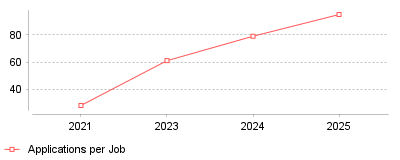
| Year | Applications per Job |
|---|---|
| 2021 | 28 |
| 2023 | 61 |
| 2024 | 79 |
| 2025 | 95 |
The data clearly demonstrates a massive escalation in both candidate application volume and employer AI adoption within the Applicant Tracking System (ATS) ecosystem over the last few years. Specifically, average applications per job posting skyrocketed from 28 in 2021 to 95 in 2025 [4], while employer utilization of AI in recruitment surged from a mere 4.9% in 2023 to 25.9% by 2025 [12].
On a micro-level, this trend means that individual recruiters are facing unprecedented pipeline overload, managing roughly three times the number of applications per role compared to just four years ago [4]. This sheer volume makes it virtually impossible for human HR professionals to manually review every submitted resume, pushing them to rely heavily on the automated filtering, skill-matching, and ranking capabilities embedded within modern ATS platforms [17]. From a macro-industry perspective, the ATS market is fundamentally shifting away from being simple digital filing cabinets into becoming intelligent, predictive algorithmic gatekeepers [23]. Consequently, job seekers are increasingly caught in an "application black hole," where only a tiny fraction of resumes—sometimes as low as 2% to 3%—ever make it past the initial algorithmic screening phase to be viewed by a human [11].
This dynamic is critically important because it highlights a growing disconnect and trust deficit between employers and job seekers in the modern labor market. As candidates utilize AI tools to auto-generate cover letters and mass-apply to hundreds of roles, ATS pipelines become clogged with "spam" or hyper-tailored but ultimately fraudulent applications [4]. Ultimately, this trend is reshaping the foundational mechanics of employment, proving that mastering the screening algorithms of Applicant Tracking Systems has become just as crucial for job seekers as possessing the actual skills required for the job.
The primary catalyst for this trend is the mainstream explosion of Generative AI tools, such as ChatGPT, which democratized the ability for candidates to instantly customize resumes and deploy AI bots to automate the application submission process [4, 7]. With over one in five candidates admitting to using AI agents to auto-apply, the friction traditionally associated with job hunting has been completely eradicated, leading to a flood of inbound applications [4]. Additionally, economic uncertainty and widespread corporate layoffs in recent years have created a highly competitive labor pool, inducing a panic-driven "spray and pray" methodology among desperate job seekers [15, 16]. In response to leaner talent acquisition teams and skyrocketing candidate volume, employers have been forced into a defensive posture, adopting AI screening capabilities within their ATS out of sheer necessity to maintain operational efficiency [6].
The transformation of Applicant Tracking Systems into AI-governed ecosystems is an irreversible trend that has permanently altered how talent is sourced, screened, and hired across the globe. While these technological advancements offer employers desperately needed efficiency in the face of crushing application volumes, they also threaten to dehumanize the hiring process and alienate highly qualified talent. The most prominent takeaway is that we are witnessing a technological feedback loop: AI empowers candidates to apply en masse, which in turn forces employers to deploy increasingly aggressive AI filters, making the modern job search a battle of algorithms rather than a human assessment of potential.
Revenue for applicant tracking systems reached $2.5 billion in 2024 [1]. Analysts project this software category will hit $3.6 billion by 2029 [2]. Organizations deploy these systems to contain escalating recruitment costs. The Society for Human Resource Management measured the average cost per hire at $4,700 during 2025 [3]. Sector variations alter this baseline dramatically. Healthcare organizations routinely spend between $9,000 and $12,000 to fill clinical roles [3]. Executive placements demand steeper investments. Companies spend an average of $35,879 to secure leadership personnel [3].
Calculation models split these figures into internal and external expenses. Internal costs include staff salaries for interviewing and onboarding. External costs encompass job board advertising and fees for specialized search firms. Time directly influences these financial metrics. Vacancies remain open for an average of 36 days across industries [4]. Extended delays introduce secondary financial penalties. Unfilled roles cost businesses approximately $500 per day in lost productivity [3]. Human resources departments allocate up to 15 percent of their total budgets to recruitment activities [5].
Poor selections multiply these baseline expenses. Data shows 26 percent of new employees leave within their first year [4]. Candidates frequently abandon slow hiring pipelines. Surveys report that 36 percent of job seekers withdraw applications following a negative interview process [6]. Executives attempt to compress this window by investing in broader human resources management software. Standard applicant tracking systems parse resumes and filter candidates before human review occurs. Market leaders like iCIMS currently command 11 percent of the market share for these software products [2].
Federal judges recently altered the liability models for software providers. Vendors historically operated as neutral technology platforms rather than active employment decision-makers. The case of Mobley against Workday changed this legal dynamic. Plaintiff Derek Mobley sued Workday under the Age Discrimination in Employment Act after receiving zero interviews for over 100 applications submitted through the platform [7].
Judge Rita Lin granted preliminary certification for a nationwide legal action on May 16, 2025 [8]. Workday attempted to dismiss the lawsuit by arguing it does not function as an employer. The court rejected this specific defense. Rulings established that software acts as an agent of the employer when algorithms recommend candidates or issue rejections [9]. The Equal Employment Opportunity Commission filed an amicus brief supporting this theory of liability for vendors [10].
Legal exposure now extends beyond the corporate entities listing jobs. Plaintiffs only need to prove disparate impact to advance their civil claims. Statistical evidence showing higher rejection rates for protected classes shifts the burden of proof to the software vendor [11]. Disparate impact doctrine examines outcomes rather than intent. The vendor must prove its screening logic relies on strict business necessity [11]. Developers argue that employer configurations control the software rules. Judges ruled that software participating in the decision process carries independent legal weight [9].

February 2025 triggered the first enforcement phase of the European Union Artificial Intelligence Act. Regulators banned software features that recognize emotions in candidates [12]. The law classifies recruitment software as a risk category subject to strict governmental oversight [13]. Total compliance becomes mandatory by August 2026 [14].
Extraterritorial reach complicates operations for global firms. The rules apply to any software processing data for candidates residing within European borders [15]. Employers must inform applicants when algorithms filter their submitted resumes. Technology teams must execute impact assessments for data protection protocols [12]. Failure to meet these standards carries financial penalties reaching 35 million euros or 7 percent of global revenue [12].
City governments in America deployed similar frameworks earlier. New York City began enforcing Local Law 144 in July 2023 [16]. This municipal statute regulates automated decision tools used for hiring within city limits. Companies must commission bias audits from independent reviewers every year [17]. Administrators evaluate algorithms to detect statistical disparities across race and gender categories [16].
Transparency rules force changes to the standard candidate experience. Employers must publish their audit summaries publicly on their corporate websites [18]. Human resources teams must also notify candidates 10 days before algorithms evaluate their digital profiles [17]. Applicants hold the legal right to request alternative assessment methods. Violations trigger daily financial penalties against the offending employer [17].
Corporate acquisitions accelerated throughout late 2024. Independent tracking systems merged into broader application suites. Workday reached a definitive agreement to buy Sana for $1.1 billion [19]. This target operates a native learning platform driven by artificial intelligence algorithms. Workday followed this move by announcing its acquisition of Paradox to improve candidate communication features [19].
Competitors executed similar expansion strategies. SAP purchased SmartRecruiters to capture volume hiring capabilities [1]. ADP acquired WorkForce Software during October 2024 to strengthen its time management functionality for global clients [20]. These financial deals indicate a market shift away from isolated point solutions. Buyers prefer integrated databases that link applicant tracking directly with payroll processing engines.
Integration eliminates manual data entry between siloed systems. Recruiting teams save up to 12 hours weekly when screening workflows automate repetitive administrative tasks [21]. Modern platforms include native modules for background checks and automated interview scheduling. Vendors continually expand these core functions through strategic marketplace acquisitions.
Turnover rates dictate software requirements for specific industry verticals. Standard tracking platforms fail when processing massive applicant pools. The home care sector experienced a 77 percent turnover rate during 2025 [22]. Administrators face rising replacement costs averaging $2,600 per hire [22]. Sourcing candidates requires a specialized system designed for home care agencies to verify medical credentials rapidly. Agencies turn away 25 percent of new patients due to worker shortages [22]. Demand for aides will rise 36 percent by 2030 [22].
Staffing firms operate under different mechanical constraints. The American staffing market will reach $183.3 billion by 2026 [23]. Agencies placed roughly 2 million temporary workers per week throughout 2025 [24]. Processing this volume demands custom software built for staffing agencies. Recruiters must route thousands of resumes to multiple hospital networks simultaneously. Travel nursing revenue dropped to $14.2 billion in 2025, but locum tenens placement grew to $9.6 billion [25]. Staffing agencies spent an average of $16,388 monthly on digital job boards in 2023 [26].
Payment structures add another layer of complexity for external labor forces. Market data reveals 67 percent of temporary workers receive weekly compensation [26]. Deploying specific hiring tools for independent contractors ensures timesheet data flows cleanly into accounting systems. Independent professionals also rely on external partners for ongoing job placement. Selecting a digital platform for recruitment agencies allows talent scouts to maintain shared candidate pools for multiple corporate clients.
Operating partners at investment firms prioritize visibility across disparate holdings. Managing talent acquisition requires distinct reporting metrics when overseeing dozens of acquired operating companies. Buyout groups deploy an ATS configured for private equity firms to balance corporate oversight with local brand autonomy [27].
Centralized dashboards highlight hiring efficiency across all subsidiary operations. Portfolio managers identify which subsidiaries build teams effectively and which experience chronic candidate drop-off. If a strong applicant misses out on a role at one software subsidiary, recruiters surface that resume for open positions at another holding [27].
Data isolation plagues traditional system configurations. Financial sponsors historically struggled to calculate aggregate recruitment spending. Unified platforms solve this operational blind spot. Leaders generate board reports showing precise sourcing costs across the entire fund architecture.
Technology providers are moving software from passive storage toward active execution. Algorithms now automate basic candidate communication protocols. Workday revealed Recruiter Agent during late 2024 to handle interview scheduling autonomously [20]. SAP embedded similar generative features within its talent modules to detect bias in job descriptions [1].
Market adoption of these features accelerates quickly. Surveys indicate 72 percent of human resources teams plan to adopt algorithmic tools by 2025 [20]. Automation reduces the time recruiters spend on initial screening phases. Technology handles candidate qualification via text message while recruiters focus on closing final compensation offers.
Compliance concerns will govern the speed of this technological transition. Organizations must balance operational speed against legal risks defined by municipal and international law. Tools that process applicant data will face continuous scrutiny from external auditors and federal judges.
| Year | Applications per Job |
|---|---|
| 2021 | 28 |
| 2023 | 61 |
| 2024 | 79 |
| 2025 | 95 |
The data clearly demonstrates a massive escalation in both candidate application volume and employer AI adoption within the Applicant Tracking System (ATS) ecosystem over the last few years. Specifically, average applications per job posting skyrocketed from 28 in 2021 to 95 in 2025 [4], while employer utilization of AI in recruitment surged from a mere 4.9% in 2023 to 25.9% by 2025 [12].
On a micro-level, this trend means that individual recruiters are facing unprecedented pipeline overload, managing roughly three times the number of applications per role compared to just four years ago [4]. This sheer volume makes it virtually impossible for human HR professionals to manually review every submitted resume, pushing them to rely heavily on the automated filtering, skill-matching, and ranking capabilities embedded within modern ATS platforms [17]. From a macro-industry perspective, the ATS market is fundamentally shifting away from being simple digital filing cabinets into becoming intelligent, predictive algorithmic gatekeepers [23]. Consequently, job seekers are increasingly caught in an "application black hole," where only a tiny fraction of resumes—sometimes as low as 2% to 3%—ever make it past the initial algorithmic screening phase to be viewed by a human [11].
This dynamic is critically important because it highlights a growing disconnect and trust deficit between employers and job seekers in the modern labor market. As candidates utilize AI tools to auto-generate cover letters and mass-apply to hundreds of roles, ATS pipelines become clogged with "spam" or hyper-tailored but ultimately fraudulent applications [4]. Ultimately, this trend is reshaping the foundational mechanics of employment, proving that mastering the screening algorithms of Applicant Tracking Systems has become just as crucial for job seekers as possessing the actual skills required for the job.
The primary catalyst for this trend is the mainstream explosion of Generative AI tools, such as ChatGPT, which democratized the ability for candidates to instantly customize resumes and deploy AI bots to automate the application submission process [4, 7]. With over one in five candidates admitting to using AI agents to auto-apply, the friction traditionally associated with job hunting has been completely eradicated, leading to a flood of inbound applications [4]. Additionally, economic uncertainty and widespread corporate layoffs in recent years have created a highly competitive labor pool, inducing a panic-driven "spray and pray" methodology among desperate job seekers [15, 16]. In response to leaner talent acquisition teams and skyrocketing candidate volume, employers have been forced into a defensive posture, adopting AI screening capabilities within their ATS out of sheer necessity to maintain operational efficiency [6].
The transformation of Applicant Tracking Systems into AI-governed ecosystems is an irreversible trend that has permanently altered how talent is sourced, screened, and hired across the globe. While these technological advancements offer employers desperately needed efficiency in the face of crushing application volumes, they also threaten to dehumanize the hiring process and alienate highly qualified talent. The most prominent takeaway is that we are witnessing a technological feedback loop: AI empowers candidates to apply en masse, which in turn forces employers to deploy increasingly aggressive AI filters, making the modern job search a battle of algorithms rather than a human assessment of potential.