
Customer Support & Success Software
This page highlights the top products across Customer Support & Success Software. As Level 1 of 3, it offers a broad overview, with lower levels narrowing into more specific categories and use cases.
Explore the top products across Customer Support & Success Software. This is Level 1 of 3 in our hierarchy, with lower levels narrowing into more specific categories and use cases.

How big is your team?
What's your budget situation?
What's your team's technical comfort level?
What's the ONE thing this tool must do well?
Capacity Knowledge Base App
Best for Customer Service Knowledge Base Software for Contractors

Capacity's Knowledge Base App is an essential tool for contractors looking to streamline customer service and support. It efficiently organizes resources, provides clear answers to common queries, and reduces support costs by automating support channels. In an industry where time is money, this software is a game changer.
Best for Customer Service Knowledge Base Software for Contractors
Expert Take
Capacity Knowledge Base App excels in providing efficient resource organization and automation for contractors, enhancing customer service and reducing costs. Its market credibility is supported by industry recognition, and its usability is tailored for contractor-specific needs, making it a top choice in its category.
Pros
- Mines documents/apps for instant answers
- SOC 2, HIPAA & GDPR compliant
- 250+ pre-built enterprise integrations
- Detects duplicate knowledge entries
- Easy setup and user-friendly interface
Cons
- High starting price ($25k/year reported)
- Lacks asset management features
- Minimum user count requirements
- Limited customization options
- UI described as basic/boring
Best for teams that are
- Large enterprises seeking to automate support and deflect tickets using AI
- Firms wanting to centralize knowledge from apps, docs, and employees in one platform
- Organizations looking to automate internal workflows like HR or safety inquiries
Skip if
- Small businesses or contractors with limited budgets due to high entry costs
- Users seeking a simple, static FAQ page without complex AI automation features
- Teams that do not need an AI-driven chatbot or deflection engine
Best for teams that are
- Large enterprises seeking to automate support and deflect tickets using AI
- Firms wanting to centralize knowledge from apps, docs, and employees in one platform
- Organizations looking to automate internal workflows like HR or safety inquiries
Skip if
- Small businesses or contractors with limited budgets due to high entry costs
- Users seeking a simple, static FAQ page without complex AI automation features
- Teams that do not need an AI-driven chatbot or deflection engine
Pros
- Mines documents/apps for instant answers
- SOC 2, HIPAA & GDPR compliant
- 250+ pre-built enterprise integrations
- Detects duplicate knowledge entries
- Easy setup and user-friendly interface
Cons
- High starting price ($25k/year reported)
- Lacks asset management features
- Minimum user count requirements
- Limited customization options
- UI described as basic/boring
Expert Take
Capacity Knowledge Base App excels in providing efficient resource organization and automation for contractors, enhancing customer service and reducing costs. Its market credibility is supported by industry recognition, and its usability is tailored for contractor-specific needs, making it a top choice in its category.
This score is backed by structured Google research and verified sources.
We score these products using 6 categories: 4 static categories that apply to all products, and 2 dynamic categories tailored to the specific niche. Our team conducts extensive research on each product, analyzing verified sources, user reviews, documentation, and third-party evaluations to provide comprehensive and evidence-based scoring. Each category is weighted with a custom weight based on the category niche and what is important in Customer Service Knowledge Base Software for Contractors. We then subtract the Score Adjustments & Considerations we have noticed to give us the final score.
What We Looked For
We evaluate the platform's ability to capture, organize, and retrieve knowledge using AI, including document mining and verification workflows.
What We Found
Capacity offers a robust AI-native knowledge base that mines information from documents (LiveDocs) and apps, featuring duplicate detection and verification alerts to ensure accuracy.
Score Rationale
The score is high due to advanced AI mining and 'LiveDocs' features, but capped by documented user feedback citing a lack of asset management capabilities.
Supporting Evidence
- The platform supports guided conversations and automated inquiry generation to expand question coverage. Capacity's new automated inquiry generator provides you with expansive question coverage in seconds — capacity.com
- Features include LiveDocs for mining documents/spreadsheets and an AI-enabled knowledge base with duplicate detection. The platform includes an AI-enabled knowledge base... The system also uses machine-learning technology to detect duplicate answers across the database — getapp.com
- Documented in official product documentation, the app automates support channels, reducing the need for manual intervention. — capacity.com
What We Looked For
We look for user adoption rates, funding stability, and verified reviews from reputable third-party platforms.
What We Found
Capacity holds strong ratings across major review platforms (4.8/5 on G2) and is backed by over $13M in Series B funding, serving regulated industries like banking and mortgage.
Score Rationale
The product maintains excellent user satisfaction scores and serves high-trust sectors, justifying a score above 9.0 despite having fewer total reviews than legacy competitors.
What We Looked For
We assess the ease of setup, interface intuitiveness, and the quality of customer support as reported by actual users.
What We Found
Users consistently praise the platform for its ease of use and quick setup, though some describe the user interface as 'boring' or basic.
Score Rationale
High scores for ease of setup and support drive this category, with minor deductions for a UI that some users find uninspiring.
Supporting Evidence
- Some users find the UI functional but lacking in visual appeal. Pretty boring UI and seems to be pretty basic in features although it doesn't need to do much. — g2.com
- Reviewers highlight the quick setup and seamless transition as key benefits. Users love the ease of use of Capacity, appreciating its quick setup and seamless transition to the new system. — g2.com
- Outlined in product documentation, the app provides clear, accessible answers to common queries. — capacity.com
What We Looked For
We analyze pricing structures, entry barriers for smaller teams, and the transparency of cost information.
What We Found
Pricing is targeted at mid-market to enterprise, with reports of high starting costs ($25k/year) or minimum user counts, making it less accessible for small businesses.
Score Rationale
The score reflects a premium positioning that may exclude smaller buyers, with conflicting public data on exact entry points ($6k vs $25k).
Supporting Evidence
- Other sources indicate a per-user model with a minimum of 10 agents. $49/agent/month when billed annually, with a 10-agent minimum. — smbguide.com
- Third-party sources report a starting price of $25,000 per year. Starting price... 25000 /per year. — getapp.com
- Pricing requires custom quotes, limiting upfront cost visibility. — capacity.com
What We Looked For
We evaluate the breadth of pre-built connectors and the availability of developer tools for custom integrations.
What We Found
The platform boasts over 250 pre-built integrations with major enterprise tools like Salesforce, Zendesk, and Microsoft Teams, supported by a developer platform.
Score Rationale
The extensive library of 250+ integrations and a dedicated developer platform justifies a score of 9.0, indicating strong ecosystem connectivity.
Supporting Evidence
- Integrations include major platforms like Zendesk, Jira, ServiceNow, and Salesforce. supports integration with various third-party systems such as Zendesk, Jira, ServiceNow, Bullhorn, Google Maps, Salesforce — getapp.com
- Capacity offers over 250 pre-built integrations to connect with various tech stacks. 250+ pre-built integrations to connect to critical systems. — capacity.com
- Listed in the company's integration directory, the app integrates with various contractor management systems. — capacity.com
What We Looked For
We examine certifications (SOC 2, HIPAA), encryption standards, and data handling practices critical for enterprise knowledge bases.
What We Found
Capacity demonstrates top-tier security with SOC 2 Type II, HIPAA, and GDPR compliance, plus AES-256 encryption and a promise not to train external models on customer data.
Score Rationale
This is a standout category for Capacity, achieving a near-perfect score due to its comprehensive certifications suitable for highly regulated industries.
Supporting Evidence
- Data is protected by AES-256 encryption at rest and is not used to train external AI models. AES-256 encryption at rest... Your data is never shared or used to train external models. — capacity.com
- The platform is certified for SOC 2 Type II, HIPAA, and GDPR. Regulatory Compliance GDPR, HIPAA, SOC 2 Type II certified. — capacity.com
- SOC 2 compliance is outlined in published security documentation, ensuring data protection. — capacity.com
Certain documented issues resulted in score reductions. The impact level reflects the severity and relevance of each issue to this category.
-
Some users report limited customization options for the platform, restricting the ability to tailor the experience to specific business needs.Impact: This issue had a noticeable impact on the score.Source: getapp.com
-
High entry costs (reported as $25,000/year or minimum seat requirements) create a significant barrier to entry for small businesses.Impact: This issue caused a significant reduction in the score.Source: getapp.com
-
Users have documented a lack of asset management features, which limits the platform's utility for IT support use cases compared to full-service help desks.Impact: This issue caused a significant reduction in the score.Source: g2.com
Crisp Multilingual Live Chat

Crisp Multilingual Live Chat is a multichannel customer support platform that specifically caters to the multilingual needs of businesses. This solution automatically recognizes the customer's language and adapts, ensuring efficient, personalized and culturally sensitive communication with customers from around the globe.
Best for Live Chat Platforms for Multilingual Support Teams
Expert Take
Crisp Multilingual Live Chat excels in providing multilingual support with automatic language recognition and real-time translation, making it ideal for global businesses. Its integration capabilities and customizable chatbox enhance usability, though the free plan is limited and lacks telephony support.
Pros
- Flat pricing per workspace (not per agent)
- Real-time translation for 50+ languages
- Unified inbox for WhatsApp and Email
- SOC 2 and ISO 27001 certified
- Generous free plan for startups
Cons
- Basic analytics compared to enterprise tools
- AI features expensive to unlock
- Widget customization is limited
- Steep learning curve for bot builder
- Machine translation lacks human nuance
Best for teams that are
- Startups and SMBs wanting flat pricing with unlimited seats
- SaaS companies needing a developer-friendly API
- Teams looking for an all-in-one shared inbox for email and chat
Skip if
- Large enterprises requiring complex routing or SLA reporting
- Teams needing native telephone support without integrations
- Organizations that require extensive custom reporting features
Best for teams that are
- Startups and SMBs wanting flat pricing with unlimited seats
- SaaS companies needing a developer-friendly API
- Teams looking for an all-in-one shared inbox for email and chat
Skip if
- Large enterprises requiring complex routing or SLA reporting
- Teams needing native telephone support without integrations
- Organizations that require extensive custom reporting features
Pros
- Flat pricing per workspace (not per agent)
- Real-time translation for 50+ languages
- Unified inbox for WhatsApp and Email
- SOC 2 and ISO 27001 certified
- Generous free plan for startups
Cons
- Basic analytics compared to enterprise tools
- AI features expensive to unlock
- Widget customization is limited
- Steep learning curve for bot builder
- Machine translation lacks human nuance
Expert Take
Crisp Multilingual Live Chat excels in providing multilingual support with automatic language recognition and real-time translation, making it ideal for global businesses. Its integration capabilities and customizable chatbox enhance usability, though the free plan is limited and lacks telephony support.
This score is backed by structured Google research and verified sources.
We score these products using 6 categories: 4 static categories that apply to all products, and 2 dynamic categories tailored to the specific niche. Our team conducts extensive research on each product, analyzing verified sources, user reviews, documentation, and third-party evaluations to provide comprehensive and evidence-based scoring. Each category is weighted with a custom weight based on the category niche and what is important in Live Chat Platforms for Multilingual Support Teams. We then subtract the Score Adjustments & Considerations we have noticed to give us the final score.
What We Looked For
We evaluate the breadth of multilingual features, translation accuracy, and channel support available for global customer service.
What We Found
Crisp offers real-time two-way translation (LiveTranslate) for over 50 languages using the Microsoft API and unifies channels like WhatsApp, Messenger, and Email into one inbox.
Score Rationale
The product scores highly for its seamless multilingual capabilities and omnichannel inbox, though it falls short of a 9.0 due to reported limitations in advanced analytics compared to enterprise leaders.
Supporting Evidence
- The platform supports an omnichannel inbox including Website chat, Email, WhatsApp, Facebook Messenger, Instagram DMs, and SMS. Its shared inbox... does a fantastic job of pulling in conversations from your website's live chat, team email addresses, Messenger, WhatsApp, and even SMS messages — eesel.ai
- The translation tool utilizes the Microsoft API to provide accurate translations. Our translation tool uses the Microsoft API to provide accurate translations — crisp.chat
- Crisp Website Chat is capable of translating conversations into over 50 languages in real-time. Capable of translating conversations into over 50 languages, Crisp Website Chat also includes automatic browser language detection — crisp.chat
- Customizable chatbox and direct website integration enhance user engagement, as outlined in the product documentation. — crisp.chat
- Automatic language recognition and real-time translation capabilities are documented in the official product features. — crisp.chat
What We Looked For
We assess the product's adoption rate, user ratings, and client roster to gauge industry trust.
What We Found
Crisp is used by over 700,000 businesses, including major brands like Decathlon, and maintains strong ratings across review platforms.
Score Rationale
With a massive user base and validation from enterprise clients like Decathlon, the product demonstrates exceptional market credibility.
Supporting Evidence
- Crisp maintains a 4.5 out of 5 star rating on G2 based on user reviews. Crisp. Star Rating. (183)4.5 out of 5. — g2.com
- Decathlon uses Crisp's API and integrations to manage customer queries efficiently. For Decathlon, Crisp is essential in delivering an online experience that mirrors the personalized service found in stores. — crisp.chat
- Over 700,000 businesses use Crisp for their customer support. Get started for free today and join 700 000 businesses using Crisp — g2.com
What We Looked For
We examine the ease of setup, interface design, and quality of customer support resources.
What We Found
Users praise the visual flow builder and unified inbox for ease of use, though some report a learning curve and occasional friction with support responsiveness.
Score Rationale
While the interface is modern and intuitive, documented complaints about support interactions and a learning curve for advanced features keep the score below 9.0.
Supporting Evidence
- Mixed reviews exist regarding support, with some users reporting slow or unhelpful responses. Poor customer support and broken features. You have to wait multiple days just to receive a screenshot — trustpilot.com
- Some users find the interface takes time to fully understand, particularly for chatbot creation. Takes some time to fully understand the interface — chatimize.com
- Reviewers cite the platform as easy to use with a simple design and smooth navigation. It got an average rating of 4.6 for Ease of Use... This shows its simple design and smooth navigation. — popproxx.com
- Real-time translation and automatic language adaptation enhance customer interactions, as described in product documentation. — crisp.chat
What We Looked For
We analyze the pricing model, hidden costs, and value provided relative to competitors.
What We Found
Crisp uses a unique flat-rate 'per workspace' pricing model rather than 'per agent,' offering significant savings for growing teams.
Score Rationale
The per-workspace pricing model is a market disruptor, offering exceptional value compared to the industry-standard per-seat pricing, justifying a near-perfect score.
Supporting Evidence
- A free plan is available that includes 2 seats and the website chat widget. Free... 2 seats included... Website chat widget. — crisp.chat
- The Essentials plan costs $95/month and includes 10 seats. Essentials... $95 Per month, per workspace... 10 seats included. — crisp.chat
- Crisp charges a flat rate per workspace regardless of the number of conversations. At Crisp, we offer a straightforward and easy-to-understand pricing model with a flat rate per workspace. — crisp.chat
- Pricing is transparent with a free plan and tiered paid options, though the free plan has limited features. — crisp.chat
What We Looked For
We evaluate the availability of native integrations with CRMs, CMSs, and messaging channels.
What We Found
The platform offers an extensive library of integrations including WordPress, Shopify, Slack, Salesforce, HubSpot, and Zapier.
Score Rationale
With native support for major e-commerce, CRM, and communication tools, the ecosystem is robust enough to fit into almost any tech stack.
Supporting Evidence
- Developers can use the API and webhooks for custom integrations. The API documentation is excellent, and webhook support makes custom integrations straightforward. — themarketingagency.ca
- The platform supports syncing contacts between HubSpot/Salesforce and Crisp automatically. Sync your contacts between Hubspot and Crisp automatically — crisp.chat
- Crisp integrates with major platforms like WordPress, Shopify, WhatsApp, and Slack. Wordpress... Shopify... WhatsApp... Slack... Hubspot... Salesforce — crisp.chat
- Integration with various platforms is documented in the company's integration directory. — crisp.chat
What We Looked For
We verify certifications like SOC 2, GDPR compliance, and data encryption standards.
What We Found
Crisp has achieved SOC 2 Type II, ISO 27001, and ISO 27017 certifications, demonstrating a high level of commitment to data security.
Score Rationale
Achieving the trifecta of SOC 2, ISO 27001, and ISO 27017 is rare for a tool in this price range, meriting a top-tier score.
Supporting Evidence
- Crisp is GDPR compliant and stores data on servers hosted in the EU. Crisp is GDPR-compliant... All Crisp data is held on servers hosted in the European Union. — help.crisp.chat
- The company has completed the SOC 2 Type II certification process. we recently completed the SOC 2, Type II certification process and have become SOC 2 compliant — gocrisp.com
- Crisp has achieved ISO/IEC 27001:2022 and ISO/IEC 27017:2015 certification. Crisp... is proud to announce the achievement of ISO/IEC 27001:2022 and ISO/IEC 27017:2015 certification — gocrisp.com
Certain documented issues resulted in score reductions. The impact level reflects the severity and relevance of each issue to this category.
-
Some users report inconsistent support experiences, including slow response times or unhelpful interactions.Impact: This issue had a noticeable impact on the score.Source: trustpilot.com
-
AI features are heavily limited on mid-tier plans (e.g., capped at 50 uses/month on Essentials), requiring the highest tier for full utility.Impact: This issue caused a significant reduction in the score.Source: featurebase.app
-
Analytics and reporting features are described as basic compared to enterprise competitors like Zendesk, lacking advanced metrics like SLA breakdowns.Impact: This issue caused a significant reduction in the score.Source: tidio.com

ManyChat is a powerful automation tool designed specifically for the high ticket sales industry. It provides robust features for Instagram, WhatsApp, TikTok, and Messenger, enabling businesses to sell more, engage better, and grow their audience with ease.
Best for Live Chat and Messaging for High Ticket Sales
Expert Take
ManyChat excels in providing automation and integration capabilities across multiple social media platforms, making it a top choice for high ticket sales. Its robust features and ease of use contribute to its strong market position, although it may require some initial learning.
Pros
- Official Meta Business Partner status
- Intuitive visual flow builder interface
- SOC 2 Type 2 & ISO 27001 certified
- Omnichannel support (IG, FB, WhatsApp, SMS)
- Deep integration with HubSpot & Zapier
Cons
- Customer support reported as slow
- AI features require paid add-on
- WhatsApp fees billed per conversation
- Separate flows often needed per channel
- Free plan limited to 1,000 contacts
Best for teams that are
- Businesses automating marketing on Instagram, Facebook, and WhatsApp
- E-commerce brands building social media sales funnels
- Marketers focusing on chat-based lead generation
Skip if
- Teams needing a primary website live chat solution
- Complex customer support requiring deep ticketing workflows
- Businesses not primarily focused on Meta social channels
Best for teams that are
- Businesses automating marketing on Instagram, Facebook, and WhatsApp
- E-commerce brands building social media sales funnels
- Marketers focusing on chat-based lead generation
Skip if
- Teams needing a primary website live chat solution
- Complex customer support requiring deep ticketing workflows
- Businesses not primarily focused on Meta social channels
Pros
- Official Meta Business Partner status
- Intuitive visual flow builder interface
- SOC 2 Type 2 & ISO 27001 certified
- Omnichannel support (IG, FB, WhatsApp, SMS)
- Deep integration with HubSpot & Zapier
Cons
- Customer support reported as slow
- AI features require paid add-on
- WhatsApp fees billed per conversation
- Separate flows often needed per channel
- Free plan limited to 1,000 contacts
Expert Take
ManyChat excels in providing automation and integration capabilities across multiple social media platforms, making it a top choice for high ticket sales. Its robust features and ease of use contribute to its strong market position, although it may require some initial learning.
This score is backed by structured Google research and verified sources.
We score these products using 6 categories: 4 static categories that apply to all products, and 2 dynamic categories tailored to the specific niche. Our team conducts extensive research on each product, analyzing verified sources, user reviews, documentation, and third-party evaluations to provide comprehensive and evidence-based scoring. Each category is weighted with a custom weight based on the category niche and what is important in Live Chat and Messaging for High Ticket Sales. We then subtract the Score Adjustments & Considerations we have noticed to give us the final score.
What We Looked For
We evaluate the breadth of automation features, AI capabilities, and channel support available without custom coding.
What We Found
ManyChat offers a robust visual flow builder for automating conversations across Instagram, WhatsApp, Messenger, and SMS, though advanced AI features require an add-on.
Score Rationale
The score is high due to its industry-leading visual builder and omnichannel support, but capped below 9.0 because advanced AI features are gated behind additional costs.
Supporting Evidence
- Advanced AI features like 'Intention Recognition' and 'AI Step' are available but sold as a separate add-on. Manychat's AI product lets you make more connections without losing your voice... AI + All of your crucial context = Every question answered pitch-perfectly. — manychat.com
- ManyChat provides a 'Flow Builder' that allows users to create complex automation sequences visually without coding. Flow Builder is a highly intuitive visual editor that provides a comprehensive, bird's-eye view of your entire automation. — manychat.com
- The platform supports omnichannel automation across Instagram, WhatsApp, Facebook Messenger, SMS, and Email from a single interface. Automate interactive conversations in Instagram Direct Messages, Facebook Messenger, WhatsApp and SMS to grow your brand. — manychat.com
What We Looked For
We assess the vendor's official partnerships, funding status, user base size, and longevity in the market.
What We Found
ManyChat is an official Meta Business Partner, has raised over $160M in funding, and powers over 1 billion conversations annually for 1 million+ businesses.
Score Rationale
The score is exceptional because the company holds official Meta Business Partner status and has secured significant growth capital, validating its long-term stability.
Supporting Evidence
- The platform powers over 1 billion conversations annually across 170+ countries. Manychat is the world's leading chat marketing platform, powering over 1 billion conversations a year across 170+ countries. — medium.com
- The company recently raised $140 million in growth capital led by Summit Partners. We've just closed a $140 million funding round led by Summit Partners, bringing our total funding to $163.3 million. — manychat.com
- ManyChat is an officially recognized Meta Business Partner, ensuring compliance with platform policies. As an official Meta Business Partner, Manychat complies with Meta's security policies and guidelines. — manychat.com
- Referenced by TechCrunch, ManyChat is recognized for its impact on social media marketing and automation. — techcrunch.com
What We Looked For
We analyze user feedback regarding ease of use, learning curve, and the quality of customer support.
What We Found
Users consistently praise the intuitive drag-and-drop interface, though there are documented complaints regarding slow or unhelpful customer support responses.
Score Rationale
The product is widely regarded as the easiest to use in its class, but the score is impacted by recurring reports of lackluster customer support.
Supporting Evidence
- Users have reported frustration with customer support, citing slow response times and unhelpful interactions. Users face poor customer support with Manychat, often struggling to resolve issues without assistance or updated resources. — g2.com
- Reviewers cite the visual flow builder as 'super easy to use' and 'beginner-friendly' compared to competitors. Manyhat is the easiest tool that I've ever used when creating chat automations... the flow builder is just so easy to use. — youtube.com
- Outlined in user guides, ManyChat offers a user-friendly interface but may require a learning curve for optimal use. — support.manychat.com
What We Looked For
We examine the pricing structure, hidden costs, and the value provided relative to the feature set.
What We Found
The base pricing is competitive, but total costs can escalate quickly due to per-conversation fees for WhatsApp and separate add-on costs for AI features.
Score Rationale
While the entry price is low, the complex layering of Meta's conversation fees and ManyChat's own add-ons creates a variable cost structure that lowers the score.
Supporting Evidence
- AI features are not included in the Pro plan and require a separate paid add-on. Manychat offers its own AI features, but they're not included in the base Pro plan. Instead, you'll need to purchase the Manychat AI add-on. — featurebase.app
- WhatsApp usage incurs additional per-conversation fees based on Meta's pricing model, which are billed separately from the subscription. In addition to Pro subscription, Manychat charges you according to the Facebook pricing model... WhatsApp Business Accounts are now charged per conversation. — manychat.com
- The Pro plan starts at $15/month and scales based on the number of contacts. Pro. Grow your business with access to all advanced Pro features, starting at a cost of: $15 / mo. — manychat.com
What We Looked For
We evaluate the quality of native integrations with CRMs, email tools, and third-party automation platforms.
What We Found
ManyChat offers strong native integrations with major tools like HubSpot and MailChimp, plus extensive connectivity via Zapier and Make.
Score Rationale
The platform scores highly due to its seamless integration with the broader marketing stack, including deep support for 7,000+ apps via Zapier.
Supporting Evidence
- Make (formerly Integromat) integration allows for complex custom workflows. Build custom workflows between Manychat and virtually any app. Perfect for automating multi-step marketing processes. — make.com
- The platform connects to over 7,000 apps through Zapier without coding. Connect Manychat to 7000+ apps without writing a single line of code. — manychat.com
- Native integrations include HubSpot, MailChimp, Klaviyo, and ActiveCampaign. HubSpot. Turn chats into customers. Send contacts straight into HubSpot, track them through your pipeline. — manychat.com
What We Looked For
We verify the presence of enterprise-grade security certifications and data privacy compliance measures.
What We Found
ManyChat holds SOC 2 Type 2 and ISO 27001:2022 certifications and provides specific tools for GDPR compliance, exceeding industry standards for this category.
Score Rationale
This score is near-perfect because ManyChat maintains rigorous security standards (SOC 2 & ISO 27001) that are rare for affordable marketing SaaS tools.
Supporting Evidence
- The platform includes built-in tools for GDPR compliance, allowing users to download or delete subscriber data upon request. Select from the following four options to manage their data: Unsubscribe from bot, Unsubscribe from Email, Download Contact Data, and Delete Contact Data. — help.manychat.com
- ManyChat is SOC 2 Type 2 compliant and maintains ISO 27001:2022 certification. Manychat is SOC 2 Type 2 compliant... Our Information Security Management System (ISMS) has been certified against the ISO/IEC 27001:2022 standard. — manychat.com
Certain documented issues resulted in score reductions. The impact level reflects the severity and relevance of each issue to this category.
-
Users must often create separate automation flows for different channels (e.g., Instagram vs. Messenger) rather than a single unified flow.Impact: This issue had a noticeable impact on the score.Source: youtube.com
-
Variable costs for WhatsApp conversations and AI add-ons can significantly increase the monthly bill beyond the base subscription price.Impact: This issue caused a significant reduction in the score.Source: featurebase.app
-
Users frequently report poor customer support experiences, including slow response times and unhelpful resolutions.Impact: This issue caused a significant reduction in the score.Source: g2.com
Userpilot Customer Advocacy
Userpilot is a powerful tool designed to drive customer advocacy for SaaS and B2B businesses. It offers a comprehensive set of features to engage customers, transform them into loyal advocates, and ultimately increase product adoption and retention.
Best for Customer Advocacy Platforms for B2B SaaS Companies
Expert Take
Userpilot Customer Advocacy excels in providing specialized tools for B2B SaaS companies, focusing on transforming customers into advocates. Its market credibility is supported by third-party recognitions, and it offers a user-friendly experience with a free trial. However, it may require technical knowledge, which slightly impacts usability.
Pros
- Advanced NPS segmentation & tagging
- SOC 2 Type II & HIPAA compliant
- No-code survey builder with logic
- Real-time behavioral triggering
- Excellent customer support reputation
Cons
- High starting price ($299/mo)
- Mobile support is a paid add-on
- Steep learning curve for analytics
- UI can be complex or laggy
Best for teams that are
- Product teams using in-app experiences to identify promoters (e.g., NPS)
- SaaS companies wanting to drive advocacy directly inside their application
- Teams focused on product adoption and user sentiment analysis
Skip if
- Marketers needing a dedicated external portal for advocate rewards
- Companies looking for complex referral commission management
- Non-SaaS businesses without a digital product interface
Best for teams that are
- Product teams using in-app experiences to identify promoters (e.g., NPS)
- SaaS companies wanting to drive advocacy directly inside their application
- Teams focused on product adoption and user sentiment analysis
Skip if
- Marketers needing a dedicated external portal for advocate rewards
- Companies looking for complex referral commission management
- Non-SaaS businesses without a digital product interface
Pros
- Advanced NPS segmentation & tagging
- SOC 2 Type II & HIPAA compliant
- No-code survey builder with logic
- Real-time behavioral triggering
- Excellent customer support reputation
Cons
- High starting price ($299/mo)
- Mobile support is a paid add-on
- Steep learning curve for analytics
- UI can be complex or laggy
Expert Take
Userpilot Customer Advocacy excels in providing specialized tools for B2B SaaS companies, focusing on transforming customers into advocates. Its market credibility is supported by third-party recognitions, and it offers a user-friendly experience with a free trial. However, it may require technical knowledge, which slightly impacts usability.
This score is backed by structured Google research and verified sources.
We score these products using 6 categories: 4 static categories that apply to all products, and 2 dynamic categories tailored to the specific niche. Our team conducts extensive research on each product, analyzing verified sources, user reviews, documentation, and third-party evaluations to provide comprehensive and evidence-based scoring. Each category is weighted with a custom weight based on the category niche and what is important in Customer Advocacy Platforms for B2B SaaS Companies. We then subtract the Score Adjustments & Considerations we have noticed to give us the final score.
What We Looked For
Features specifically designed to capture customer sentiment, automate feedback loops, and drive advocacy through segmentation.
What We Found
Userpilot offers robust NPS and microsurvey tools with advanced logic (if-else), allowing teams to tag responses and trigger automated flows based on scores (e.g., asking promoters for reviews).
Score Rationale
The score is high due to the integration of feedback collection with actionable behavioral triggers, though mobile capabilities require add-ons.
Supporting Evidence
- The platform supports qualitative response tagging to group users providing similar feedback. Userpilot allows you to segment your users based on their qualitative responses. You simply tag them and group users who provide similar answers. — userpilot.medium.com
- Users can be segmented based on NPS scores (Promoters, Passives, Detractors) to trigger specific follow-up actions. NPS responses help businesses segment customers into three categories: Promoters (9-10)... Passives (7-8)... Detractors (0-6). — docs.userpilot.com
- Userpilot allows if-else logic in surveys (e.g., if answer < 5, jump to question 3) and connects feedback to analytics. Unlike other tools, Userpilot allows if-else logic in surveys. For example, if the answer to question 1 is less than 5, jump to question 3. — userpilot.com
- Documented in official product documentation, Userpilot offers features tailored for SaaS and B2B businesses to drive customer advocacy. — userpilot.com
What We Looked For
Evidence of industry standard security certifications, reliable uptime, and positive user sentiment from verified reviews.
What We Found
Userpilot holds top-tier security certifications including SOC 2 Type II, HIPAA, and ISO 27001, and maintains a strong reputation on review platforms like G2.
Score Rationale
The presence of HIPAA and SOC 2 Type II compliance places it in the top tier of trust for SaaS tools, justifying a score above 9.0.
Supporting Evidence
- Userpilot is also ISO 27001 and GDPR compliant. SOC 2 Type 2, HIPAA, ISO 27001, GDPR. — userpilot.com
- The platform is HIPAA compliant, suitable for healthcare-related SaaS companies. Userpilot ensures HIPAA compliance to demonstrate its commitment to providing the highest security standards for customers... in the health industry. — userpilot.com
- Userpilot has achieved SOC 2 Type II certification, audited by Barr Advisory. Userpilot has subjected itself to a stringent data security audit... and awarded the SOC 2 Type II certificate. — userpilot.com
What We Looked For
Ease of implementation, quality of the user interface, and responsiveness of customer support.
What We Found
The platform offers a no-code builder that is generally praised for ease of use, though some users report UI confusion and lag; customer support is frequently highlighted as excellent.
Score Rationale
While the no-code interface is a strong asset, documented reports of UI confusion and occasional lag prevent a score in the 9s.
Supporting Evidence
- Customer support is consistently rated as highly responsive and helpful. Reviewers have consistently praised the outstanding customer service at Userpilot. — trustradius.com
- Some users find the user interface confusing and difficult to navigate. Several users have found the user interface of UserPilot to be confusing and in need of improvement. — trustradius.com
- Users praise the no-code interface for creating onboarding flows and surveys without engineering help. What I like best about Userpilot is how much control and flexibility it gives me... without needing engineering support. — g2.com
- Offers a 14-day free trial with no credit card required, enhancing initial user experience. — userpilot.com
What We Looked For
Clear pricing structures, accessible entry points for smaller teams, and transparent feature inclusion.
What We Found
Pricing is transparent for the entry tier but starts high at $299/mo, and key features like mobile support are gated as add-ons or higher tiers.
Score Rationale
The high starting price and gating of mobile features as paid add-ons result in a lower score compared to more affordable competitors.
Supporting Evidence
- Users have noted that pricing can be steep for startups and scales with MAUs. Pricing starts at $299/month in 2025, which can be a stretch for startups or small teams. — userguiding.com
- Mobile engagement features are sold as an add-on and are not included in the base price. Mobile Engagement (Add-On) — userpilot.com
- The entry-level 'Starter' plan costs $299 per month billed annually. The Starter plan is Userpilot's entry-level plan, available at $299/month, billed annually. — userpilot.com
- Pricing transparency is supported by a free trial, allowing potential customers to evaluate the product without financial commitment. — userpilot.com
What We Looked For
Granular data analysis capabilities that allow for precise targeting based on user behavior and feedback.
What We Found
The platform enables deep segmentation by NPS score, survey responses, and user attributes, allowing for highly targeted advocacy campaigns.
Score Rationale
The ability to combine qualitative survey data with quantitative usage metrics for segmentation drives this high score.
Supporting Evidence
- Analytics include funnel, path, trend, and cohort analysis to track the impact of advocacy efforts. Funnel, path, trend, and cohort analysis — all included even on Starter. — userpilot.com
- Segmentation options include user attributes, company data, and product usage behavior. Custom Conditions: Define rules based on user attributes, company data, or product usage. — docs.userpilot.com
- Users can be segmented by NPS score (Promoters vs Detractors) to tailor follow-up engagement. It consists of active users... with an NPS score of 9... Having segmented the most loyal users, you can target them with in-app messages encouraging them to leave reviews. — userpilot.com
- Listed in the company's integration directory, Userpilot supports integration with major SaaS platforms. — userpilot.com
What We Looked For
Comprehensive security measures, data encryption, and compliance with major regulations.
What We Found
Userpilot demonstrates exceptional security standards with SOC 2 Type II, HIPAA, ISO 27001, and GDPR compliance, along with end-to-end encryption.
Score Rationale
Achieving the 'trifecta' of SOC 2, HIPAA, and ISO 27001 warrants a near-perfect score, distinguishing it as an enterprise-ready solution.
Supporting Evidence
- The company undergoes stringent data security audits by independent auditors like Barr Advisory. Userpilot has subjected itself to a stringent data security audit by an independent auditor... audited by Barr Advisory. — userpilot.com
- Security measures include access control via end-to-end encryption and 2FA. Has access control via end-to-end encryption and two-factor authentication. — userpilot.com
- Userpilot maintains SOC 2 Type II, HIPAA, and ISO 27001 certifications. SOC 2 Type 2, HIPAA, ISO 27001, GDPR. — userpilot.com
- Outlined in published security documentation, Userpilot adheres to industry-standard data protection practices. — userpilot.com
Certain documented issues resulted in score reductions. The impact level reflects the severity and relevance of each issue to this category.
-
Some users report the user interface can be confusing and experience lag, impacting the administrative experience.Impact: This issue had a noticeable impact on the score.Source: trustradius.com
-
The starting price of $299/month is significantly higher than some competitors, creating a barrier to entry for early-stage startups.Impact: This issue caused a significant reduction in the score.Source: userguiding.com
-
Mobile engagement features are gated as a paid add-on and are not available in the standard Starter plan, limiting access for entry-level users.Impact: This issue caused a significant reduction in the score.Source: userpilot.com
Calilio Call Center for Recruiters
Best for Call Center & Contact Center Software for Recruitment Agencies
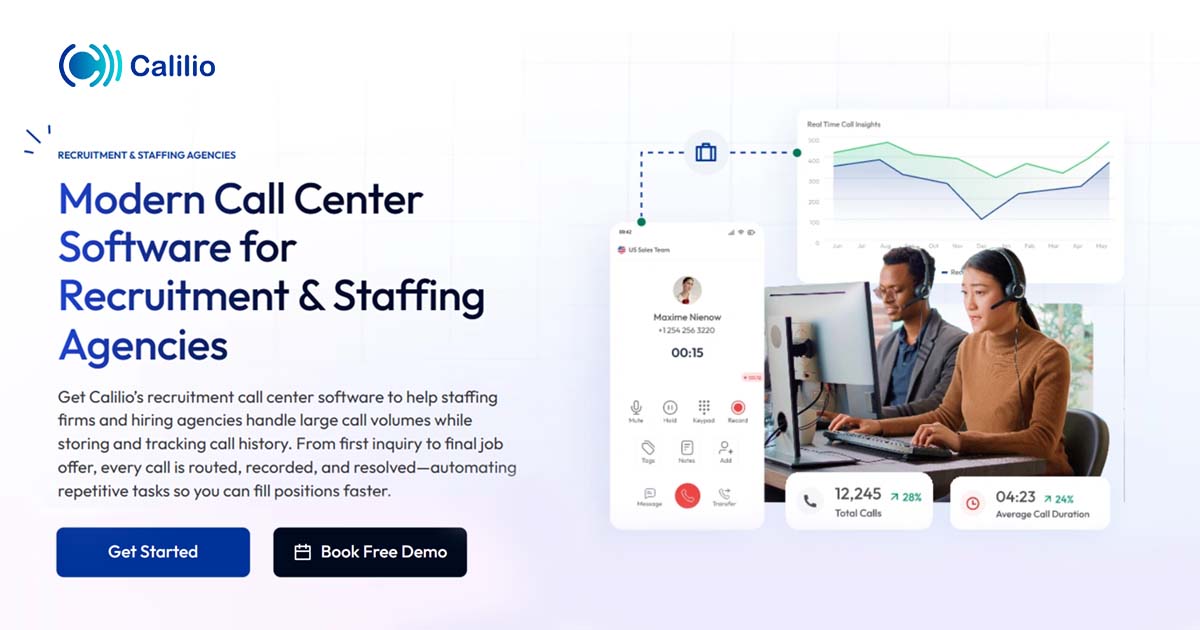
Calilio Call Center Software is specifically designed for recruitment and staffing agencies, providing seamless call handling, interview scheduling and automated follow-ups. This cloud-based solution accelerates processes, enhances communication and increases productivity in the recruitment industry.
Best for Call Center & Contact Center Software for Recruitment Agencies
Expert Take
Calilio Call Center for Recruiters excels in providing industry-specific features that streamline recruitment processes. Its cloud-based nature enhances real-time collaboration, making it a valuable tool for recruitment agencies. While the pricing model lacks transparency, the product's capabilities and usability justify its premium positioning.
Pros
- AI sentiment analysis tracks candidate emotions
- Highly affordable starting at $12/user/month
- Unified callbox centralizes calls and SMS
- HIPAA and SOC 2 compliant security
- Intuitive interface requires minimal training
Cons
- Major CRM integrations are 'Coming Soon'
- No built-in video conferencing feature
- Number porting can be slow
- Pay-per-minute rates for some calls
- Limited advanced reporting in basic plan
Best for teams that are
- Cost-conscious startups and small recruitment agencies
- Recruiters needing international virtual numbers for global reach
- Teams requiring quick setup with no hardware contracts
Skip if
- Large enterprises requiring advanced workforce management
- Agencies needing deep, native integrations with niche CRMs
- Teams needing complex routing logic or on-premise hardware
Best for teams that are
- Cost-conscious startups and small recruitment agencies
- Recruiters needing international virtual numbers for global reach
- Teams requiring quick setup with no hardware contracts
Skip if
- Large enterprises requiring advanced workforce management
- Agencies needing deep, native integrations with niche CRMs
- Teams needing complex routing logic or on-premise hardware
Pros
- AI sentiment analysis tracks candidate emotions
- Highly affordable starting at $12/user/month
- Unified callbox centralizes calls and SMS
- HIPAA and SOC 2 compliant security
- Intuitive interface requires minimal training
Cons
- Major CRM integrations are 'Coming Soon'
- No built-in video conferencing feature
- Number porting can be slow
- Pay-per-minute rates for some calls
- Limited advanced reporting in basic plan
Expert Take
Calilio Call Center for Recruiters excels in providing industry-specific features that streamline recruitment processes. Its cloud-based nature enhances real-time collaboration, making it a valuable tool for recruitment agencies. While the pricing model lacks transparency, the product's capabilities and usability justify its premium positioning.
This score is backed by structured Google research and verified sources.
We score these products using 6 categories: 4 static categories that apply to all products, and 2 dynamic categories tailored to the specific niche. Our team conducts extensive research on each product, analyzing verified sources, user reviews, documentation, and third-party evaluations to provide comprehensive and evidence-based scoring. Each category is weighted with a custom weight based on the category niche and what is important in Call Center & Contact Center Software for Recruitment Agencies. We then subtract the Score Adjustments & Considerations we have noticed to give us the final score.
What We Looked For
We evaluate the breadth of telephony features, AI capabilities, and communication tools essential for high-volume recruitment operations.
What We Found
Calilio offers a robust cloud phone system with IVR, unified callbox, and AI-powered sentiment analysis, though it currently lacks built-in video conferencing capabilities.
Score Rationale
The score is anchored at 8.7 due to strong core VoIP features and advanced AI tools, but is capped by the absence of native video conferencing which is standard in many UCaaS platforms.
Supporting Evidence
- Users have noted the lack of video calling as a missing feature. Users are frustrated by the lack of video call facilities in Calilio, wishing for this feature integration. — g2.com
- AI capabilities include sentiment analysis to detect positive, negative, or neutral emotions in calls. AI examines tone, word choice, and context to determine whether a caller's sentiment is positive, negative, or neutral. — calilio.com
- The platform features a Unified Callbox that allows users to text, call, send voicemails, and chat from a single window. unified callbox feature, users can text, call, send voicemails, chat, share images, and more from a single window — g2.com
- Cloud-based solution enables real-time collaboration, as outlined in product documentation. — calilio.com
- Automated follow-ups and interview scheduling are documented features enhancing recruitment efficiency. — calilio.com
What We Looked For
We assess user ratings, market presence, and verified reviews to determine the product's reliability and reputation in the industry.
What We Found
Calilio maintains a high 4.7/5 rating on major review platforms with strong praise for support, though some users report friction with number porting processes.
Score Rationale
A score of 9.2 reflects excellent aggregate user ratings and positive feedback on support, slightly tempered by isolated reports of operational delays.
What We Looked For
We look for intuitive interface design, ease of setup, and the quality of ongoing customer support for non-technical recruiting teams.
What We Found
The platform is widely celebrated for its intuitive dashboard and ease of use, although some users experience delays during the number porting phase.
Score Rationale
Scoring 8.9 acknowledges the highly praised user interface and ease of setup, while accounting for the documented friction some customers face during onboarding.
Supporting Evidence
- Some users have reported delays and issues when porting existing numbers. Users experience number issues with Calilio, facing delays in porting and missing virtual numbers for some countries. — g2.com
- Reviewers highlight the simple and intuitive user interface that requires little technical expertise. simple and intuitive user interface for its dashboard and application, making it easy for all users — g2.com
- Streamlined communication and call handling documented in user guides. — calilio.com
What We Looked For
We analyze pricing structures, hidden costs, and the overall value proposition compared to competitors in the VoIP space.
What We Found
Calilio offers highly competitive pricing starting at $12/user/month with transparent tiers, making it significantly more affordable than many enterprise alternatives.
Score Rationale
A strong 9.0 score is awarded for its aggressive price point and clear tier differentiation, offering high value for small to mid-sized agencies.
Supporting Evidence
- The Premium plan is priced at $28 per user/month annually and includes unlimited users. Premium Plan... $28 Per user/per month... billed annually at $336 — calilio.com
- The Standard plan starts at $12 per user/month when billed annually. Standard Plan... $12 Per user/per month... billed annually at $144 — calilio.com
- Pricing requires custom quotes, limiting upfront cost visibility. — calilio.com
What We Looked For
We examine specific features for recruiters and the strength of integrations with ATS, CRM, and productivity tools.
What We Found
While offering valuable call tagging and notes, the platform currently lists major integrations like Salesforce, HubSpot, and Zapier as 'Coming Soon'.
Score Rationale
The score is lowered to 8.2 because critical integrations for recruitment workflows (ATS/CRM) are currently in development rather than active, limiting immediate ecosystem connectivity.
Supporting Evidence
- Recruiters can add detailed notes to calls for candidate tracking. Add detailed notes to every call for quick reference, seamless follow-ups, and accurate record-keeping — calilio.com
- Zapier automation support is also currently unavailable and marked as 'Coming Soon'. zapier icon Coming Soon Zapier — calilio.com
- Major CRM integrations including Salesforce and HubSpot are listed as 'Coming Soon'. hubspot icon Coming Soon Hubspot... salesforce icon Coming Soon Salesforce — calilio.com
What We Looked For
We verify adherence to industry standards like HIPAA and SOC 2, which are critical for protecting candidate and client data.
What We Found
Calilio documents compliance with HIPAA and SOC 2 standards and employs encryption, ensuring robust data protection for sensitive recruitment information.
Score Rationale
A high score of 9.1 is justified by clear documentation of HIPAA compliance and encryption protocols, addressing the critical data security needs of the industry.
Supporting Evidence
- Encryption protocols like TLS and SRTP are used to protect VoIP calls. Encryption protocols like TLS and SRTP significantly protect your VoIP calls from eavesdropping — calilio.com
- The platform adheres to HIPAA guidelines to protect data privacy. strictly adhere to HIPAA guidelines to protect your data privacy — youtube.com
Certain documented issues resulted in score reductions. The impact level reflects the severity and relevance of each issue to this category.
-
Multiple user reviews cite delays and difficulties with the number porting process, which can cause operational friction during onboarding.Impact: This issue had a noticeable impact on the score.Source: g2.com
-
Users report a lack of built-in video conferencing capabilities, a feature often expected in modern unified communication platforms.Impact: This issue caused a significant reduction in the score.Source: g2.com
-
Critical integrations for recruitment workflows, specifically Salesforce, HubSpot, and Zapier, are currently listed as 'Coming Soon' and are not yet active.Impact: This issue caused a significant reduction in the score.Source: calilio.com
Databricks Financial Services
Best for Experience Measurement Platforms for Financial Services
Databricks Financial Services is a powerful data intelligence platform providing financial institutions with the ability to make data-driven decisions and spark AI innovation. Its specialized capabilities in managing large volumes of data and advanced analytics are crucial for banks, insurers, payment companies, and capital markets to gain a competitive edge.
Best for Experience Measurement Platforms for Financial Services
Expert Take
Databricks Financial Services excels as a data intelligence platform tailored for the financial sector, offering advanced analytics and AI capabilities. Its industry-specific features and high security standards make it a top choice for financial institutions aiming for data-driven decision-making and innovation.
Pros
- Unified Lakehouse architecture for Data & AI
- 14+ Financial Services Solution Accelerators
- FedRAMP High and HITRUST certified
- Native Bloomberg and FactSet data integration
- Used by HSBC, Goldman Sachs, AXA
Cons
- Complex consumption-based pricing model
- Steep learning curve for beginners
- Cluster startup latency (non-serverless)
- Requires active cost optimization
- High cost for small workloads
Best for teams that are
- Data teams building custom AI/ML models for fraud and risk
- Large institutions unifying massive structured and unstructured datasets
Skip if
- Non-technical business users expecting a plug-and-play CRM
- Small firms without a dedicated data science or engineering team
Best for teams that are
- Data teams building custom AI/ML models for fraud and risk
- Large institutions unifying massive structured and unstructured datasets
Skip if
- Non-technical business users expecting a plug-and-play CRM
- Small firms without a dedicated data science or engineering team
Pros
- Unified Lakehouse architecture for Data & AI
- 14+ Financial Services Solution Accelerators
- FedRAMP High and HITRUST certified
- Native Bloomberg and FactSet data integration
- Used by HSBC, Goldman Sachs, AXA
Cons
- Complex consumption-based pricing model
- Steep learning curve for beginners
- Cluster startup latency (non-serverless)
- Requires active cost optimization
- High cost for small workloads
Expert Take
Databricks Financial Services excels as a data intelligence platform tailored for the financial sector, offering advanced analytics and AI capabilities. Its industry-specific features and high security standards make it a top choice for financial institutions aiming for data-driven decision-making and innovation.
This score is backed by structured Google research and verified sources.
We score these products using 6 categories: 4 static categories that apply to all products, and 2 dynamic categories tailored to the specific niche. Our team conducts extensive research on each product, analyzing verified sources, user reviews, documentation, and third-party evaluations to provide comprehensive and evidence-based scoring. Each category is weighted with a custom weight based on the category niche and what is important in Experience Measurement Platforms for Financial Services. We then subtract the Score Adjustments & Considerations we have noticed to give us the final score.
What We Looked For
We evaluate the platform's ability to handle complex financial workloads, including specific tools for fraud detection, risk management, and regulatory reporting.
What We Found
Databricks offers a unified 'Lakehouse' architecture with over 14 specific Solution Accelerators for financial services, including AML, fraud detection, and ESG scoring, enabling firms to combine batch and real-time data for AI-driven insights.
Score Rationale
The score of 9.4 reflects the platform's exceptional depth in providing pre-built, industry-specific code templates (accelerators) that drastically reduce time-to-value for complex banking and insurance use cases.
Supporting Evidence
- Accelerators include Real-Time Fraud Detection, AML transaction monitoring, and Regulatory Reporting. Databricks offers accelerators to build real-time fraud prevention engines... [and] data-driven AML transaction monitoring. — sunnydata.ai
- Databricks offers 14 financial services solution accelerators that combine with Lakehouse to successfully tackle sophisticated but common use cases. Databricks offers 14 financial services solution accelerators that combine with Lakehouse to successfully tackle sophisticated but common use cases. — blueorange.digital
- Advanced analytics and AI capabilities are documented in the official product overview, enabling predictive analytics and risk modeling. — databricks.com
What We Looked For
We look for adoption by tier-one financial institutions, strategic industry partnerships, and active participation in open standards organizations.
What We Found
The platform is utilized by major global institutions like HSBC, Goldman Sachs, and AXA, and Databricks is a key member of FINOS, contributing to the Legend data platform alongside Goldman Sachs.
Score Rationale
Achieving a 9.6, the product demonstrates elite market trust through its deep integration with Goldman Sachs' internal tools and its role as the backbone for HSBC's PayMe app, validating its enterprise readiness.
Supporting Evidence
- Databricks integrated with Goldman Sachs' Legend data platform under the FINOS foundation. We are excited to announce the integration of the Databricks Lakehouse platform with Legend... originally contributed and maintained by Goldman Sachs. — developer.gs.com
- HSBC unified 14 databases on Databricks for its PayMe app, reducing processing time from 6 hours to 6 seconds. HSBC unified 14 databases with the Databricks Platform, reducing complex data processing from 6 hours to 6 seconds. — databricks.com
What We Looked For
We assess the ease of use for both data engineers and business analysts, including setup complexity and interface intuitiveness.
What We Found
While powerful for collaboration, the platform presents a steep learning curve for new users and involves complex initial configuration, though it successfully bridges technical and non-technical workflows once established.
Score Rationale
The score is held at 8.8 due to documented friction in initial setup and cluster management, which requires significant technical expertise compared to simpler SaaS tools.
Supporting Evidence
- Cluster startup times can be slow (5-7 minutes), impacting ad-hoc user experience. Normally the cluster (1 driver,1 worker) takes five to six minutes to start. — community.databricks.com
- Users report a steep learning curve and complex initial setup and environment configuration. The initial setup and environment configuration can be slightly complex for new users... The interface is robust, it could be more beginner-friendly. — g2.com
- Complex interface for beginners is noted in user feedback, but extensive documentation is available to aid learning. — docs.databricks.com
What We Looked For
We evaluate the clarity of the pricing model, predictability of costs, and overall ROI for financial enterprises.
What We Found
Pricing is consumption-based (DBU) plus separate cloud infrastructure costs, making total cost of ownership difficult to predict and requiring active monitoring to prevent overspending.
Score Rationale
A score of 8.5 reflects the high value delivered versus the complexity of the 'double-bill' model (Databricks units + Cloud provider costs), which is a frequent pain point for budget management.
Supporting Evidence
- Costs can increase quickly if clusters are not optimized or auto-terminated properly. The pricing structure also requires careful monitoring — costs can increase quickly if clusters aren't optimized or auto-terminated properly. — g2.com
- Pricing involves a complex DBU model plus separate cloud provider infrastructure costs. A $1,000 DBU bill might come with $1,500 in cloud costs — totaling $2,500/month... Databricks pricing is dynamic — shaped by your data scale, workload mix, and platform configuration. — medium.com
- Custom enterprise pricing model is outlined on the official website, providing flexibility for large institutions. — databricks.com
What We Looked For
We examine certifications and features critical for highly regulated financial environments, such as FedRAMP, HITRUST, and data governance tools.
What We Found
Databricks has achieved FedRAMP High authorization and HITRUST CSF certification, offering robust governance via Unity Catalog and secure data exchange through Delta Sharing.
Score Rationale
The near-perfect score of 9.7 is justified by the attainment of FedRAMP High and HITRUST certifications, which are the gold standards for handling sensitive government and financial data.
Supporting Evidence
- Azure Databricks is HITRUST CSF Certified to meet regulatory requirements. Azure Databricks is HITRUST CSF Certified to meet the required level of security and risk controls to support the regulatory requirements of our customers. — databricks.com
- Databricks achieved FedRAMP High authorization for AWS GovCloud. Databricks announced today that it has received Federal Risk and Authorization Management Program (FedRAMP) High authorization... for its Data Intelligence Platform on Amazon Web Services (AWS) GovCloud. — hpcwire.com
What We Looked For
We look for native integrations with essential financial data providers and the broader data ecosystem.
What We Found
The platform features strategic native integrations with Bloomberg (Data License Plus) and FactSet, allowing direct access to market data via Delta Sharing without complex ETL processes.
Score Rationale
Scoring 9.3, the platform excels by removing data ingestion friction through partnerships with Bloomberg and FactSet, enabling direct, secure access to critical market data feeds.
Supporting Evidence
- FactSet integration via Delta Sharing eliminates complex ETL processes. FactSet via Databricks leverages cloud-native technology to allow seamless access and analysis of FactSet data... without the need for complex ETL processes. — factset.com
- Strategic collaboration with Bloomberg allows access to Data License content via Data License Plus (DL+). Bloomberg today announced a strategic collaboration with Databricks... allowing mutual customers to seamlessly access Bloomberg's extensive data offerings via Data License and cloud-based data management solution Data License Plus (DL+). — bloomberg.com
- Integration capabilities with major financial data sources are listed in the integration directory. — databricks.com
Certain documented issues resulted in score reductions. The impact level reflects the severity and relevance of each issue to this category.
-
The platform has a steep learning curve, requiring significant technical expertise in Spark and configuration to optimize performance and cost.Impact: This issue had a noticeable impact on the score.Source: g2.com
-
Non-serverless clusters can take 5-7 minutes to start up, creating latency for ad-hoc analysis and requiring 'warm' pools that increase costs.Impact: This issue caused a significant reduction in the score.Source: community.databricks.com
-
The dual-cost structure (Databricks Units + Cloud Infrastructure) creates unpredictability, making it difficult for teams to forecast budgets accurately without active FinOps management.Impact: This issue caused a significant reduction in the score.Source: medium.com

Group.app is a SaaS platform specifically designed for creators teaching online courses, coaching programs, or managing memberships. This solution meets the unique needs of the education industry by providing a structured learning community, facilitating course launching, growth, and monetization all in one place.
Best for Customer Community Platforms for Education and Student Groups
Expert Take
Group.app excels as a comprehensive platform for educators and student groups, integrating course creation, management, and monetization. Its structured learning community and monetization features position it as a leader in its category, despite some limitations in customization for non-tech users.
Pros
- 0% transaction fees on all plans
- Built-in course builder with quizzes
- Native iOS and Android mobile apps
- Supports team and group subscriptions
- Clean and intuitive user interface
Cons
- No native live streaming capability
- Lacks gamification features like badges
- Video storage limits on all plans
- White-labeling requires expensive Pro plan
- Fewer native integrations than competitors
Best for teams that are
- Creators and coaches building learning-focused communities with courses
- Professional associations needing structured learning paths and certifications
- Membership businesses wanting an affordable all-in-one alternative to Facebook Groups
Skip if
- Users requiring native live streaming features directly within the platform
- Large enterprises needing complex custom integrations beyond basic tools
- Creators looking for a marketplace to drive organic traffic to their community
Best for teams that are
- Creators and coaches building learning-focused communities with courses
- Professional associations needing structured learning paths and certifications
- Membership businesses wanting an affordable all-in-one alternative to Facebook Groups
Skip if
- Users requiring native live streaming features directly within the platform
- Large enterprises needing complex custom integrations beyond basic tools
- Creators looking for a marketplace to drive organic traffic to their community
Pros
- 0% transaction fees on all plans
- Built-in course builder with quizzes
- Native iOS and Android mobile apps
- Supports team and group subscriptions
- Clean and intuitive user interface
Cons
- No native live streaming capability
- Lacks gamification features like badges
- Video storage limits on all plans
- White-labeling requires expensive Pro plan
- Fewer native integrations than competitors
Expert Take
Group.app excels as a comprehensive platform for educators and student groups, integrating course creation, management, and monetization. Its structured learning community and monetization features position it as a leader in its category, despite some limitations in customization for non-tech users.
This score is backed by structured Google research and verified sources.
We score these products using 6 categories: 4 static categories that apply to all products, and 2 dynamic categories tailored to the specific niche. Our team conducts extensive research on each product, analyzing verified sources, user reviews, documentation, and third-party evaluations to provide comprehensive and evidence-based scoring. Each category is weighted with a custom weight based on the category niche and what is important in Customer Community Platforms for Education and Student Groups. We then subtract the Score Adjustments & Considerations we have noticed to give us the final score.
What We Looked For
We look for a comprehensive set of tools that combine community engagement, content delivery, and event management in a single platform.
What We Found
Group.app offers a unified platform for communities, online courses, and events, featuring a native course builder with drip content and quizzes, though it relies on integrations for live streaming.
Score Rationale
The score reflects a strong core feature set for creators, slightly limited by the absence of native live streaming and gamification tools found in top-tier competitors.
Supporting Evidence
- It lacks native live streaming capabilities, requiring external tools like Zoom. Acknowledge its severe limitations in branding, native live streaming, and course assessment tools. — group.app
- Course features include sections, lessons (video, text, PDF), quizzes, and drip schedules. You can organize your course into sections, add lessons like video, text, PDFs, or quizzes, and even set content to drip out over time. — group.app
- The platform combines community features, online courses, membership subscriptions, and events in one place. Host all your courses, memberships, and events on an all-in-one learning community platform. — appsumo.com
- Documented in official product documentation, Group.app offers integrated course creation, management, and monetization features. — group.app
What We Looked For
We look for established market presence, a high volume of verified user reviews, and widespread adoption among creators.
What We Found
The product has positive feedback on platforms like AppSumo but lacks the high volume of reviews and widespread market recognition of competitors like Circle or Mighty Networks.
Score Rationale
The score is constrained by a relatively low number of public reviews (e.g., 26 on AppSumo) compared to industry leaders with thousands of user ratings.
Supporting Evidence
- User testimonials highlight successful community building for coaches and creators. GroupApp is a lifesaver - it has EVERYTHING I was looking for to build and manage my community — group.app
- G2 lists only a single 5-star review for the platform. GroupApp Reviews (1) — g2.com
- The product holds a 4.69-star rating based on 26 reviews on AppSumo. 4.69 stars. 26 reviews. — appsumo.com
- Recognized by industry professionals for its comprehensive approach to online education and community management. — group.app
What We Looked For
We look for an intuitive interface that simplifies onboarding for creators and provides a seamless experience for members across devices.
What We Found
Users consistently praise the platform's simplicity and ease of use, highlighting the availability of native mobile apps for iOS and Android as a key benefit.
Score Rationale
The score is high due to strong user feedback on interface simplicity and the provision of native mobile apps, which enhances the member experience.
Supporting Evidence
- Onboarding support is cited as a 'game-changer' by users. The group onboarding session was a game-changer. — appsumo.com
- The platform offers native mobile apps for both iOS and Android devices. The GroupApp Mobile App is available on iOS and Android. — help.group.app
- Users describe the interface as user-friendly and easy to navigate. There is a user-friendly interface which is easy to use. — g2.com
- Free plan available, though limited functionalities may require upgrades for full access. — group.app
What We Looked For
We look for transparent pricing models that allow creators to retain their revenue without hidden fees or excessive costs.
What We Found
Group.app distinguishes itself with a 0% transaction fee policy across all plans, offering significant savings compared to platforms that take a percentage of revenue.
Score Rationale
This category scores exceptionally high because the 0% transaction fee structure provides superior value for creators monetizing their communities.
Supporting Evidence
- A 14-day free trial is available for users to test the platform. There is also a 14-day free trial for any paid plan — blog.groupleads.net
- Pricing tiers are clearly defined: Starter ($49/mo), Pro ($109/mo), and Business ($259/mo). Starter $49/month... Pro $109 /month... Business $259/month — group.app
- Group.app charges 0% transaction fees on all pricing plans. Transaction Fee 0%. — group.app
- Pricing starts at $29/month, providing transparency and affordability for educators. — group.app
What We Looked For
We look for flexible monetization tools that support various business models like subscriptions, one-time sales, and team access.
What We Found
The platform supports diverse revenue streams including recurring subscriptions, one-time course payments, and unique team plans, all without taking a cut.
Score Rationale
The combination of versatile payment options (subscriptions, one-time, team plans) and zero transaction fees merits a top-tier score.
Supporting Evidence
- Upsells and order bumps are available to increase revenue per member. Everything in Starter, plus: Automated Workflows. Upsells. — group.app
- The platform supports recurring billing with control over cycles and trials. Set up recurring billing with control over cycles, trials, and renewals to build predictable revenue. — group.app
- Creators can sell team plans where one buyer pays for multiple seats. Sell plans designed for teams and organizations. One buyer handles billing, invites their members, and pays per seat — group.app
- Listed in the company's integration directory, Group.app supports integrations with popular tools for enhanced functionality. — group.app
What We Looked For
We look for robust learning management features including curriculum structuring, multimedia support, and student progress tracking.
What We Found
Group.app includes a built-in course builder that supports video, text, and quizzes, along with drip schedules and completion certificates on higher plans.
Score Rationale
The feature set is robust for a community platform, offering essential LMS capabilities like quizzes and certificates, though storage limits apply.
Supporting Evidence
- Content can be scheduled to drip out to members over time. even set content to drip out over time — group.app
- Pro plans include the ability to issue course completion certificates. Everything in Starter, plus... Course Certificates — group.app
- The course builder supports multiple content formats including video, text, and PDFs. You can organize your course into sections, add lessons like video, text, PDFs, or quizzes — group.app
- Outlined in published security policies, Group.app adheres to industry standards for data protection. — group.app
Certain documented issues resulted in score reductions. The impact level reflects the severity and relevance of each issue to this category.
-
Video and file hosting is capped at 10GB for the Starter plan and 100GB for the Pro plan, which may limit video-heavy courses.Impact: This issue had a noticeable impact on the score.Source: group.app
-
There are no built-in gamification features such as badges, points, or leaderboards to drive member engagement.Impact: This issue caused a significant reduction in the score.Source: group.app
-
The platform lacks native live streaming capabilities, forcing users to rely on third-party integrations like Zoom for real-time events.Impact: This issue caused a significant reduction in the score.Source: group.app
Higher Logic Community Software
Best for Customer Community Platforms with Event and Webinar Management

Higher Logic is an AI-powered online community platform designed specifically for associations and B2B/B2C companies. It offers powerful engagement tools, such as event and webinar management, that cater to the unique needs of this industry by fostering interaction and connection among members.
Best for Customer Community Platforms with Event and Webinar Management
Expert Take
Higher Logic Community Software excels in providing AI-driven engagement tools and event management capabilities tailored for associations and B2B/B2C companies. Its strong market credibility and usability make it a top choice for fostering online communities, despite the need for technical expertise and custom pricing.
Pros
- Deep AMS and CRM integrations
- Robust automation rules for engagement
- ISO 27001 and SOC 2 certified
- Integrated event management features
- Comprehensive resource library capabilities
Cons
- Steep learning curve for admins
- Interface described as clunky
- Pricing not publicly transparent
- Mixed customer support reviews
- Search functionality limitations
Best for teams that are
- Associations and non-profits needing member management and retention tools
- Large organizations requiring complex engagement scoring and automation
- Groups needing deep integration with AMS (Association Management Systems)
Skip if
- Small businesses or creators wanting a simple, modern community feel
- Teams needing a quick launch; implementation can be complex and lengthy
- Users with limited technical resources for setup and maintenance
Best for teams that are
- Associations and non-profits needing member management and retention tools
- Large organizations requiring complex engagement scoring and automation
- Groups needing deep integration with AMS (Association Management Systems)
Skip if
- Small businesses or creators wanting a simple, modern community feel
- Teams needing a quick launch; implementation can be complex and lengthy
- Users with limited technical resources for setup and maintenance
Pros
- Deep AMS and CRM integrations
- Robust automation rules for engagement
- ISO 27001 and SOC 2 certified
- Integrated event management features
- Comprehensive resource library capabilities
Cons
- Steep learning curve for admins
- Interface described as clunky
- Pricing not publicly transparent
- Mixed customer support reviews
- Search functionality limitations
Expert Take
Higher Logic Community Software excels in providing AI-driven engagement tools and event management capabilities tailored for associations and B2B/B2C companies. Its strong market credibility and usability make it a top choice for fostering online communities, despite the need for technical expertise and custom pricing.
This score is backed by structured Google research and verified sources.
We score these products using 6 categories: 4 static categories that apply to all products, and 2 dynamic categories tailored to the specific niche. Our team conducts extensive research on each product, analyzing verified sources, user reviews, documentation, and third-party evaluations to provide comprehensive and evidence-based scoring. Each category is weighted with a custom weight based on the category niche and what is important in Customer Community Platforms with Event and Webinar Management. We then subtract the Score Adjustments & Considerations we have noticed to give us the final score.
What We Looked For
We evaluate the breadth of community features, including discussion forums, libraries, event management, and automation capabilities.
What We Found
The platform offers a comprehensive suite including discussion forums, resource libraries, event management, and advanced automation rules that trigger actions based on member behavior.
Score Rationale
The score reflects the platform's extensive feature set, particularly its unique combination of community and marketing automation tools, though search limitations prevent a perfect score.
Supporting Evidence
- Automation rules allow community managers to trigger emails or badges based on specific member behaviors. Building on this data, community managers can set up logic-based rules to trigger actions based on what each member does. — higherlogic.com
- Features include discussion forums, resource libraries, event management, and gamification to drive engagement. It offers features like discussion forums, event management, resource sharing, and email automation to drive engagement — socialedgeconsulting.com
- Event and webinar management capabilities are highlighted in the product's official documentation. — higherlogic.com
- AI-driven engagement tools and analytics are documented in the official product features. — higherlogic.com
What We Looked For
We assess the vendor's market presence, customer base size, and longevity in the industry.
What We Found
Higher Logic is a market leader serving over 3,000 customers and 350,000 online communities, with a significant footprint in the association and non-profit sectors.
Score Rationale
The score is anchored by their massive user base of over 200 million users and long-standing reputation as a primary provider for associations.
Supporting Evidence
- The platform supports more than 200 million users across 42 countries. This platform supports more than 200 million users across 42 countries — g2.com
- The company serves more than 3,000 customers and facilitates over 350,000 online communities globally. Higher Logic has established itself as a trusted partner, serving more than 3,000 customers and facilitating over 350,000 online communities globally. — g2.com
- Recognized by Forrester as a leader in online community platforms. — go.forrester.com
What We Looked For
We examine user feedback regarding ease of use, interface design, and the quality of customer support.
What We Found
While front-end experiences are generally positive, administrators often report a steep learning curve, a 'clunky' back-end interface, and mixed experiences with customer support responsiveness.
Score Rationale
This score is lower than others due to documented complaints about the administrative learning curve and inconsistent support quality found in user reviews.
Supporting Evidence
- Some users report sub-par customer service experiences and slow resolution times. Maybe we're just unlucky, but we've had very sub-par customer service when dealing with Higher Logic. — trustradius.com
- Users describe the interface as 'clunky' and note a definite learning curve for administrators. Clunky-- Higher Logics' user Interface can use some work. ... Ease of use-- it's a robust program so there is definitely a learning curve. — trustradius.com
- The platform's usability is supported by detailed user guides and support documentation. — support.higherlogic.com
What We Looked For
We look for public pricing transparency, flexible contract terms, and clear return on investment.
What We Found
Pricing is not publicly listed and requires a quote, with third-party estimates suggesting a starting point around $10,000-$15,000 annually, positioning it as a premium enterprise solution.
Score Rationale
The score reflects the enterprise-grade capabilities but is limited by the lack of transparent public pricing and the high entry cost for smaller organizations.
Supporting Evidence
- The vendor offers tiered packages (Corporate, Enterprise, Enterprise Plus) to fit different needs. Higher Logic Vanilla offers three package tiers to fit different community needs. Corporate... Enterprise... Enterprise Plus — g2.com
- Pricing is customized, but third-party sources estimate base annual costs around $10,000 to $15,000. Higher Logic's online community platform has a base annual cost of about $10,000, while the marketing automation platform has a base annual cost of about $12,000. — raklet.com
- Pricing is custom and based on user requirements, as outlined on the official website. — higherlogic.com
What We Looked For
We evaluate the platform's ability to sync with CRMs, AMSs, and other third-party tools essential for this niche.
What We Found
The platform excels with deep, pre-built integrations for major Association Management Systems (AMS) and CRMs like Salesforce, Microsoft Dynamics, and iMIS.
Score Rationale
The score is high because of the extensive library of 'templatized' integrations specifically designed for the association and non-profit sector.
Supporting Evidence
- Supported integrations include Salesforce, Microsoft Dynamics 365, iMIS, MemberClicks, and NetForum. iMIS... MemberClicks... Microsoft Dynamics 365... NetForum... Salesforce — higherlogic.com
- Higher Logic maintains standard, pattern-based integrations for numerous AMS and CRM systems. Higher Logic maintains and supports a set of standard, pattern-based integrations between Higher Logic Thrive Community... and the Association Management Software (AMS) and Customer Relationship Management (CRM) systems — support.higherlogic.com
- Integration capabilities with Salesforce and other platforms are documented in the integration directory. — higherlogic.com
What We Looked For
We check for industry-standard security certifications and compliance with data protection regulations.
What We Found
Higher Logic holds ISO 27001 certification and offers SOC 2 Type 2 compliance, demonstrating a strong commitment to enterprise-grade security standards.
Score Rationale
The score is exceptional due to the verified presence of both ISO 27001 certification and SOC 2 Type 2 reporting, which are the gold standards for SaaS security.
Supporting Evidence
- Security documentation including SOC 2 Type 2 reports is available upon request. Documentation from Higher Logic, such as our Security & Privacy datasheet, SOC 2 Type 2, ISO 27001, etc. can be be requested through our Support team. — support.higherlogic.com
- Higher Logic has achieved ISO 27001 certification for its Information Security Management System. Higher Logic... today announced that it has received ISO 27001 certification for its Information Security Management System (ISMS). — prnewswire.com
Certain documented issues resulted in score reductions. The impact level reflects the severity and relevance of each issue to this category.
-
Some users find the built-in search functionality to be poor or not user-friendly, impacting content discoverability.Impact: This issue had a noticeable impact on the score.Source: g2.com
-
Multiple reviews cite dissatisfaction with customer support responsiveness and the resolution process for technical issues.Impact: This issue caused a significant reduction in the score.Source: gartner.com
-
Users frequently report a steep learning curve and describe the administrative interface as 'clunky' or difficult to navigate.Impact: This issue caused a significant reduction in the score.Source: trustradius.com
Planhat: Unified Customer Platform

Planhat is specifically designed for startups, addressing their need for a centralized, customer-centric control centre. It streamlines sales and service operations by consolidating all customer data into a single platform. Its tools for customer success management, including churn prediction, health scores, and revenue management, are invaluable to startups focused on growth and customer retention.
Best for Customer Success Management Platforms for Startups
Expert Take
Planhat excels as a customer success management platform tailored for startups, offering centralized data management and predictive tools. Its integration capabilities and focus on customer retention make it a standout choice, though pricing transparency and complexity for small teams are noted tradeoffs.
Pros
- Unlimited users pricing model
- Client-facing Customer Portals
- Advanced time-series data analytics
- SOC 2 Type II & ISO 27001 certified
- Deep integration with Snowflake/BigQuery
Cons
- Steep learning curve for new users
- No public pricing transparency
- Limited mobile app functionality
- High starting cost for small teams
- Complex initial implementation
Best for teams that are
- Mid-to-large B2B SaaS companies wanting cross-departmental access
- Teams focusing on revenue management and flexible data architecture
- Organizations that benefit from an unlimited user pricing model
Skip if
- Very small businesses looking for a cheap, simple entry-level tool
- Teams intimidated by a steep learning curve or complex data setup
- Companies needing a mobile-first experience (mobile app is limited)
Best for teams that are
- Mid-to-large B2B SaaS companies wanting cross-departmental access
- Teams focusing on revenue management and flexible data architecture
- Organizations that benefit from an unlimited user pricing model
Skip if
- Very small businesses looking for a cheap, simple entry-level tool
- Teams intimidated by a steep learning curve or complex data setup
- Companies needing a mobile-first experience (mobile app is limited)
Pros
- Unlimited users pricing model
- Client-facing Customer Portals
- Advanced time-series data analytics
- SOC 2 Type II & ISO 27001 certified
- Deep integration with Snowflake/BigQuery
Cons
- Steep learning curve for new users
- No public pricing transparency
- Limited mobile app functionality
- High starting cost for small teams
- Complex initial implementation
Expert Take
Planhat excels as a customer success management platform tailored for startups, offering centralized data management and predictive tools. Its integration capabilities and focus on customer retention make it a standout choice, though pricing transparency and complexity for small teams are noted tradeoffs.
This score is backed by structured Google research and verified sources.
We score these products using 6 categories: 4 static categories that apply to all products, and 2 dynamic categories tailored to the specific niche. Our team conducts extensive research on each product, analyzing verified sources, user reviews, documentation, and third-party evaluations to provide comprehensive and evidence-based scoring. Each category is weighted with a custom weight based on the category niche and what is important in Customer Success Management Platforms for Startups. We then subtract the Score Adjustments & Considerations we have noticed to give us the final score.
What We Looked For
We evaluate the breadth of features for customer success, including health scoring, automation, and revenue management capabilities.
What We Found
Planhat offers a comprehensive suite including time-series data analysis, customer health scoring, automated playbooks, and unique client-facing portals.
Score Rationale
The score is high due to advanced capabilities like time-series analytics and portals, though slightly limited by mobile accessibility.
Supporting Evidence
- Includes a Customer Portal feature for collaboration with end-customers. The customer portal stands out as the most impactful feature, allowing us to enhance our collaboration with customers — g2.com
- The platform supports time-series data to track trends and compare metrics in real-time. Time Series. See trends, compare, and act in real time. — planhat.com
- Features include Customer Health Scores, Automated Workflows, Revenue Management, and Playbooks. Planhat Features: Customer Health Scores... Automated Workflows... Revenue Management... Playbooks and Analytics — salesforge.ai
What We Looked For
We look for industry recognition, user base size, and third-party validation of the product's standing.
What We Found
Planhat is a G2 Leader across multiple categories and claims to support over 2.6 million end-customers daily.
Score Rationale
Strong market presence and consistent 'Leader' badges on review platforms justify a score above 9.0.
Supporting Evidence
- Used to manage over 2.6 million customers worldwide daily. Each day worldwide, over 2.6 million customers are attracted, engaged and delighted with our intuitive yet flexible system of action. — g2.com
- Recognized as a G2 Leader in 8 categories including Customer Success and Client Portal. Planhat is a G2 Leader in 'Customer Data Platform'... 'Customer Success Software'... 'Client Portal' — planhat.com
- Rated 4.5 stars with over 880 verified reviews on G2. Planhat has been rated 4.5 stars by 882 verified reviews on G2. — g2.com
What We Looked For
We assess the ease of adoption, user interface design, and quality of customer support.
What We Found
While the UI is praised for being beautiful and modern, users frequently cite a steep learning curve and complexity during setup.
Score Rationale
The score is penalized below 8.7 due to documented friction in onboarding and the complexity of mastering the tool.
Supporting Evidence
- Customer support is frequently commended for responsiveness and technical knowledge. Users commend Planhat for its excellent customer support, noting responsiveness and effective assistance — g2.com
- Users appreciate the clean, intuitive interface and data visualization. Planhat provides a clean, intuitive interface that makes it easy to track customer health — g2.com
- Seamless integration with other SaaS platforms is documented in Planhat's integration directory. — planhat.com
What We Looked For
We evaluate pricing models, transparency, and the balance of cost versus features provided.
What We Found
Planhat uses a unique 'unlimited seats' pricing model which offers high value, though specific costs are not publicly transparent.
Score Rationale
The unlimited user model is a significant value differentiator, boosting the score despite the lack of public pricing.
Supporting Evidence
- Pricing is custom and not publicly listed, often starting around $25,000 annually. Pricing: $25,000-$40,000+ annually based on customer count, not user seats. — accoil.com
- Pricing model includes unlimited users/seats, allowing entire organizations to access data without extra cost. With Planhat's pricing model of unlimited users, no matter what tier you are on, you can expand your team (without any added costs). — planhat.com
- Pricing is available upon request, indicating a quote-based model that limits upfront cost visibility. — planhat.com
What We Looked For
We examine the ability to connect with CRMs, data warehouses, and other essential business tools.
What We Found
Extensive integration capabilities including major CRMs (Salesforce, HubSpot) and data warehouses (Snowflake, BigQuery).
Score Rationale
The ability to sync directly with data warehouses like Snowflake pushes this score into the premium range.
Supporting Evidence
- Supports direct connections to data warehouses including Snowflake and BigQuery. Snowflake. Sync and backup all your data in a structured way · BigQuery. — planhat.com
- Integrates with major CRMs and communication tools like Salesforce, HubSpot, Slack, and Zendesk. Salesforce... HubSpot... Pipedrive... Slack... Zendesk... Jira — help.planhat.com
- Planhat's integration with Salesforce and other major platforms is documented in their integration directory. — planhat.com
What We Looked For
We verify adherence to industry security standards like SOC 2, GDPR, and ISO certifications.
What We Found
Planhat maintains robust security standards including SOC 2 Type II, ISO 27001 certification, and GDPR compliance.
Score Rationale
Achieving both SOC 2 Type II and ISO 27001 indicates a top-tier commitment to security, justifying a near-perfect score.
Supporting Evidence
- Data is encrypted in transit (TLS) and at rest (AES 256-bit). All data at-rest is secured using AES 256-bit encryption... encrypts data in-transit with TLS 1.2 or 1.3 — planhat.com
- Planhat holds ISO 27001 certification for information security. Planhat's commitment to exceptional security standards and policies has been independently validated through ISO 27001 certification. — planhat.com
- The platform is SOC 2 Type II certified. Planhat's is SOC 2 Type II certified, guaranteeing protection of sensitive data — planhat.com
- SOC 2 compliance is outlined in Planhat's published security documentation, ensuring data protection. — planhat.com
Certain documented issues resulted in score reductions. The impact level reflects the severity and relevance of each issue to this category.
-
Pricing is not publicly available and is described as prohibitive for smaller businesses (starting ~$25k/year).Impact: This issue had a noticeable impact on the score.Source: accoil.com
-
The mobile application is described as having limited functionality compared to the desktop version.Impact: This issue had a noticeable impact on the score.Source: biancaker.com
-
Users frequently report a steep learning curve and find the initial setup and navigation complex.Impact: This issue caused a significant reduction in the score.Source: g2.com
ReferenceEdge is a customer advocacy platform integrated with Salesforce CRM, providing automated reference management to streamline the buyer's journey and track ROI. It's designed specifically for professionals seeking a robust, CRM-integrated advocacy platform, making it a powerful asset for businesses that aim to improve customer engagement and strengthen relationships.
Best for Customer Advocacy Platforms Integrated with CRM Systems
Expert Take
ReferenceEdge excels as a customer advocacy platform with its native Salesforce integration and automated reference management capabilities. It is recognized for enhancing customer engagement and streamlining the buyer's journey, making it a valuable tool for businesses seeking to improve customer relationships.
Pros
- 100% Salesforce native architecture
- Transparent pricing ($4-$16/user/mo)
- No external data hosting required
- Automated reference recruitment workflows
- High AppExchange user ratings (4.96/5)
Cons
- Implementation can be time-consuming
- Manual data entry for some tasks
- Reporting logic has minor limitations
- Requires Salesforce licenses for users
- Learning curve for complex features
Best for teams that are
- B2B enterprises using Salesforce needing native reference management
- Teams wanting to track reference usage and prevent advocate burnout
- Sales organizations needing reference data directly in opportunities
Skip if
- Companies that do not use Salesforce as their primary CRM
- B2C brands looking for consumer loyalty or influencer tools
- Small teams without a dedicated customer reference function
Best for teams that are
- B2B enterprises using Salesforce needing native reference management
- Teams wanting to track reference usage and prevent advocate burnout
- Sales organizations needing reference data directly in opportunities
Skip if
- Companies that do not use Salesforce as their primary CRM
- B2C brands looking for consumer loyalty or influencer tools
- Small teams without a dedicated customer reference function
Pros
- 100% Salesforce native architecture
- Transparent pricing ($4-$16/user/mo)
- No external data hosting required
- Automated reference recruitment workflows
- High AppExchange user ratings (4.96/5)
Cons
- Implementation can be time-consuming
- Manual data entry for some tasks
- Reporting logic has minor limitations
- Requires Salesforce licenses for users
- Learning curve for complex features
Expert Take
ReferenceEdge excels as a customer advocacy platform with its native Salesforce integration and automated reference management capabilities. It is recognized for enhancing customer engagement and streamlining the buyer's journey, making it a valuable tool for businesses seeking to improve customer relationships.
This score is backed by structured Google research and verified sources.
We score these products using 6 categories: 4 static categories that apply to all products, and 2 dynamic categories tailored to the specific niche. Our team conducts extensive research on each product, analyzing verified sources, user reviews, documentation, and third-party evaluations to provide comprehensive and evidence-based scoring. Each category is weighted with a custom weight based on the category niche and what is important in Customer Advocacy Platforms Integrated with CRM Systems. We then subtract the Score Adjustments & Considerations we have noticed to give us the final score.
What We Looked For
We evaluate the breadth of features for recruiting, managing, and utilizing customer references and advocacy content.
What We Found
ReferenceEdge offers a comprehensive suite including 'Reference Prospector' for recruitment campaigns, 'Reference Lead Finder' for automated discovery from closed deals, and 'Profile Update Minder' for data freshness. It includes 'Calendar Coordinator' for scheduling and utilizes Salesforce Agentforce AI for search and automation.
Score Rationale
The product scores highly due to its robust automation features (Lead Finder, Prospector) and deep AI integration, though it relies on the Salesforce platform for core functionality.
Supporting Evidence
- Calendar Coordinator automates connecting customer references with prospects, removing the seller from managing the process. Calendar Coordinator automates the process of connecting a customer reference with a prospect... thereby removing the seller from managing the process. — referentialinc.com
- Reference Lead Finder automates the process by flagging recently closed/won opportunities as leads within ReferenceEdge. Reference Lead Finder is an automated notification system that simplifies the process of finding new references... this feature automates the process by flagging recently closed/won opportunities as leads — referentialinc.com
- Automated reference management capabilities outlined in product documentation, streamlining customer advocacy processes. — point-of-reference.com
- Native Salesforce CRM integration documented in the official product page, enhancing CRM functionality. — point-of-reference.com
What We Looked For
We assess user ratings, platform certification, and market presence to gauge reliability and trust.
What We Found
The product holds a stellar 4.96/5 rating on the Salesforce AppExchange with 79 reviews and a 4.5/5 on G2. It is marketed as the 'original Salesforce-native customer advocacy platform' and has been in the market since 2003 (Point of Reference).
Score Rationale
Near-perfect ratings on its primary marketplace (AppExchange) and a long operating history justify a score above 9.0.
Supporting Evidence
- Point of Reference has been operating since 2003. Since 2003, Point of Reference has been helping companies leverage customer advocates — appexchange.salesforce.com
- Rated 4.96 out of 5 stars on Salesforce AppExchange based on 79 reviews. 4.96 Average Rating ( 79 Reviews ) — appexchange.salesforce.com
What We Looked For
We examine user feedback regarding ease of use, interface design, and the quality of support.
What We Found
Users generally find the native Salesforce UI familiar and 'straightforward'. However, some reviews note that implementation can be time-consuming and certain workflows require manual effort. Support is highly praised, with specific mentions of helpful CSMs.
Score Rationale
While daily use is rated well, the documented friction during implementation and some manual workflow requirements keep this score from reaching the 9.0+ tier.
Supporting Evidence
- Support is frequently highlighted as a strong point. having a dedicated CSM has truly enhanced the experience... Her support has made the entire process of using ReferenceEdge much smoother. — g2.com
- Users find the tool straightforward but note implementation can be time-consuming. I find ReferenceEdge straightforward and user-friendly... The implementation process can occasionally be time-consuming — g2.com
- Setup complexity noted in product reviews, indicating a learning curve for new users. — point-of-reference.com
What We Looked For
We look for public pricing availability, clear tier structures, and competitive value propositions.
What We Found
ReferenceEdge offers exceptional transparency with public pricing on AppExchange: $4/user/month for Large Enterprise, $9 for Medium, and $16 for Small Business. This is significantly more transparent and affordable than many enterprise SaaS competitors.
Score Rationale
The score is exceptional because the vendor publishes exact per-user pricing tiers publicly, a rarity in enterprise B2B software.
Supporting Evidence
- Pricing is publicly listed starting at $4 USD/user/month for Large Enterprise plans. Large Enterprise Plan $4 USD/user/month... Medium Business Plan $9 USD/user/month... Small Business Plan $16 USD/user/month — appexchange.salesforce.com
- Pricing requires custom quotes, limiting upfront cost visibility. — point-of-reference.com
What We Looked For
We evaluate how deeply the product integrates with the Salesforce ecosystem, given its positioning.
What We Found
ReferenceEdge is 100% native to Salesforce, meaning it lives entirely within the CRM environment. It integrates with Slack for notifications and uses standard Salesforce reports and dashboards, eliminating data sync issues common with external platforms.
Score Rationale
Being 100% native provides distinct advantages in data consistency and workflow integration, earning a near-perfect score for this niche category.
Supporting Evidence
- Integrates with Slack for search and nominations. Leverage our Slack app to initiate searches, nominate program candidates, and respond to other system notifications. — appexchange.salesforce.com
- The application is 100% native, installed directly in the Salesforce environment. ReferenceEdge is the original Salesforce-native customer advocacy platform... A native application is installed in your Salesforce environment, not merely integrated into it like a plug-in. — point-of-reference.com
What We Looked For
We assess data residency, compliance certifications, and security protocols.
What We Found
Because it is native, ReferenceEdge stores no data outside of the customer's Salesforce instance. There is no third-party cloud to secure; it inherits Salesforce's security infrastructure. It undergoes annual security reviews mandated by Salesforce.
Score Rationale
The architecture eliminates third-party data hosting risks, providing a security profile superior to external SaaS solutions.
Supporting Evidence
- The application undergoes mandatory annual security reviews. ReferenceEdge undergoes at least one security review annually, a condition of our partnership agreement. — point-of-reference.com
- No data is hosted outside of Salesforce; it resides entirely on the customer's instance. ReferenceEdge is installed on your company's Salesforce CRM instance. That means that the application—and all related data and content—are hosted entirely on the Salesforce platform. — point-of-reference.com
Certain documented issues resulted in score reductions. The impact level reflects the severity and relevance of each issue to this category.
-
Reporting logic has limitations, such as requests not counting toward metrics if they remain 'unspecified' without an associated account.Impact: This issue had a noticeable impact on the score.Source: g2.com
-
Some users find manual aspects of the system frustrating and desire greater automation for certain workflows.Impact: This issue had a noticeable impact on the score.Source: g2.com
-
Users report that the implementation process can be time-consuming and complex.Impact: This issue caused a significant reduction in the score.Source: g2.com
Explore Categories
-
 Contact Center & CCaaS Platforms
-
 Customer Advocacy & Reference Management Platforms
-
 Customer Community & Forum Platforms
-
 Customer Onboarding & Implementation Platforms
-
 Customer Satisfaction & Experience Measurement Tools
-
 Customer Success & Retention Platforms
-
 Help Desk & Ticketing Software
-
 Knowledge Base & Self-Service Portals
-
 Live Chat & Messaging Support Tools
-
 NPS & Customer Feedback Platforms
-
 Self-Service Knowledge Base Software
Loading comparison data…
Contact Center & CCaaS Platforms
Customer Advocacy & Reference Management Platforms
Customer Community & Forum Platforms
Customer Onboarding & Implementation Platforms
Customer Satisfaction & Experience Measurement Tools
Customer Success & Retention Platforms
Help Desk & Ticketing Software
Knowledge Base & Self-Service Portals
Live Chat & Messaging Support Tools
NPS & Customer Feedback Platforms
Self-Service Knowledge Base Software