1. Home
  2. Customer Support & Success
  3. Knowledge Base & Self-Service Portals

Category · Customer Support & Success Software

Knowledge Base & Self-Service Portals

Knowledge Base & Self-Service Portals are essential tools for businesses aiming to enhance customer support efficiency and empower users to find solutions independently.

3 rankings26 products scored6 criteria eachUpdated Aug 28, 2026
01

Top picks across Knowledge Base & Self-Service Portals

The highest scorer from each vendor across all 3 rankings. Six little boxes show each one against its ranking average, and the full review sits under each card.

1

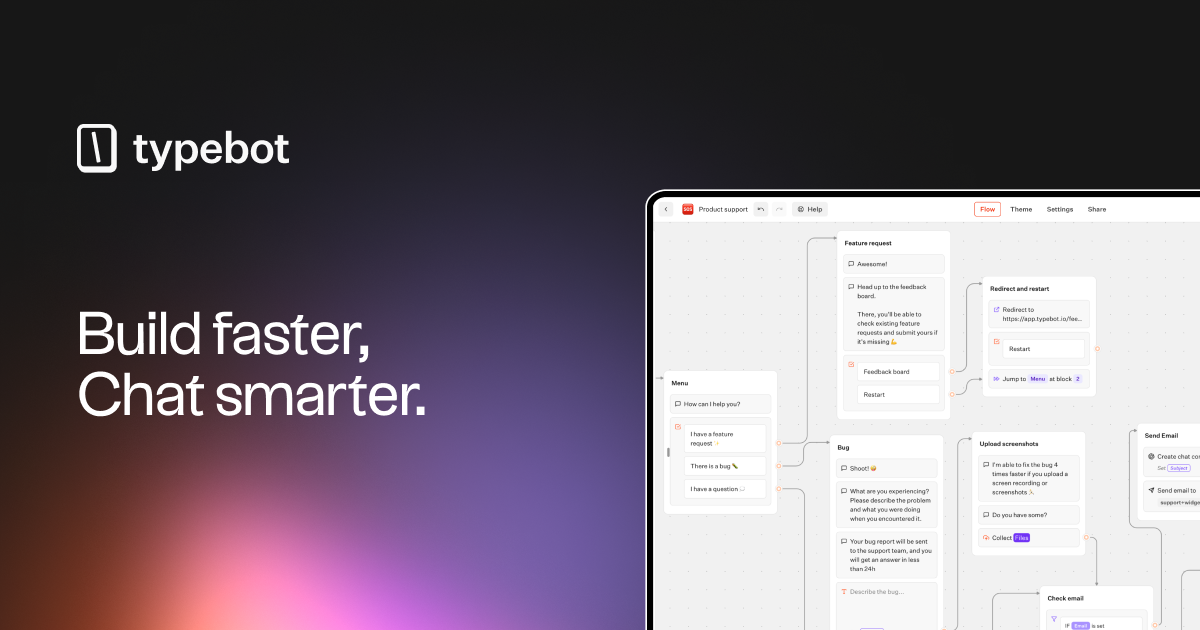
Typebot

typebot.io · Typebot Solution #1 of 10 in Conversational Support Platforms with No Code Bot Builders

Open-source chatbot builder, thin on debugging tools

Best forDevelopers and marketers wanting self-hosted, no-code conversational forms.

Free tier From $9 per month free planopen sourceself-hosted
Top of its ranking

A no-code, open-source chatbot builder you can self-host for full data privacy and cost control.

Standout factScores 9.6 for ease of setup on G2, ahead of ChatBot's 8.5 g2.com
Biggest catchDebugging complex flows takes time due to limited native debugging tools. reddit.com
9.6/10G2 ease-of-setup scoreg2.com
4.6/5G2 ratingg2.com
200Free chats per monthtypebot.io

Free vs paid

Personal (free)

$0
  • Unlimited typebots
  • 200 chats/month

Paid from

$9/mo
  • Higher chat limits
  • Self-hosted option available

Source: typebot.io

What reviewers say

G2
4.6/5 · 41

Source: g2.com

Upside

  • No-code visual drag-and-drop builder
  • Self-hosting for full data privacy
  • 200 free chats a month

Catch

  • Limited debugging tools
  • No Instagram DM embed support
  • Sparse docs for advanced features
Pick it ifDevelopers and marketers wanting self-hosted, no-code conversational forms.
Skip it ifSupport teams needing a full-service helpdesk suite.
PricingFree plan with 200 chats/mo; paid from $9/mo

Editor's takeTypebot pairs a no-code visual builder with a self-hosted option, so teams can skip per-message SaaS fees entirely. It scores 9.6 for ease of setup on G2, ahead of ChatBot's 8.5. Complex flows can be hard to debug since native debugging tools are limited, and Instagram DM embedding is not supported.

Can Typebot be self-hosted?

Yes. Self-hosting lets users pay only for their own server instead of per-message or per-seat SaaS fees, and includes full data ownership with no vendor lock-in, per Typebot's self-hosting guide.

Does Typebot have a free plan?

Yes. The Personal plan is free with unlimited typebots and 200 chats a month. Paid plans start at $9 a month for higher chat volumes and more features.

The evidence: 6 criteria, 3 penalties
9.1
Product Capability & DepthLooked for: We evaluate the versatility of the visual builder, the range of input types, and the ability to handle complex logic flows without coding.Typebot offers a visual drag-and-drop builder with over 30 native building blocks, including advanced inputs like payment gateways (Stripe), file uploads, and conditional logic.addrom.comtypebot.io
8.9
Market Credibility & Trust SignalsLooked for: We assess user reviews, community activity, and transparency regarding open-source licensing and business stability.The platform holds a strong 4.6/5 rating on G2 and boasts a large community of over 12,000 users, backed by a transparent 'Fair Source' licensing model.g2.comsaasworthy.com
9.6
Usability & Customer ExperienceLooked for: We analyze the learning curve, interface design, and how quickly a new user can deploy a functional solution.Users consistently praise the intuitive interface, with G2 data highlighting a 'ease of setup' score of 9.6, significantly higher than competitors.g2.comg2.com
9.4
Value, Pricing & TransparencyLooked for: We examine the pricing tiers, free plan generosity, and the viability of the self-hosted option for cost savings.Typebot offers a generous free tier (200 chats/month) and a self-hosting option that eliminates subscription fees entirely, offering exceptional value.typebot.ioaddrom.com
9.0
Integrations & Ecosystem StrengthLooked for: We evaluate native connections to third-party tools, API availability, and support for automation platforms like Zapier.The platform features deep native integrations with OpenAI, Google Sheets, and WhatsApp, plus extensive connectivity via Zapier and Make.com.addrom.comintegrately.com
9.5
Developer Experience & Open Source FlexibilityLooked for: We assess the quality of the open-source codebase, deployment options (Docker), and freedom from vendor lock-in.Typebot provides a Docker-ready self-hosted version with no vendor lock-in, recently adopting the Functional Source License (FSL) to balance openness with sustainability.addrom.comdocs.typebot.io

Score adjustments−0.17 points in total

−0.07Users report that debugging complex flows can be time-consuming due to a lack of advanced debugging tools.reddit.com · severity 50/100
−0.05Direct embedding in Instagram DMs is not supported due to Meta platform limitations, requiring external links.reddit.com · severity 45/100
−0.05Native routing and menu bar capabilities are rated lower (8.7) compared to specialized competitors like ChatBot (9.8).g2.com · severity 40/100
2

LivePerson

liveperson.com · LivePerson Healthcare Chatbots #1 of 8 in Chatbots for Healthcare and Patient Support

LivePerson meets HITRUST, contracts auto-renew tightly

Best forLarge health systems needing enterprise security and EHR integrations

From $61,000 per year HITRUST certifiedHIPAAEHR integration
Top of its ranking

HITRUST-certified conversational AI for health systems, deflecting phone calls to secure patient messaging.

Standout factLivePerson's average annual software cost runs around $61,000 for enterprise contracts. vendr.com
Biggest catchContracts auto-renew without reminders, and canceling can lock customers into a full extra year. trustpilot.com
~$61,000Average annual costvendr.com
HITRUST, HIPAA, SOC 2, ISO 27001Security certificationstrust.liveperson.com

Compliance

✓ HITRUST✓ HIPAA✓ SOC 2 Type II✓ ISO 27001✓ PCI DSS 4.0

Source: trust.liveperson.com

The thing people get wrong

You can cancel a LivePerson contract anytime without penalty

Customers report contracts auto-renew without reminders, risking a full extra year of payments

Source: trustpilot.com

Upside

  • HITRUST certified and HIPAA compliant
  • Integrates with Epic and Cerner
  • Deflects calls to secure messaging

Catch

  • Contracts auto-renew without reminders
  • Average cost runs near $61,000/year
  • Reporting tools can feel slow
Pick it ifLarge health systems needing enterprise security and EHR integrations
Skip it ifSmall private practices with limited budget or technical resources
PricingEnterprise pricing, averaging around $61,000/year

Editor's takeLivePerson is audited against the HITRUST Common Security Framework and signs HIPAA Business Associate Agreements for covered entities. It integrates with Epic and Cerner EHRs to pull patient data directly into chatbot flows. Average annual cost runs around $61,000, and reviewers report contracts that auto-renew without a cancellation reminder.

Is LivePerson HIPAA compliant?

Yes. It signs Business Associate Agreements with HIPAA-covered entities and is audited against the HITRUST Common Security Framework.

How much does LivePerson cost?

Pricing is not public. Vendr reports the average annual cost around $61,000, plus possible implementation and professional services fees.

3

Omnichat

omnichat.ai · Omnichat WhatsApp Chatbot #2 of 8 in Chatbots for WhatsApp and Messaging Channels

Omnichat links online sales to offline staff, hides its price

Best forRetailers in Asia integrating online and offline sales across store locations.

Quote only WhatsApp BSPOMO retailISO 27001
#2 in its ranking

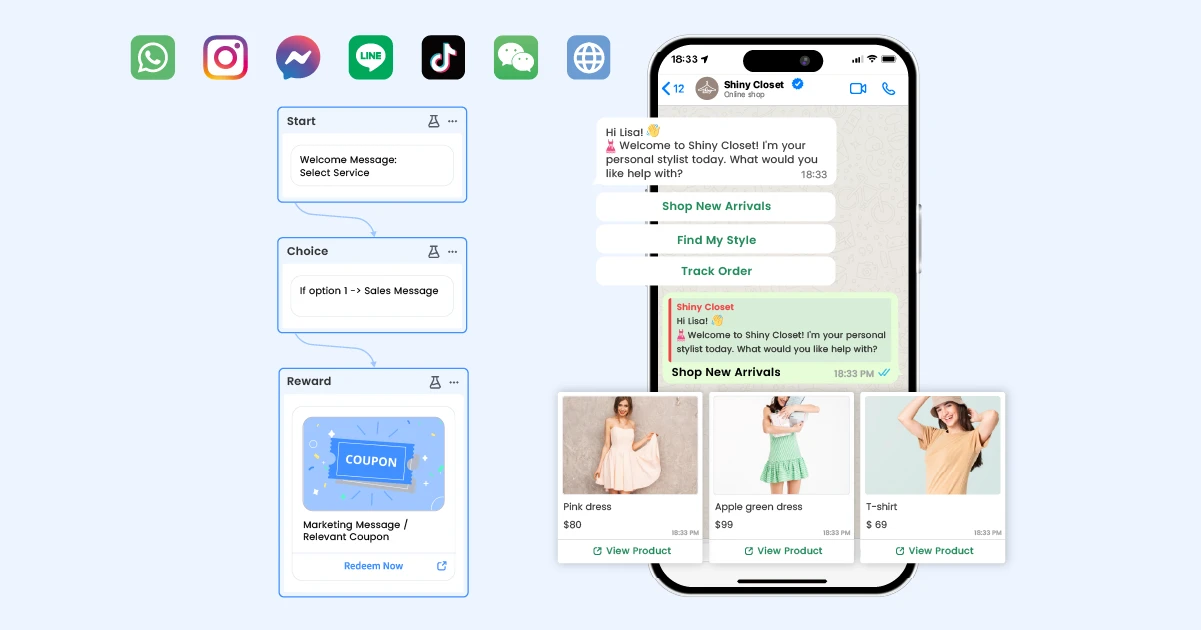
Official WhatsApp BSP unifying messaging and OMO sales tracking across WhatsApp, Facebook, Instagram and LINE.

Standout factServes over 5,000 retail and ecommerce companies, including LVMH Group and Watsons g2.com
Biggest catchOnly annual subscriptions are offered; no monthly billing option exists. omnichat.ai
5,000+Retail companies servedg2.com
ISO/IEC 27001:2022Security certificationsgs.com

Standout number

5,000+retail and ecommerce companies served

Source: g2.com

Compliance

✓ ISO/IEC 27001:2022✓ GDPR

Source: sgs.com

Upside

  • Official WhatsApp BSP and Meta Partner
  • OMO sales binds online leads to store staff
  • ISO/IEC 27001:2022 certified

Catch

  • Annual subscription only, no monthly option
  • Pricing hidden behind a quote
  • No remember-me function for login
Pick it ifRetailers in Asia integrating online and offline sales across store locations.
Skip it ifSmall local businesses outside the APAC region needing basic messaging only.
PricingCustom quote, annual subscription only

Editor's takeOmnichat holds official WhatsApp Business Solution Provider and Meta Business Partner status, serving over 5,000 retail and ecommerce companies including LVMH Group and Watsons. Its OMO feature binds online inquiries to specific offline sales staff, a niche capability built for Asia-Pacific retail chains, backed by ISO/IEC 27001:2022 certification. The tradeoff is commitment and transparency, since pricing is quote-only, and plans run annual-only with no monthly billing option.

Is Omnichat an official WhatsApp partner?

Yes. It is an Official WhatsApp Business Solution Provider (BSP) and a Meta Business Partner, per its own product documentation.

Can I pay for Omnichat monthly?

No. Omnichat currently only offers annual subscription plans, with no monthly billing option, according to its pricing page.

The evidence: 6 criteria, 3 penalties
9.0
Product Capability & DepthLooked for: We evaluate the sophistication of chatbot automation, omnichannel unification, and specialized features like OMO (Online-Merge-Offline) sales tools.Omnichat offers a robust drag-and-drop chatbot builder, unique OMO sales features that bind online leads to offline staff, and a Social CDP for cross-channel data unification.omnichat.aiomnichat.aiomnichat.ai
9.5
Market Credibility & Trust SignalsLooked for: We assess official partnership status with major platforms, industry certifications, and the caliber of the client roster.Omnichat is an official WhatsApp Business Solution Provider (BSP) and Meta Business Partner, serving major brands like Timberland and Watsons.omnichat.aig2.com
8.8
Usability & Customer ExperienceLooked for: We examine the ease of setup, interface intuitiveness, and the quality of customer support resources.Users praise the 'easy to manage' centralized interface and responsive support, though some note minor friction points like login persistence.omnichat.aig2.comomnichat.ai
8.2
Value, Pricing & TransparencyLooked for: We look for transparent public pricing, flexible billing options, and clear value propositions without hidden commitments.Pricing is not publicly listed (quote-based), and the company strictly enforces annual subscriptions with no monthly billing option.omnichat.aiomnichat.aiomnichat.ai
8.9
Integrations & Ecosystem StrengthLooked for: We evaluate the breadth of native integrations with CRMs, e-commerce platforms, and automation tools.Strong native integrations with Salesforce, HubSpot, Shopify, and SHOPLINE, plus connectivity via Make (formerly Integromat).omnichat.aiomnichat.aimake.com
9.3
Security, Compliance & Data ProtectionLooked for: We verify data security standards, GDPR compliance, and industry-recognized certifications for handling sensitive customer data.Omnichat holds the prestigious ISO/IEC 27001:2022 certification and adheres to GDPR standards, ensuring enterprise-grade security.sgs.comomnichat.ai

Score adjustments−0.12 points in total

−0.04The product requires an annual subscription commitment and does not offer a monthly billing option.omnichat.ai · severity 60/100
−0.04Pricing is not publicly disclosed; all plans require contacting sales for a quote.omnichat.ai · severity 50/100
−0.04Users report frustration with the lack of a 'remember me' login function, requiring frequent logins.g2.com · severity 40/100
4

Landbot

landbot.io · Landbot AI Chatbot Generator #2 of 10 in Conversational Support Platforms with No Code Bot Builders

Landbot blends AI and rules, but WhatsApp costs bite

Best forMarketing teams building conversational landing pages and WhatsApp campaigns

Free tier From $30 per month free planSOC 2GDPR
#2 in its ranking

No-code chatbot builder combining rule-based flows and AI agents across Web, WhatsApp, and Messenger.

Standout fact4.7/5 G2 rating based on 300+ reviews smbguide.com
Biggest catchWhatsApp pricing starts around $233 a month, pricier than competitors. tidio.com
4.7/5G2 ratingsmbguide.com
300+G2 reviewssmbguide.com
$233/moWhatsApp starting costtidio.com

What reviewers say

G2
4.7/5 · 300+

Source: smbguide.com

Compliance

✓ SOC 2 Type II✓ GDPR

Source: trust.landbot.io

Upside

  • Hybrid AI plus rule-based flows
  • Native n8n integration
  • SOC 2 Type II certified

Catch

  • No mobile app for chat management
  • Expensive WhatsApp pricing
  • Steep learning curve for advanced logic
Pick it ifMarketing teams building conversational landing pages and WhatsApp campaigns
Skip it ifLow-budget projects, since WhatsApp and AI chat pricing scale fast
PricingFrom $30/month, free plan available

Editor's takeLandbot pairs AI agents with rule-based logic, a combination most rivals skip. Reviewers rate the builder 4.7 out of 5 on G2, citing an easy drag-and-drop setup. WhatsApp and extra AI chat volume cost more than competitors, so budget for that before scaling.

Does Landbot have a free plan?

Landbot lists a starting price around $30 a month, with a free plan available according to its feature listing. WhatsApp and additional AI chat volume cost extra, so check current plan details on landbot.io before signing up.

Does Landbot work with WhatsApp?

Yes. Landbot deploys bots natively across Web, WhatsApp, and Facebook Messenger from one builder. WhatsApp plans cost more than competitors, with pricing near $233 a month according to Tidio's review.

The evidence: 6 criteria, 3 penalties
9.1
Product Capability & DepthLooked for: We evaluate the platform's ability to build complex conversational flows, support multiple channels, and leverage AI without requiring code.Landbot offers a robust visual builder that seamlessly combines rule-based logic with AI agents across Web, WhatsApp, and Messenger, supported by features like an AI Copilot and advanced conditional logic.landbot.ioserp.aiyoutube.com
9.3
Market Credibility & Trust SignalsLooked for: We assess the product's reputation, user base, compliance certifications, and standing within the industry.Landbot is a market leader with high user ratings on G2 and Capterra, trusted by major enterprises like Nestlé and Uber, and maintains rigorous SOC 2 Type II and GDPR compliance.appsruntheworld.comsmbguide.comtrust.landbot.io
8.9
Usability & Customer ExperienceLooked for: We examine the ease of use for non-technical users, quality of support, and availability of learning resources.Users consistently praise the intuitive drag-and-drop interface and responsive support, though some note a steep learning curve for advanced features and the lack of a mobile app.g2.comerwinvanginkel.com10web.io
8.4
Value, Pricing & TransparencyLooked for: We analyze pricing structures, hidden costs, and value for money compared to competitors.While the entry-level web plans are affordable, WhatsApp integration and AI chat add-ons are significantly more expensive than competitors, with extra costs for additional seats and volume.tidio.comchatimize.comlandbot.coupons
9.0
Integrations & Ecosystem StrengthLooked for: We evaluate the breadth of native integrations, API availability, and compatibility with third-party tools.Landbot boasts a strong ecosystem with native integrations for HubSpot, Salesforce, and Zapier, plus a deep native integration with n8n for complex workflows.youtube.comg2.comserp.ai
9.2
Security, Compliance & Data ProtectionLooked for: We verify the platform's adherence to security standards, data privacy regulations, and enterprise-grade protection measures.Landbot demonstrates a strong security posture with SOC 2 Type II certification, GDPR compliance, and a dedicated Trust Center detailing their controls.trust.landbot.iolandbot.iomoustacheai.fr

Score adjustments−0.15 points in total

−0.04WhatsApp integration and AI chat features are significantly more expensive than competitors, with high per-message costs for AI.tidio.com · severity 60/100
−0.05There is no mobile application available for managing chats or the platform on iOS or Android devices.community.landbot.io · severity 50/100
−0.06Users report a steep learning curve when implementing advanced conditional logic and complex flows.10web.io · severity 45/100
5

MXChat

mxchat.ai · MXChat No Code Chatbot Builder #3 of 10 in Conversational Support Platforms with No Code Bot Builders

MXChat sells a lifetime license for $69.97

Best forWordPress site owners wanting a native plugin solution

Free tier From $70 one-time one-time licenseWordPress pluginbring your own key
#3 in its ranking

WordPress AI chatbot plugin using your own API keys, no monthly SaaS fee.

Standout factThe Pro plan costs a one-time payment of about $69.97, with no monthly fee. skywork.ai
Biggest catchUsers must supply and pay for their own AI provider API keys separately. skywork.ai
$69.97 one-timePro license priceskywork.ai
1,000+Active installationswordpress.org
100+AI models supportedwordpress.org

Starting price

$69.97one-timePro license, no monthly plugin fee. API costs billed separately by provider.

Standout number

100+AI models supported through MXChat

Source: wordpress.org

Upside

  • One-time $69.97 license, no monthly fee
  • Connects to 100+ AI models
  • Data stays on your WordPress server

Catch

  • Requires your own API keys
  • Works only inside WordPress
  • RAG setup needs some fine-tuning
Pick it ifWordPress site owners wanting a native plugin solution
Skip it ifNon-WordPress websites like Shopify, Wix, or custom stacks
PricingFree plan available, Pro lifetime license about $69.97 one-time

Editor's takeMXChat charges a one-time fee of about $69.97 for its Pro license instead of a monthly SaaS subscription, and it connects to over 100 AI models including GPT-4, Claude, and Gemini through a bring-your-own-key setup. Knowledge base data stays inside the WordPress environment rather than an external SaaS database. The tradeoff is that users manage and pay for their own API keys separately, and the plugin only works on WordPress sites.

Does MXChat charge a monthly fee?

No. The Pro version uses a one-time lifetime license priced around $69.97, though users still pay their own AI provider for API usage, according to independent pricing research.

Does MXChat work outside WordPress?

No. It is built specifically as a WordPress plugin and does not support other platforms like Shopify or Wix.

The evidence: 6 criteria, 2 penalties
9.0
Product Capability & DepthLooked for: We evaluate the breadth of AI model support, RAG capabilities, and native functionality within the WordPress environment.MXChat offers native RAG technology allowing training on sitemaps, PDFs, and WooCommerce products, while supporting over 100 AI models including GPT-4, Claude, Gemini, and Grok.wordpress.orgmxchat.aiwordpress.org
8.8
Market Credibility & Trust SignalsLooked for: We assess user adoption, review sentiment, and developer transparency within the WordPress community.The product maintains a perfect 5-star rating across 25 reviews with over 1,000 active installations, though it is a relatively newer entrant compared to legacy competitors.wordpress.orgaitools.fyi
9.2
Usability & Customer ExperienceLooked for: We examine the ease of setup, interface design, and quality of support resources for non-technical users.Users consistently praise the clean, modern UI and the developer's 'hands-on' support, noting it is significantly more user-friendly than competitors.wordpress.orgwordpress.org
9.5
Value, Pricing & TransparencyLooked for: We analyze the pricing model, hidden costs, and value proposition compared to subscription-based SaaS.MXChat disrupts the market with a lifetime license model for its Pro version, eliminating monthly platform fees, though users must pay their own API costs.skywork.aiwordpress.com
8.9
Integrations & Ecosystem StrengthLooked for: We evaluate how well the product connects with third-party tools, specifically within the WordPress and e-commerce landscape.Strong integrations with WooCommerce, Slack for live agent handoff, and marketing tools like Loops, making it a versatile tool for business operations.wordpress.orgreddit.com
8.8
Security, Compliance & Data ProtectionLooked for: We assess data residency, reliance on external servers, and compliance features.As a native plugin, it keeps knowledge base data within the WordPress environment (vector embeddings) rather than external SaaS databases, enhancing control.skywork.aiwordpress.org

Score adjustments−0.11 points in total

−0.05Users must manage their own API keys and billing for AI providers (OpenAI, Anthropic), which adds complexity compared to all-in-one SaaS solutions.skywork.ai · severity 50/100
−0.06Some users report needing to 'finagle' the knowledge base settings and encountering bugs with similarity thresholds during setup.wordpress.org · severity 45/100
6

BastionGPT

bastiongpt.com · BastionGPT Healthcare Chatbot #2 of 8 in Chatbots for Healthcare and Patient Support

BastionGPT gives HIPAA-safe GPT-4 access from $20/mo

Best forHealthcare providers wanting a HIPAA-safe alternative to ChatGPT.

From $20 per user/mo HIPAA compliantGPT-4 accesszero data retention
#2 in its ranking

A HIPAA-compliant AI assistant giving clinicians secure access to GPT-4, Claude, and Gemini.

Standout factProfessional plan starts at $20 per user a month, versus $600+ for Nuance DAX. bastion-gpt.tenereteam.com
Biggest catchIt has no direct, bi-directional EHR sync, relying on copy-paste or file export instead. bastiongpt.com
$20/user/moStarting pricebastion-gpt.tenereteam.com
150,000 wordsContext windowbastiongpt.com
3,000+Practices trusting itbastionintelligence.com

Starting price

$20/user/moProfessional plan, BAA included

Standout number

150,000word context window for document review

Source: bastiongpt.com

Upside

  • HIPAA compliant with BAA on every plan
  • Access to GPT-4, Claude, and Gemini
  • Zero data retention after 30 days

Catch

  • No direct bi-directional EHR sync
  • Requires manual copy-paste workflow
  • Strictly limited to healthcare topics
Pick it ifHealthcare providers wanting a HIPAA-safe alternative to ChatGPT.
Skip it ifOrganizations wanting a patient-facing chatbot for their website.
PricingProfessional plan: $20/user/mo.

Editor's takeBastionGPT gives clinicians HIPAA-compliant access to GPT-4, Claude, and Gemini starting at $20 a month. It signs a BAA on every plan and deletes chat history after 30 days. It works with all major EHRs through copy-paste rather than a direct, bi-directional sync.

How much does BastionGPT cost?

The Professional plan starts at $20 per user a month, well under enterprise competitors like Nuance DAX, which runs $600 or more monthly.

Does BastionGPT connect directly to EHR systems?

Not directly. It works alongside all major EHRs through copy-paste or file export rather than an automated, bi-directional sync.

The evidence: 6 criteria, 3 penalties
9.0
Product Capability & DepthLooked for: We evaluate the breadth of AI models available, the accuracy of medical transcription, and the ability to handle complex clinical documentation tasks.BastionGPT provides access to over 200 AI models including GPT-4, Claude, and Gemini, featuring an AI Scribe with multi-speaker recognition and a 150,000-word context window for analyzing extensive medical records.bastiongpt.combastiongpt.comelion.health
9.2
Market Credibility & Trust SignalsLooked for: We assess regulatory compliance certifications, partnerships, and verified user trust within the healthcare sector.The platform is fully HIPAA compliant, signs Business Associate Agreements (BAA) for all plans, and is trusted by over 3,000 healthcare practices.bastiongpt.comhealthcareitnews.comhipaatimes.com
8.8
Usability & Customer ExperienceLooked for: We look for ease of adoption, interface intuitiveness, and how seamlessly it fits into existing clinical workflows.Users report the tool is 'incredibly user-friendly' with no setup fees, though the workflow primarily relies on copy-paste rather than direct EHR insertion.bastiongpt.combastiongpt.combastion-gpt.tenereteam.com
9.6
Value, Pricing & TransparencyLooked for: We evaluate the cost relative to features, transparency of pricing models, and contract flexibility.Pricing is highly disruptive, starting at $20/month/user, significantly undercutting competitors like Nuance DAX ($600+/mo) and Nabla ($119/mo).bastiongpt.combastion-gpt.tenereteam.combastiongpt.com
9.5
Security, Compliance & Data ProtectionLooked for: We examine data retention policies, training data usage, and specific healthcare security measures.BastionGPT enforces a strict zero-retention policy where data is deleted after 30 days and never used to train AI models, operating in an isolated environment.bastiongpt.combastiongpt.combastiongpt.com
8.0
Integrations & Ecosystem StrengthLooked for: We assess the depth of integration with Electronic Health Records (EHR) and availability of APIs.Integration is primarily achieved via 'copy-paste' compatibility with all EHRs rather than direct bi-directional sync, which is a limitation compared to enterprise alternatives.bastiongpt.combastion-gpt.tenereteam.com

Score adjustments−0.15 points in total

−0.05Relies primarily on copy-paste workflows rather than direct, bi-directional API integration with EHR systems, which creates manual friction compared to enterprise competitors.bastiongpt.com · severity 50/100
−0.06Like all generative AI, the system can produce 'hallucinations' or errors, requiring mandatory professional review of all outputs before clinical use.bastiongpt.com · severity 45/100
−0.04Users report the tool strictly enforces healthcare-only queries, refusing to answer general productivity questions, which limits its utility as an all-in-one assistant.reddit.com · severity 30/100
7

SmartBot360

smartbot360.com · SmartBot360: Healthcare Chatbot #3 of 8 in Chatbots for Healthcare and Patient Support

SmartBot360 hid its pricing after the KLaunch acquisition.

Best forMedical and dental practices needing a HIPAA-compliant chat widget.

Quote only HIPAA compliantNSF-funded researchhidden pricing
#3 in its ranking

A HIPAA-compliant healthcare chatbot with NSF-funded AI and pre-built patient intake templates.

Standout factBuilt on research backed by two National Science Foundation grants. smartbot360.com
Biggest catchPricing is hidden behind the parent company KLaunch's platform. smartbot360.com
2NSF grants receivedsmartbot360.com
2023acquired by KLaunchsmartbot360.com
3architecture tierssmartbot360.com

Compliance

✓ HIPAA✓ BAA available? SOC 2

Source: keragon.com

The thing people get wrong

SMS texting with patients cannot meet HIPAA rules

SmartBot360 sends a secure link that moves the chat to a HIPAA-compliant web bot

Source: smartbot360.com

Upside

  • Natively HIPAA-compliant, signs BAAs
  • NSF-funded anti-dropout AI design
  • Pre-built PHQ-9 and triage templates

Catch

  • Pricing hidden behind parent company
  • Smaller review volume than rivals
  • Training AI on complex queries takes effort
Pick it ifMedical and dental practices needing a HIPAA-compliant chat widget.
Skip it ifProviders wanting a clinical documentation or AI scribe tool.
PricingContact for pricing, managed through KLaunch

Editor's takeSmartBot360 uses a three-tier architecture that blends flow logic with AI, built on research backed by two NSF grants. It signs Business Associate Agreements and moves SMS conversations to a HIPAA-compliant web chat for PHI. Since its 2023 acquisition by KLaunch, pricing is no longer listed and now requires contacting sales.

Is SmartBot360 HIPAA compliant?

Yes. It is natively HIPAA-compliant and will sign a Business Associate Agreement with covered entities. It also moves SMS chats to a secure web link for exchanging patient health information.

How much does SmartBot360 cost?

Pricing is not public. Since the 2023 acquisition by KLaunch, plans are managed through the parent platform. Contact sales for a quote.

The evidence: 6 criteria, 2 penalties
8.9
Product Capability & DepthLooked for: We evaluate the sophistication of healthcare-specific conversational AI, including pre-built medical templates and handling of complex patient queries.SmartBot360 utilizes a proprietary 'anti-dropout' architecture that combines flow-based logic with AI to handle off-script patient queries, supported by specialized templates for PHQ-9 assessments and triage.smartbot360.comsmartbot360.comsmartbot360.com
9.1
Market Credibility & Trust SignalsLooked for: We look for industry recognition, funding stability, and verified user adoption within the healthcare sector.The product is backed by National Science Foundation (NSF) grants for its AI research and was acquired by KLaunch in 2023, signaling strong technological validation and market stability.healthcareitnews.comsmartbot360.comsmartbot360.com
8.8
Usability & Customer ExperienceLooked for: We assess the ease of deployment for non-technical staff and the quality of the patient user interface.The platform offers a no-code builder with drag-and-drop functionality, allowing healthcare providers to deploy bots in minutes without technical expertise.techradar.comsmartbot360.comproprofschat.com
8.2
Value, Pricing & TransparencyLooked for: We evaluate pricing clarity, accessibility, and the balance of features against cost.Pricing is no longer publicly transparent following the KLaunch acquisition; users must now contact sales or access the parent platform for quotes.smartbot360.comsmartbot360.com
9.4
Security, Compliance & Data ProtectionLooked for: We examine HIPAA compliance, BAA availability, and data encryption standards critical for healthcare.SmartBot360 is natively HIPAA-compliant, signs Business Associate Agreements (BAAs), and offers secure SMS options that redirect to encrypted web chats for PHI exchange.keragon.comsmartbot360.com
8.7
Integrations & Ecosystem StrengthLooked for: We look for depth of integration with Electronic Health Records (EHRs) and CRM systems.Offers documented integrations with major EHRs like DrChrono and CRMs like Salesforce and HubSpot, plus API access for custom connections.smartbot360.comsmartbot360.com

Score adjustments−0.09 points in total

−0.04Pricing is not publicly available and requires navigating to a parent platform or contacting sales, reducing transparency.smartbot360.com · severity 60/100
−0.05Some users report difficulties in training the bot to understand complex end-user queries, leading to potential conversation loops.g2.com · severity 45/100
8

Chatfuel

chatfuel.com · Chatfuel AI Sales Agents #3 of 8 in Chatbots for WhatsApp and Messaging Channels

Chatfuel cut HelloFresh response times 76%, bills per chat

Best forBeauty, aesthetics and service businesses automating bookings.

From $24 per month Meta Business Partnerno-codeShopify integration
#3 in its ranking

An AI chatbot platform for WhatsApp, Instagram and Facebook with autonomous sales agents.

Standout factHelloFresh cut customer response times by 76% using Chatfuel, despite a 47% jump in message volume. chatfuel.com
Biggest catchChatbot flows cannot be duplicated across channels, requiring manual rebuilding for each platform. chatimize.com
76%HelloFresh response time cutchatfuel.com
$24/moStarting pricemessengerbot.app

What changed

76%HelloFresh response time reduction

Source: chatfuel.com

Plans

WhatsApp$34/mo

1,000 conversations

Source: messengerbot.app

Upside

  • Autonomous Fuely AI agent for sales
  • Native Shopify abandoned cart recovery
  • Official Meta Business Partner

Catch

  • Flows can't transfer between channels
  • Per-conversation fees on WhatsApp
  • No built-in multilingual support
Pick it ifBeauty, aesthetics and service businesses automating bookings.
Skip it ifEnterprises needing complex, multi-department support routing.
PricingFrom ~$24/mo for Facebook/Instagram, $34/mo WhatsApp

Editor's takeChatfuel's Fuely AI agent, built on OpenAI models, handles bookings and sales questions autonomously. It connects to Shopify, Stripe and Calendly to close the loop on transactions. HelloFresh used the platform to cut response times by 76 percent even as message volume rose 47 percent.

Can Chatfuel flows work across multiple channels?

Not automatically. Flows built for one channel need manual rebuilding for others.

Does Chatfuel integrate with Shopify?

Yes, including automated abandoned cart recovery reminders sent through WhatsApp.

The evidence: 6 criteria, 2 penalties
8.7
Product Capability & DepthLooked for: We evaluate the sophistication of AI agents, flow building flexibility, and cross-channel automation capabilities.Chatfuel offers 'Fuely AI', an autonomous agent based on OpenAI models that handles sales, bookings, and support across Meta platforms, though it requires manual flow replication for each channel.chatfuel.comchatfuel.comchatfuel.com
9.2
Market Credibility & Trust SignalsLooked for: We assess industry standing, partnerships, and verifiable case studies from major enterprise clients.Chatfuel is an official Meta Business Partner with significant enterprise case studies, including HelloFresh, and a long operating history since 2015.chatfuel.comchatfuel.com
8.9
Usability & Customer ExperienceLooked for: We look for ease of setup, no-code interface quality, and the learning curve for non-technical users.The platform provides a drag-and-drop 'Flow Builder' that requires no coding, allowing users to set up AI agents in minutes, though complex logic trees can become visually cluttered.chatfuel.comchatfuel.comchatfuel.com
8.5
Value, Pricing & TransparencyLooked for: We evaluate pricing structures, hidden costs, and the balance of features versus monthly fees.Pricing is transparent with plans starting around $29/mo for Facebook/Instagram and $49/mo for WhatsApp, but costs scale with conversation volume.chatfuel.commessengerbot.appchatfuel.com
9.0
Integrations & Ecosystem StrengthLooked for: We examine the depth of third-party connections, particularly for e-commerce and scheduling workflows.Chatfuel features robust native integrations with Shopify for abandoned cart recovery, Stripe for payments, and Calendly for bookings, specifically tailored for sales automation.chatfuel.comchatfuel.com
9.1
Security, Compliance & Data ProtectionLooked for: We verify GDPR compliance, data encryption standards, and privacy policy clarity.Chatfuel is fully GDPR compliant, offers a standard Data Processing Agreement (DPA), and encrypts data at rest, ensuring enterprise-grade security.chatfuel.comchatfuel.com

Score adjustments−0.15 points in total

−0.08Users cannot duplicate chatbot flows across different channels (e.g., Facebook to Instagram), requiring manual rebuilding for each platform.chatimize.com · severity 60/100
−0.07The platform lacks built-in multilingual support, forcing users to create separate flows for each language manually.reddit.com · severity 50/100
02

Every ranking in Knowledge Base & Self-Service Portals

Each card shows the top three. The eye opens a quick look. Open a ranking for every product, the evidence and the comparison table.

1 LivePersonLivePerson meets HITRUST, contracts auto-renew tightly 9.0/10
Visit ↗
2 BastionGPTBastionGPT gives HIPAA-safe GPT-4 access from $20/mo 8.8/10
Visit ↗
3 SmartBot360SmartBot360 hid its pricing after the KLaunch acquisition. 8.8/10
Visit ↗
See all 8 ranked
1 LivePersonSigns HIPAA BAAs, but pricing stays behind a sales quote. 8.9/10
Visit ↗
2 OmnichatOmnichat links online sales to offline staff, hides its price 8.9/10
Visit ↗
3 ChatfuelChatfuel cut HelloFresh response times 76%, bills per chat 8.8/10
Visit ↗
See all 8 ranked
1 TypebotOpen-source chatbot builder, thin on debugging tools 9.1/10
Visit ↗
2 LandbotLandbot blends AI and rules, but WhatsApp costs bite 8.9/10
Visit ↗
3 MXChatMXChat sells a lifetime license for $69.97 8.9/10
Visit ↗
See all 10 ranked
03

About Knowledge Base & Self-Service Portals

What the category is, how it developed, and what to look for. Two minutes, or the long read.

This category covers software used to capture, organize, and disseminate institutional knowledge to external customers and internal employees across the full service lifecycle: from initial query and troubleshooting to complex problem resolution and technical documentation. It sits between Help Desk/Ticketing Systems (which manage reactive, 1:1 agent interactions) and Content Management Systems (which focus on broad web publishing). It includes both general-purpose knowledge management platforms and vertical-specific self-service portals built for complex industries like manufacturing, healthcare, and financial services.

Read the full category guide

What Is Knowledge Base & Self-Service Portal Software?

At its core, this software category solves the "efficiency paradox" of modern business: as products and services become more complex, the volume of support inquiries scales faster than human teams can handle. A Knowledge Base & Self-Service Portal is not merely a static repository of FAQs; it is an active operational layer that deflects routine inquiries, empowers users to resolve their own issues via guided workflows, and provides support agents with instant access to verified information. For the buyer, it represents the shift from high-touch, high-cost support models to scalable, low-touch resolution engines.

History of the Category

The lineage of modern Knowledge Base and Self-Service Portals traces back to the "Knowledge Management" (KM) movement of the 1990s. In this era, the focus was primarily internal. Large enterprises deployed on-premise intranets and heavy database systems to digitize paper manuals. As noted by early industry observers, these systems were essentially "electronic filing cabinets"—searchable but static, often requiring users to navigate complex folder structures to find information [1].

The late 1990s and early 2000s saw a pivot driven by the "dot-com" boom. As businesses moved online, the need for customer-facing documentation exploded. This period birthed the first generation of web-based FAQs and basic search portals. However, these early solutions were often disconnected from the actual support workflow, serving as little more than digitized brochures [2]. The market was dominated by heavy ERP extensions or custom-coded HTML pages.

The true category definition crystallized with the rise of the cloud and the SaaS revolution in the late 2000s and early 2010s. The shift from on-premise installations to cloud-hosted platforms democratized access, allowing mid-market companies to deploy sophisticated help centers without IT overhaul. This era introduced the concept of "Knowledge-Centered Service" (KCS) into software design—the idea that knowledge creation should be integrated into the support workflow, not treated as an afterthought.

From 2015 to the present, the market has undergone a wave of consolidation and intelligence. Buyers stopped asking for "databases" and started demanding "actionable intelligence." The integration of machine learning for search intent, natural language processing (NLP) for auto-suggestions, and the convergence of chatbots with static articles has reshaped the landscape. Today, the category is defined by its ability to deliver the right answer, to the right person, at the right time—often without human intervention.

What to Look For

Evaluating Knowledge Base & Self-Service Portals requires looking beyond storage capacity to how the system actively serves information. A robust platform must offer context-aware search that handles natural language queries, typos, and synonyms. If a user types "bill" and the system doesn't surface "invoice" or "payment," the search engine is failing. Look for multi-brand and multi-lingual architecture if you operate across regions; duplicating content manually for every language is a scalability trap.

Red flags include proprietary data formats that make exporting your content difficult (vendor lock-in) and a lack of granular permissions. In complex B2B environments, you need the ability to hide sensitive documentation from specific user tiers while keeping public guides open. A warning sign is a platform that treats "internal" and "external" knowledge as two entirely separate silos; the best practice is a "single source of truth" where one article can have sections visible only to agents and others visible to customers.

Key questions to ask vendors should focus on maintenance and analytics: "How does the system identify aging or ineffective content?" and "Can we see exactly what users searched for but didn't find?" (the "no results" report). This data is critical for closing knowledge gaps. Furthermore, ask about API rate limits and webhook capabilities. As your portal becomes a hub for customer data, you will need to pipe interaction data into your CRM or marketing automation tools without hitting arbitrary ceilings.

Industry-Specific Use Cases

Retail & E-commerce

In retail, the self-service portal is a transactional engine, not just a library. The primary evaluation priority here is integration with Order Management Systems (OMS). A generic knowledge base is insufficient; retailers need portals where a customer can log in, see their recent orders, and initiate a return or exchange without speaking to an agent. This requires deep API connectivity to pull real-time shipping status and inventory data. According to industry analysis, reducing "Where is my order?" (WISMO) tickets is the single largest ROI driver for this sector [3].

Content needs are visual and fast-paced. Retailers should look for platforms that support rich media—video tutorials for assembly, sizing charts that integrate with dynamic tools, and image-heavy troubleshooting guides. Evaluation should focus on mobile responsiveness, as the vast majority of retail self-service occurs on mobile devices. A key differentiator is the ability to personalize content based on purchase history; showing a user a manual for the specific blender they bought three months ago is far more effective than forcing them to search a generic catalog.

Healthcare

For healthcare organizations, security and compliance are the non-negotiable gatekeepers. Self-service portals in this sector often serve as patient triage points or insurance claim centers. The software must support HIPAA-compliant architecture, including audit logs of who accessed what information and when [4]. Unlike retail, where friction is the enemy, healthcare portals sometimes introduce intentional friction (such as multi-factor authentication) to protect Protected Health Information (PHI).

A unique workflow in healthcare is the intelligent triage form. Patients self-selecting symptoms need to be routed to the correct level of care—urgent, virtual visit, or FAQ. Evaluation should prioritize logic-branching capabilities in forms and the ability to integrate with Electronic Health Records (EHR) systems like Epic or Cerner for appointment scheduling. Success is measured not just in deflection, but in patient safety and the reduction of administrative burden on clinical staff [5].

Financial Services

Financial institutions require a "Fort Knox" approach to knowledge management. The self-service portal is often the primary interface for secure document exchange (e.g., uploading loan applications or tax forms) and accessing sensitive account data. The critical evaluation criteria is role-based access control (RBAC) at a granular level. A high-net-worth client should see different investment FAQs and service options than a standard checking account holder.

Compliance dictates that every version of a knowledge article must be tracked. If a bank updates its fee schedule policy in the portal, they need a permanent record of what the policy said on a specific past date in case of a dispute. Therefore, version control and audit trails are paramount. Red flags include any platform that allows content to be permanently deleted without an archival footprint. The trend is moving towards "active compliance," where the portal proactively prompts users to update their KYC (Know Your Customer) information [6].

Manufacturing

Manufacturing buyers need portals that can handle extreme complexity and technical depth. These "Dealer Portals" or "Partner Portals" serve technicians and distributors who need access to complex schematics, exploded parts views, and warranty claim systems. A generic wiki cannot handle a dynamic schematic where clicking a part number adds it to a shopping cart. The software must support heavy file types (CAD drawings, high-res PDFs) and intricate taxonomy structures to organize thousands of SKUs [7].

The critical workflow here is the warranty adjudication process. Manufacturers need a portal where a dealer can upload photos of a defect, enter a serial number to validate warranty status, and receive an automated approval or rejection. This requires the portal to dip into ERP data for validation. Evaluation should verify the platform's ability to function in low-bandwidth environments (e.g., a technician in a basement or remote site) and support offline synchronization.

Professional Services

For law firms, consultancies, and agencies, the self-service portal functions as a Client Collaboration Hub. The focus shifts from "troubleshooting" to "transparency." Clients use these portals to view project status, approve deliverables, and access billing history. The primary pain point driving this adoption is the need to reduce non-billable administrative email traffic ("Can you resend that invoice?").

Evaluation should focus on customizability and branding. The portal is an extension of the firm's brand; it cannot look like a generic help desk. Integration with project management tools (like Asana or Monday.com) and billing software is essential to automate status updates. Unlike other industries, "deflection" isn't the goal—"engagement" is. The portal is a tool to demonstrate value and progress to the client, so features that visualize timelines and milestones are highly valued [8].

Subcategory Overview

Live Chat Platforms with AI and Chatbot Handoffs

This subcategory specifically addresses the critical "fumble zone" between automation and human intervention. While general knowledge bases rely on passive search, these tools use active conversational AI to triage intent. The niche differentiator is the intelligent handoff protocol: the ability to pass not just the chat, but the full context (pages visited, bot interaction history, sentiment score) to a human agent without forcing the user to repeat themselves. A workflow unique to this niche is "sentiment-based routing," where a bot detects frustration via NLP and bypasses standard queues to alert a manager immediately. Buyers choose this over generic chat tools to solve the pain point of "bot loops," where customers get trapped in automated cycles, destroying CSAT scores. For a detailed comparison, see our guide to Live Chat Platforms with AI and Chatbot Handoffs.

Live Chat Platforms with Co Browsing and Screen Share

This niche caters to high-touch support environments where "telling" isn't enough and agents need to "show." Unlike standard screen sharing (like Zoom), co-browsing allows an agent to interact with the user's specific web browser tab—highlighting elements, clicking buttons, or filling forms—without seeing the rest of the user's desktop or sensitive tabs. This is a critical distinction for privacy-conscious sectors like banking and healthcare. The specific workflow handled here is "visual guidance," used for complex onboarding or form completion. Buyers move to this niche when verbal troubleshooting ("Do you see the blue button?") fails, causing high Average Handle Time (AHT). Learn more about these specialized tools in our review of Live Chat Platforms with Co Browsing and Screen Share.

Live Chat Tools with Integrated Knowledge Bases

These platforms merge the repository with the communication channel, solving the "toggle tax" where agents switch screens to find answers. The distinguishing feature is agent-assist functionality, which automatically suggests knowledge base articles in the agent's sidebar based on the live text analysis of the customer's chat. A workflow unique to this tool is the "one-click send," where an agent can insert a formatted article or snippet directly into the chat stream. The pain point driving buyers here is speed; separate tools slow down response times and lead to inconsistent answers. Explore the top options in our guide to Live Chat Tools with Integrated Knowledge Bases.

Customer Messaging Platforms with In App Campaigns

This subcategory focuses on proactive engagement rather than reactive support. These tools sit inside a web or mobile product and trigger messages based on user behavior (e.g., "User visited the 'Pricing' page 3 times"). The niche differentiator is the use of session data to trigger outbound campaigns within the product interface. A unique workflow is the "onboarding tour," where specific help articles pop up sequentially as a user tries a new feature. Buyers choose this over standard email marketing or static help desks to drive product adoption and reduce churn by catching confused users in the moment. See our analysis of Customer Messaging Platforms with In App Campaigns.

Live Chat Platforms for SaaS and Web Apps

Built specifically for software companies, these tools prioritize user identity and technical context. Unlike generic chat widgets, these platforms ingest custom user attributes (e.g., "Plan Type: Enterprise," "Last Login: Today," "Error Code: 404"). This allows for a workflow where support is tiered automatically: enterprise users get routed to VIP agents, while free users get a bot. The driving pain point for this niche is the need to support logged-in users differently than anonymous website visitors, requiring deep integration with the SaaS product's authentication system. Read more in our guide to Live Chat Platforms for SaaS and Web Apps.

Deep Dive: Pricing Models & TCO

Pricing in the Knowledge Base and Self-Service market has bifurcated into two dominant models: per-seat (user) and usage-based (consumption). The traditional per-seat model charges based on the number of support agents or admin users accessing the backend. This provides predictability but can penalize growth. The emerging usage-based model charges based on the number of "active users" (customers logging in), "articles viewed," or "API calls."

According to OpenView Partners, usage-based pricing has seen rapid adoption because it lowers the barrier to entry, allowing customers to pay only as they scale [9]. However, this introduces TCO volatility. For example, a hypothetical SaaS company with 25 support agents might pay $2,500/month on a per-seat model ($100/seat). If they switch to a usage-based model charging $0.05 per article view, and they have a sudden traffic spike due to a service outage resulting in 100,000 views, their bill could unexpectedly double to $5,000 for that month. A real-world buyer scenario involves a fast-growing B2C startup that chose a "free unlimited agents" plan that charged per "contact." As their user base grew to 1 million, even a 1% contact rate exploded their monthly costs, forcing a painful migration to a per-seat enterprise contract. TCO calculations must include not just license fees, but the hidden costs of API overages and sandbox environments, which are often gated behind the most expensive tiers.

Deep Dive: Integration & API Ecosystem

Integration is the circulatory system of a self-service portal. A standalone knowledge base is of limited value; it must talk to the CRM, the ticketing system, and often the product itself. The critical metric to evaluate here is API rate limits—the cap on how many requests your systems can make to the vendor's server per minute. Low rate limits can cripple a busy support operation during peak times.

Consider a 50-person professional services firm integrating their client portal with their project management and invoicing systems. They design a workflow where every time a task is completed in the project tool, the portal updates the client's progress bar and triggers an invoice. If the portal's API is poorly designed or rate-limited, this synchronization lags. The client sees a "0% complete" status on a project they just received an invoice for, eroding trust instantly. Furthermore, weak integration often lacks webhook support, meaning the portal has to "poll" for updates constantly (inefficient) rather than receiving real-time pushes. Gartner estimates that through 2025, integration strategy will account for 50% of the time and cost of building digital platforms [10].

Deep Dive: Security & Compliance

Security in this category goes beyond standard encryption. It involves the complex management of identity and access management (IAM). A common requirement is Single Sign-On (SSO) integration (e.g., Okta, Azure AD) to ensure that when an employee leaves the company, their access to the internal knowledge base is instantly revoked. For external portals, the standard is SOC 2 Type II compliance, which verifies that the vendor's security controls have been tested over time, not just at a single point.

In a healthcare scenario, a "HIPAA-compliant" badge on a website isn't enough. A real buyer must verify that the vendor will sign a Business Associate Agreement (BAA). Without a BAA, the software vendor cannot legally store any Protected Health Information (PHI). Imagine a patient portal where a patient uploads a photo of a wound for triage. If that image is stored on a server that is not covered by a BAA and lacks encryption at rest, the healthcare provider faces massive fines. Forrester notes that security breaches are increasingly tracing back to third-party SaaS tools, making vendor risk assessment a critical step in the buying cycle [11].

Deep Dive: Implementation & Change Management

Software implementation failure rates remain stubbornly high, with research indicating that up to 70% of digital transformation initiatives do not reach their stated goals [12]. In the context of Knowledge Bases, the primary point of failure is rarely the technology itself, but the content strategy and cultural adoption. A "build it and they will come" approach consistently fails.

Successful implementation requires a Knowledge-Centered Service (KCS) adoption strategy. This involves a cultural shift where agents are rewarded not just for closing tickets, but for creating and updating knowledge articles. A concrete example of failure is a mid-sized logistics company that spent six months migrating to a new high-end portal but didn't train their agents on the new authoring workflow. Agents continued to use their private "cheat sheets" and outdated PDFs saved on their desktops. The new portal remained empty and inaccurate, leading to a 0% deflection rate and wasted investment. Effective change management requires identifying "Knowledge Champions" within the team who own the quality of the content.

Deep Dive: Vendor Evaluation Criteria

When evaluating vendors, buyers must look past the "feature list wars" and focus on vendor partnership and roadmap alignment. Does the vendor have a customer success team that understands your specific industry? Are they investing in the features that matter to you (e.g., AI search) or distracting features (e.g., NFT integration)?

A critical, often overlooked criterion is Data Portability. If you need to leave this vendor in three years, can you export your knowledge base in a structured format (HTML, JSON, Markdown) with image links intact? Many vendors offer a simple CSV export that strips out formatting and breaks images, effectively locking you in. Gartner advises that organizations should prioritize vendors that support open standards and offer robust API-based extraction tools [13]. A practical test is to ask the vendor for a sample export file during the demo phase to verify its usability.

Emerging Trends and Contrarian Take

Emerging Trends 2025-2026: The Agentic Shift The dominant trend is the move from "passive retrieval" to "agentic action." By 2026, the market will shift toward AI Agents that don't just summarize an answer but execute tasks. Instead of telling a user how to reset a router, the agent will interface with the device API to reset it for them. We are also seeing the rise of "zero-click" knowledge, where AI predicts what a user needs based on their navigation path and proactively surfaces the solution before a search is even typed [14].

Contrarian Take: The Deflection Delusion The industry's obsession with "Deflection Rate" is damaging customer relationships. A high deflection rate often just means you've made it impossible to contact a human, not that you've satisfied the customer. Many "deflected" users simply abandon the brand entirely. The contrarian insight here is that frictionless access to a human is the ultimate trust-builder. The most successful companies will use AI not to block customers from humans, but to route them to the right human instantly, with all context pre-loaded. Optimizing for "Resolution Rate" rather than "Deflection Rate" will separate the winners from the losers in the next decade [15].

Common Mistakes

Buying for Day 1, Not Year 3: Buyers often select a tool that looks great with 50 articles but collapses under the weight of 5,000. They fail to test the taxonomy depth (can you have categories within categories?) and search performance at scale.

Ignoring the "No Results" Search Term Report: This is the most valuable piece of data a knowledge base generates. Failing to review what users are searching for—and failing to find—is a massive missed opportunity to identify product confusion and content gaps [16].

Over-Engineering the Workflow: Companies often create approval workflows so complex (Draft -> Review -> SME Approval -> Legal -> Publish) that publishing a simple update takes weeks. By the time the article is live, the information is outdated. The best practice is "publish then review" for low-risk content to maintain agility.

Questions to Ask in a Demo

1. "Show me the export file." Do not settle for "yes, we can export." Ask to see the actual file structure. Is it a usable HTML/JSON zip file, or a flat CSV that strips all formatting and breaks image links?

2. "How does your search handle typos and synonyms?" Ask the rep to search for a misspelled word or a colloquial term (e.g., "cell" instead of "mobile"). If the search engine requires exact keyword matching, it will fail your users.

3. "Can we segment content by user attribute?" Ask to see how you would hide a specific article from "Silver" tier users but show it to "Gold" tier users. If this requires custom coding or duplicate articles, it’s a red flag for scalability.

4. "What happens to our API limits during a traffic spike?" Clarify if the system throttles your support center during a crisis or if there is burst capacity. You don't want your help center to crash exactly when your customers need it most.

5. "Demonstrate the 'Link Rot' management." Ask how the system handles broken links. Does it automatically redirect deleted articles? Does it scan for broken external links? Maintaining link health is a manual nightmare without tool support.

Before Signing the Contract

Check the SLA (Service Level Agreement): Ensure the uptime guarantee includes the public-facing portal, not just the agent backend. A portal outage is a public relations incident.

Negotiate Sandbox Access: For enterprise implementations, demand a full sandbox environment for testing changes before they go live. Vendors often charge extra for this; try to negotiate it into the base contract.

Verify Data Ownership: Ensure the contract explicitly states that all data, including usage analytics and customer interaction logs, belongs to you and must be returned in a usable format upon termination.

Review the "Overage" Clauses: If the pricing is usage-based, understand exactly what triggers an overage charge and what the multiplier is. Negotiate a "soft cap" or alert system rather than automatic hard charges.

Closing

Choosing the right Knowledge Base & Self-Service Portal is a strategic decision that impacts customer loyalty and operational costs for years. If you need help navigating the nuances of these platforms or validating your shortlist, feel free to reach out.

Email: albert@whatarethebest.com

04

Research

Original reporting on this corner of the market.

All research

Administrators reversed 30% of 165 million contested moderation decisions under EU law

May 24, 2026

Commercial sales win rates fell to 21% last year as buyers avoid sales reps

May 16, 2026

Medallia's debt service costs hit $300 million against just $200 million in earnings

May 3, 2026
05

Questions people ask

Which Knowledge Base & Self-Service Portals is best?

Typebot holds the highest score in the category at 9.1, in Conversational Support Platforms with No Code Bot Builders. The right pick depends on the ranking that matches your use case, so start with the ranking list above.

Why are there 3 separate rankings?

Buyers in Knowledge Base & Self-Service Portals have different jobs, so each ranking is scoped to one of them and weights the six criteria for that job. The same product can hold different ranks in different rankings.

How are the scores produced?

Documentation, pricing pages, security pages and third-party reviews are reviewed against six criteria. Each criterion records what was found and links its sources. Penalties pull the score down and are shown with their evidence. Rank follows the score. Full methodology.

06

More in Customer Support & Success

The whole group