Secure File Transfer Tools

These are the specialized categories within Secure File Transfer Tools. Looking for something broader? See all Cloud Storage, Backup & File Management categories.

Not sure which one is right for you?

Answer 4 quick questions and we'll match you with your best options

Find Your Best Match

How big is your team?

Just me
2 - 10
11 - 50
51 - 200
201 - 1,000
1,000+

What's your budget situation?

Free or open-source only
Free to start, pay later
Best value for money
Price isn't the main factor

What's your team's technical comfort level?

We want it to just work
We can handle some setup
We have developers who'll customize it

What's the ONE thing this tool must do well?

Step 1 of 4
Box Secure File Transfer

Box is specifically designed for contractors who need to securely share large files without file compression, even without a Box account. Its shared link transfer system ensures confidential files are only accessible to those granted permission, addressing the industry's demand for secure, easy-to-use, and efficient file transfer solutions.

Best for Secure File Transfer Tools for Contractors

Expert Take

Box Secure File Transfer excels in providing secure, permission-based file sharing tailored for contractors. It offers a user-friendly interface and mobile accessibility, enhancing efficiency for users in the construction industry. Despite some limitations on the free plan, its robust security features and market credibility position it as a top choice in its category.

Pros

  • FedRAMP High & DoD IL4 security
  • 1,500+ native enterprise integrations
  • Used by 68% of Fortune 500
  • Granular 7-level permission controls
  • Unlimited storage on business plans

Cons

  • SFTP/FTPS limited to 32GB files
  • Slow sync speeds reported frequently
  • Directory listing limit (20k items)
  • Expensive for small teams
  • Complex tiering for advanced features

Best for teams that are

  • Mid-to-large enterprises needing scalable cloud storage and governance. [cite: 24, 25]
  • Distributed teams relying on deep Microsoft 365 or Salesforce integrations. [cite: 24, 26]

Skip if

  • Lean teams needing cheap, ad-hoc sharing without paying for governance. [cite: 26]
  • Users requiring OCR-intensive workflows or structured data extraction. [cite: 24]

Best for teams that are

  • Mid-to-large enterprises needing scalable cloud storage and governance. [cite: 24, 25]
  • Distributed teams relying on deep Microsoft 365 or Salesforce integrations. [cite: 24, 26]

Skip if

  • Lean teams needing cheap, ad-hoc sharing without paying for governance. [cite: 26]
  • Users requiring OCR-intensive workflows or structured data extraction. [cite: 24]

Pros

  • FedRAMP High & DoD IL4 security
  • 1,500+ native enterprise integrations
  • Used by 68% of Fortune 500
  • Granular 7-level permission controls
  • Unlimited storage on business plans

Cons

  • SFTP/FTPS limited to 32GB files
  • Slow sync speeds reported frequently
  • Directory listing limit (20k items)
  • Expensive for small teams
  • Complex tiering for advanced features

Expert Take

Box Secure File Transfer excels in providing secure, permission-based file sharing tailored for contractors. It offers a user-friendly interface and mobile accessibility, enhancing efficiency for users in the construction industry. Despite some limitations on the free plan, its robust security features and market credibility position it as a top choice in its category.

2
9.9 / 10
NordLocker

NordLocker provides contractors with robust, zero-knowledge encryption for secure file transfers. It simplifies high-grade cryptography with an intuitive drag-and-drop interface while ensuring users maintain control over their data keys.

Best for Secure File Transfer Tools for Contractors

Expert Take

NordLocker excels at stripping the complexity out of high-grade cryptography. Backed by the reputable Nord Security ecosystem, it offers a seamless zero-knowledge environment where users retain absolute control over their data keys. By utilizing advanced ciphers like XChaCha20-Poly1305 and an intuitive drag-and-drop interface, NordLocker provides impenetrable security without the steep learning curve traditionally associated with end-to-end encryption tools.

Pros

  • Zero-knowledge end-to-end encryption
  • Free 3GB storage plan
  • Drag-and-drop intuitive interface
  • Cross-platform application support

Cons

  • No file versioning capabilities
  • Lacks block-level file syncing
  • No collaborative document editing

Best for teams that are

  • Privacy-focused users and small businesses needing zero-knowledge encryption. [cite: 39, 40]
  • Users already invested in the Nord ecosystem looking for simple file storage. [cite: 39]

Skip if

  • Large enterprises needing extensive collaboration tools or high capacities. [cite: 39, 40]
  • Users seeking advanced administrative oversight and complex integrations. [cite: 39]

Best for teams that are

  • Privacy-focused users and small businesses needing zero-knowledge encryption. [cite: 39, 40]
  • Users already invested in the Nord ecosystem looking for simple file storage. [cite: 39]

Skip if

  • Large enterprises needing extensive collaboration tools or high capacities. [cite: 39, 40]
  • Users seeking advanced administrative oversight and complex integrations. [cite: 39]

Pros

  • Zero-knowledge end-to-end encryption
  • Free 3GB storage plan
  • Drag-and-drop intuitive interface
  • Cross-platform application support

Cons

  • No file versioning capabilities
  • Lacks block-level file syncing
  • No collaborative document editing

Expert Take

NordLocker excels at stripping the complexity out of high-grade cryptography. Backed by the reputable Nord Security ecosystem, it offers a seamless zero-knowledge environment where users retain absolute control over their data keys. By utilizing advanced ciphers like XChaCha20-Poly1305 and an intuitive drag-and-drop interface, NordLocker provides impenetrable security without the steep learning curve traditionally associated with end-to-end encryption tools.

MASV Large File Transfer Service

MASV is specifically designed to address the needs of marketing agencies that often need to transfer large files securely and quickly. With its cloud and hybrid workflow compatibility, MASV ensures seamless collaboration among team members, regardless of file size or location, making it an ideal tool for remote teams.

Best for Secure File Transfer Tools for Marketing Agencies

Expert Take

MASV is a premium solution for marketing agencies needing secure, large file transfers. Its pay-as-you-go model, robust security, and unlimited user access make it highly suitable for remote teams. While its per-GB pricing may be costly, the service's capabilities justify its positioning as a best-of-the-best product.

Pros

  • Unlimited file and package sizes
  • No plugins or software installation required
  • TPN Gold Shield security certification
  • Pay-as-you-go with no subscription fees
  • Multiconnect bonds multiple internet connections

Cons

  • Expensive for high-volume multi-recipient transfers
  • Per-download billing multiplies costs
  • Storage fees apply after 5-7 days
  • Store-and-forward adds step vs point-to-point
  • Requires internet upload speed (no shipping drives)

Best for teams that are

  • Video production teams moving massive raw media files up to 15TB.
  • Media professionals needing fast, browser-based transfers without accounts.

Skip if

  • Organizations with high-volume transfers seeking cheaper flat-fee pricing.
  • Teams requiring persistent document collaboration, editing, and versioning.

Best for teams that are

  • Video production teams moving massive raw media files up to 15TB.
  • Media professionals needing fast, browser-based transfers without accounts.

Skip if

  • Organizations with high-volume transfers seeking cheaper flat-fee pricing.
  • Teams requiring persistent document collaboration, editing, and versioning.

Pros

  • Unlimited file and package sizes
  • No plugins or software installation required
  • TPN Gold Shield security certification
  • Pay-as-you-go with no subscription fees
  • Multiconnect bonds multiple internet connections

Cons

  • Expensive for high-volume multi-recipient transfers
  • Per-download billing multiplies costs
  • Storage fees apply after 5-7 days
  • Store-and-forward adds step vs point-to-point
  • Requires internet upload speed (no shipping drives)

Expert Take

MASV is a premium solution for marketing agencies needing secure, large file transfers. Its pay-as-you-go model, robust security, and unlimited user access make it highly suitable for remote teams. While its per-GB pricing may be costly, the service's capabilities justify its positioning as a best-of-the-best product.

Egnyte Enterprise File Sharing

Egnyte is a robust file sharing solution designed for contractors, offering secure enterprise file sharing, threat prevention, and a unified platform for data control. It addresses the industry's need for secure file transfer and collaboration, data security, and compliance.

Best for Secure File Transfer Tools for Contractors

Expert Take

Egnyte Enterprise File Sharing is a top-tier solution for contractors needing secure file transfer and collaboration. It excels in security, compliance, and usability, making it a reliable choice for handling sensitive data. Its strong market credibility and integration capabilities further solidify its position as a leading product in its category.

Pros

  • Hybrid cloud and on-premise syncing
  • Advanced CMMC and HIPAA compliance tools
  • Excellent large file (CAD/BIM) handling
  • Granular permission and access controls
  • Mapped drive experience for desktop users

Cons

  • Expensive compared to standard cloud storage
  • Mac OS sync stability issues reported
  • Mobile preview limits for restricted files
  • Steep learning curve for admin features
  • Opaque Enterprise tier pricing

Best for teams that are

  • Enterprises seeking hybrid cloud environments with AI governance. [cite: 19, 20]
  • Organizations handling sensitive data requiring granular access controls. [cite: 11, 21]

Skip if

  • Small teams or individuals looking for budget-friendly cloud storage. [cite: 22]
  • Non-IT professionals, as the admin portal and setup can be overwhelming. [cite: 22]

Best for teams that are

  • Enterprises seeking hybrid cloud environments with AI governance. [cite: 19, 20]
  • Organizations handling sensitive data requiring granular access controls. [cite: 11, 21]

Skip if

  • Small teams or individuals looking for budget-friendly cloud storage. [cite: 22]
  • Non-IT professionals, as the admin portal and setup can be overwhelming. [cite: 22]

Pros

  • Hybrid cloud and on-premise syncing
  • Advanced CMMC and HIPAA compliance tools
  • Excellent large file (CAD/BIM) handling
  • Granular permission and access controls
  • Mapped drive experience for desktop users

Cons

  • Expensive compared to standard cloud storage
  • Mac OS sync stability issues reported
  • Mobile preview limits for restricted files
  • Steep learning curve for admin features
  • Opaque Enterprise tier pricing

Expert Take

Egnyte Enterprise File Sharing is a top-tier solution for contractors needing secure file transfer and collaboration. It excels in security, compliance, and usability, making it a reliable choice for handling sensitive data. Its strong market credibility and integration capabilities further solidify its position as a leading product in its category.

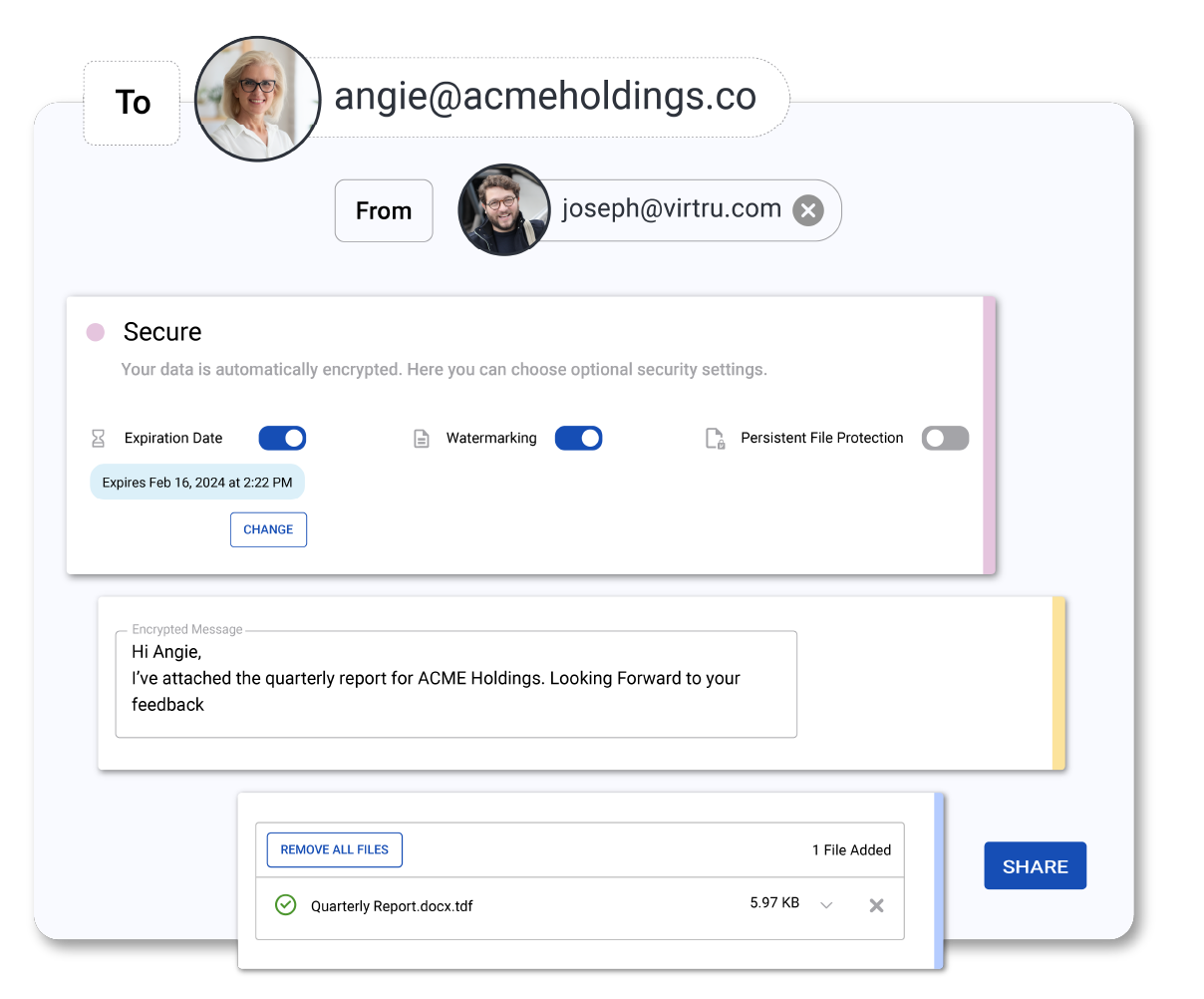
FileCloud for Insurance

FileCloud offers a unique blend of secure file sharing, compliance, and collaboration tools, specifically tailored for the insurance industry. This solution aids in seamless remote access and sharing of files, ensuring that data is secure and compliant with industry regulations, thereby facilitating effective collaboration among teams and with clients.

Best for Secure File Transfer Tools for Insurance Agents

Expert Take

FileCloud for Insurance is tailored for the insurance industry, offering secure file sharing and compliance features that are critical for this sector. Its capabilities in remote access and collaboration make it a strong choice for insurance professionals. While setup complexity and training needs are noted, its specialized features and compliance focus justify its premium positioning.

Pros

  • Unlimited file versioning included
  • FIPS 140-2 & HIPAA compliant
  • Hybrid & on-premise deployment options
  • Unlimited external users (Essentials tier)
  • Granular data residency controls

Cons

  • Minimum 10-20 user purchase required
  • Sync client performance issues reported
  • Mobile app slower than desktop
  • Fewer native integrations than Box
  • Advanced tier pricing requires quote

Best for teams that are

  • Firms requiring strict data residency control (on-premise) and HIPAA compliance
  • Organizations needing secure remote access to network files without a VPN
  • IT managers wanting granular control over user permissions and device management

Skip if

  • Very small teams wanting a zero-maintenance, purely cloud-based tool
  • Non-technical admins who find self-hosting setup too complex
  • Users who prefer a simple SaaS interface over deep customization

Best for teams that are

  • Firms requiring strict data residency control (on-premise) and HIPAA compliance
  • Organizations needing secure remote access to network files without a VPN
  • IT managers wanting granular control over user permissions and device management

Skip if

  • Very small teams wanting a zero-maintenance, purely cloud-based tool
  • Non-technical admins who find self-hosting setup too complex
  • Users who prefer a simple SaaS interface over deep customization

Pros

  • Unlimited file versioning included
  • FIPS 140-2 & HIPAA compliant
  • Hybrid & on-premise deployment options
  • Unlimited external users (Essentials tier)
  • Granular data residency controls

Cons

  • Minimum 10-20 user purchase required
  • Sync client performance issues reported
  • Mobile app slower than desktop
  • Fewer native integrations than Box
  • Advanced tier pricing requires quote

Expert Take

FileCloud for Insurance is tailored for the insurance industry, offering secure file sharing and compliance features that are critical for this sector. Its capabilities in remote access and collaboration make it a strong choice for insurance professionals. While setup complexity and training needs are noted, its specialized features and compliance focus justify its premium positioning.

FileCloud Secure Transfer

FileCloud is specifically designed for businesses in the contracting sector, offering secure file transfer that prevents unauthorized access to sensitive project data. It ensures the safeguarding of proprietary information both in transit and at rest, which is critical in an industry where data security is paramount.

Best for Secure File Transfer Tools for Contractors

Expert Take

FileCloud Secure Transfer excels in providing secure file transfer solutions tailored for contractors, with strong encryption and advanced sharing controls. While the user interface could be more intuitive, its security features and multi-platform support make it a top choice in its category.

Pros

  • Unlimited file size transfers
  • Hybrid and on-premises deployment
  • FIPS 140-2 & ITAR compliance
  • Zero Trust File Sharing
  • Granular DRM access controls

Cons

  • Mobile app lacks desktop features
  • Minimum user count requirements
  • Complex setup for non-tech users
  • Higher entry cost for small teams
  • Occasional sync issues reported

Best for teams that are

  • Defense contractors needing strict CMMC/ITAR data compliance. [cite: 9, 10]
  • Enterprises requiring self-hosted or highly controlled data residency. [cite: 11]

Skip if

  • Small businesses without IT staff, as setup can be complex. [cite: 12]
  • Users primarily needing native integrations with web builders like Wix. [cite: 12]

Best for teams that are

  • Defense contractors needing strict CMMC/ITAR data compliance. [cite: 9, 10]
  • Enterprises requiring self-hosted or highly controlled data residency. [cite: 11]

Skip if

  • Small businesses without IT staff, as setup can be complex. [cite: 12]
  • Users primarily needing native integrations with web builders like Wix. [cite: 12]

Pros

  • Unlimited file size transfers
  • Hybrid and on-premises deployment
  • FIPS 140-2 & ITAR compliance
  • Zero Trust File Sharing
  • Granular DRM access controls

Cons

  • Mobile app lacks desktop features
  • Minimum user count requirements
  • Complex setup for non-tech users
  • Higher entry cost for small teams
  • Occasional sync issues reported

Expert Take

FileCloud Secure Transfer excels in providing secure file transfer solutions tailored for contractors, with strong encryption and advanced sharing controls. While the user interface could be more intuitive, its security features and multi-platform support make it a top choice in its category.

Globalscape Secure File Sharing

Globalscape's Secure File Sharing offers a robust tool for ecommerce businesses that need to securely share large files, regardless of platform. It caters specifically to the industry's needs for secure digital asset exchange, ensuring data protection while maintaining ease of use.

Best for Secure File Transfer Tools for Ecommerce Businesses

Expert Take

Globalscape Secure File Sharing is tailored for ecommerce businesses requiring secure and efficient file transfers. It excels in product capability and security, supported by industry recognition and certifications. Its usability and integration capabilities further enhance its standing as a premium solution.

Pros

  • No-code Advanced Workflow Engine
  • Native PCI, HIPAA, GDPR modules
  • DMZ Gateway prevents data exposure
  • Supports SFTP, FTPS, AS2, HTTPS
  • Active-Active High Availability support

Cons

  • Pricing is high and opaque
  • Reporting database performance issues
  • HA upgrades require downtime
  • Steep learning curve for advanced features
  • Large file transfer limitations

Best for teams that are

  • Retailers and financial firms needing strict PCI DSS, SOX, or FTC regulatory compliance.
  • Windows-centric organizations looking to replace legacy FTP servers with secure MFT.
  • Enterprises requiring centralized management of complex, automated file workflows.

Skip if

  • Small businesses with basic, ad-hoc file sharing needs and limited IT budgets.
  • Mac-centric environments or teams seeking a lightweight, cloud-native only tool.

Best for teams that are

  • Retailers and financial firms needing strict PCI DSS, SOX, or FTC regulatory compliance.
  • Windows-centric organizations looking to replace legacy FTP servers with secure MFT.
  • Enterprises requiring centralized management of complex, automated file workflows.

Skip if

  • Small businesses with basic, ad-hoc file sharing needs and limited IT budgets.
  • Mac-centric environments or teams seeking a lightweight, cloud-native only tool.

Pros

  • No-code Advanced Workflow Engine
  • Native PCI, HIPAA, GDPR modules
  • DMZ Gateway prevents data exposure
  • Supports SFTP, FTPS, AS2, HTTPS
  • Active-Active High Availability support

Cons

  • Pricing is high and opaque
  • Reporting database performance issues
  • HA upgrades require downtime
  • Steep learning curve for advanced features
  • Large file transfer limitations

Expert Take

Globalscape Secure File Sharing is tailored for ecommerce businesses requiring secure and efficient file transfers. It excels in product capability and security, supported by industry recognition and certifications. Its usability and integration capabilities further enhance its standing as a premium solution.

8
9.7 / 10
Meshnet

Meshnet offers secure, peer-to-peer virtual LANs, ideal for gamers, remote workers, and privacy enthusiasts. It enables global traffic routing through home IP addresses, boasting strong NordLynx encryption and seamless connection of up to 60 devices.

Best for Secure File Transfer Tools for Contractors

Expert Take

NordVPN’s Meshnet fundamentally democratizes secure, peer-to-peer virtual local area networks (LANs). By decoupling this feature from its paid VPN tiers and releasing its core source code, NordVPN has provided immense value to gamers, remote workers, and privacy enthusiasts. It cleanly bypasses complex port-forwarding configurations while allowing users to safely route traffic through their own home IP addresses globally. With strong end-to-end NordLynx encryption, Meshnet transforms how everyda

Pros

  • 100% free without a premium NordVPN subscription
  • Connects up to 60 global devices seamlessly
  • Recently open-sourced to ensure code transparency
  • Peer-to-peer file transfers feature no size limits

Cons

  • Speeds are bottlenecked by local upload capacity
  • Occasional timeouts during massive file transfers
  • Host machines must remain active and online

Best for teams that are

  • Remote workers bypassing IP whitelisting to access local office networks. [cite: 41]
  • Tech-savvy users wanting a free P2P network for secure file sharing. [cite: 42, 43]

Skip if

  • Large teams needing centralized administrative controls, SSO, or audit logs. [cite: 41]
  • Enterprises requiring HIPAA/SOC 2 compliance or formal data governance. [cite: 41]

Best for teams that are

  • Remote workers bypassing IP whitelisting to access local office networks. [cite: 41]
  • Tech-savvy users wanting a free P2P network for secure file sharing. [cite: 42, 43]

Skip if

  • Large teams needing centralized administrative controls, SSO, or audit logs. [cite: 41]
  • Enterprises requiring HIPAA/SOC 2 compliance or formal data governance. [cite: 41]

Pros

  • 100% free without a premium NordVPN subscription
  • Connects up to 60 global devices seamlessly
  • Recently open-sourced to ensure code transparency
  • Peer-to-peer file transfers feature no size limits

Cons

  • Speeds are bottlenecked by local upload capacity
  • Occasional timeouts during massive file transfers
  • Host machines must remain active and online

Expert Take

NordVPN’s Meshnet fundamentally democratizes secure, peer-to-peer virtual local area networks (LANs). By decoupling this feature from its paid VPN tiers and releasing its core source code, NordVPN has provided immense value to gamers, remote workers, and privacy enthusiasts. It cleanly bypasses complex port-forwarding configurations while allowing users to safely route traffic through their own home IP addresses globally. With strong end-to-end NordLynx encryption, Meshnet transforms how everyda

Smash Large File Transfer

Smash's Large File Transfer service is an ideal solution for marketing agencies looking to send large files swiftly and securely. Its ability to allow the transfer of large files up to 5 times faster than other services makes it particularly advantageous for agencies dealing with high-resolution media files, advertising assets, and large-scale project data.

Best for Secure File Transfer Tools for Marketing Agencies

Expert Take

Smash Large File Transfer excels in providing a fast and secure solution for marketing agencies needing to manage large files. Its unique features like unlimited file size and file preview enhance usability, while its competitive pricing and security measures make it a strong contender in the secure file transfer market.

Pros

  • Unlimited file size on free tier
  • No account registration required
  • Password protection included for free
  • Customizable download page branding
  • Robust API and Node.js SDK

Cons

  • No resume for interrupted uploads
  • Queue/throttling for free files >2GB
  • Pro plan limited to 250GB/transfer
  • Requires stable internet connection
  • Files expire after 7-30 days

Best for teams that are

  • Creative professionals needing unlimited file size transfers for free.
  • Organizations seeking eco-friendly, ephemeral file sharing solutions.

Skip if

  • Enterprises requiring advanced workflow automation and compliance archiving.
  • Teams needing persistent, long-term document collaboration and editing.

Best for teams that are

  • Creative professionals needing unlimited file size transfers for free.
  • Organizations seeking eco-friendly, ephemeral file sharing solutions.

Skip if

  • Enterprises requiring advanced workflow automation and compliance archiving.
  • Teams needing persistent, long-term document collaboration and editing.

Pros

  • Unlimited file size on free tier
  • No account registration required
  • Password protection included for free
  • Customizable download page branding
  • Robust API and Node.js SDK

Cons

  • No resume for interrupted uploads
  • Queue/throttling for free files >2GB
  • Pro plan limited to 250GB/transfer
  • Requires stable internet connection
  • Files expire after 7-30 days

Expert Take

Smash Large File Transfer excels in providing a fast and secure solution for marketing agencies needing to manage large files. Its unique features like unlimited file size and file preview enhance usability, while its competitive pricing and security measures make it a strong contender in the secure file transfer market.

Diplomat MFT Secure Transfer

Diplomat MFT is a perfect solution for Insurance Agents who need to handle sensitive data securely. Its powerful encryption and automation features eliminate the risks associated with manual transfers, ensuring data safety and compliance. Furthermore, its audit-ready design assures that industry-specific regulatory requirements are met, easing the burden of data management for agents.

Best for Secure File Transfer Tools for Insurance Agents

Expert Take

Diplomat MFT Secure Transfer excels in providing secure and compliant file transfer solutions tailored for insurance agents. Its strong encryption, automation capabilities, and audit-ready design make it a top choice for handling sensitive data. Despite requiring technical skills for setup, it remains a premium product in its category.

Pros

  • 20+ years breach-free record
  • Transparent public pricing tiers
  • Built-in PGP encryption automation
  • Exceptional customer support ratings
  • No-code workflow orchestration

Cons

  • SFTP Server requires Enterprise Edition
  • Interface lacks modern web polish
  • Large price jump to Enterprise
  • Manual key management in older versions
  • Steep learning curve for some

Best for teams that are

  • Operations needing affordable, automated PGP/SFTP transfers without scripting
  • Teams focusing on scheduled backend data transfers rather than user sharing
  • Organizations needing 340B compliance or specific healthcare data automation

Skip if

  • Users needing a modern, slick web interface for ad-hoc client sharing
  • Teams requiring extensive mobile app support or real-time collaboration
  • Those needing 24/7 support on lower-tier plans

Best for teams that are

  • Operations needing affordable, automated PGP/SFTP transfers without scripting
  • Teams focusing on scheduled backend data transfers rather than user sharing
  • Organizations needing 340B compliance or specific healthcare data automation

Skip if

  • Users needing a modern, slick web interface for ad-hoc client sharing
  • Teams requiring extensive mobile app support or real-time collaboration
  • Those needing 24/7 support on lower-tier plans

Pros

  • 20+ years breach-free record
  • Transparent public pricing tiers
  • Built-in PGP encryption automation
  • Exceptional customer support ratings
  • No-code workflow orchestration

Cons

  • SFTP Server requires Enterprise Edition
  • Interface lacks modern web polish
  • Large price jump to Enterprise
  • Manual key management in older versions
  • Steep learning curve for some

Expert Take

Diplomat MFT Secure Transfer excels in providing secure and compliant file transfer solutions tailored for insurance agents. Its strong encryption, automation capabilities, and audit-ready design make it a top choice for handling sensitive data. Despite requiring technical skills for setup, it remains a premium product in its category.

Loading comparison data…

How We Rank Products

Our Evaluation Process

Evaluation of Secure File Transfer Tools involves assessing key features such as encryption protocols, integration flexibility, and scalability options. Transparent pricing and the ability to seamlessly integrate with existing systems are crucial evaluation criteria. Customer feedback from third-party sources is also considered to provide insights into real-world performance and reliability. These factors help determine the suitability of each tool in meeting specific business requirements.

Verification

  • Products evaluated through comprehensive research and analysis of security features and user feedback.
  • Rankings based on a thorough examination of encryption standards, transfer speeds, and user ratings.
  • Selection criteria focus on compliance with industry standards and user satisfaction metrics.

Score Breakdown

0.0 / 10

About Secure File Transfer Tools

What Is Secure File Transfer Tools?

This category covers software used to secure, automate, and audit the exchange of sensitive data between systems, employees, and external partners. Unlike basic file sharing or email attachments, Secure File Transfer Tools (often referred to in the enterprise as Managed File Transfer or MFT) are designed to handle critical "data in motion" and "data at rest" with rigorous compliance, encryption, and reliability standards. These tools manage the full lifecycle of a file transfer: from initiation and authentication to encryption, transmission, integrity verification, and final delivery confirmation. They serve as the central nervous system for data exchange, replacing fragile, ad-hoc scripts with a governed, visible platform.

It sits between Enterprise File Sync and Share (EFSS)—which focuses on human-centric collaboration like folder syncing and document co-editing—and Integration Platform as a Service (iPaaS), which focuses on granular, API-based data transformation and application logic. While EFSS tools prioritize user experience for general office documents, Secure File Transfer Tools prioritize the security, speed, and automation of bulk data, sensitive compliance artifacts, and high-volume system-to-system transactions.

It includes both system-centric solutions designed for automated server-to-server transfers (often using protocols like SFTP, AS2, or OFTP2) and people-centric solutions that provide secure ad-hoc transfer capabilities for business users (replacing insecure email attachments). The category encompasses general-purpose platforms suitable for any compliance-heavy industry, as well as vertical-specific tools tailored for sectors like healthcare (HIPAA compliance) and manufacturing (supply chain integration).

History of the Category

The Secure File Transfer category emerged in the 1990s as a response to the growing fragility of the internet’s early data plumbing. In the early days of the web, businesses relied heavily on standard File Transfer Protocol (FTP) to move data. IT administrators would write custom scripts to batch-transfer sales data, inventory lists, or payroll files overnight. However, as [1] notes, the lack of security in basic FTP—which transmits credentials in clear text—and the fragility of custom scripts created a "gap" that demanded a professional solution. If a script failed at 2:00 AM, business processes ground to a halt until an administrator manually intervened.

The 2000s marked the "Compliance Era" for this category. Regulations like HIPAA (1996), Sarbanes-Oxley (2002), and later PCI DSS forced companies to abandon ad-hoc scripts. Auditors demanded proof: Who sent the file? Was it encrypted? Did it arrive intact? This pressure birthed "Managed File Transfer" (MFT) as a distinct software market. Vendors began wrapping the raw FTP protocol in layers of management: centralized logging, automation engines, and encryption management. As noted in historical timelines [2], this era shifted buyer expectations from simply "moving files" to ensuring "governance and visibility."

From 2010 to present, the market has been defined by the shift from on-premises "appliances" to cloud-native and hybrid architectures. Early solutions were strictly physical servers sitting in a corporate DMZ. Today, with the rise of the hybrid enterprise, buyers expect tools that can orchestrate transfers between a legacy mainframe, an AWS S3 bucket, and a SaaS CRM seamlessly. We have also seen significant market consolidation, with large infrastructure players acquiring standalone MFT vendors to bundle file transfer into broader security or integration suites [3]. Yet, despite the rise of APIs, the sheer volume of bulk data—CAD files, massive database dumps, and video assets—ensures that Secure File Transfer remains a critical, standalone pillar of the enterprise technology stack.

What To Look For

Evaluating Secure File Transfer tools requires looking beyond simple "upload and download" buttons. The differentiator between a consumer-grade tool and a professional secure transfer platform lies in automation, auditability, and protocol support. A robust solution must offer an automation engine that can trigger transfers based on events (e.g., "when a file lands in Folder A, encrypt it and send it to Partner B") rather than just time-based schedules. This event-driven architecture is critical for modern real-time business processes.

Security and Compliance Controls are the non-negotiable baseline. Look for "data at rest" encryption (encrypting files while they sit on the server) in addition to standard "data in transit" encryption (SSL/TLS). Superior tools offer granular role-based access control (RBAC), allowing you to define exactly which sub-folders a specific partner or employee can access. Critical features also include Data Loss Prevention (DLP) integration, which scans files for sensitive patterns (like credit card numbers) and blocks the transfer automatically if a violation is detected [4].

Red flags during evaluation include a lack of detailed logging. If the tool cannot generate a report showing exactly which IP address accessed a file and the precise timestamp of the download, it is unfit for regulated industries. Another warning sign is limited protocol support; a modern tool should handle not just SFTP, but also specialized protocols like AS2 (for retail) or HTTPS (for web access) without requiring expensive add-ons. Finally, be wary of vendors that charge exorbitant fees for "connectors" to common cloud storage services like Azure Blob or Amazon S3, as hybrid cloud connectivity is now a standard requirement, not a luxury [5].

Key Questions to Ask Vendors:

  • Does the platform support "checkpoint restart" to automatically resume interrupted transfers of large files without restarting from zero?
  • How does the licensing model scale? Is it based on the number of "partners" (connections) or the volume of data transferred?
  • Can the automation engine execute custom scripts or call external APIs as part of a workflow step?
  • Does the solution offer a "DMZ gateway" or proxy architecture to keep incoming connections out of the internal private network?

Industry-Specific Use Cases

Retail & E-commerce

In the retail sector, Secure File Transfer tools are the silent engine behind the supply chain. Retailers rely on these tools to exchange massive inventory catalogs, high-volume order batches, and invoices with thousands of suppliers and logistics partners. The priority here is automation and EDI support. Unlike a human emailing a spreadsheet, these systems must automatically pull inventory CSVs from an ERP system, convert them to the required format, and push them to suppliers via AS2 or SFTP protocols. Compliance with PCI DSS is paramount because these files often contain transaction data involving credit card information [6].

Evaluation priorities for e-commerce businesses include high-availability architectures that ensure transfers happen even during Black Friday traffic spikes. A unique consideration is the ability to onboard new partners quickly. Retailers often churn through suppliers; a tool that requires days of engineering work to add a new connection is a bottleneck. Look for "partner portal" features that allow vendors to self-configure their connection settings, offloading work from your internal IT team [7].

Healthcare

Healthcare organizations use Secure File Transfer tools to bridge the gap between interoperability and strict patient privacy. The core use case involves transferring Protected Health Information (PHI)—such as patient records, insurance claims, and massive medical imaging files (DICOM)—between hospitals, insurance payers, and research institutions. The overriding need is HIPAA compliance and data integrity. A corrupted medical image or a leaked patient record can have life-altering consequences and result in massive regulatory fines [4].

Unlike retail, where speed is key, healthcare prioritizes audit trails and non-repudiation. The system must prove beyond a doubt that File X was sent by Doctor A and received by Clinic B at a specific time. Unique considerations include the ability to integrate with Electronic Health Record (EHR) systems and support for large file sizes, as a single MRI dataset can be gigabytes in size. Tools that offer "secure email" features for ad-hoc doctor-to-patient transfers are also highly valued in this sector [6].

Financial Services

Banks, investment firms, and insurance companies operate in a high-stakes environment where data security is synonymous with financial solvency. Use cases range from batch-processing millions of overnight transactions to securely exchanging loan applications containing Social Security numbers. The critical evaluation priority is security depth: features like FIPS 140-2 validated encryption, integration with Hardware Security Modules (HSM), and DLP integration are often mandatory. Compliance with GLBA, SOX, and regional banking standards drives every purchase decision [8].

A unique consideration for financial services is workflow orchestration. These institutions often have legacy mainframes that need to talk to modern fintech apps. The secure file transfer tool acts as a translator and bridge, moving data from a 30-year-old mainframe COBOL system to a modern cloud data lake for analytics. Reliability is non-negotiable; a failed transfer of a "global payments" file can disrupt markets or delay funds for thousands of customers [7].

Manufacturing

Manufacturers use Secure File Transfer tools to protect their most valuable asset: Intellectual Property. They transfer complex CAD/CAM designs, proprietary formulas, and technical specifications to third-party fabrication plants and suppliers globally. The specific need here is IP protection and handling massive binary files. Unlike text-based CSVs, engineering files are huge and complex; a transfer tool must ensure they don't get corrupted during transmission over poor network connections in remote factory locations [9].

The automotive sector, in particular, relies on a specific protocol called OFTP2 (Odette File Transfer Protocol), which is designed specifically for the secure exchange of automotive data over the internet. A general-purpose tool that lacks OFTP2 support is often a non-starter for major auto supply chains. Manufacturers also increasingly use these tools to aggregate data from IoT devices on the factory floor, requiring the tool to handle high-frequency, smaller file uploads from thousands of endpoints [10].

Professional Services

Law firms, consultancies, and accounting firms sell trust. They use Secure File Transfer tools to exchange sensitive client artifacts—contracts, discovery evidence, and audit results—without exposing them to the vulnerabilities of email. The priority is ease of use for non-technical staff. Attorneys and accountants will not use a command-line interface; they need a secure, Outlook-integrated plugin or a simple web portal that feels like a consumer app but acts like a fortress [11].

A unique consideration for legal services is metadata scrubbing. When transferring a Word document via a secure tool, the system should ideally integrate with or support processes to remove "track changes" history and hidden comments that could compromise a client's negotiating position. Furthermore, the "chain of custody" reporting is vital for e-discovery; firms must be able to prove in court exactly when a piece of evidence was transferred and who accessed it [12].

Subcategory Overview

Secure File Transfer Tools for Ecommerce Businesses

What sets ecommerce-focused file transfer tools apart is their ability to bridge the gap between modern, API-driven web storefronts and legacy, batch-driven supplier systems. While a generic tool moves files from A to B, an ecommerce-specific solution is designed to handle the high-velocity "inventory sync" workflow. A generic tool might fail to alert you if a supplier's inventory CSV is malformed, leading to you selling out-of-stock products. Specialized tools often include basic data parsing capabilities to validate that the "Price" column is actually a number before the file hits your ERP.

The workflow that ONLY this niche handles well is the Drop-Ship Automation Loop. In this scenario, your store automatically exports order files every hour; the tool encrypts them, translates them into the specific CSV or EDI format each of your 50 different suppliers requires, and routes them via SFTP or AS2. It then watches for the "Tracking Number" return file, parses it, and updates your Shopify or Magento store status. Generic tools lack the commerce-aware logic to handle the parsing and status updates effectively. Buyers flock to our guide to Secure File Transfer Tools for Ecommerce Businesses when they realize their generic FTP client can't handle the logic required to manage hundreds of heterogeneous supplier connections without constant manual intervention.

Secure File Transfer Tools for Contractors

For contractors in construction and engineering, the differentiator is "ephemeral field access." Generic secure transfer tools assume the recipient is a desk worker with a stable internet connection and a corporate laptop. Contractor-focused tools are built for the reality of the job site: mobile-first interfaces, support for viewing massive BIM/CAD files on an iPad without downloading 5GB of data, and permission structures that handle transient workforces. A general tool requires creating a permanent user account for every subcontractor; specialized tools excel at "project-based" access that automatically expires when the contract ends.

The workflow that this niche dominates is the Bid Package Distribution. A general contractor needs to send a 2GB set of blueprints to 20 different electrical subcontractors for bidding. The specialized tool allows the GC to send a secure link that tracks exactly who opened the blueprints and which version they saw. If the blueprints are updated, the link automatically serves the new version, preventing the costly mistake of a sub bidding on outdated plans. The pain point driving buyers to Secure File Transfer Tools for Contractors is the version control chaos and "file size limit" errors that plague email or basic cloud drives when dealing with complex construction data.

Secure File Transfer Tools for Marketing Agencies

Marketing agencies deal with "creative" data—video rushes, high-res photography, and InDesign files—which behave differently than corporate database rows. The key distinction here is visual verification and client experience. A generic secure transfer tool presents a file list like a directory: `CAM_1_FINAL.mov`. A marketing-specific tool presents a visual gallery with playback capabilities. The "transfer" is not just about moving the file; it's about the client approval process that happens around the file.

The unique workflow is the Asset Approval Tunnel. An agency sends a 4K video spot to a client. The client can stream the secure file directly from the transfer portal without downloading it (which might take hours) and leave time-coded comments. The transfer tool acts as a collaboration layer on top of the security layer. Generic MFT tools frustrate creative clients who just want to "see the video" without installing decryption software. Agencies move to specialized Secure File Transfer Tools for Marketing Agencies because "security friction" in generic tools kills the creative momentum and frustrates non-technical brand managers.

Secure File Transfer Tools for Digital Marketing Agencies

Distinct from the "creative" agencies above, Digital Marketing Agencies deal with "audience data"—lists of customer emails, cookie IDs, and CRM exports used for ad targeting. The niche differentiator here is PII Compliance and Ad-Tech Integration. While creative agencies need video playback, digital agencies need a tool that can securely hash email lists (SHA-256) before sending them to platforms like Facebook or Google for customer matching. The focus is not on file size, but on data privacy regulations like GDPR and CCPA.

A workflow unique to this group is the Secure Audience Onboarding pipeline. The agency receives a raw customer list from a client via a secure upload portal. The tool automatically scans the CSV to ensure no unhashed credit card numbers are present (DLP), encrypts the file, and then securely pushes it to a Data Management Platform (DMP) via API. Generic tools lack the specific "hashing" and ad-platform connectors required here. Buyers choose Secure File Transfer Tools for Digital Marketing Agencies because mishandling this data—even once—can lead to massive privacy lawsuits and loss of platform access.

Secure File Transfer Tools for Insurance Agents

The insurance niche requires tools that act as "Digital Intake Lockboxes." Unlike other categories where the focus is often on sending, insurance agents primarily need a secure, friction-free way for clients to upload evidence—photos of car accidents, medical reports, and identity documents. The differentiator is the Zero-Barrier Uplink. Generic tools often require the sender (the client) to create an account to upload securely. Insurance-specific tools allow agents to send a "secure request link" that lets a client upload files from their phone without registering, while still maintaining encryption.

The critical workflow is Claims Evidence Collection. An agent is on the phone with a distressed client at a crash site. The agent texts a secure link from the tool. The client clicks, snaps photos of the damage, and uploads them instantly. The files are automatically routed to the correct case folder in the agent's system and scanned for malware. The pain point driving agents to Secure File Transfer Tools for Insurance Agents is the friction of forcing stressed clients to "log in" to a portal just to send a picture, leading clients to resort to insecure text messaging or email.

Integration & API Ecosystem

In the modern enterprise, a Secure File Transfer tool that stands alone is a silo that creates debt. The true power of these tools lies in their integration capabilities, specifically how well they play with the broader ecosystem of iPaaS (Integration Platform as a Service) and API management. According to research by [3], the managed file transfer market is projected to grow to $2.68 billion by 2029, largely driven by the demand for "API integration and interoperability." This growth underscores that buyers are no longer looking for a standalone FTP server; they are looking for a connected orchestration node.

Expert Insight: A report from [13] highlights that "MFT and iPaaS are complementary," noting that while iPaaS handles granular logic, MFT is essential for "guaranteeing delivery and security without the overhead of parsing" large payloads. Essentially, you use MFT to move the heavy box securely to the doorstep, and iPaaS to open the box and sort the contents.

Scenario: Consider a 50-person logistics firm that uses a legacy on-premise Warehouse Management System (WMS) and a modern cloud-based NetSuite ERP. They need to sync shipping manifests every hour. A poorly designed integration relies on a custom Python script running on a desktop machine to move these files. When the internet blips or the desktop updates its OS, the script fails silently. The firm doesn't know orders aren't processing until customers complain. By implementing an MFT solution with robust APIs, they replace the script with a managed workflow. The MFT tool uses a "Folder Monitor" agent on the legacy WMS server to detect new files, encrypts them, and pushes them to NetSuite via API. If the connection drops, the MFT tool's "checkpoint restart" feature pauses the transfer and resumes it automatically when connectivity returns, alerting the IT admin via Slack webhook only if the retry limit is exceeded. This shifts the process from "hope-based" to "guarantee-based."

Security & Compliance

Security is the bedrock of this category. The cost of failure is astronomical. The IBM Cost of a Data Breach Report 2024 reveals that the global average cost of a data breach has reached a staggering $4.88 million [14]. Even more alarming for file transfer specifically is the role of human error; the [15] Verizon 2024 Data Breach Investigations Report notes that the "human element" was a component in 68% of breaches. This statistic is the single strongest argument for replacing "user-driven" email attachments with "system-driven" automated file transfers.

Expert Insight: As noted by [16], "Companies that lead with [Secure File Transfer] realize that fast, sloppy data is just as good as no data at all – or it might as well be breached data." The expert consensus is that relying on encryption during transit (HTTPS/SFTP) is no longer enough; "Data at Rest" encryption is now the standard to protect files sitting on the server waiting to be picked up.

Scenario: Imagine a regional bank that needs to send a "Positive Pay" file (a list of approved checks) to the Federal Reserve daily. They historically used a manually triggered SFTP client. One day, a junior analyst accidentally uploads the file to the wrong external folder because the interface was confusing and lacked restrictions. The file contained unencrypted account numbers. In a proper Secure File Transfer environment, this risk is engineered out. The bank implements a solution with strict Data Loss Prevention (DLP) rules. Now, when the user tries to upload the file, the MFT tool scans the content. It recognizes the pattern of account numbers and checks the destination. If the destination is not on the "Allow List" for financial data, the transfer is blocked instantly, and the Compliance Officer is notified. The user cannot make the mistake even if they try.

Pricing Models & TCO

Pricing in this category has shifted from perpetual "per-server" licenses to consumption-based or "per-connection" subscription models. Understanding Total Cost of Ownership (TCO) requires looking beyond the sticker price. A cloud-based MFT solution might appear more expensive monthly than an on-premise server, but the hidden costs of the latter are significant. A TCO analysis by [17] suggests that for 24x7 workloads, cloud costs can be higher (~$854K vs ~$411K over 5 years), but this assumes 100% utilization. For typical bursty file transfer workloads (e.g., end-of-month reporting), the elasticity of cloud pricing can actually undercut rigid on-premise hardware costs significantly.

Expert Insight: According to [18], "For organisations with stable, predictable IT needs... the cumulative costs of cloud subscriptions may exceed the cost of owning and maintaining on-premises infrastructure." However, they note that cloud models offer "predictable and scalable" structures that CFOs often prefer to avoid CapEx spikes.

Scenario: Let's calculate the TCO for a hypothetical 25-person marketing agency transferring 10TB of video data annually. Option A (On-Premises): They buy a $5,000 server and a $10,000 perpetual software license. Maintenance is 20% annually ($2,000). They also need a dedicated IT admin (allocating 10% of a $100k salary = $10k/year) to patch the OS and manage backups. Option B (SaaS MFT): They pay a flat fee of $15,000/year which includes 10TB bandwidth and unlimited users. Over 3 years: On-Prem = $15k (upfront) + $6k (maintenance) + $30k (labor) + electricity/cooling = ~$55,000+. SaaS = $15k * 3 = $45,000. Crucially, the SaaS option also eliminates the "opportunity cost" of the IT admin's time, allowing them to focus on revenue-generating projects rather than patching an FTP server. The agency saves money and gains agility.

Implementation & Change Management

The technical installation of Secure File Transfer software is often the easy part; the challenge is user adoption. "Shadow IT" is the enemy of implementation. If the official tool is clunky or requires a 10-step login process, employees will revert to using their personal Dropbox or WeTransfer accounts, rendering your security investment useless. A Forrester study [19] highlights that migrating legacy on-premise solutions to the cloud can reduce TCO by 3.4%, largely by "reducing the burden on IT systems administrators" and improving user accessibility.

Expert Insight: As [20] notes, "Many IT professionals have a go-to technology that they've used before... It is wise to conduct thorough research to ensure you're not backing the wrong technology." This speaks to the need for change management that focuses on requirements rather than habit.

Scenario: A manufacturing company decides to replace its legacy scripts with a modern MFT platform. The IT team installs the tool but fails to train the non-technical procurement team. The procurement officers find the web portal confusing and return to emailing unencrypted PDF purchase orders to suppliers. Six months later, a supplier's email is compromised, and the manufacturer loses $50,000 in a fraudulent invoice scam. A successful implementation would have involved a "Pilot Phase" where the procurement team helped design the portal interface. The IT team could have set up an "Email-to-MFT" bridge, allowing users to send files via their familiar email client while the MFT tool stripped the attachments and replaced them with secure links automatically behind the scenes. This creates security without forcing a change in user behavior.

Vendor Evaluation Criteria

When selecting a vendor, you are choosing a partner for your data's safety, not just buying code. The evaluation must go beyond the feature checklist. Critical criteria include the vendor's vulnerability response time (how quickly did they patch the last major CVE?) and their support ecosystem. [21] warns that "Vendors in this space, who notoriously feature lackluster support organizations and product roadmaps... will be left behind." You do not want to be stuck with a "zombie" vendor that is collecting maintenance fees but not innovating.

Expert Insight: [22] (referencing a Forrester TEI methodology) emphasizes identifying "flexibility and risk factors" in the investment decision. A vendor that locks you into a proprietary protocol or data format creates a high long-term risk.

Scenario: An enterprise evaluates Vendor X and Vendor Y. Both check all the technical boxes (SFTP, Encryption, Automation). Vendor X is 20% cheaper. However, during the Proof of Concept (POC), the buyer logs a "Severity 2" support ticket. Vendor Y responds in 30 minutes with a qualified engineer. Vendor X takes 48 hours and sends a generic KB link. The buyer chooses Vendor Y. Two years later, when a critical SSL certificate expires on a Sunday night, halting all supply chain transfers, that 30-minute response time saves the company millions in potential lost orders, dwarfing the initial 20% price difference. The lesson: Support quality is a feature.

Emerging Trends and Contrarian Take

Emerging Trends 2025-2026: The immediate future of Secure File Transfer is AI-Driven Anomaly Detection. Traditional MFT relies on static rules (e.g., "Alert if transfer fails"). Emerging tools use machine learning to establish a baseline of "normal" activity. If a user who typically downloads 10MB on Fridays suddenly downloads 5GB on a Tuesday at 2 AM, the system triggers a behavioral alert before the data leaves the network [21]. Another trend is the convergence of MFT with DataOps pipelines [23], where file transfer is no longer just "moving files" but an integrated step in a broader data analytics workflow, triggering downstream ETL processes automatically.

Contrarian Take: The "Secure File Transfer" category is slowly dissolving into the "Integration" layer. For decades, MFT was a standalone island. But as businesses move from "batch processing" to "real-time streaming," the need to move a static file from Point A to Point B is decreasing relative to the need to stream API data. In 5 to 10 years, standalone MFT tools may become a niche legacy requirement for industries stuck on mainframes (like banking), while the mid-market will simply use "File Connectors" inside their broader iPaaS or Automation platforms (like Zapier or MuleSoft). Buyers today who sign 5-year contracts for massive, standalone MFT monoliths are likely overpaying for a dying architecture. The smart money is on lightweight, API-first MFT tools that accept they are just one node in a larger mesh, rather than the center of the universe.

Common Mistakes

1. Over-Customization of Workflows Buyers often try to make the MFT tool fix their broken business processes by writing complex, custom scripts inside the tool. This creates a "fragile monolith." When the original author leaves, no one knows how to update the script. Best Practice: Keep the MFT logic simple (Move, Encrypt, Alert). Put complex business logic (e.g., parsing data, updating database rows) in a dedicated integration tool or application layer, not the file transfer tool.

2. Ignoring "Data at Rest" Encryption Many organizations obsess over SSL/TLS (encrypting the pipe) but leave the files sitting unencrypted on the server's hard drive once they arrive. If a hacker gains access to the server OS, they can read everything. Best Practice: Ensure your chosen tool automatically encrypts files the moment they land on the disk (using AES-256) and decrypts them only when an authorized user downloads them [24].

3. Underestimating "Shadow IT" Adoption IT teams often buy the most secure tool with the most complex interface, assuming users will be forced to use it. They won't. They will email the file or use a free online transfer service because it's easier. Best Practice: Prioritize User Experience (UX) as highly as security. If the tool offers an Outlook plugin that makes sending a 2GB secure file feel exactly like sending a regular email attachment, adoption will skyrocket [25].

Questions to Ask in a Demo

  • "Show me exactly how a non-technical user sends a secure file to an external client who does not have an account in your system. How many clicks does it take?"
  • "Does your automation engine support 'checkpoint restart' for large files? Can we simulate a network interruption right now to see it recover?"
  • "How do you handle 'secrets management'? Are passwords for my external trading partners stored in plain text, reversible encryption, or integrated with a vault like CyberArk?"
  • "Can I see the audit log for a single file? I want to see the specific IP address, protocol version, and encryption cipher used for a transfer that happened yesterday."
  • "If we need to migrate 10,000 existing transfer definitions from our legacy script environment, what automated tools do you provide to import them?"

Before Signing the Contract

Decision Checklist:

  • Protocol Coverage: Does it support every protocol your partners use today (SFTP, FTPS, AS2) and might use tomorrow (OFTP2, HTTPS)?
  • Scalability clause: Check the limits on "concurrent transfers." Some vendors charge extra if you try to send more than 10 files at once.
  • Data Residency: If you are in the EU or handle GDPR data, ensure the vendor guarantees exactly which physical data center your files will reside in.
  • Exit Strategy: Is your data stored in a proprietary format? If you cancel the subscription, can you easily export your logs and configurations, or will you be locked in?

Deal-Breaker: If the vendor cannot provide a SOC 2 Type II report or ISO 27001 certification upon request, walk away. In the security market, "trust us" is not a valid compliance strategy.

Closing

Secure File Transfer is no longer just about moving data; it is about protecting the lifeblood of your digital ecosystem. Whether you are a small agency protecting creative assets or a global bank securing billions in transactions, the right tool turns a liability into a competitive advantage. Don't settle for "good enough" when the cost of failure is so high.

If you have specific questions about your architecture or need help shortlisting vendors for your unique requirements, feel free to reach out.

Email: albert@whatarethebest.com

Quick one question survey

Thanks for your input!
Your response has been recorded.