WHAT IS REVENUE INTELLIGENCE & FORECASTING PLATFORMS?
The core problem this category solves is the "reality gap" between what sales representatives report in a CRM and what is actually happening in the field. For decades, revenue leaders relied on subjective confidence scores and manual data entry, leading to missed targets and blind spots. Revenue Intelligence automates the capture of "dark data"—the unstructured communications and activity data that never makes it into the CRM manually—and applies machine learning to forecast results with mathematical precision rather than gut instinct. This software is primarily used by Sales Operations, Revenue Operations (RevOps), Sales Leadership (CROs/VPs), and Finance teams to align on a "single number" and allocate resources efficiently.
HISTORY
The trajectory of revenue forecasting technology mirrors the broader evolution of enterprise software: a shift from static data storage to dynamic, actionable intelligence. In the 1990s and early 2000s, the market was dominated by on-premise Contact Management software and early cloud CRMs. These tools solved the problem of digitization—moving rolodexes and spreadsheets into a centralized digital database—but they created a new issue: data hygiene. These systems were "empty shells" that relied entirely on manual entry from sales representatives. If a rep didn't log a call or update a stage, the forecast was effectively fiction. During this era, forecasting was essentially an arithmetic exercise in spreadsheets, exported from the database and manipulated by finance teams.
The mid-2010s marked the emergence of the "Revenue Operations" movement and the birth of true Revenue Intelligence. As cloud computing costs dropped and machine learning capabilities advanced, a new class of vertical SaaS emerged to address the gaps left by horizontal CRMs. The critical innovation was "autocapture"—technology that could automatically scrape emails, calendars, and phone systems to populate the CRM without human intervention. This shifted the value proposition from "manage your contacts" to "understand your deals."
By the late 2010s and early 2020s, market consolidation began to reshape the landscape. Vendors that started as niche "conversation intelligence" tools (recording and transcribing calls) began acquiring or building forecasting modules, while pure-play forecasting platforms added activity capture capabilities. This convergence created the modern Revenue Intelligence platform: a unified system that combines hard data (deal values, dates) with soft data (sentiment, engagement frequency) to predict revenue. Today, buyer expectations have evolved significantly; leaders no longer accept a "system of record" that passively stores data. They demand a "system of insight" that proactively identifies risk, recommends next steps, and predicts the future with high accuracy.
WHAT TO LOOK FOR
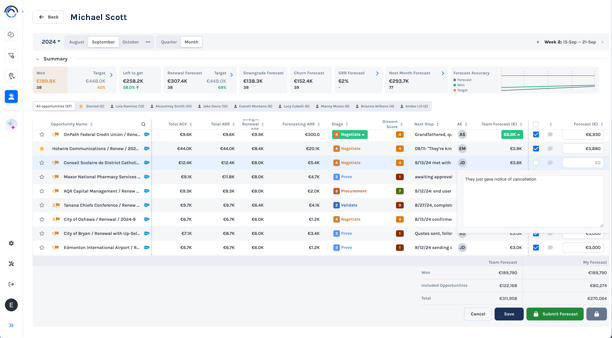
When evaluating Revenue Intelligence & Forecasting Platforms, buyers must prioritize predictive explainability over "black box" scores. A platform might assign a deal a "92% win probability," but unless it can explain why—citing factors like "lack of executive engagement" or "stalled email cadence"—the score is useless for coaching. Look for tools that provide a "waterfall" view of the pipeline, showing exactly how the forecast has changed since the start of the quarter (e.g., slipped deals, pulled-in deals, value changes). This visibility is critical for diagnosing the root cause of forecast variance.
Another critical evaluation criterion is the completeness of data capture. The best platforms do not rely on API calls alone but integrate directly with email servers (Exchange, Gmail) and calendar systems at the root level. This ensures that even if a rep forgets to log an activity or creates a contact on their mobile device, the platform captures the interaction. Ask vendors specifically about their "matching algorithms"—how they associate a stray email address with the correct opportunity record when multiple deals exist for one account. Poor matching logic leads to "data pollution," where activities are attributed to the wrong deal, skewing the forecast.
Red flags include platforms that require extensive manual tagging or "training" periods that last longer than a fiscal quarter. If the vendor claims their AI needs 12 months of your historical data to be accurate, proceed with caution; modern pre-trained models should offer value within weeks, even if they refine over time. Additionally, be wary of tools that lack robust hierarchy management. Enterprise sales teams often have complex matrixed structures (e.g., overlay product specialists, regional managers, vertical leads). If the platform cannot easily model these roll-ups and allow for "split credits" or "overlay forecasts," it will fail during the first end-of-quarter review.
Key questions to ask vendors:
- "How does your model handle seasonality and anomalies (like a one-off mega deal) to prevent skewing future predictions?"
- "Can we create 'shadow forecasts' where managers can override a rep's number without changing the rep's view, allowing for management judgment to be tracked separately?"
- "Does your activity capture distinguish between automated marketing emails and genuine human-to-human sales interactions?"
INDUSTRY-SPECIFIC USE CASES
Retail & E-commerce
In the retail and e-commerce sector, Revenue Intelligence platforms must integrate tightly with inventory management and supply chain data. Unlike B2B service sales, revenue here is constrained by physical availability. A forecast predicting a $5M spike in Q4 is dangerous if the supply chain can only support $3M in product delivery. Evaluation priorities here focus on SKU-level forecasting and the ability to overlay marketing campaign schedules onto revenue projections. Retail buyers often need platforms that can ingest high-volume, low-value transaction data rather than just high-touch deal pipelines. A unique consideration is the impact of returns and chargebacks on "net revenue," which general-purpose tools often overlook.
Healthcare
For healthcare organizations, particularly those selling medical devices or pharmaceuticals, the sales cycle is exceptionally long and involves complex buying committees (clinicians, procurement, hospital administration). Revenue Intelligence tools in this space must be able to map multi-threaded relationships and track engagement across disjointed stakeholders. Compliance is the paramount evaluation priority; the platform must be HIPAA-compliant and capable of scrubbing Protected Health Information (PHI) from captured emails or call transcripts automatically. Furthermore, forecasting in healthcare often involves "usage-based" revenue models (e.g., consumables used in a surgery) rather than simple one-time contracts, requiring a platform that can forecast based on consumption trends rather than just contract signatures.
Financial Services
Financial Services firms, including wealth management and commercial banking, operate in a highly regulated environment where data residency and privacy are non-negotiable. Use cases here heavily emphasize relationship intelligence—identifying who knows whom within a client organization to facilitate cross-selling. For example, a commercial banker needs to know if a wealth management colleague already has a relationship with a prospective corporate client. Deep integration with "walled garden" communication tools (like Bloomberg terminals or compliant chat apps) is often required. Forecasters in this sector also need to account for macro-economic indicators (interest rates, market volatility) that directly impact revenue, a feature rarely found in generic tools.
Manufacturing
Manufacturing sales forecasting is inextricably linked to production capacity and "run-rate" business. Unlike software sales where a deal closes and revenue recognition is immediate, manufacturing deals often look like long-term agreements (LTAs) with variable draw-downs. Platforms here must support demand planning integration, translating "sales probability" into "production demand." A critical evaluation criterion is the ability to forecast "account health" based on operational metrics (e.g., on-time delivery stats) rather than just sales sentiment. If a client is experiencing shipping delays, the Revenue Intelligence platform should flag the renewal revenue as "at risk" automatically.
Professional Services
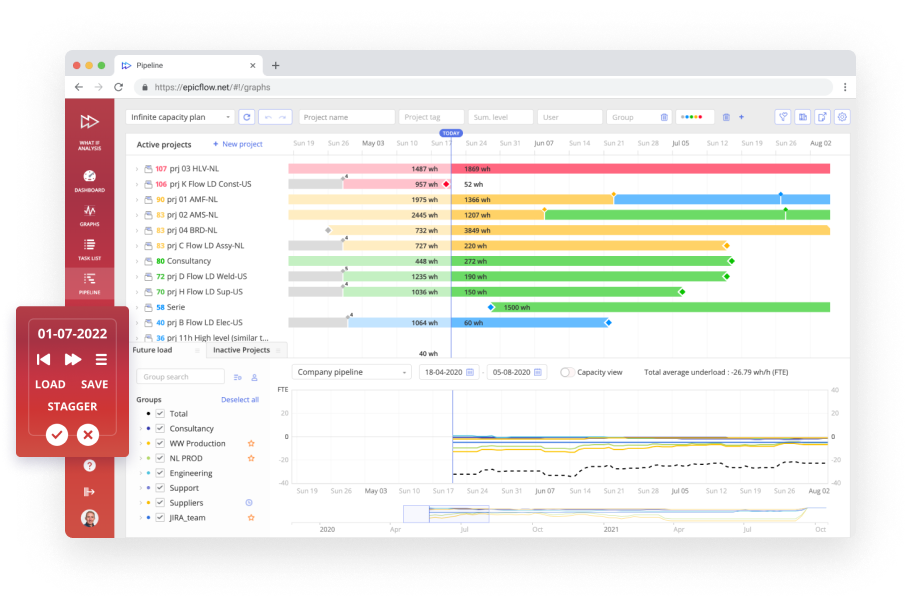
For Professional Services firms (consultancies, agencies), revenue is a function of headcount and billable hours, not just closed contracts. A signed contract for $1M is meaningless for Q3 forecasting if the firm lacks the staff to deliver the work in Q3. Therefore, forecasting platforms in this sector must bridge the gap between CRM (pipeline) and PSA (Professional Services Automation). The workflow that only specialized tools handle well is "resource-constrained revenue forecasting"—calculating potential revenue based on available staff capacity. The pain point driving buyers to niche tools here is the failure of generic platforms to account for "revenue leakage" caused by project delays or scope creep.
EMERGING TRENDS AND CONTRARIAN TAKE
Emerging Trends (2025-2026): The next frontier is Autonomous Revenue Orchestration. We are moving past "intelligence" (telling you what happened) to "agency" (doing the work). AI agents will soon begin autonomously updating CRM fields, scheduling follow-up meetings based on email context, and even drafting forecast narratives for QBRs without human input. Gartner predicts that by 2028, 60% of B2B seller work will be executed through conversational user interfaces via Generative AI sales technologies [9]. Additionally, "Platform Convergence" is accelerating; standalone forecasting tools are rapidly being acquired or built into broader "Revenue Operating Systems," blurring the lines between Sales Engagement, Forecasting, and CI (Conversation Intelligence).
Contrarian Take: The "Single Pane of Glass" is a myth that is hurting, not helping, sales productivity. While vendors preach consolidation, the reality is that cramming every signal—intent data, voice analysis, forecasting, and enablement—into one UI creates cognitive overload for the average rep. The most effective revenue teams in 2026 will likely decouple the "manager's view" (the forecasting platform) from the "rep's view" (the execution tool). Trying to force a rep to live in a forecasting tool for their daily work is a fundamental misunderstanding of their workflow; the best forecasting data will come from background agents that reps never even see, rendering the "user interface" of these platforms irrelevant for 80% of the sales organization.
COMMON MISTAKES
Over-reliance on "Out of the Box" AI: Many buyers assume the AI will work like magic on Day 1. In reality, every company's sales process is unique. If you define "Stage 2" differently than the industry standard, the AI's default probability model will be wrong. Failing to invest time in configuring the model to your specific sales stages and exit criteria is a fatal error.
Ignoring Data Hygiene Pre-Requisites: Buying a $100k forecasting platform to fix a broken CRM is like buying a Ferrari to fix a potholed road. If your underlying data structure is messy—duplicate accounts, inconsistent close dates, missing contact roles—the Revenue Intelligence platform will simply amplify the noise. The most successful deployments start with a rigorous data cleanup initiative before the software contract is signed.
Poor Change Management for Middle Management: Executives often buy these tools for themselves (for better boardroom slides) and force them on reps. They forget the critical layer: middle management. If front-line sales managers don't know how to use the platform for their 1:1 coaching sessions, they will revert to using spreadsheets. The tool dies when the managers stop logging in.
QUESTIONS TO ASK IN A DEMO
- "Can you show me exactly how a 'split opportunity' is handled in the forecast when two reps share credit?"
- "Does your platform require my reps to install a browser extension or plugin, and what happens if they disable it?"
- "Show me the 'Audit Trail'—if a forecast number changes from $100k to $50k, can I see exactly who changed it, when, and what reason they provided?"
- "How does your model treat 'stalled' deals? Does it automatically degrade the win probability over time, or does it rely on the rep to update the stage?"
- "Can I export the raw data behind these visualizations into a CSV or data warehouse for my Finance team to use independently?"
BEFORE SIGNING THE CONTRACT
Decision Checklist: Ensure you have a defined "Admin" owner for the platform—this is not a "set and forget" tool. Verify that your InfoSec team has approved the vendor's data handling policies, specifically regarding email reading permissions and voice recording storage. Confirm that the contract includes a "sandbox" environment for testing configuration changes before they go live.
Negotiation Points: Push for a "ramp" in seat count. You likely won't roll this out to all 500 reps in Month 1. Ask to pay for only the seats deployed for the first 90 days. Negotiate the "Implementation Fee" aggressively; often vendors will waive or reduce this if you sign a multi-year deal. Ensure you have clear terms regarding data ownership—if you leave the vendor in 2 years, how do you get your historical forecast data back?
Deal-Breakers: Lack of SOC2 Type II certification should be an immediate deal-breaker for any company handling customer data. Similarly, if the vendor cannot demonstrate bi-directional sync with your specific CRM (e.g., writing data back to Salesforce, not just reading from it), walk away. You do not want a forecasting tool that creates a data silo separate from your system of record.
CLOSING
The transition from "guessing" to "knowing" your future revenue is one of the most powerful shifts a sales organization can make. If you have questions about specific vendors or need help building your shortlist, I’m happy to help.
Email: albert@whatarethebest.com

 A