1. Home
  2. Project Management & Productivity
  3. Product Feedback & Feature Voting Tools

Category · Project Management & Productivity Tools

Product Feedback & Feature Voting Tools

Feature Request & Feedback Tools are essential for businesses seeking to gather and manage user input efficiently within their project management and productivity workflows. These SaaS solutions cater to product managers, development teams, and customer support professionals who aim to streamline the process of collecting, prioritizing, and implementing feedback from stakeholders and end-users.

4 rankings22 products scored6 criteria eachUpdated Sep 1, 2026
01

Top picks across Product Feedback & Feature Voting Tools

The highest scorer from each vendor across all 4 rankings. Six little boxes show each one against its ranking average, and the full review sits under each card.

1

Featurebase

featurebase.app · Featurebase Feedback Platform #1 of 3 in Feature Feedback Dashboards for Product Managers

Featurebase undercuts Canny's price, skips mobile app

Best forStartups and SMBs wanting an affordable, all-in-one feedback and support suite

Free tier From $29 per user/mo SOC 2 Type IIfree planLinear sync
Top of its ranking

Feedback, roadmap, and AI support platform with two-way Linear and Jira sync, SOC 2 Type II certified.

Standout factFeaturebase serves more than 1,500 companies, including Elementor and OpenSea, with 99.9% uptime. featurebase.app
Biggest catchThere is no dedicated mobile app, making it harder to manage tickets on the go. g2.com
1,500+Customers servedfeaturebase.app
>99.9%Uptimefeaturebase.app
$29/seat/moGrowth plan pricefeaturebase.app

Featurebase vs Canny, per user reports

Starting paid price

Source: featurebase.app

Connects to

LinearJiraGitHubSlackDiscord10+ total

Source: featurebase.app

Upside

  • Cheaper than Canny by far
  • SOC 2 Type II certified
  • Two-way Linear and Jira sync

Catch

  • No dedicated mobile app
  • Limited branding customization
  • Fewer enterprise governance controls
Pick it ifStartups and SMBs wanting an affordable, all-in-one feedback and support suite
Skip it ifTeams needing a dedicated mobile app or 50-plus legacy integrations
PricingFree plan available; Growth plan from $29/seat/month

Editor's takeFeaturebase combines feedback boards, roadmaps, changelogs, and an AI support inbox in one SOC 2 Type II certified platform. Paid plans start at $29 per seat monthly, well under Canny's $399 per month pricing for similar features. It has no dedicated mobile app, so admins manage tickets from a browser only.

Is Featurebase cheaper than Canny?

Yes. Featurebase plans start at $29 per seat monthly, compared to Canny pricing users describe as reaching $399 per month for similar features.

Does Featurebase have a mobile app?

No. It is web-only, which reviewers on G2 cite as a drawback for managing tickets and feedback away from a desktop.

The evidence: 6 criteria, 2 penalties
9.0
Product Capability & DepthLooked for: We evaluate the breadth of feedback collection, roadmap management, and support features integrated into a single platform.Featurebase consolidates feedback boards, public roadmaps, changelogs, and an AI-powered support inbox into one suite, offering features like duplicate detection and revenue-based prioritization.featurebase.appfeaturebase.appfeaturebase.app
9.1
Market Credibility & Trust SignalsLooked for: We look for security certifications, uptime guarantees, and adoption by recognizable industry players.The platform is SOC 2 Type II certified, GDPR compliant, and used by over 1,500 companies including Elementor and OpenSea, with a 99.9% uptime record.feedback.featurebase.appfeaturebase.appfeaturebase.app
8.8
Usability & Customer ExperienceLooked for: We assess ease of setup, interface design, and user satisfaction with the daily workflow across devices.Users consistently praise the intuitive UI and quick setup, but frequently cite the lack of a dedicated mobile app as a hindrance for managing tickets on the go.featurebase.appfeaturebase.appg2.com
9.5
Value, Pricing & TransparencyLooked for: We compare pricing tiers, free plan availability, and feature access relative to major competitors.Featurebase offers a generous free plan and paid tiers starting at $29/mo, which users explicitly contrast favorably against Canny's $399/mo pricing for similar features.featurebase.appfeaturebase.appfeaturebase.app
8.9
Integrations & Ecosystem StrengthLooked for: We evaluate the quality and breadth of native integrations with development and support workflows.Strong two-way sync integrations with Linear, Jira, and GitHub for dev teams, plus support integrations with Intercom, Zendesk, Slack, and Discord.featurebase.appfeaturebase.appfeaturebase.app
9.3
Security, Compliance & Data ProtectionLooked for: We examine data residency, encryption standards, and compliance with global privacy regulations.The platform adheres to strict security standards including SOC 2 Type II, GDPR compliance, and encryption at rest (AES) and in transit (TLS).help.featurebase.apphelp.featurebase.app

Score adjustments−0.10 points in total

−0.05Users report a lack of a dedicated mobile app, making it difficult to manage tickets and respond to feedback on the go.g2.com · severity 50/100
−0.05Some users find branding and customization options limited compared to enterprise-focused competitors.g2.com · severity 40/100
2

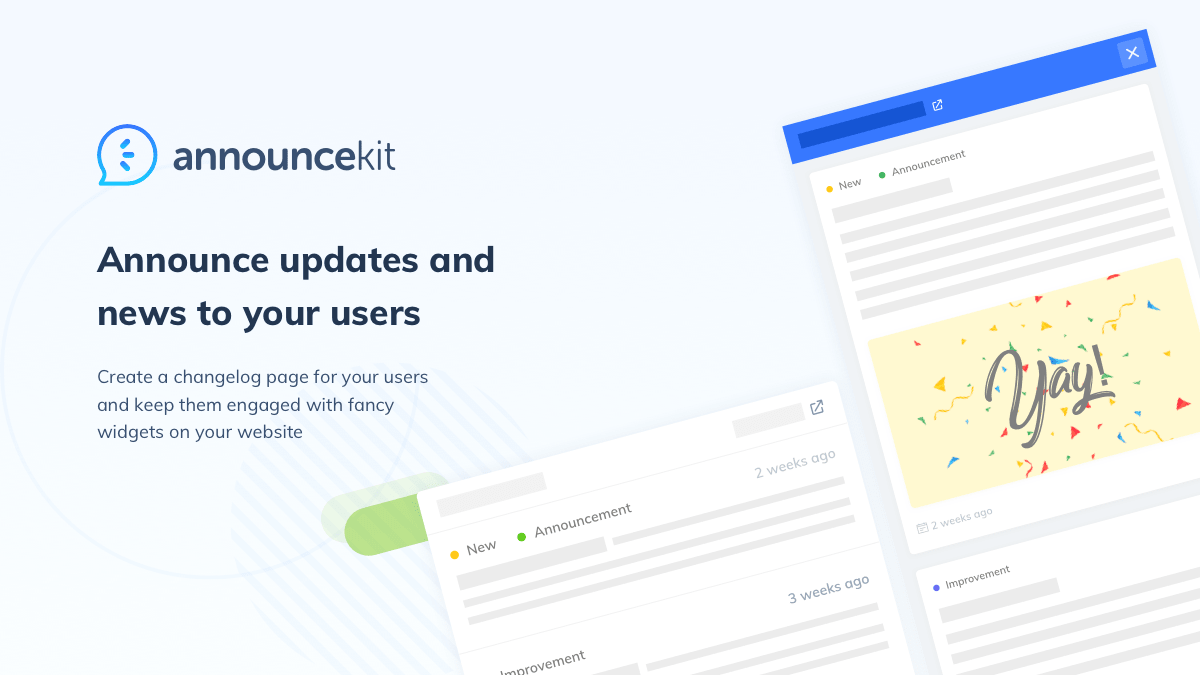
AnnounceKit

announcekit.app · AnnounceKit Feature Request Tool #1 of 7 in Feature Request Tools for SaaS Products

AnnounceKit rates 4.8 of 5, skips a real free plan

Best forTeams wanting changelogs and feature requests in one place

From $79 per month SOC 2AI featuresJira integration
Top of its ranking

Product communication platform combining changelogs, feature requests, and roadmaps with SOC 2 security.

Standout factAnnounceKit holds a 4.8 out of 5 rating from more than 100 verified reviews. announcekit.app
Biggest catchThere is no permanent free plan, accounts turn read-only after the 15-day trial. announcekit.app
4.8/5G2/Capterra ratingannouncekit.app
$79/moEntry plan priceannouncekit.app

What reviewers say

AnnounceKit reviews
4.8/5 · 100+

Source: announcekit.app

Starting price

$79/mono permanent free plan, 15-day trial only

Upside

  • 4.8 of 5 rating from 100+ reviews
  • SOC 2 Type I certified
  • AI post generator included

Catch

  • No permanent free plan
  • Branding removal needs $339/mo plan
  • NPS costs $49/mo extra
Pick it ifTeams wanting changelogs and feature requests in one place
Skip it ifStartups wanting a free or low-cost entry-level tool
PricingFrom $79 a month, no permanent free plan

Editor's takeAnnounceKit scores 9.4 out of 10 for usability, the top mark among feature request tools rated here. It holds a 4.8 out of 5 rating from more than 100 verified reviews. There is no permanent free plan, and accounts turn read-only after the 15-day trial.

Does AnnounceKit have a free plan?

No permanent free plan exists. After the 15-day trial ends, projects downgrade to read-only mode unless you upgrade to a paid plan.

Is AnnounceKit SOC 2 certified?

Yes. It is certified under AICPA SOC 2 Type I for security, availability, and confidentiality, and it is fully GDPR compliant.

The evidence: 6 criteria, 3 penalties
8.9
Product Capability & DepthLooked for: We evaluate the breadth of feature request management tools, including voting systems, roadmap integration, and feedback centralization.AnnounceKit offers a robust feature request tool that integrates directly with changelogs and roadmaps, allowing users to suggest, vote, and comment on ideas.announcekit.appannouncekit.appchangelog.announcekit.app
9.2
Market Credibility & Trust SignalsLooked for: We assess industry reputation, user reviews, and adoption by reputable companies in the SaaS space.The product holds high ratings across major review platforms and maintains a strong reputation for reliability and support.saashub.comannouncekit.appg2.com
9.4
Usability & Customer ExperienceLooked for: We look for ease of setup, intuitive interface design, and the quality of the end-user experience for both admins and customers.Reviewers overwhelmingly cite the clean UI and ease of integration as primary strengths, with setup taking minutes.youtube.comannouncekit.app
8.5
Value, Pricing & TransparencyLooked for: We evaluate pricing structures, hidden costs, and the availability of free tiers or trials relative to feature access.While the product offers a 15-day trial, it lacks a permanent free plan for active use, and key customization features are expensive.announcekit.appannouncekit.appchangelog.announcekit.app
8.8
Integrations & Ecosystem StrengthLooked for: We assess the availability and quality of native integrations with key development and communication tools.The tool offers strong native integrations with Slack, Jira, and Zapier, covering the most critical workflows for product teams.announcekit.appannouncekit.appannouncekit.app
9.0
Security, Compliance & Data ProtectionLooked for: We examine security certifications, data handling policies, and compliance with standards like GDPR and SOC 2.AnnounceKit demonstrates enterprise-grade security with SOC 2 Type I certification and full GDPR compliance.announcekit.appannouncekit.appannouncekit.app

Score adjustments−0.11 points in total

−0.04There is no permanent free plan for active use; accounts are downgraded to 'Read-only' after the 15-day trial, unlike some competitors that offer limited free tiers.announcekit.app · severity 60/100
−0.04Removing the 'AnnounceKit' branding and accessing Custom CSS is restricted to the 'Scale' plan, which costs $339/month, a high threshold for branding control.announcekit.app · severity 55/100
−0.03The Net Promoter Score (NPS) tool is not included in the base subscription and requires an additional $49/month add-on.changelog.announcekit.app · severity 45/100
3

Fider

fider.io · Fider Feature Request Tracker #2 of 7 in Feature Request Tools for SaaS Products

Free open-source feedback tool, no native mobile app

Best forTechnical teams wanting a free, self-hosted feedback board

Free tier open sourcefree self-hostedOAuth/SSO
#2 in its ranking

An open-source feature request tracker teams can self-host free or run as a paid cloud service.

Standout factSelf-hosted version is completely free, installed on your own servers github.com
Biggest catchSelf-hosted users have reported database thread locking that requires manual restarts. github.com
4,000+GitHub starsgithub.com
250 itemsFree cloud tier limitfider.io

Standout number

4,000+GitHub stars for Fider's open-source repo

Source: github.com

Free vs paid

Self-hosted

$0
  • Unlimited use
  • Full feature set
  • AGPL-3.0 license

Cloud Pro

$49/mo
  • Hosted for you
  • More advanced features

Source: fider.io

Upside

  • Free, open-source self-hosted version
  • Clean, distraction-free interface
  • OAuth sign-in via Google, GitHub

Catch

  • No native mobile apps
  • Limited native PM integrations
  • Self-hosted locking issues reported
Pick it ifTechnical teams wanting a free, self-hosted feedback board
Skip it ifNon-technical teams needing a fully managed solution
PricingFree to self-host; cloud plans include a free tier plus a $49/mo Pro plan

Editor's takeFider's core pitch is control. The AGPL-3.0 license lets teams self-host for free with no feature gating, a rarity among feedback tools. Projects like OBS and Scaleway chose it specifically for that openness, though GitHub issues document database locking in self-hosted deployments that needs a manual restart.

Is Fider really free?

Self-hosting is completely free under the AGPL-3.0 license, according to Fider's GitHub repository. The cloud version has a free tier capped at 250 feedback items, plus a Pro plan around $49 a month.

Does Fider have known technical issues?

Self-hosted users have reported database thread locking that requires manual restarts, according to a GitHub issue thread on the project's repository.

The evidence: 6 criteria, 3 penalties
8.7
Product Capability & DepthLooked for: We evaluate the breadth of feedback collection features, voting mechanisms, and roadmap management tools available for product teams.Fider provides a focused set of core features including feature voting, threaded discussions, status tracking (Planned, Started, Completed), and markdown support, though it lacks advanced project management suites.fider.iofider.iofider.io
9.2
Market Credibility & Trust SignalsLooked for: We look for adoption by reputable organizations, open-source activity, and community endorsement.Fider is highly regarded in the open-source community, used by notable technical projects like the OBS Project and Scaleway, and maintains a healthy repository with over 4,000 GitHub stars.github.comgithub.com
8.9
Usability & Customer ExperienceLooked for: We assess the ease of setup, interface design, and user friction for both administrators and end-users.Users consistently praise the 'sober' and clean user interface, noting that it is 'ridiculously easy' to set up, particularly for the cloud version.fider.iogithub.comfider.io
9.6
Value, Pricing & TransparencyLooked for: We analyze pricing tiers, free plan generosity, and the transparency of costs and limitations.Fider offers exceptional value with a fully functional free self-hosted version and a transparent cloud pricing model that includes a generous free tier.fider.iofider.iofider.io
9.4
Open Source & Deployment FlexibilityLooked for: We evaluate the ability to self-host, control data, and modify the codebase to suit specific needs.Fider stands out with its AGPL-3.0 license, allowing organizations full control over their data and infrastructure via Docker and standard deployment methods.github.comgithub.comgithub.com
8.2
Integrations & API ExtensibilityLooked for: We examine the availability of native integrations, API quality, and authentication options like SSO.While Fider offers a robust API and supports OAuth for SSO (Google, GitHub, etc.), it lacks the extensive library of one-click native integrations found in commercial competitors.fider.iofider.iofider.io

Score adjustments−0.16 points in total

−0.06Self-hosted users have reported technical stability issues such as database thread locking requiring manual restarts.github.com · severity 60/100
−0.05Fider lacks native, built-in integrations with popular project management tools (e.g., Jira, Linear), requiring users to build their own connections via API.fider.io · severity 50/100
−0.05The platform does not offer dedicated mobile applications, which may be a limitation for mobile-first teams or users.saashub.com · severity 40/100
4

UserJot

userjot.com · UserJot Feedback Platform #3 of 7 in Feature Request Tools for SaaS Products

UserJot keeps unlimited users free forever on every plan

Best forStartups wanting unlimited users without per-seat price hikes

Free tier From $29 per month unlimited usersflat-rate pricingAI duplicate detection
#3 in its ranking

Feedback and roadmap platform for SaaS teams, with flat-rate pricing and unlimited users on every plan.

Standout factUnlimited users stay free forever, with paid plans flat-rate at $29 or $59 per month. userjot.com
Biggest catchG2 does not yet have enough reviews to offer buying insight. g2.com
$29/moStarter planuserjot.com
30 secSetup time claimedcustomerfeedbackplatform.com
BootstrappedFundinguserjot.com

Free vs paid

Free forever

$0
  • Unlimited users
  • Feedback boards & voting

Paid from

$29/mo
  • AI changelog writer
  • Priority integrations

Source: userjot.com

The thing people get wrong

More team members always means a higher bill

UserJot charges a flat rate with unlimited users on every plan

Source: userjot.com

Upside

  • Unlimited users on every plan
  • Flat-rate pricing, no per-seat fees
  • AI duplicate detection and changelog

Catch

  • Few third-party reviews yet
  • Fewer integrations than enterprise tools
  • API still maturing
Pick it ifStartups wanting unlimited users without per-seat price hikes
Skip it ifEnterprises requiring SOC 2 or deep legacy integrations
PricingFree forever (unlimited users); paid from $29/mo flat-rate

Editor's takeUserJot fits startups that want feedback boards and roadmaps without paying more as the team grows. Flat-rate pricing with unlimited users breaks from the per-seat model most competitors use. Enterprises needing SOC 2 certification or deep legacy integrations should look at more established tools.

Is UserJot really free?

Unlimited users stay free forever on UserJot. Paid plans add features starting at $29 per month for Starter and $59 for Professional, both flat-rate.

Does UserJot require sign-up for feedback voting?

No. Guests can submit feedback and vote without creating an account, which lowers friction compared to platforms that require registration first.

The evidence: 6 criteria, 3 penalties
8.9
Product Capability & DepthLooked for: We evaluate the completeness of feedback loops, including collection widgets, voting boards, roadmapping, and changelog publishing.UserJot provides a comprehensive suite including public/private feedback boards, voting mechanisms, automated roadmaps, and an AI-assisted changelog editor.userjot.comuserjot.comcustomerfeedbackplatform.com
8.7
Market Credibility & Trust SignalsLooked for: We assess the company's track record, funding status, user base transparency, and third-party review presence.UserJot is a bootstrapped, transparently indie-run company with a growing presence but currently lacks the high volume of verified enterprise reviews found with legacy competitors.userjot.comg2.com
9.3
Usability & Customer ExperienceLooked for: We look for ease of setup, interface design quality, and friction-free user interaction for both admins and end-users.The platform emphasizes a 'beautiful, modern design' with a 30-second setup time and requires no account creation for guest feedback, significantly reducing friction.userjot.comcustomerfeedbackplatform.comuserjot.com
9.6
Value, Pricing & TransparencyLooked for: We analyze pricing models for hidden costs, per-seat limitations, and the generosity of free tiers.UserJot offers a disruptive flat-rate pricing model with unlimited users on all plans, including a 'free forever' tier, contrasting sharply with competitors' per-user fees.userjot.comuserjot.comuserjot.com
9.0
AI & Automation FeaturesLooked for: We evaluate the use of artificial intelligence to reduce manual administrative work in sorting and managing feedback.The platform utilizes AI for duplicate detection, auto-categorization of feedback, and drafting changelog updates, significantly automating the feedback loop.userjot.comuserjot.com
8.5
Integrations & EcosystemLooked for: We check for native connections to essential development and communication tools like Jira, Slack, and Linear.UserJot supports key integrations like Slack, Discord, Linear, and Jira, though users have noted fewer integrations compared to mature enterprise competitors.userjot.comg2.com

Score adjustments−0.15 points in total

−0.05Users report fewer integrations compared to established competitors, which may limit workflow automation for complex enterprise stacks.g2.com · severity 50/100
−0.05The product has a low volume of third-party verified reviews on major platforms like G2, providing less social proof than legacy alternatives.g2.com · severity 45/100
−0.05Lacks deep technical debugging features (like console logs or session replay) found in bug-tracking focused alternatives.userjot.com · severity 40/100
5

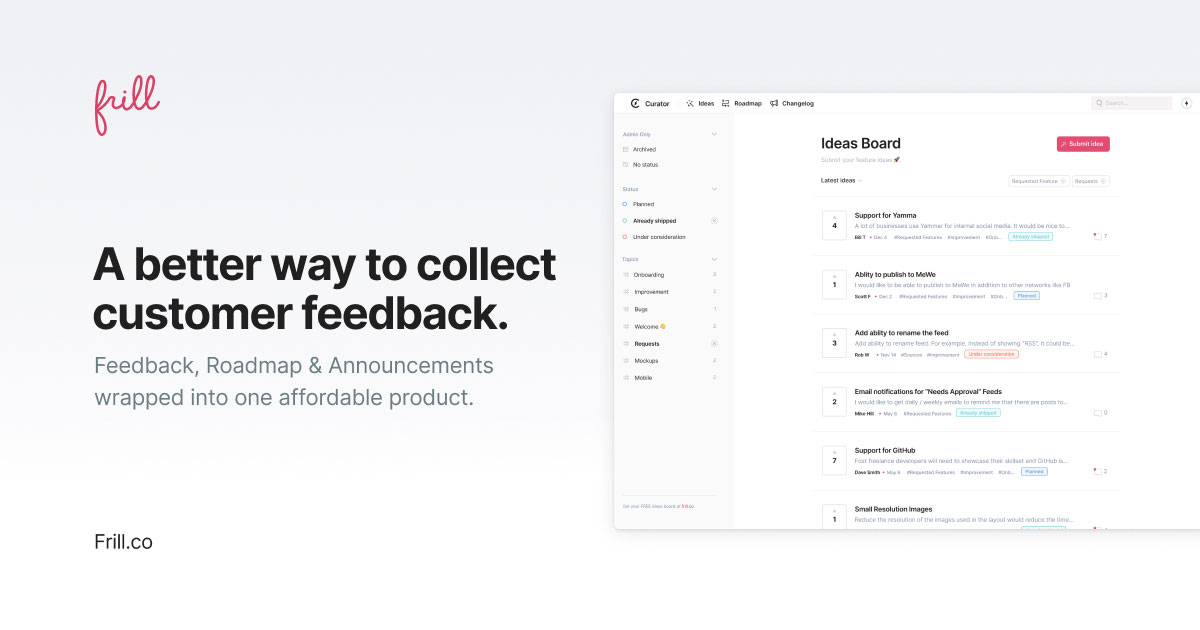
Frill

frill.co · Frill - Feedback, Roadmap & Announcements Tool #1 of 8 in Public Roadmap and Feedback Tools

Frill charges unlimited users, but white labeling costs $100/mo

Best forSaaS businesses wanting a clean, minimalist alternative to Canny

From $25 per month free trialSSO includedunlimited users
Top of its ranking

Feedback, roadmap, and announcement tool with unlimited tracked users on every plan and native Intercom and Jira integrations.

Standout factFrill includes unlimited tracked users and team members on every pricing plan. frill.co
Biggest catchRemoving Frill branding costs an extra $100 per month, four times the entry plan price. frill.co
4.8/5G2 ratingg2.com
$25/moStarting pricefrill.co
+$100/moWhite labeling add-onfrill.co

Starting price

$25/mounlimited tracked users included, white labeling +$100/mo

Learning curve

AfternoonWeeks

Minimalist UI, users report almost no learning curve

Upside

  • Unlimited tracked users on all plans
  • Minimalist, low-learning-curve interface
  • Native Intercom and Jira integrations

Catch

  • White labeling costs $100/mo extra
  • No revenue-based prioritization
  • Privacy controls are a paid add-on
Pick it ifSaaS businesses wanting a clean, minimalist alternative to Canny
Skip it ifEnterprises needing complex permissions or deep CRM integrations
PricingFrom $25 per month, unlimited users, white labeling +$100/mo

Editor's takeFrill charges a flat rate regardless of how many users or customers get tracked, a sharp contrast to competitors like Canny that charge per seat and start above $400 monthly. Reviewers consistently point to its minimalist design as the reason they switched from legacy tools. The catch is add-on pricing: full white labeling costs $100 a month on top of a $25-$49 base plan.

Does Frill charge per user?

No. Frill includes unlimited tracked users and unlimited team members on every plan, starting at $25 per month, unlike competitors that charge per seat.

How much does white labeling cost on Frill?

Removing Frill's branding costs an additional $100 per month, on top of the base subscription, which starts at $25 to $49 per month.

The evidence: 6 criteria, 2 penalties
8.7
Product Capability & DepthLooked for: We evaluate the comprehensiveness of feedback collection, roadmapping, changelog features, and the ability to manage feature requests effectively.Frill provides a cohesive suite of feedback boards, roadmaps, and announcements with essential features like SSO, voting, and widget embedding, though it lacks some advanced enterprise analytics.frill.cofrill.cofrill.co
9.2
Market Credibility & Trust SignalsLooked for: We assess user reviews, market presence, company stability, and reputation among SaaS professionals.Frill maintains a stellar reputation with high ratings on major review platforms, frequently praised for its design and responsiveness, positioning it as a top 'bootstrapped' favorite.g2.comappsumo.com
9.5
Usability & Customer ExperienceLooked for: We analyze the user interface design, ease of setup, administrative workflow, and end-user interaction quality.Frill's standout feature is its minimalistic, intuitive UI/UX which requires almost no learning curve, consistently cited by users as superior to legacy tools.frill.coappsumo.comfrill.co
8.9
Value, Pricing & TransparencyLooked for: We examine pricing tiers, hidden costs, feature gating, and overall ROI compared to market alternatives.Frill offers a highly competitive entry price ($25/mo) with unlimited users, but significant features like White Labeling and Privacy are sold as separate, somewhat costly add-ons.frill.cofrill.cofrill.co
8.8
Integrations & Ecosystem StrengthLooked for: We look for native integrations with key SaaS tools (Jira, Intercom, Slack) and API availability for custom workflows.The platform offers robust native integrations with major tools like Intercom, Jira, and Slack, along with a developer API and webhooks for custom connections.frill.cointercom.com
8.6
Customization & White LabelingLooked for: We evaluate the ability to adapt the tool to a brand's identity, including language, colors, domains, and email settings.Frill supports full translations, custom domains, and themes, but full white labeling (removing 'Powered by') is gated behind a significant additional cost.frill.cofrill.co

Score adjustments−0.12 points in total

−0.08Frill lacks advanced user segmentation features, specifically the ability to prioritize feedback based on customer revenue data, which is a standard feature in some competitor tools.featurebase.app · severity 60/100
−0.04Full white labeling (removing Frill branding) costs an additional $100/month, which is 4x the price of the entry-level plan.frill.co · severity 50/100
6

Canny

canny.io · Public Roadmap by Canny #2 of 8 in Public Roadmap and Feedback Tools

Canny's useful features start at $399 a month

Best forB2B SaaS teams needing deep integrations with Jira and Salesforce

From $50 per month SOC 2Jira integrationpublic roadmap
#2 in its ranking

Public roadmap tool that syncs feedback status two-way with Jira and GitHub automatically.

Standout factCanny is used by over 900 customers including CircleCI, Ahrefs, and ClickUp. g2.com
Biggest catchThe Growth Plan, the only tier with genuinely useful features, costs $399 a month. featurebase.app
900+Customers servedg2.com
4.6/5G2 ratingg2.com
$399/monthGrowth plan pricefeaturebase.app

What reviewers say

G2
4.6/5 · 900+ customers

Source: g2.com

Starting price

$399/moGrowth plan, the tier reviewers call the first one with useful features

Upside

  • Two-way sync with Jira and GitHub
  • SOC 2 Type II and GDPR compliant
  • Trusted by 900+ companies like Ahrefs

Catch

  • Real features need the $399/mo plan
  • Pricing scales unpredictably with users
  • Custom statuses locked to higher tiers
Pick it ifB2B SaaS teams needing deep integrations with Jira and Salesforce
Skip it ifEarly-stage startups wary of a $399/month jump to Growth
PricingFrom $50/month, but useful features require the $399/month Growth plan.

Editor's takeCanny's public roadmap automatically moves posts through statuses as engineering updates Jira or GitHub, so the roadmap stays current without manual work. It holds SOC 2 Type II certification and counts CircleCI, Ahrefs, and ClickUp among its 900-plus customers. Pricing starts at $50 a month, but reviewers note the entry tiers feel limited and the Growth plan, at $399 a month, is where the useful features actually live.

How much does Canny's public roadmap tool cost?

Plans start at $50 a month, but reviewers note the Growth plan at $399 a month is the first tier with genuinely useful features like custom statuses.

Does Canny sync with engineering tools?

Yes. It pushes posts to Jira, links existing issues, and syncs statuses two-way, so the public roadmap updates automatically as engineering work progresses.

The evidence: 6 criteria, 2 penalties
8.7
Product Capability & DepthLooked for: Features related to public roadmap visualization, status management, and integration with feedback loops.Canny provides a visual public roadmap that automatically syncs with feedback boards, allowing posts to move through statuses like "Planned" and "In Progress" based on internal updates. It supports two-way syncing with development tools, though advanced customization is tiered.canny.iohelp.canny.iohelp.canny.io
9.2
Market Credibility & Trust SignalsLooked for: Evidence of user adoption, enterprise customers, and verified third-party reviews.Canny is widely trusted by over 900 customers including major tech brands like CircleCI and Ahrefs, holding a strong 4.6/5 rating on G2 with verified organic reviews.g2.comg2.com
8.9
Usability & Customer ExperienceLooked for: User feedback on ease of setup, interface design, and support responsiveness.Users consistently praise the platform's ease of use and quick setup, describing it as "simple, straightforward, and helpful," though some note support can be difficult to reach.canny.iog2.comg2.com
8.5
Value, Pricing & TransparencyLooked for: Pricing structure, free tier limits, and cost predictability for growing teams.While a free plan exists, the "tracked user" pricing model is frequently cited as expensive and unpredictable for growing companies, with significant jumps between tiers.canny.iohelp.canny.iofeaturebase.app
9.0
Integrations & Ecosystem StrengthLooked for: Connectivity with development tools, CRMs, and communication platforms.The platform offers a comprehensive suite of two-way integrations with key development tools like Jira and GitHub, plus CRMs like Salesforce and HubSpot.canny.iocanny.iocanny.io
9.2
Security, Compliance & Data ProtectionLooked for: SOC2 certification, GDPR compliance, and SSO capabilities.Canny demonstrates enterprise-grade security with SOC 2 Type II certification, GDPR compliance, and SSO options including Okta and Azure AD.canny.iocanny.iocanny.io

Score adjustments−0.10 points in total

−0.04The 'Tracked User' pricing model creates unpredictable costs as user engagement grows, often forcing expensive upgrades.featureos.app · severity 60/100
−0.06Custom statuses and roadmap columns are locked behind higher-tier plans (Growth/Business), limiting flexibility for smaller teams.help.canny.io · severity 45/100
7

Softr

softr.io · Softr PM Dashboard Creator #3 of 3 in Feature Feedback Dashboards for Product Managers

Softr turns Airtable data into dashboards for $29/month

Best forPMs building internal dashboards on top of existing Airtable data.

Free tier From $29 per month free planSOC 2ISO 27001
#3 in its ranking

No-code platform that turns Airtable and Google Sheets data into secure product dashboards and client portals.

Standout factTrusted by over 800,000 teams worldwide. softr.io
Biggest catchBusiness plan costs $323/month, needed for advanced permissions at scale. softr.io
800,000+Teams using Softrsoftr.io
4.7/5G2 ratingg2.com
$323/moBusiness plan pricesoftr.io

Plans

Free$0/mo
Professional$167/mo
Business$323/mo

1M database records

Source: softr.io

Adoption

800,000+teams using Softr worldwide

Source: softr.io

Upside

  • Builds apps from Airtable in minutes
  • SOC 2 Type II and ISO 27001 certified
  • Granular permissions by user group

Catch

  • Limited design control vs Bubble
  • Performance dips on large datasets
  • Business tier costs $323/month
Pick it ifPMs building internal dashboards on top of existing Airtable data.
Skip it ifTeams with massive datasets that need complex custom logic.
PricingFrom $29/month, free plan available

Editor's takeSoftr turns spreadsheet data into a working dashboard in minutes using drag-and-drop blocks. It holds SOC 2 Type II and ISO 27001 certification, rare for a no-code builder. Pricing climbs fast once a team needs the Business plan for full permission controls and higher record limits.

Does Softr have a free plan?

Yes. Pricing starts at $0/month, with paid tiers running $59 to $323/month depending on features and record limits.

Is Softr SOC 2 certified?

Yes. Softr's SOC 2 Type II audit reported no exceptions, and its servers run in an ISO 27001 certified German datacenter.

The evidence: 6 criteria, 3 penalties
8.7
Product Capability & DepthLooked for: We evaluate the platform's ability to build functional product management tools like roadmaps, feedback trackers, and release planners without code.Softr provides specialized templates and blocks for product management, including roadmap visualization, feature request forms, and bug tracking, though it relies on external data sources for backend logic.softr.iosoftr.iosoftr.io
9.2
Market Credibility & Trust SignalsLooked for: We assess the vendor's market presence, user base size, and adoption among established companies to ensure long-term reliability.Softr has established significant market presence with over 800,000 teams using the platform, including adoption by employees at major tech companies.softr.iog2.com
8.9
Usability & Customer ExperienceLooked for: We look for ease of use in the building process, quality of templates, and the availability of support resources for non-technical users.The platform is widely praised for its ease of use, allowing users to build apps in minutes using drag-and-drop blocks, though some users report support delays.softr.iosoftr.iog2.com
8.5
Value, Pricing & TransparencyLooked for: We analyze the pricing structure, free tier availability, and cost scalability for growing teams and external user bases.Softr offers a robust free tier and clear pricing steps, but costs can escalate significantly for the Business plan ($323/mo) when advanced features or scale are needed.softr.iosoftr.iosoftr.io
8.8
Integrations & Ecosystem StrengthLooked for: We evaluate the breadth of native data source connections and the ability to integrate with third-party automation tools.Softr natively connects with major data sources like Airtable, Google Sheets, and BigQuery, and supports automation via Zapier and Make.softr.iosoftr.iosoftr.io
9.0
Security, Compliance & Data ProtectionLooked for: We examine the platform's adherence to enterprise security standards, data residency options, and compliance certifications.Softr demonstrates enterprise-grade security with SOC 2 Type II and ISO 27001 certifications, plus GDPR compliance with data hosting in Germany.softr.iosoftr.iosoftr.io

Score adjustments−0.18 points in total

−0.08Users report limited design customization and inability to build complex logic compared to full-stack alternatives like Bubble.research.com · severity 60/100
−0.07Performance issues have been documented when applications handle complex or data-heavy workloads.research.com · severity 50/100
−0.03Pricing can scale steeply, with some users noting that costs jump faster than expected as requirements grow.g2.com · severity 45/100
8

Rapidr

rapidr.io #3 of 4 in Internal Feature Feedback Tools for Teams

Rapidr's GDPR compliance is still listed as coming soon

Best forCost-conscious teams wanting flat-rate pricing as they scale

From $49 per month flat-rate pricingfast setupfeedback to changelog
#3 in its ranking

Feedback and roadmap platform with flat-rate pricing, unifying idea boards, voting, and changelogs.

Standout factSetup is advertised to take less than 15 minutes with no code required. rapidr.io
Biggest catchGDPR compliance is listed as coming soon, not yet confirmed. rapidr.io
$49/moStartup planrapidr.io
<15 minSetup time claimedrapidr.io
99.99%Uptime targetrapidr.io

Plans

Startup$49/mo
Business$199/mo

Source: rapidr.io

The thing people get wrong

Rapidr is fully GDPR compliant today

GDPR compliance is listed as coming soon on the features page

Source: rapidr.io

Upside

  • Flat-rate pricing, no per-seat cost
  • Setup in under 15 minutes
  • Unlimited boards on every plan

Catch

  • GDPR still listed as coming soon
  • No native GitHub or Salesforce
  • Text-only feedback widget
Pick it ifCost-conscious teams wanting flat-rate pricing as they scale
Skip it ifTeams needing GitHub, Salesforce, or advanced AI triage now
PricingFrom $49/mo (Startup), $199/mo (Business), 14-day trial

Editor's takeRapidr fits product teams that want feedback, roadmap, and changelog tools in one flat-rate system. Setup takes under 15 minutes, and pricing does not climb per seat as the team grows. Teams needing confirmed GDPR compliance or native GitHub and Salesforce integration should verify roadmap timing first.

How much does Rapidr cost?

The Startup plan is $49 per month, and Business is $199 per month. Pricing is flat-rate, not per seat, with a 14-day free trial and no credit card required.

Is Rapidr GDPR compliant?

Not yet confirmed. GDPR compliance is listed as coming soon on the features page, which matters for teams handling European user data.

The evidence: 5 criteria, 3 penalties
8.9
Product Capability & DepthLooked for: We evaluate the comprehensiveness of feedback collection, prioritization tools, roadmap visualization, and changelog publishing capabilities.Rapidr provides a complete suite for the feedback lifecycle, including idea boards, private internal boards, public roadmaps, and a changelog widget, though it currently lacks diverse widget types beyond text.rapidr.iorapidr.iorapidr.io
8.4
Market Credibility & Trust SignalsLooked for: We assess security certifications (SOC2, GDPR), uptime guarantees, and the volume of verified third-party reviews.While the platform uses AWS and offers encryption, key compliance standards like GDPR are explicitly listed as 'Coming Soon' in feature lists, and review volume is low compared to enterprise competitors.rapidr.iorapidr.io
9.2
Usability & Customer ExperienceLooked for: We analyze setup complexity, interface intuitiveness, and the responsiveness of the support team based on user reports.Users consistently praise the platform for being 'super easy to get up and running' and highlight the product team's rapid responsiveness to feature requests and issues.rapidr.iog2.comrapidr.io
9.4
Value, Pricing & TransparencyLooked for: We examine pricing structures, hidden costs, free trial availability, and feature access across different plan tiers.Rapidr offers highly transparent pricing starting at $49/mo with a generous feature set, a 14-day free trial requiring no credit card, and no per-seat pricing penalties.rapidr.iorapidr.iorapidr.io
8.6
Feedback Lifecycle ManagementLooked for: We check for native integrations with essential development and communication tools like Jira, Slack, GitHub, and Salesforce.While core integrations like Slack, Jira, and Intercom are robust, major enterprise connectors like Salesforce and GitHub are currently listed as 'Coming Soon'.rapidr.iorapidr.iorapidr.io

Score adjustments−0.18 points in total

−0.08GDPR compliance is explicitly listed as 'COMING SOON' on the features page, which is a significant regulatory gap for European markets.rapidr.io · severity 75/100
−0.06Key integrations for development and sales teams, specifically GitHub and Salesforce, are currently unavailable and marked as 'Coming Soon'.rapidr.io · severity 60/100
−0.04Users have noted a limitation in widget variety, specifically citing a lack of input types beyond standard text fields.g2.com · severity 30/100
02

Every ranking in Product Feedback & Feature Voting Tools

Each card shows the top three. The eye opens a quick look. Open a ranking for every product, the evidence and the comparison table.

1 FeaturebaseFeaturebase undercuts Canny's price, skips mobile app 9.0/10
Visit ↗
2 CannyCanny's mobile widget skips a native app for WebView 8.7/10
Visit ↗
3 SoftrSoftr turns Airtable data into dashboards for $29/month 8.7/10
Visit ↗
See all 3 ranked
1 AnnounceKitAnnounceKit rates 4.8 of 5, skips a real free plan 8.9/10
Visit ↗
2 FiderFree open-source feedback tool, no native mobile app 8.8/10
Visit ↗
3 UserJotUserJot keeps unlimited users free forever on every plan 8.8/10
Visit ↗
See all 7 ranked
1 FeaturebaseFeaturebase undercuts Canny on price, mobile app has gaps 8.8/10
Visit ↗
2 CannyCanny's Autopilot AI reads support tickets for feedback 8.7/10
Visit ↗
3 RapidrRapidr's GDPR compliance is still listed as coming soon 8.7/10
Visit ↗
See all 4 ranked

Best Public Roadmap and Feedback Tools

8 productsUpdated Jul 2026
1 FrillFrill charges unlimited users, but white labeling costs $100/mo 8.8/10
Visit ↗
2 CannyCanny's useful features start at $399 a month 8.8/10
Visit ↗
3 UserJotUserJot charges flat pricing, not per tracked user. 8.8/10
Visit ↗
See all 8 ranked
03

About Product Feedback & Feature Voting Tools

What the category is, how it developed, and what to look for. Two minutes, or the long read.

This category covers software used to capture, organize, and prioritize user input regarding a product's functionality and future development across its lifecycle: collecting feature requests, managing bug reports, facilitating user voting, and communicating roadmap progress. It sits between Customer Support (which focuses on immediate issue resolution) and Product Management/Engineering (which focuses on execution and delivery). It includes both general-purpose feedback portals and vertical-specific tools built for industries like SaaS, e-commerce, and enterprise manufacturing.

Read the full category guide

What Are Product Feedback & Feature Voting Tools?

Product Feedback & Feature Voting Tools bridge the critical gap between raw user sentiment and actionable product strategy. Unlike simple survey tools or static suggestion boxes, these platforms provide a structured environment where qualitative data—user comments, upvotes, and feature requests—can be quantified and linked directly to business value. They serve two primary stakeholders: the product team, which needs to validate development priorities with real market data, and the customer base, which seeks transparency and reassurance that their voice influences the product roadmap. For modern enterprises, these tools are not merely listening posts; they are the strategic filter that prevents costly development missteps by ensuring engineering resources are allocated to features that drive retention and revenue.

History of Product Feedback & Feature Voting Tools

The evolution of Product Feedback & Feature Voting Tools traces a clear trajectory from passive data collection to active, strategic intelligence. In the 1990s and early 2000s, customer feedback was largely the domain of Customer Relationship Management (CRM) systems or isolated within early helpdesk ticketing software. During this era, feedback was treated as a transactional artifact—a record of a complaint or a suggestion stored in static database fields, often accessible only to sales or support staff. Product managers operated with significant opacity, relying on anecdotal evidence from sales teams or expensive, infrequent focus groups to guide development. The primary gap was the lack of a direct line between the end-user and the product architect.

The late 2000s and early 2010s marked a pivotal shift with the rise of the "Voice of the Customer" (VoC) movement and the explosion of vertical SaaS. As software delivery moved from on-premise releases to continuous cloud deployment, the feedback loop tightened. Users expected faster iterations, and product teams needed real-time validation. This era saw the emergence of dedicated feedback portals—distinct from CRMs—that introduced the concept of "socializing" feedback. Early innovators in this space commoditized the "feature voting" mechanism, allowing users to see and support each other's ideas. This consolidation wave moved the market from "give me a database" to "give me a community," democratizing the roadmap process. However, these early tools often became "graveyards of good ideas," where suggestions piled up without clear resolution, leading to user frustration.

From 2015 to the present, the market has matured into an "intelligence" phase. Consolidation has been rampant, with large Customer Experience (CX) platforms acquiring niche feedback tools to offer end-to-end experience management. Buyer expectations have fundamentally shifted: providing a voting board is no longer sufficient. Today's tools are expected to integrate seamlessly with engineering workflows (like Jira or Azure DevOps), offer sophisticated segmentation (differentiating a feature request from a high-value enterprise client versus a free user), and utilize machine learning to analyze sentiment at scale. The focus is now on "closing the loop"—proving to customers that their feedback resulted in tangible product changes.

What to Look For

When evaluating Product Feedback & Feature Voting Tools, buyers must prioritize mechanisms that reduce friction for the user while increasing clarity for the product manager. The most critical evaluation criterion is the feedback capture experience. A tool must offer authentication flexibility—allowing users to submit feedback via Single Sign-On (SSO) or directly within the application without requiring a separate login. Friction at this stage decimates response rates. Furthermore, look for duplication management capabilities. Advanced tools use semantic search to suggest existing ideas to users before they type, preventing the "100 versions of the same request" problem that plagues manual systems.

A significant red flag is a lack of segmentation depth. If a tool treats every upvote equally, it is dangerous for B2B contexts. You must be able to weight feedback based on customer attributes—such as Monthly Recurring Revenue (MRR), plan type, or contract renewal date. A feature requested by ten free users should not necessarily outweigh one requested by a strategic enterprise account. Warning signs also include vendor lock-in regarding data export. Ensure the platform allows you to export raw feedback data, not just aggregated reports, as this data is vital for training future AI models or migrating systems.

Key questions to ask vendors include: "How does your system handle 'stale' feedback that hasn't been addressed in 6 months?" (The answer should involve automated archiving or re-engagement workflows, not manual cleanup). Ask, "Can we communicate roadmap updates only to the specific users who voted for a feature?" (This targets the closing-the-loop requirement). Finally, inquire about integration depth: "Does the integration with our issue tracker sync status updates bi-directionally?" If a developer marks a ticket as "Done" in Jira, the feedback tool should automatically notify the relevant customers without PM intervention.

Industry-Specific Use Cases

Retail & E-commerce

In the retail and e-commerce sector, the definition of "product feedback" extends beyond software features to include inventory selection, merchandising, and the digital shopping experience itself. High-volume retailers use these tools to capture sentiment regarding website usability (e.g., checkout friction) and to crowd-source demand for new physical products. A critical evaluation priority here is mobile responsiveness and visual feedback capabilities. Shoppers encountering a broken filter on a mobile app need to be able to submit a screenshot or quick comment instantly.

Unlike B2B software, where feedback is often technical, retail feedback is emotional and immediate. Therefore, tools must support high-volume sentiment analysis to flag trending issues (like a coupon code failure) in real-time. According to McKinsey’s 2025 State of the Consumer report, 32% of consumers use social platforms specifically for product research [1]. Retailers must look for tools that can ingest social listening data alongside direct feedback to form a complete picture. A unique consideration is the integration with inventory management systems—can a "vote" for a sold-out item automatically trigger a "back in stock" notification request?

Healthcare

Healthcare organizations face a unique constraint: the absolute necessity of HIPAA (in the US) and GDPR (in Europe) compliance. Product Feedback tools in this sector are used to improve patient portals, telemedicine apps, and internal clinician software. The primary evaluation priority is data sanitization and privacy governance. Feedback forms must have rigid controls to prevent the accidental submission of Protected Health Information (PHI). If a patient describes a symptom in a "feature request" box, the system must detect and redact it.

For healthcare buyers, a critical distinction is the ability to segment feedback by role—separating patient input from provider input. Clinicians often have highly technical workflow requests that impact patient safety and efficiency, whereas patients focus on accessibility and ease of use. A generic voting board that mixes these audiences is often inappropriate. Furthermore, integration with Electronic Health Records (EHR) systems for context (without storing sensitive data) is a "holy grail" feature for enterprise healthcare buyers. Wing Security reports that 96.7% of organizations experienced a SaaS security incident in the past year [2], underscoring the critical need for rigorous vendor security assessments in this sensitive vertical.

Financial Services

Financial institutions operate under intense regulatory scrutiny, making audit trails and complaint management the dominant evaluation criteria. In this sector, "feedback" often overlaps with "complaint," which triggers specific regulatory reporting requirements (such as those from the CFPB or FCA). Tools must distinguish between a suggestion ("I want dark mode") and a compliance issue ("I can't access my tax documents"). The ability to route specific keywords immediately to compliance teams is a mandatory feature.

Financial services buyers also prioritize on-premise or private cloud options due to security policies that restrict multi-tenant SaaS usage. When evaluating vendors, they must ask about "Bring Your Own Key" (BYOK) encryption and granular access controls. Transparency is a double-edged sword here; while public roadmaps are popular in tech, a bank may expose competitive strategy by publishing a detailed feature timeline. Thus, robust access control lists (ACLs) for internal-only vs. public-facing boards are essential. Forrester notes that firms failing to close the feedback loop risk creating "zombie" data that invites regulatory risk without adding value [3].

Manufacturing

For manufacturing, product feedback often relates to the physical attributes of goods or the efficiency of B2B ordering portals. The feedback loop here is longer and involves distinct supply chain partners: distributors, wholesalers, and end-users. A unique consideration is offline capability and field service integration. Sales representatives or field technicians visiting a factory floor may need to capture feedback on a tablet without a stable internet connection. The tool must sync this data once connectivity is restored.

Manufacturers prioritize attachments and CAD file support in feedback tools. A verbal description of a defect is often insufficient; users need to upload photos or schematics. Furthermore, the "voting" aspect is often internal—used by engineering teams to prioritize production shifts rather than by consumers. The integration ecosystem focuses on ERP (Enterprise Resource Planning) and PLM (Product Lifecycle Management) systems. Quality management statistics from ASQ suggest that effective feedback loops can reduce cost of poor quality by significant margins, making the ROI of these tools tied directly to production efficiency [4].

Professional Services

In legal, consulting, and accounting firms, "product" is synonymous with "service delivery" and "client experience." Feedback tools here are used to monitor the health of high-value relationships. The priority is discretion and relationship mapping. Unlike a B2C volume play, professional services firms deal with fewer, higher-value clients. A public voting board is rarely appropriate. Instead, they require private client portals where key stakeholders can request new service modules or report friction.

Integration with Professional Services Automation (PSA) tools is key. If a key client gives negative feedback on a project management tool, the account partner needs to be alerted immediately to prevent churn. The evaluation criteria center on Net Promoter Score (NPS) automation and the ability to link feedback to specific billable projects. Bain & Company research highlights that linking feedback to incentives is common in this sector, requiring tools that offer unimpeachable data integrity to support compensation decisions [5].

Subcategory Overview

Public Roadmap and Feedback Tools This subcategory is defined by its focus on transparency and community engagement. Unlike internal-facing tools, these platforms are designed to be a public "town square" where users can view the company's long-term vision and interact with one another. What makes this niche genuinely different is the emphasis on deflection and community moderation. A workflow that ONLY this tool handles well is the "crowd-sourced validation" loop: a user intends to submit a request, sees it already exists on the public board with 50 upvotes, and simply adds their vote instead of creating a duplicate ticket. This significantly reduces the triage burden on product managers. The specific pain point driving buyers here is the overwhelming volume of duplicate support tickets asking "when will this be ready?" By publishing a live roadmap, companies proactively answer this question. For a deeper look at the specific tools that excel in this transparent approach, refer to our guide to Public Roadmap and Feedback Tools.

Feature Feedback Dashboards for Product Managers These tools are the "command center" for the product professional, distinct from the collection widgets used by end-users. The differentiator here is synthesis and strategy alignment. While other tools collect data, these dashboards excel at aggregating inputs from disparate sources (Salesforce, Zendesk, Slack, Email) into a single prioritized list. A workflow that ONLY this specialized tool handles well is "strategic weighting"—assigning value scores to features based on business goals (e.g., "features that drive Enterprise retention") rather than just raw vote counts. The pain point driving buyers to this niche is "analysis paralysis"—having thousands of feedback items but no framework to decide what to build next. These platforms turn noise into a ranked execution plan. To explore platforms that specialize in this high-level synthesis, see our analysis of Feature Feedback Dashboards for Product Managers.

Internal Feature Feedback Tools for Teams This niche serves organizations where the product roadmap is highly sensitive or where the "users" are actually internal stakeholders (Sales, CS, Engineering). What makes this genuinely different is the proxy-voting workflow. Sales representatives often need to submit feedback on behalf of a prospect without exposing that prospect to a public portal. Only these specialized tools handle the "on-behalf-of" workflow effectively, linking the request to the CRM opportunity while keeping the actual feedback loop internal. The specific pain point driving buyers here is the "black hole" phenomenon experienced by customer-facing teams who feel their insights are ignored by Product. These tools provide visibility into internal request status, fostering alignment between revenue and product teams. For solutions focused on internal alignment, check out our guide to Internal Feature Feedback Tools for Teams.

Feature Request Tools for SaaS Products Specifically engineered for software-as-a-service companies, these tools are distinct because of their deep in-app contextualization. Unlike generic survey forms, these tools utilize SDKs to embed feedback widgets directly into the SaaS application's UI. One workflow ONLY this tool handles well is capturing technical metadata (browser version, screen resolution, user path) automatically alongside the feedback, which is crucial for debugging and reproducing SaaS issues. The specific pain point driving buyers to this niche is the "context gap"—users submitting vague requests like "it doesn't work" without the product team knowing where they were in the app or what plan they are on. These tools pass user attributes seamlessly to the feedback record. For tools built specifically for the SaaS ecosystem, review our coverage of Feature Request Tools for SaaS Products.

Integration & API Ecosystem

In the modern tech stack, a standalone feedback tool is a silo of dead data. The true value of these platforms is realized only when they integrate bi-directionally with the systems of record for Sales (CRM) and Engineering (Issue Tracking). A report by CTO Magazine highlights that 24% of CMOs have lost customers specifically due to martech stack failures and poor integration, illustrating the high stakes of disconnected data [6]. Expert analysis from research firms consistently points to "integration friction" as a primary cause of shelfware.

Consider a practical scenario: A 50-person professional services firm uses HubSpot for sales and Jira for project management. They purchase a feedback tool that claims "seamless integration." However, the integration is one-way only—pushing feedback into Jira. When the engineering team completes the feature in Jira, the status doesn't sync back to the feedback tool. The result? The account manager sees the request as "Pending" for months, telling the client it's not done, while the feature has actually been live for weeks. This disconnect damages client trust and wastes the development effort. A well-designed integration would map custom fields (like "Client Tier") from HubSpot to the feedback ticket, and sync the Jira "Resolution" status back to the feedback portal, triggering an automated email to the account manager. Buyers must test this "round-trip" capability during the demo phase, ensuring that API limits or rigid field mapping don't break their specific workflow.

Security & Compliance

Security in feedback tools is often underestimated, yet these platforms aggregate highly sensitive data: strategic roadmap plans, customer complaints, and potentially exposed personal data (PII). Wing Security reports that 96.7% of organizations used at least one SaaS application that had a security incident in the past year, a staggering statistic that proves no tool is too small to be a vector for attack [2]. Compliance is not just a checkbox; it is a legal requirement for many industries.

For a healthcare software provider selling to hospitals, the feedback tool is a business associate. If a doctor pastes a patient name into a feedback field, that tool must be HIPAA compliant. In a real-world scenario, a fintech startup might use a feedback tool that stores data in a public cloud without "Data Residency" controls. When expanding to the EU, they discover they cannot use the tool because it violates GDPR requirements to keep European citizen data within EU borders. The "fix" involves a painful migration to a new vendor. Experts like those at Diligent warn that "cyber risk is no longer just a security issue — it's a business and governance imperative," meaning product leaders must vet SOC 2 Type II reports and ISO 27001 certifications before signing [7]. Buyers must demand granular "Attribute-Based Access Control" (ABAC) to ensure that internal comments discussing vulnerabilities or competitive strategy are never exposed to the public board.

Pricing Models & TCO

Pricing in this category has shifted dramatically from flat-rate subscriptions to complex tiered models, often hiding the Total Cost of Ownership (TCO). OpenView Partners found that SaaS companies with usage-based pricing grew revenue 38% faster than their peers, incentivizing vendors to adopt models that scale with your success—or your budget's detriment [8]. The most common models are "Per-Seat" (admin users), "Per-Tracked User" (end-users giving feedback), or flat "Platform Fees."

Let's walk through a TCO calculation for a hypothetical mid-sized B2B SaaS company with 25 internal employees needing access and 10,000 active monthly users (MTUs). Vendor A (Per-Seat Model): Charges $50/seat/month. 25 seats x $50 = $1,250/month. Unlimited end-users. Vendor B (MTU Model): Charges flat $200 for 3 seats, but $0.05 per active tracked user. 10,000 users x $0.05 = $500 + $200 base = $700/month. At first glance, Vendor B looks cheaper. However, if the company runs a viral marketing campaign and MTUs spike to 50,000 the next month, Vendor B's bill jumps to $2,700/month—a massive, unbudgeted variance. Conversely, if the company wants to give "view-only" access to the entire 50-person sales team, Vendor A's model becomes prohibitively expensive ($2,500/month). Buyers must model these "success disaster" scenarios. Hidden costs often include "SSO Taxes" (extra fees for Single Sign-On) and "Custom Domain" fees, which can add 20-30% to the base price.

Implementation & Change Management

The failure of feedback tools is rarely technical; it is cultural. Implementing a tool without a clear process for who reviews the feedback and how decisions are communicated leads to "feedback fatigue." Forrester reports that 61% of companies have no formal process for closing the customer feedback loop, creating a vacuum where customers feel ignored [3].

Consider a manufacturing firm that rolls out a feedback app to its 200 field distributors. They technically set up the tool perfectly. However, they fail to assign a "Moderator" role. Within two weeks, the board is flooded with 500 requests, many duplicates or irrelevant complaints about pricing (not product). The Product Manager, overwhelmed, stops checking the board. Distributors see their posts sitting at "Awaiting Review" for 60 days and stop using the tool entirely. The implementation fails not because the software broke, but because the workflow broke. Successful implementation requires a defined "Triage SLA"—a promise that every piece of feedback will be reviewed and tagged within 48 hours. It also requires "Feedback Gardeners"—designated team members responsible for merging duplicates and responding to comments to keep the community alive.

Vendor Evaluation Criteria

Beyond features, buyers must evaluate the vendor's viability and support structure. The "Feature Factory" trap is real—vendors that pump out features but lack stability. Gartner suggests that customer service and support leaders must prioritize trust, noting that 53% of customers would consider switching competitors if they found a company used AI for service in a way that reduced human connection or quality [9]. This sentiment applies to the feedback vendors themselves: do they use their own tool to listen to you?

In a rigorous evaluation, a buyer should test the vendor's support responsiveness before signing. Open a ticket asking a technical API question. If the response takes 4 days or is a generic bot reply, this is a warning sign of what post-sales support will look like. Furthermore, evaluate the "Exit Strategy." Does the vendor provide a documented JSON/CSV export schema? A real buyer scenario involves a startup that grew into an enterprise and needed to migrate to a custom-built solution. The feedback vendor held their data hostage in a proprietary format, requiring a $10,000 "professional services" fee to extract it. To avoid this, include a "Data Portability" clause in the contract and verify the export function during the trial.

Emerging Trends and Contrarian Take

Emerging Trends (2025-2026): The dominant trend is the shift from "Passive Collection" to "Agentic Discovery." McKinsey identifies Agentic AI—systems that can autonomously plan and execute workflows—as a major frontier [10]. In product feedback, this means AI agents that don't just summarize comments but actively reach out to users. Imagine an AI that notices a user rage-clicking on a feature and instantly initiates a chat: "I see you're struggling with the export function. Can you tell me more?" It then aggregates this qualitative data with session replay logs and drafts a Jira ticket for the PM. Additionally, Platform Convergence is accelerating; standalone feedback tools are increasingly being absorbed into broader "Product Operating Systems" that combine roadmapping, analytics, and feedback into a single pane of glass.

Contrarian Take: Most feedback portals are actually increasing your churn. The industry sells the idea that a public voting board creates community and transparency. In reality, for 80% of businesses, a public board creates a "Theater of Disappointment." It highlights exactly what your product lacks to every prospect who visits it. It allows competitors to mine your customers' pain points and build a sales deck specifically targeting your weaknesses. Furthermore, seeing a feature request from 2021 with 500 votes that is still "Under Consideration" signals to customers that you are stagnant or unresponsive. A private, curated feedback loop—where you control the narrative and only validate ideas you actually intend to consider—is often strategically superior to the "radical transparency" defaulted to by most tools.

Common Mistakes

Overbuying Features: Buyers often purchase Enterprise-tier plans for features like "Sentiment Analysis AI" that they lack the volume to use. If you receive 50 pieces of feedback a month, a human can and should read them. AI summarization only becomes statistically significant and ROI-positive at volumes of thousands of inputs per month. Start small and upgrade only when the manual process breaks.

Ignoring the "No": A common implementation mistake is failing to have a process for saying "No." Product teams are afraid to reject customer ideas, so they leave them in limbo states like "Future Consideration." This bloats the database and frustrates users. It is better to have a "Closed - Will Not Build" status with a clear, respectful explanation. This honesty builds more trust than a silent limbo.

Siloing the Tool: Deploying the tool only to the Product team is a mistake. Customer Success and Sales teams are the frontline intelligence gatherers. If the tool is not accessible to them (or integrated into their CRM), you lose the highest-quality proxy feedback. The mistake lies in treating the tool as a "Product Team Utility" rather than a "Company-Wide Intelligence Asset."

Questions to Ask in a Demo

  • "Can you show me the exact workflow for a user to submit feedback without creating a new account?" (Tests friction).
  • "How does your system handle merging two ideas that are similar but not identical? Does it merge the votes and the comments?" (Tests data integrity).
  • "Show me how I can email only the 50 people who voted for 'Dark Mode' once we ship it." (Tests closing the loop).
  • "What attributes can I pass via the SSO token to segment this feedback? Can I pass 'Plan Value'?" (Tests segmentation depth).
  • "If we leave your platform next year, can we export the raw conversation threads, or just the high-level idea titles?" (Tests data ownership).

Before Signing the Contract

Final Decision Checklist: Does the tool support your requisite authentication method (SAML, JWT, OAuth)? Have you verified the GDPR/SOC2 compliance documents? Have you tested the mobile experience on your actual user's devices? Is the roadmap for the tool itself aligned with your needs?

Common Negotiation Points: Vendor pricing is often negotiable on "Contributor" seats (internal users who can view but not edit). Ask for unlimited "Viewer" licenses to ensure transparency across your org without exploding costs. Also, negotiate the "Data Retention" period—ensure your data isn't auto-deleted after 12 months if you need historical trend analysis.

Deal-Breakers: Lack of SSO in the mid-tier plan is a major friction point. Inability to customize the "Status" workflow (e.g., forcing you to use their default statuses like "Planned" vs. your internal "Q3 Commitment") indicates a rigid tool that won't adapt to your process. Finally, weak API documentation (or no API) is a definitive deal-breaker for any scaling company that intends to automate workflows.

Closing

Selecting the right Product Feedback & Feature Voting Tool is a strategic decision that shapes how your company listens, learns, and evolves. It is the difference between guessing what your market wants and knowing with data-backed certainty. If you have specific questions about your stack or need a sounding board for your evaluation, I invite you to reach out.

Email: albert@whatarethebest.com

04

Research

Original reporting on this corner of the market.

All research

Technology companies increased product management headcount by 68% in 2023

Mar 29, 2026

Project Management & Productivity Tools and Transcription & Meeting Notes Tools

May 27, 2026

Workers conduct up to 8 separate searches to find a single correct document

May 18, 2026
05

Questions people ask

Which Product Feedback & Feature Voting Tools is best?

Featurebase holds the highest score in the category at 9.0, in Feature Feedback Dashboards for Product Managers. The right pick depends on the ranking that matches your use case, so start with the ranking list above.

Why are there 4 separate rankings?

Buyers in Product Feedback & Feature Voting Tools have different jobs, so each ranking is scoped to one of them and weights the six criteria for that job. The same product can hold different ranks in different rankings.

How are the scores produced?

Documentation, pricing pages, security pages and third-party reviews are reviewed against six criteria. Each criterion records what was found and links its sources. Penalties pull the score down and are shown with their evidence. Rank follows the score. Full methodology.

06

More in Project Management & Productivity

The whole group