Lead Management Software

Updated July 6, 2026

These are the specialized categories within Lead Management Software. Looking for something broader? See all CRM & Sales Software categories.

Not sure which one is right for you?

Answer 4 quick questions and we'll match you with your best options

Find Your Best Match

How big is your team?

Just me
2 - 10
11 - 50
51 - 200
201 - 1,000
1,000+

What's your budget situation?

Free or open-source only
Free to start, pay later
Best value for money
Price isn't the main factor

What's your team's technical comfort level?

We want it to just work
We can handle some setup
We have developers who'll customize it

What's the ONE thing this tool must do well?

Step 1 of 4
Orion Advisor Solutions

Orion Advisor Solutions provides a tech-enabled fiduciary process tailored for financial advisors. Its wealth management and lead nurturing tools streamline client-advisor interactions, making it specifically suitable for the financial advisory industry.

Best for Lead Management Software for Financial Advisors

Expert Take

Orion Advisor Solutions excels in providing tailored lead management and wealth management tools for financial advisors, supported by strong integration capabilities and industry recognition. While pricing transparency is limited, the product's depth and usability make it a top choice for its niche.

Pros

  • Used by 17 of top 20 Barron's RIAs
  • ISO 27001 and SOC 2 Type 2 certified
  • Deep integration with Redtail CRM
  • Robust client portal and mobile app

Cons

  • Advisor interface described as clunky/dated
  • High starting cost ($13k+ annually)
  • Steep learning curve for reporting tools
  • Fragmented experience due to acquisitions

Best for teams that are

  • Established RIAs managing significant AUM ($10M+)
  • Advisors looking to outsource back-office operations

Skip if

  • New or small advisors with low AUM due to high minimums
  • Firms wanting a simple tool just for lead tracking

Best for teams that are

  • Established RIAs managing significant AUM ($10M+)
  • Advisors looking to outsource back-office operations

Skip if

  • New or small advisors with low AUM due to high minimums
  • Firms wanting a simple tool just for lead tracking

Pros

  • Used by 17 of top 20 Barron's RIAs
  • Comprehensive 'most-in-one' wealthtech platform
  • ISO 27001 and SOC 2 Type 2 certified
  • Deep integration with Redtail CRM
  • Robust client portal and mobile app

Cons

  • Advisor interface described as clunky/dated
  • High starting cost ($13k+ annually)
  • Support quality reported as inconsistent
  • Steep learning curve for reporting tools
  • Fragmented experience due to acquisitions

Expert Take

Orion Advisor Solutions excels in providing tailored lead management and wealth management tools for financial advisors, supported by strong integration capabilities and industry recognition. While pricing transparency is limited, the product's depth and usability make it a top choice for its niche.

Follow Up Boss: Real Estate OS

Follow Up Boss is the ideal SaaS solution for real estate teams, offering more than a simple CRM, it provides a central hub for organizing leads, integrating with over 250 tools, and functioning as an open platform. This product addresses the industry need for efficient lead management, tracking and follow-ups, making it essential for real estate professionals.

Best for Lead Management Software for Real Estate Agents

Expert Take

Follow Up Boss excels as a specialized lead management solution for real estate professionals. Its extensive integration capabilities and real estate-specific features make it a standout choice in its category. The platform's focus on streamlining lead management processes ensures it meets the high standards expected of premium SaaS solutions.

Pros

  • Intuitive, user-friendly interface
  • Robust automated lead routing
  • SOC 3 certified data security
  • 7-day/week US-based support

Cons

  • Expensive per-user pricing model
  • Dialer costs extra on base plan
  • Limited native marketing tools
  • No native full-drip text automation

Best for teams that are

  • Mid-sized real estate teams generating a high volume of internet leads.
  • Agents wanting an open platform that integrates with 250+ existing tools.

Skip if

  • Part-time agents or those generating fewer than 30 leads per month.
  • Solo or new agents with limited budgets who find high per-user pricing steep.

Best for teams that are

  • Mid-sized real estate teams generating a high volume of internet leads.
  • Agents wanting an open platform that integrates with 250+ existing tools.

Skip if

  • Part-time agents or those generating fewer than 30 leads per month.
  • Solo or new agents with limited budgets who find high per-user pricing steep.

Pros

  • Open API with 250+ integrations
  • Intuitive, user-friendly interface
  • Robust automated lead routing
  • SOC 3 certified data security
  • 7-day/week US-based support

Cons

  • Expensive per-user pricing model
  • No built-in transaction management
  • Dialer costs extra on base plan
  • Limited native marketing tools
  • No native full-drip text automation

Expert Take

Follow Up Boss excels as a specialized lead management solution for real estate professionals. Its extensive integration capabilities and real estate-specific features make it a standout choice in its category. The platform's focus on streamlining lead management processes ensures it meets the high standards expected of premium SaaS solutions.

Wise Agent: Real Estate CRM

Wise Agent is a comprehensive CRM software specifically designed for real estate agents. It addresses the industry's need for efficient lead generation, organized contact management, and streamlined automation. The software integrates seamlessly with other tools, making it a user-friendly and affordable choice for real estate professionals.

Best for Lead Management Software for Real Estate Agents

Expert Take

Wise Agent is a specialized CRM designed for real estate agents, offering efficient lead management and automation features. It is recognized for its user-friendly interface and affordability. Despite some limitations in advanced features and mobile app availability, it remains a strong choice for real estate professionals.

Pros

  • Free one-on-one onboarding session
  • Direct MLS integration for listings
  • Affordable flat-rate pricing ($49/mo)
  • Built-in AI writing and bot tools

Cons

  • No native mobile app (web only)
  • Extra fees for SMS texting
  • Transaction management is basic
  • No free plan (only trial)

Best for teams that are

  • Solo real estate agents and growing teams needing an affordable all-in-one CRM.
  • Users who highly value 24/7 live customer support.

Skip if

  • Agents needing highly robust transaction management with minimal setup steps.
  • Teams wanting advanced website activity tracking like BoomTown.

Best for teams that are

  • Solo real estate agents and growing teams needing an affordable all-in-one CRM.
  • Users who highly value 24/7 live customer support.

Skip if

  • Agents needing highly robust transaction management with minimal setup steps.
  • Teams wanting advanced website activity tracking like BoomTown.

Pros

  • 24/7 live customer support included
  • Free one-on-one onboarding session
  • Direct MLS integration for listings
  • Affordable flat-rate pricing ($49/mo)
  • Built-in AI writing and bot tools

Cons

  • No native mobile app (web only)
  • Interface feels dated and clunky
  • Extra fees for SMS texting
  • Transaction management is basic
  • No free plan (only trial)

Expert Take

Wise Agent is a specialized CRM designed for real estate agents, offering efficient lead management and automation features. It is recognized for its user-friendly interface and affordability. Despite some limitations in advanced features and mobile app availability, it remains a strong choice for real estate professionals.

Capsule CRM for Accountants

Capsule CRM for Accountants is a powerful, industry-specific solution designed to streamline client management in accounting firms. It efficiently organizes contact details, project history, and billing information, thus enhancing client relationships and improving project management.

Best for Lead Management Software for Accountants

Expert Take

Capsule CRM for Accountants is a specialized CRM solution tailored for accounting firms, offering features that enhance client management and streamline project workflows. While it lacks direct accounting software integration, its user-friendly design and industry-specific capabilities make it a strong contender in its niche.

Pros

  • Deep 2-way Xero integration
  • Zero learning curve interface
  • Offline-capable mobile app
  • Projects feature for deadlines

Cons

  • No phone or live chat
  • Automation requires expensive plan
  • No native email sequences
  • Address sync limitations

Best for teams that are

  • Solopreneurs and small firms needing a simple, user-friendly CRM
  • Users wanting a free or low-cost entry point to manage contacts

Skip if

  • Large teams requiring advanced automation or complex sales pipelines
  • Users needing built-in email marketing sequences without paid add-ons

Best for teams that are

  • Solopreneurs and small firms needing a simple, user-friendly CRM
  • Users wanting a free or low-cost entry point to manage contacts

Skip if

  • Large teams requiring advanced automation or complex sales pipelines
  • Users needing built-in email marketing sequences without paid add-ons

Pros

  • Deep 2-way Xero integration
  • SOC 2 Type II accredited
  • Zero learning curve interface
  • Offline-capable mobile app
  • Projects feature for deadlines

Cons

  • No phone or live chat
  • Automation requires expensive plan
  • Basic reporting on lower tiers
  • No native email sequences
  • Address sync limitations

Expert Take

Capsule CRM for Accountants is a specialized CRM solution tailored for accounting firms, offering features that enhance client management and streamline project workflows. While it lacks direct accounting software integration, its user-friendly design and industry-specific capabilities make it a strong contender in its niche.

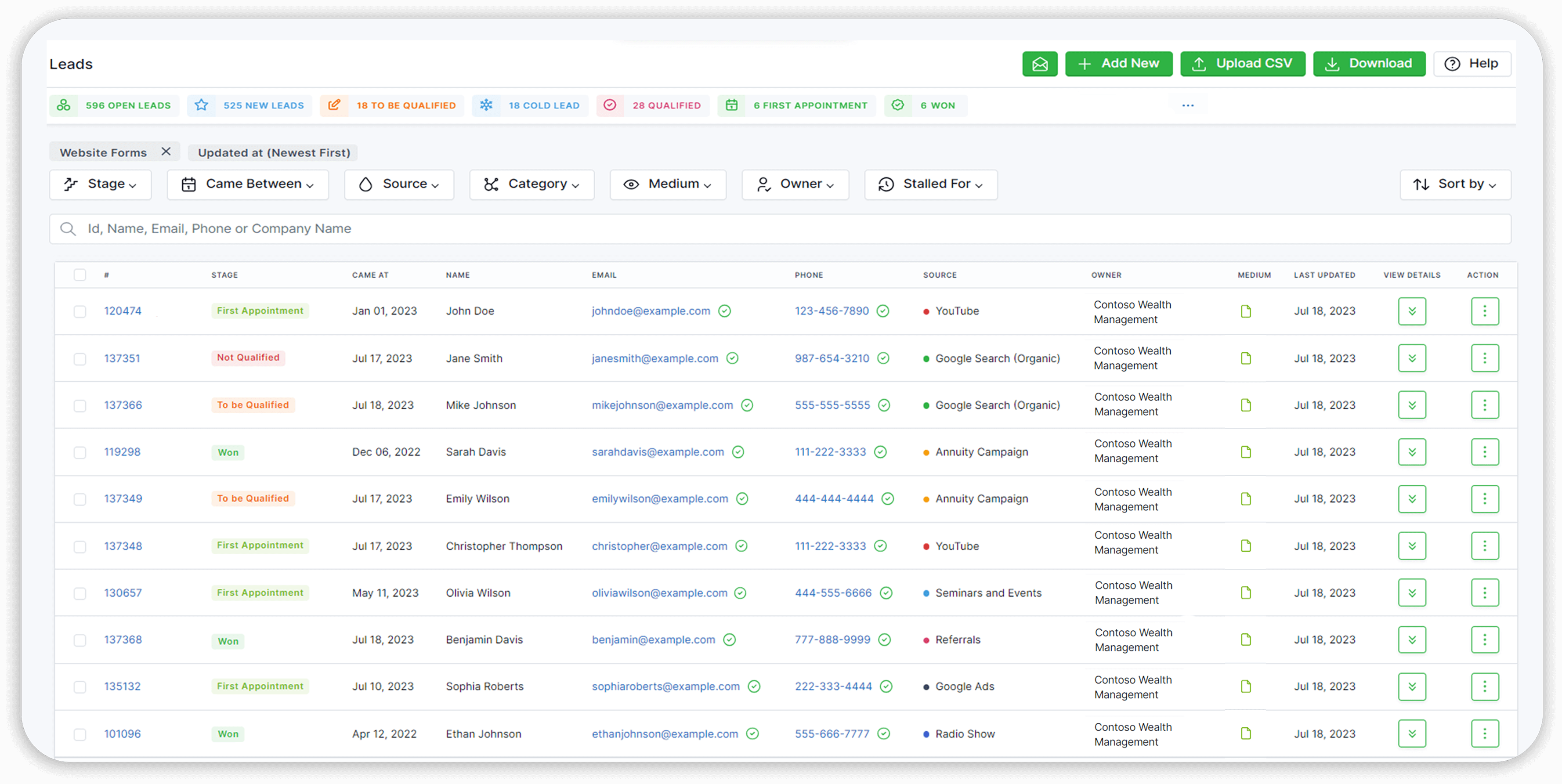
Cloven Advisor Lead Management

Cloven's Advisor Lead Management is a specialized solution for financial advisors in Canada, designed to optimize lead capture, organization and conversion. It is particularly tailored to meet the unique compliance needs of the financial industry, ensuring that advisors stay within regulatory guidelines while managing their leads.

Best for Lead Management Software for Financial Advisors

Expert Take

Cloven Advisor Lead Management excels in providing a specialized solution for financial advisors in Canada, focusing on compliance and lead management. Its industry-specific features and compliance tracking make it a top choice for financial advisors. However, its limited geographic scope and variable pricing model are notable considerations.

Pros

  • Includes 50+ productivity tools (e-sign, booking)
  • Free onboarding and data import for most users
  • Integrates with BlueSun and SideDrawer
  • Bi-directional Open API for custom connections

Cons

  • Lacks direct carrier data feeds (vs Equisoft)
  • Higher monthly cost than generic CRMs
  • Limited to Canadian market support

Best for teams that are

  • Canadian financial advisors needing local compliance tools
  • Firms looking for built-in productivity tools like e-signature

Skip if

  • U.S. or international advisors (designed for Canada)
  • Firms deeply integrated into Salesforce or Redtail ecosystems

Best for teams that are

  • Canadian financial advisors needing local compliance tools
  • Firms looking for built-in productivity tools like e-signature

Skip if

  • U.S. or international advisors (designed for Canada)
  • Firms deeply integrated into Salesforce or Redtail ecosystems

Pros

  • Includes 50+ productivity tools (e-sign, booking)
  • 100% Canadian data residency (PIPEDA compliant)
  • Free onboarding and data import for most users
  • Integrates with BlueSun and SideDrawer
  • Bi-directional Open API for custom connections

Cons

  • Lacks direct carrier data feeds (vs Equisoft)
  • Higher monthly cost than generic CRMs
  • Built on Zoho (underlying complexity exists)
  • Limited to Canadian market support

Expert Take

Cloven Advisor Lead Management excels in providing a specialized solution for financial advisors in Canada, focusing on compliance and lead management. Its industry-specific features and compliance tracking make it a top choice for financial advisors. However, its limited geographic scope and variable pricing model are notable considerations.

6
8.9 / 10
Funnel Leasing CRM

Funnel Leasing is a revolutionary CRM property management software specifically designed for landlords and property managers. It streamlines the leasing process, saving both time and money while offering a more efficient rental experience. This solution addresses the industry's need for an effective lead management system that can optimize rental transactions.

Best for Lead Management Software for Landlords

Expert Take

Funnel Leasing CRM is a specialized lead management software for landlords, offering tailored features that streamline the leasing process. It is recognized for its depth in property management capabilities and integration with industry tools. While it excels in usability and market credibility, its pricing transparency is limited due to enterprise-level custom quotes.

Pros

  • Transparent per-unit pricing models
  • Real-time bi-directional PMS integrations
  • Advanced AI leasing assistant & automation
  • Excellent customer support & training

Cons

  • Complex and lengthy implementation process
  • Higher cost than basic CRM alternatives
  • Steep learning curve for extensive features

Best for teams that are

  • Teams needing centralized leasing across multiple communities
  • Operators focusing on a renter-centric management model

Skip if

  • Small independent landlords or single-family home managers
  • Those with small portfolios unable to meet minimum unit counts

Best for teams that are

  • Teams needing centralized leasing across multiple communities
  • Operators focusing on a renter-centric management model

Skip if

  • Small independent landlords or single-family home managers
  • Those with small portfolios unable to meet minimum unit counts

Pros

  • Renter-centric single guest card architecture
  • Transparent per-unit pricing models
  • Real-time bi-directional PMS integrations
  • Advanced AI leasing assistant & automation
  • Excellent customer support & training

Cons

  • Complex and lengthy implementation process
  • Not suitable for small portfolios (<2000 units)
  • Higher cost than basic CRM alternatives
  • Steep learning curve for extensive features

Expert Take

Funnel Leasing CRM is a specialized lead management software for landlords, offering tailored features that streamline the leasing process. It is recognized for its depth in property management capabilities and integration with industry tools. While it excels in usability and market credibility, its pricing transparency is limited due to enterprise-level custom quotes.

7
8.9 / 10
Insurance Agent CRM

Agent CRM is specifically designed for insurance agents, combining AI-powered automation with a comprehensive CRM system. It streamlines the sales process by enabling efficient follow-up and unlocking potential sales from existing leads. It is built to help agents close more appointments and manage leads effectively.

Best for Lead Management Software for Insurance Agents

Expert Take

Insurance Agent CRM excels in providing a specialized CRM solution tailored for insurance agents. Its AI-powered automation and comprehensive lead management capabilities position it as a top choice in its category. While it may require some technical knowledge, its industry-specific features and efficient sales process management justify its premium status.

Pros

  • Daily live Zoom support calls for real-time help
  • Pre-built 'Branning Bundles' for insurance marketing
  • Includes AI appointment setter (ScheduleBot) at no extra cost
  • Replaces multiple tools like ClickFunnels and Calendly

Cons

  • Additional carrier fees apply for calls and texts
  • No refunds for unused subscription time
  • Steep learning curve for advanced automation features

Best for teams that are

  • Agents focused on marketing funnels and appointment automation
  • Solo agents needing an affordable, all-in-one marketing tool

Skip if

  • Agencies needing policy downloads (IVANS) or servicing features
  • Large agencies requiring complex policy administration

Best for teams that are

  • Agents focused on marketing funnels and appointment automation
  • Solo agents needing an affordable, all-in-one marketing tool

Skip if

  • Agencies needing policy downloads (IVANS) or servicing features
  • Large agencies requiring complex policy administration

Pros

  • Unlimited contacts, funnels, and pipelines included
  • Daily live Zoom support calls for real-time help
  • Pre-built 'Branning Bundles' for insurance marketing
  • Includes AI appointment setter (ScheduleBot) at no extra cost
  • Replaces multiple tools like ClickFunnels and Calendly

Cons

  • Additional carrier fees apply for calls and texts
  • Cancellation process reported as difficult by some users
  • No refunds for unused subscription time
  • Steep learning curve for advanced automation features

Expert Take

Insurance Agent CRM excels in providing a specialized CRM solution tailored for insurance agents. Its AI-powered automation and comprehensive lead management capabilities position it as a top choice in its category. While it may require some technical knowledge, its industry-specific features and efficient sales process management justify its premium status.

Juniper Square AI CRM

Juniper Square's AI CRM is a powerful tool for investor relations, designed specifically to help raise capital faster and strengthen investor relationships. The SaaS solution leverages artificial intelligence to streamline customer relationship management, providing in-depth analytics and insights to drive decision making. It is an industry-specific solution, addressing the unique needs of investment professionals.

Best for Lead Management Software for Investors

Expert Take

Juniper Square AI CRM excels in providing a specialized CRM solution for investor relations, leveraging AI to enhance decision-making and streamline operations. Its industry-specific focus and robust compliance features make it a standout choice for investment professionals.

Pros

  • AI automates LP activity summaries
  • Manages over $1 trillion in equity
  • Native Nasdaq and Preqin data integrations
  • SOC 1 & SOC 2 Type 2 certified

Cons

  • High starting price of ~$18,000/year
  • Custom integrations require API development
  • Some manual workflows remain
  • Mobile app accessibility limitations

Best for teams that are

  • Investor relations teams managing fundraising and LP commitments
  • Firms needing automated subscription and KYC workflows

Skip if

  • General B2B sales teams selling physical products or services
  • Companies needing a generic sales pipeline tool

Best for teams that are

  • Investor relations teams managing fundraising and LP commitments
  • Firms needing automated subscription and KYC workflows

Skip if

  • General B2B sales teams selling physical products or services
  • Companies needing a generic sales pipeline tool

Pros

  • Purpose-built for private markets fundraising
  • AI automates LP activity summaries
  • Manages over $1 trillion in equity
  • Native Nasdaq and Preqin data integrations
  • SOC 1 & SOC 2 Type 2 certified

Cons

  • High starting price of ~$18,000/year
  • No public pricing transparency
  • Custom integrations require API development
  • Some manual workflows remain
  • Mobile app accessibility limitations

Expert Take

Juniper Square AI CRM excels in providing a specialized CRM solution for investor relations, leveraging AI to enhance decision-making and streamline operations. Its industry-specific focus and robust compliance features make it a standout choice for investment professionals.

9
8.9 / 10
Landlord Studio

Landlord Studio is a robust all-in-one property management solution specifically tailored for landlords. It simplifies and streamlines real estate accounting, tenant screening, and online rent collection, addressing the unique needs of landlords who need to efficiently manage their properties and tenants.

Best for Lead Management Software for Landlords

Expert Take

Landlord Studio excels as a property management solution tailored for landlords, offering comprehensive tools for accounting, tenant screening, and rent collection. Its market credibility is supported by strong user adoption and recognition in the property management space. While pricing transparency is limited due to feature restrictions in the free plan, the product's usability and depth make it a top choice for landlords.

Pros

  • Excellent mobile app with receipt scanning
  • Automated bank feeds on PRO plan
  • Seamless one-way Xero integration
  • Intuitive interface for DIY landlords

Cons

  • Rent deposits take 3-5 business days
  • No bi-directional sync with Xero
  • Not for commercial or complex leases
  • Bank feeds require paid subscription

Best for teams that are

  • Users needing mobile receipt scanning and expense management
  • Small portfolio owners focused on accounting over leasing

Skip if

  • Property managers needing robust leasing automation
  • Users looking for a comprehensive tenant portal

Best for teams that are

  • Users needing mobile receipt scanning and expense management
  • Small portfolio owners focused on accounting over leasing

Skip if

  • Property managers needing robust leasing automation
  • Users looking for a comprehensive tenant portal

Pros

  • First 3 units free on GO plan
  • Excellent mobile app with receipt scanning
  • Automated bank feeds on PRO plan
  • Seamless one-way Xero integration
  • Intuitive interface for DIY landlords

Cons

  • Rent deposits take 3-5 business days
  • Per-unit pricing scales costs higher
  • No bi-directional sync with Xero
  • Not for commercial or complex leases
  • Bank feeds require paid subscription

Expert Take

Landlord Studio excels as a property management solution tailored for landlords, offering comprehensive tools for accounting, tenant screening, and rent collection. Its market credibility is supported by strong user adoption and recognition in the property management space. While pricing transparency is limited due to feature restrictions in the free plan, the product's usability and depth make it a top choice for landlords.

Nitrogen Wealth Platform

Nitrogen is a specialized lead management software for financial advisors that streamlines client acquisition, retention, and growth. It addresses industry-specific needs like risk tolerance measurement, personalized proposal creation, and retirement readiness guidance, all in one platform, making it an essential tool for financial advisors.

Best for Lead Management Software for Financial Advisors

Expert Take

Nitrogen Wealth Platform excels as a specialized lead management tool for financial advisors, offering industry-specific features like risk tolerance assessment and personalized proposal creation. Its focus on financial advisors' needs and comprehensive feature set make it a standout product in its category.

Pros

  • Industry-standard 'Risk Number' metric
  • Deep integrations with major CRMs
  • SOC 2 Type 2 certified security
  • Command Center for compliance oversight

Cons

  • Significant price increases reported
  • Strict contract cancellation policies
  • Feature bloat for simple users
  • Support response times have slowed

Best for teams that are

  • Advisors using risk assessments to convert prospects
  • Advisors needing professional proposal generation tools

Skip if

  • Firms seeking a standalone CRM for contact management
  • Advisors who do not subscribe to risk-based investing philosophies

Best for teams that are

  • Advisors using risk assessments to convert prospects
  • Advisors needing professional proposal generation tools

Skip if

  • Firms seeking a standalone CRM for contact management
  • Advisors who do not subscribe to risk-based investing philosophies

Pros

  • Industry-standard 'Risk Number' metric
  • Visual proposal generation tools
  • Deep integrations with major CRMs
  • SOC 2 Type 2 certified security
  • Command Center for compliance oversight

Cons

  • Significant price increases reported
  • Strict contract cancellation policies
  • Invoicing and billing errors
  • Feature bloat for simple users
  • Support response times have slowed

Expert Take

Nitrogen Wealth Platform excels as a specialized lead management tool for financial advisors, offering industry-specific features like risk tolerance assessment and personalized proposal creation. Its focus on financial advisors' needs and comprehensive feature set make it a standout product in its category.

Loading comparison data…

How We Rank Products

Our Evaluation Process

Products in the Lead Management Software category are evaluated based on their documented features and specifications, such as automation capabilities and integration options. Pricing transparency and the availability of scalable solutions are also considered critical evaluation criteria. Additionally, compatibility with existing CRM systems and third-party customer feedback play essential roles in assessing the overall effectiveness and usability of these software solutions.

Verification

  • Products evaluated through comprehensive research and analysis of user feedback and industry standards.
  • Rankings based on a thorough examination of features, performance metrics, and customer satisfaction ratings.
  • Selection criteria focus on key factors such as integration capabilities, user interface, and scalability for effective lead management.

Score Breakdown

0.0 / 10

About Lead Management Software

Lead Management Software: The Authority Guide

This category covers software used to manage the acquisition and conversion of prospective customers across the early stages of the revenue cycle: capturing inquiries, qualifying intent, distributing prospects to sales teams, nurturing interest through automated workflows, and tracking conversion metrics. It sits narrower than Customer Relationship Management (CRM), which governs the entire customer lifecycle, and is distinct from Marketing Automation, which focuses primarily on top-of-funnel demand generation and broad-cast communication. It includes both general-purpose platforms designed for agnostic sales teams and vertical-specific tools built for industries with complex regulatory or workflow requirements, such as mortgage lending, insurance, and healthcare.

1. What Is Lead Management Software?

At its most fundamental level, lead management software is the operational infrastructure that bridges the gap between marketing spend and sales revenue. It solves the specific problem of "leakage"—the phenomenon where potential revenue is lost not because of a poor product or lack of demand, but because of process failures in speed, context, or persistence. In high-velocity environments, a lead is a depreciating asset; its value halves within minutes of inaction. Lead management software exists to arrest this depreciation by enforcing a systematic process of capture, qualification, and action.

Who uses this software? While often conflated with CRM, lead management is the primary domain of high-volume sales organizations, business development representatives (BDRs), and demand generation teams who operate in environments where volume exceeds human capacity to manually prioritize. It matters because it shifts the sales paradigm from "reactive" to "prescriptive." Instead of a salesperson deciding who to call based on intuition, the software utilizes algorithmic scoring and behavioral signals to dictate who must be contacted, through which channel, and with what message. In 2025, this definition has expanded to include "Agentic" workflows, where autonomous software agents not only route the lead but engage in preliminary negotiations and qualification without human intervention.

The core distinction of this category is its focus on *velocity* and *conversion* rather than *retention*. Where a CRM is a system of record designed to hold static data about a customer for years, lead management software is a system of action designed to move a prospect from "curious" to "committed" in the shortest possible timeframe. It is the engine of customer acquisition cost (CAC) reduction.

2. History: From Rolodexes to Algorithmic Intelligence

The genealogy of lead management software does not begin with the mainframe, but with the "Sales Force Automation" (SFA) boom of the 1990s. During this era, the primary objective was digitization—moving contact records from index cards and physical Rolodexes into relational databases. Early systems were rigid, on-premise installations that functioned primarily as electronic filing cabinets. They solved the problem of data storage but failed to address the problem of data utility. A salesperson in 1995 could find a phone number faster, but the software offered no intelligence on *when* to dial it.

The late 1990s and early 2000s saw the emergence of the "cloud" and the bifurcation of the market into Marketing Automation and CRM. This era, defined by the rise of email marketing, introduced the concept of "digital body language." For the first time, software could track whether a prospect opened an email or visited a pricing page. This created the "gap" that defined the modern lead management category: Marketing teams were generating digital signals, but sales teams were operating in CRMs that couldn't interpret them. Lead management software emerged as the translation layer, turning raw clicks into scored, prioritized lists for sales representatives.

The 2010s were characterized by the "Vertical SaaS" revolution. Buyers realized that a generic sales tool built for a software company was ill-suited for a mortgage broker or a real estate agent. This decade saw the market fragment into highly specialized sub-verticals. Tools emerged that were hard-coded with industry specificities—compliance logic for loan officers, ACORD forms for insurance agents, and IDX integration for realtors. The expectation shifted from "customizable" to "purpose-built."

By the early 2020s, market consolidation waves reshaped the landscape. Major enterprise CRM platforms aggressively acquired specialized lead management and marketing automation tools to create "unified" clouds. However, this consolidation often resulted in "Frankenstein" suites—loosely integrated applications that shared a billing portal but lacked a unified data model. This failure of true integration led to the current era (2024-2025), where buyer expectations have evolved from "give me a database" to "give me actionable intelligence." Today's systems are judged not by how well they store data, but by their ability to predict outcomes using generative AI and machine learning, effectively serving as a co-pilot that whispers instructions to the sales rep in real-time.

3. What to Look For

Evaluating lead management software requires a departure from feature-checklist thinking. Most vendors will claim parity on basic features like email sequencing, form capture, and reporting. The differentiation—and the success of the implementation—lies in the architecture of how these features interact with your specific business model. The following criteria are critical for a sophisticated evaluation.

Lead Velocity and Routing Logic

The first critical evaluation criterion is the sophistication of the routing engine. Basic tools use "round-robin" assignment, which simply deals leads like cards in a deck. Advanced systems allow for "skill-based" or "performance-based" routing. Look for logic that can route a lead based on a complex matrix of variables: geography, product interest, lead score, and the historical conversion rate of the specific sales rep for that specific lead type. Warning signs include systems that rely on batch processing rather than real-time distribution; in a world where a 5-minute delay can drop conversion rates by 400%, batch processing is a deal-breaker.

The "Golden Record" and Data Hygiene

A red flag in any demonstration is a system that lacks robust, native deduplication and enrichment capabilities. Ask vendors specifically: "How does the system handle a lead that re-converts after 12 months with a different email address but the same phone number?" Inferior systems create a duplicate record, fragmenting the history and confusing the sales rep. Superior systems merge the signal into a single "Golden Record," resurfacing the old context. Furthermore, look for native integration with data enrichment providers that automatically populate firmographic data (company size, revenue, tech stack) without requiring the prospect to fill out a 12-field form.

Multi-Channel Orchestration, Not Just Logging

Many platforms claim "omnichannel" capabilities but strictly mean they can log calls and emails. True lead management requires orchestration. If a prospect clicks a link in an SMS, does the system automatically stop the scheduled email sequence? If a prospect visits the pricing page, does it trigger an immediate task for a phone call? The critical evaluation point is the bi-directional flow of logic between channels. A warning sign is a system where the telephony dialer is a separate "app" that frames into the browser window without writing data back to the lead score in real-time.

Key Questions to Ask Vendors

  • "Does your API support webhooks for real-time signaling, or are we limited to polling the API at set intervals?" (This reveals latency issues).
  • "Can lead scoring models be segmented by product line, or is there only one global score for the entire instance?" (Critical for multi-product companies).
  • "Show me the exact workflow for a rep to disqualify a lead and recycle it back to marketing. Is it one click, or five?" (Adoption hinges on this specific friction point).

4. Industry-Specific Use Cases

The operational reality of lead management varies wildly across sectors. A "lead" in retail is a cart to be recovered; a "lead" in wealth management is a household to be entrusted. Generic software often fails because it cannot accommodate these fundamental structural differences.

Retail & E-commerce

In the retail sector, lead management is synonymous with "Cart Abandonment Recovery" and high-volume behavioral triggering. Unlike B2B sales, there is rarely a human "owner" of a lead. The "manager" is an algorithmic workflow. The evaluation priority here is identity resolution—the ability to link an anonymous browser on a mobile device to a known email address on a desktop. A unique consideration for this industry is the handling of high-volume, low-value interactions. The software must process thousands of events per second without latency. Retailers utilize AI agents to engage customers instantly upon abandonment, offering dynamic incentives. A specific need is integration with inventory systems; a lead management tool for e-commerce must know if the item in the abandoned cart is out of stock before sending a recovery email [1].

Healthcare

For healthcare, the definition of a lead shifts to "patient intake," and the non-negotiable evaluation priority is HIPAA compliance and data security. Lead management here is not just about conversion; it is about triage and eligibility. Systems must distinguish between a "marketing lead" (someone downloading a wellness guide) and a "clinical lead" (someone requesting a consultation for a specific condition). A unique consideration is the workflow for insurance verification. Superior tools in this space integrate directly with payer databases to verify coverage eligibility in real-time before a human scheduler even picks up the phone. The "speed to lead" metric here is often a matter of patient health outcomes, not just revenue [2].

Financial Services

Financial services utilize lead management software within a heavily regulated framework (SEC/FINRA). The critical evaluation priority is "WORM" (Write Once, Read Many) compliance for communication logs—every email and text sent to a lead must be archivally preserved and unalterable. Use cases often revolve around "speed to lead" for commoditized products like loans, where the first responder wins the deal. However, for wealth management, the system must support "household aggregation," treating a lead not as an individual but as part of a family unit with complex asset structures. Compliance officers must have oversight dashboards that are just as robust as the sales manager's dashboards [3].

Manufacturing

Manufacturing lead management is unique because of the "channel conflict" dynamic. Manufacturers often do not sell directly to the end-user; they sell through a network of distributors and dealers. Therefore, the software serves as a partner portal. The specific need is "Lead Distribution and Registration"—the ability to pass a lead to a local dealer while maintaining visibility into that dealer's follow-up activity. Evaluation priorities focus on CPQ (Configure, Price, Quote) integration. A lead in manufacturing often requires a complex engineering configuration before a price can be discussed. The software must handle "long sales cycles" that can last 18 months or more, requiring "keep-in-touch" automation that is far less aggressive than retail or SaaS [4].

Professional Services

In law, accounting, and consulting, a "lead" is often a referral. Consequently, the software must track "Who knows who?" relationships rather than just cold contact data. The specific need is managing the "Partner" relationship (referral sources) as distinct from the "Client" relationship. Lead management here acts closer to a Project Management intake form. High-value professional services firms evaluate software based on its ability to draft engagement letters and manage conflict-of-interest checks automatically. Unlike high-volume transactional sales, the priority is on detailed backgrounding and context gathering before the first partner interaction.

5. Subcategory Overview

While generalist platforms dominate the headlines, the highest ROI often comes from tools that ignore 90% of the market to serve 10% perfectly. These subcategories are not merely "customized" versions of generic tools; they are architected around fundamentally different data models and workflows.

Lead Management Software for Loan Officers

Generic CRMs view a "closed deal" as the end of a process. For loan officers, a closed loan is the beginning of a monitoring phase. This niche is genuinely different because it integrates directly with Loan Origination Systems (LOS) like Encompass or Calyx. The workflow that ONLY this specialized tool handles well is the "Rate Watch" trigger. These systems monitor daily bond markets and interest rates, automatically triggering a lead alert when a past client's interest rate drops by a specific threshold (e.g., 0.5%), signaling a refinance opportunity. Buyers flock to this niche because generic tools cannot connect the "lead" status to real-time financial market data or the complex 1003 loan application form. For a comprehensive analysis of these specialized tools, refer to our guide to Lead Management Software for Loan Officers.

Lead Management Software for Insurance Agents

The specific pain point driving buyers to this niche is the ACORD form. In the insurance industry, moving a lead from "interested" to "quoted" requires filling out standardized, dense government-regulated forms. Generic tools handle text fields well but fail miserably at mapping data to PDF ACORD templates. Specialized insurance lead management tools auto-populate these forms from the intake data, a workflow impossible in standard CRMs without heavy customization. Additionally, these tools handle "Policy Renewals" as a distinct lead type. They automatically generate a new lead 60 or 90 days before a policy expires, creating a cyclical revenue engine that generic tools, built for linear sales funnels, struggle to replicate. To explore the top platforms in this sector, read our review of Lead Management Software for Insurance Agents.

Lead Management Software for Landlords

This software sits at the intersection of CRM and Property Management. The workflow that only this tool handles is the "Showing-to-Application" conversion. Unlike a B2B sales meeting, a property showing is a physical logistical event involving access codes, current tenant notifications, and key management. This software automates the scheduling of these physical events and instantly converts attendees into applicants, often integrating background checks and credit screening directly into the lead stage. Generic tools cannot handle the concept of a "unit" being the product, where one lead (the tenant) is attached to one asset (the apartment), and that asset inventory changes status in real-time. Buyers choose this niche to automate tenant screening compliance, which is a legal minefield. Landlords can find detailed comparisons in our guide to Lead Management Software for Landlords.

Lead Management Software for Financial Advisors

The differentiator here is "Household Aggregation." A general CRM sees "John Smith" and "Jane Smith" as two contacts. Financial advisor software sees them as one "Household" with shared assets, distinct risk profiles, and joint goals. This is critical for determining "Share of Wallet." The workflow unique to this niche is the integration with custodial data feeds (e.g., Schwab, Fidelity) to update the "lead's" potential value based on actual assets under management (AUM). Buyers leave generic tools because they lack the compliance archiving required by the SEC (Rule 17a-4) regarding interactions with these prospects. The risk of a non-compliant email in a generic tool can cost millions in fines. Advisors should consult our breakdown of Lead Management Software for Financial Advisors.

Lead Management Software for Accountants

Accountants operate on a distinct "Tax Season" cycle that compresses lead volume into a frantic 3-month window. The workflow only these tools handle well is the "PBC" (Provided by Client) list automation. When a lead becomes a client, the immediate next step is gathering massive amounts of sensitive documentation (W2s, 1099s). Specialized software treats the document collection process as part of the lead funnel, using secure, encrypted portals rather than email. Generic tools lack the security protocols for handling Tax IDs and financial statements. The pain point driving this niche is the "chase"—automating the follow-up for missing documents, which consumes 40% of an accountant's time in generic systems. For firm-specific solutions, see our report on Lead Management Software for Accountants.

6. Deep Dive Sections

The following sections dissect the structural pillars of lead management software. These are the areas where implementations typically succeed or fail.

Integration & API Ecosystem

Integration is no longer about connecting two systems; it is about synchronizing a fragmented data landscape. According to the 2025 MuleSoft Connectivity Benchmark Report, the average enterprise now uses 897 distinct applications, yet only 29% of them are integrated, creating massive data silos that paralyze decision-making [5]. In the context of lead management, a "poorly designed integration" is one that relies on one-way data pushes rather than bi-directional syncing.

Consider a practical scenario: A 50-person professional services firm connects their lead management tool to their invoicing (ERP) and project management systems. If the integration is designed as a one-way "hand-off," sales reps lose visibility the moment the deal closes. When a client calls the sales rep to dispute an invoice or check a project timeline, the rep is blind. They must log into three different systems to find the answer. A robust API integration would "virtualize" this data, displaying the invoice status and project percentage-complete directly within the lead management contact record. This allows the rep to identify upsell opportunities based on project success or intervene in billing disputes before they cause churn. When evaluating vendors, demand "native, bi-directional sync" for your critical stack, not just "Zaps" or third-party connectors.

Security & Compliance

Security in lead management is often treated as an IT checkbox, but it is a financial imperative. The 2025 IBM Cost of a Data Breach Report reveals that the average cost of a data breach in the healthcare sector has reached $7.42 million [6]. This cost is not just in remediation, but in lost business and regulatory fines. Lead management software often houses PII (Personally Identifiable Information) before a formal business relationship exists, making it a prime target for attacks.

Expert analysis from cybersecurity firms emphasizes that "Shadow IT" within sales teams is a major vector for these breaches. For example, a sales rep might export a list of 5,000 leads to a non-compliant AI writing tool to generate email scripts. If that tool is breached, the company is liable. Real-world compliance involves more than encryption at rest; it requires granular "Role-Based Access Control" (RBAC). In a financial services scenario, a junior lead qualifier should not have access to a prospect's social security number or net worth data, even if they need to call them to confirm an appointment. Superior software allows admins to mask specific fields based on user roles, ensuring that data exposure is minimized to the "principle of least privilege."

Pricing Models & TCO

The pricing landscape is shifting dramatically from "Per-Seat" to "Consumption-Based" models. A 2025 survey by Metronome found that 85% of surveyed software companies have now adopted some form of usage-based pricing, driven largely by the variable costs of AI features [7]. Buyers must be wary of the "Seat-Plus" trap, where the base license appears cheap ($50/user), but essential functions like API calls, storage, or AI credits are billed as overages.

Let's walk through a Total Cost of Ownership (TCO) calculation for a hypothetical 25-person team.

  • Base License: $75/user/month = $22,500/year.
  • Implementation: Typically 50-100% of the first year's ACV (Annual Contract Value) for mid-market tools = $15,000 (one-time).
  • Hidden API Costs: Many vendors cap API calls at 10,000/day. A bi-directional sync with a marketing platform can hit this in hours. The "Enterprise API Upgrade" might add $500/month = $6,000/year.
  • AI Credits: New generative features often charge per email generated. If 25 reps send 20 AI-emails daily at $0.05/credit = $6,250/year.
  • Data Storage: Storage tiers are often low. Exceeding the 10GB limit can incur steep penalties.
The "sticker price" was $22,500. The actual Year 1 TCO is closer to $50,000. Buyers must model these usage variables during negotiation, not after the invoice arrives.

Implementation & Change Management

Implementation failure is rarely a failure of technology; it is a failure of sociology. Historical data from analysts like Gartner and Forrester consistently places CRM and lead management implementation failure rates between 50% and 70%, a statistic that has remained stubbornly high for decades [8]. The primary culprit is "Process Mismatch."

Consider a manufacturing firm moving from Excel to a sophisticated lead management platform. The sales team is used to "owning" their data in personal spreadsheets. The new system enforces visibility—managers can now see every neglected lead. If the implementation focuses only on "how to click the buttons" (training) rather than "why this helps you sell" (change management), the reps will revolt. They will enter "dummy data" to satisfy the system while working their real deals offline. A successful implementation scenario involves a "Pilot Cohort"—taking the 3 most influential (and perhaps skeptical) sales reps, involving them in the configuration phase, and letting them present the system to the wider team. If the "alpha" sellers validate the tool, adoption follows. If leadership imposes it, rejection is all but guaranteed.

Vendor Evaluation Criteria

When evaluating vendors, look beyond the feature list to the "Vendor Vitality." In a consolidating market, you do not want to buy a tool that will be sunsetted in 18 months post-acquisition. Forrester's research into B2B buying emphasizes the importance of verifying the vendor's roadmap execution [9]. Ask for the release notes from the last 12 months. Did they ship what they promised? Are the updates substantial features or just bug fixes?

A concrete evaluation scenario involves the "Live Data Test." Do not rely on the vendor's demo environment, which is populated with perfect, clean data. Provide the vendor with a messy CSV file of your actual leads—duplicates, missing fields, weird formatting—and ask them to upload it live during the demo. Watch how the system handles the errors. Does it choke? Does it flag duplicates intelligently? Or does it ingest the garbage without complaint? This "stress test" reveals more about the system's real-world utility than any polished slide deck.

7. Emerging Trends and Contrarian Take

Emerging Trends: The Agentic Era

The dominant trend for 2025-2026 is the shift from "Automated" to "Agentic." Gartner identifies "Multiagent Systems" and "Agentic AI" as top strategic trends, predicting that by 2028, 33% of enterprise software applications will include agentic AI [10]. Automation executes a predefined rule (e.g., "Send email X if lead does Y"). Agents make decisions (e.g., "The lead asked about pricing; I will analyze their company size, look up our discount tiers, and generate a custom quote"). We are moving toward a future where the "user" of lead management software is not a human sales rep, but an AI agent that orchestrates the process, only looping in a human for the final negotiation.

Contrarian Take: The End of "Lead Management" as a Silo

The contrarian insight that most vendors will not admit is that Lead Management is a dying category, rapidly being subsumed by "Revenue Lifecycle Management." The arbitrary wall between "Lead" (Marketing/SDR) and "Opportunity" (Sales) is a relic of 2010s organizational structures. Modern "Revenue Operations" (RevOps) demands a unified data stream where a "lead" is just a customer at an early stage of maturity. The mid-market is currently overserved by point solutions and overpaying for fragmentation. Businesses buying standalone "Lead Management" tools in 2025 are essentially investing in a data silo. The smartest play is not to buy a better lead management tool, but to invest in a unified data platform where "leads" are simply a status field on a unified customer record, eliminating the "handoff" friction entirely.

8. Common Mistakes

Overbuying Complexity

The most pervasive mistake is purchasing "Enterprise" grade complexity for a "Mid-Market" process. Buyers are seduced by features like "predictive AI modeling" or "multi-touch attribution," failing to realize that these features require massive data volumes to function. If you generate 50 leads a month, AI scoring is statistically irrelevant; it will likely hallucinate patterns. You are paying for a Ferrari to drive in a school zone.

Ignoring the "Un-Happy" Path

Most buyers design their system for the "Happy Path"—lead comes in, lead is qualified, lead buys. They fail to build workflows for the "Un-Happy Path"—lead ghosting, lead disqualification, or incorrect data. Without these "sanitation" workflows, the database clogs with junk. A healthy system devotes as much logic to recycling and deleting leads as it does to promoting them.

The "Field Bloat" Fallacy

Companies often mistake "more data" for "better data." They force reps to fill out 15 fields before converting a lead. The result is not better data; it is "garbage entry." Reps will mash the keyboard to bypass mandatory fields. The mistake is failing to automate data capture. If you need to know a prospect's industry, buy a data enrichment tool; don't force your rep to be a data entry clerk.

9. Questions to Ask in a Demo

  • "Show me the error log." (Don't ask if it has one. Ask to see it. If they can't find it or it's unintelligible, troubleshooting integration breaks will be a nightmare.)
  • "What happens to a lead assignment if the assigned rep is on vacation?" (Does it sit in a black hole, or is there an automated 'out-of-office' re-routing logic?)
  • "Can I create a custom report without knowing SQL or calling your support team?" (Ask them to build a specific report—e.g., 'Leads by source by month'—live in the demo. If it takes them more than 3 minutes, it's too complex.)
  • "How does the system handle time-zone-aware scheduling?" (Crucial for global or national teams. Does it prevent a rep in NY from auto-dialing a lead in California at 8 AM EST/5 AM PST?)
  • "Demonstrate the mobile experience for a field rep." (Don't look at slides. Ask them to mirror their phone. Can a rep log a call with voice-to-text in 30 seconds while walking to their car?)

10. Before Signing the Contract

The Data Exit Clause

Before signing, verify the "prenup." If you leave this vendor in two years, in what format do you get your data back? Some vendors hold interaction data (notes, call logs) hostage, offering only a CSV of basic contact info. Ensure the contract stipulates a full relational database export including all historical activity logs.

Sandbox Requirements

Never sign a contract for a mission-critical system without a "Sandbox" environment included. You cannot test new lead routing rules or API integrations in your live production environment without risking revenue. If the vendor charges extra for a sandbox, negotiate it into the base price. It is a necessity, not a luxury.

SLA on API Uptime

Most Service Level Agreements (SLAs) cover "Platform Uptime" (can you log in?). They often exclude "API Uptime" (do integrations work?). For lead management, if the API is down, leads from your website don't enter the system. Demand an SLA that specifically covers API availability and throughput.

11. Closing

Lead management is not a software category you "install and forget." It is a discipline that you encode into software. The tools listed in this guide represent the current pinnacle of that discipline, but their efficacy depends entirely on the clarity of your internal revenue processes. If you have questions about specific vendors or need help auditing your current stack, I invite you to reach out.

Email: albert@whatarethebest.com

Quick one question survey

Thanks for your input!
Your response has been recorded.