


The most significant trend in business VoIP over the last year is the rapid consolidation of telephony into collaboration suites, marked by Microsoft Teams Phone surpassing 20 million PSTN users in April 2024. This surge coincides with a major market "push" factor: the exit of legacy giant NEC from the on-premise PBX market, forcing a massive migration of hardware-reliant businesses to cloud solutions. This shift signals the end of the standalone business phone era, as voice becomes merely a feature within broader UCaaS (Unified Communications as a Service) platforms. 2
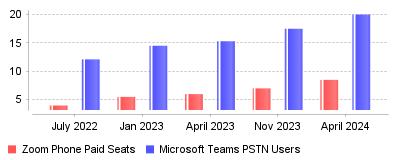
| Date | Zoom Phone Paid Seats | Microsoft Teams PSTN Users |
|---|---|---|
| July 2022 | 4.0 | 12.1 |
| Jan 2023 | 5.5 | 14.5 |
| April 2023 | 6.0 | 15.3 |
| Nov 2023 | 7.0 | 17.5 |
| April 2024 | 8.5 | 20.0 |
The data reveals a decisive shift where business telephony is no longer purchased as a standalone utility but activated as an add-on to existing collaboration suites. Specifically, Microsoft Teams Phone announced it crossed 20 million PSTN users in April 2024, representing a year-over-year growth of approximately 30% [1] [2]. Concurrently, Zoom Phone has seen rapid adoption, growing from 4 million seats in mid-2022 to over 7 million by late 2023, further validating that the market prefers single-platform "suite" solutions over disparate phone systems [3].
In the micro view, IT departments are consolidating vendors; rather than renewing contracts with traditional telecom providers, they are simply adding calling licenses (like Microsoft Teams Phone or Zoom Phone) to the software their employees already use daily. On a macro level, the industry is witnessing the extinction of the "PBX" (Private Branch Exchange) as a hardware category. This was solidified in mid-2024 when NEC, a global leader in on-premise telephony, announced it would exit the on-premise PBX business outside of Japan, discontinuing new hardware sales by the end of 2024 and ending support by March 2026 [4] [5]. This forces thousands of businesses to migrate immediately, likely accelerating the cloud numbers shown above.
This trend represents a critical "forced migration" event for the telecommunications industry. With NEC—a player that once held a massive market share in hospitality and SMB sectors—leaving the field, there is an estimated multi-billion dollar "scramble" for replacement systems happening right now [6]. Furthermore, as voice data moves entirely into platforms like Teams and Zoom, it becomes accessible to AI tools (like Microsoft Copilot) for transcription and sentiment analysis, unlocking value that was previously trapped in "dumb" phone lines [7].
The primary driver is the post-pandemic dominance of hybrid work, where a physical desk phone is obsolete; employees need their work number to follow them to their laptop and mobile app effortlessly. Additionally, the financial strain on legacy hardware manufacturers (exacerbated by supply chain issues post-COVID) made the low-margin hardware business unsustainable compared to the high-margin recurring revenue models of cloud software [8]. Finally, the convenience of "single-pane-of-glass" management for IT admins—managing voice, video, and chat in one portal—has won out over the feature-rich but complex legacy systems.
The convergence of Microsoft reaching 20 million PSTN users and NEC exiting the hardware market marks 2024 as the tipping point where cloud voice became the default, not the alternative. Businesses still clinging to on-premise systems face an immediate "adapt or die" deadline (March 2026 for NEC support), which will likely drive Teams and Zoom adoption numbers even higher in the next 12 months. The prominent takeaway is that voice is no longer a product you buy; it is a feature you enable.
The global landscape of business communication is undergoing a structural transformation, driven by the convergence of Unified Communications as a Service (UCaaS), Contact Center as a Service (CCaaS), and the rapid infusion of generative artificial intelligence (GenAI). Once viewed merely as a utility—a dial tone and a desk phone—business VoIP (Voice over Internet Protocol) has evolved into a central nervous system for organizational productivity and data intelligence. Market analysis indicates the global VoIP services market is projected to reach approximately $326 billion by 2032, growing at a CAGR of 10.8% [1]. However, this growth brings significant operational headwinds, ranging from sophisticated cybersecurity threats to complex regulatory compliance frameworks like The Campaign Registry (TCR) for SMS.
For modern enterprises, the selection of a communication platform is no longer a simple IT procurement decision; it is a strategic maneuver that impacts customer experience (CX), regulatory risk, and operational efficiency. This report analyzes the current trends reshaping the Business VoIP & Cloud Phone Systems market, identifies critical operational challenges, and evaluates the implications for specific industry verticals.
The most dominant trend in the 2024-2025 cycle is the shift from basic automation to "Agentic AI." While previous generations of VoIP features offered static auto-attendants or basic call routing, the current market is adopting AI agents capable of autonomous decision-making. These systems do not merely transcribe calls; they analyze sentiment in real-time, surface relevant CRM data, and execute post-call workflows without human intervention [2].

Organizations are increasingly deploying AI "copilots" integrated directly into their VoIP softphones. These tools listen to live conversations to provide agents with real-time coaching, objection handling, and compliance warnings. Research suggests that by 2025, a significant portion of UCaaS interactions will involve some form of AI mediation [3]. For sales-heavy organizations, such as Business VoIP & Cloud Phone Systems for SaaS Companies, this technology reduces ramp time for new account executives and ensures messaging consistency. The operational impact is a measurable reduction in "after-call work" (ACW), as AI automatically summarizes calls and updates the CRM, a critical efficiency gain for high-velocity environments [4].
Historically, internal business phone systems (UCaaS) and customer-facing contact centers (CCaaS) operated in silos. This separation created data fragmentation, where a subject matter expert in the back office could not easily be looped into a customer support call. The current trend is the rapid consolidation of these stacks. By 2025, it is predicted that the integration of these platforms will accelerate, driven by the need for a "single pane of glass" view of the customer journey [5]. This convergence allows for shared data models, meaning a support agent can seamlessly transfer a high-value client to a dedicated account manager without losing the context of the interaction [6].
As functionality expands, so does the threat landscape. The migration to cloud telephony has exposed businesses to new vectors of attack and regulatory scrutiny.
The most alarming operational challenge emerging in 2024 and 2025 is the weaponization of AI for "vishing" (voice phishing). Threat actors are utilizing deepfake technology to clone the voices of executives or trusted colleagues to authorize fraudulent transfers or credential resets. Reports indicate that deepfake-enabled vishing surged by over 1,600% in early 2025 compared to the previous year [7]. Unlike standard phishing emails, which employees are trained to spot, high-fidelity voice clones exploit the biological trust humans place in recognizing a familiar voice.
Business Implication: Organizations must move toward "Zero Trust" telephony architectures. This involves implementing multi-factor authentication not just for system access, but potentially for authorizing high-value voice transactions. For industries handling sensitive capital, such as Business VoIP & Cloud Phone Systems for Venture Capital Firms, the risk of CEO fraud via voice cloning is an existential threat that requires advanced biometric authentication and encrypted voice channels.
A major operational disruption for US-based businesses utilizing VoIP for text messaging is the enforcement of 10DLC (10-Digit Long Code) registration via The Campaign Registry (TCR). Mobile carriers now mandate that all business SMS traffic be registered to a verified brand and use case. Unregistered traffic is subject to severe blocking and filtering [8].
Small businesses and Business VoIP & Cloud Phone Systems for Startups have faced significant friction, with registration delays lasting weeks and high rejection rates due to minor data mismatches. The days of instantly spinning up a VoIP number to blast marketing texts are over. Failure to comply results in messages not being delivered, rendering SMS marketing channels useless [9]. This has forced many organizations to restructure their outreach strategies and invest in providers that offer "white-glove" support for TCR compliance.
The Securities and Exchange Commission (SEC) has aggressively cracked down on financial firms for failing to preserve electronic communications. In 2024 and 2025, the SEC imposed hundreds of millions of dollars in fines on investment advisers and broker-dealers for using "off-channel" communications like WhatsApp or personal texts for business purposes [10], [11].
Business Implication: This creates a specific operational burden for financial sectors. Business VoIP & Cloud Phone Systems for Private Equity Firms must now include robust archiving capabilities that capture not just voice recordings, but also SMS and internal chat logs. The ability to seamlessly archive communication from mobile apps is no longer optional; it is a regulatory mandate. Firms utilizing platforms that do not integrate with compliance archiving tools risk substantial penalties.
The "best" VoIP solution is highly dependent on the specific operational workflows of the industry. The following analysis breaks down requirements for key sectors.
For recruitment professionals, the telephone is the primary revenue-generating tool. The operational challenge here is volume and data integrity. Recruiters often make 50-100 calls per day. If the VoIP system does not automatically log these calls, notes, and outcomes into the Applicant Tracking System (ATS), valuable data is lost.
Operational Requirement: Deep integration with ATS platforms like Bullhorn or JobDiva is essential. Business VoIP & Cloud Phone Systems for Recruitment Agencies must offer features like "click-to-dial" to save seconds per call, and "power dialing" to automate the outbound process [12]. Furthermore, staffing agencies often manage a transient workforce. Business VoIP & Cloud Phone Systems for Staffing Agencies need the flexibility to spin up numbers for temporary recruiters and utilize SMS for mass candidate outreach, provided they navigate the TCR compliance successfully [13].
Contractors and plumbers face a fundamentally different set of challenges. Their work environment is not a quiet office but a noisy job site. They require mobile-first solutions that are robust against background noise and unreliable cellular data connections.
Operational Requirement: The critical feature for this demographic is noise cancellation and mobile app reliability. A VoIP app that crashes when switching between Wi-Fi and 5G is a liability. Business VoIP & Cloud Phone Systems for Contractors must offer seamless "call flip" capabilities (moving a call from desk to mobile without interruption) and robust noise suppression to filter out power tools or wind [14]. Similarly, Business VoIP & Cloud Phone Systems for Plumbers benefit from automated attendant features that can route emergency calls differently than routine scheduling inquiries, ensuring urgent service requests are never missed [15].
For startups and SaaS companies, scalability and integration speed are paramount. These organizations often use a diverse stack of Project Management & Productivity Tools and require their phone system to act as a data source for CRM and Helpdesk software.
Operational Requirement: Startups cannot afford long-term contracts or proprietary hardware. They require softphone-only deployments that can scale from 5 to 500 users instantly. Business VoIP & Cloud Phone Systems for Startups often prioritize open APIs to build custom workflows, such as triggering a Slack notification upon receiving a voicemail from a VIP client [16].
Looking toward 2026 and beyond, the standalone "phone system" will likely cease to exist for most competitive enterprises. Instead, voice will become a feature within broader productivity ecosystems. The integration of 5G will finally deliver on the promise of HD mobile video and voice reliability that rivals wired connections [17], making the physical desk phone obsolete for all but the most static roles.
Furthermore, the battle for VoIP dominance will be fought on the ground of AI utility. Providers that can offer "Agentic" workflows—where the phone system not only facilitates the conversation but actively participates in the business process by scheduling meetings, updating records, and flagging compliance risks—will capture the market [18]. However, this future depends entirely on the industry's ability to solve the trust crisis posed by AI voice cloning and the operational friction of regulatory compliance.
The most significant trend in business VoIP over the last year is the rapid consolidation of telephony into collaboration suites, marked by Microsoft Teams Phone surpassing 20 million PSTN users in April 2024. This surge coincides with a major market "push" factor: the exit of legacy giant NEC from the on-premise PBX market, forcing a massive migration of hardware-reliant businesses to cloud solutions. This shift signals the end of the standalone business phone era, as voice becomes merely a feature within broader UCaaS (Unified Communications as a Service) platforms. 2
| Date | Zoom Phone Paid Seats | Microsoft Teams PSTN Users |
|---|---|---|
| July 2022 | 4.0 | 12.1 |
| Jan 2023 | 5.5 | 14.5 |
| April 2023 | 6.0 | 15.3 |
| Nov 2023 | 7.0 | 17.5 |
| April 2024 | 8.5 | 20.0 |
The data reveals a decisive shift where business telephony is no longer purchased as a standalone utility but activated as an add-on to existing collaboration suites. Specifically, Microsoft Teams Phone announced it crossed 20 million PSTN users in April 2024, representing a year-over-year growth of approximately 30% [1] [2]. Concurrently, Zoom Phone has seen rapid adoption, growing from 4 million seats in mid-2022 to over 7 million by late 2023, further validating that the market prefers single-platform "suite" solutions over disparate phone systems [3].
In the micro view, IT departments are consolidating vendors; rather than renewing contracts with traditional telecom providers, they are simply adding calling licenses (like Microsoft Teams Phone or Zoom Phone) to the software their employees already use daily. On a macro level, the industry is witnessing the extinction of the "PBX" (Private Branch Exchange) as a hardware category. This was solidified in mid-2024 when NEC, a global leader in on-premise telephony, announced it would exit the on-premise PBX business outside of Japan, discontinuing new hardware sales by the end of 2024 and ending support by March 2026 [4] [5]. This forces thousands of businesses to migrate immediately, likely accelerating the cloud numbers shown above.
This trend represents a critical "forced migration" event for the telecommunications industry. With NEC—a player that once held a massive market share in hospitality and SMB sectors—leaving the field, there is an estimated multi-billion dollar "scramble" for replacement systems happening right now [6]. Furthermore, as voice data moves entirely into platforms like Teams and Zoom, it becomes accessible to AI tools (like Microsoft Copilot) for transcription and sentiment analysis, unlocking value that was previously trapped in "dumb" phone lines [7].
The primary driver is the post-pandemic dominance of hybrid work, where a physical desk phone is obsolete; employees need their work number to follow them to their laptop and mobile app effortlessly. Additionally, the financial strain on legacy hardware manufacturers (exacerbated by supply chain issues post-COVID) made the low-margin hardware business unsustainable compared to the high-margin recurring revenue models of cloud software [8]. Finally, the convenience of "single-pane-of-glass" management for IT admins—managing voice, video, and chat in one portal—has won out over the feature-rich but complex legacy systems.
The convergence of Microsoft reaching 20 million PSTN users and NEC exiting the hardware market marks 2024 as the tipping point where cloud voice became the default, not the alternative. Businesses still clinging to on-premise systems face an immediate "adapt or die" deadline (March 2026 for NEC support), which will likely drive Teams and Zoom adoption numbers even higher in the next 12 months. The prominent takeaway is that voice is no longer a product you buy; it is a feature you enable.