

The data reveals a significant, ongoing decline in the efficacy of B2B cold email outreach over the last three years, specifically regarding open and reply rates. This trend is critical because it marks the end of volume-based "spray and pray" tactics, forced by stricter email provider regulations (/Yahoo) and increasingly sophisticated AI spam filtering.
| Year | Average Open Rate | Average Reply Rate |
|---|---|---|
| 2023 | 36 | 7 |
| 2024 | 27.7 | 5.8 |
| 2025 (YTD) | 20 | 4 |
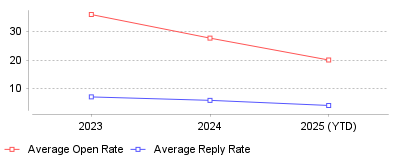
The data highlights a sharp downward trajectory in engagement metrics for B2B cold email campaigns between 2023 and 2025. Specifically, average open rates have plummeted from approximately 36% to realistic benchmarks of 15–25%, while reply rates have nearly halved from 7% to roughly 4–5% [1] [2]. This visualization confirms that getting a prospect's attention is becoming exponentially more difficult year over year.
On a micro level, this means that Sales Development Representatives (SDRs) now need to send significantly more emails to achieve the same number of meetings, or fundamentally change their approach to hyper-personalization. On a macro industry level, this signifies the death of "volume-based" lead generation where quantity could compensate for a lack of quality. The market is shifting toward "signal-based" selling, where outreach is triggered by intent data rather than static lists [3]. Furthermore, it indicates that the "inbox" is no longer a free-for-all marketing channel; it is becoming a gated community protected by aggressive AI and strict provider protocols.
This trend is critical because cold email has historically been the highest ROI channel for B2B customer acquisition, often returning $36 for every $1 spent [4]. As efficiency drops, customer acquisition costs (CAC) rise, forcing companies to restructure their entire go-to-market motions. Without adapting to these new benchmarks, businesses relying on traditional outbound methods will face pipeline starvation and potential domain blacklisting.
The primary driver is the implementation of stricter sender guidelines by and Yahoo in early 2024, which mandated authentication protocols (SPF, DKIM, DMARC) and enforced spam complaint thresholds below 0.3% [5]. Additionally, the proliferation of AI-enabled sales tools allowed inexperienced users to flood inboxes with low-quality, generic messages, leading to "inbox fatigue" among decision-makers who now receive over 10 cold pitches weekly [6]. Simultaneously, email providers have deployed advanced AI filters that judge engagement (not just keywords), meaning emails that are deleted without being read hurt the sender's future deliverability. Finally, the commoditization of B2B contact data has made it too easy for bad actors to scrape and spam, forcing privacy and gatekeeping measures to tighten.
The era of relying on mass cold emailing as a primary growth engine is effectively over. To survive this trend, B2B marketers must pivot to "omnichannel" strategies that combine email with LinkedIn and phone calls, as these integrated approaches show 31% lower cost-per-lead [7]. The key takeaway is that future success depends on "data hygiene" and "relevance" over volume; you must send fewer emails, but ensure they are hyper-targeted based on behavioral signals.

The data reveals a significant, ongoing decline in the efficacy of B2B cold email outreach over the last three years, specifically regarding open and reply rates. This trend is critical because it marks the end of volume-based "spray and pray" tactics, forced by stricter email provider regulations (/Yahoo) and increasingly sophisticated AI spam filtering.
| Year | Average Open Rate | Average Reply Rate |
|---|---|---|
| 2023 | 36 | 7 |
| 2024 | 27.7 | 5.8 |
| 2025 (YTD) | 20 | 4 |
The data highlights a sharp downward trajectory in engagement metrics for B2B cold email campaigns between 2023 and 2025. Specifically, average open rates have plummeted from approximately 36% to realistic benchmarks of 15–25%, while reply rates have nearly halved from 7% to roughly 4–5% [1] [2]. This visualization confirms that getting a prospect's attention is becoming exponentially more difficult year over year.
On a micro level, this means that Sales Development Representatives (SDRs) now need to send significantly more emails to achieve the same number of meetings, or fundamentally change their approach to hyper-personalization. On a macro industry level, this signifies the death of "volume-based" lead generation where quantity could compensate for a lack of quality. The market is shifting toward "signal-based" selling, where outreach is triggered by intent data rather than static lists [3]. Furthermore, it indicates that the "inbox" is no longer a free-for-all marketing channel; it is becoming a gated community protected by aggressive AI and strict provider protocols.
This trend is critical because cold email has historically been the highest ROI channel for B2B customer acquisition, often returning $36 for every $1 spent [4]. As efficiency drops, customer acquisition costs (CAC) rise, forcing companies to restructure their entire go-to-market motions. Without adapting to these new benchmarks, businesses relying on traditional outbound methods will face pipeline starvation and potential domain blacklisting.
The primary driver is the implementation of stricter sender guidelines by and Yahoo in early 2024, which mandated authentication protocols (SPF, DKIM, DMARC) and enforced spam complaint thresholds below 0.3% [5]. Additionally, the proliferation of AI-enabled sales tools allowed inexperienced users to flood inboxes with low-quality, generic messages, leading to "inbox fatigue" among decision-makers who now receive over 10 cold pitches weekly [6]. Simultaneously, email providers have deployed advanced AI filters that judge engagement (not just keywords), meaning emails that are deleted without being read hurt the sender's future deliverability. Finally, the commoditization of B2B contact data has made it too easy for bad actors to scrape and spam, forcing privacy and gatekeeping measures to tighten.
The era of relying on mass cold emailing as a primary growth engine is effectively over. To survive this trend, B2B marketers must pivot to "omnichannel" strategies that combine email with LinkedIn and phone calls, as these integrated approaches show 31% lower cost-per-lead [7]. The key takeaway is that future success depends on "data hygiene" and "relevance" over volume; you must send fewer emails, but ensure they are hyper-targeted based on behavioral signals.