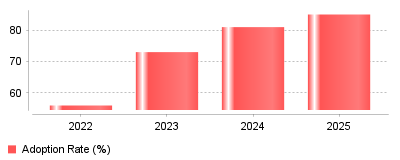
Skills-based hiring adoption jumped from 56% to 85% in just 3 years
Global Employer Adoption of Skills-Based Hiring
| Year |
Adoption Rate (%) |
| 2022 |
56 |
| 2023 |
73 |
| 2024 |
81 |
| 2025 |
85 |
The "Credential Cliff": The mass adoption of Skills-Based Hiring
What is this showing
The data illustrates a rapid, linear acceleration in the adoption of skills-based hiring practices over the last four years. Adoption rates have climbed steadily from 56% in 2022 to 85% in 2025, indicating that this method has graduated from an experimental tactic to the dominant operating model for global talent acquisition [1][2]. Concurrently, the reliance on traditional resumes is declining, with usage dropping to 67% in 2025 as employers seek more objective measures of ability [3].
What this means
For the HR software industry, this signals a pivot away from "System of Record" platforms that merely store static biographies toward "System of Intelligence" platforms that actively verify competencies. We are seeing a "de-credentialing" of the workforce; over half (53%) of employers have now formally eliminated degree requirements from job descriptions to widen their funnels [1]. At a macro level, this democratizes access to high-value jobs for "STARs" (Skilled Through Alternative Routes) and creates a more liquid labor market where talent is tradeable based on verifiable output rather than pedigree. For HR departments, it means the death of the "keyword match" strategy and the rise of multi-measure assessments (cognitive, personality, and coding tests) as the first gatekeeper.
Why is this important
This shift is critical because it directly correlates with superior business outcomes in a tight labor market. Data indicates that employees hired via skills-based methods have a 9% to 34% longer tenure compared to those hired via traditional methods, significantly reducing turnover costs [4][5]. Furthermore, it appears to be the most effective hedge against hiring inefficiency, with 89.6% of organizations reporting greater efficiency after making the switch [6].
What might have caused this
The primary catalyst is likely the "AI paradox": while AI tools help candidates polish perfect resumes, they also make those resumes less trustworthy, forcing employers to verify skills directly [1]. Additionally, persistent talent shortages have forced companies to look beyond university graduates, as skills-based approaches can expand talent pools by up to 6.1 times [7]. The rapid half-life of technical skills also means that what was learned in a degree program five years ago is often obsolete, making current demonstrated capability the only metric that matters.
Conclusion
Skills-based hiring has effectively won the war of ideas in recruitment, moving from a niche "fairness" initiative to a core efficiency driver adopted by 85% of employers. The takeaway for HR leaders is that "experience" is no longer a proxy for "ability." To remain competitive, HCM tech stacks must evolve to capture, verify, and match granular skills data rather than just parsing job titles.
Executive Summary: The Evolution of Human Capital Management
The landscape of Human Capital Management (HCM) is undergoing a fundamental structural shift, driven by the convergence of generative artificial intelligence (AI), tightening regulatory frameworks, and the permanent decentralization of the workforce. No longer merely a system of record for payroll and benefits,
HR & People Management Software has evolved into a critical operational infrastructure that dictates organizational agility. As businesses move into 2025, the market for HCM software is projected to reach substantial valuations, with estimates suggesting a compound annual growth rate (CAGR) of approximately 10% to 12% through the end of the decade [
1]. This growth is not merely a reflection of software adoption but indicates a deeper reliance on digital tools to navigate labor shortages, compliance complexities, and the productivity imperative.
However, this technological expansion brings distinct operational challenges. Organizations are currently grappling with the "productivity paradox" of AI integration, where the promise of automation clashes with the reality of fragmented data silos and change management fatigue. Furthermore, the divergence between desk-based employees and the deskless workforce has exposed significant gaps in software capabilities, forcing vendors and practitioners to rethink how HR technology serves the frontline. This report analyzes the prevailing trends, the operational friction points, and the strategic implications for diverse business models, from private equity firms to construction contractors.
The AI Transformation: From Automation to "Superagency"
The most dominant trend in the current HCM landscape is the transition from predictive analytics to generative and agentic AI. While machine learning has long been used for candidate matching and attrition prediction, the integration of Large Language Models (LLMs) is fundamentally altering the user interface of
HR Management & HCM Software.
Operational Shift: The Rise of Agentic AI
We are moving beyond simple chatbots toward "agentic AI"—systems capable of autonomous decision-making and executing complex workflows with limited human supervision. According to Gartner, agentic AI is expected to make at least 15% of day-to-day work decisions by 2028, up from effectively 0% in 2024 [
2]. This shift promises to resolve the "blank page" problem in HR, automating the creation of job descriptions, performance reviews, and personalized learning pathways.
The business implication here is a dramatic reduction in administrative overhead. Research indicates that AI-driven HR tools could save organizations up to $1.5 trillion globally by 2025 through efficiency gains [
3]. However, this capability introduces a critical operational challenge: "algorithmic accountability". As AI agents take on more substantive roles in hiring and performance management, the risk of "black box" decision-making increases. HR leaders are now tasked with auditing algorithms for bias, a competency that most traditional HR departments lack.
The Productivity Paradox and Implementation Gaps
Despite the enthusiasm, actual maturity in AI deployment remains low. McKinsey research highlights that while 92% of companies plan to increase AI investment, only 1% of leaders consider their organizations "mature" in AI deployment [
4]. The operational friction lies in the quality of the underlying data. AI models require pristine, unified data sets to function effectively. Yet, many organizations struggle with fragmented legacy systems where payroll, performance, and recruiting data exist in isolation. Without a unified data architecture, AI "hallucinations" and errors become a liability rather than an asset.
Operational Challenge: The Compliance Labyrinth and Data Privacy
As software capabilities expand, so does the regulatory perimeter. The days of unrestricted data usage are over, replaced by a patchwork of global and local regulations that demand rigorous compliance features within HCM platforms.
Pay Transparency and Equity
One of the most significant operational hurdles in recent years is the rise of pay transparency legislation. Jurisdictions across the United States (such as California, New York, and Washington) and the European Union now require employers to disclose salary ranges and, in some cases, reporting on pay gaps. This fundamentally changes compensation management from a private administrative task to a public-facing strategic element.
For specialized entities, such as recruitment firms, this presents a dual challenge.
HR Management Software for Recruitment Agencies must now possess automated compliance engines that can instantly validate job postings against local laws to avoid heavy fines. The operational burden of manually verifying compliance for thousands of requisitions is unsustainable, driving the need for software that integrates real-time legislative updates.
AI Bias and Algorithmic Regulation
Simultaneously, governments are scrutinizing the use of AI in employment decisions. New York City’s Local Law 144, which requires bias audits for automated employment decision tools (AEDTs), is a harbinger of broader regulation. The operational challenge for HR departments is ensuring that their vendor stack is compliant. Leaders must now demand "explainability" from their software providers—understanding *how* an algorithm ranked a candidate. This is particularly acute for
HR Management Software for Startups, where rapid scaling often leads to the adoption of "black box" tools that may inadvertently violate emerging bias laws.
The "Siloed" Architecture Problem in M&A and Scaling
A persistent operational failure mode in HCM is the inability to integrate disparate systems following organizational changes, particularly mergers and acquisitions (M&A).
The Integration Imperative for Private Equity
Private Equity (PE) firms operate with a distinct thesis: value creation through operational efficiency. However, human capital often represents the largest cost and the highest risk in a portfolio company. When PE firms acquire or merge entities, they frequently inherit a "Frankenstein" stack of incompatible HR systems.
This lack of integration leads to "data blindness," where firms cannot accurately assess headcount costs, turnover trends, or leadership bench strength across the portfolio.
HR Management Software for Private Equity Firms is increasingly focused on interoperability and rapid deployment. The operational goal is to establish a "single source of truth" within the first 100 days of an acquisition to execute value creation plans effectively [
5]. Failure to integrate these data streams results in delayed synergies and missed financial targets.
Scaling Challenges for SaaS Companies
Similarly, Software-as-a-Service (SaaS) companies face unique HCM challenges related to hyper-growth and global talent acquisition. As these companies scale, they often outgrow the "spreadsheet phase" rapidly. The operational challenge is maintaining culture and compliance while hiring across multiple borders.
HR Management Software for SaaS Companies must handle multi-currency payroll, global benefits administration, and asynchronous performance management. The friction point here is often "SaaS sprawl," where different departments adopt their own shadow HR tools, leading to security vulnerabilities and disconnected employee experiences [
6].
The Deskless Workforce and the Gig Economy Gap
While corporate offices discuss the nuances of hybrid work, a massive segment of the workforce—deskless workers and independent contractors—remains underserved by traditional HCM solutions.
Bridging the Digital Divide for Deskless Workers
Deskless workers (e.g., in healthcare, construction, retail, and field services) comprise approximately 80% of the global workforce yet historically receive less than 1% of enterprise software venture funding [
7]. The operational challenge is connectivity and access. Traditional HCM platforms often require desktop access or complex logins that are impractical for a plumber or construction worker on a job site.
This has driven demand for mobile-first
HR Management Software for Contractors. These platforms must focus on specific functionalities: geo-fenced time tracking, mobile safety compliance checks, and instant shift swapping. The trend is moving away from "HR administration" toward "workforce enablement," ensuring that the software helps the worker do their job rather than just recording it.
Managing the Gig Economy and Contingent Labor
The rise of the gig economy has complicated the definition of "employee." Organizations are increasingly relying on contingent workers to fill skills gaps. However, managing this workforce requires distinct workflows regarding classification, tax compliance (e.g., IR35 in the UK, 1099 in the US), and project-based payments.
Operational risks here are high; misclassifying a worker can lead to severe legal penalties. Modern HCM platforms are evolving to support "total talent management," allowing HR to view full-time employees and contractors in a single dashboard. This visibility is crucial for
HR Management Software for Staffing Agencies, which must manage high-volume turnover and complex billing rates simultaneously. The challenge lies in integrating these contingent workers into the company culture and communication loops without violating co-employment regulations [
8].
The Cost of Poor Onboarding and Data Silos
The operational impact of failing to optimize HCM systems is measurable and severe. Data silos—where information is trapped in disconnected apps—are a primary driver of inefficiency.
Financial Implications of Disconnected Systems
Research indicates that HR teams spend up to 57% of their time on administrative tasks, primarily reconciling data between systems [
9]. When recruitment data does not flow seamlessly into onboarding and payroll systems, the "time to productivity" for a new hire is significantly delayed.
The cost of poor onboarding is particularly high. Statistics suggest that organizations with weak onboarding processes see higher early attrition rates, with nearly 20% of new hires leaving within the first 45 days. Conversely, effective onboarding can improve retention by over 82% [
10]. For high-growth sectors like SaaS and Startups, where customer acquisition costs are high, losing talent due to administrative friction is a direct hit to profitability.
The Role of Integration-Platform-as-a-Service (iPaaS)
To combat this, the industry is trending toward iPaaS (Integration Platform as a Service) solutions that act as the connective tissue between disparate HR apps. The goal is to create a seamless "employee journey" where a candidate's data flows from the Applicant Tracking System (ATS) to the HCM, to the Learning Management System (LMS), and finally to the offboarding process without manual re-entry.
Future Outlook: The "Human-Centric" Tech Stack
Looking toward 2026 and beyond, the HCM market will likely bifurcate. On one side, massive "all-in-one" suites will continue to consolidate features, attempting to be the single operating system for the enterprise. On the other, specialized "best-of-breed" solutions will dominate niches like deskless worker management and AI-driven recruitment, relying on robust APIs to integrate with core systems.
Key Future Drivers
- Skills-Based Architecture: Software will move away from job titles toward "skills inference," using AI to map an employee's capabilities dynamically. This allows for more agile internal mobility and project staffing.
- Hyper-Personalization: Similar to consumer technology (like Netflix or Spotify), HCM interfaces will become highly personalized, suggesting benefits, learning courses, and internal gigs based on individual behavior and preferences.
- Ethical AI Governance: "AI Ethics Officers" will become stakeholders in HR software procurement, ensuring that automated systems do not introduce liability through bias.
Business Implications
For organizations, the message is clear: the HCM tech stack is no longer a back-office concern—it is a frontline competitive advantage. Companies that successfully integrate AI while maintaining human oversight, and those that bridge the gap between their desk and deskless workers, will see higher retention and productivity. Those that allow data silos to fester will face increasing operational costs and compliance risks.