


| Year | Creative PM Software | Online Proofing Software |
|---|---|---|
| 2021 | 2.9 | 1.15 |
| 2022 | 3.2 | 1.25 |
| 2023 | 3.5 | 1.38 |
| 2024 | 3.8 | 1.54 |
| 2025 | 4.15 | 1.67 |
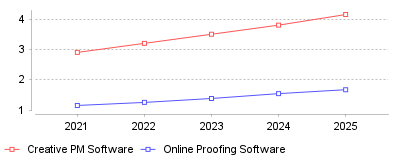
The data shows a persistent, compounding expansion in the financial valuations of the Creative Project Management and Online Proofing software markets between 2021 and 2025. Specifically, the global creative project management software market reached approximately $3.5 billion in 2023 [1], while the online proofing software market surpassed $1.54 billion in 2024 [2], with both sectors tracking at strong annual growth rates through the current year.
On a micro level, this indicates that individual creative teams and agencies are fundamentally restructuring how they work, moving away from fragmented email threads and manual spreadsheets. A 2025 Monotype survey found that an alarming 57% of creative teams spend over a quarter of their time on non-creative administrative tasks, such as font management, compliance checks, and workflow tracking [3]. By adopting robust project management and proofing tools, these professionals are attempting to reclaim lost hours and redirect their energy toward actual content generation. On a macro industry level, this represents the industrialization of digital marketing, where creative operations are now treated as rigorous supply chains [4]. Software platforms are evolving into centralized sources of truth that integrate directly with enterprise-wide objectives to maintain brand compliance and speed up go-to-market cycles.
Without these specialized tools, organizations face steep collaboration taxes that directly impact their bottom lines and project success rates. Research demonstrates that ineffective communication and misaligned expectations are the primary causes of project failure in a staggering 44% of unsuccessful initiatives [5]. By implementing centralized online proofing and AI-assisted task management, companies can eliminate ambiguities, automate version control, and ensure stakeholders are perfectly aligned before execution begins.
The sudden explosion in this software category is likely driven by the post-pandemic normalization of remote and hybrid work, which exposed the severe limitations of traditional, localized creative review processes [2]. Furthermore, the sheer volume of content required for modern omnichannel digital marketing has exceeded human capacity to manage manually. The recent integration of Generative AI into these platforms has also acted as a major catalyst for rapid adoption and expanded budgets. In fact, 55% of software buyers in 2025 stated that the desire to add AI functionality was their primary trigger for purchasing new project management tools [6]. Ultimately, as project complexity scales to accommodate global campaigns, organizations have no choice but to rely on intelligent, automated systems to catch errors and predict bottlenecks before they derail timelines.
The trajectory of creative project management and online proofing software underscores a permanent shift from manual task-tracking to AI-enhanced, strategic creative operations. As content demands continue to soar, businesses that fail to invest in these platforms will inevitably succumb to operational friction and misaligned objectives. The prominent takeaway is that reclaiming the 57% of time lost to administrative burdens is no longer just an efficiency goal, but rather a mandatory competitive advantage for the modern enterprise.
Marketing budgets flatlined at 7.7% of company revenue in 2025 [1]. Fifty-nine percent of executives report having insufficient funds to execute their annual strategies [2]. This capital constraint forces leaders to extract higher output from existing personnel. Directors cannot simply hire more staff to solve volume problems. They must optimize existing workflows to maintain productivity. Paid media consumption accounts for 30.6% of these flat budgets [3]. Media price inflation means buyers get less reach for every dollar spent. This dynamic leaves a smaller slice of capital for production labor and external fees. Thirty-nine percent of surveyed executives plan to reduce their agency budgets to free up cash [4]. Actions include eliminating unproductive relationships and streamlining vendor rosters. Work inevitably moves in-house when external contracts expire. Internal teams absorb this excess workload without proportional increases in headcount. Leaders bridge this gap by purchasing software. Technology investments promise to automate administrative tasks and accelerate production cycles. The alternative is widespread employee burnout and missed deadlines.
Adobe reported $6.40 billion in first-quarter revenue for fiscal 2026 [5]. This figure represents a 12% year-over-year increase. Their subscription revenue for professionals reached $4.39 billion during the same period [6]. Adobe's annualized recurring revenue hit $26.06 billion [7]. This scale demonstrates that spending on software remains strong despite broader budget stagnation. Corporations invest heavily in design, creative and media production software to manage daily operations. Asana's financial trajectory mirrors this demand. The work management company posted $723.9 million in fiscal 2025 revenue [8]. This marks an 11% increase from the previous year. Their core customers spending over $100,000 annually grew by 20% [9]. Organizations are abandoning scattered spreadsheets. They adopt structured task management to prevent timeline collapse. Chief financial officers approve these software purchases because they believe digital tools drive labor efficiency. Software vendors prioritize sustainable operations over aggressive expansion. Asana achieved positive cash flow of $2.6 million in fiscal 2025 [10]. This profitability focus translates to more stable roadmaps for their customers.

Corporate departments face unprecedented volume. Teams must produce variations of a single graphic for Instagram, LinkedIn, email broadcasts, and display networks. This geometric multiplication of deliverables overwhelms traditional spreadsheets. A single product launch might require 50 unique assets. Directors implement specialized project software for marketing teams to manage this load. These platforms track resource capacity across the entire department. Managers assign specific deadlines to individual creators. The system stores file attachments directly within the task card. This centralized approach prevents staff burnout by balancing workloads evenly. Centralized content organizations use engagement metrics rather than supply metrics to evaluate performance [11]. They care about audience reaction rather than merely tracking production speed. Decentralized teams still focus on internal delivery times. Proper project software allows leaders to shift their focus from output volume to asset quality. Data visibility improves when every task lives in one system. Marketing directors can identify operational bottlenecks by analyzing task completion rates. They use this information to justify new hires during annual budget reviews.
External firms face a distinct crisis. Agencies sell human time. When campaigns drag past their original deadlines, agencies lose money. Scope creep destroys profit margins. Account managers spend hours compiling feedback from fragmented email chains. Clients routinely request extra revisions that fall outside the original contract. To combat this margin decay, firm leaders purchase project management tools built for agencies. These specialized platforms integrate time tracking directly into the task interface. When a designer uploads a file, the system records the exact minutes spent on execution. This allows finance directors to measure client profitability accurately. It prevents account teams from over-servicing unprofitable accounts. Agency executives use this data to negotiate better contracts during annual reviews. If a client constantly demands additional iterations, the agency has the data to justify a fee increase. Software transforms vague complaints about overwork into quantifiable metrics. Tracking hours at the task level also helps traffic managers forecast future availability. They can confidently accept new pitches without overloading their creative staff.
Execution is rarely the slowest phase of any campaign. Approval cycles cause the most severe delays. Stakeholders provide conflicting feedback across multiple communication channels. A copywriter might receive edits via Slack, email, and a physical printout. This fragments the revision process. Teams waste hours deciphering vague requests like "make it pop" or "adjust the layout." Without a defined hierarchy, junior designers struggle to prioritize conflicting edits from different vice presidents. To solve this, companies use creative project management and proofing tools. These platforms centralize all comments into a single environment. Every stakeholder views the exact same file version. The software forces reviewers to tag specific locations on the asset when leaving a comment. This spatial context eliminates ambiguity. Approval routing ensures that the legal department only sees the file after the brand manager signs off. This sequential process prevents executives from wasting time reviewing unpolished drafts. It establishes clear accountability for every decision made during the design process.
Video files compound this approval problem exponentially. Text documents allow simple margin comments. Motion graphics require frame-accurate feedback. A stakeholder asking to cut a scene must specify the exact timestamp. Without specialized tools, reviewers manually type timecodes into email messages. This creates immense friction for the video editor. Producers implement proofing applications for video and motion graphics to eliminate timeline confusion. These interfaces allow reviewers to click directly on the video frame during playback. The software pauses the video and attaches a specific timestamp to the written note. The editor clicks the note, and the timeline automatically jumps to the correct frame. This removes all ambiguity from the revision cycle. High-end systems integrate directly with editing software like Adobe Premiere Pro. Editors view client feedback inside their native workspace without opening a web browser. This seamless connection accelerates the delivery of final files. It also reduces the hardware strain on the editor's workstation by preventing constant application switching.
Static imagery faces similar version control hurdles. Designers manage dozens of minor requests per asset. Brand managers scrutinize color codes and logo placements. A campaign might require separate graphic dimensions for 12 different platforms. Departments use review and proofing software targeted at designers to track version history. This prevents executives from accidentally approving an outdated file. The software stacks versions sequentially. Reviewers can overlay version two on top of version one to highlight exactly what changed. A slider tool reveals pixel-level differences between the two drafts. It creates a clear record of who requested specific changes. If a chief marketing officer questions a design choice weeks later, the team can produce the exact comment that prompted the change. This accountability protects creative staff from unfair criticism. It also forces reviewers to think carefully before requesting arbitrary changes. Centralized feedback eliminates the risk of a designer executing edits on an obsolete file format.
The Federal Trade Commission updated its digital guidelines to target undisclosed influencer sponsorships [12]. They pursue unsupported claims with increased aggression. Regulators hold brands accountable for every asset published across social channels. Compliance teams must verify that proper disclosures accompany promotional material before publication. Financial sectors operate under even stricter oversight. The Food and Drug Administration issued 2024 draft guidance on artificial intelligence in promotional materials [13]. This document emphasizes strict accountability for any generated claims. Marketing departments in these sectors cannot risk ad-hoc approval chains. Software solves this compliance gap by generating automatic trails. Every comment, revision, and final signature is logged with a permanent timestamp. If a regulator questions a specific advertisement, the company can produce the exact approval sequence. This protects the organization from severe liability. It proves that the company followed established compliance protocols before publishing the asset. Maintaining these records manually through spreadsheets exposes the corporation to unacceptable legal risk.
Generative models alter how managers allocate hours. Automation handles repetitive tasks. Artificial intelligence investments deliver measurable returns through time efficiency for 49% of surveyed executives [14]. Another 40% report direct gains in cost efficiency from these implementations. Hybrid teams using artificial intelligence achieve cycle-time reductions of 40% to 60% [15]. This allows creators to focus on narrative strategy rather than manual resizing. Adobe integrated Sensei GenAI into its Experience Cloud platform [16]. This feature generates text and images directly within the project interface. It removes the need to switch between separate applications. Multimodal models create content on a massive scale [17]. These rapid generation capabilities force teams to adopt stronger project management protocols. If software generates 100 variations of an advertisement, humans still need a structured system to review and approve them. Artificial intelligence accelerates creation but necessitates more rigorous review parameters.
Unifying software contracts saves capital. Chief financial officers scrutinize duplicate licenses across departments. Centralized supply solutions deliver a 310% return on investment over a three-year period [18]. By consolidating task management and file proofing into single platforms, companies reduce subscription overhead. Predictive allocation of resources will dominate the next software generation. Artificial intelligence will forecast employee burnout by analyzing historical rates of task completion. Managers will receive alerts before a designer misses a deadline. System interoperability will also improve. Disconnected tools will merge through open programming interfaces. Modern operations require cross-functional collaboration [19]. Sales, product, and marketing departments will share unified dashboards. This transparency aligns corporate strategy with daily creative execution. As technology evolves, the distinction between project management software and creative design software will disappear completely. Vendors will continue merging these functionalities to provide uninterrupted workflows for corporate users.
| Year | Creative PM Software | Online Proofing Software |
|---|---|---|
| 2021 | 2.9 | 1.15 |
| 2022 | 3.2 | 1.25 |
| 2023 | 3.5 | 1.38 |
| 2024 | 3.8 | 1.54 |
| 2025 | 4.15 | 1.67 |
The data shows a persistent, compounding expansion in the financial valuations of the Creative Project Management and Online Proofing software markets between 2021 and 2025. Specifically, the global creative project management software market reached approximately $3.5 billion in 2023 [1], while the online proofing software market surpassed $1.54 billion in 2024 [2], with both sectors tracking at strong annual growth rates through the current year.
On a micro level, this indicates that individual creative teams and agencies are fundamentally restructuring how they work, moving away from fragmented email threads and manual spreadsheets. A 2025 Monotype survey found that an alarming 57% of creative teams spend over a quarter of their time on non-creative administrative tasks, such as font management, compliance checks, and workflow tracking [3]. By adopting robust project management and proofing tools, these professionals are attempting to reclaim lost hours and redirect their energy toward actual content generation. On a macro industry level, this represents the industrialization of digital marketing, where creative operations are now treated as rigorous supply chains [4]. Software platforms are evolving into centralized sources of truth that integrate directly with enterprise-wide objectives to maintain brand compliance and speed up go-to-market cycles.
Without these specialized tools, organizations face steep collaboration taxes that directly impact their bottom lines and project success rates. Research demonstrates that ineffective communication and misaligned expectations are the primary causes of project failure in a staggering 44% of unsuccessful initiatives [5]. By implementing centralized online proofing and AI-assisted task management, companies can eliminate ambiguities, automate version control, and ensure stakeholders are perfectly aligned before execution begins.
The sudden explosion in this software category is likely driven by the post-pandemic normalization of remote and hybrid work, which exposed the severe limitations of traditional, localized creative review processes [2]. Furthermore, the sheer volume of content required for modern omnichannel digital marketing has exceeded human capacity to manage manually. The recent integration of Generative AI into these platforms has also acted as a major catalyst for rapid adoption and expanded budgets. In fact, 55% of software buyers in 2025 stated that the desire to add AI functionality was their primary trigger for purchasing new project management tools [6]. Ultimately, as project complexity scales to accommodate global campaigns, organizations have no choice but to rely on intelligent, automated systems to catch errors and predict bottlenecks before they derail timelines.
The trajectory of creative project management and online proofing software underscores a permanent shift from manual task-tracking to AI-enhanced, strategic creative operations. As content demands continue to soar, businesses that fail to invest in these platforms will inevitably succumb to operational friction and misaligned objectives. The prominent takeaway is that reclaiming the 57% of time lost to administrative burdens is no longer just an efficiency goal, but rather a mandatory competitive advantage for the modern enterprise.