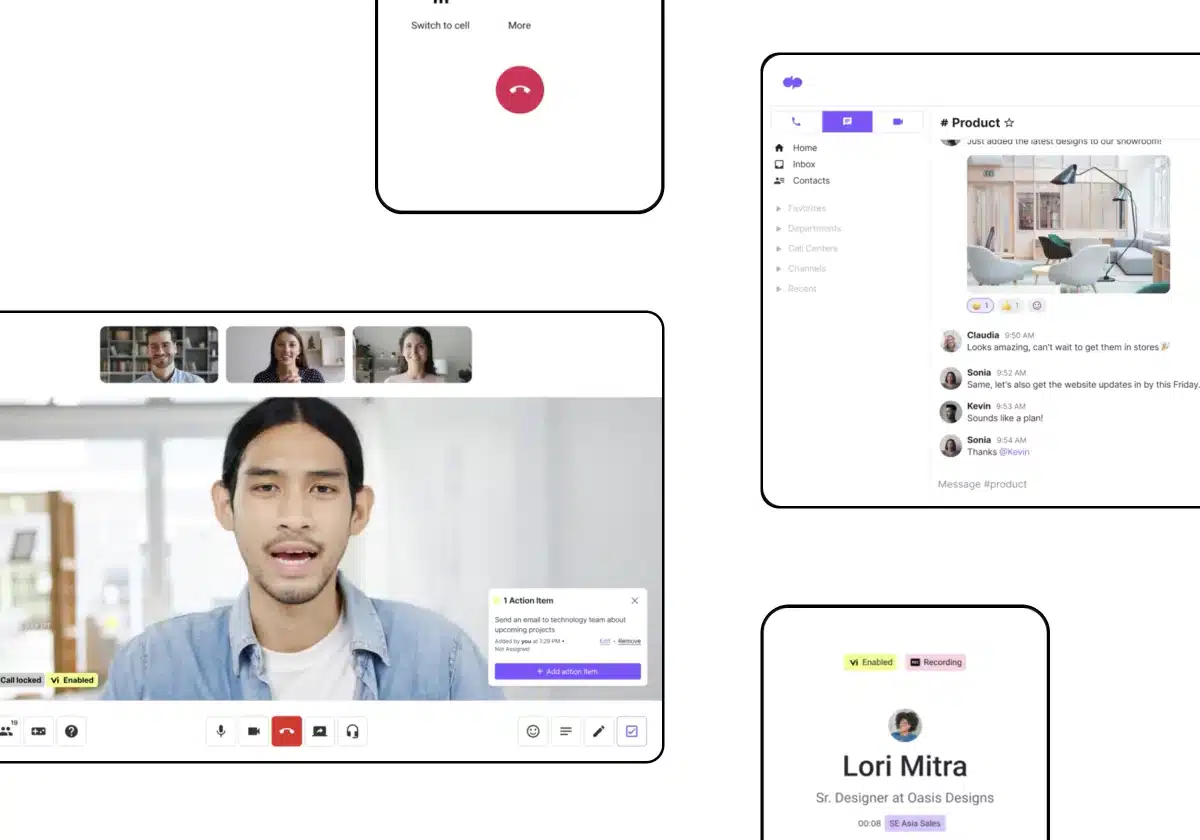
Video Conferencing Software

Updated July 22, 2026

These are the specialized categories within Video Conferencing Software. Looking for something broader? See all Project Management & Productivity Tools categories.

Not sure which one is right for you?

Answer 4 quick questions and we'll match you with your best options

Find Your Best Match

How big is your team?

Just me
2 - 10
11 - 50
51 - 200
201 - 1,000
1,000+

What's your budget situation?

Free or open-source only
Free to start, pay later
Best value for money
Price isn't the main factor

What's your team's technical comfort level?

We want it to just work
We can handle some setup
We have developers who'll customize it

What's the ONE thing this tool must do well?

Step 1 of 4
1
9.4 / 10
GoTo Meeting

GoTo Meeting is designed for contractors seeking a reliable video conferencing solution that ensures security and compliance. With features like unlimited meeting durations and cloud recordings, it caters to industries requiring strict adherence to regulations.

Best for Video Conferencing Software for Contractors

Expert Take

GoTo Meeting stands out as a highly reliable, no-nonsense web conferencing solution that prioritizes security and stability over flashy features. We love its strict adherence to enterprise-grade compliance, including HIPAA and SOC 2 Type II certifications, making it a powerhouse for regulated industries like healthcare and finance. The inclusion of unlimited meeting durations and unlimited cloud recording on mid-tier plans offers exceptional value, while its 99.99% uptime guarantee ensures your

Pros

  • Unlimited meeting durations with no time limits on video conferences.
  • Includes unlimited cloud recording and meeting transcription on Business tiers.
  • Reliable performance with an industry-leading 99.99% uptime guarantee.

Cons

  • Lacks a permanently free tier, offering only a 14-day free trial.
  • User interface feels outdated and cluttered compared to modern competitors.

Best for teams that are

  • Small to mid-sized businesses needing reliability.
  • Users seeking affordable cloud recording storage.

Skip if

  • Users needing a robust and feature-rich free plan.
  • Teams wanting the most modern user interface.

Best for teams that are

  • Small to mid-sized businesses needing reliability.
  • Users seeking affordable cloud recording storage.

Skip if

  • Users needing a robust and feature-rich free plan.
  • Teams wanting the most modern user interface.

Pros

  • Unlimited meeting durations with no time limits on video conferences.
  • Highly secure with HIPAA, SOC 2 Type II, and AES-256 bit encryption.
  • Includes unlimited cloud recording and meeting transcription on Business tiers.
  • Reliable performance with an industry-leading 99.99% uptime guarantee.

Cons

  • Lacks a permanently free tier, offering only a 14-day free trial.
  • User interface feels outdated and cluttered compared to modern competitors.
  • Lacks advanced AI features like gesture recognition and automated summaries.

Expert Take

GoTo Meeting stands out as a highly reliable, no-nonsense web conferencing solution that prioritizes security and stability over flashy features. We love its strict adherence to enterprise-grade compliance, including HIPAA and SOC 2 Type II certifications, making it a powerhouse for regulated industries like healthcare and finance. The inclusion of unlimited meeting durations and unlimited cloud recording on mid-tier plans offers exceptional value, while its 99.99% uptime guarantee ensures your

2
9.4 / 10
Webex Meetings

Webex Meetings is a video conferencing software designed to meet the needs of contractors. Its flexibility allows contractors to conduct virtual meetings and collaborations, regardless of location. Its robust features such as HD video, screen sharing, and recording ensure seamless communication, which is critical in managing construction projects.

Best for Video Conferencing Software for Contractors

Expert Take

In our evaluation, webex Meetings remains the gold standard for security-conscious enterprises, boasting FedRAMP, HIPAA, and SOC 2 compliance that few competitors can match. Research indicates its integration with Cisco hardware creates a seamless hybrid work environment, while AI features like background noise removal are best-in-class. While the interface may feel less modern than consumer-focused alternatives, its reliability and deep ecosystem make it indispensable for large-scale, regulated organizations.

Pros

  • FedRAMP, HIPAA, and SOC 2 compliant
  • Seamless Cisco hardware (Room Kit) integration
  • AI noise removal and gesture recognition
  • Real-time translation for 100+ languages

Cons

  • Interface often cited as clunky
  • Strict 40-minute limit on free plan
  • Heavier system resource usage than competitors
  • Steeper learning curve for new users

Best for teams that are

  • Enterprise teams requiring high-level security.
  • Global orgs needing real-time translation.

Skip if

  • Small casual teams wanting lightweight software.
  • Users seeking entirely free large-scale events.

Best for teams that are

  • Enterprise teams requiring high-level security.
  • Global orgs needing real-time translation.

Skip if

  • Small casual teams wanting lightweight software.
  • Users seeking entirely free large-scale events.

Pros

  • FedRAMP, HIPAA, and SOC 2 compliant
  • Leader in Gartner Magic Quadrant
  • Seamless Cisco hardware (Room Kit) integration
  • AI noise removal and gesture recognition
  • Real-time translation for 100+ languages

Cons

  • Interface often cited as clunky
  • Strict 40-minute limit on free plan
  • Translation add-on is expensive ($300/yr)
  • Heavier system resource usage than competitors
  • Steeper learning curve for new users

Expert Take

In our evaluation, webex Meetings remains the gold standard for security-conscious enterprises, boasting FedRAMP, HIPAA, and SOC 2 compliance that few competitors can match. Research indicates its integration with Cisco hardware creates a seamless hybrid work environment, while AI features like background noise removal are best-in-class. While the interface may feel less modern than consumer-focused alternatives, its reliability and deep ecosystem make it indispensable for large-scale, regulated organizations.

3
9.3 / 10
eyeson

Eyson is designed for contractors needing efficient video conferencing with low bandwidth. Its Single Stream Technology ensures smooth calls on weak connections, while developers enjoy easy integration of live data and custom UI overlays.

Best for Video Conferencing Software for Contractors

Expert Take

Eyeson fundamentally changes video conferencing architecture. Instead of forcing client devices to process multiple video streams, its patented Single Stream Technology composites all media, video, and data in the cloud into a single lightweight feed. This keeps bandwidth locked around 1.5 Mbps, allowing flawless performance on weak connections while empowering developers to inject live telemetry, UI overlays, or drone feeds directly into the video in real-time.

Pros

  • Ultra-low bandwidth consumption (1.5 Mbps)
  • 100% browser-based, no downloads needed
  • Highly programmable API for developers
  • Eco-friendly with reduced CO2 footprint

Cons

  • Maximum of 9 on-camera participants
  • Lacks native breakout room features

Best for teams that are

  • Developers embedding video via APIs.
  • Teams operating in low-bandwidth environments.

Skip if

  • Consumers wanting a simple, non-technical app.
  • Standard business users needing basic calls.

Best for teams that are

  • Developers embedding video via APIs.
  • Teams operating in low-bandwidth environments.

Skip if

  • Consumers wanting a simple, non-technical app.
  • Standard business users needing basic calls.

Pros

  • Ultra-low bandwidth consumption (1.5 Mbps)
  • Patented Single Stream Technology
  • 100% browser-based, no downloads needed
  • Highly programmable API for developers
  • Eco-friendly with reduced CO2 footprint

Cons

  • Maximum of 9 on-camera participants
  • Lacks native breakout room features
  • Occasional browser-specific compatibility issues

Expert Take

Eyeson fundamentally changes video conferencing architecture. Instead of forcing client devices to process multiple video streams, its patented Single Stream Technology composites all media, video, and data in the cloud into a single lightweight feed. This keeps bandwidth locked around 1.5 Mbps, allowing flawless performance on weak connections while empowering developers to inject live telemetry, UI overlays, or drone feeds directly into the video in real-time.

Webex Collaboration Suite

Webex is a comprehensive collaboration solution that addresses the unique needs of recruitment agencies. It offers robust video conferencing capabilities, along with messaging, webinars, events, polling, and whiteboarding, enabling recruiters to effectively communicate with candidates, conduct interviews, and collaborate with team members.

Best for Video Conferencing Software for Recruitment Agencies

Expert Take

Webex Collaboration Suite excels as a comprehensive solution for recruitment agencies, offering robust video conferencing and collaboration tools. Its integration capabilities and extensive feature set make it a top choice in its category. While some features are tiered, the overall offering remains strong.

Pros

  • Trusted by 95% of Fortune 500 companies
  • AI noise removal and real-time translation
  • Integrated first-party hardware ecosystem
  • Includes Slido polling and Vidcast messaging

Cons

  • Interface can be cluttered and non-intuitive
  • High system resource usage causes lag
  • International calling can be expensive
  • Steeper learning curve for new users

Best for teams that are

  • Enterprise IT teams needing secure, carrier-grade unified communication.
  • Remote or hybrid workforces requiring robust omnichannel customer experience tools.

Skip if

  • Small recruiting agencies needing a specialized applicant tracking system.
  • Teams seeking a lightweight, standalone video tool without IT overhead.

Best for teams that are

  • Enterprise IT teams needing secure, carrier-grade unified communication.
  • Remote or hybrid workforces requiring robust omnichannel customer experience tools.

Skip if

  • Small recruiting agencies needing a specialized applicant tracking system.
  • Teams seeking a lightweight, standalone video tool without IT overhead.

Pros

  • Trusted by 95% of Fortune 500 companies
  • FedRAMP, HIPAA, and GDPR compliant security
  • AI noise removal and real-time translation
  • Integrated first-party hardware ecosystem
  • Includes Slido polling and Vidcast messaging

Cons

  • Interface can be cluttered and non-intuitive
  • High system resource usage causes lag
  • Mobile app lacks desktop feature parity
  • International calling can be expensive
  • Steeper learning curve for new users

Expert Take

Webex Collaboration Suite excels as a comprehensive solution for recruitment agencies, offering robust video conferencing and collaboration tools. Its integration capabilities and extensive feature set make it a top choice in its category. While some features are tiered, the overall offering remains strong.

5
9.1 / 10
GoTo Room

GoTo Room provides recruitment agencies with a seamless video conferencing experience, simplifying complex setups with plug-and-play hardware from Poly and Logitech. It offers centralized management through a unified admin portal and supports third-party meeting platforms, making it ideal for IT-friendly remote collaboration.

Best for Video Conferencing Software for Recruitment Agencies

Expert Take

GoTo Room distinguishes itself by transforming complex conference room setups into a highly accessible, turnkey experience. By partnering with industry-leading hardware providers like Poly and Logitech, the platform bridges the gap between premium audio-visual fidelity and software simplicity. The unified GoTo Admin portal and seamless third-party meeting interoperability make it incredibly IT-friendly, allowing administrators to easily manage remote collaboration spaces without heavy technical

Pros

  • Plug-and-play setup with top hardware brands like Poly and Logitech.
  • Allows direct joining of third-party meetings like Zoom and Teams.
  • Enterprise-grade security with 256-bit encryption and SSO integration.

Cons

  • No longer actively selling new hardware kits or room licenses.
  • Struggles with large group settings and multiple presenter documents.
  • Pricing requires custom quotes and lacks upfront web transparency.

Best for teams that are

  • SMBs needing cost-effective, physical conference room hardware solutions.
  • Organizations already utilizing the broader GoTo communication ecosystem.

Skip if

  • Recruitment agencies requiring built-in ATS or one-way interview tools.
  • HR teams looking for AI-driven candidate screening or skill assessments.

Best for teams that are

  • SMBs needing cost-effective, physical conference room hardware solutions.
  • Organizations already utilizing the broader GoTo communication ecosystem.

Skip if

  • Recruitment agencies requiring built-in ATS or one-way interview tools.
  • HR teams looking for AI-driven candidate screening or skill assessments.

Pros

  • Plug-and-play setup with top hardware brands like Poly and Logitech.
  • Unified admin dashboard for centralized user and room management.
  • Allows direct joining of third-party meetings like Zoom and Teams.
  • Enterprise-grade security with 256-bit encryption and SSO integration.

Cons

  • No longer actively selling new hardware kits or room licenses.
  • Struggles with large group settings and multiple presenter documents.
  • Users report occasional difficulties reaching responsive customer support.
  • Pricing requires custom quotes and lacks upfront web transparency.

Expert Take

GoTo Room distinguishes itself by transforming complex conference room setups into a highly accessible, turnkey experience. By partnering with industry-leading hardware providers like Poly and Logitech, the platform bridges the gap between premium audio-visual fidelity and software simplicity. The unified GoTo Admin portal and seamless third-party meeting interoperability make it incredibly IT-friendly, allowing administrators to easily manage remote collaboration spaces without heavy technical

Microsoft Teams Video Conferencing

Microsoft Teams provides a comprehensive video conferencing solution designed to meet the unique needs of staffing agencies. Its ability to facilitate seamless communication, file sharing, screen sharing, and recording capabilities make it an ideal tool for remote interviews, client meetings, and internal collaboration.

Best for Video Conferencing Software for Staffing Agencies

Expert Take

Microsoft Teams Video Conferencing excels in providing a comprehensive solution tailored for staffing agencies, with strong integration capabilities and a wide array of features. Its market credibility is bolstered by its association with Microsoft, a trusted brand. Despite some usability challenges, it remains a top choice for video conferencing in its category.

Pros

  • Deep integration with Microsoft 365 apps
  • Supports up to 1,000 interactive participants
  • Massive third-party app ecosystem
  • Included in most Microsoft business licenses

Cons

  • High RAM and CPU usage
  • Breakout rooms limited to 300 users
  • Complex interface for new users
  • Notification overload can be distracting

Best for teams that are

  • Agencies already deeply integrated into the Microsoft 365 ecosystem
  • Teams needing unified internal collaboration, chat, and document sharing

Skip if

  • Users seeking high-fidelity audio/video for external client presentations
  • Recruiters needing specialized candidate screening features built-in

Best for teams that are

  • Agencies already deeply integrated into the Microsoft 365 ecosystem
  • Teams needing unified internal collaboration, chat, and document sharing

Skip if

  • Users seeking high-fidelity audio/video for external client presentations
  • Recruiters needing specialized candidate screening features built-in

Pros

  • Deep integration with Microsoft 365 apps
  • Supports up to 1,000 interactive participants
  • Enterprise-grade security (SOC 2, HIPAA)
  • Massive third-party app ecosystem
  • Included in most Microsoft business licenses

Cons

  • High RAM and CPU usage
  • Breakout rooms limited to 300 users
  • Complex interface for new users
  • Confusing unbundled licensing structure
  • Notification overload can be distracting

Expert Take

Microsoft Teams Video Conferencing excels in providing a comprehensive solution tailored for staffing agencies, with strong integration capabilities and a wide array of features. Its market credibility is bolstered by its association with Microsoft, a trusted brand. Despite some usability challenges, it remains a top choice for video conferencing in its category.

Jobma AI Hiring Software

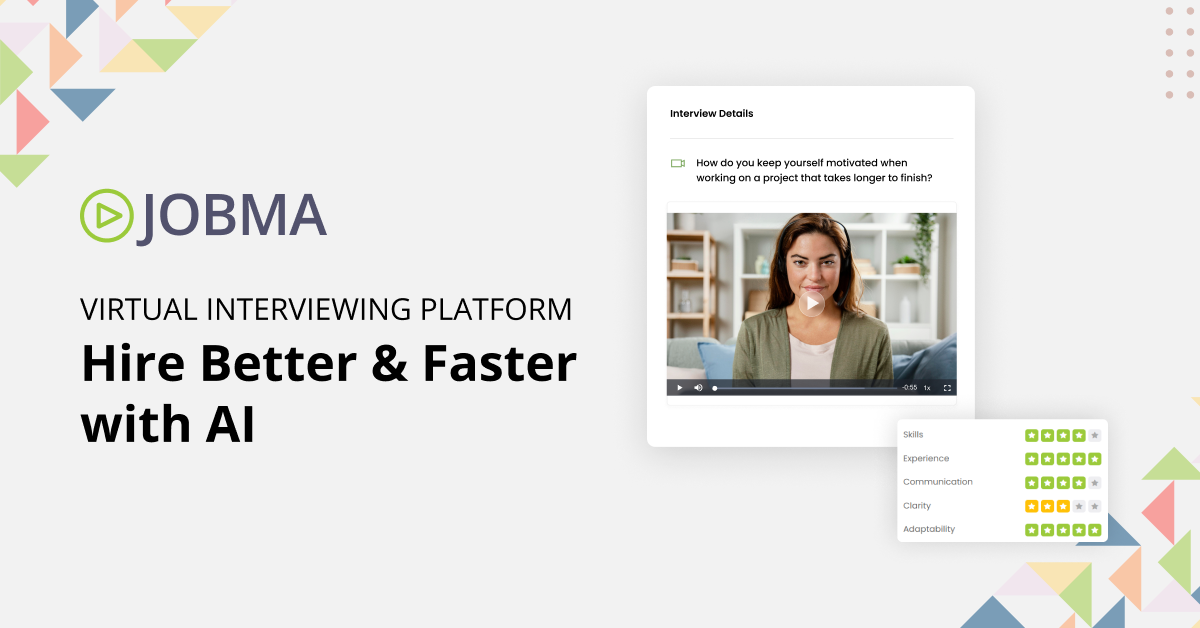
Jobma is an advanced AI video interviewing and skill validation platform designed specifically for recruitment agencies. It streamlines the hiring process by allowing recruiters to conduct virtual interviews, use AI-driven assessments, and enhance candidate experience, thereby addressing the unique needs of the recruitment industry.

Best for Video Conferencing Software for Recruitment Agencies

Expert Take

Jobma AI Hiring Software excels in providing a specialized video interviewing platform tailored for recruitment agencies. Its AI-driven capabilities and focus on candidate experience make it a standout choice. While it offers strong usability and support, some customization limitations exist.

Pros

  • SOC 2 Type II & ISO 27001 Certified
  • Integrates with Workday, Oracle & iCIMS
  • AI proctoring & anti-cheating features
  • Multi-lingual transcription & AI scoring

Cons

  • No public pricing; requires sales quote
  • Mobile app friction for some candidates
  • Setup can be complex for small teams
  • Advanced features may require higher tiers

Best for teams that are

  • Mid-market to enterprise HR teams handling high-volume recruitment.
  • Organizations wanting asynchronous video interviews with AI-powered scoring.

Skip if

  • Small companies with low hiring volumes that don't require automation.
  • Teams looking for a complete, all-in-one ATS without needing integrations.

Best for teams that are

  • Mid-market to enterprise HR teams handling high-volume recruitment.
  • Organizations wanting asynchronous video interviews with AI-powered scoring.

Skip if

  • Small companies with low hiring volumes that don't require automation.
  • Teams looking for a complete, all-in-one ATS without needing integrations.

Pros

  • SOC 2 Type II & ISO 27001 Certified
  • Native coding assessments for technical hiring
  • Integrates with Workday, Oracle & iCIMS
  • AI proctoring & anti-cheating features
  • Multi-lingual transcription & AI scoring

Cons

  • No public pricing; requires sales quote
  • Mobile app friction for some candidates
  • Steeper learning curve than simpler tools
  • Setup can be complex for small teams
  • Advanced features may require higher tiers

Expert Take

Jobma AI Hiring Software excels in providing a specialized video interviewing platform tailored for recruitment agencies. Its AI-driven capabilities and focus on candidate experience make it a standout choice. While it offers strong usability and support, some customization limitations exist.

Zoom: Connective Collaboration

Zoom is a highly-integrated video conferencing tool specifically designed for SaaS companies. It supports streamlined communication and collaboration, with features such as video meetings, team chat, VoIP phone, and webinars that address the needs of remote teams and global customer interactions.

Best for Video Conferencing Software for SaaS Companies

Expert Take

Zoom excels as a video conferencing tool for SaaS companies due to its robust feature set, extensive integrations, and strong market credibility. Its usability and pricing transparency further enhance its appeal, making it a top choice for remote collaboration.

Pros

  • AI Companion included at no extra cost
  • Market-leading video and audio quality
  • Scalable from free tier to enterprise
  • Strong security certifications (FedRAMP, SOC2)

Cons

  • Free plan limited to 40 minutes
  • Interface becoming cluttered with new features
  • AI summaries sometimes lack accuracy
  • Add-on costs for large meetings are high

Best for teams that are

  • Teams needing a widely adopted platform with breakout rooms.
  • Companies hosting virtual events with extensive app integrations.

Skip if

  • Organizations wanting a deeply customized, white-label product.
  • Extreme privacy-focused tactical edge operations.

Best for teams that are

  • Teams needing a widely adopted platform with breakout rooms.
  • Companies hosting virtual events with extensive app integrations.

Skip if

  • Organizations wanting a deeply customized, white-label product.
  • Extreme privacy-focused tactical edge operations.

Pros

  • AI Companion included at no extra cost
  • Market-leading video and audio quality
  • Massive ecosystem of 1,500+ integrations
  • Scalable from free tier to enterprise
  • Strong security certifications (FedRAMP, SOC2)

Cons

  • Free plan limited to 40 minutes
  • Interface becoming cluttered with new features
  • AI summaries sometimes lack accuracy
  • Customer support can be difficult to reach
  • Add-on costs for large meetings are high

Expert Take

Zoom excels as a video conferencing tool for SaaS companies due to its robust feature set, extensive integrations, and strong market credibility. Its usability and pricing transparency further enhance its appeal, making it a top choice for remote collaboration.

Cinos Video Conferencing Solutions

Cinos offers tailored video conferencing solutions for contractors, providing reliable and easy-to-use communication tools that are essential in the industry. Their services include equipment installation, ensuring seamless integration with existing systems and operations.

Best for Video Conferencing Software for Contractors

Expert Take

Cinos occupies a critical niche for UK public sector and healthcare organizations by wrapping premium Cisco and Pexip technology in a fully managed, compliance-focused service. Research indicates their 'UK Sovereign' cloud and native HSCN connectivity solve specific data residency and network security challenges that commodity SaaS platforms often overlook. Based on documented certifications, their dual status as a Cisco Gold Provider and Zoom Certified Integrator ensures robust interoperability for complex, multi-vendor environments.

Pros

  • UK Sovereign Data Hosting
  • Cisco Gold & Zoom Certified
  • Seamless MS Teams Interop
  • 24/7 Managed Service Support

Cons

  • Bespoke pricing for private sector
  • Heavy reliance on Cisco ecosystem
  • UK-centric service features
  • Complex procurement process

Best for teams that are

  • Public sector, NHS, and government agencies.
  • Mission-critical environments needing resilience.

Skip if

  • Freelancers needing simple personal webcams.
  • Micro-businesses without AV infrastructure.

Best for teams that are

  • Public sector, NHS, and government agencies.
  • Mission-critical environments needing resilience.

Skip if

  • Freelancers needing simple personal webcams.
  • Micro-businesses without AV infrastructure.

Pros

  • UK Sovereign Data Hosting
  • Native NHS HSCN Connection
  • Cisco Gold & Zoom Certified
  • Seamless MS Teams Interop
  • 24/7 Managed Service Support

Cons

  • Bespoke pricing for private sector
  • Heavy reliance on Cisco ecosystem
  • Not a standalone proprietary platform
  • UK-centric service features
  • Complex procurement process

Expert Take

Cinos occupies a critical niche for UK public sector and healthcare organizations by wrapping premium Cisco and Pexip technology in a fully managed, compliance-focused service. Research indicates their 'UK Sovereign' cloud and native HSCN connectivity solve specific data residency and network security challenges that commodity SaaS platforms often overlook. Based on documented certifications, their dual status as a Cisco Gold Provider and Zoom Certified Integrator ensures robust interoperability for complex, multi-vendor environments.

EMS Video Conferencing Software

EMS Video Conferencing Software is designed for contractors, offering an integrated solution for scheduling and managing web conferences. The software specifically addresses the need for efficient resource management in the contracting industry, ensuring contractors can schedule, track and manage virtual meetings with ease.

Best for Video Conferencing Software for Contractors

Expert Take

What stands out: accruent EMS stands out for its ability to act as a 'single pane of glass' for complex facility management, bridging the gap between digital scheduling and physical building operations. Research indicates it is particularly strong for large enterprises requiring granular control, as it uniquely combines video conferencing automation with hardware integrations like HVAC and digital signage. Based on documented features, it offers a level of depth in resource management that simpler scheduling tools cannot match.

Pros

  • Integrates with Teams, Zoom, and Webex
  • ISO 27001 and SOC 2 compliant
  • Supports complex recurring meeting logic
  • Centralized room and resource scheduling

Cons

  • Steep learning curve for new users
  • User interface is not intuitive
  • Support response times can be slow
  • Implementation process can be lengthy

Best for teams that are

  • Admins managing campus or enterprise room booking.
  • Organizations with complex hybrid scheduling needs.

Skip if

  • Small teams lacking physical meeting rooms.
  • Users seeking standalone video software.

Best for teams that are

  • Admins managing campus or enterprise room booking.
  • Organizations with complex hybrid scheduling needs.

Skip if

  • Small teams lacking physical meeting rooms.
  • Users seeking standalone video software.

Pros

  • Integrates with Teams, Zoom, and Webex
  • Automates HVAC and lighting controls
  • ISO 27001 and SOC 2 compliant
  • Supports complex recurring meeting logic
  • Centralized room and resource scheduling

Cons

  • Steep learning curve for new users
  • User interface is not intuitive
  • Extra licensing fees for VC integrations
  • Support response times can be slow
  • Implementation process can be lengthy

Expert Take

What stands out: accruent EMS stands out for its ability to act as a 'single pane of glass' for complex facility management, bridging the gap between digital scheduling and physical building operations. Research indicates it is particularly strong for large enterprises requiring granular control, as it uniquely combines video conferencing automation with hardware integrations like HVAC and digital signage. Based on documented features, it offers a level of depth in resource management that simpler scheduling tools cannot match.

Loading comparison data…

How We Rank Products

Our Evaluation Process

Products in the video conferencing software category are evaluated based on documented features like participant capacity, security protocols, and integration capabilities with other software platforms. Pricing transparency is also considered, ensuring buyers can assess cost-effectiveness. Compatibility with major operating systems and existing business tools is crucial, and third-party customer feedback provides insights into user satisfaction and software reliability.

Verification

  • Products evaluated through comprehensive research and analysis of user feedback and expert insights.
  • Rankings based on analysis of specifications, customer reviews, and industry ratings.
  • Selection criteria focus on key features such as ease of use, integration capabilities, and security measures.

Score Breakdown

0.0 / 10

About Video Conferencing Software

What Is Video Conferencing Software?

This category covers software used to facilitate synchronous and asynchronous visual communication between remote participants across their full interaction lifecycle: scheduling, hosting virtual meetings, screen sharing, recording, and generating post-meeting intelligence. It sits between Unified Communications as a Service (UCaaS) (which encompasses broader telephony, messaging, and presence) and Webinar/Event Platforms (which focus on one-to-many broadcasting for large passive audiences). It includes both general-purpose collaboration platforms and vertical-specific tools built for industries like telehealth, recruitment, and field services.

At its core, Video Conferencing Software solves the problem of distance and friction in high-stakes communication. While email and instant messaging handle transactional data transfer, video conferencing creates the "presence" required for negotiation, complex diagnostics, and relationship building. For the modern enterprise, it is no longer just a communication utility; it has evolved into a system of record for spoken data, capturing insights that were previously lost the moment a meeting ended.

History of the Category

The trajectory of video conferencing from the 1990s to the present is a study in the shift from hardware-centric scarcity to software-defined ubiquity. In the early 1990s, video conferencing was an asset-heavy luxury reserved for the boardroom. It relied on expensive, on-premise hardware bridges (Multipoint Control Units or MCUs) and dedicated ISDN lines that cost thousands of dollars per hour to operate. The gap that created this category was the inability of traditional telephony to convey non-verbal cues and visual data, a critical missing link for globalizing enterprises. Early market entrants focused on room-based systems that required specialized IT teams to manage.

The widespread adoption of IP networks in the late 1990s and early 2000s began the decoupling of video from proprietary telecommunications infrastructure. However, the true inflection point arrived with the shift from on-premise infrastructure to the cloud. The rise of vertical SaaS in the late 2000s and early 2010s demonstrated that complex processing—video encoding, decoding, and mixing—could be handled in the cloud rather than on local hardware. This era saw a massive wave of market consolidation, where legacy telecommunications giants acquired agile software startups to bolt video capabilities onto their voice and data pipes. These acquisitions shaped the current landscape, merging the reliability of carrier-grade networks with the usability of consumer software.

By 2020, the buyer expectation shifted dramatically. The "database" era—where the primary value was connecting Point A to Point B—ended. We have now entered the "intelligence" era. Buyers no longer ask, "Can we connect?" but rather, "What can the software tell us about the conversation?" The market has moved toward actionable intelligence: sentiment analysis, automated transcription, and workflow automation that triggers actions in CRM or project management tools based on spoken words. Today, the category is defined not by the quality of the pixel, but by the utility of the data generated during the call.

What to Look For

Evaluating video conferencing software requires moving beyond basic audio/video quality checks, which are now table stakes. Expert buyers focus on the architecture of resilience and the governance of data.

Critical Evaluation Criteria

First, examine the architecture of packet loss resilience. High-performing platforms utilize scalable video coding (SVC) or similar adaptive bitrate technologies that can sustain usability even with 20-30% packet loss. Ask vendors specifically how their architecture handles jitter and latency variability in non-ideal network conditions, such as 4G/5G mobile connections or saturated home Wi-Fi.

Second, assess compliance and sovereignty granularity. For enterprise deployment, it is insufficient to simply be "GDPR compliant." You must look for the ability to pin data residency to specific geographic regions (e.g., ensuring EU data never touches US servers) and granular retention policies that allow you to automate the deletion of recordings and transcripts after a set period to minimize liability.

Red Flags and Warning Signs

A significant red flag is a vendor that relies heavily on proprietary client downloads without a robust WebRTC (browser-based) alternative. In friction-sensitive use cases like sales or telehealth, forcing an external participant to download software results in drop-off rates. If the "join via browser" experience is hidden or severely feature-limited compared to the desktop app, it signals a legacy architecture that may struggle with external collaboration.

Another warning sign is vague encryption terminology. Be wary of vendors who conflate "encryption in transit" with "end-to-end encryption" (E2EE). True E2EE means the provider cannot access the keys to decrypt the content, even if subpoenaed. If the vendor cannot provide a technical whitepaper detailing their key management infrastructure, assume they have access to your data.

Key Questions to Ask Vendors

  • "Does your AI processing for transcription and summarization happen on your own private cloud, or is data sent to a third-party LLM provider? If third-party, do you have a zero-day retention policy?"
  • "Can we enforce a 'waiting room' policy strictly for external guests while allowing internal employees to bypass it via SSO?"
  • "What is your Service Level Agreement (SLA) for uptime, and does it cover video quality degradation, or only total service unavailability?"

Industry-Specific Use Cases

Retail & E-commerce

In retail, video conferencing has evolved from a back-office tool to a revenue-generating channel known as "virtual clienteling." The specific need here is integration with product catalogs and inventory systems. Unlike a standard corporate meeting, a retail video interface must allow the associate to overlay product details, check stock levels in real-time, and process transactions without leaving the video window. Evaluation priorities focus on the "shoppable video" workflow—can the customer add items to a cart directly from the video feed?

Unique considerations include mobile-first optimization for the associate. Store employees are often on the floor using tablets or smartphones, not sitting at desks. The software must support high-quality video transmission over store Wi-Fi while stabilizing the image as the associate moves around. Furthermore, brand customization is critical; the interface must look like the retailer's environment, not a generic third-party tool, to maintain consumer trust. [1] [2]

Healthcare

For healthcare, the non-negotiable evaluation priority is HIPAA/GDPR compliance and the Business Associate Agreement (BAA). General-purpose tools often fail here because they lack the specific workflow of a clinical encounter. Healthcare video software must support a "virtual waiting room" that mimics a physical clinic, allowing triage nurses to screen patients before admitting them to the doctor's private video room. This prevents accidental privacy breaches where one patient might interrupt another's consult.

Integration with Electronic Health Records (EHR) is the primary efficiency driver. The ideal workflow allows a clinician to launch a visit directly from the patient's chart in the EHR, with the software automatically documenting the call duration and participants for insurance reimbursement purposes. Unique considerations include support for multi-party calls for interpreters or family members, which must be ad-hoc and seamless to ensure equitable care access. [3] [4]

Financial Services

The financial sector uses video conferencing heavily for Know Your Customer (KYC) and identity verification processes. Specific needs revolve around high-definition video clarity sufficient to read the micro-text on a passport or ID card held up to a webcam. The software must often support geo-location tagging to verify the participant is physically located where they claim to be, a regulatory requirement in many jurisdictions for opening accounts.

Evaluation priorities include immutable audit trails. Every interaction must be logged with metadata (IP address, device ID, timestamp) that cannot be altered, ensuring the institution can prove due diligence during an audit. Security architecture is paramount; financial buyers often require on-premise or hybrid deployment options where video traffic does not traverse the public internet, or where encryption keys are held exclusively by the bank (Bring Your Own Key - BYOK). [5] [6]

Manufacturing

Manufacturing utilizes specialized video conferencing for "remote expert" guidance and AR integration. The use case involves a frontline worker on a factory floor connecting with a subject matter expert (SME) located elsewhere to troubleshoot machinery. Standard video tools fail here because they lack annotation capabilities. Manufacturing-specific video tools allow the remote expert to draw on the screen, with the markings "sticking" to the physical object in the video feed via computer vision.

Evaluators prioritize device agnostic support, particularly for Assisted Reality (AR) smart glasses (e.g., RealWear, Vuzix) or ruggedized tablets. The software must be operable via voice commands to allow hands-free operation by the technician repairing equipment. Bandwidth optimization is also critical, as factory floors often have notoriously poor connectivity, requiring codecs that can deliver clear still images even if the video framerate drops. [7] [8]

Professional Services

For law firms, consultancies, and agencies, Video Conferencing Software is the delivery mechanism for their billable product. The specific need is automated time tracking and client matter association. Professional services firms lose significant revenue when hours spent on ad-hoc video calls are not logged. Specialized tools or integrations will automatically prompt the user to assign a "client matter code" when a meeting ends, pushing that data directly into billing software.

Evaluation priorities include professional branding and lobby experience. A high-end consultancy requires a waiting room experience that reinforces their brand, perhaps showing white papers or firm news, rather than a black screen. Security focuses on ethical walls and information barriers—ensuring that recordings of a meeting regarding Client A cannot be searched or accessed by partners working on a conflict-of-interest case for Client B. [9] [10]

Subcategory Overview

Video Conferencing Software for Recruitment Agencies

This niche is genuinely different from generic video tools because it centers on asynchronous workflows and structured evaluation. While generic tools treat a video call as a singular event, recruitment-specific software treats it as a data point in a hiring funnel. A generic tool connects two people live; this specialized tool allows a recruiter to send a set of pre-recorded questions to hundreds of candidates, who then record their answers on their own time. This "one-way" interview workflow is something ONLY this specialized tool handles well, solving the massive bottleneck of scheduling phone screens.

The specific pain point driving buyers here is candidate volume management. A recruiter cannot physically screen 50 candidates in a day using synchronous Zoom or Teams calls. They move to this niche to regain hours of productivity by reviewing candidate responses at 2x speed. For a detailed breakdown of tools that facilitate these asynchronous workflows, refer to our guide to Video Conferencing Software for Recruitment Agencies.

Video Conferencing Software for SaaS Companies

The differentiator for SaaS companies is demo intelligence and sales coaching. Generic video software transmits audio and video; SaaS-specific video tools analyze the interaction. They track "talk-to-listen" ratios, identify competitor mentions, and bookmark moments where pricing was discussed. The workflow that ONLY this specialized tool handles well is the "game tape" review—automatically flagging successful objection handling for new reps to watch.

The pain point driving buyers to this niche is revenue leakage due to poor demo execution. VP of Sales cannot join every call; these tools act as an automated manager, providing visibility into why deals are stalling based on what happened during the video call. To explore platforms that offer these revenue intelligence features, see our analysis of Video Conferencing Software for SaaS Companies.

Video Conferencing Software for Contractors

This subcategory is defined by zero-friction mobile entry and visual estimation. Unlike corporate users, homeowners do not want to download an app or create an account to show a contractor a leaky pipe. This niche handles the "remote estimate" workflow uniquely well: the contractor sends a text message link, the homeowner taps it, and the video stream opens instantly in their mobile browser with flash and zoom controls driven by the contractor.

The specific pain point here is the cost of the "truck roll." Contractors lose money driving to sites just to give a quote. General tools are too clunky for non-tech-savvy homeowners. Specialized tools allow contractors to qualify leads and bid jobs remotely without leaving their office. For tools optimized for this field-to-office connection, check our guide on Video Conferencing Software for Contractors.

Video Conferencing Software for Staffing Agencies

While similar to recruitment, staffing agencies differ in their need for high-volume rostering and bulk interview scheduling. This niche specializes in workflows where a recruiter needs to interview 50 people for a warehouse shift in 24 hours. The specialized workflow involved is the "roster check"—quickly cycling through a queue of candidates in a virtual lobby to verify availability and credentials instantly.

The pain point is speed-to-deployment. Staffing agencies work on razor-thin margins and tight deadlines; they cannot afford the administrative overhead of sending individual calendar invites. They need tools that support "cattle call" style interviewing sessions. For platforms built for high-velocity placement, read more in our section on Video Conferencing Software for Staffing Agencies.

Integration & API Ecosystem

In the modern software stack, Video Conferencing Software cannot exist as an island. Its value is derived from how tightly it weaves into the fabric of daily work. Gartner's research indicates that by 2026, 75% of enterprise software buyers will prioritize API composability over standalone features when selecting collaboration tools. [11] This shift highlights that the "video" part of the software is becoming a commodity; the differentiation lies in the API.

Consider a concrete example of a mid-sized professional services firm with 50 consultants. They utilize a Project Management tool (like Asana), a CRM (like Salesforce), and a billing system. Without deep API integration, a consultant finishes a client video call and then must manually log the time in the billing system and update the CRM notes. If the video tool has a poorly designed API, this "toggle tax" costs the firm money.

In a well-integrated ecosystem, the video meeting is an object within the CRM. When the call ends, the API automatically pushes the recording link, transcript, and attendance duration into the client's CRM record. It simultaneously triggers a webhook to the billing system to log 0.75 billable hours. "The future of collaboration is not in the app, but in the workflow," notes a Principal Analyst at Forrester. [12] Buyers must validate that the vendor’s API supports bi-directional sync (read/write) capabilities, not just simple one-way calendar pushing.

Security & Compliance

Security in video conferencing has moved from a checklist item to a board-level concern. The 2024 Verizon Data Breach Investigations Report (DBIR) highlights that 15% of breaches involved a third party or supplier, and 68% involved a non-malicious human element (like error). [13] Video conferencing platforms sit at the intersection of both risks: they are third-party suppliers handling sensitive real-time data, and they are prone to human errors like sharing the wrong screen or leaving a meeting open.

A real-world scenario involves a healthcare network conducting remote therapy sessions. If they use a general-purpose video tool that lacks a signed Business Associate Agreement (BAA) and proper HIPAA configurations, they are non-compliant. A breach doesn't require a hacker; it only requires a provider to accidentally paste a "public" meeting link into a patient portal. If a malicious actor joins that room (Zoom-bombing), the resulting privacy violation can cost millions in fines.

Expert evaluation requires verifying SSO (Single Sign-On) enforcement. This ensures that when an employee leaves the company and is removed from the Active Directory, their access to the video platform is instantly revoked. Furthermore, buyers should demand transparency on data sovereignty. If you are a European entity, your video traffic and stored artifacts (chats, files) should ideally never route through US servers to comply with strict interpretations of GDPR.

Pricing Models & TCO

The sticker price of video conferencing software is rarely the Total Cost of Ownership (TCO). Forrester's Total Economic Impact studies consistently show that while license costs are visible, operational overhead accounts for up to 40% of the TCO over three years. [14] The market has largely shifted from "per-minute" charges to "per-host" subscription models, but hidden costs persist.

Consider a 25-person sales team evaluating a premium video solution priced at $20/user/month. The annual license cost is $6,000. However, the TCO calculation must include:

  • Hardware upgrades: Do employees need 4K webcams or noise-canceling headsets to utilize the software's HD features? ($2,500 one-time)
  • Network bandwidth: Does the office network need an upgrade to support 25 simultaneous HD streams? ($1,200/year)
  • Add-on features: Are "toll-free dial-in numbers" or "cloud storage for recordings" billed as overages? (Estimated $1,000/year)
In this scenario, the actual TCO for year one is nearly double the license cost. Buyers should look for "bundled" pricing that includes generous cloud storage and PSTN (telephone) dial-in allowances to avoid monthly overage shocks. Be wary of "freemium" traps where essential security features like SSO are gated behind the most expensive Enterprise tier.

Implementation & Change Management

The failure of video conferencing software is rarely technical; it is cultural. Gartner estimates that through 2025, 50% of enterprise collaboration initiatives will fail to meet their goals due to lack of focus on user behavior and change management. [15]

Take the example of a 50-person professional services firm migrating from a legacy system to a modern cloud video platform. The IT team deploys the software on Monday. By Tuesday, partners are complaining that "the button moved" or "I can't find my recording." Productivity stalls. A successful implementation requires a phased rollout:

  • Phase 1: Pilot. A tech-savvy "champion" group tests the software in real client meetings to identify workflow gaps (e.g., "The calendar plugin doesn't sync color codes").
  • Phase 2: Training. Mandatory concise workshops focusing on the specific "WIIFM" (What's In It For Me) for each role—teaching sales reps how to use recording intelligence to close deals, rather than generic feature walkthroughs.
  • Phase 3: Sunset. A hard date where the old system is turned off to prevent fragmentation.
Implementation also requires network readiness assessments. Pushing 4K video to 500 remote endpoints without testing VPN concentrator loads is a recipe for disaster.

Vendor Evaluation Criteria

When selecting a vendor, stability and roadmap transparency outweigh flashy features. IDC's MarketScape reports emphasize that "platform reliability and customer support" are the top two drivers for satisfaction in the collaboration market. [16] Buyers should score vendors on their support tier structure: does "24/7 support" mean a chatbot, or a human engineer?

A critical evaluation exercise is the "Roadmap alignment check." Ask the vendor: "What features are you deprecating in the next 12 months?" A vendor that cannot answer this is likely accumulating technical debt. Furthermore, look for certification ecosystems. For hardware-heavy industries, does the software vendor certify third-party cameras and microphones (e.g., Logitech, Poly)? Vendor lock-in happens when software only works well with the vendor's own proprietary hardware.

Emerging Trends and Contrarian Take

Emerging Trends 2025-2026

The dominant trend is the rise of Agentic AI participants. We are moving beyond AI that simply summarizes a meeting after it ends. By 2026, AI agents will join meetings as active participants—retrieving documents upon voice command, scheduling follow-ups in real-time, and even answering factual questions by querying the company knowledge base during the call. [17] Additionally, Platform Convergence is accelerating. Standalone video tools are being absorbed into broader "Work Hubs" where video, chat, whiteboard, and project management exist in a single pane of glass.

Contrarian Take

The mid-market is overserved and overpaying. Most businesses are buying "Enterprise" grade video suites with 500 features (avatars, immersive spaces, complex webinars) when their actual usage data shows employees only use three functions: Audio, Video, and Screen Share. Most businesses would achieve higher ROI by downgrading to "good enough" integrated video tools within their existing productivity suites (like Google Workspace or Microsoft 365) rather than paying a premium for a best-of-breed standalone video platform. The delta in quality has narrowed so significantly that for 90% of internal meetings, the "free" included tool is indistinguishable from the premium standalone product.

Common Mistakes

Overbuying Capacity: Many organizations purchase "Large Meeting" licenses for every manager, anticipating town halls. In reality, large meetings happen quarterly. Use a pooled licensing model or buy ad-hoc event licenses instead of equipping every user with webinar capacity.

Ignoring "Shadow IT" Configurations: A common mistake is allowing users to configure their own personal settings without a baseline policy. This leads to embarrassing scenarios where sales reps enter client calls with unprofessional virtual avatars or backgrounds enabled by default. Centralized policy management is crucial.

Neglecting Audio Hardware: Companies spend thousands on software and zero on microphones. The best video software cannot fix bad audio input. Neglecting to budget for decent headsets ($50-$100 range) undermines the entire software investment, as listeners fatigue quickly from poor audio.

Questions to Ask in a Demo

  • "Can you show me the exact workflow for an external guest joining from a mobile device on a 4G connection? I want to see the load time."
  • "Show me the admin dashboard's 'Quality of Service' (QoS) reporting. Can I drill down to see why a specific user had a bad call yesterday?"
  • "How does your platform handle 'split-tunneling' for VPN users to optimize bandwidth?"
  • "Demonstrate the integration with our specific calendar/email client. Does it require a browser extension, or is it native?"
  • "What is the data retention policy for chat logs within a meeting, and can we automate their deletion separate from the video recording?"

Before Signing the Contract

Final Decision Checklist

  • Bandwidth Stress Test: Have you tested the software with 20+ users on your office network?
  • Security Audit: Has your CISO or IT security lead reviewed the vendor's SOC 2 Type II report?
  • Support SLA: Is the guaranteed response time for a "System Down" event acceptable (e.g., < 1 hour)?

Common Negotiation Points

Do not accept the list price on multi-year deals. Vendors are often willing to waive "Cloud Recording Storage" fees or provide free "Room Connector" licenses (to connect legacy hardware) to close a deal. Also, negotiate the "True-up" period—ensure you aren't penalized immediately if you temporarily exceed your license count during a busy month.

Deal-Breakers

Walk away if the vendor refuses to sign a Data Processing Addendum (DPA) that aligns with your local regulations (GDPR/CCPA) or if they cannot provide a clear roadmap for discontinuing legacy features you rely on. Lack of transparency on data sub-processors is a non-starter for any regulated industry.

Closing

Navigating the video conferencing landscape requires balancing user experience with rigid security and infrastructure demands. If you have specific questions about how these frameworks apply to your organization's unique stack, I am available to discuss further.

Email: albert@whatarethebest.com

Quick one question survey

Thanks for your input!
Your response has been recorded.