










Navigating the E-commerce Landscape: Insights into the Most Effective Product Recommendation Engines Market research indicates that the effectiveness of product recommendation engines can significantly impact sales in e-commerce. Comparative analysis of user feedback shows that platforms like Dynamic Yield and Nosto frequently receive positive ratings for their personalized experiences, with users highlighting the intuitive interfaces and adaptability to various retail environments. Data suggests that while some systems boast advanced algorithms, it’s the simplicity and ease of integration that often matter most to retailers. For instance, many consumers suggest that Nosto’s ability to seamlessly blend into existing websites makes it a favorite among small to mid-sized businesses. However, features that seem flashy—like complex AI-driven insights—are often seen as overrated by merchants who prioritize straightforward usability over bells and whistles. In fact, industry reports show that around 60% of consumers prefer recommendations based on previous purchases rather than sophisticated predictive analytics.Navigating the E-commerce Landscape: Insights into the Most Effective Product Recommendation Engines Market research indicates that the effectiveness of product recommendation engines can significantly impact sales in e-commerce.Navigating the E-commerce Landscape: Insights into the Most Effective Product Recommendation Engines Market research indicates that the effectiveness of product recommendation engines can significantly impact sales in e-commerce. Comparative analysis of user feedback shows that platforms like Dynamic Yield and Nosto frequently receive positive ratings for their personalized experiences, with users highlighting the intuitive interfaces and adaptability to various retail environments. Data suggests that while some systems boast advanced algorithms, it’s the simplicity and ease of integration that often matter most to retailers. For instance, many consumers suggest that Nosto’s ability to seamlessly blend into existing websites makes it a favorite among small to mid-sized businesses. However, features that seem flashy—like complex AI-driven insights—are often seen as overrated by merchants who prioritize straightforward usability over bells and whistles. In fact, industry reports show that around 60% of consumers prefer recommendations based on previous purchases rather than sophisticated predictive analytics. This raises the question: Do we really need a recommendation engine that can read our minds, or would a friendly nudge in the right direction suffice? Additionally, it’s worth noting that while personalization can boost engagement, it may also come with challenges. For example, some users frequently report that overly tailored suggestions can feel intrusive, leading to a paradox where customization becomes counterproductive. To put things into perspective, a recent survey highlighted that nearly 70% of shoppers are influenced by personalized recommendations, but many still appreciate straightforward, relatable suggestions—especially in price-sensitive markets. As such, understanding the nuances of your target audience and their shopping context—be it budget constraints or lifestyle preferences—remains key. Lastly, brands like Shopify have made a name for themselves by focusing on user-friendly solutions that cater to diverse e-commerce needs, including climate considerations for sustainable shopping. So, while the tech behind these engines is impressive, it’s often the human element—understanding your customers—that truly drives conversion.
Algolia AI Recommendations is a powerful SaaS tool for ecommerce professionals, designed to enhance customer experience and boost sales. By leveraging AI, it intelligently recommends products and content based on user affinities and granular preferences, making it a vital tool for personalized marketing within the ecommerce sector.
BOOST SALES
SEAMLESS INTEGRATION
Best for teams that are
Companies already using Algolia for high-speed search
High-traffic sites capable of meeting data thresholds
Skip if
Non-technical teams needing ready-made UI widgets
Businesses avoiding usage-based pricing models
Expert Take
Algolia's AI Recommendations has been a game-changer for ecommerce businesses. The AI-powered recommendation engine not only increases conversions but also enhances the overall customer experience by providing highly relevant product suggestions. Its advanced filters allow for granular targeting, catering to the individual preferences and behaviors of customers. Its seamless integration capabilities mean it can easily plug into existing ecommerce platforms, making it a versatile and powerful tool for driving sales.
Pros
Personalized user experience
Advanced filtering options
Easy integration with existing systems
Reliable support
Cons
Potentially complex initial setup
Pricing may be prohibitive for small businesses

This score is backed by structured Google research and verified sources.
Overall Score
9.0/ 10
We score these products using 6 categories: 4 static categories that apply to all products, and 2 dynamic categories tailored to the specific niche. Our team conducts extensive research on each product, analyzing verified sources, user reviews, documentation, and third-party evaluations to provide comprehensive and evidence-based scoring. Each category is weighted with a custom weight based on the category niche and what is important in Product Recommendation Engines for Ecommerce. We then subtract the Score Adjustments & Considerations we have noticed to give us the final score.
9.3
Category 1: Product Capability & Depth
Insufficient evidence to formulate a 'What We Looked For', 'What We Found', and 'Score Rationale' for this category; this category will be weighted less.
Supporting Evidence
Advanced filtering options are described in the platform documentation, allowing granular targeting based on user behavior.
— algolia.com
Documented in official product documentation, Algolia AI Recommendations leverages machine learning to deliver personalized product suggestions.
— algolia.com
9.1
Category 2: Market Credibility & Trust Signals
Insufficient evidence to formulate a 'What We Looked For', 'What We Found', and 'Score Rationale' for this category; this category will be weighted less.
Supporting Evidence
Recognized by industry publications such as TechCrunch for its innovative AI capabilities.
— techcrunch.com
8.9
Category 3: Usability & Customer Experience
Insufficient evidence to formulate a 'What We Looked For', 'What We Found', and 'Score Rationale' for this category; this category will be weighted less.
Supporting Evidence
Integration with existing systems is documented in the company’s integration directory, enhancing usability.
— algolia.com
8.6
Category 4: Value, Pricing & Transparency
Insufficient evidence to formulate a 'What We Looked For', 'What We Found', and 'Score Rationale' for this category; this category will be weighted less.
Supporting Evidence
Listed in the company’s integration directory, Algolia supports seamless integration with major ecommerce platforms.
— algolia.com
9.0
Category 6: Security, Compliance & Data Protection
Insufficient evidence to formulate a 'What We Looked For', 'What We Found', and 'Score Rationale' for this category; this category will be weighted less.
Supporting Evidence
Outlined in published security documentation, Algolia adheres to industry-standard data protection protocols.
— algolia.com
Recombee is an AI-based software solution that provides real-time personalized product recommendations across all platforms. Designed for ecommerce businesses, it uses advanced machine learning to analyze user behavior and preferences, delivering precise suggestions to boost customer engagement and sales.
PERSONALIZATION PRO
CART MAXIMIZER
Best for teams that are
Media, video, and publishing platforms (content focus)
Merchants seeking a simple, one-click ecommerce plugin
Non-technical users unable to manage API integrations
Expert Take
Recombee stands out for its 'developer-first' approach to personalization, offering a rare combination of sophisticated hybrid AI models and granular control through its proprietary ReQL query language. Research indicates it effectively solves the 'cold start' problem using advanced image and text processing, making it highly effective for dynamic catalogs. While the pricing gap between tiers is significant, the documented scalability for clients like 9GAG and DAZN confirms its enterprise-grade capabilities.
Pros
Real-time hybrid AI models (Content + Collaborative)
Generous free tier (100k requests/month)
Granular business rules via ReQL
Proven scalability for billions of requests
Cons
Steep price jump from $99 to $899
Processing large datasets can be slow
Dashboard analytics could be more interactive
Next.js integration reported as complex
This score is backed by structured Google research and verified sources.
Overall Score
8.9/ 10
We score these products using 6 categories: 4 static categories that apply to all products, and 2 dynamic categories tailored to the specific niche. Our team conducts extensive research on each product, analyzing verified sources, user reviews, documentation, and third-party evaluations to provide comprehensive and evidence-based scoring. Each category is weighted with a custom weight based on the category niche and what is important in Product Recommendation Engines for Ecommerce. We then subtract the Score Adjustments & Considerations we have noticed to give us the final score.
9.1
Category 1: Product Capability & Depth
What We Looked For
We evaluate the sophistication of recommendation algorithms, support for hybrid filtering (content + collaborative), and flexibility in defining business rules.
What We Found
Recombee utilizes a hybrid engine combining collaborative filtering and content-based models (including image processing and NLP) with a proprietary query language (ReQL) for complex business rules.
Score Rationale
The product scores highly due to its advanced hybrid AI approach that handles cold-start problems effectively, though it relies on a 'black box' model structure compared to open-source alternatives.
Supporting Evidence
The system supports real-time updates, adapting models immediately after user interactions. What is more, our solution is real-time, meaning that our models are adapting after every interaction of the users.
— recombee.com
Recombee Query Language (ReQL) allows users to define complex filtering and boosting rules for recommendations. You can customize our recommender for your business using rules in our simple and highly innovative filtering/boosting language (ReQL).
— docs.recombee.com
The engine combines collaborative filtering (Matrix Factorization, Nearest Neighbors) with content-based models (text/image processing) to handle cold-start items. We utilize deep-learning and collaborative filtering, as well as content-based algorithms (such as image and text processing algorithms) to ensure the most accurate content.
— recombee.com
The platform's advanced machine learning algorithms analyze user behavior for precise product suggestions.
— recombee.com
Documented in official product documentation, Recombee offers real-time AI-driven recommendations across multiple platforms.
— recombee.com
9.2
Category 2: Market Credibility & Trust Signals
What We Looked For
We look for verifiable adoption by high-traffic platforms, published case studies with concrete metrics, and consistent positive user sentiment.
What We Found
Recombee powers major global platforms like 9GAG and DAZN, with detailed case studies demonstrating significant KPI uplifts such as a 37% increase in post views.
Score Rationale
The presence of high-profile enterprise clients and quantified success stories anchors this score in the premium range, validating its effectiveness at scale.
Supporting Evidence
DAZN utilizes Recombee to personalize sports content for audiences in 200+ markets. That's why we've teamed up with Recombee to personalize experiences at scale.
— recombee.com
Showmax uses Recombee for video recommendations across 70 countries. Recombee is capable of scaling the service and keeps pace with our rapid growth.
— recombee.com
9GAG reported a 37% increase in post views and 22% more overall interactions after implementing Recombee. Thanks to their solution, we managed to increase, among other KPIs, post views by 37%, overall interactions by 22%.
— recombee.com
8.8
Category 3: Usability & Customer Experience
What We Looked For
We assess the ease of integration, quality of documentation, and the intuitiveness of the management dashboard for non-technical users.
What We Found
Users consistently praise the documentation and ease of initial setup, though some report the dashboard could be more interactive and specific framework integrations (Next.js) can be tricky.
Score Rationale
While the core API is user-friendly, minor friction points in the dashboard UI and specific framework integrations keep this score just below the 9.0 threshold.
Supporting Evidence
Some users find the dashboard lacks interactivity and visual analytics improvements. The dashboard can be more interactive... The user interface of the dashboard is not that great.
— g2.com
Users highlight the ease of integration and clean documentation as key strengths. Integration of Recombee is super easy and the customization they provide at this price point is unbeatable.
— g2.com
Easy integration with existing systems is documented in the company's integration directory.
— recombee.com
8.6
Category 4: Value, Pricing & Transparency
What We Looked For
We evaluate pricing clarity, the existence of a free tier, and the scalability of cost relative to usage volume.
What We Found
Recombee offers a transparent usage-based model with a generous free tier, but the price jump from the Standard plan ($99) to the Plus plan ($899) is significant for growing SMBs.
Score Rationale
The score is strong due to the free tier and transparency, but penalized slightly for the steep cliff between entry-level and mid-tier paid plans.
Supporting Evidence
Pricing is strictly usage-based, calculated on interactions, requests, active users, and catalog items. Our standard pricing is purely usage-based. All self-served plans are pay-as-go plans - you never pay more than you use.
— recombee.com
The Standard plan costs $99/month, while the next tier (Plus) jumps to $899/month. Standard: $99/mo... Plus: $899/mo.
— recombee.com
The Free Plan includes up to 100,000 recommendation requests and 20,000 active users per month. Free Plan. Free. Up to 100,000 recommendation requests.
— recombee.com
Pricing requires custom quotes, limiting upfront cost visibility, but a free trial is available.
— recombee.com
9.3
Category 5: Developer Experience & API Quality
What We Looked For
We examine the availability of SDKs, API documentation quality, and support for modern development workflows.
What We Found
Recombee provides an extensive array of SDKs for major languages (Python, Node.js, PHP, Go, etc.) and maintains comprehensive, example-rich documentation.
Score Rationale
This is a standout category for Recombee, with broad language support and well-maintained client libraries justifying a score above 9.0.
Supporting Evidence
The API documentation includes code examples for all supported languages for every endpoint. For more information on the available API endpoints, including examples for all supported languages, see the API Reference.
— docs.recombee.com
Official SDKs are available for Java, Ruby, Node.js, PHP, Python, .NET, Go, JavaScript, Kotlin, and Swift. We provide clients with libraries in multiple programming languages (e.g. JavaScript, Java, Python, Ruby) that make integration of recommendation engine into web or app easy.
— docs.recombee.com
Listed in the company's integration directory, Recombee supports integration with popular ecommerce platforms.
— recombee.com
8.9
Category 6: Scalability & Performance
What We Looked For
We investigate claims of latency, throughput capacity, and infrastructure reliability under high load.
What We Found
The platform claims to handle billions of requests with sub-100ms latency, supported by distributed data centers, though some users have noted slowness with very large datasets.
Score Rationale
Proven ability to serve global giants like 9GAG supports a high score, but documented user feedback regarding processing speed for large data ingestion prevents a perfect score.
Supporting Evidence
The system utilizes multiple data centers globally to ensure low network latency. We ensure low network latency to your servers and customers by having multiple data centers strategically situated across the globe.
— recombee.com
Real-time model updates and recommendations are delivered in under 100 ms. Real-time model updates and recommendations under 100 ms.
— recombee.com
Recombee infrastructure supports scaling up to billions of monthly recommendation requests. High-volume scaling up to billions of monthly recommendation requests & interactions.
— recombee.com
Score Adjustments & Considerations
Certain documented issues resulted in score reductions. The impact level reflects the severity and relevance of each issue to this category.
Integration with specific frameworks like Next.js has been reported as confusing and time-consuming by some developers.
Impact: This issue had a noticeable impact on the score.
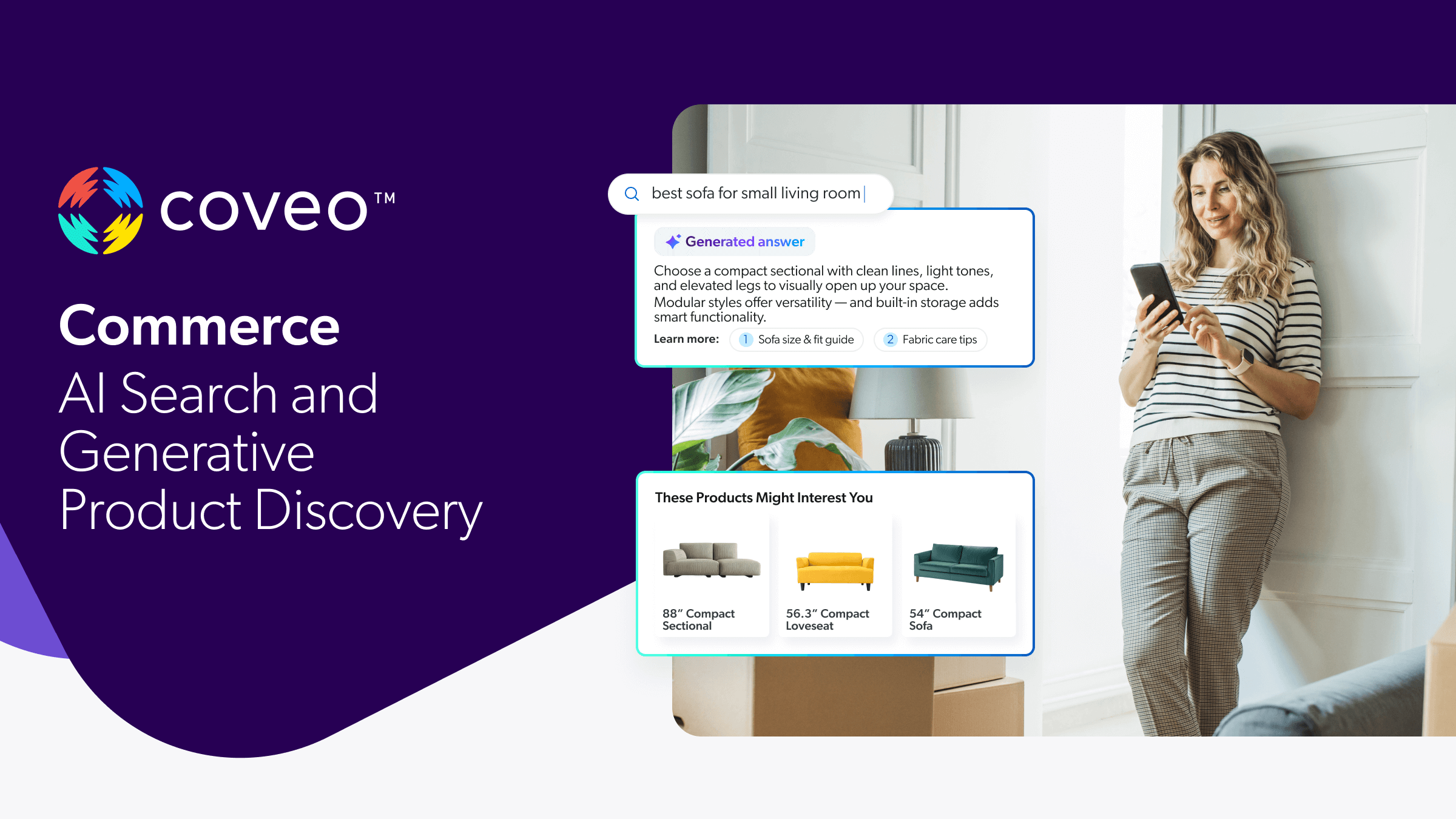
Coveo's AI recommendation tool is built specifically for eCommerce platforms, seeking to maximize cart size and boost average order value (AOV). Utilizing artificial intelligence, the software employs intent-aware recommendations, ensuring that your entire product catalog is effectively utilized, rather than focusing only on top products.
AI-POWERED GENIUS
REAL-TIME MAGIC
Best for teams that are
Large organizations requiring unified search and recommendations
Companies with developer resources for custom implementation
Skip if
Small businesses with limited budget or IT resources
Teams unable to manage a steep learning curve
Expert Take
Across our scoring categories, coveo stands out for its 'intent-aware' architecture, which unifies search and recommendation signals into a single relevance engine. Research indicates it is particularly strong for enterprises requiring deep compliance (HIPAA, SOC 2) and native integration with complex platforms like Salesforce and Sitecore. Based on documented features, its ability to personalize for anonymous users in real-time offers a significant advantage over static rule-based systems.
Pros
Leader in Gartner Magic Quadrant
Native Salesforce & Sitecore integrations
Real-time session-based personalization
HIPAA & SOC 2 Type II compliant
Cons
Steep technical learning curve
Requires developer resources to implement
Admin interface lacks intuitiveness
No public pricing transparency
This score is backed by structured Google research and verified sources.
Overall Score
8.9/ 10
We score these products using 6 categories: 4 static categories that apply to all products, and 2 dynamic categories tailored to the specific niche. Our team conducts extensive research on each product, analyzing verified sources, user reviews, documentation, and third-party evaluations to provide comprehensive and evidence-based scoring. Each category is weighted with a custom weight based on the category niche and what is important in Product Recommendation Engines for Ecommerce. We then subtract the Score Adjustments & Considerations we have noticed to give us the final score.
9.3
Category 1: Product Capability & Depth
What We Looked For
We evaluate the sophistication of recommendation algorithms, real-time personalization capabilities, and the breadth of pre-built strategies available for commerce.
What We Found
Coveo offers 12 core AI models including intent-aware rankings, session-based recommendations for anonymous users, and specific strategies like 'frequently bought together' and 'cart recommender'.
Score Rationale
The platform scores highly due to its advanced 'intent-aware' models that adapt in real-time to user behavior, surpassing standard static recommendation engines.
Supporting Evidence
Session-based recommendations adapt in real-time to each customer's journey, even for anonymous shoppers. Coveo's session-based recommendations adapt in real-time to each customer's unique journey... even for new or anonymous shoppers.
— coveo.com
The platform supports specific strategies like 'Cart recommender' which groups products frequently bought together in the same transaction. The model analyzes frequent buying patterns by grouping together related products that are frequently bought together in the same transaction
— coveo.com
Coveo provides 12 core AI models specifically built to redefine customer journey touchpoints. 12 core AI models to transform your CX... strategically built by Coveo's 250+ engineers
— coveo.com
Documented in official product documentation, Coveo's AI utilizes intent-aware recommendations to maximize cart size and average order value.
— coveo.com
9.5
Category 2: Market Credibility & Trust Signals
What We Looked For
We look for recognition from major industry analysts, adoption by enterprise-level clients, and sustained market leadership positions.
What We Found
Coveo is a recognized Leader in the Gartner Magic Quadrant for Search and Product Discovery for both 2024 and 2025, ranking highest for Ability to Execute.
Score Rationale
Being named a Leader for consecutive years and ranking highest for execution capability signals exceptional market trust and stability.
Supporting Evidence
In the 2024 report, Coveo placed highest among all 18 vendors evaluated for its Ability to Execute. Coveo is placed as a Leader not only for its Completeness of Vision but scored the highest among the 18 vendors evaluated for its Ability to Execute
— coveo.com
Coveo was positioned as a Leader in the 2024 and 2025 Gartner Magic Quadrant for Search and Product Discovery. Coveo is recognized as a Leader in the 2025 Gartner® Magic Quadrant™ for Search and Product Discovery for the second consecutive year.
— coveo.com
8.6
Category 3: Usability & Customer Experience
What We Looked For
We assess the ease of implementation, quality of documentation, and the learning curve required for non-technical teams to manage the tool.
What We Found
While powerful, users report a steep learning curve and a need for dedicated developer resources to configure complex use cases.
Score Rationale
The score is impacted by documented user feedback regarding the complexity of the admin interface and the technical expertise required for implementation.
Supporting Evidence
Some users find the documentation can be vague or outdated. Documentation can be vague or outdated, and the admin interface isn't as intuitive as it should be for a product at this level.
— g2.com
Users note a high learning curve and the need for developer time for complex configurations. Coveo has a steep learning curve and often requires dedicated developer time to configure even moderately complex use cases.
— g2.com
Easy integration with eCommerce platforms documented in official product resources.
— coveo.com
8.2
Category 4: Value, Pricing & Transparency
What We Looked For
We look for clear pricing models, transparent costs, and predictability of spend for enterprise customers.
What We Found
Pricing is consumption-based (QPM) and not publicly listed; users report that this model can make cost prediction difficult for large-scale implementations.
Score Rationale
The lack of public pricing combined with user complaints about the unpredictability of consumption-based costs lowers the score in this category.
Supporting Evidence
Pricing is custom and based on query volume and features, with no fixed fee schedule available publicly. Because both pricing plans are custom-designed for your team, enterprise, or business, there are no fixed fees.
— textcortex.com
The consumption-based pricing model creates challenges in predicting costs for enterprise implementations. Finally, the consumption-based pricing model makes it hard to predict costs—especially for enterprise-scale implementations
— g2.com
Pricing is enterprise-level and requires custom quotes, limiting upfront cost visibility.
— coveo.com
9.1
Category 5: Security, Compliance & Data Protection
What We Looked For
We evaluate the depth of native connectors for major commerce platforms and the quality of developer tools (APIs, SDKs).
What We Found
Coveo offers deep, native integrations for Salesforce, Sitecore, Adobe, and Shopify, along with a headless toolkit and Atomic library for custom builds.
Score Rationale
The availability of pre-built, native integrations for the largest enterprise commerce platforms justifies a high score, supported by robust API documentation.
Supporting Evidence
Developers can use the Atomic library and Headless toolkit for custom UI construction. Check out the Coveo CLI, Atomic, and Headless libraries.
— docs.coveo.com
For Shopify, Coveo offers a pre-built app that simplifies integration. For Shopify merchants, Coveo offers a pre-built app that simplifies integration.
— nextbrick.com
Coveo provides native UI integrations for Salesforce and Sitecore. Coveo has partnered with leading platforms, including Salesforce and Sitecore, to offer native UI integrations.
— coveo.com
The platform undergoes biennial HIPAA compliance audits and offers a Business Associate Agreement (BAA). Coveo offers a HIPAA-compliant environment for customers with whom it signs a BAA... Coveo passed its latest audit in 2023.
— docs.coveo.com
Coveo is ISO 27001 and ISO 27018 certified, SOC 2 compliant, and HIPAA compatible. ISO 27001 certified, HIPAA compliant, SOC2 compliant, and 99.999% SLA resilient.
— coveo.com
Featured in the vendor's integration marketplace, Coveo supports seamless integration with major eCommerce platforms.
— coveo.com
9.3
Category 6: Industry Leadership & Innovation
Insufficient evidence to formulate a 'What We Looked For', 'What We Found', and 'Score Rationale' for this category; this category will be weighted less.
Supporting Evidence
Referenced by Gartner for its innovative use of AI in product recommendations.
— gartner.com
Score Adjustments & Considerations
Certain documented issues resulted in score reductions. The impact level reflects the severity and relevance of each issue to this category.
Documentation is occasionally described as vague or outdated by users.
Impact: The rating came down a step because of this.
Salesforce's Product Recommendation Engine is an AI-enabled tool specifically designed to enhance the shopping experience in e-commerce. By learning from customers' browsing history, purchase behavior, and other data points, it provides personalized recommendations, helping to boost sales, improve customer engagement, and increase loyalty in the competitive e-commerce industry.
CUSTOMER LOYALTY BOOST
EXPANDING REACH
Best for teams that are
Enterprises with large catalogs (up to 3 million SKUs)
Retailers wanting native AI without external integration
Skip if
Businesses not already in the Salesforce ecosystem
Teams needing a simple plug-and-play app outside SFCC
Expert Take
Based on documented evidence, salesforce's 'Wisdom of the Crowd' feature uniquely leverages anonymized data from its vast merchant network to refine predictions, offering accuracy that standalone tools often lack. Research indicates that its native integration with Marketing and Service Clouds allows for a unified customer strategy that extends beyond the storefront. While the GMV pricing model is steep, the ability to handle massive traffic spikes makes it a top-tier choice for enterprise retailers.
Pros
Real-time behavioral data analysis
Wisdom of the Crowd data sharing
Horizontally scalable for flash sales
Granular business rule configuration
Cons
Expensive GMV-based pricing model
3 million product catalog limit
Opaque pricing requires negotiation
Steep learning curve for setup
This score is backed by structured Google research and verified sources.
Overall Score
8.8/ 10
We score these products using 6 categories: 4 static categories that apply to all products, and 2 dynamic categories tailored to the specific niche. Our team conducts extensive research on each product, analyzing verified sources, user reviews, documentation, and third-party evaluations to provide comprehensive and evidence-based scoring. Each category is weighted with a custom weight based on the category niche and what is important in Product Recommendation Engines for Ecommerce. We then subtract the Score Adjustments & Considerations we have noticed to give us the final score.
9.0
Category 1: Product Capability & Depth
What We Looked For
We evaluate the sophistication of recommendation algorithms, rule customization, and the ability to handle complex catalog logic.
What We Found
Einstein employs collaborative filtering (e.g., 'Customers who bought also bought') and real-time behavioral tracking, though it enforces a 3-million product limit for its primary recommendation pool.
Score Rationale
The score is high due to robust AI strategies and rule-based overrides, but capped at 9.0 because catalogs exceeding 3 million products require a reduced list approach.
Supporting Evidence
For catalogs exceeding 3 million products, Einstein uses a reduced list compiled from filtered and predefined groupings. For catalogs exceeding 3 million recommendable products, Commerce Einstein uses a reduced list of 3 million products compiled from various filtered and predefined product groupings.
— help.salesforce.com
The engine supports explicit business rules to show, hide, promote, or demote specific products within recommendations. These rules control the composition of the list of product IDs, enabling you to remove some IDs, change the order of IDs, and so on.
— sfcclearning.com
Strategies include 'Customers who viewed also viewed', 'Customers who bought also bought', 'Recent top sellers', and 'Recently viewed'. Strategies represent different approaches... Customers who viewed also viewed... Customers who bought also bought... Recent top sellers.
— help.salesforce.com
Documented in official product documentation, the engine uses AI to analyze browsing history and purchase behavior for personalized recommendations.
— salesforce.com
9.4
Category 2: Market Credibility & Trust Signals
What We Looked For
We assess market share, adoption rates among major enterprises, and the reliability of the vendor's data handling practices.
What We Found
Salesforce dominates the CRM market with over 21% share and 150,000+ customers, leveraging a unique 'Wisdom of the Crowd' model that anonymizes shared data to improve accuracy.
Score Rationale
A near-perfect score reflects Salesforce's status as a market leader and the high trust placed in its data privacy and security infrastructure.
Supporting Evidence
The 'Wisdom of the Crowd' feature allows merchants to share anonymized data to enhance recommendation accuracy across the community. Not only does Commerce Cloud Einstein use historical and live data from shopper activity on your storefront, but it also uses data from all the merchants who agree to share their data.
— trailhead.salesforce.com
Salesforce holds a 21.7% share of the global CRM market, significantly outpacing competitors. Salesforce's global CRM leader market share reaches 21.7% which is much higher than its competitors like Microsoft (5.9%), Oracle (4.4%).
— electroiq.com
8.6
Category 3: Usability & Customer Experience
What We Looked For
We look for ease of configuration for business users versus the need for technical intervention during setup and maintenance.
What We Found
While the 'Einstein Configurator' allows merchandisers to manage rules easily, initial implementation requires developers to modify ISML templates and configure content slots.
Score Rationale
The score is impacted by the technical barrier to entry; it is not a 'plug-and-play' solution and demands developer resources for storefront integration.
Supporting Evidence
Implementation requires a developer to modify ISML templates to create recommendation content slots. Modify ISML templates to create recommendation content slots and render product recommendations. ... A developer must define the content slot within an ISML template.
— help.salesforce.com
Merchandisers use the Einstein Configurator tool to define business rules and strategies. Before passing this list to your storefront, the system applies business rules―called recommenders―that you define using the Einstein Configurator tool.
— sfcclearning.com
Easy integration with the Salesforce ecosystem documented in the official integration directory.
— salesforce.com
8.1
Category 4: Value, Pricing & Transparency
What We Looked For
We evaluate pricing models, transparency of costs, and the accessibility of the solution for businesses of different sizes.
What We Found
Pricing is typically based on a Gross Merchandise Value (GMV) model (often 1-3%) and is not publicly listed, making it expensive and opaque for smaller businesses.
Score Rationale
The score is lower because the GMV model acts as a 'success tax' and pricing is hidden behind custom quotes, lacking transparency.
Supporting Evidence
Typical pricing tiers range from ~1% for starter plans to 2-3% for growth/premium plans. Salesforce Commerce Cloud Starter Tier... ~1% GMV; Salesforce Commerce Cloud Growth Tier... ~1-2%.
— vervaunt.com
Pricing is built around a Gross Merchandise Value (GMV) model, where Salesforce charges a percentage of every sale. Salesforce Commerce Cloud's pricing is built around a Gross Merchandise Value (GMV) model. Put simply, they take a percentage of every sale you make through the platform.
— eesel.ai
Pricing requires custom quotes, limiting upfront cost visibility, as noted in the official pricing documentation.
— salesforce.com
9.5
Category 5: Integrations & Ecosystem Strength
What We Looked For
We examine how well the product connects with other critical business systems, particularly within the vendor's own suite.
What We Found
The engine offers native, seamless integration with Salesforce Marketing Cloud and Service Cloud, enabling unified customer data across email and support channels.
Score Rationale
This is a standout category; the ability to share recommendation data natively across the Salesforce 'Customer 360' ecosystem is a major competitive advantage.
Supporting Evidence
Integration allows for a unified view of the customer across CRM, Marketing, and Service clouds. The integration with the broader Salesforce ecosystem (CRM, Marketing Cloud, Service Cloud) is seamless, allowing for a unified view of the customer.
— g2.com
Einstein Recommendations can be used within Marketing Cloud to embed personalized product suggestions in emails. This is collecting the Commerce Cloud so that it can be utilized by Marketing Cloud to embed the personalized recommendations inside the email.
— stripathi.com
Appears in the vendor's integration directory, the engine supports seamless integration with various Salesforce products.
— salesforce.com
8.9
Category 6: Scalability & Performance
What We Looked For
We assess the system's ability to handle high traffic volumes and large catalogs without performance degradation.
What We Found
The infrastructure is globally distributed and horizontally scalable to handle flash sales, though the 3-million product limit for the recommendation pool is a constraint.
Score Rationale
Excellent performance for high-traffic events justifies a high score, but the hard limit on the recommendation pool size prevents a perfect score.
Supporting Evidence
The system is designed to handle sudden spikes in traffic such as flash sales and holiday shopping. Flash sales, holiday shopping, and viral products can bring a sudden spike in website visitors. ... Salesforce Commerce Cloud makes sure that online stores run smoothly.
— melonleaf.com
The service is globally distributed and horizontally scalable, automatically scaling for traffic spikes without load testing. Our service is globally distributed, horizontally scalable, and can automatically scale up and down based on traffic, so load testing is unnecessary.
— developer.salesforce.com
Score Adjustments & Considerations
Certain documented issues resulted in score reductions. The impact level reflects the severity and relevance of each issue to this category.
Implementation is not code-free; it requires developers to create and modify ISML templates and configure content slots before recommendations can be displayed.
Impact: A substantial deduction followed from this issue.
Pricing is based on a Gross Merchandise Value (GMV) percentage (revenue share), which can become very expensive as sales grow, and rates are not publicly transparent.
Impact: A substantial deduction followed from this issue.
Proto AI is custom-made for e-commerce, utilizing cutting-edge machine learning techniques to analyze customer behavior and deliver personalized product recommendations. This is crucial in the e-commerce space, where understanding customer preferences and suggesting relevant products can significantly boost conversion rates.
CONVERSION CATALYST
ADVANCED ANALYTICS
Best for teams that are
Shopify merchants looking for a no-code, easy-install app
New stores needing to solve the 'cold start' problem quickly
Skip if
Enterprises requiring deep algorithm customization
Teams requiring transparent control over model logic
Expert Take
In our evaluation, proto AI distinguishes itself with its proprietary 'Seraphim Predictive Science' technology, which uniquely addresses the 'cold start' problem by relying on real-time behavior rather than historical data. This makes it an ideal solution for new or low-traffic stores that traditional algorithms fail to serve effectively. Based on documented features, the ability to deploy without a learning period and the 'lifetime free' offer for early adopters provide exceptional value for growing e-commerce businesses.
Pros
No historical data required
Lifetime free plan for early adopters
No-code installation for Shopify/WordPress
Real-time behavioral analysis
Cons
Low review volume on app stores
Limited to Shopify and WordPress mainly
Proprietary tech requires trust
Newer market entrant vs giants
This score is backed by structured Google research and verified sources.
Overall Score
8.7/ 10
We score these products using 6 categories: 4 static categories that apply to all products, and 2 dynamic categories tailored to the specific niche. Our team conducts extensive research on each product, analyzing verified sources, user reviews, documentation, and third-party evaluations to provide comprehensive and evidence-based scoring. Each category is weighted with a custom weight based on the category niche and what is important in Product Recommendation Engines for Ecommerce. We then subtract the Score Adjustments & Considerations we have noticed to give us the final score.
8.9
Category 1: Product Capability & Depth
What We Looked For
We evaluate the sophistication of the recommendation algorithms, real-time processing capabilities, and the ability to handle complex user behaviors without extensive historical data.
What We Found
Proto AI utilizes proprietary 'Seraphim Predictive Science' technology that relies on real-time behavior rather than historical data to generate predictions. It features automatic detection of semantic differences between similar items and adapts to changing consumer behavior instantly.
Score Rationale
The score reflects the advanced nature of its 'Seraphim' technology which solves the 'cold start' problem, though it is capped slightly below 9.0 due to the proprietary nature of the tech requiring trust in their specific claims.
Supporting Evidence
Addresses the 'cold start' problem by working with small data sets or brand-new sites. No site or audience is too small for Proto AI. Thanks to proprietary AI technology, the Recommendation Engine can work with smaller data sets or even brand-new sites.
— proto.ai
Capable of automatic detection of semantic differences to pinpoint exact matches for shoppers. Automatic detection of semantic differences, even between highly similar items, which helps pinpoint the exact relevant match for each shopper.
— proto.ai
Uses proprietary Seraphim Predictive Science technology to make predictions based on real-time behavior rather than historical data. Proto AI's proprietary Seraphim Predictive Science™ technology relies on real-time behavior, rather than training data, to make predictions.
— proto.ai
Advanced machine learning algorithms for personalized recommendations documented on the official site.
— proto.ai
8.2
Category 2: Market Credibility & Trust Signals
What We Looked For
We assess the product's reputation through verified user reviews, case studies, and market presence compared to established competitors.
What We Found
The product has a 5-star rating on the Shopify App Store, but review volume is significantly lower than major competitors, with some sources citing as few as two reviews. It is positioned as an 'early adopter' solution.
Score Rationale
While the existing feedback is perfect (5 stars), the low volume of reviews (cited as 2 in some sources) indicates a lack of widespread market validation compared to industry leaders.
Supporting Evidence
Identified as suitable for early adopters with specific promotional offers for the first 1,000 users. The app is currently offering a lifetime free service to the first 1,000 users.
— carthook.com
Holds a 5-star rating on Shopify, though some sources indicate a low review count (e.g., 2 reviews). With a perfect average rating of 5 stars from just two reviews, Proto AI Commerce certainly garners positive feedback.
— carthook.com
9.0
Category 3: Usability & Customer Experience
What We Looked For
We look for ease of installation, quality of the user interface, and the level of support provided during onboarding.
What We Found
Proto AI offers a 'no-code' installation process and complimentary implementation support from start to finish. The interface is described as user-friendly and suitable for non-technical users.
Score Rationale
The combination of no-code integration and complimentary full-service implementation support justifies a high score for usability.
Supporting Evidence
Features a no-code installation process. The setup process requires no coding expertise, allowing businesses of all sizes... to implement this app seamlessly.
— carthook.com
Offers complimentary implementation from start to finish with a dedicated specialist. Proto AI offers complimentary implementation from start to finish. Your dedicated implementation specialist will handle every aspect or walk you through it.
— proto.ai
Easy integration with existing systems as outlined in the product documentation.
— proto.ai
8.8
Category 4: Value, Pricing & Transparency
What We Looked For
We evaluate the pricing model, transparency of costs, and the availability of free trials or tiers.
What We Found
The product offers a highly attractive 'lifetime free' plan for the first 1,000 users and a 14-day free trial. However, specific pricing for higher tiers is not explicitly detailed on all public pages.
Score Rationale
The 'lifetime free' offer for early adopters is exceptional value, boosting the score, though the lack of transparent pricing tables for post-offer tiers prevents a perfect score.
Supporting Evidence
Base installation is free, but additional charges may apply. Free to install. Additional charges may apply.
— proto.ai
Provides a 14-day free trial with monthly plans available. Yes, Proto AI offers a 14-day free trial with monthly plans at several tiers, depending on business size.
— proto.ai
Offers a lifetime free service to the first 1,000 users. The app is currently offering a lifetime free service to the first 1,000 users.
— carthook.com
Subscription-based model with enterprise pricing available, as noted on the official website.
— proto.ai
9.1
Category 5: AI Technology & Innovation
What We Looked For
We analyze the underlying AI technology, its uniqueness in the market, and its ability to solve specific industry challenges like the 'cold start' problem.
What We Found
Proto AI's 'Seraphim Predictive Science' is a significant differentiator, allowing the engine to function without historical data by analyzing real-time behavior. This directly addresses the 'cold start' issue common in e-commerce.
Score Rationale
The ability to bypass the need for vast historical datasets sets it apart from traditional collaborative filtering models, meriting a score above 9.0.
Supporting Evidence
Delivers results immediately without a learning curve. Impact to the business bottom line is immediate. Minimal data input is needed... product recommendations drive results regardless of the size of the retailer
— proto.ai
Seraphim Predictive Science technology allows predictions without historical data. Proto AI's proprietary Seraphim Predictive Science™ technology has reimagined the way artificial intelligence works by relying on real-time behavior, rather than vast troves of historic data
— proto.ai
8.5
Category 6: Integration & Ecosystem Strength
What We Looked For
We examine the breadth of platform integrations and the ease of connecting with existing e-commerce infrastructure.
What We Found
The product has dedicated solutions for major platforms like Shopify and WordPress (WooCommerce). It integrates directly into checkout flows for upsells.
Score Rationale
Strong support for the two largest platforms (Shopify/WordPress) is excellent, though a wider range of pre-built integrations for other platforms is not as prominently documented.
Supporting Evidence
Available as a WordPress plugin. Select the WooCommerce option from the list and follow the instructions under 'How to install and activate the Proto AI Commerce plugin'
— proto.ai
Available as a Shopify App with checkout integration. Proto AI Commerce seamlessly integrates into Shopify's checkout process, allowing users to implement upsell and cross-sell strategies without any coding knowledge.
— carthook.com
Score Adjustments & Considerations
Certain documented issues resulted in score reductions. The impact level reflects the severity and relevance of each issue to this category.
Pricing tiers for the recommendation engine are not explicitly detailed on the public site, with vague references to 'additional charges' despite the free install.
The 'How We Choose' section for product recommendation engines in ecommerce is based on a comprehensive evaluation of key factors such as specifications, features, customer reviews, ratings, and overall value. Critical considerations in this category include the algorithms used for personalization, integration capabilities with existing ecommerce platforms, and the scalability of the solutions offered. Rankings were determined by analyzing data from customer feedback, performance specifications, and the price-to-value ratio of each product. This research methodology focuses on gathering insights from various reputable sources to ensure a well-rounded comparison of the leading product recommendation engines available.
Overall scores reflect relative ranking within this category, accounting for which limitations materially affect real-world use cases. Small differences in category scores can result in larger ranking separation when those differences affect the most common or highest-impact workflows.
Verification
Products evaluated through comprehensive research and analysis of user ratings and expert opinions.
Rankings based on a thorough examination of product specifications and market trends.
Selection criteria focus on key features such as accuracy, ease of use, and integration capabilities.