


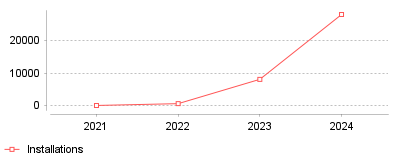
| Year | Installations |
|---|---|
| 2021 | 85 |
| 2022 | 636 |
| 2023 | 8066 |
| 2024 | 27864 |
The data illustrates a dramatic transformation in how marketing automation platforms are distributed and utilized across the digital landscape [1]. On one front, there is exponential growth in platforms like HighLevel, whose installations surged from a mere 85 in 2021 to nearly 27,864 in 2024, signaling the success of white-labeled, agency-driven software distribution [1]. Simultaneously, while general AI adoption in marketing grew from 61.4% in 2023 to 69.1% in 2024, the reliance on fully AI-generated content actually dropped from 44.0% to 35.1% [2]. This points to a strategic pivot toward hybrid AI models, where human oversight is intimately integrated with autonomous workflows to preserve output quality [3].
For the micro industry of individual marketing agencies, this dual trend means they are evolving from mere service providers into critical software distributors and technology partners [1]. By reselling automation infrastructure to local businesses—such as dentists or plumbers—agencies are capturing new recurring revenue streams and bridging the gap for demographics that traditional enterprise software companies cannot efficiently reach [1]. On a macro level, the entire marketing technology ecosystem is recognizing the fundamental limitations of raw, unsupervised generative AI [4]. Organizations are actively restructuring their automation strategies to emphasize human-in-the-loop architecture, ensuring that while AI handles data gathering and mundane execution, human experts retain control over creative direction and quality assurance [3]. Consequently, the value of marketing automation is no longer judged solely by its capacity to eliminate human effort, but rather by its ability to intelligently augment human judgment [5].
Understanding this shift is critical because it fundamentally redefines the barriers to entry and the competitive dynamics within the digital marketing sector [1]. For software vendors, the success of the agency-as-software paradigm highlights a vastly more efficient customer acquisition strategy that leverages established client-agency trust networks rather than fighting for direct B2B sales [1]. Furthermore, the decline in fully AI-driven content generation serves as a vital warning to brands about AI fatigue and the decreasing consumer engagement associated with suspected machine-generated content [4]. Adapting to a hybrid model ensures that businesses can scale their operations efficiently without sacrificing the authenticity and trust necessary to drive high-value conversions [6].
The explosive growth of agency-distributed software was likely catalyzed by the rising cost of traditional B2B customer acquisition and the increasing technical complexity of omnichannel engagement, which forced small businesses to lean entirely on their trusted agency partners for cohesive technological solutions [1]. Simultaneously, the pullback from fully automated AI content was almost certainly triggered by a noticeable degradation in content quality and subsequent algorithmic penalties from search engines, leading to a massive 61% drop in organic click-through rates when purely AI-generated summaries appeared [4]. As consumers became more sophisticated and adept at spotting AI slop, audiences began to disengage from brands that clearly lacked human editorial oversight [1]. This commercial backlash naturally forced marketers to retreat from complete automation, pushing them toward a balanced hybrid approach where AI handles the quantitative heavy lifting while humans meticulously manage the qualitative messaging [2].
The marketing automation landscape is experiencing a profound maturation, characterized by innovative, decentralized distribution channels and a more disciplined, cautious application of artificial intelligence [5]. The concurrent rise of agency-resold software and hybrid AI workflows underscores that technology is most effective when it empowers, rather than replaces, local expertise and human creativity [3]. A prominent takeaway for businesses is that competitive advantage will no longer stem from adopting the most automation, but rather from deploying automation in ways that preserve authentic human connections and leverage existing trust-based relationships.
Grand View Research measured the global marketing automation software sector at $6.65 billion in 2024 [1]. Analysts project this category will reach $15.58 billion by 2030, representing a 15.3% compound annual growth rate [1]. North American companies dominate current purchasing, accounting for 43.6% of global revenue share [1]. Email functionality remains the primary driver of these purchases, capturing 26.7% of total application spend [1]. Despite the rapid transition to cloud applications across most enterprise software categories, on-premises deployments maintained the largest revenue share through 2024 [1]. Large organizations continue to demand strict data control over their customer records, keeping infrastructure strictly internal.
Consistent financial expansion obscures deep operational inefficiencies. Enterprise buyers invest millions into broad digital advertising software, yet internal teams fail to deploy the features. Gartner surveyed chief marketing officers in 2025 and found that technology utilization dropped to 49% [2]. Organizations pay for advanced predictive scoring and multi-channel orchestration but rely almost entirely on basic batch email distribution. Only 15% of surveyed organizations qualify as high performers who meet their strategic software goals and demonstrate positive returns on their software investments [2].
This deployment failure coincides with severe financial constraints. Marketing budgets flatlined at 7.7% of total company revenue for the second consecutive year in 2025 [3]. Inflationary pressures forced 48.7% of companies to actively decrease their promotional spending [4]. Executives face a distinct mathematical problem. Media costs continue to rise, consuming 30.6% of the average marketing department budget [3]. Software subscriptions consume another 22% [5]. When teams utilize only half of their purchased automated engagement tools, the wasted capital directly degrades overall departmental performance. Unsurprisingly, 59% of marketing executives report they possess insufficient funding to execute their desired strategies [3].
Vendors respond by pushing artificial intelligence as an efficiency mechanism. Application providers integrate generative text models to accelerate content production and campaign assembly. Gartner reports that AI investments deliver measurable returns, improving time efficiency for 49% of marketing leaders and cost efficiency for 40% [3]. These features allow operators to launch campaigns faster, theoretically improving the 49% utilization metric. However, adding complex algorithmic features to platforms that users already find difficult to navigate rarely solves foundational adoption problems.
Google and Yahoo permanently altered digital communication tactics in February 2024 [6]. The major inbox providers enforced identical security regulations targeting high-volume senders. Any organization transmitting more than 5,000 messages daily to Gmail or Yahoo addresses now falls under the bulk sender classification [7]. Once categorized as a bulk sender, a domain must comply with strict infrastructure rules or face immediate traffic rejection.
Compliance requires three distinct technical protocols. Senders must implement the Sender Policy Framework to define their authorized mail servers [8]. They must use DomainKeys Identified Mail to add digital signatures to their messages, proving the content remained unaltered during transit [8]. Finally, organizations must publish a Domain-based Message Authentication, Reporting, and Conformance policy to instruct receiving servers on handling unauthenticated messages [6]. Beyond server authentication, the rules mandate one-click unsubscribe links in all commercial emails, with operators required to process these removals within two days [6]. Senders must also format all messages according to the specific Internet Message Format standard [9].
Service providers absorbed the immediate operational shock. Firms implementing client management software for marketing firms had to pause client outreach programs entirely. Account managers lost billable hours auditing Domain Name System records for hundreds of distinct client domains. Unprepared agencies saw client emails bounce, leading to strained contracts and lost revenue.
The most restrictive component of the mandate involves user feedback. Google explicitly requires senders to maintain a reported spam rate below 0.10% inside Google Postmaster Tools [7]. Operators must never exceed a 0.30% spam rate [7]. If three out of one thousand recipients mark a message as spam, Google diverts the entire campaign to the junk folder or blocks the domain entirely [10]. Enforcement escalated throughout the spring. Google issued temporary error codes in February 2024, followed by outright rejection of non-compliant traffic beginning in April 2024 [7]. This absolute threshold forces marketing departments to aggressively purge their subscriber lists, eliminating cold contacts and focusing exclusively on engaged audiences.

Consumer privacy features systematically degrade marketing analytics. Apple introduced Link Tracking Protection with the release of iOS 17 and expanded the feature's scope during the rollout of iOS 18 [11]. This software function automatically removes user-identifiable tracking parameters from URLs when individuals interact with links inside Apple Mail, Messages, or Safari Private Browsing [12].
Before this update, advertising platforms appended unique alphanumeric strings to destination links. These identifiers allowed analytics systems to connect a specific user click directly to a subsequent website purchase. Apple now strips common parameters from the uniform resource locator before the web page loads [11]. The website still functions normally, but the receiving server cannot trace the visitor back to their originating email campaign. Furthermore, industry analysts report that Apple will likely extend this protection across all Safari browser sessions in upcoming iOS 26 updates [13]. iPhones account for more than half of the United States smartphone market, making this data loss mathematically devastating for consumer brands [14].
High-ticket sales professionals experience severe disruptions from these hidden parameters. Agents relying on property outreach systems struggle to determine which specific neighborhood newsletter generated a showing request. The resulting attribution gap makes their highest-performing campaigns look artificially weak on internal reporting dashboards [14]. Operators who depend on precise tracking to calculate their return on investment must abandon deterministic measurement models.
Organizations must adapt to an ambiguous reporting environment. Experts advise transitioning away from specific click-level attribution toward broader media mix modeling. Apple's changes force software vendors to re-engineer their reporting interfaces. Platforms now highlight aggregate engagement trends rather than promising exact dollar values tied to individual email sends. Companies that continue attempting to track individual users across devices will find their data increasingly fragmented and unreliable.
HubSpot demonstrated strong financial performance despite a difficult software market. The software provider reported $2.63 billion in total revenue for the full 2024 fiscal year [15]. This total signifies a 21% increase over 2023 results on an as-reported basis [15]. The company closed the year with 247,939 total customers, growing its user base by 21% [15]. Calculated billings reached $767.6 million in the fourth quarter alone, rising 16% on an as-reported basis and 21% in constant currency [16]. Operating margins also showed clear improvement. HubSpot delivered a 19% non-GAAP operating margin in the fourth quarter, alongside $194.1 million of operating cash flow [16].
Salesforce presented a divergent narrative regarding its marketing products. The enterprise giant achieved $34.86 billion in total revenue during its 2024 fiscal year, an 11% increase year-over-year [17]. The company posted a full-year non-GAAP operating margin of 30.5% and generated $10.2 billion in operating cash flow [17]. However, specific product lines showed distinct vulnerabilities later in the cycle. During the fourth quarter of fiscal 2026, the combined Agentforce Marketing and Agentforce Commerce divisions declined 1% year-over-year in constant currency [18]. This segment generated $1.4 billion in Q4 but represented the only major product category to shrink, contrasting sharply with the 37% growth seen in the company's platform division [18].
Consolidation drives this divergence in vendor success. Mid-market companies actively seek unified databases rather than patching together separate applications. Financial professionals using loan officer communication software require their outreach tools to exist natively within their core pipeline manager. Transferring sensitive applicant data between a standalone email provider and a primary sales database creates security risks and delays response times. HubSpot benefits from this consolidation trend by building all hubs on a single metadata layer, while Salesforce manages distinct architectures resulting from historical acquisitions like ExactTarget.
Both companies signal massive investments in autonomous agents. Salesforce leadership highlights their Agentforce adoption metrics, noting 2.4 billion automated actions delivered [18]. HubSpot executives attribute their 2025 financial guidance to their transition toward an AI-first platform model [19]. Software providers must demonstrate that their algorithms actively generate revenue, as corporate buyers will no longer tolerate escalating subscription costs for simple email distribution software.
Corporate executives use technology to systematically eliminate external labor costs. Gartner research indicates that 39% of chief marketing officers plan to cut their agency budgets throughout 2025 [20]. Marketing leaders cite eliminating unproductive relationships and streamlining their vendor rosters as their primary cost-saving actions [21]. Another 39% of executives plan to reduce spending on internal labor by simplifying overlapping roles and reducing total headcount [21].
Generative capabilities enable this rapid restructuring. Software handles the repetitive segmentation and drafting tasks previously assigned to junior agency staff. Fully 22% of surveyed marketing leaders explicitly credit artificial intelligence with reducing their reliance on external agencies for creative production and strategy development [20]. Organizations reallocate these saved agency fees to cover rising paid media costs or to fund enterprise software upgrades. AI represents 9% of total marketing budgets in 2026, an increase from 7% in 2024 [4].
Sector-specific use cases highlight the speed of this transition. Brokers operating policyholder engagement systems use language models to analyze client claim histories and automatically generate personalized coverage upgrade emails. The agency owner no longer requires a freelance copywriter to draft fifty different email templates. The impact of this shift extends far beyond basic marketing departments. Forrester analysts predict that generative capabilities will displace 100,000 frontline agents from global contact center outsourcers by the end of 2025 [22]. Since 62% of contact centers in consumer-facing industries operate through outsourced labor, automating low-complexity interactions will permanently shrink human staffing requirements [22].
The math forces this operational change. With marketing budgets stalled at 7.7% of company revenue [3], leaders cannot afford to employ human workers for manual data entry or basic content generation. Software platforms that successfully embed these labor-saving features gain immediate pricing power during contract renewals.
Fragmented databases actively damage consumer relationships. Forrester reports that 78% of United States B2C marketing executives operate entirely siloed marketing and loyalty technology stacks [23]. When an organization isolates its promotional email tool from its customer service platform, the resulting communication lacks appropriate context. Automation rules trigger promotional discounts to users actively experiencing severe product failures.
This technical disconnect accelerates consumer attrition. Analysts predict a 25% decline in brand loyalty throughout 2025 as buyers face rising prices and generic outreach [22]. While overall brand loyalty drops, usage of specific loyalty programs will increase as shoppers seek immediate financial value and discounts [22]. Companies cannot successfully run these value-driven programs if their core databases fail to communicate.
Field service businesses struggle with identical API integration failures. Regional operators deploying lead tracking software for builders routinely fail to sync inbound website inquiries with active project management systems. Estimators arrive at job sites lacking vital context gathered during the initial automated email sequence. Resolving these database conflicts requires expensive developer interventions that small businesses simply cannot afford.
Organizations must unify their data structures immediately. Forrester anticipates that corporate investment dedicated to merging loyalty and marketing databases will triple in 2025 [22]. Leaders recognize that artificial intelligence requires clean historical data to function correctly. If the underlying data structure remains fractured, any algorithmic features layered on top will only generate faster, more visible errors.
The marketing software sector faces a period of harsh rationalization. Buyers refuse to tolerate 49% utilization rates on expensive annual contracts [2]. Administrators will aggressively audit their technology stacks, canceling any application that does not directly link to closed revenue.
Regulatory frameworks will permanently restrict audience size. Google and Yahoo established a firm precedent with their 0.3% spam threshold [7]. Marketing departments must prioritize extreme list hygiene over continuous audience expansion. Mass distribution tactics will result in immediate domain blocklists, crippling a company's ability to conduct basic business operations.
Platform consolidation will accelerate across all verticals. Standalone email distribution tools provide little value in an environment where Apple blocks link tracking [11] and algorithms handle content creation. Successful software vendors will merge promotional capabilities directly into primary customer relationship managers, ensuring that automated messaging uses real-time behavioral data. The companies that navigate this shift will capture the majority of the projected $15.58 billion market [1], while isolated tools slowly lose their enterprise renewals.
| Year | Installations |
|---|---|
| 2021 | 85 |
| 2022 | 636 |
| 2023 | 8066 |
| 2024 | 27864 |
The data illustrates a dramatic transformation in how marketing automation platforms are distributed and utilized across the digital landscape [1]. On one front, there is exponential growth in platforms like HighLevel, whose installations surged from a mere 85 in 2021 to nearly 27,864 in 2024, signaling the success of white-labeled, agency-driven software distribution [1]. Simultaneously, while general AI adoption in marketing grew from 61.4% in 2023 to 69.1% in 2024, the reliance on fully AI-generated content actually dropped from 44.0% to 35.1% [2]. This points to a strategic pivot toward hybrid AI models, where human oversight is intimately integrated with autonomous workflows to preserve output quality [3].
For the micro industry of individual marketing agencies, this dual trend means they are evolving from mere service providers into critical software distributors and technology partners [1]. By reselling automation infrastructure to local businesses—such as dentists or plumbers—agencies are capturing new recurring revenue streams and bridging the gap for demographics that traditional enterprise software companies cannot efficiently reach [1]. On a macro level, the entire marketing technology ecosystem is recognizing the fundamental limitations of raw, unsupervised generative AI [4]. Organizations are actively restructuring their automation strategies to emphasize human-in-the-loop architecture, ensuring that while AI handles data gathering and mundane execution, human experts retain control over creative direction and quality assurance [3]. Consequently, the value of marketing automation is no longer judged solely by its capacity to eliminate human effort, but rather by its ability to intelligently augment human judgment [5].
Understanding this shift is critical because it fundamentally redefines the barriers to entry and the competitive dynamics within the digital marketing sector [1]. For software vendors, the success of the agency-as-software paradigm highlights a vastly more efficient customer acquisition strategy that leverages established client-agency trust networks rather than fighting for direct B2B sales [1]. Furthermore, the decline in fully AI-driven content generation serves as a vital warning to brands about AI fatigue and the decreasing consumer engagement associated with suspected machine-generated content [4]. Adapting to a hybrid model ensures that businesses can scale their operations efficiently without sacrificing the authenticity and trust necessary to drive high-value conversions [6].
The explosive growth of agency-distributed software was likely catalyzed by the rising cost of traditional B2B customer acquisition and the increasing technical complexity of omnichannel engagement, which forced small businesses to lean entirely on their trusted agency partners for cohesive technological solutions [1]. Simultaneously, the pullback from fully automated AI content was almost certainly triggered by a noticeable degradation in content quality and subsequent algorithmic penalties from search engines, leading to a massive 61% drop in organic click-through rates when purely AI-generated summaries appeared [4]. As consumers became more sophisticated and adept at spotting AI slop, audiences began to disengage from brands that clearly lacked human editorial oversight [1]. This commercial backlash naturally forced marketers to retreat from complete automation, pushing them toward a balanced hybrid approach where AI handles the quantitative heavy lifting while humans meticulously manage the qualitative messaging [2].
The marketing automation landscape is experiencing a profound maturation, characterized by innovative, decentralized distribution channels and a more disciplined, cautious application of artificial intelligence [5]. The concurrent rise of agency-resold software and hybrid AI workflows underscores that technology is most effective when it empowers, rather than replaces, local expertise and human creativity [3]. A prominent takeaway for businesses is that competitive advantage will no longer stem from adopting the most automation, but rather from deploying automation in ways that preserve authentic human connections and leverage existing trust-based relationships.