


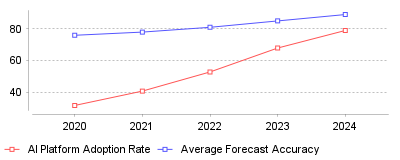
| Year | AI Platform Adoption Rate | Average Forecast Accuracy |
|---|---|---|
| 2020 | 32 | 76 |
| 2021 | 41 | 78 |
| 2022 | 53 | 81 |
| 2023 | 68 | 85 |
| 2024 | 79 | 89 |
This data illustrates the steady increase in the adoption of AI-powered revenue intelligence platforms by B2B sales organizations from 2020 to early 2024. Alongside this adoption curve, we see a parallel increase in average forecast accuracy, climbing steadily from a baseline of 76% up to nearly 90% over the five-year period.
On a micro level, individual sales reps and frontline managers are spending significantly less time manually interrogating spreadsheets and more time relying on automated CRM data capture. For the broader tech and SaaS industry, this indicates a fundamental shift in how revenue teams operate, moving from intuition-based commit calls to data-backed, algorithmic pipeline management. Platforms like Clari, Gong, and Salesforce Revenue Intelligence have transitioned from being optional sales coaching tools to indispensable operational systems of record. Consequently, organizations that fail to adopt these predictive models risk falling behind competitors who can allocate resources and adjust pricing with far greater precision.
Accurate revenue forecasting is the lifeblood of corporate strategy, directly influencing hiring decisions, budget allocation, and overarching investor confidence. When companies miss their forecasts, they experience severe stock market penalties and internal operational volatility. By closing the gap between projected and actual revenue through intelligence platforms, organizations achieve stability and can scale with predictable, capital-efficient growth .
The primary catalyst for this shift is the rapid maturation of generative AI and natural language processing within modern B2B tech stacks. Previously, sales representatives actively avoided manual data entry, which inevitably led to empty CRM fields and fundamentally flawed forecasting models. Modern revenue intelligence tools now automatically ingest data from emails, video calls, and messaging apps, entirely bypassing the need for human data entry. Furthermore, the global economic tightening of 2022 and 2023 forced CFOs to demand rigorous pipeline scrutiny, accelerating the mandate for mathematical predictability over gut-feeling sales leadership .
The era of manual, spreadsheet-based revenue forecasting is effectively over, replaced by algorithmic engines that dynamically learn from real-time seller activities. As adoption nears 80% among enterprise teams, utilizing AI-driven revenue intelligence is no longer merely a competitive advantage but a baseline requirement for corporate survival. The most prominent takeaway is that investing in data automation directly yields higher forecast accuracy, empowering businesses to navigate volatile economic markets with supreme confidence.
Global spending on sales technology reached $12.8 billion in 2023.
Gartner projects this figure will grow 14% annually through 2027 . Revenue intelligence applications represent the fastest-growing segment within this software class. Buyers are shifting budgets away from broad platforms toward specialized forecasting tools. This reallocation reflects a strict operational reality. Win rates declined 27% between 2021 and 2024 . Sales executives need exact visibility into their active pipelines. They cannot rely on historical averages during periods of weak demand.
The underlying infrastructure for these tools remains fragmented. Most organizations currently maintain separate databases for activity tracking and financial reporting. When business leaders evaluate CRM and sales software, they often discover integration gaps. Disconnected systems force operations teams to export pipeline data into static spreadsheets. Manual reconciliation wastes 12 hours per week for the average sales manager . Vendors are responding by acquiring smaller startups to fill these capability gaps. Clari acquired Groove in August 2023 to combine engagement tracking with revenue forecasting . Salesloft purchased Drift in early 2024 to capture buyer signals . These transactions highlight a clear trend. Standalone products are losing their commercial viability.
Salesforce added predictive scoring to Sales Cloud in Q3 2024. HubSpot followed with a similar feature two months later.
These platform updates signal a departure from legacy strategies. For years, major systems relied on external integrations to provide analytics. Independent vendors built successful businesses by extracting raw records and applying proprietary algorithms. That operational model is collapsing. Customers refuse to pay extra fees for baseline analytics. Salesforce reported a 15% year-over-year increase in Data Cloud consumption during a recent earnings call . This growth indicates that enterprise organizations prefer native processing over external transit. Moving sensitive records across multiple servers creates security vulnerabilities. The Securities and Exchange Commission adopted strict rules for cybersecurity incidents in July 2023 . Public companies must now report material breaches within four days. Chief Information Security Officers are consequently blocking deployments of external applications.
Security restrictions directly impact sales operations. Revenue teams require continuous flows to predict quarterly earnings accurately. They increasingly demand forecasting tools integrated with CRM and BI architecture. Embedded applications bypass external reviews because they operate within the established perimeter. This structural advantage gives incumbent vendors massive pricing power over independent startups. Independent providers must convince buyers that their specialized algorithms justify the added security risk. Few can meet this burden of proof. Gartner estimates that 60% of B2B sales organizations will consolidate their technology stacks by 2025 . Consolidation threatens any vendor lacking native platform status.

Additional metrics often decrease prediction accuracy. Sales managers routinely demand more dashboards when pipeline visibility drops.
This reactionary approach harms organizational execution. Revenue leaders assume that tracking every variable will expose hidden insights. Instead, overflowing dashboards obscure buying signals. A 2023 study by Harvard Business Review found that salespeople spend just 28% of their week actually selling . They waste the remaining hours classifying records to feed hungry algorithms. If frontline workers enter rushed updates, the resulting analytical models produce flawed targets. Bad input yields bad output. Organizations try to fix this by mandating strict protocols. Compliance drops further. It becomes a destructive cycle.
Automation offers the only practical exit from this cycle. Modern systems ingest information without manual keystrokes. Software parses email threads and calendar invites to determine account health. Firms deploying revenue intelligence tools with conversation and activity data report higher adoption than those using manual modules. Gong and Chorus built corporate valuations around this passive collection. These applications transcribe video calls and extract sentiment metrics using language processing. The resulting analytics evaluate rep performance and buyer hesitation simultaneously. Forrester reports that businesses using automated capture see a 15% increase in forecast accuracy within six months . Passive collection removes the human bottleneck from the prediction process.
Interest rates climbed 525 basis points between 2022 and 2024. Capital became expensive.
Corporate buying behavior changed immediately. The Federal Reserve tightening cycle forced chief financial officers to scrutinize every software purchase . Signature authority moved up the corporate hierarchy. Deals that previously required director approval now require executive sign-off. This additional friction stretches sales cycles by weeks or months. Historical algorithms fail under these conditions. A forecasting model trained on 2021 data will vastly overestimate 2024 conversion probabilities. When models miscalculate revenue, executives make dangerous hiring decisions. Tech companies laid off more than 260,000 employees in 2023 after missing inflated revenue targets . Static formulas carry severe financial consequences.
Dynamic environments require flexible testing environments. Revenue operators must test various assumptions before committing to a final board presentation. They need forecasting platforms with scenario and what if modeling capabilities. These systems allow analysts to adjust variables like discount rates or churn assumptions without altering the master database. If a competitor drops prices by 20%, an operations director can instantly model the pipeline impact. Scenario planning isolates risk. McKinsey data shows that companies using dynamic resource reallocation achieve twice the shareholder return of static planners .
Governments are actively restricting automated voice surveillance. Regional privacy laws conflict with global software deployments.
Revenue applications record millions of sales conversations daily. These recordings contain personal identifiers and proprietary corporate strategies. Lawmakers view this mass collection as a severe privacy threat. The European Union passed the AI Act in early 2024 to classify artificial intelligence applications based on risk levels . Emotion recognition systems operating in workplaces face strict limitations under this framework. Many software features analyze caller tone to gauge purchasing intent. European regulators could classify these exact features as high-risk applications requiring heavy compliance audits. Companies operating internationally must partition their databases to satisfy regional mandates.
Compliance costs degrade profit margins. Software companies must hire legal teams to navigate international frameworks. The California Privacy Rights Act already imposes strict deletion requirements for state residents . If a California-based prospect requests deletion, the vendor must purge their voice prints from all training models. Erasing specific nodes from a neural network is computationally expensive. Some vendors simply delete entire data batches to ensure compliance. This defensive deletion degrades the accuracy of subsequent revenue projections. Organizations evaluating sales forecasting and revenue intelligence vendors must audit their retention architectures. A provider lacking granular deletion capabilities poses an unacceptable legal risk.
Inaccurate pipeline visibility directly impacts payroll. Sales representatives depend on precise tracking to receive their commission checks.
When prediction models fail, quota attainment drops. Reps lose faith in the corporate tracking mechanism. A secondary crisis emerges when leadership adjusts quotas mid-year to compensate for faulty projections. Gartner reports that 45% of sellers consider leaving their jobs when quotas change unexpectedly . Staff turnover destroys customer continuity and depresses future earnings. Maintaining rep trust requires absolute transparency in how targets are calculated and measured.
Platform vendors understand this operational vulnerability. They are building commission calculators directly into their intelligence modules. Capturing activity data, predicting the close date, and calculating the corresponding commission payout now happens sequentially in one interface. This functional consolidation eliminates disputes between the finance department and frontline sellers. The representative sees exactly how a specific deal delay will affect their take-home pay. Transparency aligns individual behavior with corporate forecasting goals.
Industrial equipment sales operate on entirely different timelines than software subscriptions. Heavy machinery deals often stretch across multiple fiscal years.
These extended cycles break standard software templates. A typical technology platform assumes a 90-day transaction window. When a tractor manufacturer attempts to force a 24-month procurement cycle into that framework, the predictive algorithms collapse. The system misinterprets a six-month period of silence as a lost deal. In reality, the municipal buyer is simply waiting for a budget committee vote. This structural misalignment forces industrial firms to abandon commercial applications entirely. They revert to manual tracking methods that offer zero predictive capability. The Association of Equipment Manufacturers notes that supply chain disruptions have stretched average delivery times by 40% since 2020 . Operations directors cannot accurately forecast revenue if the factory cannot confirm a delivery date. Modern intelligence tools must ingest external supply chain feeds to calculate realistic closing probabilities for physical goods.
Customization requirements scale exponentially with company size. Global corporations rarely implement software straight out of the box.
A Fortune 500 company might maintain forty distinct sales methodologies across different regional subsidiaries. Mapping these varied processes into a unified architecture takes months of expensive consulting work. The vendor promises immediate visibility during the sales pitch. The reality involves endless technical workshops to define basic terms like qualified lead. A 2024 survey by the International Data Corporation found that 42% of enterprise software implementations exceed their initial timelines . Delays erode executive sponsorship. When a deployment stretches past six months, the original economic buyer often rotates into a new role. The project loses momentum and becomes abandoned shelfware.
Successful deployments start with aggressive scope reduction. Smart operations leaders isolate one specific region or product line for the initial rollout. They establish a functional baseline before expanding the architecture globally. This iterative approach limits blast radius if the initial data mapping proves faulty. Vendors are adapting by releasing pre-configured industry templates. These templates provide a workable foundation that requires minor adjustment rather than a total custom build. Speed to initial value dictates long-term contract renewal.
Investment firms are forcing portfolio companies to upgrade their operational software. Spreadsheets are no longer acceptable during board meetings.
When a private equity group acquires a mid-market company, their first initiative involves professionalizing the revenue operations function. They install specialized reporting software to monitor their investment accurately. The ownership group demands cohort analysis, net revenue retention rates, and pipeline coverage ratios. Legacy reporting methods cannot generate these metrics quickly. Analysts at McKinsey found that private equity firms increasingly prioritize margin expansion over pure revenue growth . Achieving margin expansion requires precise allocation of sales resources. You cannot deploy expensive field representatives to low-probability accounts.
Intelligence software solves this allocation problem. By analyzing thousands of historical transactions, the system identifies the exact characteristics of a profitable deal. Management can then restrict travel budgets and expense accounts to opportunities matching that specific profile. This targeted deployment of capital instantly improves operating margins. The intelligence tool transforms from a simple prediction calculator into a strategic allocation engine. It enforces investment discipline across the entire commercial organization.
Many organizations generate most of their revenue through external reseller networks. These external partners guard their data fiercely.
A manufacturer relies on independent distributors to sell its products. The manufacturer has zero visibility into the distributor pipeline until a purchase order arrives. This blind spot destroys accurate production planning. If the manufacturer produces too much inventory, storage costs erase their profit margin. If they produce too little, they miss guaranteed revenue. Channel partners refuse to grant manufacturers direct access to their CRM systems. They fear the manufacturer might steal their customer relationships and bypass the distributor entirely. This trust deficit creates a severe data bottleneck.
Cryptographic techniques offer a technical solution to this trust problem. Multiparty computation allows multiple organizations to analyze combined datasets without exposing the underlying records. A vendor can calculate aggregate pipeline volume across fifty distributors without ever seeing a single customer name. Academic research from the Massachusetts Institute of Technology demonstrates that these privacy protocols operate efficiently at commercial scale . While currently rare in standard sales software, this cryptographic approach represents the future of channel forecasting. It delivers statistical visibility while maintaining strict commercial boundaries.
Initial client acquisition represents a small fraction of total lifetime value. Renewals drive modern profitability.
Software companies historically structured their reporting around net new logos. Sales managers celebrated closed contracts and immediately abandoned the account. The subscription economy punishes this behavior. A company can increase its new bookings by 20% and still shrink if its customer churn rate hits 30%. Churn cancels out acquisition. Forrester analysts assert that organizations focusing exclusively on initial acquisition face severe financial penalties during economic downturns . The focus must shift from the initial signature to long-term usage tracking. Account managers need intelligence software that monitors product telemetry.
Platform vendors are expanding their forecasting models to include customer health scoring. These models monitor how often users log into the purchased application. If a client buys one hundred licenses but only activates twenty, the system flags the account as an extreme churn risk. Revenue leaders can then deploy customer success managers to drive adoption before the renewal conversation begins. Predicting a downgrade six months early gives the vendor time to rescue the contract. Integrating product usage data with financial projections provides a mathematical picture of future cash flow. Subscription survival depends on continuous value verification.
Sales compensation plans actively encourage data manipulation. Employees optimize their behavior to maximize their bonuses.
If a company measures representative performance purely on pipeline creation, representatives will create fake pipeline. They will log low-quality conversations as qualified opportunities to hit their weekly quota targets. This behavior artificially inflates the organizational forecast. Management looks at a bloated pipeline and assumes they will hit quarterly targets. The subsequent shortfall shocks the executive team. A study by the National Bureau of Economic Research demonstrates that complex incentive structures frequently cause unintended operational sabotage . Representatives hoard deals until the next quarter if they have already hit their current commission cap. This deliberate sandbagging destroys quarter-over-quarter prediction accuracy.
Software cannot fix bad management policy. Intelligence platforms highlight these behavioral anomalies, but leaders must act on the findings. A modern system will flag a representative who consistently pushes closing dates to the final week of the fiscal quarter. The software exposes the tactic. Operations directors must then redesign the compensation plan to reward linear deal progression. Aligning employee incentives with organizational truth represents the hardest operational challenge. Technology merely provides the mirror.
Application programming interfaces restrict the volume of data moving between systems. Cloud providers cap transmission speeds to protect server stability.
Organizations assume their connected software stack updates instantaneously. This assumption proves false at the enterprise scale. When a global company updates ten thousand records simultaneously, the central database triggers an API limit. The system throttles the data transfer to prevent a server crash. This throttling delays critical pipeline updates. An executive reviewing a dashboard at 9:00 AM might look at figures from the previous evening. The United States Bureau of Labor Statistics notes that database administrators spend increasing hours managing these exact cloud transit bottlenecks . As companies attach more point solutions to their core CRM, API limits become a structural barrier to real-time intelligence.
Venture funding for standalone sales technology collapsed in 2023. Startups cannot survive on single products.
The market witnessed an explosion of point solutions between 2018 and 2021. Founders built entire companies around minor workflow improvements, like formatting email signatures or scheduling follow-up tasks. The era of cheap capital funded these niche applications. That era ended definitively. Chief Information Officers refuse to manage forty separate vendor contracts for a single sales department. They demand unified suites. The SEC S-1 filing for Klaviyo in late 2023 highlighted how buyers strongly prefer bundled applications over fractured tools . This buyer preference forces smaller startups to sell themselves to larger platforms. The remaining independent vendors face severe pricing pressure.
Multinational operations face severe mathematical challenges. A closed deal in Europe might lose 10% of its value before the cash reaches an American bank account.
Standard forecasting applications assume a static exchange rate throughout the fiscal quarter. This assumption breaks during periods of macroeconomic volatility. The United States Dollar strengthened significantly against the Euro and Yen throughout 2023. Software companies reporting earnings in dollars saw their international revenue drop strictly due to currency conversion rates. Microsoft cited foreign exchange headwinds as a primary drag on their commercial software division in their FY24 Q1 earnings report . If an intelligence platform ignores real-time exchange rates, the resulting forecast is mathematically fictional. Operations leaders need systems that recalculate pipeline value daily using live currency market feeds.
Chief Information Security Officers now veto software purchases. Feature lists do not matter if the architecture fails compliance checks.
Intelligence applications require access to a company's most sensitive information. They read executive emails, analyze pricing discounts, and record client conversations. A data breach within one of these platforms would expose a company's entire strategic roadmap. Vendors must prove their infrastructure isolates client data completely. The National Institute of Standards and Technology released updated cybersecurity guidelines in early 2024 emphasizing zero-trust architecture . Procurement teams use these guidelines to evaluate software vendors. If a platform cannot demonstrate end-to-end encryption, the procurement team blocks the purchase immediately. Security certification acts as an absolute market barrier.
Autonomous agents are executing tasks without human supervision. This automation creates severe operational liabilities.
Software vendors are deploying intelligent agents that can draft emails, schedule meetings, and update CRM records independently. A representative simply tells the system to nurture a stalled account. The agent reviews previous transcripts, generates a personalized message, and sends the communication. This sounds efficient until the agent misinterprets a transcript. If an agent emails a massive discount to a client who already agreed to full pricing, the business loses margin instantly. Human workers catch contextual nuances that algorithms miss. The European Commission defines autonomous decision-making in commercial environments as a high-risk category requiring human oversight . Companies deploying autonomous agents must implement strict approval layers. The agent can draft the communication, but a human must click send.
Generative models will not replace deterministic mathematics in financial planning.
Analysts frequently confuse conversational interfaces with analytical processing power. Language models excel at summarizing meeting notes or drafting follow-up emails. They fail at reliable numerical extrapolation. Large language models hallucinate facts. You cannot present hallucinated pipeline figures to a board of directors. The SEC actively penalizes companies that misrepresent their financial capabilities. In December 2023, the SEC began warning public firms about washing their disclosures with false artificial intelligence claims . Regulators demand verifiable accounting procedures.
Next-generation software will separate the conversational layer from the calculation engine. Users will query the system using natural speech. They might ask the application to identify all accounts with declining engagement. The platform will translate that text request into a strict database query. The deterministic calculation engine will execute the math and return the exact figures. The language model will then format those figures into a readable summary. This hybrid architecture protects financial integrity while improving user accessibility. IDC forecasts that businesses will spend $40 billion globally on generative artificial intelligence by 2025 . The most successful vendors will deploy these funds to build strict guardrails around their mathematical models. Prediction requires absolute mathematical certainty.
| Year | AI Platform Adoption Rate | Average Forecast Accuracy |
|---|---|---|
| 2020 | 32 | 76 |
| 2021 | 41 | 78 |
| 2022 | 53 | 81 |
| 2023 | 68 | 85 |
| 2024 | 79 | 89 |
This data illustrates the steady increase in the adoption of AI-powered revenue intelligence platforms by B2B sales organizations from 2020 to early 2024. Alongside this adoption curve, we see a parallel increase in average forecast accuracy, climbing steadily from a baseline of 76% up to nearly 90% over the five-year period.
On a micro level, individual sales reps and frontline managers are spending significantly less time manually interrogating spreadsheets and more time relying on automated CRM data capture. For the broader tech and SaaS industry, this indicates a fundamental shift in how revenue teams operate, moving from intuition-based commit calls to data-backed, algorithmic pipeline management. Platforms like Clari, Gong, and Salesforce Revenue Intelligence have transitioned from being optional sales coaching tools to indispensable operational systems of record. Consequently, organizations that fail to adopt these predictive models risk falling behind competitors who can allocate resources and adjust pricing with far greater precision.
Accurate revenue forecasting is the lifeblood of corporate strategy, directly influencing hiring decisions, budget allocation, and overarching investor confidence. When companies miss their forecasts, they experience severe stock market penalties and internal operational volatility. By closing the gap between projected and actual revenue through intelligence platforms, organizations achieve stability and can scale with predictable, capital-efficient growth .
The primary catalyst for this shift is the rapid maturation of generative AI and natural language processing within modern B2B tech stacks. Previously, sales representatives actively avoided manual data entry, which inevitably led to empty CRM fields and fundamentally flawed forecasting models. Modern revenue intelligence tools now automatically ingest data from emails, video calls, and messaging apps, entirely bypassing the need for human data entry. Furthermore, the global economic tightening of 2022 and 2023 forced CFOs to demand rigorous pipeline scrutiny, accelerating the mandate for mathematical predictability over gut-feeling sales leadership .
The era of manual, spreadsheet-based revenue forecasting is effectively over, replaced by algorithmic engines that dynamically learn from real-time seller activities. As adoption nears 80% among enterprise teams, utilizing AI-driven revenue intelligence is no longer merely a competitive advantage but a baseline requirement for corporate survival. The most prominent takeaway is that investing in data automation directly yields higher forecast accuracy, empowering businesses to navigate volatile economic markets with supreme confidence.