File-sharing phishing attacks surged 350% as 60% now use legitimate domains like Dropbox
Global Average Cost of a Data Breach (USD Millions)
The Weaponization of Legitimate File Sharing Services An alarming trend has emerged in the cybersecurity landscape where threat actors are increasingly weaponizing trusted business file-sharing platforms to execute sophisticated phishing attacks. Recent data reveals a massive 350% year-over-year surge in file-sharing phishing attacks, where criminals exploit the implicit trust users place in not
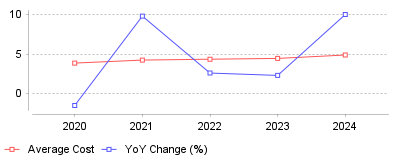
| Year | Average Cost | YoY Change (%) |
|---|
| 2020 | 3.86 | -1.5 |
| 2021 | 4.24 | 9.8 |
| 2022 | 4.35 | 2.6 |
| 2023 | 4.45 | 2.3 |
| 2024 | 4.88 | 10 |
The "Bait and Switch" Surge in File Sharing
What is this showing
Recent cybersecurity research indicates a drastic shift in how business file-sharing platforms are being exploited, with file-sharing phishing attacks increasing by 350% year-over-year between June 2023 and June 2024 [1]. Furthermore, 60% of these attacks now originate from legitimate domains and trusted services—such as Dropbox, iCloud, and DocuSign—rather than spoofed or malicious domains [2]. Simultaneously, the financial impact of falling victim to such breaches has hit a record high, with the global average cost of a data breach rising 10% in 2024 to reach $4.88 million [3].
What this means
This trend signifies a "weaponization of trust" within the business file-sharing ecosystem, where the platforms designed to facilitate collaboration are now the primary vectors for compromise. Because these attacks utilize valid notifications from legitimate services (e.g., a real email from Dropbox containing a link to a malicious PDF hosted on Dropbox), they successfully bypass traditional Secure Email Gateways (SEGs) that rely on blacklisting known malicious domains [4]. For the macro industry, this forces a move away from domain-reputation security models toward behavioral analysis, as the "sender" is technically a trusted vendor. On a micro level, finance and construction firms are disproportionately affected, likely due to their heavy reliance on sharing high-value invoices and contracts externally [2].
Why is this important
The ubiquity of file-sharing platforms in hybrid work environments makes this vector particularly dangerous; employees are conditioned to click "View Document" notifications daily. The financial stakes are escalating rapidly, as the 10% jump in breach costs in 2024 was the largest annual increase since the pandemic [3]. If organizations cannot distinguish between a legitimate contract and a weaponized file-share link, the fundamental utility of these platforms for external collaboration is threatened.
What might have caused this
The widespread adoption of Multi-Factor Authentication (MFA) has likely pushed attackers toward methods that trick users into voluntarily handing over credentials via convincing "login" pages hosted on trusted sites. Additionally, the rise of Generative AI allows attackers to create grammatically perfect, context-aware lures that mimic legitimate business correspondence, making social engineering significantly more effective [5]. Attackers are also capitalizing on the "freemium" models of file-sharing services, which allow them to create valid accounts instantly to host malicious payloads without immediate detection.
Conclusion
Business file-sharing platforms have evolved from passive storage repositories into active attack surfaces, evidenced by the 350% explosion in platform-based phishing. As breach costs near the $5 million mark, organizations must urgently audit their configurations and adopt AI-driven security tools capable of detecting anomalous sharing behavior rather than relying solely on link reputation. The prominent takeaway is that "trusted" domains are no longer synonymous with "safe" content.
Market Consolidation and the $1.2 Trillion Software Surge
Global IT spending on software is projected to reach $1.43 trillion in 2026, marking a 15.2% increase from 2025 levels
[1]. This capital injection is not flowing evenly across the sector. Instead, it is congregating around platforms that integrate generative AI, enforce strict data governance, and support hybrid workflows. The file sharing market, once defined by simple storage lockers, has morphed into a battleground for intelligent content management and regulatory compliance.
Two major transactions in late 2024 and early 2025 signaled a contraction in the standalone file sharing market. Progress Software completed its acquisition of ShareFile for $875 million in October 2024, absorbing the platform to bolster its digital experience portfolio
[2]. Less than five months later, Egnyte secured a majority investment from TA Associates and GI Partners, valuing the company at $1.5 billion
[3]. These moves indicate that mid-market file sharing vendors are exiting the public eye or merging into larger stacks to survive.
Enterprises must now evaluate vendors based on longevity and capital depth rather than feature lists alone. The era of the "best-of-breed" point solution for simple file transfer is ending. CIOs are prioritizing platforms that offer
cloud storage, backup, and file management within a unified security perimeter. The operational challenge has shifted from "how do we share files" to "how do we govern data sprawl across a consolidating vendor market."
The Regulatory Vise: SEC Fines and European Resilience
Regulatory bodies are dismantling the concept of "off-channel" communications. The U.S. Securities and Exchange Commission (SEC) charged 26 firms a combined $393 million in August 2024 for failing to preserve electronic records sent via personal devices and messaging apps
[4]. This enforcement sweep brings the total penalties for recordkeeping violations to over $2 billion since December 2021
[5].
Firms can no longer treat file sharing and messaging as separate compliance domains. An investment adviser sharing a client prospectus via WhatsApp or a personal cloud link creates a regulatory liability. The SEC explicitly noted that these failures deprived investigators of evidence in other matters. Companies must integrate their
business file sharing platforms with archiving solutions that capture context, metadata, and audit trails for every shared document.
Europe is simultaneously enforcing operational resilience. The Digital Operational Resilience Act (DORA) took full effect in January 2025, mandating that financial entities and their ICT providers demonstrate recovery capabilities from cyber incidents
[6]. DORA treats file sharing platforms as critical third-party providers. A bank using Box or Dropbox must now verify that these vendors meet strict resilience standards. Failure to do so exposes the financial institution to penalties of up to 2% of their total worldwide net turnover.
Ransomware Evolution: From Encryption to Pure Extortion
Ransomware tactics changed radically in 2024. Attackers are increasingly skipping the encryption phase and moving directly to data extortion. Arctic Wolf reported an elevenfold increase in data-only extortion incidents between November 2024 and November 2025
[7]. This shift negates the value of traditional backups as a ransomware defense. Restoring from a backup does not stop a criminal group from leaking sensitive IP or customer data.
Manufacturing became the top target for these attacks in 2025, seeing a 56% increase in incidents
[8]. The median ransom payment dropped to $115,000 as more organizations refused to pay, but the operational disruption remains severe
[9].
Zero-day exploits against edge devices are fueling this surge. The 2025 Verizon Data Breach Investigations Report (DBIR) found that attacks exploiting vulnerabilities in VPNs and edge appliances increased by nearly 800%
[10]. File sharing platforms often sit behind these edge devices. When a VPN is compromised, the file repository becomes accessible. Security teams must enforce zero-trust access controls directly on the file platform rather than relying on perimeter defenses.
Operational Challenge: The Shadow AI Sprawl
Employees are feeding proprietary data into unsanctioned AI tools at an alarming rate. IBM's 2025 Cost of a Data Breach Report identified "Shadow AI" as a factor in 20% of breaches, adding an average of $670,000 to the total cost of each incident
[11]. Workers eager to summarize documents or generate code are bypassing approved tools and uploading files to public generative AI models.
Organizations lack governance policies to stop this. IBM found that 63% of organizations have no formal AI governance framework
[12]. A file sharing platform that does not integrate managed AI capabilities forces users to look elsewhere. Vendors are racing to plug this gap. Box launched Enterprise Advanced in early 2025 to integrate AI agents directly into its content layer, allowing secure document querying without data leaving the tenant
[13]. Dropbox continues to push its Dash product as a universal search layer to keep users within its interface
[14].
The operational mandate is clear: provide secure, embedded AI or face the risk of IP leakage through public models.
Sector-Specific Operational Pressures
Generic file sharing is dead. Vertical-specific workflows now dictate platform choice.
Construction and Engineering
Construction firms face a unique synchronization challenge. Large CAD files and BIM models must move between headquarters and remote job sites with poor connectivity.
Business file sharing platforms for contractors are increasingly integrating directly with project management systems like Procore. Egnyte's 2024 AEC Data Insights Report showed that cloud storage needs in this sector grew at a compound annual rate of 50.3%
[15].
The operational bottleneck is version control. Field teams accessing outdated drawings leads to costly rework. Platforms that offer block-level syncing and delta updates are essential for sites relying on cellular data.
Private Equity and M&A
Deal speed drives platform selection in finance.
Business file sharing platforms for private equity firms effectively function as Virtual Data Rooms (VDRs). The market for VDRs is projected to reach $5.1 billion by 2030, driven by bankruptcy proceedings and complex M&A due diligence
[16]. Security here is binary: a single leak kills the deal. Firms are demanding "investor-ready" rooms with granular engagement analytics to track which LPs are actually reading the diligence materials
[17].
Technology and SaaS
Source code protection is the primary concern for technology vendors.
Business file sharing platforms for SaaS companies must defend against credential stuffing and token theft. In 2024, attackers compromised Cloudflare's Atlassian environment using credentials stolen in a prior Okta breach
[18]. The interconnectedness of SaaS tools means a file sharing platform often holds API keys or config files that grant access to production environments.
Staffing and HR
Recruitment firms handle high volumes of Personally Identifiable Information (PII), making them prime targets for identity theft rings.
Business file sharing platforms for staffing agencies must automate data retention policies. Holding candidate passports and tax forms indefinitely is a liability. The FTC's amended Safeguards Rule, which requires reporting breaches affecting 500+ consumers within 30 days, adds direct regulatory pressure to this sector
[19].
Venture Capital
VCs face the dual challenge of fundraising and portfolio management.
Business file sharing platforms for venture capital firms are evolving into relationship intelligence tools. The trend is toward platforms that can ingest pitch decks and automatically extract key metrics into a CRM. However, this creates a data privacy paradox: founders want their IP protected, while VCs want AI to scrape it for insights.
The "Simple Plan" Fallacy: Box vs. Dropbox Divergence
The financial results from early 2025 clarify the divergence between the two market leaders. Dropbox is retrenching. Its Q4 2024 revenue grew only 1.4% year-over-year, and paying users increased marginally to 18.22 million
[20]. The company is pivoting to a "simple plan" strategy, focusing on individual productivity and self-serve users.
Box is aggressively moving upmarket. Its fiscal year 2025 revenue hit $1.09 billion, up 5%, with record free cash flow
[13]. Box's strategy relies on "Intelligent Content Management"—a suite of enterprise features including document generation, workflow automation, and deep integration with Salesforce and Microsoft 365.
For IT buyers, the choice is no longer about storage capacity. It is a choice between a lightweight collaboration tool (Dropbox) and a heavy content platform (Box). The operational risk of choosing the wrong one lies in future scalability. A firm that starts with a simple tool may face painful migration costs when compliance needs force a switch to a platform with stronger governance controls.
Future Outlook: The 2026 Spending Pause is Over
The "uncertainty pause" that dampened IT spending in early 2025 has lifted. Gartner forecasts that worldwide IT spending will exceed $6 trillion in 2026, driven by a 9.8% growth rate
[1]. Software will outpace all other segments with double-digit growth.
This spending wave will fund the replacement of legacy on-premises file servers with cloud-native platforms. However, the definition of "file sharing" will continue to erode. By 2026, standalone file sharing will be largely obsolete. The market will be dominated by "Content Services Platforms" (CSPs) that handle the entire lifecycle of a document: creation, co-editing, signing, retention, and deletion.
Organizations must prepare for the "agentic" future. Forrester's Q4 2025 analysis of digital experience platforms highlights that AI agents—autonomous software that can execute complex tasks—are becoming the center of software stacks
[21]. In file sharing, this means agents will soon handle permissions auditing, PII scanning, and even vendor risk assessments without human intervention.
Conclusion
The file sharing market is undergoing a forced maturation. Private equity is stripping away the inefficiencies of mid-tier players. Regulators are criminalizing lax recordkeeping. Cybercriminals are weaponizing data exfiltration.
Operational success in 2025 and 2026 requires a defensive posture. IT leaders must audit their file sharing footprint for Shadow AI, enforce strict data residency controls for DORA compliance, and integrate their platforms with security operations centers to detect the early signs of data extortion. The days of "set it and forget it" cloud storage are over.