

Back-to-school season is here again, and with it comes the familiar scramble: the lists, the receipts, the mental math done in a store aisle at the end of summer. Teachers, in their usual big-hearted way, are rounding up whatever supplies they can (inside those famously generous school budgets, naturally) so their students walk in with the tools they need. Parents are loading up backpacks with the year's worth of supplies their kids will inevitably lose by October.
The catch in 2026? Parents have always been expected to spend their own money on their own children. Teachers are now shouldering a big piece of that load too, on paychecks that stopped keeping up with the cost of living a while ago. A new WhatAreTheBest poll of 2,500 US teachers and 2,500 parents of school-age children dug in to find out what keeping a classroom running really costs the people who do it.
That $1,067 is not a rounding error in a teacher's budget. For the typical educator, it works out to roughly 20% of a single month's salary handed back to the job. When we asked teachers whether their pay was enough, the answer was blunt: 73% say their salary does not give them the resources to maintain an adequate life at home and at work.
It is not just markers and glue sticks in the early grades, folks. Teachers at every level are reaching into their own wallets, though the youngest classrooms carry the heaviest load. Here is who makes up the spending:
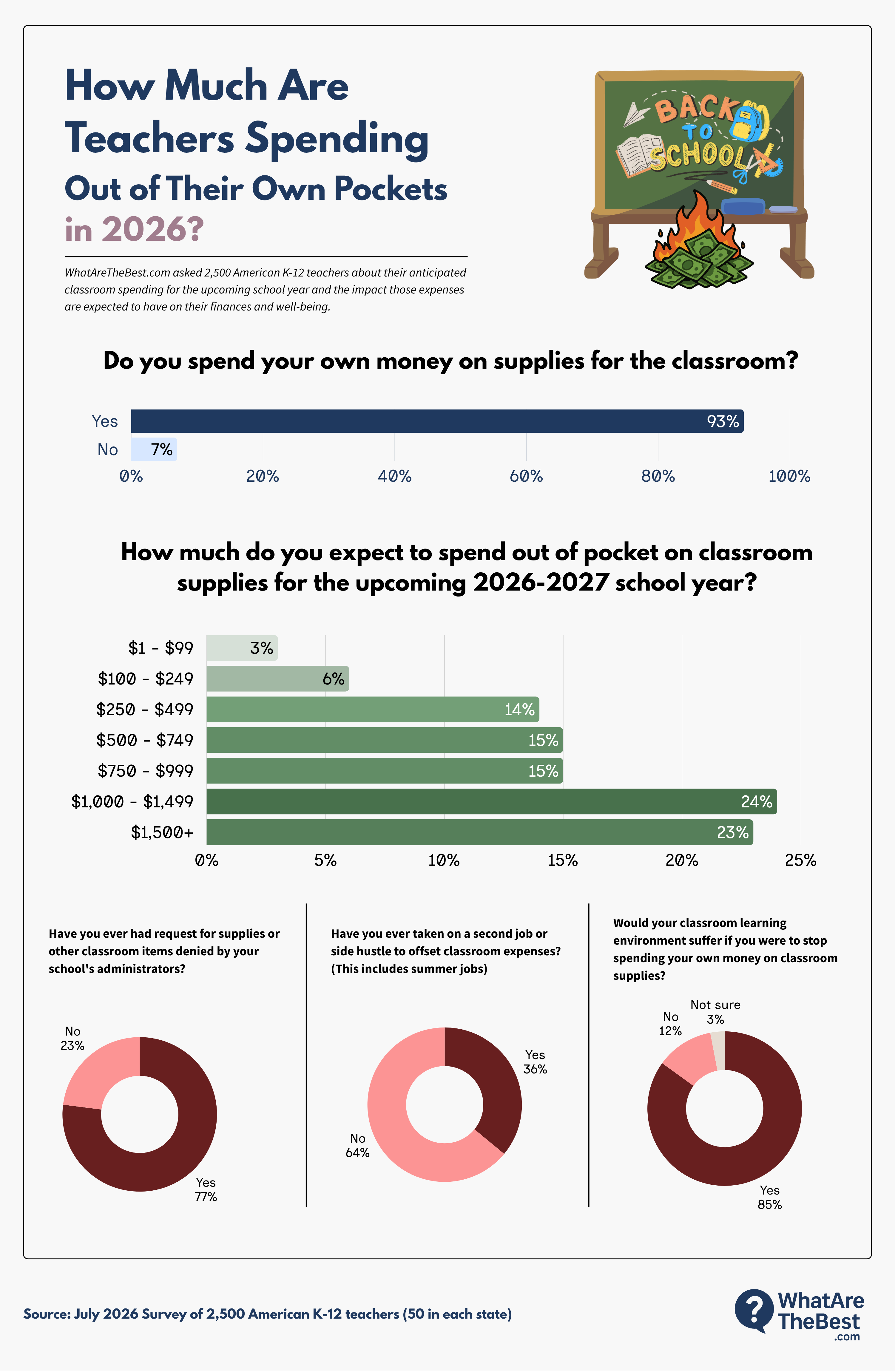
An incredible 93% of teachers spend their own money to create classrooms that are well-stocked, inviting, and ready for learning. That level of dedication is inspiring, and it has been a reality for years. But as classroom costs continue to increase, it's harder to accept a system that relies on teachers, regardless of income, to shoulder the financial burden.
So why do teachers keep opening their wallets every August, and throughout the school year? Because they know many of their students would go without if they didn't. In fact, 85% say their classrooms would suffer if they stopped spending their own money. That concern is understandable when 77% have had requests for basic classroom supplies denied by their administrators.
The Economic Policy Institute found the teacher pay penalty hit a record 26.9% in 2024, meaning teachers earn about 73 cents for every dollar paid to comparable college graduates, up from a gap of just 6.1% in 1996. At the same time, the cost of ordinary life has pulled away from the paycheck. The National Council on Teacher Quality reports that between 2019 and 2025, housing costs climbed 47% to 51% while beginning teacher salaries grew only 24%, about half the pace. Rent alone is up roughly 53% over the past decade according to Bureau of Labor Statistics data, and the NEA calculates that teacher pay is now about 5% lower in real terms than it was ten years ago. Teachers are absorbing a bigger classroom bill with a paycheck that buys less each year.
It would be one thing if teachers were only buying a few classroom basics like extra pens, pencils, or a bit of paper. But that's rarely the case. They're investing in a wide range of supplies, resources, and materials that make the classroom more engaging, supportive, and enriching for every student.
It's a remarkable level of generosity, and these numbers don't even capture all the little expenses that add up throughout the year. Think surprise pizza party to celebrate a milestone, supplies for an impromptu project, subscription fees, or countless other purchases that come with wanting students to enjoy learning and have what they need to succeed.
So, how much are teachers actually spending out of their own pockets? Here's the breakdown.
That burden is heavier than it used to be. Among teachers who were already in the classroom in 2021, most now say they are spending noticeably more out of pocket than they did five years ago:
A third of teachers (33%) put the increase at $250 to $499 a year, and 32% say it has climbed by $500 or more.
Teachers spending an average of $1,067 out of pocket each year is a testament to their commitment, but it also raises an important question about who should really be paying the price.
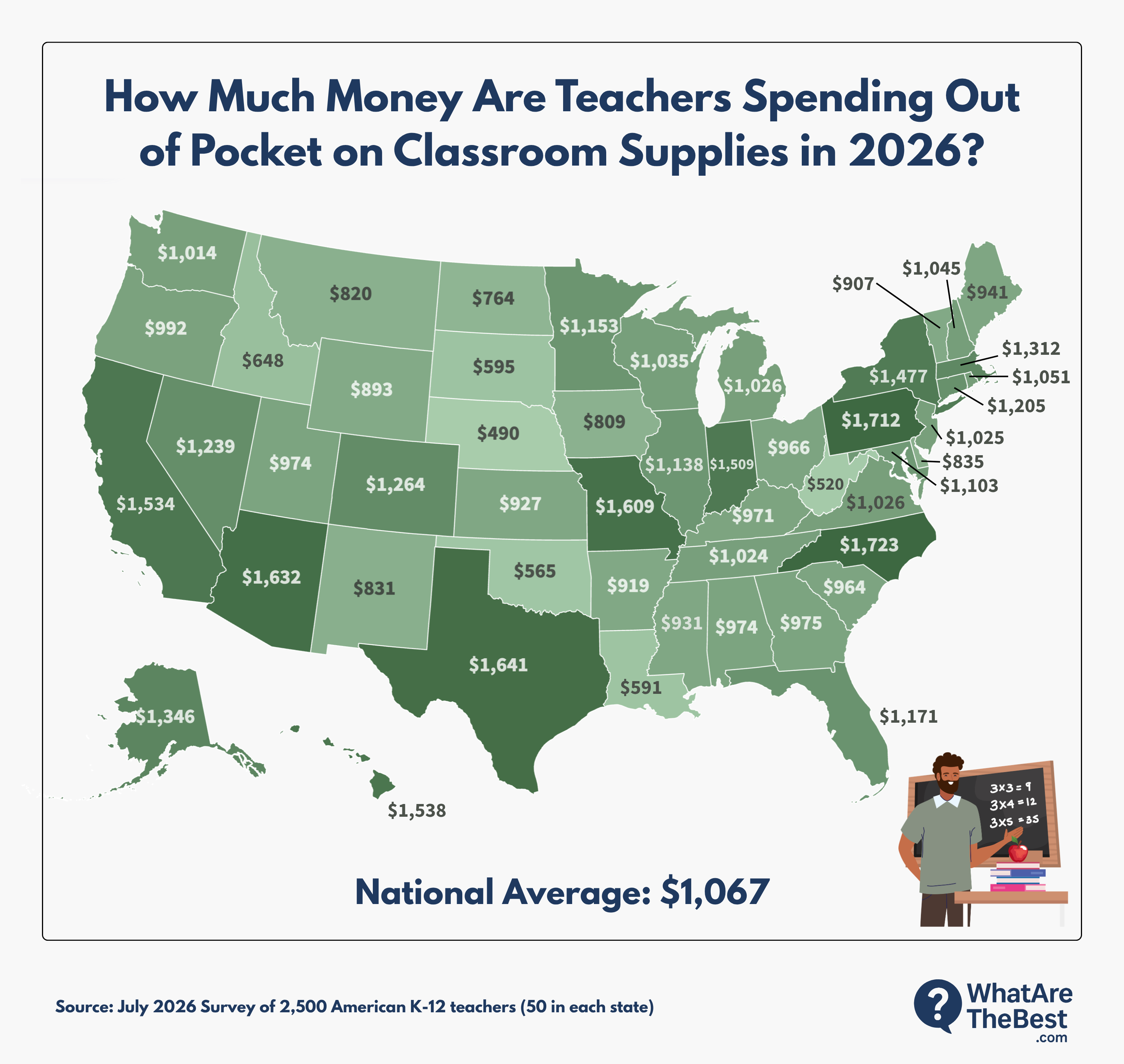
Teachers in North Carolina report the highest out-of-pocket spending in the country at $1,723, followed by Pennsylvania ($1,712), Texas ($1,641), Arizona ($1,632), and Missouri ($1,609).
At the other end, teachers in Nebraska spend the least at $490, followed by West Virginia ($520) and Oklahoma ($565).
Moms and dads are not only outfitting their own children; 18% say they have also spent their own money on supplies for their child's classroom or teacher, quietly topping up the same shortfall. And the strain is building: 79% of parents say back-to-school costs feel harder to afford than they did five years ago. Asked how much more they expect to spend this year than they did back in 2021, here is what parents who had a child in school at the time told us:
Parents spend an average of $844 per child each year on back-to-school shopping, covering everything from clothing and backpacks to classroom supplies and course-specific materials. Yes, parents, we see you too. Sending kids back to school is always a costly effort (whatever that cost happens to be), and the data shows just how much families typically budget for this annual event:
As with teachers' out-of-pocket spending, though, those costs aren't the same everywhere.
.png)
There is no quick fix for a pay gap or a rent curve, but there are smaller levers a shopper can still pull. When every dollar is stretched and a bad purchase means buying the same thing twice, checking reviews before you buy is one of the few things fully in a family's control. Reading what other shoppers actually experienced, comparing options, and skipping the items that disappoint will not close the gap, though it keeps more of a tight budget doing the work it was meant to do.
When a paycheck stops stretching, the shortfall goes somewhere. For many teachers, it goes onto a credit card. We learned 44% of teachers have gone into debt to cover classroom expenses through credit cards, buy-now-pay-later plans, or loans, and 36% have taken on a second job or side hustle to keep up. Parents are in the same bind: 46% have gone into debt to afford back-to-school, and 37% have picked up a second job or side hustle of their own.
Understanding these costs helps families plan ahead, whether by budgeting early, shopping sales, or finding other ways to stretch their dollars. At the end of the day, parents and teachers share the same goal: making sure children have the tools they need to succeed academically, socially, and emotionally.
That shared commitment is undeniable. Teachers continue to invest hundreds, and often thousands, of dollars of their own money to create welcoming, well-equipped classrooms, even as many struggle to secure adequate funding through traditional channels.
The solution cannot rest on their shoulders alone. The wide differences in spending across states point to a broader need for investment in schools and classroom resources. Recognizing the financial burden borne by both families and educators is the first step toward building a system where every student, regardless of where they live, has access to the opportunities and resources they deserve.
This survey was conducted in July 2026 across a pool of 2,500 American teachers (50 per state) and a pool of 2,500 American parents of school-age children (50 per state). The teacher pool was 70% women, 29% men, and 1% non-binary; the parent pool was 56% women, 43% men, and 1% non-binary. External figures on pay and cost of living are drawn from the Economic Policy Institute, the National Council on Teacher Quality, the National Education Association, and the Bureau of Labor Statistics.
If you'd like to share this data, you are welcome to utilize any of the information or graphics above for non-commercial use. Just make sure to include a linked attribution to this page in your article.
Media inquiries: albert@whatarethebest.com