Territory Mapping & Quota Planning Tools

These are the specialized categories within Territory Mapping & Quota Planning Tools. Looking for something broader? See all CRM & Sales Software categories.

1

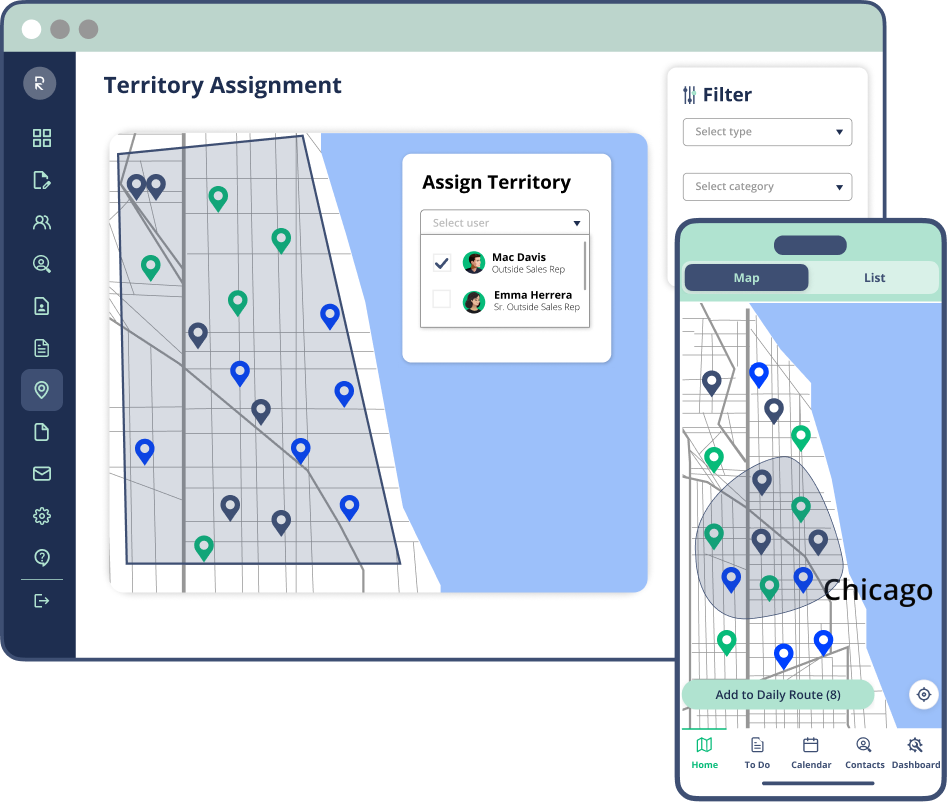
RepMove Territory Management

Best for Territory Management Tools for Field Sales Teams

Score
9.8 / 10
RepMove Territory Management

RepMove is a game-changer for field sales teams, providing them with an intuitive tool to manage sales territories. It transforms raw location data into a customized Google Map, offering a clear visualization of your sales territories in seconds. It's perfect for this industry as it helps professionals to plan, monitor, and make data-driven decisions.

Best for Territory Management Tools for Field Sales Teams

Expert Take

RepMove excels in providing field sales teams with a tailored solution for territory management, leveraging customized Google Map visualizations. Its intuitive interface and data-driven decision-making capabilities position it as a leading tool in its category, despite the lack of transparent pricing information.

Pros

  • Mobile-first design for field sales
  • Multi-stop route optimization included
  • Transparent and affordable pricing
  • Native integrations with Salesforce/HubSpot
  • High user satisfaction (4.9/5 G2)

Cons

  • 10,000 record limit on mid-tier
  • No public API documentation found
  • Steep learning curve for some
  • Occasional slow performance reported
  • Time-consuming initial data entry

Best for teams that are

  • Field sales teams wanting an easy-to-use, all-in-one mobile CRM and router
  • Sales leaders needing simple visibility into territories and pipelines
  • Teams needing a standalone solution that can also integrate with CRMs

Skip if

  • Enterprises requiring complex territory modeling and hierarchy management
  • Teams needing deep, native integration inside Salesforce (vs. bolt-on)
  • Office-based sales teams who don't need route optimization

Best for teams that are

  • Field sales teams wanting an easy-to-use, all-in-one mobile CRM and router
  • Sales leaders needing simple visibility into territories and pipelines
  • Teams needing a standalone solution that can also integrate with CRMs

Skip if

  • Enterprises requiring complex territory modeling and hierarchy management
  • Teams needing deep, native integration inside Salesforce (vs. bolt-on)
  • Office-based sales teams who don't need route optimization

Pros

  • Mobile-first design for field sales
  • Multi-stop route optimization included
  • Transparent and affordable pricing
  • Native integrations with Salesforce/HubSpot
  • High user satisfaction (4.9/5 G2)

Cons

  • 10,000 record limit on mid-tier
  • No public API documentation found
  • Steep learning curve for some
  • Occasional slow performance reported
  • Time-consuming initial data entry

Expert Take

RepMove excels in providing field sales teams with a tailored solution for territory management, leveraging customized Google Map visualizations. Its intuitive interface and data-driven decision-making capabilities position it as a leading tool in its category, despite the lack of transparent pricing information.

2
Score
9.8 / 10
2
9.8 / 10
Forma Architect

Forma Architect is a territory planning and quota management solution specifically designed for growing sales teams. It provides intelligent tools to balance workloads, align targets, and drive predictable growth with data-driven quota setting and territory planning. This is essential for industries where accurate sales forecasting and efficient territory management are key to successful revenue generation.

Best for Lightweight Territory and Quota Tools for Growing Teams

Expert Take

Forma Architect excels in providing data-driven insights for territory planning and quota management, crucial for growing sales teams. Its integration capabilities and market credibility are supported by third-party validations, making it a top choice in its category.

Pros

  • AI-driven 'Workload Index' for territory balancing
  • Real-time scenario modeling with financial impact
  • Unified territory planning and incentive execution
  • Automated ASC 606 compliance and audit trails
  • 200+ pre-built integrations with robust ETL

Cons

  • Steep learning curve for initial setup
  • Rigid custom reporting capabilities
  • No public pricing transparency
  • Complex implementations may require vendor support
  • Limited brand awareness compared to legacy giants

Best for teams that are

  • Mid-to-large enterprises with complex sales and incentive structures
  • Teams wanting to unify territory planning directly with incentive compensation

Skip if

  • Small businesses or startups with simple compensation needs
  • Organizations looking for a standalone mapping tool without incentive management

Best for teams that are

  • Mid-to-large enterprises with complex sales and incentive structures
  • Teams wanting to unify territory planning directly with incentive compensation

Skip if

  • Small businesses or startups with simple compensation needs
  • Organizations looking for a standalone mapping tool without incentive management

Pros

  • AI-driven 'Workload Index' for territory balancing
  • Real-time scenario modeling with financial impact
  • Unified territory planning and incentive execution
  • Automated ASC 606 compliance and audit trails
  • 200+ pre-built integrations with robust ETL

Cons

  • Steep learning curve for initial setup
  • Rigid custom reporting capabilities
  • No public pricing transparency
  • Complex implementations may require vendor support
  • Limited brand awareness compared to legacy giants

Expert Take

Forma Architect excels in providing data-driven insights for territory planning and quota management, crucial for growing sales teams. Its integration capabilities and market credibility are supported by third-party validations, making it a top choice in its category.

3

SPOTIO Territory Management

Best for Territory Management Tools for Field Sales Teams

Score
9.7 / 10
SPOTIO Territory Management

SPOTIO is a top-rated field sales engagement and territory management SaaS solution designed to boost revenue and maximize profitability for field sales teams. Its advanced features and intuitive interface cater specifically to the needs of sales reps and managers, seamlessly addressing the unique challenges of territory management in field sales.

Best for Territory Management Tools for Field Sales Teams

Expert Take

SPOTIO Territory Management is a leading solution for field sales teams, offering comprehensive features tailored to optimize territory management. Its strong market presence and specialized capabilities make it a top choice in its category, despite some limitations in pricing transparency and initial usability.

Pros

  • Visual territory hierarchies (Parent/Child)
  • SOC 2 Type II certified security
  • Native Salesforce 2-way sync
  • Route optimization (150 stops/route)
  • Mobile-first field interface

Cons

  • Pricing often hidden/gated
  • Reliance on Zapier for HubSpot
  • App sync issues reported
  • Contract renewal friction
  • No native order management

Best for teams that are

  • Door-to-door sales teams and canvassers (Solar, Roofing, Home Services)
  • Managers needing real-time tracking of rep location and knocking activity
  • Teams needing visual territory assignment for high-volume prospecting

Skip if

  • Pure B2B account management teams that do not canvas or knock doors
  • Teams needing complex route optimization for pre-set appointments
  • Enterprises needing deep, complex ERP integrations beyond standard connectors

Best for teams that are

  • Door-to-door sales teams and canvassers (Solar, Roofing, Home Services)
  • Managers needing real-time tracking of rep location and knocking activity
  • Teams needing visual territory assignment for high-volume prospecting

Skip if

  • Pure B2B account management teams that do not canvas or knock doors
  • Teams needing complex route optimization for pre-set appointments
  • Enterprises needing deep, complex ERP integrations beyond standard connectors

Pros

  • Visual territory hierarchies (Parent/Child)
  • SOC 2 Type II certified security
  • Native Salesforce 2-way sync
  • Route optimization (150 stops/route)
  • Mobile-first field interface

Cons

  • Pricing often hidden/gated
  • Reliance on Zapier for HubSpot
  • App sync issues reported
  • Contract renewal friction
  • No native order management

Expert Take

SPOTIO Territory Management is a leading solution for field sales teams, offering comprehensive features tailored to optimize territory management. Its strong market presence and specialized capabilities make it a top choice in its category, despite some limitations in pricing transparency and initial usability.

4

CARTO: Advanced GIS Platform

Best for Territory Management Tools with Mapping and Geo Intelligence

Score
9.7 / 10
CARTO: Advanced GIS Platform

CARTO is the go-to SaaS solution for professionals in the territory management industry. Its unparalleled geospatial analysis tools and mapping capabilities empower teams to visualize, analyze and make data-driven decisions. Importantly, it ensures your spatial data remains within your cloud, ensuring security and control.

Best for Territory Management Tools with Mapping and Geo Intelligence

Expert Take

CARTO excels as a 'best-of-the-best' product in the territory management industry due to its advanced geospatial analysis tools and secure cloud-based infrastructure. It is recognized for its scalability and ease of use, despite requiring some technical expertise for full utilization. The platform's capabilities are well-documented and supported by third-party validations.

Pros

  • Cloud-native architecture eliminates ETL
  • Seamless integration with Snowflake/BigQuery
  • Access to 10,000+ spatial datasets
  • SOC 2 Type II certified
  • Stunning deck.gl based visualizations

Cons

  • SQL skills needed for advanced use
  • Enterprise pricing is opaque
  • Performance lags on massive datasets
  • Documentation gaps for updates
  • Usage-based pricing can scale costs

Best for teams that are

  • Data scientists and developers building custom spatial applications
  • Enterprises requiring SQL-based analysis and complex data visualization
  • Industries like logistics and telecom needing heavy spatial data processing

Skip if

  • Non-technical sales managers looking for out-of-the-box territory mapping
  • Small businesses wanting a simple, no-code visual interface
  • Teams without internal data science or development resources

Best for teams that are

  • Data scientists and developers building custom spatial applications
  • Enterprises requiring SQL-based analysis and complex data visualization
  • Industries like logistics and telecom needing heavy spatial data processing

Skip if

  • Non-technical sales managers looking for out-of-the-box territory mapping
  • Small businesses wanting a simple, no-code visual interface
  • Teams without internal data science or development resources

Pros

  • Cloud-native architecture eliminates ETL
  • Seamless integration with Snowflake/BigQuery
  • Access to 10,000+ spatial datasets
  • SOC 2 Type II certified
  • Stunning deck.gl based visualizations

Cons

  • SQL skills needed for advanced use
  • Enterprise pricing is opaque
  • Performance lags on massive datasets
  • Documentation gaps for updates
  • Usage-based pricing can scale costs

Expert Take

CARTO excels as a 'best-of-the-best' product in the territory management industry due to its advanced geospatial analysis tools and secure cloud-based infrastructure. It is recognized for its scalability and ease of use, despite requiring some technical expertise for full utilization. The platform's capabilities are well-documented and supported by third-party validations.

5

Canidium Territory and Quota Planning

Best for Lightweight Territory and Quota Tools for Growing Teams

Score
9.7 / 10
Canidium Territory and Quota Planning

Canidium is a powerful SaaS solution that offers territory optimization and quota planning. It is designed specifically to balance workloads across sales territories and establish effective sales targets. Its tailored solutions help growing teams in the sales industry to boost efficiency and productivity.

Best for Lightweight Territory and Quota Tools for Growing Teams

Expert Take

Canidium Territory and Quota Planning is a specialized SaaS solution designed to optimize sales territories and quotas for growing teams. It excels in workload balancing and sales target setting, which are crucial for efficiency and productivity. The product's tailored approach for expanding sales teams positions it as a top choice in its category.

Pros

  • Tailored workload balancing for sales teams
  • Deep integration with SAP and Xactly
  • Comprehensive managed services and support
  • Focus on measurable ROI and revenue
  • Real-time data adaptation capabilities

Cons

  • Long implementation timeline (12-36 weeks)
  • No public pricing transparency
  • Dependent on third-party software ecosystems
  • Low volume of public user reviews
  • Complex setup for smaller organizations

Best for teams that are

  • Enterprises needing expert consulting to design and implement complex strategies
  • Organizations looking for managed services to implement tools like SAP or Varicent

Skip if

  • DIY users looking for an out-of-the-box, self-service software subscription
  • Small teams with limited budgets seeking a quick plug-and-play tool

Best for teams that are

  • Enterprises needing expert consulting to design and implement complex strategies
  • Organizations looking for managed services to implement tools like SAP or Varicent

Skip if

  • DIY users looking for an out-of-the-box, self-service software subscription
  • Small teams with limited budgets seeking a quick plug-and-play tool

Pros

  • Tailored workload balancing for sales teams
  • Deep integration with SAP and Xactly
  • Comprehensive managed services and support
  • Focus on measurable ROI and revenue
  • Real-time data adaptation capabilities

Cons

  • Long implementation timeline (12-36 weeks)
  • No public pricing transparency
  • Dependent on third-party software ecosystems
  • Low volume of public user reviews
  • Complex setup for smaller organizations

Expert Take

Canidium Territory and Quota Planning is a specialized SaaS solution designed to optimize sales territories and quotas for growing teams. It excels in workload balancing and sales target setting, which are crucial for efficiency and productivity. The product's tailored approach for expanding sales teams positions it as a top choice in its category.

6

eSpatial CRM Mapping

Best for Territory Alignment Tools Integrated with CRM

Score
9.7 / 10
eSpatial CRM Mapping

eSpatial CRM Mapping is a SaaS solution that provides detailed geographical visualization of CRM data. It's ideal for sales and revenue operations, enabling effective sales territory and quota management. Its integration capabilities with various CRM systems make it versatile and adaptable to various industry needs.

Best for Territory Alignment Tools Integrated with CRM

Expert Take

eSpatial CRM Mapping is a top-tier solution for sales territory and quota management, offering robust integration with CRM systems and advanced geographical visualization. Its capabilities in transforming CRM data into interactive maps make it a valuable tool for sales operations. Despite a learning curve, its comprehensive features justify its premium positioning.

Pros

  • Bi-directional Salesforce integration
  • ISO 27001:2022 security certified
  • Dedicated Customer Success Manager included
  • Advanced territory balancing tools
  • Transparent public pricing structure

Cons

  • High starting price ($1,495/yr)
  • System lagging with large data
  • Limited advanced GIS functions
  • Closed ecosystem for integrations
  • No monthly billing option

Best for teams that are

  • Mid-market to enterprise sales teams needing robust territory optimization
  • Users requiring strong route planning and optimization features
  • Organizations valuing high-touch, 'white glove' customer support

Skip if

  • Micro-businesses with minimal budgets
  • Users seeking a free or basic mapping tool for simple visualization
  • Teams not needing deep CRM integration or optimization features

Best for teams that are

  • Mid-market to enterprise sales teams needing robust territory optimization
  • Users requiring strong route planning and optimization features
  • Organizations valuing high-touch, 'white glove' customer support

Skip if

  • Micro-businesses with minimal budgets
  • Users seeking a free or basic mapping tool for simple visualization
  • Teams not needing deep CRM integration or optimization features

Pros

  • Bi-directional Salesforce integration
  • ISO 27001:2022 security certified
  • Dedicated Customer Success Manager included
  • Advanced territory balancing tools
  • Transparent public pricing structure

Cons

  • High starting price ($1,495/yr)
  • System lagging with large data
  • Limited advanced GIS functions
  • Closed ecosystem for integrations
  • No monthly billing option

Expert Take

eSpatial CRM Mapping is a top-tier solution for sales territory and quota management, offering robust integration with CRM systems and advanced geographical visualization. Its capabilities in transforming CRM data into interactive maps make it a valuable tool for sales operations. Despite a learning curve, its comprehensive features justify its premium positioning.

7

Esri Sales Territory Optimization

Best for Territory Management Tools with Mapping and Geo Intelligence

Score
9.7 / 10
Esri Sales Territory Optimization

Esri's Sales Territory Optimization software is a powerful tool specifically designed for the manufacturing industry. The software taps into the location elements of existing data, allowing businesses to visualize how sales are distributed across product lines, territories, and channels. This helps companies identify underperforming territories and realign their resources effectively.

Best for Territory Management Tools with Mapping and Geo Intelligence

Expert Take

Esri Sales Territory Optimization excels in providing location intelligence and mapping capabilities tailored for the manufacturing industry. Its integration with existing data sources and ability to visualize sales distribution make it a standout tool. While it offers significant strategic benefits, its enterprise pricing and technical requirements may limit accessibility for smaller businesses.

Pros

  • Automated territory balancing algorithms
  • Access to 15,000+ demographic variables
  • Advanced barrier and constraint handling
  • Global data coverage (135+ countries)
  • Seamless integration with ArcGIS ecosystem

Cons

  • Steep learning curve for non-GIS users
  • Complex credit-based pricing model
  • Requires high-performance hardware
  • Occasional stability issues in new releases
  • Expensive for small businesses

Best for teams that are

  • Manufacturing and supply chain organizations needing complex network visualization
  • Enterprises already invested in the Esri ArcGIS ecosystem
  • Operations leaders requiring data-driven territory realignment for fluctuating markets

Skip if

  • Small businesses with simple, static territory lists
  • Sales teams without access to GIS technical expertise or analysts
  • Users seeking a standalone, lightweight mobile CRM app

Best for teams that are

  • Manufacturing and supply chain organizations needing complex network visualization
  • Enterprises already invested in the Esri ArcGIS ecosystem
  • Operations leaders requiring data-driven territory realignment for fluctuating markets

Skip if

  • Small businesses with simple, static territory lists
  • Sales teams without access to GIS technical expertise or analysts
  • Users seeking a standalone, lightweight mobile CRM app

Pros

  • Automated territory balancing algorithms
  • Access to 15,000+ demographic variables
  • Advanced barrier and constraint handling
  • Global data coverage (135+ countries)
  • Seamless integration with ArcGIS ecosystem

Cons

  • Steep learning curve for non-GIS users
  • Complex credit-based pricing model
  • Requires high-performance hardware
  • Occasional stability issues in new releases
  • Expensive for small businesses

Expert Take

Esri Sales Territory Optimization excels in providing location intelligence and mapping capabilities tailored for the manufacturing industry. Its integration with existing data sources and ability to visualize sales distribution make it a standout tool. While it offers significant strategic benefits, its enterprise pricing and technical requirements may limit accessibility for smaller businesses.

8

Varicent Territory Planning

Best for Lightweight Territory and Quota Tools for Growing Teams

Score
9.7 / 10
Varicent Territory Planning

Varicent's Territory Planning Software is a data-driven solution for designing balanced territories, perfect for sales teams looking to maximize each rep's potential. It is designed to address the needs of growing teams in the sales industry, with a focus on maximizing revenue and sales enablement.

Best for Lightweight Territory and Quota Tools for Growing Teams

Expert Take

Varicent Territory Planning excels in providing data-driven solutions for sales territory management, making it a top choice for growing sales teams. Its advanced analytics and intuitive interface are well-documented, supporting its premium positioning. While onboarding is required, the platform's capabilities justify its use for maximizing sales potential.

Pros

  • Leader in Forrester Wave Q1 2025
  • Advanced AI modeling via Symon.AI
  • ISO 27001 and SOC 2 certified
  • Native Salesforce & Snowflake connectors
  • Handles complex territory hierarchies

Cons

  • Pricing is expensive and opaque
  • Steep learning curve for backend
  • Slow performance with large datasets
  • Implementation often requires consultants
  • Complex configuration for admins

Best for teams that are

  • Large enterprises requiring a robust, integrated Sales Performance Management suite
  • Teams managing complex, matrixed territory hierarchies and data sources

Skip if

  • Small businesses with simple territory lists
  • Users seeking a lightweight, standalone tool without broader SPM infrastructure

Best for teams that are

  • Large enterprises requiring a robust, integrated Sales Performance Management suite
  • Teams managing complex, matrixed territory hierarchies and data sources

Skip if

  • Small businesses with simple territory lists
  • Users seeking a lightweight, standalone tool without broader SPM infrastructure

Pros

  • Leader in Forrester Wave Q1 2025
  • Advanced AI modeling via Symon.AI
  • ISO 27001 and SOC 2 certified
  • Native Salesforce & Snowflake connectors
  • Handles complex territory hierarchies

Cons

  • Pricing is expensive and opaque
  • Steep learning curve for backend
  • Slow performance with large datasets
  • Implementation often requires consultants
  • Complex configuration for admins

Expert Take

Varicent Territory Planning excels in providing data-driven solutions for sales territory management, making it a top choice for growing sales teams. Its advanced analytics and intuitive interface are well-documented, supporting its premium positioning. While onboarding is required, the platform's capabilities justify its use for maximizing sales potential.

9
Score
9.7 / 10
9
9.7 / 10
Veeva Vault Align

Specifically designed for life sciences, Veeva Vault Align offers a comprehensive solution for field planning, including roster management, territory assignment, and engagement plans. Its integration with CRM systems allows for seamless data flow, ensuring accurate, up-to-date information for strategic decision-making.

Best for Territory Alignment Tools Integrated with CRM

Expert Take

Veeva Vault Align excels as a specialized tool for the life sciences industry, offering robust integration with CRM systems and comprehensive field planning capabilities. Its market credibility is supported by industry-specific features and third-party recognition, making it a top choice for territory alignment in this sector.

Pros

  • Reduces territory alignment time by up to 75%
  • Native seamless integration with Veeva CRM
  • Integrated Territory Feedback for direct rep input
  • Full GDPR and 21 CFR Part 11 compliance
  • Scalable for global enterprise deployments

Cons

  • High licensing and implementation costs
  • Integration jobs interrupted during maintenance windows
  • Steep learning curve for administrators
  • Pricing is not publicly disclosed
  • Sync errors possible with high data volumes

Best for teams that are

  • Life sciences and pharmaceutical companies managing field forces
  • Organizations already using the Veeva Vault CRM ecosystem
  • Teams needing strict compliance, roster management, and engagement planning

Skip if

  • Companies outside the life sciences or pharmaceutical industries
  • Small businesses looking for a generic, low-cost mapping tool
  • Sales teams not utilizing Veeva CRM

Best for teams that are

  • Life sciences and pharmaceutical companies managing field forces
  • Organizations already using the Veeva Vault CRM ecosystem
  • Teams needing strict compliance, roster management, and engagement planning

Skip if

  • Companies outside the life sciences or pharmaceutical industries
  • Small businesses looking for a generic, low-cost mapping tool
  • Sales teams not utilizing Veeva CRM

Pros

  • Reduces territory alignment time by up to 75%
  • Native seamless integration with Veeva CRM
  • Integrated Territory Feedback for direct rep input
  • Full GDPR and 21 CFR Part 11 compliance
  • Scalable for global enterprise deployments

Cons

  • High licensing and implementation costs
  • Integration jobs interrupted during maintenance windows
  • Steep learning curve for administrators
  • Pricing is not publicly disclosed
  • Sync errors possible with high data volumes

Expert Take

Veeva Vault Align excels as a specialized tool for the life sciences industry, offering robust integration with CRM systems and comprehensive field planning capabilities. Its market credibility is supported by industry-specific features and third-party recognition, making it a top choice for territory alignment in this sector.

10

Linen Territory Management

Best for Territory Alignment Tools Integrated with CRM

Score
9.6 / 10
Linen Territory Management

A cloud-based territory management software that seamlessly integrates with popular CRMs like Salesforce and Hubspot. It's designed to help sales professionals build, maintain, and adjust sales territories based on their specific variables, thus optimizing sales and revenue.

Best for Territory Alignment Tools Integrated with CRM

Expert Take

Linen Territory Management excels in integrating with popular CRM systems, offering robust territory management capabilities tailored to sales variables. Its market credibility is supported by integration with leading platforms like Salesforce and Hubspot, although pricing transparency is limited due to the enterprise model. The product's usability is enhanced by its CRM integration, but setup may require time.

Pros

  • Native Salesforce integration with one-click publish
  • No-code framework for easy rule adjustments
  • AI-driven continuous territory optimization
  • Proven scalability with Fortune 500 clients
  • Drastic reduction in planning cycle time

Cons

  • Limited public pricing for enterprise modules
  • Fewer third-party reviews than legacy competitors
  • Brand confusion with 'Linen Tech' laundry software
  • Requires annual plan for hierarchy management
  • Niche focus on complex enterprise needs

Best for teams that are

  • Sales Ops teams aligning territories with quotas and compensation
  • Salesforce or HubSpot users wanting a no-code, drag-and-drop interface
  • Companies needing to manage complex sales hierarchies

Skip if

  • Field reps primarily needing route optimization and navigation
  • Small businesses without complex quota or compensation planning needs
  • Teams not using Salesforce or HubSpot for CRM

Best for teams that are

  • Sales Ops teams aligning territories with quotas and compensation
  • Salesforce or HubSpot users wanting a no-code, drag-and-drop interface
  • Companies needing to manage complex sales hierarchies

Skip if

  • Field reps primarily needing route optimization and navigation
  • Small businesses without complex quota or compensation planning needs
  • Teams not using Salesforce or HubSpot for CRM

Pros

  • Native Salesforce integration with one-click publish
  • No-code framework for easy rule adjustments
  • AI-driven continuous territory optimization
  • Proven scalability with Fortune 500 clients
  • Drastic reduction in planning cycle time

Cons

  • Limited public pricing for enterprise modules
  • Fewer third-party reviews than legacy competitors
  • Brand confusion with 'Linen Tech' laundry software
  • Requires annual plan for hierarchy management
  • Niche focus on complex enterprise needs

Expert Take

Linen Territory Management excels in integrating with popular CRM systems, offering robust territory management capabilities tailored to sales variables. Its market credibility is supported by integration with leading platforms like Salesforce and Hubspot, although pricing transparency is limited due to the enterprise model. The product's usability is enhanced by its CRM integration, but setup may require time.

How We Rank Products

Our Evaluation Process

Products in the Sales Territory & Quota Management Tools category are evaluated based on documented features like territory mapping, quota setting functionalities, and analytics capabilities. Pricing transparency and the scope of available integrations with other CRM and sales software are critical considerations. Additionally, third-party customer feedback provides insights into user satisfaction and tool effectiveness, aiding in the decision-making process.

Verification

  • Products evaluated through comprehensive research and analysis of sales performance metrics.
  • Selection criteria focus on features such as quota tracking efficiency and user interface design.
  • Comparison methodology analyzes customer feedback and expert reviews to determine top-rated tools.

Score Breakdown

0.0 / 10

About Territory Mapping & Quota Planning Tools

What Is Territory Mapping & Quota Planning Tools?

Territory Mapping and Quota Planning Tools form a specialized category of sales performance management software designed to optimize the allocation of market potential across a sales organization. Unlike Customer Relationship Management (CRM) systems, which record transactional data and individual interactions, or Incentive Compensation Management (ICM) systems, which calculate payouts after the fact, this category focuses on the strategic design and distribution of the addressable market. It sits squarely between the "strategy" phase of sales planning and the "execution" phase of CRM.

This software category covers the full lifecycle of territory and quota construction: ingesting market data, segmenting accounts based on logic (geography, vertical, revenue band), visualizing coverage gaps on geospatial maps, assigning fair and equitable quotas based on historical velocity and future potential, and deploying these targets to the field. It includes both general-purpose platforms suitable for broad B2B sales and vertical-specific tools tailored for complex field sales networks in industries like pharmaceuticals, consumer goods, and financial services.

The core problem these tools solve is the inefficiency and inequality of manual sales planning. Without dedicated software, organizations rely on static spreadsheets and intuition, leading to unbalanced territories where some representatives starve while others leave revenue on the table due to lack of capacity. By digitizing this process, businesses ensure that every dollar of quota is backed by empirical market potential, maximizing revenue capture and minimizing sales force attrition due to perceived unfairness.

History of the Category

The evolution of Territory Mapping and Quota Planning tools tracks the broader shift in enterprise software from static systems of record to dynamic systems of intelligence. In the 1990s, territory planning was largely a manual exercise dominated by mainframe exports and physical maps. Sales operations leaders would print customer lists from early contact management databases and literally draw lines on wall-mounted maps with markers. The digital equivalent was the early spreadsheet—a tool that, while flexible, lacked any spatial awareness or dynamic link to the underlying data. The primary "gap" that birthed this category was the inability of early CRM and ERP systems to handle the complex, "what-if" scenario modeling required to carve up a market equitably.

The late 1990s and early 2000s saw the emergence of desktop-based Geographic Information Systems (GIS) adapted for business use. These were powerful but clunky, requiring specialized analysts to operate. They allowed for the first true digital visualizations of sales data but remained disconnected from the daily workflow of the sales rep [1]. The market began to shift significantly with the rise of vertical SaaS and the cloud revolution in the late 2000s. As CRM moved to the cloud, buyers began to demand that their planning tools live where their data lived. This killed off many legacy desktop mapping applications and gave rise to browser-based solutions that could sync changes instantly.

Recent market consolidation waves have further shaped the landscape. Large Sales Performance Management (SPM) suites began acquiring standalone territory and quota niche players to create end-to-end "planning-to-payment" platforms. Simultaneously, CRM giants expanded their native capabilities, forcing standalone vendors to pivot toward deep, specialized intelligence. Today, buyer expectations have evolved from "give me a database of zip codes" to "give me actionable intelligence." Modern buyers expect tools not just to display data, but to recommend optimal territory splits using predictive algorithms, marking the transition from simple mapping to strategic revenue optimization [2].

What to Look For

When evaluating Territory Mapping and Quota Planning software, buyers must look beyond basic visualization features. The market is saturated with tools that can put pins on a map; the differentiator is the ability to handle complex logic and bi-directional data flow. Critical evaluation criteria should center on the tool's "scenario modeling" capabilities. Can the system run multiple parallel "what-if" scenarios without affecting the live production environment? A robust tool must allow operations teams to model a 10% headcount reduction or a merger with a competitor and instantly see the impact on quota coverage and travel time.

Another vital area is attribute-based balancing. While legacy tools rely heavily on geography (zip codes), modern sales organizations often carve territories based on non-spatial attributes like industry vertical, company revenue, or technician skill set. The software must be able to balance territories using weighted scores that combine these variables—for example, creating a territory that contains "50 high-value healthcare accounts" rather than just "all of Chicago." [3].

Red flags and warning signs often appear in the integration capabilities. Be wary of vendors who promise "seamless integration" but rely on flat-file CSV uploads for data transfer. In a high-velocity sales environment, data stale by even a week can lead to conflict when two reps claim the same account. A system that does not support API-based, scheduled, or real-time sync with your CRM is a significant liability. Furthermore, avoid tools that lack hierarchy management. If a tool cannot easily handle parent-child account relationships (ensuring a subsidiary is in the same territory as its headquarters), it will fail in enterprise environments.

Key questions to ask vendors include: "How does your system handle exception management when a rep leaves mid-year?" "Can we lock specific named accounts while auto-optimizing the rest of the territory?" and "Does the quota planning module support top-down, bottom-up, and hybrid planning methodologies simultaneously?"

Industry-Specific Use Cases

Retail & E-commerce

In the retail and e-commerce sector, territory mapping is less about assigning salespeople to leads and more about optimizing physical footprint and logistics. These businesses use mapping tools to define catchment areas—the geographic sphere from which a store draws the majority of its customers [4]. The evaluation priority here is heavily weighted toward demographic data enrichment. A capable tool must overlay external datasets—such as household income, population density, and competitor locations—over internal sales data. This allows planners to identify "cannibalization zones" where a new store might steal revenue from an existing one, rather than capturing net new market share. For e-commerce specifically, these tools help align last-mile delivery territories to balance driver workload, ensuring that delivery quotas are achievable based on drive-time analysis rather than simple straight-line distance.

Healthcare

The healthcare sector, particularly medical device and pharmaceutical sales, requires a unique approach centered on referral patterns and point-of-care coverage. Unlike standard B2B sales, the "customer" (a patient or prescribing doctor) often moves between facilities. Territory tools here must track affiliations—mapping how a physician splits time between a private clinic and a major hospital system [5]. Evaluation priorities include the ability to ingest complex third-party data sources (like prescription volume data) and handle strict compliance boundaries. A critical consideration is ensuring that territory alignments do not violate anti-kickback statutes or internal compliance rules regarding representative rotation. Tools must support "teams-based" coverage where a clinical specialist and a sales rep share a territory but have different quotas and activity targets.

Financial Services

In financial services, territory planning focuses on managing a book of business rather than pure geographic prospecting. Wealth management and insurance firms use these tools to ensure that advisors are not hoarding accounts they cannot service. The software must analyze "wallet share"—the percentage of a client's total assets managed by the firm—and identify under-penetrated territories [6]. A unique need in this industry is the handling of "orphaned accounts." When an advisor retires, their book must be redistributed immediately to prevent client attrition. Financial services buyers prioritize tools with robust succession planning workflows that can automatically carve up a departing advisor's territory and distribute it to peers based on capacity and certification levels (e.g., ensuring a rep has the right licenses to sell in a specific state).

Manufacturing

Manufacturing sales territories are often complex hybrids of direct sales teams and third-party distributor networks. The primary use case here is channel conflict management. Manufacturers need tools that can map not only their own reps but also the coverage areas of their distributors to spot white space or overlap [7]. If a distributor covers the Midwest, the direct team must be blocked from prospecting there to maintain partner relationships. Evaluation priorities include "partner portal" capabilities, where distributors can view their assigned territories, and "supply chain alignment," where sales territories are mapped against warehouse locations to minimize shipping costs and lead times. The tool must be able to visualize the physical flow of goods alongside the flow of deals.

Professional Services

For law firms, consulting agencies, and accounting firms, territory planning is often about relationship mapping and conflict of interest avoidance rather than geographic conquest. "Territories" in this context are often defined by industry vertical or named accounts (e.g., "The Global Banking Practice"). Tools must integrate deeply with CRM to map the "who knows who" web of relationships. A unique consideration is conflict checking—ensuring that assigning a partner to a new client in the Energy sector doesn't create a conflict with an existing client in the same territory [8]. Workflows here emphasize collaborative planning, allowing multiple partners to negotiate account ownership within the tool to ensure that the firm's best resources are aligned with its highest-potential clients.

Subcategory Overview

Lightweight Territory and Quota Tools for Growing Teams

This subcategory serves small to mid-sized businesses that are graduating from spreadsheets but do not yet require enterprise-grade governance. What makes this niche genuinely different is its focus on speed of deployment and visualization over complex logic. These tools often lack deep integration capabilities or hierarchical permission structures but excel at drag-and-drop interface design. A workflow that only this specialized tool handles well is the "rapid rebalance"—a sales manager can pull up a map, circle a group of pins with a lasso tool, and drag them to a new rep's bucket in seconds during a weekly meeting. The specific pain point driving buyers here is administrative overhead; they want to avoid the multi-month implementation cycles of enterprise platforms. For a deeper look, consult our guide to Lightweight Territory and Quota Tools for Growing Teams.

Territory Alignment Tools Integrated with CRM

This niche is defined by its architectural dependency: these tools often live inside the CRM (like Salesforce native apps) rather than syncing with it. This distinction makes them genuinely different because they share the same data schema and security model as the CRM, eliminating the need for complex API maintenance. A workflow that only these tools handle well is the real-time routing trigger. When a lead is created in the CRM, these tools can instantly check the territory logic and assign ownership without a sync delay. Buyers choose this niche to solve the pain point of data latency and "swivel-chair" management—they want their operations team to work in the same environment as their sellers. Explore more in our breakdown of Territory Alignment Tools Integrated with CRM.

Territory Management Tools for Field Sales Teams

These tools are purpose-built for the "road warrior." They differ from generic tools by prioritizing mobile-first experiences and logistics over desktop planning. While a generic tool focuses on annual planning, these tools focus on daily execution. A workflow unique to this niche is route density optimization: the tool not only defines the territory but automatically sequences the rep's daily appointments to minimize windshield time and maximize face-to-face visits. The driving pain point here is operational inefficiency in the field—buyers invest in these tools because their reps are spending more time driving than selling. Learn more about these specific solutions in our guide to Territory Management Tools for Field Sales Teams.

Territory Management Tools with Mapping and Geo Intelligence

This subcategory represents the high-end analytical tier of the market. What sets it apart is the inclusion of proprietary external datasets—these vendors don't just map your data; they sell you data about the world (traffic patterns, weather, detailed census demographics). A workflow exclusive to this group is white space discovery based on lookalike modeling. The tool can analyze a high-performing territory and scan the entire country to find geographically similar regions that are currently unassigned. Buyers move to this niche when they hit the pain point of market saturation; they have squeezed all efficiency out of their current data and need external intelligence to find growth. See our detailed review of Territory Management Tools with Mapping and Geo Intelligence.

Integration & API Ecosystem

In the modern sales stack, a territory planning tool that stands alone is a liability. The strength of a tool’s Integration & API Ecosystem determines whether your territory plan is a living strategy or a static snapshot. Enterprise buyers must prioritize bi-directional synchronization—the ability to not only pull historical data from a CRM but to push complex territory definitions and split-credit logic back into it. According to research by the Aberdeen Group, companies with strong sales and marketing alignment—underpinned by integrated data systems—achieve 32% higher revenue growth [9]. The ecosystem must also extend beyond CRM to ERP (for revenue actuals) and HRIS (for headcount planning).

Experts warn against the hidden costs of poor integration. As noted by industry analysts, "API limits are the silent killer of real-time territory management." A specific scenario illustrating this involves a 50-person professional services firm using a CRM-integrated planning tool. If the integration is poorly designed, a bulk update of 5,000 account assignments at the start of a quarter might trigger API rate limits [10]. This causes the sync to fail silently, leaving half the sales team with the old territory map while the other half sees the new one. The result is "commission chaos," where reps close deals they no longer own, leading to payment disputes and hours of manual reconciliation by finance.

Security & Compliance

Security in territory planning is no longer just about password protection; it is about Data Residency and Governance. As territory tools ingest sensitive customer data—addresses, revenue figures, and sometimes patient health information—they fall under the scope of GDPR, CCPA, and HIPAA. A critical evaluation criterion is whether the vendor allows you to define where your data physically resides. For global teams, this is non-negotiable. Research indicates that data residency requirements are becoming a primary driver for software selection in the EU, with strict limitations on cross-border data transfers [11].

Consider a multinational financial services company planning territories for advisors in Europe and North America. They select a US-based tool that does not offer EU data hosting. When they attempt to upload their German client list to optimize territories, they violate GDPR data localization mandates, risking fines of up to 4% of global turnover [12]. Beyond regulation, internal compliance is equally vital. "Ethical walls" features are necessary to ensure that a rep covering "Competitor A" cannot see the territory data or pricing strategy for "Competitor B," a common requirement in consulting and investment banking.

Pricing Models & TCO

Pricing for territory mapping tools has shifted from perpetual licenses to complex SaaS models, making Total Cost of Ownership (TCO) harder to calculate. The two dominant models are "per user" (seat-based) and "per record" (consumption-based). While per-user pricing seems predictable, it often hides the cost of "viewer" licenses—stakeholders who need to see the map but not edit it. Conversely, per-record pricing can skyrocket as your database grows. Gartner analysis suggests that SaaS costs are growing "without control" in many organizations due to decentralized purchasing and hidden consumption metrics [13].

To visualize this, let's walk through a TCO calculation for a hypothetical 25-person sales team.

  • Scenario A (Per-Seat): Vendor charges $75/user/month. Calculation: $75 * 25 users * 12 months = $22,500/year. Hidden Cost: The VP of Sales and 5 regional directors need "Admin" access at $150/month ($4,500 extra), plus a required "Success Package" for implementation ($5,000). Total Year 1: $32,000.
  • Scenario B (Per-Record): Vendor charges $500/month for up to 10,000 records. The team has 8,000 accounts today. However, they buy a lead list of 5,000 prospects in Q2, pushing them to 13,000 records. This triggers a tier jump to $1,000/month. Hidden Cost: Geocoding fees. The vendor charges $0.01 per address verification after the first 1,000. For 13,000 records, that's an extra $120 one-time fee every quarter they refresh data. Total Year 1: $13,500 approx., but highly variable.
For a stable team, Scenario A is safer. For a high-growth data environment, Scenario B introduces unpredictable variance that can wreck a budget.

Implementation & Change Management

The most common cause of failure in territory planning software is not technical bugs, but cultural rejection. Sales representatives are notoriously protective of their patches; shifting a zip code from Rep A to Rep B is often perceived as "taking money out of my pocket." Successful implementation requires a strategy of transparency. According to the Alexander Group, thoughtfully designing and optimizing sales territories can realize productivity increases of 10–20%, but only if the field adopts the new plan [14].

A concrete example of failure occurs when a company rolls out a new AI-driven territory map without explaining the "why." Imagine a manufacturing firm that uses a "black box" algorithm to reassign territories. A senior rep who has cultivated relationships in a specific county for 10 years suddenly loses it because the algorithm flagged it as "inefficient drive time." Without a change management process—specifically, a "Ranger Rep" program where senior sellers are involved in the pilot phase—the rep may quit, taking their institutional knowledge and relationships to a competitor [15]. Effective implementation involves a "soft launch" period where reps can challenge the data before it becomes official policy.

Vendor Evaluation Criteria

When selecting a vendor, buyers must evaluate the Scalability of Logic. Many tools function beautifully with 50 territories but crumble under the weight of 500 complex hierarchies. Evaluation must focus on the "Rule Engine." Can the system handle complex "if/then" logic? (e.g., "Assign to Rep A IF zip code is 90210 AND revenue > $1M, UNLESS industry is Healthcare, then assign to Specialist B"). Simple mapping tools fail this test.

Expert analysts at Gartner emphasize that organizations must adopt a "structured approach to adaptive decision making," moving away from static plans [16]. In practice, this means testing the vendor's support for hierarchy changes. Ask the vendor to demonstrate a "reorg scenario." Give them a dataset and ask: "Show me how your tool handles splitting the 'Northeast' region into 'New England' and 'Mid-Atlantic' while preserving historical quota attainment data for year-over-year reporting." If the vendor says "you'd need to export to Excel and re-import," that is a disqualifying red flag for enterprise teams.

Emerging Trends and Contrarian Take

Emerging Trends 2025-2026: The next frontier is the rise of Agentic AI in Territory Management. We are moving beyond "predictive" tools (which suggest a territory split) to "autonomous" agents. These AI agents will monitor territory health in real-time and automatically propose micro-adjustments—like moving a set of neglected accounts to a rep with excess capacity—requiring only a manager's one-click approval. Another trend is the convergence of Territory Planning with Revenue Intelligence. Instead of just mapping "potential," tools will overlay "conversation intelligence" data (e.g., call sentiment analysis) to heat-map territories based on engagement quality, not just demographics [17].

Contrarian Take: The concept of the "Annual Territory Plan" is a relic that is actively harming sales organizations. Most businesses would get more ROI from scrapping the Q4 planning marathon entirely and shifting to a Continuous Planning Model. The market shifts too fast for a plan locked in January to be relevant in June. Companies obsessed with "locking" territories for 12 months are prioritizing administrative comfort over revenue reality. The highest-performing teams of the future will treat territories as liquid assets, rebalanced quarterly or even monthly based on real-time triggers, rather than static fiefdoms protected by tradition [18].

Common Mistakes

The most pervasive mistake is Over-Optimizing for Equity at the Expense of Continuity. Sales ops leaders often obsess over making every territory mathematically equal in potential (e.g., every rep gets exactly $1M in pipeline). While fair on paper, this often necessitates dissecting existing relationships. Disrupting a strong client-rep relationship to balance a spreadsheet is a net loss for the business. Stability often outperforms theoretical optimization.

Another major error is Ignoring "Windshield Time" in Virtual Sales. Even inside sales teams have a "virtual commute"—the mental switching cost of jumping between time zones and industries. Assigning a rep a "patchwork" territory of accounts scattered across four time zones destroys productivity, even if they never leave their desk. Failing to account for the logistics of attention is a critical oversight. Finally, buyers often mistake Visualization for Planning. Buying a tool that makes pretty heat maps is useless if it lacks the workflow engine to effectively communicate and enforce those maps in the CRM. A map is a picture; a plan is a process.

Questions to Ask in a Demo

  • "Can you show me the exact workflow for handling a mid-year rep departure and splitting their territory among three peers?" (Watch for how many clicks/screens this takes).
  • "How does your system handle 'parent-child' account hierarchies where the HQ is in one territory and the subsidiary is in another?" (This reveals if they truly understand B2B complexity).
  • "Does the geocoding engine charge extra for verifying addresses, and what happens if an address is ambiguous?" (Checks for hidden costs and data quality features).
  • "Can we create 'overlay' territories for product specialists that sit on top of geographic territories without double-counting revenue?" (Essential for matrixed organizations).
  • "Show me how a rep disputes a quota or territory assignment within the tool." (Tests the collaboration/workflow capabilities).

Before Signing the Contract

Final Decision Checklist: Ensure the tool supports your specific "Fiscal Year" structure (e.g., 4-4-5 calendars). Verify that the vendor has documented distinct "Sandbox" and "Production" environments to prevent planning accidents from impacting live sales data. Check the Service Level Agreement (SLA) for support during "crunch times"—specifically the end of Q4 when your team will be scrambling to finalize plans for the new year.

Common Negotiation Points: Negotiate the definition of a "User." Vendors often push for licenses for everyone who views a map. Push for a "Viewer" class license that is free or deeply discounted, paying full price only for the Ops planners. Also, negotiate the "Data Storage" limits. If the tool charges by record count, ensure the contract creates a buffer for "lead spikes" (e.g., after a trade show) so you aren't hit with overage fees for temporary data.

Deal-Breakers to Watch For: If the vendor cannot provide a verified reference from a customer with a similar data volume (not just similar industry), walk away. A tool that works for 1,000 accounts may crash with 100,000. Additionally, lack of SSO (Single Sign-On) support is a security deal-breaker for any modern enterprise. Finally, if the integration with your CRM relies on a third-party connector (like Zapier) rather than a native API integration, consider it a significant reliability risk.

Closing

Territory mapping is the architectural blueprint of your revenue strategy. Getting it right requires tools that balance mathematical precision with the human reality of sales. If you have specific questions about your tech stack or need a sounding board for your TCO calculations, don't hesitate to reach out.

Email: albert@whatarethebest.com