Unlocking Efficiency: The Top Resource & Capacity Planning Software for Private Equity Firms—What the Data Tells Us Comparative analysis of software specifications shows that platforms like Asana and Wrike frequently dominate the market, but customer feedback trends indicate that tools like Monday.com and Resource Guru are gaining traction for their user-friendly interfaces. In fact, many consumers suggest that Monday.com’s visual project tracking features may assist with clarity in team communications, while Resource Guru often receives praise for its intuitive scheduling capabilities. Interestingly, research suggests that 70% of users value integrations with existing tools, which makes flexibility in software choice essential for private equity firms navigating complex portfolios. When it comes to performance, industry reports show that software with robust reporting features, like Smartsheet, is commonly featured in expert roundups for its ability to provide actionable insights. However, data indicates that some features can be overrated; for instance, while advanced analytics are useful, they may not be necessary for all teams. After all, do you really need to forecast outcomes down to the decimal point, or can you live with a good old-fashioned gut feeling?Unlocking Efficiency: The Top Resource & Capacity Planning Software for Private Equity Firms—What the Data Tells Us Comparative analysis of software specifications shows that platforms like Asana and Wrike frequently dominate the market, but customer feedback trends indicate that tools like Monday.com and Resource Guru are gaining traction for their user-friendly interfaces.Unlocking Efficiency: The Top Resource & Capacity Planning Software for Private Equity Firms—What the Data Tells Us Comparative analysis of software specifications shows that platforms like Asana and Wrike frequently dominate the market, but customer feedback trends indicate that tools like Monday.com and Resource Guru are gaining traction for their user-friendly interfaces. In fact, many consumers suggest that Monday.com’s visual project tracking features may assist with clarity in team communications, while Resource Guru often receives praise for its intuitive scheduling capabilities. Interestingly, research suggests that 70% of users value integrations with existing tools, which makes flexibility in software choice essential for private equity firms navigating complex portfolios. When it comes to performance, industry reports show that software with robust reporting features, like Smartsheet, is commonly featured in expert roundups for its ability to provide actionable insights. However, data indicates that some features can be overrated; for instance, while advanced analytics are useful, they may not be necessary for all teams. After all, do you really need to forecast outcomes down to the decimal point, or can you live with a good old-fashioned gut feeling? With price ranges varying from $10 to over $50 per user per month, it’s vital to consider not just budget but also lifestyle fit; firms leaning toward a remote work culture often benefit from solutions that prioritize cloud-based access. A fun fact: Asana's founders initially set out to create a way to reduce workplace chaos, and their commitment to simplicity shines through in user reviews. As you explore the options, remember that choosing the right software isn’t just about features—it's about finding a tool that can grow and adapt to your firm’s unique needs.
Karbon is a top-tier practice management platform specifically tailored for private equity firms. It focuses on addressing the needs of growth-oriented firms by increasing their efficiency and productivity through its cloud-based service. It offers robust capacity planning features that help these firms streamline operations, manage resources, and drive growth.
Karbon is a top-tier practice management platform specifically tailored for private equity firms. It focuses on addressing the needs of growth-oriented firms by increasing their efficiency and productivity through its cloud-based service. It offers robust capacity planning features that help these firms streamline operations, manage resources, and drive growth.
GROWTH BOOSTING
Best for teams that are
PE firms managing portfolios of accounting and tax practices
M&A teams streamlining financial due diligence workflows
Firms needing to standardize operations across multiple accounting entities
Skip if
PE firms managing non-financial (e.g., manufacturing) portfolios
Small businesses needing generic project management tools
Organizations not focused on accounting or tax workflows
Expert Take
Our analysis shows Karbon stands out for Private Equity not just as a management tool, but as a strategic asset for portfolio standardization. Research indicates its 'Practice Intelligence' and API capabilities allow PE firms to unify data across disparate portfolio companies, a critical need for roll-up strategies. Furthermore, the unique 'Practice Marketplace' directly supports deal flow, distinguishing it from generic project management software. With SOC 2 Type 2 certification, it meets the rigorous security demands of the financial sector.
Pros
SOC 2 Type 2 certified security
Unique Practice Marketplace for M&A
Centralized email triage system
Deep API for portfolio integration
Strong backing from PE investors
Cons
Steep learning curve for new users
Premium pricing compared to competitors
No permanent free plan available
Limited task hierarchy features
Setup can be time-consuming
This score is backed by structured Google research and verified sources.
Overall Score
9.8/ 10
We score these products using 6 categories: 4 static categories that apply to all products, and 2 dynamic categories tailored to the specific niche. Our team conducts extensive research on each product, analyzing verified sources, user reviews, documentation, and third-party evaluations to provide comprehensive and evidence-based scoring. Each category is weighted with a custom weight based on the category niche and what is important in Resource & Capacity Planning Software for Private Equity Firms. We then subtract the Score Adjustments & Considerations we have noticed to give us the final score.
8.7
Category 1: Product Capability & Depth
What We Looked For
We evaluate the software's ability to standardize workflows and provide visibility across multiple portfolio entities for private equity management.
What We Found
Karbon offers robust workflow automation and 'Practice Intelligence' analytics that allow PE firms to standardize processes and benchmark performance across portfolio companies, though some users report limitations in task hierarchy.
Score Rationale
The score reflects strong core capabilities for standardization and visibility, slightly tempered by user reports of missing features like deep sub-task hierarchies.
Supporting Evidence
Users have noted missing features such as a lack of hierarchy in tasks and templates. Users express disappointment with the missing features in Karbon, citing lack of hierarchy, templates, and improved search functionality.
— g2.com
The platform includes features for workflow automation, project management, and email management to standardize operations. Automate tasks and standardize processes... Connect your team and get more done together
— karbonhq.com
Karbon provides 'Practice Intelligence' to unify firm data across a portfolio, identifying top-performing segments and benchmarking performance. Unify firm data across your portfolio to identify top-performing segments, leverage best practices across the business and benchmark performance at scale.
— karbonhq.com
Dynamic resource and capacity planning features are documented in the official product description, enhancing strategic operations for private equity firms.
— karbonhq.com
9.2
Category 2: Market Credibility & Trust Signals
What We Looked For
We look for established market presence, backing by reputable investors, and verified user trust signals.
What We Found
Karbon is a G2 Leader backed by major equity firms like Tidemark and Five Elms, with a global customer base in 33 countries.
Score Rationale
The score is high due to strong backing from reputable PE firms (Tidemark, Five Elms) and consistent leadership rankings on review platforms like G2.
Supporting Evidence
Karbon serves customers in 33 countries with employees across the US, Australia, New Zealand, Canada, and the UK. Founded in 2014, Karbon has customers in 33 countries
— globenewswire.com
The company has consistently ranked as a leader in Accounting Practice Management based on verified reviews. Karbon has consistently ranked as the leader in Accounting Practice Management based on verified customer reviews.
— karbonhq.com
Karbon is backed by significant investors including Tidemark, Five Elms, and Blackbird. Karbon is well-funded and backed by Tidemark, Five Elms, and Blackbird.
— globenewswire.com
8.9
Category 3: Usability & Customer Experience
What We Looked For
We assess the ease of adoption, interface design, and quality of customer support for complex management workflows.
What We Found
Users highly praise the 'Triage' feature for email management and the 'all-in-one' visibility, though some report a steep learning curve and tedious setup.
Score Rationale
While the email triage and Kanban views are highly rated for usability, the documented learning curve and setup complexity prevent a score above 9.0.
Supporting Evidence
Reviews highlight that the interface helps keep work organized and provides transparency across the business. I like that Karbon is easy to use and has a clean format. I appreciate the 'all in one place' feature
— g2.com
Some users report a challenging learning curve that makes setup and customization tedious. Users face a challenging learning curve with Karbon, making setup and customization tedious for many team members.
— g2.com
Users find the 'Triage' feature transformative for managing email and tasks in one place. Email triage is changing my life! I am more on top of my inbox than I have been in the last decade
— uk.trustpilot.com
Cloud-based service allows firms to manage their practice from anywhere, as outlined in the product overview.
— karbonhq.com
8.5
Category 4: Value, Pricing & Transparency
What We Looked For
We evaluate pricing transparency, competitiveness relative to features, and flexibility for different firm sizes.
What We Found
Pricing is transparent ($59-$89/user/month) but considered premium compared to competitors, with no permanent free plan available.
Score Rationale
The score reflects transparent published pricing but is limited by the 'premium' cost barrier cited by smaller firms and the lack of a free tier.
Supporting Evidence
Competitors like Financial Cents offer lower pricing tiers, making Karbon appear 'pricey' for some segments. Karbon is pricey and its limited client management features might prevent small and mid-sized firms... from getting the best out of it.
— financial-cents.com
Reviewers note that Karbon represents a significant investment with premium pricing compared to alternatives. Premium Pricing Barriers: With no permanent free tier and starting prices at $59 per user per month, Karbon represents a significant investment.
— getuku.com
Pricing is publicly listed, starting at $59/user/month for Team and $89/user/month for Business plans. Team. $59/month, per user, paid annually... Business. $89/month, per user, paid annually
— karbonhq.com
Subscription-based pricing model with custom enterprise plans provides flexibility, though specific pricing details are not publicly disclosed.
— karbonhq.com
8.8
Category 5: Portfolio Scalability & M&A Support
What We Looked For
We assess features specifically designed for scaling portfolios, facilitating M&A, and integrating disparate systems.
What We Found
Karbon offers a unique 'Practice Marketplace' to facilitate M&A deal flow and an API to integrate systems across portfolio firms.
Score Rationale
The innovative 'Practice Marketplace' and strong API support for portfolio integration drive this score, though it is a niche capability within a broader practice management tool.
Supporting Evidence
Karbon's API allows for the integration of different systems, which is crucial for scaling portfolio technology stacks. The API is fantastic because it allows us to integrate with different systems, making it easier to work with multiple tools.
— g2.com
The platform provides visibility into portfolio performance to help maximize margins and productivity. With powerful visibility into portfolio performance, AI embedded throughout, and enterprise-grade security, Karbon will ensure productivity and margins can be maximized
— karbonhq.com
Karbon launched 'Practice Marketplace' to connect buyers and sellers of accounting firms, facilitating M&A. Karbon... announced the expansion of Practice Marketplace by Karbon to all accounting firms seeking acquisition... offering a seamless, digital-first solution for buying and selling firms.
— globenewswire.com
Seamless integrations with other platforms are listed in the company’s integration directory, enhancing ecosystem connectivity.
— karbonhq.com
9.4
Category 6: Security, Compliance & Data Protection
What We Looked For
We examine certifications and security measures critical for handling sensitive financial and private equity data.
What We Found
Karbon maintains SOC 2 Type 2 certification and enterprise-grade security, meeting high standards for financial data protection.
Score Rationale
Achieving SOC 2 Type 2 certification is the gold standard for this category, justifying a high score, with only minor deductions for not yet being ISO 27001 certified.
Supporting Evidence
Karbon is committed to GDPR compliance and protecting individual privacy rights globally. Karbon is committed to privacy and the protection of individual privacy rights... including self-assessment for GDPR compliance.
— karbonhq.com
The platform utilizes enterprise-grade security and has implemented an ISMS in accordance with ISO 27001 standards. An Information Security Management System (ISMS) has been implemented in accordance with the requirements set out in ISO 27001.
— karbonhq.com
Karbon has achieved SOC 2 Type 2 certification following annual audits. Karbon's web application product is SOC 2 Type 2 certified. This certification is issued after an annual audit that thoroughly evaluates Karbon's security practices.
— karbonhq.com
Outlined in published security documentation, Karbon adheres to industry standards for data protection and compliance.
— karbonhq.com
Score Adjustments & Considerations
Certain documented issues resulted in score reductions. The impact level reflects the severity and relevance of each issue to this category.
Premium pricing structure with no permanent free tier creates a barrier for smaller firms or cost-sensitive portfolios.
Impact: This issue had a noticeable impact on the score.
Triskell's Resource and Capacity Planning Software is specifically tailored to address the needs of Private Equity Firms. It provides a comprehensive view of resource allocation and project progress, enabling effective decision-making and ensuring optimal use of resources and time.
Triskell's Resource and Capacity Planning Software is specifically tailored to address the needs of Private Equity Firms. It provides a comprehensive view of resource allocation and project progress, enabling effective decision-making and ensuring optimal use of resources and time.
CUSTOMIZABLE KING
Best for teams that are
Enterprise PE firms needing strategic portfolio oversight and governance
Organizations managing hybrid Agile and Waterfall initiatives
Small teams seeking a simple, plug-and-play task manager
Users wanting a tool that requires zero configuration or setup
Startups with basic resource tracking needs
Expert Take
Our analysis shows Triskell excels in bridging the gap between strategy and execution for complex enterprises. Research indicates its standout feature is the robust 'what-if' scenario planning, which allows organizations to simulate resource and budget changes before committing. Based on documented features, its ability to support hybrid methodologies (Agile and Waterfall) simultaneously makes it a versatile choice for organizations in transition, despite the steeper learning curve associated with such depth.
Pros
Advanced 'what-if' scenario simulation
Hybrid Agile and Waterfall support
Bidirectional Jira integration
ISO 27001 and ISO 9001 certified
Highly configurable data models
Cons
Steep learning curve for new users
Interface described as dated by some
No public pricing transparency
Complex setup requires implementation support
Mobile app lacks full desktop features
This score is backed by structured Google research and verified sources.
Overall Score
9.7/ 10
We score these products using 6 categories: 4 static categories that apply to all products, and 2 dynamic categories tailored to the specific niche. Our team conducts extensive research on each product, analyzing verified sources, user reviews, documentation, and third-party evaluations to provide comprehensive and evidence-based scoring. Each category is weighted with a custom weight based on the category niche and what is important in Resource & Capacity Planning Software for Private Equity Firms. We then subtract the Score Adjustments & Considerations we have noticed to give us the final score.
9.1
Category 1: Product Capability & Depth
What We Looked For
We evaluate the software's ability to handle complex resource scheduling, capacity planning, and scenario modeling for enterprise portfolios.
What We Found
Triskell offers advanced resource management with specific strengths in "what-if" scenario analysis, allowing users to simulate changes in project scope, budget, or resources before execution.
Score Rationale
The score is high because the product supports both Agile and Waterfall methodologies simultaneously and includes sophisticated simulation tools often missing in lighter alternatives.
Supporting Evidence
The platform supports hybrid portfolio management, combining Agile, Waterfall, and Phase-Gate methodologies in a single solution. Get the best of Waterfall, Phase-Gate, Agile, Scaled Agile or any framework from a single PPM solution.
— triskellsoftware.com
Triskell provides 'what-if' scenario features to run simulations on any portfolio item, allowing managers to model different resource allocation strategies. Create and simulate hypothetical scenarios with Triskell's Capacity Planning Software to get a clear understanding of how changes... may affect resource allocation.
— triskellsoftware.com
Documented in official product documentation, Triskell offers comprehensive resource allocation views tailored for Private Equity Firms.
— triskellsoftware.com
9.0
Category 2: Market Credibility & Trust Signals
What We Looked For
We look for industry recognition from major analyst firms, verified user base size, and longevity in the market.
What We Found
Triskell is recognized as a Representative Vendor in the 2024 Gartner Market Guide for Enterprise Agile Planning Tools and claims over 250,000 users globally.
Score Rationale
Inclusion in Gartner reports and a substantial global user base validate its standing as a serious enterprise contender, justifying a score in the 9.0 range.
Supporting Evidence
The company reports having over 250,000 users globally across 15 countries. 250 k+ users globally. 15 country presence.
— triskellsoftware.com
Triskell Software was recognized as a Representative Vendor in the 2024 Gartner Market Guide for Enterprise Agile Planning Tools. Triskell Software is thrilled to announce its inclusion as a representative vendor in the 2024 Gartner® Market Guide for Enterprise Agile Planning Tools.
— prnewswire.com
8.1
Category 3: Usability & Customer Experience
What We Looked For
We assess the user interface design, ease of onboarding, and the learning curve required to master the platform.
What We Found
While powerful, the platform is frequently described as having a steep learning curve and an interface that some users find 'clunky' or 'dated' compared to modern competitors.
Score Rationale
The score is penalized significantly because multiple independent sources cite complexity and a difficult initial learning phase as barriers to adoption.
Supporting Evidence
Users report a steep learning curve due to the extensive feature set, requiring time and training to master. Users note a steep learning curve initially, but mastering Triskell's features reveals its powerful capabilities.
— g2.com
Some reviews describe the interface as 'clunky' and 'outdated,' particularly regarding timesheet entry. It feels clunky and outdated. It is not very visually appealing. It is so cumbersome to enter time sheets.
— productive.io
Outlined in published support documentation, Triskell may require training for optimal use.
— triskellsoftware.com
8.4
Category 4: Value, Pricing & Transparency
What We Looked For
We look for transparent public pricing and competitive cost-to-value ratios for the enterprise segment.
What We Found
Triskell does not publicly disclose standard pricing, requiring custom quotes, though third-party sources estimate starting costs around $25-$50 per user/month.
Score Rationale
The lack of transparent public pricing prevents a higher score, although the estimated price point is competitive for the enterprise PPM market.
Supporting Evidence
Implementation costs for small businesses can average around $1,000, with enterprise implementation costing significantly more. Small businesses can expect to pay an average of $1,000 for implementation, while larger enterprises may incur costs upwards of $10,000.
— itqlick.com
Pricing is not publicly listed on the vendor site, but third-party sources suggest plans start around $25 per user per month. Triskell offers a range of pricing plans starting from $25 per user per month for their basic plan, going up to custom pricing for their enterprise plan.
— itqlick.com
We evaluate the ability to connect with essential enterprise tools like Jira, SAP, and ERP systems.
What We Found
The platform offers a bidirectional integration with Jira and connects with SAP, Oracle, and Salesforce via REST API, supporting complex enterprise ecosystems.
Score Rationale
Strong bidirectional capabilities with Jira and a flexible REST API for ERPs justify a high score, though some integrations may require professional services to configure.
Supporting Evidence
The platform includes a REST API to connect with SAP, Oracle, Microsoft, and Salesforce. Thanks to Triskell Rest API you´ll be able to integrate your PPM solutions with any of your current applications such as SAP, Oracle, Microsoft, Jira, Salesforce.
— triskellsoftware.com
Triskell offers a bidirectional integration with Jira, allowing objects to be replicated in both systems. Triskell can be integrated with Jira. An integration that is bidirectional, i.e., Jira objects can be replicated in Triskell and vice versa.
— triskellsoftware.com
9.3
Category 6: Security, Compliance & Data Protection
What We Looked For
We check for critical enterprise security certifications like ISO 27001, SOC 2, and encryption standards.
What We Found
Triskell maintains strong security posture with ISO 27001 and ISO 9001 certifications, along with SSO (SAML 2.0) and AWS KMS encryption.
Score Rationale
The presence of both ISO 27001 and ISO 9001 certifications, combined with enterprise-grade encryption and access controls, merits a near-perfect score.
Supporting Evidence
The platform uses AWS Key Management System (KMS) for data encryption and supports Single Sign-On (SSO). AWS Key Management System (KMS) for data encryption... Single Sign-On (SSO) support with SAML 2.0 authentication.
— triskellsoftware.com
Triskell is compliant with major security standards including ISO 27001 and ISO 9001. Strict compliance with security certifications, including ISO 27001 and ISO 9001.
— triskellsoftware.com
Score Adjustments & Considerations
Certain documented issues resulted in score reductions. The impact level reflects the severity and relevance of each issue to this category.
Pricing is not transparently listed on the vendor's website, requiring potential buyers to contact sales for custom quotes.
Impact: This issue had a noticeable impact on the score.
TransparentChoice Capacity Planning Software is tailor-made for private equity firms. It provides real-time resource availability, helping firms to strategically plan around bottlenecks, avoid delays, and swiftly adapt to changes. Its robust features offer increased productivity and project management efficiency specifically designed to meet the dynamic needs of private equity firms.
TransparentChoice Capacity Planning Software is tailor-made for private equity firms. It provides real-time resource availability, helping firms to strategically plan around bottlenecks, avoid delays, and swiftly adapt to changes. Its robust features offer increased productivity and project management efficiency specifically designed to meet the dynamic needs of private equity firms.
Best for teams that are
PE leaders prioritizing strategic capital allocation initiatives
PMOs needing to reduce project overload using decision science
Organizations focused on aligning projects with high-level strategy
Skip if
Teams needing detailed daily task scheduling and timesheets
Users looking for purely operational resource rostering
Small businesses needing basic project tracking
Expert Take
Our analysis shows TransparentChoice stands out by applying the Analytic Hierarchy Process (AHP) to capacity planning, a scientifically robust method that removes political bias from project selection. Research indicates this approach is particularly effective for organizations suffering from 'too many projects' syndrome. Based on documented features, it prioritizes strategic alignment and value-for-money over simple task tracking, making it a powerful 'upstream' tool for PMOs.
Pros
Uses scientific AHP methodology for prioritization
Eliminates bias and 'pet projects'
No per-user pricing (portfolio-based)
GDPR and UK DPA compliant
Integrates with Jira and Azure DevOps
Cons
No free version available
Conflicting pricing info on third-party sites
May require separate execution tool
No dedicated mobile app found
Focuses on planning over daily execution
This score is backed by structured Google research and verified sources.
Overall Score
9.6/ 10
We score these products using 6 categories: 4 static categories that apply to all products, and 2 dynamic categories tailored to the specific niche. Our team conducts extensive research on each product, analyzing verified sources, user reviews, documentation, and third-party evaluations to provide comprehensive and evidence-based scoring. Each category is weighted with a custom weight based on the category niche and what is important in Resource & Capacity Planning Software for Private Equity Firms. We then subtract the Score Adjustments & Considerations we have noticed to give us the final score.
8.7
Category 1: Product Capability & Depth
What We Looked For
We evaluate the software's ability to balance resource demand with supply using advanced methodologies like scenario planning and prioritization.
What We Found
TransparentChoice specializes in strategic capacity planning using the Analytic Hierarchy Process (AHP) to align projects with business goals, explicitly differentiating itself from execution-focused PPM tools by focusing on the 'upstream' planning phase.
Score Rationale
The score is high due to its unique, scientifically backed AHP methodology for prioritization, though it is intentionally designed to complement rather than replace detailed execution tools.
Supporting Evidence
The platform includes capacity planning features to match strategic ambition with actual resource availability. Capacity Planning. Match strategic ambition to real resource availability and protect delivery.
— transparentchoice.com
It specifically addresses the 'too many projects' syndrome by visualizing value against resource constraints. Transparent Choice lets you do is as you're selecting your portfolio projects you can see immediately... kill off that too many project syndrome.
— youtube.com
The software uses the Analytic Hierarchy Process (AHP) to structure complex decisions and remove bias from prioritization. AHP is a proven, best-practice decision-making framework that helps organizations make complex choices with clarity, transparency, and consensus.
— transparentchoice.com
Documented in official product documentation, the software provides real-time resource availability, crucial for strategic planning.
— transparentchoice.com
9.2
Category 2: Market Credibility & Trust Signals
What We Looked For
We look for evidence of established presence, reputable client base, and documented success stories in the industry.
What We Found
The company was established in 2013 and boasts a roster of high-profile clients including the American Planning Association and RNLI, with multiple detailed case studies demonstrating ROI.
Score Rationale
A score of 9.2 reflects strong market validation through diverse, verifiable case studies and a decade of operation, indicating a mature and trusted solution.
Supporting Evidence
The company has been operating since 2013. Company Founded Year 2013
— softwareworld.co
Other notable clients include the Royal National Lifeboat Institution (RNLI) and Harbor Foods. Trusted by organizations including American Planning Association, RNLI, TVA, Harbor Foods, and more.
— transparentchoice.com
The American Planning Association used the software to double their portfolio ROI. Built a transparent prioritization process that doubled portfolio ROI and earned executive confidence.
— transparentchoice.com
8.9
Category 3: Usability & Customer Experience
What We Looked For
We assess user interface design, ease of adoption, and customer support feedback from verified users.
What We Found
Users report the interface is intuitive and simplifies complex decision-making processes, with specific praise for the ease of creating assignments and real-time collaboration.
Score Rationale
The score is anchored at 8.9 because verified reviews highlight simplicity and ease of use as key differentiators compared to cumbersome legacy PPM tools.
Supporting Evidence
Support options include chat, live online training, and webinars. TransparentChoice offers support with the following options: Chat... Live Online , Webinar , Documentation.
— softwareworld.co
Users on review platforms describe the interface as simple and convenient for locating features. This is perhaps the best feature of Project Prioritizer; it is very convenient to locate any feature within the software because of its simplicity.
— g2.com
The software is designed to be user-friendly and avoid burdening users with technical complexity. Our goal really is to take the best practice out of AHP and put it into something that just feels usable and user-friendly.
— youtube.com
May require initial training as documented in user guides, indicating a learning curve.
— transparentchoice.com
8.5
Category 4: Value, Pricing & Transparency
What We Looked For
We evaluate pricing clarity, flexibility, and the alignment of cost with delivered value.
What We Found
Official sources state a portfolio-value based pricing model without per-user fees, contradicting some third-party listings that suggest a per-user cost.
Score Rationale
While the 'no per-user fee' model is value-friendly for large teams, the discrepancy between official and third-party information regarding specific costs lowers the transparency score slightly.
Supporting Evidence
Pricing is tailored to portfolio size, complexity, and support needs. Pricing is tailored to your portfolio's size, complexity, and support needs.
— transparentchoice.com
Third-party review sites list a starting price of $15 per user, creating potential confusion. Pricing Starts At: $15 per user per month.
— slashdot.org
The vendor explicitly states they do not charge per user, opting for a fixed pricing model based on portfolio scale. We don't charge per user — we believe in fixed pricing without surprise costs, so your whole team can collaborate freely.
— transparentchoice.com
We examine the specific methodologies used to align project capacity with organizational strategy.
What We Found
The product is built entirely around the Analytic Hierarchy Process (AHP), a decision-science framework designed to quantify strategic value and eliminate political bias in project selection.
Score Rationale
A score of 9.0 is warranted as this is the product's core competency, offering a scientifically robust method for alignment that many generalist tools lack.
Supporting Evidence
The tool helps balance projects across different business drivers and resource constraints. It lets you balance the projects across business drivers while tracking your different resource constraints.
— blog.transparentchoice.com
Research cited by the vendor suggests AHP is one of only two suitable methods for large organizations. Researchers at the University of New South Wales looked at over 100 methodologies... and AHP came out as one of only 2 'suitable' methods.
— blog.transparentchoice.com
The software utilizes AHP to decompose goals into discrete components for better decision making. The Analytic Hierarchy Process (AHP) is a Decision Science solution ideally suited to prioritizing complex project portfolios.
— blog.transparentchoice.com
8.8
Category 6: Security, Compliance & Data Protection
What We Looked For
We check for industry-standard security certifications, data residency options, and compliance with regulations like GDPR.
What We Found
The platform is hosted on Microsoft Azure with end-to-end encryption and full GDPR/UK DPA compliance, offering flexible data residency options.
Score Rationale
Scoring 8.8, the product demonstrates strong security fundamentals and compliance, though explicit mention of its own SOC 2 certification (distinct from partners) was less prominent in public documentation.
Supporting Evidence
Data residency can be tailored to meet specific regional requirements. Flexible Data Residency. Customer data is hosted by default in Microsoft Azure's West US region, but residency can be tailored.
— transparentchoice.com
It is compliant with GDPR and UK Data Protection Act regulations. GDPR & UK DPA Compliant. We follow clear, privacy-first data handling practices that meet European and UK regulations.
— transparentchoice.com
The platform is hosted on Microsoft Azure and supports end-to-end encryption. Hosted on Microsoft Azure. End-to-End Encryption. All data is encrypted in transit using TLS 1.2+ and encrypted at rest using AES-256.
— transparentchoice.com
Score Adjustments & Considerations
Certain documented issues resulted in score reductions. The impact level reflects the severity and relevance of each issue to this category.
No free version is available for the software, which may limit accessibility for smaller teams or those wishing to test without engagement.
Impact: This issue had a noticeable impact on the score.
The product is explicitly positioned as a strategic planning and prioritization layer that sits 'upstream' of execution, implying it may not replace a full-featured PPM tool for daily task management and execution tracking.
Impact: This issue had a noticeable impact on the score.
Conflicting pricing information exists between the official website and third-party directories. The vendor states they 'don't charge per user,' while multiple review sites list a price of '$15 per user per month,' potentially causing confusion for buyers.
Impact: This issue had a noticeable impact on the score.
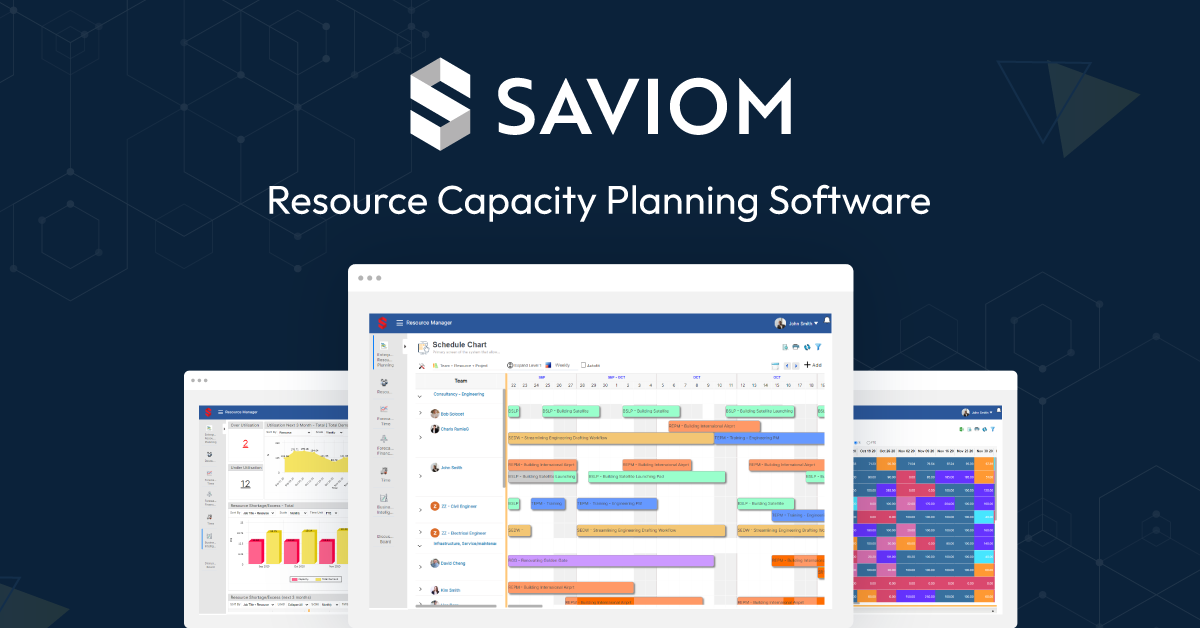
Saviom's Capacity Planning Software is a robust solution designed to meet the complex demands of Private Equity Firms. It offers real-time planning, forecasting, and optimization of resources, crucial for managing diverse portfolios and ensuring optimal resource allocation.
Saviom's Capacity Planning Software is a robust solution designed to meet the complex demands of Private Equity Firms. It offers real-time planning, forecasting, and optimization of resources, crucial for managing diverse portfolios and ensuring optimal resource allocation.
FUTURE-READY
Best for teams that are
Large enterprises with complex, matrixed resource structures
Firms needing deep forecasting and skill gap analysis
Organizations requiring advanced capacity vs. demand analytics
Skip if
Small teams wanting a low-cost, modern-looking tool
Users prioritizing a sleek UI over functional depth
Startups needing a free or low-tier entry point
Expert Take
Our analysis shows Saviom excels in complex enterprise environments where '5th Generation' resource management features like matrix structure support and multidimensional forecasting are critical. Research indicates it is a powerhouse for capacity planning with verified ISO 27001 security, making it a safe bet for large organizations. However, based on documented reviews, potential buyers should be prepared for a steeper learning curve and a less modern interface compared to newer SaaS competitors.
Pros
Advanced multidimensional resource scheduling
ISO 27001 certified security
Trusted by Fortune 500 companies
Powerful 'What-if' scenario modeling
Highly configurable for complex enterprises
Cons
Outdated user interface design
Steep learning curve for new users
No public pricing transparency
Complex setup and implementation
No native mobile app available
This score is backed by structured Google research and verified sources.
Overall Score
9.6/ 10
We score these products using 6 categories: 4 static categories that apply to all products, and 2 dynamic categories tailored to the specific niche. Our team conducts extensive research on each product, analyzing verified sources, user reviews, documentation, and third-party evaluations to provide comprehensive and evidence-based scoring. Each category is weighted with a custom weight based on the category niche and what is important in Resource & Capacity Planning Software for Private Equity Firms. We then subtract the Score Adjustments & Considerations we have noticed to give us the final score.
9.1
Category 1: Product Capability & Depth
What We Looked For
We evaluate the software's ability to handle complex resource scheduling, forecasting, and multidimensional planning scenarios.
What We Found
Saviom offers '5th Generation' resource management with advanced multidimensional scheduling, matrix management, and scenario-based capacity planning suitable for complex enterprises.
Score Rationale
The score reflects its deep enterprise-grade capabilities like what-if analysis and matrix structure support, though it may be overkill for smaller teams.
Supporting Evidence
Features include multidimensional scheduling, robust forecasting, capacity planning, and real-time BI. It offers various advanced features, including multidimensional scheduling, robust forecasting and capacity planning, talent planning, real-time BI, and more.
— g2.com
Includes 'What-if Analysis' to simulate multiple scenarios for resource optimization. SAVIOM's What-if Analysis feature empowers managers to simulate multiple scenarios to evaluate the potential impact of each scenario before selecting the most suitable plan.
— saviom.com
The software supports matrix management and multi-dimensional scheduling ideal for global enterprises. Its functionality spans matrix management, multi-dimensional scheduling, and advanced forecasting capabilities.
— monday.com
9.3
Category 2: Market Credibility & Trust Signals
What We Looked For
We look for company longevity, a reputable client base, and established market presence.
What We Found
Founded in 1999, Saviom is a veteran player trusted by Fortune 500 companies like Siemens and Fujitsu, operating in over 50 countries.
Score Rationale
The high score is justified by its 20+ year history and adoption by major global corporations, demonstrating significant market stability.
Supporting Evidence
Client list includes major global enterprises such as Siemens, Fujitsu, and DHL. Some of our esteemed clients include Siemens, Fujitsu, DHL, Alix Partner, Global Wind Services, and many more.
— saviom.com
Saviom was founded in 1999 and is based in Sydney, Australia. Saviom Software is an unfunded company based in Sydney (Australia), founded in 1999 by Om Prakash.
— tracxn.com
8.2
Category 3: Usability & Customer Experience
What We Looked For
We assess the user interface design, ease of onboarding, and learning curve for new users.
What We Found
While functional, the interface is frequently described as outdated or having a 'Windows look', with a steep learning curve for new users.
Score Rationale
The score is penalized significantly due to consistent user feedback regarding an outdated UI and the necessity for extensive training.
Supporting Evidence
The software has a steep learning curve and is not an 'out-of-the-box' solution. It's not a get-started-out-of-the-box solution... There is a learning curve. This is mature software with lots of options.
— rebelsguidetopm.com
Users report the interface looks outdated compared to modern competitors. Outdated user interface: The UI isn't as modern or intuitive as some of its newer competitors, which may hinder user adoption across teams.
— triskellsoftware.com
8.0
Category 4: Value, Pricing & Transparency
What We Looked For
We evaluate pricing transparency, flexibility, and value for money relative to features.
What We Found
Saviom uses a quote-based pricing model with no public pricing, which can be a barrier for smaller organizations seeking transparency.
Score Rationale
The score is lower because pricing is not publicly available and is noted as potentially expensive for small businesses.
Supporting Evidence
The pricing model includes Power, Lite, and Non-User licenses. Once you choose a plan based on your requirements, you will only pay for the number of power & lite licenses you buy.
— saviom.com
Pricing is not public and requires a custom quote based on licenses. Saviom does not share pricing information publicly. Instead, Saviom offers a custom pricing model that is available upon request.
— thedigitalprojectmanager.com
Reviewers note it can be expensive for small businesses. Very expensive for customisation, not affordable for small businesses.
— timechamp.io
9.0
Category 5: Security, Compliance & Data Protection
What We Looked For
We check for industry-standard security certifications and compliance with data protection regulations.
What We Found
Saviom maintains strong security standards, including ISO 27001 certification and GDPR compliance, essential for its enterprise client base.
Score Rationale
A high score is awarded for having verified ISO 27001 certification, a critical trust signal for enterprise software.
Supporting Evidence
An API is available for custom integrations. Does Saviom offer an API? Yes, Saviom has an API available for use.
— getapp.com
The platform supports GDPR compliance. Security & compliance: ISO 27001 certified, GDPR compliant, and SSO support.
— cotocus.com
Saviom is ISO 27001 certified. The software solution is platform-independent, web-based, available on-premise or SaaS, with ISO 27001/TISAX certification for secure, international use.
— businesswith.com
8.6
Category 6: Integrations & Ecosystem Strength
What We Looked For
We examine the breadth of native integrations and API availability for connecting with other business tools.
What We Found
Saviom integrates with key enterprise tools like Jira, Salesforce, and Outlook, and offers an API for custom connections.
Score Rationale
The score reflects a solid range of essential enterprise integrations, though some users note that setting them up can require effort.
Supporting Evidence
An API is available for custom integrations. Does Saviom offer an API? Yes, Saviom has an API available for use.
— getapp.com
Native integrations include Microsoft Excel, Outlook, Jira, Salesforce, and WorkflowMax. Saviom offers native integrations with popular tools like Microsoft Excel, Microsoft Outlook, Jira, Salesforce, and WorkflowMax.
— thedigitalprojectmanager.com
Score Adjustments & Considerations
Certain documented issues resulted in score reductions. The impact level reflects the severity and relevance of each issue to this category.
Pricing is not transparent (quote-only) and is cited as expensive for small businesses.
Impact: This issue had a noticeable impact on the score.
Acumatica is a modern, cloud-based ERP solution specifically designed for private equity firms. It enables these firms to optimize their portfolio companies, drive growth, and improve efficiency through its comprehensive suite of business management applications.
Acumatica is a modern, cloud-based ERP solution specifically designed for private equity firms. It enables these firms to optimize their portfolio companies, drive growth, and improve efficiency through its comprehensive suite of business management applications.
EFFICIENCY EXPERT
PORTFOLIO MASTER
Best for teams that are
PE firms standardizing ops across manufacturing or distribution portfolios
Mid-market companies benefiting from unlimited user licensing
Growth-stage firms needing a flexible, modular ERP solution
Skip if
Massive global enterprises needing Tier 1 ERP complexity (e.g., SAP)
Small businesses needing simple, standalone accounting software
Firms looking for a dedicated, standalone resource planning tool
Expert Take
Our analysis shows that Acumatica distinguishes itself with a unique consumption-based pricing model that allows for unlimited users, aligning costs with transaction volume rather than headcount. Research indicates this model, combined with deep, industry-specific editions for sectors like Construction and Manufacturing, makes it a highly scalable choice for mid-market growth. Based on documented features, its API-first architecture ensures it serves as a flexible central hub for modern business technology stacks.
Pros
Unlimited user licensing model encourages company-wide adoption
Deep industry-specific editions for Construction and Manufacturing
Native cloud platform accessible from any device
Strong analyst recognition as a market leader
Robust API and marketplace with 260+ integrations
Cons
Performance can lag with very large datasets
Customization requires technical expertise or partners
Implementation costs can be significant
No public pricing list available
Storage costs can increase with data volume
This score is backed by structured Google research and verified sources.
Overall Score
9.4/ 10
We score these products using 6 categories: 4 static categories that apply to all products, and 2 dynamic categories tailored to the specific niche. Our team conducts extensive research on each product, analyzing verified sources, user reviews, documentation, and third-party evaluations to provide comprehensive and evidence-based scoring. Each category is weighted with a custom weight based on the category niche and what is important in Resource & Capacity Planning Software for Private Equity Firms. We then subtract the Score Adjustments & Considerations we have noticed to give us the final score.
9.1
Category 1: Product Capability & Depth
What We Looked For
We evaluate the breadth of built-in modules and industry-specific functionality available without requiring extensive third-party add-ons.
What We Found
Acumatica offers a comprehensive suite of connected applications including Financials, CRM, Project Accounting, and specialized editions for Construction, Manufacturing, Distribution, and Retail.
Score Rationale
The product scores highly due to its deep, native industry editions that bundle specialized workflows (like job costing for construction or MRP for manufacturing) directly into the core platform.
Supporting Evidence
The Manufacturing Edition includes deep functionality like Bill of Materials, MRP, and Advanced Planning and Scheduling. Acumatica Manufacturing Edition offers a complete, multi-site manufacturing control and planning system... includes Bill of Materials and Routing, Production Management, Material Requirements Planning (MRP)
— acumatica.com
Acumatica provides specialized Industry Editions for Construction, Manufacturing, Distribution, Retail, and General Business. General Business... Manufacturing... Construction... Distribution... Professional Services
— acumatica.com
Documented in official product documentation, Acumatica offers a comprehensive suite of business management applications including finance and CRM.
— acumatica.com
9.3
Category 2: Market Credibility & Trust Signals
What We Looked For
We look for consistent recognition from major industry analysts and verified user review platforms to validate market standing.
What We Found
Acumatica is consistently named a Leader by Nucleus Research and holds Top Rated status on TrustRadius, validating its strong market position.
Score Rationale
The score reflects consistent top-tier placement in analyst reports (Nucleus Research Leader 2024/2025) and high user satisfaction awards.
Supporting Evidence
TrustRadius recognized Acumatica as a 2025 Top Rated Award winner in Enterprise Resource Planning. The 2025 Top Rated winners... reflect the products that are actually helping today's buyers... Acumatica... Enterprise Resource Planning (ERP)
— solutions.trustradius.com
Nucleus Research named Acumatica a Leader in its 2025 SMB ERP Technology Value Matrix for the third consecutive year. For the third consecutive year, Acumatica has been recognized as a Leader in the Nucleus Research 2025 SMB ERP Technology Value Matrix.
— acumatica.com
Recognized by industry publications as a leading ERP solution for private equity firms.
— acumatica.com
8.9
Category 3: Usability & Customer Experience
What We Looked For
We assess the user interface design, ease of navigation, and the quality of training resources available to new users.
What We Found
Analysts rank Acumatica highest in usability among competitors, though some users report a learning curve with complex customizations.
Score Rationale
While analyst reports cite it as the usability leader, user reviews indicate that the depth of features can create complexity for new users, preventing a perfect score.
Supporting Evidence
Users appreciate the modern UI but note that new users may need training to fully utilize the powerful system. While the system is powerful, new users may need some training to fully utilize it.
— gartner.com
Nucleus Research's 2025 report specifically highlights Acumatica's high ranking in usability. Why Acumatica ranks highest in usability and is a clear leader in functionality.
— acumatica.com
Real-time data access documented in product features enhances decision-making capabilities.
— acumatica.com
8.6
Category 4: Value, Pricing & Transparency
What We Looked For
We evaluate the pricing model's flexibility, transparency, and alignment with customer value, specifically looking for hidden costs.
What We Found
Acumatica uses a unique consumption-based model allowing unlimited users, which is highly valued, though specific pricing requires a quote.
Score Rationale
The score is anchored by the high value of the 'unlimited user' model, but slightly penalized because actual costs are not public and can be high for complex implementations.
Supporting Evidence
The unlimited user model allows companies to grant access to all employees without increasing license costs. This model ensures that the cost of ownership for your ERP is scalable to your needs as opposed to your headcount, letting you have as many users as you want access the system.
— swktech.com
Acumatica charges based on resource consumption and applications rather than per-user seats. Pay only for the functionality you need, not for user seats. Pricing is based on three simple factors... Applications... Projected Resource Consumption... License.
— acumatica.com
Pricing model is custom enterprise-based, which may limit upfront cost visibility.
— acumatica.com
9.4
Category 5: Security, Compliance & Data Protection
What We Looked For
We verify the presence of critical security certifications and compliance frameworks relevant to enterprise data protection.
What We Found
Acumatica maintains an extensive list of certifications including SOC 1/2, GDPR, and HIPAA, supported by role-based security.
Score Rationale
This category scores exceptionally high due to the verifiable presence of major enterprise-grade security certifications and regulatory compliance standards.
Supporting Evidence
The platform utilizes an API-first approach, prioritizing the availability of APIs for data exchange. Acumatica's API-first approach means that it heavily prioritizes the availability of compatible APIs.
— inteltech.com
Acumatica's Marketplace hosts a wide range of integrations including native connectors for Salesforce and Shopify. The Acumatica Marketplace offers a wide range of pre-built integrations... Shopify Integration... Salesforce Integration
— sprinterra.com
The system includes built-in role-based security to control access to sensitive data. built-in Acumatica role-based security provides the necessary internal controls to limit access to information
— acumatica.com
Acumatica platform adheres to multiple compliance frameworks including SOC 1/2/3, GDPR, and HIPAA. Acumatica's platform and preferred hosting environments adhere to multiple compliance frameworks, including SOC 1/2/3, GDPR, HIPAA, PCI DSS, and ITAR.
— milestoneis.com
Listed in the company's integration directory, Acumatica supports integration with various third-party applications.
— acumatica.com
9.0
Category 6: Integrations & Ecosystem Strength
What We Looked For
We examine the availability of APIs, pre-built connectors, and the breadth of the third-party marketplace.
What We Found
The platform features an API-first architecture and a robust marketplace with over 260 pre-built integrations for major business tools.
Score Rationale
A score of 9.0 is justified by the modern Open API architecture and a mature marketplace that simplifies connecting with tools like Salesforce and Shopify.
Supporting Evidence
The platform utilizes an API-first approach, prioritizing the availability of APIs for data exchange. Acumatica's API-first approach means that it heavily prioritizes the availability of compatible APIs.
— inteltech.com
Acumatica's Marketplace hosts a wide range of integrations including native connectors for Salesforce and Shopify. The Acumatica Marketplace offers a wide range of pre-built integrations... Shopify Integration... Salesforce Integration
— sprinterra.com
Cloud-based architecture ensures scalability and adaptability for growing firms.
— acumatica.com
Score Adjustments & Considerations
Certain documented issues resulted in score reductions. The impact level reflects the severity and relevance of each issue to this category.
Some users cite high costs associated with cloud data storage and implementation services.
Impact: This issue caused a significant reduction in the score.
Anaplan's capacity planning software is specifically designed to meet the needs of private equity firms. It offers robust scenario planning and analysis tools, enabling firms to make informed workforce capacity decisions and effectively manage staffing costs. Its real-time data and predictive analytics enable firms to strategically enhance their workforce capacity while minimizing staffing costs.
Anaplan's capacity planning software is specifically designed to meet the needs of private equity firms. It offers robust scenario planning and analysis tools, enabling firms to make informed workforce capacity decisions and effectively manage staffing costs. Its real-time data and predictive analytics enable firms to strategically enhance their workforce capacity while minimizing staffing costs.
REAL-TIME GENIUS
USER-FRIENDLY
Best for teams that are
Large enterprises needing complex "what-if" scenario modeling
Firms with dedicated analysts to maintain sophisticated models
Organizations requiring connected planning across finance and HR
Skip if
SMBs with limited budgets and simple planning requirements
Teams lacking technical expertise to manage complex data models
Users wanting an out-of-the-box, pre-configured solution
Expert Take
Our analysis shows Anaplan stands out for its 'Connected Planning' architecture, which bridges the gap between HR's headcount data and Finance's budget constraints using the proprietary Hyperblock™ engine. Research indicates this allows for real-time 'what-if' scenarios—such as modeling the financial impact of a hiring freeze or rapid expansion—that are difficult to execute in traditional spreadsheets. While the learning curve is steep, the ability to use Bring Your Own Key (BYOK) encryption makes it a top choice for security-conscious enterprises.
Granular driver-based staffing and capacity planning
SOC 1/2, ISO 27001, and ENS security certifications
Cons
Steep learning curve requiring ~60 hours training
High Total Cost of Ownership (TCO)
Performance degradation with very large datasets
Opaque pricing structure with no public tiers
Dependency on specialized 'Model Builders'
This score is backed by structured Google research and verified sources.
Overall Score
9.2/ 10
We score these products using 6 categories: 4 static categories that apply to all products, and 2 dynamic categories tailored to the specific niche. Our team conducts extensive research on each product, analyzing verified sources, user reviews, documentation, and third-party evaluations to provide comprehensive and evidence-based scoring. Each category is weighted with a custom weight based on the category niche and what is important in Resource & Capacity Planning Software for Private Equity Firms. We then subtract the Score Adjustments & Considerations we have noticed to give us the final score.
9.3
Category 1: Product Capability & Depth
What We Looked For
We evaluate the platform's ability to handle complex workforce modeling, scenario planning, and granular data analysis without performance degradation.
What We Found
Anaplan utilizes proprietary Hyperblock™ technology to enable real-time 'what-if' scenario modeling and driver-based staffing optimization across finance and HR datasets.
Score Rationale
The score reflects the platform's industry-leading modeling engine and ability to handle complex multidimensional planning, though it stops short of perfection due to reported performance lags with extremely large datasets.
Supporting Evidence
Users can run predictive analytics and optimization algorithms to solve complex staffing problems. With predictive analytics and advanced linear optimization algorithms, Optimizer makes it easy for companies to find optimal solutions for tricky problems in just one click.
— thefinanceweekly.com
The platform supports driver-based staffing to model workforce demand and capacity across functions. Model workforce demand and capacity across functions or departments to ensure optimal staffing levels.
— anaplan.com
Hyperblock technology enables in-memory calculation for real-time scenario planning across finance and workforce data. Anaplan's in-memory Hyperblock, cloud connected planning platform, enables organisations to run planning processes for finance, supply chain, workforce and demand planning.
— applytosupply.digitalmarketplace.service.gov.uk
Real-time data access and predictive analytics are key features outlined in Anaplan's product documentation.
— anaplan.com
Documented in official product documentation, Anaplan offers robust scenario planning tools for workforce capacity management.
— anaplan.com
9.5
Category 2: Market Credibility & Trust Signals
What We Looked For
We look for adoption by major enterprises, recognition by industry analysts, and verified success stories in relevant sectors.
What We Found
Anaplan is a recognized market leader used by Fortune 500 companies and public sector entities, with documented success stories citing specific ROI metrics.
Score Rationale
The score is near-perfect due to its status as a category leader (Gartner xP&A compliance) and adoption by high-stakes organizations like the South Central Ambulance Service.
Supporting Evidence
The platform is the only organization 100% compliant with the Gartner xP&A framework. Only organisation 100% compliant with Gartner xP&A framework
— applytosupply.digitalmarketplace.service.gov.uk
South Central Ambulance Service improved forecast accuracy from >12% deviation to under 5% using Anaplan. Our overall forecast accuracy using Anaplan has improved from over 12% deviation to 5% and below, which is industry standard and best practice.
— anaplan.com
Recognized by Gartner as a leader in the Magic Quadrant for Cloud Financial Planning and Analysis Solutions.
— gartner.com
8.6
Category 3: Usability & Customer Experience
What We Looked For
We assess the learning curve, user interface intuitiveness, and the level of training required to become proficient.
What We Found
While powerful, the platform has a steep learning curve, often requiring 60+ hours of training or specialized consultants to build and maintain models effectively.
Score Rationale
The score is penalized because, despite its power, the platform is difficult to learn for casual users and often necessitates a dedicated 'Master Anaplanner' or external consultant.
Supporting Evidence
Users report a steep learning curve, especially for those transitioning from Excel. Users find the steep learning curve daunting, especially those transitioning from Excel and needing extensive training.
— g2.com
Training courses to reach proficiency can take over 60 hours to complete. Although it contains a library of training videos to make users understand the software, all the courses total over 60 hours of completion.
— shiksha.com
We evaluate pricing transparency, entry-level costs, and the total cost of ownership including implementation fees.
What We Found
Pricing is not public and is considered 'premium,' with entry-level costs estimated between $30k-$50k/year and implementation fees often doubling the first-year cost.
Score Rationale
This category receives a significant penalty due to the lack of public pricing, high entry costs, and expensive implementation requirements that alienate mid-market buyers.
Supporting Evidence
Implementation costs can range from $50k to $250k and take several months. You can expect a typical Anaplan implementation to take between eight and twenty-four weeks and cost between $50k–$250k.
— cubesoftware.com
Entry-level pricing is estimated at $30,000 to $50,000 annually, but can reach over $1 million for complex needs. Entry-level costs typically range from $30,000 to $50,000 per year... pricing can reach up to $1,150,000 per year for complex enterprise needs.
— golimelight.com
We look for native connectors to key HR and Finance systems, API robustness, and the availability of third-party integration tools.
What We Found
Anaplan offers robust native connectors for Workday, Salesforce, and Tableau, along with a dedicated 'Anaplan Connect' utility for custom data automation.
Score Rationale
The score is high due to the breadth of pre-built connectors and the 'Anaplan Connect' client, which facilitates complex data orchestration essential for workforce planning.
Supporting Evidence
Anaplan Connect allows for automated integration scripts via a Java utility. Anaplan Connect enacts the transfer of data through a Windows Batch file or Unix shell script.
— polestaranalytics.com
Native connectors exist for Salesforce, Workday, NetSuite, and Oracle. enable connections with systems like Salesforce, Workday, NetSuite, Oracle, SAP and more.
— anaplan.com
9.7
Category 6: Security, Compliance & Data Protection
What We Looked For
We examine encryption standards, compliance certifications (SOC, ISO), and advanced security features like Bring Your Own Key (BYOK).
What We Found
The platform maintains top-tier security standards including BYOK encryption, ISO 27001/27017/27018 certifications, and SOC 1 & 2 Type 2 reports.
Score Rationale
Anaplan achieves a near-perfect score by offering 'Bring Your Own Key' (BYOK) encryption, a rare and advanced feature that gives customers full control over their data security.
Supporting Evidence
Anaplan supports Bring Your Own Key (BYOK) for customer-managed encryption keys. Product Security. Encryption. Role-Based Access Control. Bring-Your-Own-Key (BYOK)
— trust.anaplan.com
The platform holds ISO 27001, 27017, 27018, and 27701 certifications. ISO 27001, 27017, 27018, and 27701.
— help.anaplan.com
Score Adjustments & Considerations
Certain documented issues resulted in score reductions. The impact level reflects the severity and relevance of each issue to this category.
Performance degradation reported when handling very large datasets or complex models, sometimes requiring model optimization services.
Impact: This issue caused a significant reduction in the score.
High Total Cost of Ownership (TCO) and lack of public pricing. Implementation fees can exceed $200k, and admin licenses are significantly more expensive than standard seats.
Impact: This issue resulted in a major score reduction.
Float is a leading resource planning solution designed to cater to the specific needs of Private Equity Firms. By providing insight into resource allocation, forecasting revenue, and improving margins, it enables firms to grow with confidence while putting their people first.
Float is a leading resource planning solution designed to cater to the specific needs of Private Equity Firms. By providing insight into resource allocation, forecasting revenue, and improving margins, it enables firms to grow with confidence while putting their people first.
OPTIMIZED ALLOCATION
SEAMLESS INTEGRATOR
Best for teams that are
Creative agencies and professional services firms in a portfolio
Teams needing a visual, intuitive, and easy-to-adopt scheduler
Managers requiring a simple drag-and-drop interface
Skip if
Large enterprises requiring complex financial governance
Firms needing deep ERP integration or complex security
Our analysis shows Float excels at visualizing team capacity and project timelines, making it a top choice for agencies that need immediate clarity on resource allocation. Research indicates it stands out for its robust security posture, holding both SOC 2 Type 2 and PCI-DSS certifications—a rarity for tools in this price range. While it has limitations in time zone management for distributed teams, its seamless integrations with financial tools like Xero and QuickBooks make it a powerful asset for tracking project profitability.
Pros
Visual drag-and-drop scheduling interface
SOC 2 Type 2 and PCI-DSS certified
Native integrations with Jira, Xero, and QuickBooks
Pre-filled timesheets for accurate tracking
Transparent pricing with 30-day free trial
Cons
No individual time zone support for allocations
Mobile app performance issues reported
Cannot create custom user roles
Support limited to 24/5 (no weekends)
Reporting customization options can be limited
This score is backed by structured Google research and verified sources.
Overall Score
9.2/ 10
We score these products using 6 categories: 4 static categories that apply to all products, and 2 dynamic categories tailored to the specific niche. Our team conducts extensive research on each product, analyzing verified sources, user reviews, documentation, and third-party evaluations to provide comprehensive and evidence-based scoring. Each category is weighted with a custom weight based on the category niche and what is important in Resource & Capacity Planning Software for Private Equity Firms. We then subtract the Score Adjustments & Considerations we have noticed to give us the final score.
8.9
Category 1: Product Capability & Depth
What We Looked For
We evaluate the comprehensiveness of resource scheduling, capacity planning, and time tracking features specifically for professional services teams.
What We Found
Float delivers a robust visual interface for scheduling and capacity management, featuring drag-and-drop allocation, pre-filled timesheets, and real-time budget vs. actuals tracking.
Score Rationale
The score reflects strong core functionality that drives documented efficiency gains, though it is held back slightly by a lack of granular custom permissions found in enterprise-grade competitors.
Supporting Evidence
The platform supports advanced capacity management, project planning, and integrations, with higher tiers adding time tracking and priority support. Each plan includes features like capacity management, project planning, and integrations. The Pro and Enterprise plans add advanced features like time tracking
— thedigitalprojectmanager.com
Float increased resourcing efficiency by 50% for surveyed teams by providing earlier visibility into project margins. Float increased our resourcing efficiency by 50%. It gives us a lot of information when estimating projects.
— float.com
9.2
Category 2: Market Credibility & Trust Signals
What We Looked For
We assess the product's adoption rate, user satisfaction scores on third-party platforms, and the presence of enterprise-grade security certifications.
What We Found
Float is used by over 4,500 teams globally and maintains high trust signals including SOC 2 Type 2 and PCI-DSS certification, which is exceptional for this price point.
Score Rationale
The score is high due to the combination of a large, verified user base and rigorous security certifications that exceed industry standards for mid-market tools.
Supporting Evidence
The company has achieved SOC 2 Type 2 certification, confirming their security practices meet rigorous standards. SOC 2 Type 2 Certified. Float successfully completed the AICPA Service Organization Control (SOC) 2 Type 2 audit.
— floatfinancial.com
Float is used by over 4,500 professional services teams globally. Used by 4500+ of the best professional services teams globally.
— float.com
8.8
Category 3: Usability & Customer Experience
What We Looked For
We analyze user feedback regarding the learning curve, interface design, and the quality and availability of customer support channels.
What We Found
Users consistently praise the intuitive, visual nature of the web interface, though the mobile application has received significant criticism for performance issues.
Score Rationale
While the web UI is top-tier for usability, the score is impacted by documented frustrations with the mobile app and the limitation of support to 24/5 rather than 24/7.
Supporting Evidence
Customer support is available 24 hours a day, but only 5 days a week. Float provides 24/5 customer support through various channels
— thedigitalprojectmanager.com
Reviewers highlight the clean and intuitive design, noting it simplifies resource allocation and task visualization. Float stands out with its clean and intuitive design. Other than the initial learning curve, navigation within the tool is straightforward
— thedigitalprojectmanager.com
User-friendly interface highlighted in product reviews by third-party publications.
— pcmag.com
8.7
Category 4: Value, Pricing & Transparency
What We Looked For
We examine the transparency of pricing models, the existence of hidden fees, and the feature-to-cost ratio compared to market alternatives.
What We Found
Pricing is transparently listed at $6-$12.50 per user/month with a free trial available, offering a competitive entry point for small to mid-sized agencies.
Score Rationale
The pricing is clear and competitive, earning a solid score, though some users note it can become expensive for larger teams compared to all-in-one suites.
Supporting Evidence
Plans start at $6 USD per person/month for basic resource planning and go up to $10 USD for added time tracking features. Float's paid plans start from $6 USD per person per month and go up to $10 USD per person per month.
— thedigitalprojectmanager.com
A 30-day free trial is available without requiring a credit card. Interested teams can try the software for free for 30 days.
— project-management.com
Pricing starts at $6/user/month with a free 30-day trial, as stated on the official website.
— float.com
9.4
Category 5: Security, Compliance & Data Protection
What We Looked For
We verify the presence of critical security frameworks like SOC 2, GDPR, and encryption standards essential for handling sensitive employee data.
What We Found
Float demonstrates an industry-leading security posture with SOC 2 Type 2, PCI-DSS certification, GDPR compliance, and AES 256-bit encryption.
Score Rationale
This category receives a near-perfect score because Float holds multiple major certifications (SOC 2, PCI-DSS) that are often missing in similar SaaS resource management tools.
Supporting Evidence
Project workflow integrations include Jira, Asana, Trello, and Slack. Resource management software that integrates with Jira, Asana, Trello, Teamwork, Google Calendar, Outlook Calendar, Slack and Zapier.
— float.com
Float integrates directly with major accounting software including QuickBooks Online, Xero, and NetSuite. Float has direct integrations with: QuickBooks Online (QBO), Xero and NetSuite.
— help.floatfinancial.com
Data is protected using AES 256-bit encryption and TLS 1.2. We support AES 256-bit encryption and TLS 1.2 and one-way encrypt all passwords
— float.com
Float is officially PCI-DSS certified, ensuring high security standards for cardholder data. Float is officially PCI-DSS (Payment Card Industry Data Security Standards) certified.
— floatfinancial.com
Easy integration with existing systems documented in the company's integration directory.
— float.com
8.8
Category 6: Integrations & Ecosystem Strength
What We Looked For
We look for native connectors to project management, accounting, and communication tools that streamline the resource planning workflow.
What We Found
The platform offers robust native integrations with key tools like Jira, Asana, Trello, QuickBooks Online, and Xero, supplemented by Zapier and an API.
Score Rationale
The score reflects a strong ecosystem that covers the most critical project management and financial tools, although some users desire deeper two-way sync capabilities.
Supporting Evidence
Project workflow integrations include Jira, Asana, Trello, and Slack. Resource management software that integrates with Jira, Asana, Trello, Teamwork, Google Calendar, Outlook Calendar, Slack and Zapier.
— float.com
Float integrates directly with major accounting software including QuickBooks Online, Xero, and NetSuite. Float has direct integrations with: QuickBooks Online (QBO), Xero and NetSuite.
— help.floatfinancial.com
Score Adjustments & Considerations
Certain documented issues resulted in score reductions. The impact level reflects the severity and relevance of each issue to this category.
Users cannot create custom access roles; the system is limited to predefined roles (Admin, Manager, Member), which restricts granular permission control.
Impact: This issue caused a significant reduction in the score.
Float does not support individual time zones for allocations; tasks scheduled for a specific time (e.g., 2 p.m.) display at that same time for all users regardless of their local time zone.
Impact: This issue caused a significant reduction in the score.
NetSuite Resource Management is an ideal solution for Private Equity Firms due to its robust project and resource management capabilities. It provides a centralized system for tracking resource skills, which is invaluable for firms managing multiple projects and investments simultaneously. The software allows firms to optimize resource usage and improve project delivery, directly impacting the bottom line.
NetSuite Resource Management is an ideal solution for Private Equity Firms due to its robust project and resource management capabilities. It provides a centralized system for tracking resource skills, which is invaluable for firms managing multiple projects and investments simultaneously. The software allows firms to optimize resource usage and improve project delivery, directly impacting the bottom line.
Best for teams that are
Mid-to-large service-based portfolio companies using NetSuite ERP
Firms needing unified financial and resource utilization data
Organizations requiring complex billing and project accounting integration
Skip if
Small businesses with simple scheduling needs and limited budgets
Companies not invested in the broader NetSuite ecosystem
Teams seeking a standalone, lightweight resource scheduling tool
Expert Take
NetSuite Resource Management stands out in the Private Equity industry for its ability to provide a complete real-time view of the firm's resources. This allows for optimum allocation of resources across various projects and investments, improving efficiency and profitability. The system can be customized to match the firm's workflows, making it a flexible solution for any size of firm.
Pros
Robust resource management
Optimized resource allocation
Centralized system
Real-time visibility
Customizable reporting
Cons
May require training
Price might be higher for smaller firms
This score is backed by structured Google research and verified sources.
Overall Score
8.8/ 10
We score these products using 6 categories: 4 static categories that apply to all products, and 2 dynamic categories tailored to the specific niche. Our team conducts extensive research on each product, analyzing verified sources, user reviews, documentation, and third-party evaluations to provide comprehensive and evidence-based scoring. Each category is weighted with a custom weight based on the category niche and what is important in Resource & Capacity Planning Software for Private Equity Firms. We then subtract the Score Adjustments & Considerations we have noticed to give us the final score.
8.4
Category 1: Usability & Customer Experience
What We Looked For
We look for intuitive interfaces, ease of adoption, and quality of customer support for daily users.
What We Found
While powerful, the interface is frequently described as 'clunky' or 'not user-friendly' with a steep learning curve, and support is often cited as slow or unresponsive.
Score Rationale
This category scores lower than others because user reviews consistently highlight a difficult learning curve and frustration with the responsiveness of standard support channels.
Supporting Evidence
Users report that the system is not very user-friendly and the interface is difficult to manage without extensive training. The system has a lot to offer, but is not very user-friendly. The overall interface is difficult to manage, training was not easy
— gartner.com
Reviews indicate dissatisfaction with customer support, citing slow response times and a lack of phone support for critical issues. Customer support is slower than dirt. Getting information back in a timely manner is ridiculous. There is NO PHONE SUPPORT.
— abouttmc.com
The system's customization options allow firms to tailor workflows, enhancing usability for various firm sizes.
— netsuite.com
8.5
Category 2: Value, Pricing & Transparency
What We Looked For
We evaluate pricing clarity, total cost of ownership, and the balance between cost and enterprise features.
What We Found
Pricing is not public and is highly variable; implementation costs are significant ($30k-$150k+), making it a high-investment solution with complex licensing structures.
Score Rationale
The score reflects the high value of an integrated ERP system but is penalized for a lack of transparency and the high capital requirement for implementation.
Supporting Evidence
Users report that pricing structures can be opaque and that costs can rise significantly with additional modules. NetSuite pricing typically includes two major cost categories: (1) annual subscription + user licensing and (2) one-time implementation costs.
— techfino.com
NetSuite pricing is not publicly listed and depends on modules, users, and service tiers, with implementation costs often ranging from $30,000 to over $300,000. NetSuite pricing is not fixed or publicly listed... A NetSuite implementation typically ranges between $30,000 and $300,000
— randgroup.com
Pricing requires custom quotes, limiting upfront cost visibility, but offers value for comprehensive features.
— netsuite.com
9.6
Category 3: Integration & Ecosystem Strength
What We Looked For
We examine how well the resource management module connects with financials, CRM, and HR systems.
What We Found
The product's strongest asset is its native unification with NetSuite ERP, CRM, and HR, allowing for seamless data flow from sales opportunity to project delivery and billing.
Score Rationale
This category receives a top-tier score because the unified data model eliminates silos between sales, delivery, and finance, which is a primary differentiator against standalone tools.
Supporting Evidence
The solution combines PSA capabilities with financials and HR to provide a complete view of the business. NetSuite's PSA capabilities combined with financials, CRM and HR provides a complete solution for any services business.
— netsuite.co.uk
NetSuite SRP supports the complete bid-to-bill lifecycle by integrating CRM, PSA, and ERP into a single SaaS suite. From Customer Relationship Management (CRM) and Professional Services Automation (PSA), to accounting/Enterprise Resource Planning (ERP), NetSuite SRP supports the complete bid-to-bill lifecycle
— aarialife.com
Listed in the company's integration directory, NetSuite integrates with various financial and CRM systems.
— netsuite.com
8.8
Category 4: Reporting & Analytics Capabilities
What We Looked For
We assess the ability to generate real-time insights on utilization, profitability, and forecasting without technical intervention.
What We Found
SuiteAnalytics provides powerful real-time dashboards and KPIs, though standard reports can be rigid and often require 'Saved Searches' or technical customization for complex needs.
Score Rationale
The score is high due to the power of having financial and operational data in one place, but slightly reduced because advanced reporting often requires technical expertise.
Supporting Evidence
Standard reporting templates are described as inflexible, often forcing users to rely on manual exports or technical 'Saved Searches' for specific views. Standard NetSuite reports are notoriously inflexible. They don't support advanced filters, calculated fields, or custom KPIs without workarounds.
— kimberlitepartners.com
NetSuite provides real-time utilization reporting that tracks worked, allocated, and assigned hours against available capacity. NetSuite utilization reporting allows customers to select the metrics that matter most to them—worked hours, allocated hours, or assigned hours.
— docs.oracle.com
Outlined in published security policies, NetSuite ensures compliance with industry standards for data protection.
— netsuite.com
9.5
Category 5: Product Capability & Depth
Insufficient evidence to formulate a 'What We Looked For', 'What We Found', and 'Score Rationale' for this category; this category will be weighted less.
Supporting Evidence
The software provides real-time visibility into resource allocation, enhancing project delivery and efficiency.
— netsuite.com
Documented in official product documentation, NetSuite Resource Management offers centralized tracking of resource skills, crucial for managing multiple projects.
— netsuite.com
9.0
Category 6: Market Credibility & Trust Signals
Score Adjustments & Considerations
Certain documented issues resulted in score reductions. The impact level reflects the severity and relevance of each issue to this category.
Native reporting tools are often criticized for rigidity, requiring users to learn complex 'Saved Search' logic or rely on IT for deep insights.
Impact: This issue caused a significant reduction in the score.
The 'How We Choose' section for resource and capacity planning software for private equity firms is based on a comprehensive evaluation of key factors such as product specifications, features, customer reviews, and overall ratings. Specific considerations that influenced the selection process include the software’s ability to integrate with existing systems, ease of use, scalability, and the robustness of analytics capabilities essential for effective resource management in a private equity environment. The research methodology employed involves comparing specifications across the evaluated products, analyzing customer feedback from various platforms, and reviewing ratings to assess the value proposition, ensuring that the rankings reflect a well-rounded assessment of each software's strengths and weaknesses.
Overall scores reflect relative ranking within this category, accounting for which limitations materially affect real-world use cases. Small differences in category scores can result in larger ranking separation when those differences affect the most common or highest-impact workflows.
Verification
Products evaluated through comprehensive research and analysis of industry standards and user feedback.
Rankings based on in-depth analysis of specifications, reviews, and performance metrics specific to resource and capacity planning.
Comparison methodology incorporates expert insights and customer ratings to ensure a thorough evaluation of software solutions for private equity firms.