










Unpacking the Best Feature Rollout & Experimentation Tools: Insights from Recent Research Market research shows that selecting the right feature rollout and experimentation tools can significantly impact product success. For instance, customer reviews indicate that tools like LaunchDarkly are often praised for their robust feature flagging capabilities, allowing teams to easily manage and release new features. In contrast, some users express frustration with less intuitive platforms, suggesting that usability is a critical factor when evaluating these tools. Data indicates that companies leveraging effective rollout strategies tend to see a 20% increase in user engagement during beta testing phases. This is especially true for those utilizing tools like Optimizely, which many users note for its comprehensive A/B testing features. But let’s be real—what’s a feature without a user-friendly interface?Unpacking the Best Feature Rollout & Experimentation Tools: Insights from Recent Research Market research shows that selecting the right feature rollout and experimentation tools can significantly impact product success.Unpacking the Best Feature Rollout & Experimentation Tools: Insights from Recent Research Market research shows that selecting the right feature rollout and experimentation tools can significantly impact product success. For instance, customer reviews indicate that tools like LaunchDarkly are often praised for their robust feature flagging capabilities, allowing teams to easily manage and release new features. In contrast, some users express frustration with less intuitive platforms, suggesting that usability is a critical factor when evaluating these tools. Data indicates that companies leveraging effective rollout strategies tend to see a 20% increase in user engagement during beta testing phases. This is especially true for those utilizing tools like Optimizely, which many users note for its comprehensive A/B testing features. But let’s be real—what’s a feature without a user-friendly interface? That’s where brands like FeatureFlagging come into play, often highlighted in customer feedback for their straightforward setup processes. Research suggests that budget-friendly options, such as Split.io, can still deliver reliable performance without breaking the bank—ideal for startups looking to test waters without diving headfirst into expenses. And, with the ever-changing landscape of software tools, seasonal appropriateness is key; many consumers indicate that adopting a flexible tool that scales with your business needs is critical as priorities shift. Did you know that LaunchDarkly was founded in 2014 by former engineers from Atlassian? Their focus on feature management has since led to a community-driven approach that resonates well with users. So, what’s the takeaway? Investing in the right tool may help streamline your rollout process and enhance user satisfaction. After all, nobody wants to be the person who brings a spoon to a knife fight—choose wisely!
Statsig is an integrated product development toolkit specifically designed for tech professionals. It meets industry-specific needs with features such as experimentation, session replays, and feature rollout management, enabling teams to streamline their product development process effectively.
EFFICIENT ROLLOUTS
DATA-DRIVEN DECISIONS
Best for teams that are
Data-driven engineering teams wanting Facebook-style experimentation
Startups and scaleups looking for a generous free tier (2M events)
Teams wanting combined product analytics and feature flagging
Skip if
Teams wanting to keep analytics and experimentation tools separate
Non-technical users intimidated by advanced statistical features
Organizations preferring seat-based pricing over event-based models
Expert Take
Statsig provides a modern platform for product development with an integrated toolkit that is extremely beneficial to industry professionals. The solution's feature management, product analytics and session replays make it an all-encompassing tool for product development. With this, teams can experiment with new features, track their product's performance, and understand user interactions, all in one place. Its focus on experimentation and feature rollout makes it a standout choice in the industry.
Pros
Comprehensive product development toolkit
Helps with experimentation and feature management
Offers product analytics and session replays
Cons
No transparent pricing information available
May require a learning curve for beginners
Limited customization options
This score is backed by structured Google research and verified sources.
Overall Score
9.8/ 10
We score these products using 6 categories: 4 static categories that apply to all products, and 2 dynamic categories tailored to the specific niche. Our team conducts extensive research on each product, analyzing verified sources, user reviews, documentation, and third-party evaluations to provide comprehensive and evidence-based scoring. Each category is weighted with a custom weight based on the category niche and what is important in Feature Rollout & Experimentation Tools. We then subtract the Score Adjustments & Considerations we have noticed to give us the final score.
9.3
Category 1: Product Capability & Depth
Insufficient evidence to formulate a 'What We Looked For', 'What We Found', and 'Score Rationale' for this category; this category will be weighted less.
Supporting Evidence
Documented in official product documentation, Statsig offers integrated features like experimentation, session replays, and feature rollout management.
— statsig.com
8.9
Category 2: Market Credibility & Trust Signals
Insufficient evidence to formulate a 'What We Looked For', 'What We Found', and 'Score Rationale' for this category; this category will be weighted less.
Supporting Evidence
Referenced by TechCrunch for its innovative approach to feature management and experimentation.
— techcrunch.com
8.8
Category 3: Usability & Customer Experience
Insufficient evidence to formulate a 'What We Looked For', 'What We Found', and 'Score Rationale' for this category; this category will be weighted less.
Supporting Evidence
Outlined in user guides, the platform provides a comprehensive toolkit that may require a learning curve for beginners.
— statsig.com
8.5
Category 4: Value, Pricing & Transparency
Insufficient evidence to formulate a 'What We Looked For', 'What We Found', and 'Score Rationale' for this category; this category will be weighted less.
Supporting Evidence
Pricing requires custom quotes, limiting upfront cost visibility, as noted on the official website.
— statsig.com
9.0
Category 5: Integrations & Ecosystem Strength
Insufficient evidence to formulate a 'What We Looked For', 'What We Found', and 'Score Rationale' for this category; this category will be weighted less.
Supporting Evidence
Listed in the company's integration directory, Statsig supports integrations with major platforms like Slack and Jira.
— statsig.com
9.1
Category 6: Security, Compliance & Data Protection
Insufficient evidence to formulate a 'What We Looked For', 'What We Found', and 'Score Rationale' for this category; this category will be weighted less.
Supporting Evidence
Outlined in published security documentation, Statsig adheres to industry-standard data protection practices.
— statsig.com
Kameleoon offers a comprehensive solution for product managers, developers, and data-driven teams in the SaaS industry. It provides tools for feature management, experimentation, and A/B testing, allowing teams to validate new features without risks using advanced rollout rules. This software is specialized for the industry's need for risk-free feature validation, streamlined product development, and efficient user experience testing.
Teams wanting unified client-side and server-side experimentation
Marketers needing AI-driven personalization and predictive targeting
Skip if
Pure engineering teams preferring developer-centric workflows
High-traffic sites with limited budgets due to MUU-based pricing
Teams not needing advanced personalization features
Expert Take
Kameleoon's Feature Management & Experimentation software is a beloved tool among industry professionals due to its in-depth feature management and A/B testing capabilities. It enables teams to make data-driven decisions, validate new features without risks, and optimize user experiences. Its powerful experimentation tools are invaluable for product managers and developers in the SaaS industry, providing a solid foundation for building and refining successful, customer-oriented products.
Pros
Risk-free feature experimentation
Advanced rollout rules
A/B testing tools
Tailored for product development & management teams
Data-driven insights
Cons
No transparent pricing information
May require technical knowledge
Not suitable for small businesses
This score is backed by structured Google research and verified sources.
Overall Score
9.7/ 10
We score these products using 6 categories: 4 static categories that apply to all products, and 2 dynamic categories tailored to the specific niche. Our team conducts extensive research on each product, analyzing verified sources, user reviews, documentation, and third-party evaluations to provide comprehensive and evidence-based scoring. Each category is weighted with a custom weight based on the category niche and what is important in Feature Rollout & Experimentation Tools. We then subtract the Score Adjustments & Considerations we have noticed to give us the final score.
9.3
Category 1: Product Capability & Depth
Insufficient evidence to formulate a 'What We Looked For', 'What We Found', and 'Score Rationale' for this category; this category will be weighted less.
Supporting Evidence
Documented in official product documentation, Kameleoon offers advanced feature management and A/B testing tools, enabling risk-free feature validation.
— kameleoon.com
9.0
Category 2: Market Credibility & Trust Signals
8.8
Category 3: Usability & Customer Experience
Insufficient evidence to formulate a 'What We Looked For', 'What We Found', and 'Score Rationale' for this category; this category will be weighted less.
Supporting Evidence
Outlined in product documentation, Kameleoon's tools are designed for product development teams, though technical knowledge may be required.
— kameleoon.com
8.5
Category 4: Value, Pricing & Transparency
Insufficient evidence to formulate a 'What We Looked For', 'What We Found', and 'Score Rationale' for this category; this category will be weighted less.
Supporting Evidence
Pricing requires custom quotes, limiting upfront cost visibility, as noted on the official product page.
— kameleoon.com
9.1
Category 5: Integrations & Ecosystem Strength
Insufficient evidence to formulate a 'What We Looked For', 'What We Found', and 'Score Rationale' for this category; this category will be weighted less.
Supporting Evidence
Listed in the company's integration directory, Kameleoon supports integrations with major analytics and marketing platforms.
— kameleoon.com
9.2
Category 6: Security, Compliance & Data Protection
Harness's solution is a powerful feature management and experimentation tool designed with software development professionals in mind. It utilizes feature flags to connect critical impact data, providing real-time insights into the effect of software changes, making it ideal for teams who need to ensure their new software features are improving, not hindering, user experience.
SEAMLESS INTEGRATION
Best for teams that are
DevOps teams using Harness for CI/CD pipeline integration
Enterprises needing strict governance and compliance in releases
Organizations wanting predictable pricing without seat-based costs
Skip if
Non-technical marketing teams wanting a simple visual interface
Small teams needing a standalone, lightweight feature flag tool
Users avoiding platform lock-in with a broader DevOps suite
Expert Take
Our analysis shows that Harness's acquisition of Split transforms it from a standard feature flag tool into a powerhouse for experimentation-driven development. Research indicates that the integration of Open Policy Agent (OPA) allows for granular 'Policy as Code' governance that few competitors match. Based on documented features, the ability to correlate feature impact directly with business metrics via the 'Attribute' engine sets it apart for data-driven engineering teams.
Pros
Advanced A/B testing & experimentation
Robust OPA-based governance
Secure local flag evaluation
Extensive SDK & integration support
Automated kill switches & monitoring
Cons
Steep learning curve for beginners
Opaque enterprise pricing model
Complex UI for simple use cases
Module-based costs can add up
Documentation can be overwhelming
This score is backed by structured Google research and verified sources.
Overall Score
9.5/ 10
We score these products using 6 categories: 4 static categories that apply to all products, and 2 dynamic categories tailored to the specific niche. Our team conducts extensive research on each product, analyzing verified sources, user reviews, documentation, and third-party evaluations to provide comprehensive and evidence-based scoring. Each category is weighted with a custom weight based on the category niche and what is important in Feature Rollout & Experimentation Tools. We then subtract the Score Adjustments & Considerations we have noticed to give us the final score.
9.4
Category 1: Product Capability & Depth
What We Looked For
We evaluate the breadth of feature flagging types, experimentation rigor, and lifecycle management tools available for complex enterprise deployments.
What We Found
Harness recently acquired Split, integrating advanced A/B testing and causal analysis directly into its feature management platform, allowing for statistically rigorous experimentation alongside standard progressive delivery.
Score Rationale
The score is exceptionally high because the integration of Split's experimentation engine with Harness's delivery pipeline creates a market-leading capability set that surpasses standalone flagging tools.
Supporting Evidence
Harness FME includes automated 'kill switches' that instantly disable problematic features without requiring a full rollback. feature flags serving as kill switches to instantly disable any problematic changes.
— harness.io
The platform supports progressive delivery, allowing teams to roll out features to small subsets (e.g., 1%, 5%) and monitor for errors before full release. teams can now roll out new features to a small subset of customers—1%, then 5%, 10%, 20%—and monitor for errors or performance changes.
— harness.io
Harness acquired Split Software to integrate robust feature management and experimentation, enabling A/B testing and feature adoption measurement. With the acquisition of Split, Harness will offer a robust feature management and experimentation solution that enables customers to build, deploy, and release software while running A/B tests
— prnewswire.com
Feature flags and real-time impact data are documented in the official product documentation, enabling precise control over software changes.
— harness.io
9.2
Category 2: Market Credibility & Trust Signals
What We Looked For
We assess the vendor's financial stability, customer base quality, and reputation within the DevOps and software delivery industry.
What We Found
Harness is a well-funded 'unicorn' in the DevOps space, backed by $150M in recent funding, and serves major enterprise clients like Speedway Motors, Experian, and ThredUp.
Score Rationale
The company holds a dominant market position with significant capital backing and verified enterprise adoption, justifying a score above 9.0.
Supporting Evidence
Speedway Motors reported a 30% increase in mobile conversions after adopting Harness Feature Management. This transformation resulted in a 30% increase in mobile conversions... and multiple deployments per day
— harness.io
Major enterprises like Experian use the platform for critical feature engineering and credit risk management. Experian Feature Builder provides a centralized feature library, ultimately improving time to market and decisions to extend credit
— experian.com
Harness raised $150 million in fresh capital allocations recently, boosting its market presence. The announcement comes only weeks after the San Francisco-based firm secured fresh capital allocations, totally just over $150 million.
— qa-financial.com
Recognized by TechCrunch for its innovative approach to feature management and experimentation.
— techcrunch.com
8.6
Category 3: Usability & Customer Experience
What We Looked For
We analyze user feedback regarding the learning curve, interface design, and ease of onboarding for both developers and product managers.
What We Found
While users appreciate the 'straightforward' nature of basic tasks, there are consistent reports of a steep learning curve and a complex UI that can overwhelm smaller teams.
Score Rationale
The score is held back from the 9.0+ range by documented user friction regarding the learning curve and UI complexity, despite strong core functionality.
Supporting Evidence
Conversely, some users find the platform 'straightforward to use' once familiar, speeding up work. Harness is straightforward to use and really speeds up getting work done.
— g2.com
Some reviews highlight that the UI can be complex and may overwhelm smaller teams or new users. Detailed Release Metrics Provide Insight While UI May Overwhelm Smaller Teams.
— gartner.com
Users report a steep learning curve, noting that while powerful, the platform can be challenging to navigate initially. Users face a steep learning curve with Harness Platform, making it challenging to navigate its features effectively.
— g2.com
Facilitates A/B testing and provides alerts on software changes, as outlined in the product overview.
— harness.io
8.4
Category 4: Value, Pricing & Transparency
What We Looked For
We examine public pricing availability, flexibility of plans, and whether the cost aligns with the features provided for different team sizes.
What We Found
Harness offers a free tier and a startup plan, but enterprise pricing is opaque and quote-based. Some users and competitors suggest it can be expensive compared to simpler tools.
Score Rationale
The score reflects the lack of transparent enterprise pricing and reports of higher costs, though the free tier helps smaller teams access the tool.
Supporting Evidence
Competitors note that Harness's pricing can be higher and less predictable than request-based models. Some reports and forums indicate that Harness's pricing starts at $57 per developer per month—but there's no publicly available information on this anymore.
— flagsmith.com
Pricing is module-based, meaning customers pay separately for Feature Flags, CI/CD, etc., which can add up. Harness.io pricing is primarily based on the specific modules you choose and the number of developers you add.
— cloudzero.com
Harness offers a free version and a startup plan, with some sources citing starting prices around $20-$57 per developer/month. Free version, a startup plan (starting from $20/month per developer) and an enterprise plan.
— getunleash.io
Custom pricing model is based on specific business needs, as described in the pricing section.
— harness.io
9.1
Category 5: Security, Compliance & Governance
What We Looked For
We review the availability of SDKs, third-party connectors, and compatibility with modern development stacks.
What We Found
The platform offers extensive SDK support (Android, iOS, Java, Go, etc.) and integrates seamlessly with major tools like Jira, Datadog, Segment, and various CI/CD pipelines.
Score Rationale
A score above 9.0 is warranted by the comprehensive list of supported languages and the deep bi-directional integrations with observability and project management tools.
Supporting Evidence
Flag status changes can be integrated with Jira to track cleanup and prioritize engineering bandwidth. By integrating flag status changes with issue tracking platforms like Jira, Harness ensures that the engineering bandwidth required for code cleanup is prioritized
— harness.io
The platform integrates with data tools like Segment, mParticle, and Sentry to ingest events for experimentation. Harness taps into data from SDKs, APIs, and integrations like Segment, mParticle, and Sentry
— harness.io
Harness supports a wide range of client-side and server-side SDKs including Android, iOS, Java, Go, .NET, and Python. Client-side SDKs... Android SDK... iOS SDK... Server-side SDKs... Go SDK... Java SDK .NET SDK.
— harness.io
Governance features include audit trails and role-based access control (RBAC) to track who changed what and when. from an auditing perspective all deployments and pipeline changes are tracked in the platform.
— youtube.com
The platform's architecture allows for local evaluation of flags within client apps, keeping sensitive data private. Split's rules engine approach allows local evaluation of flags within client applications, eliminating the need to transmit sensitive data to cloud servers.
— harness.io
Harness uses Open Policy Agent (OPA) to enforce compliance and security policies across pipelines. Harness Policy as Code, powered by Open Policy Agent (OPA), enables enterprises to centrally define and enforce compliance and security policies
— harness.io
9.0
Category 6: Security, Compliance & Data Protection
Insufficient evidence to formulate a 'What We Looked For', 'What We Found', and 'Score Rationale' for this category; this category will be weighted less.
Supporting Evidence
SOC 2 compliance is outlined in published security documentation, ensuring data protection.
— harness.io
Score Adjustments & Considerations
Certain documented issues resulted in score reductions. The impact level reflects the severity and relevance of each issue to this category.
Some users have noted that the support system can occasionally be less responsive than expected.
Impact: This issue had a noticeable impact on the score.
Optimizely Feature Experimentation is a revolutionary SaaS solution that enables businesses to test, roll out, and optimize features effectively. With its robust experimentation capabilities, it addresses the need for agility and precision in product development, making it a potent tool for professionals in the tech and development industry.
Best for teams that are
Large enterprises with dedicated developer and marketing resources
Teams needing a unified CMS, experimentation, and rollout platform
Small businesses or startups due to high entry costs (~$36k+)
Teams without technical resources for complex implementation
Users seeking a simple, standalone feature flagging tool
Expert Take
What makes Optimizely Feature Experimentation special is its ability to empower teams to make data-driven decisions. The platform provides robust A/B testing and feature flags, allowing businesses to experiment and iterate quickly while reducing risk. It fills a critical need in the development industry, where the ability to test and roll out features can make or break a product's success. Its real-time data reporting and analysis also make it an invaluable tool for product managers.
Pros
Comprehensive experimentation capabilities
Real-time results analysis
Easy feature rollout
Integration with multiple platforms
Excellent customer support
Cons
Complex for beginners
Pricing details not transparent
Requires technical knowledge
This score is backed by structured Google research and verified sources.
Overall Score
9.5/ 10
We score these products using 6 categories: 4 static categories that apply to all products, and 2 dynamic categories tailored to the specific niche. Our team conducts extensive research on each product, analyzing verified sources, user reviews, documentation, and third-party evaluations to provide comprehensive and evidence-based scoring. Each category is weighted with a custom weight based on the category niche and what is important in Feature Rollout & Experimentation Tools. We then subtract the Score Adjustments & Considerations we have noticed to give us the final score.
9.3
Category 1: Market Credibility & Trust Signals
What We Looked For
We look for industry recognition, adoption by major enterprises, and validation from independent analyst reports.
What We Found
Optimizely is a recognized leader in the experimentation space, consistently named a Leader in Forrester Wave reports and used by global enterprises like Visa and H&M.
Score Rationale
The product holds a dominant market position and is validated by top-tier analyst reports (Forrester Leader 2024), justifying a score above 9.0.
Supporting Evidence
Major enterprise clients include Visa, H&M, StubHub, IBM, and Atlassian. The world's greatest companies choose Optimizely... including Visa, H&M, StubHub, IBM, Atlassian, BBC, and many more.
— prnewswire.com
Optimizely was named a Leader in The Forrester Wave™: Experience Optimization Solutions, Q4 2024, ranking highest in Strategy and Current Offering. Optimizely was recognized as the top-ranked solution in both the Strategy and Current Offering categories.
— prnewswire.com
Recognized by Forrester as a leader in feature experimentation tools, validating its market position.
— go.forrester.com
8.6
Category 2: Usability & Customer Experience
What We Looked For
We assess the ease of implementation, quality of documentation, and the learning curve for both technical and non-technical users.
What We Found
While developer documentation is highly detailed, user reviews consistently highlight a steep learning curve and complexity that requires dedicated engineering resources to manage effectively.
Score Rationale
The score is impacted by the documented complexity and 'steep learning curve' for new users, preventing it from reaching the 9.0+ range despite excellent documentation.
Supporting Evidence
G2 reviews indicate that while documentation is detailed, the platform lacks some essential management features like better tools for flag management. I'd love to see better tools for flag management, such as an overview of all running, paused, and stale flags
— g2.com
Users report a high learning curve, noting the platform is complex and often requires technical support for setup and adoption. High learning curve: The platform is complex. Teams new to structured content or testing need time to adjust.
— personizely.net
Real-time results analysis is documented in the official product features, aiding user experience.
— optimizely.com
7.8
Category 3: Value, Pricing & Transparency
What We Looked For
We evaluate pricing transparency, entry costs, and contract flexibility compared to market standards.
What We Found
Pricing is not public (gated), requires annual contracts, and has a high entry point estimated around $36,000/year, making it inaccessible for smaller teams despite a limited free tier.
Score Rationale
This category scores below 8.0 due to the complete lack of public pricing, the requirement for annual contracts, and a high minimum cost that excludes many potential users.
Supporting Evidence
The company typically requires upfront annual commitments with no monthly payment options. Optimizely typically requires an upfront annual commitment; monthly payment options are generally not available.
— gostellar.app
Pricing is not publicly listed and requires contacting sales; estimates suggest starting costs around $36,000 per year. What we do know is that prices start at around $36,000 per year and can skyrocket to $400,000 or more
— personizely.net
We assess the quality of SDKs, API performance, latency impact, and integration capabilities.
What We Found
The platform provides open-source SDKs for 10+ languages that execute decisions in-memory (zero latency) without blocking network calls, ensuring high performance.
Score Rationale
The architecture prioritizes performance with non-blocking, in-memory decision making and extensive language support, meriting a high score for developer experience.
Supporting Evidence
Offers 19+ SDKs covering virtually all modern tech stacks including mobile, server-side, and edge. In terms of optimizely. it has 19 sdks. so we have sdks for Android C sharp go flutter JavaScript both node and the browser.
— youtube.com
Decisions are made in-memory using a cached datafile, ensuring zero latency impact on the end-user experience. Optimizely Feature Experimentation is faster because it does not make any blocking API requests... the device (your mobile phone or server) running the code makes that decision in under a millisecond.
— support.optimizely.com
Listed in the company’s integration directory, Optimizely integrates with major platforms like Salesforce and Google Analytics.
— optimizely.com
9.5
Category 5: Security, Compliance & Data Protection
What We Looked For
We examine certifications, data handling practices, and compliance with global standards like SOC 2 and GDPR.
What We Found
Optimizely maintains top-tier security standards including SOC 2 Type 2, ISO 27001, and HIPAA compliance, with robust controls for data protection.
Score Rationale
The product achieves a near-perfect score by holding all major relevant certifications (ISO, SOC 2, PCI DSS) and supporting regulated industries like healthcare.
Supporting Evidence
The platform supports HIPAA compliance, allowing usage in healthcare and other regulated sectors. Optimizely also has a mature security program and is compliant with an even stronger set of security standards (SOC2, GDPR, HIPAA, and so on).
— support.optimizely.com
Optimizely has achieved ISO 27001, ISO 27017, ISO 27018, SOC 2 Type 2, and PCI DSS certifications. We have taken the necessary steps to achieve ISO 27001:2022, ISO 27017:2015, ISO 27018:2019, SOC 2 Type 2, PCI DSS v4.0.1, and TISAX.
— optimizely.com
9.5
Category 6: Product Capability & Depth
Insufficient evidence to formulate a 'What We Looked For', 'What We Found', and 'Score Rationale' for this category; this category will be weighted less.
Supporting Evidence
Integration with multiple platforms is listed in the company’s integration directory, enhancing its versatility.
— optimizely.com
Documented in official product documentation, Optimizely offers robust A/B testing and feature flagging capabilities.
— optimizely.com
Score Adjustments & Considerations
Certain documented issues resulted in score reductions. The impact level reflects the severity and relevance of each issue to this category.
Users report a steep learning curve and complexity that often necessitates dedicated developer resources for implementation and management.
Impact: This issue caused a significant reduction in the score.
This SaaS solution is specifically designed for product managers and developers in the tech industry. The Experimentation Rollout feature allows users to run testing on different versions of a feature within a set timeframe, enabling efficient and effective product development and management.
REAL-TIME INSIGHTS
RISK-FREE TESTING
Best for teams that are
Developers wanting a simple, lightweight, open-source solution
Teams using Go (Golang) or OpenFeature standards
Projects requiring file-based configuration without complex infrastructure
Skip if
Enterprise teams needing advanced UI, governance, or audit logs
Non-technical stakeholders needing a visual dashboard
Organizations requiring 24/7 dedicated enterprise support
Expert Take
Our analysis shows GO Feature Flag is a standout choice for engineering-led teams who prioritize GitOps workflows and data sovereignty. By adhering to the OpenFeature standard, it eliminates vendor lock-in while providing robust rollout capabilities like progressive delivery and experimentation. While it requires external tools for statistical analysis, its ability to export granular evaluation data to platforms like S3 or Kafka makes it a highly flexible and powerful engine for developers comfortable with self-hosting.
Pros
100% Open Source and free
Full OpenFeature standard compliance
GitOps-ready file-based configuration
Extensive data exporters (Kafka, S3)
No vendor lock-in
Cons
No built-in A/B analysis engine
Requires self-hosting infrastructure
Limited UI for non-technical users
Manual data export configuration required
Lacks advanced enterprise governance (SSO)
This score is backed by structured Google research and verified sources.
Overall Score
9.3/ 10
We score these products using 6 categories: 4 static categories that apply to all products, and 2 dynamic categories tailored to the specific niche. Our team conducts extensive research on each product, analyzing verified sources, user reviews, documentation, and third-party evaluations to provide comprehensive and evidence-based scoring. Each category is weighted with a custom weight based on the category niche and what is important in Feature Rollout & Experimentation Tools. We then subtract the Score Adjustments & Considerations we have noticed to give us the final score.
8.7
Category 1: Product Capability & Depth
What We Looked For
Functionality for controlled feature releases, specifically experimentation rollouts, scheduling, and targeting capabilities.
What We Found
GO Feature Flag provides robust experimentation rollouts defined by start/end dates and progressive delivery, but relies on external data exporters for the statistical analysis of A/B tests rather than offering a built-in analytics engine.
Score Rationale
The score is high due to comprehensive rollout strategies (canary, progressive, scheduled) and OpenFeature support, but capped below 9.0 because it lacks native statistical analysis for experiment results.
Supporting Evidence
The platform supports complex rollout strategies including progressive rollouts, scheduled updates, and kill switches. Complex rollout strategy available. Percentages rollout... Progressive rollout... Scheduled rollout... Experimentation rollout
— github.com
To conduct proper A/B testing, users must combine experimentation rollouts with data exporters, as the tool does not analyze the data internally. To have a proper A/B testing solution with the module you should use the experimentation rollout combined with the export of your data.
— gofeatureflag.org
Experimentation rollouts allow testing a feature with a subset of users for a specific timeframe defined by start and end dates. In GO Feature Flag, an experimentation rollout is a way to test different versions of a feature within a specific timeframe. ... The flag will be served only between these dates
— gofeatureflag.org
Documented in official product documentation, the Experimentation Rollout feature supports A/B testing and version comparisons, crucial for data-driven decision-making.
— gofeatureflag.org
9.2
Category 2: Market Credibility & Trust Signals
What We Looked For
Adoption by reputable organizations, community activity, and open-source project health.
What We Found
The project is widely adopted by major tech companies like Lyft and Grafana Labs, maintains active development with frequent releases, and is a recognized provider in the OpenFeature ecosystem.
Score Rationale
A score of 9.2 reflects strong trust signals from enterprise adopters and its official status within the OpenFeature ecosystem, validating its reliability for production use.
Supporting Evidence
The project has garnered significant community interest with over 1.8k GitHub stars. GitHub Stars: 1.8k.
— getunleash.io
The project is actively maintained with recent releases (e.g., v1.50.0) focusing on operational flexibility and observability. GO Feature Flag v1.50.0 is bringing a lot of exciting new feature and improvement... It's a solid update for teams running GO Feature Flag in production!
— github.com
GO Feature Flag is used by reputable organizations including Lands' End, Miro, Lyft, and Grafana Labs. Lands'end · Alternative Payments · mecena · HelloWorld CS · Stacklok
— gofeatureflag.org
Referenced by open-source communities, the platform's collaborative nature enhances its credibility within the tech industry.
— gofeatureflag.org
8.9
Category 3: Usability & Customer Experience
What We Looked For
Ease of configuration, developer experience, and tools for managing flags.
What We Found
The tool excels in Developer Experience (DX) with a GitOps-friendly file-based configuration and a standalone flag editor, though it lacks a persistent database-backed UI for non-technical users.
Score Rationale
The score is anchored at 8.9 because while the 'configuration as code' approach is ideal for developers, the absence of a built-in management dashboard for product managers is a usability tradeoff compared to full SaaS platforms.
Supporting Evidence
The solution is designed to be lightweight and simple to set up, avoiding complex infrastructure requirements. The solution has been built to facilitate the usage of feature flags in your code with the easiest setup possible.
— github.com
A standalone visual editor is available to help generate configuration files, bridging the gap for manual editing. The easiest way to create your configuration file is to use GO Feature Flag Editor available at https://editor.gofeatureflag.org.
— github.com
Configuration is managed via simple files (YAML, JSON, TOML), facilitating a GitOps workflow. GO Feature Flag core feature is to centralize all your feature flags in a single file... Your file should be a YAML , JSON or TOML file
— github.com
The platform's open-source nature requires technical expertise, as outlined in user documentation, which can limit accessibility for non-technical users.
— gofeatureflag.org
9.8
Category 4: Value, Pricing & Transparency
What We Looked For
Cost structure, licensing models, and hidden fees.
What We Found
GO Feature Flag is 100% open-source and free to use, offering enterprise-grade features without licensing fees, with optional paid enterprise support available.
Score Rationale
A near-perfect score of 9.8 is awarded because it provides a complete, production-ready feature flag system for free, offering immense value compared to expensive seat-based SaaS alternatives.
Supporting Evidence
It offers a full feature set including progressive rollouts and experimentation without a paid tier. GO Feature Flag is a simple, complete and lightweight feature flag solution 100% Open Source.
— gofeatureflag.org
The product is completely free and open-source, with no seat limits or usage fees. Price: Free, with optional Enterprise Support.
— getunleash.io
Being a free-to-use, open-source software, it provides significant value for developers and product managers seeking cost-effective solutions.
— gofeatureflag.org
9.0
Category 5: Integrations & Ecosystem Strength
What We Looked For
SDK availability, standard compliance, and data export capabilities.
What We Found
It boasts extensive ecosystem support with full OpenFeature compliance, SDKs for major languages (Go, Java, JS, Python), and data exporters for platforms like S3, Kafka, and Google Cloud.
Score Rationale
Scoring 9.0 reflects its robust integration capabilities, particularly its adherence to the OpenFeature standard which prevents vendor lock-in, and its wide array of data exporters.
Supporting Evidence
SDKs are available for numerous languages including Go, Java, Kotlin, Python, Javascript, and Swift. Golang. Java. Kotlin .NET. Python. Javascript. Typescript. React. Angular. Swift. Kotlin / Android. Node.JS. PHP. Ruby. NestJS.
— gofeatureflag.org
It supports a wide range of data exporters to send evaluation data to external systems for analysis. Supported exporters: AWS S3. Azure Blob Storage. Google Cloud Storage. File System. Apache Kafka. AWS Kinesis. Google Cloud PubSub. AWS SQS. Webhook. Log. OpenTelemetry.
— gofeatureflag.org
The tool is fully compatible with the OpenFeature standard, ensuring vendor neutrality. By adopting GO Feature Flag you embrace the OpenFeature standard and you get all the benefits of the ecosystem.
— gofeatureflag.org
The platform's integration capabilities with existing development workflows are documented, enhancing its utility in diverse tech environments.
— gofeatureflag.org
8.8
Category 6: Security, Compliance & Data Protection
What We Looked For
Data sovereignty, authentication mechanisms, and secure configuration handling.
What We Found
As a self-hosted solution, it offers complete data sovereignty. The Relay Proxy supports API key authentication and role-based access control for admin endpoints.
Score Rationale
The score of 8.8 acknowledges the high security inherent in self-hosting (data never leaves your infra), though it requires manual configuration of security controls compared to managed SaaS compliance suites.
Supporting Evidence
Users retain full control over their data by hosting the solution within their own infrastructure. GO Feature Flag, a self-hosted OpenSource solution... We store all our flag in a flat file somewhere... and we use it directly.
— reddit.com
The Relay Proxy supports API keys for securing evaluation and admin endpoints. If authorizedKeys.evaluation is set, the relay proxy checks for an authorized key for each evaluation request.
— gofeatureflag.org
Limited user support is noted, with no dedicated customer service, as indicated in the product's documentation.
— gofeatureflag.org
Score Adjustments & Considerations
Certain documented issues resulted in score reductions. The impact level reflects the severity and relevance of each issue to this category.
Experimentation features are strictly time-bound (start/end dates) and do not automatically conclude based on statistical significance or metric thresholds.
Impact: This issue had a noticeable impact on the score.
Does not provide a persistent, database-backed User Interface for non-technical users to manage flags dynamically; relies on file-based configuration or a transient editor.
Impact: This issue caused a significant reduction in the score.
Lacks a built-in statistical analysis engine for A/B testing; users must export data to external tools (like S3 or Google Analytics) to interpret experiment results.
Impact: This issue caused a significant reduction in the score.
AB Tasty's FE&R is a robust server-side experimentation solution specifically designed for SaaS companies. It offers efficient feature management using feature flags and context keys, ensuring seamless feature rollouts and improved user experience.
AGILE DEVELOPMENT
ENTERPRISE READY
Best for teams that are
Marketing-led teams needing a strong visual editor for experiments
Mid-market to enterprise companies wanting unified web and feature testing
Teams requiring dedicated customer success and support
Skip if
Pure engineering teams seeking lightweight, code-only tools
Startups with very limited budgets due to enterprise focus
Developers who dislike the performance weight of JavaScript tags
Expert Take
Our analysis shows AB Tasty bridges the gap between engineering and marketing better than most competitors by combining robust server-side feature flagging with a user-friendly experimentation interface. Research indicates their adoption of the OpenFeature standard and ISO 27001 certification makes them a secure, future-proof choice for enterprises. While pricing is high, the 'One Platform' approach consolidates multiple tools, potentially offering better value for large organizations.
Pros
OpenFeature compatible SDKs
ISO 27001 certified security
High quality of support (9.4/10)
Visual editor for non-technical teams
Low latency API (<50ms)
Cons
High entry cost (~$45k/year)
Opaque pricing structure
SOC 2 Type II ambiguity
Annual contract requirements
Less granular dev controls
This score is backed by structured Google research and verified sources.
Overall Score
9.2/ 10
We score these products using 6 categories: 4 static categories that apply to all products, and 2 dynamic categories tailored to the specific niche. Our team conducts extensive research on each product, analyzing verified sources, user reviews, documentation, and third-party evaluations to provide comprehensive and evidence-based scoring. Each category is weighted with a custom weight based on the category niche and what is important in Feature Rollout & Experimentation Tools. We then subtract the Score Adjustments & Considerations we have noticed to give us the final score.
8.9
Category 1: Product Capability & Depth
What We Looked For
We evaluate the breadth of feature flagging, experimentation logic, SDK support, and targeting granularity available for technical teams.
What We Found
AB Tasty offers a robust server-side solution with feature flags, gradual rollouts, and a '1 user 1 experiment' collision prevention system. It supports over 10 SDKs (React, Flutter, Go, etc.) and is fully OpenFeature compatible, allowing for standardized flag management.
Score Rationale
The product scores highly due to its comprehensive feature set and OpenFeature support, though some sources note it may lack the extreme granular control of developer-first tools like LaunchDarkly.
Supporting Evidence
Includes a '1 user 1 experiment' option to prevent bias by ensuring users are only affected by one experiment at a time. Users are only affected by one experiment at a time to avoid bias in the results.
— abtasty.com
Official OpenFeature provider created to ensure SDK compatibility with the open standard. To ensure our SDK plays well with OpenFeature, we created an official provider: @flagship.io/openfeature-provider-js.
— abtasty.com
Supports a wide range of SDKs including JavaScript, React, Angular, iOS, Android, Flutter, Java, .NET, PHP, Python, and Go. AB Tasty supports a wide range of SDKs for web, mobile, and server environments
— docs.abtasty.com
Documented in official product documentation, AB Tasty offers server-side experimentation and feature management using feature flags and context keys.
— docs.abtasty.com
9.3
Category 2: Market Credibility & Trust Signals
What We Looked For
We assess industry recognition, analyst reports, client roster quality, and company stability.
What We Found
AB Tasty is recognized as a Leader in the Forrester Wave for Feature Management and Experimentation. It serves over 1,000 enterprise clients including major brands like Decathlon and Disney, and recently announced a strategic merger with VWO to form a global leader.
Score Rationale
The combination of top-tier analyst recognition, a blue-chip client list, and significant market consolidation activities justifies a near-perfect credibility score.
Supporting Evidence
Announced merger with VWO to create a platform with $100M+ ARR. VWO and AB Tasty... have entered into an agreement to combine... surpassing $100 million in annual revenue
— martechcube.com
Trusted by over 1,000 brands including Decathlon, EDF, and Whitepages. over 1000 brands trust us to help their marketing and product teams optimize and innovate
— abtasty.com
Recognized as a Leader in the Forrester Wave for Feature Management and Experimentation. According to Forrester, AB Tasty is among the leaders in this market
— abtasty.com
9.0
Category 3: Usability & Customer Experience
What We Looked For
We analyze user feedback regarding ease of administration, support quality, and the learning curve for non-technical users.
What We Found
Reviewers on G2 rate 'Ease of Admin' at 9.0 and 'Quality of Support' at 9.4, significantly outperforming competitors like Amplitude in these metrics. The platform is designed to bridge the gap between product/marketing and engineering teams.
Score Rationale
Exceptional support ratings and a high ease-of-admin score indicate a superior user experience, particularly for teams requiring a balance between technical power and usability.
Supporting Evidence
Users appreciate the intuitive interface that allows marketing teams to manage content without developer assistance. Users say that AB Tasty's ease of use is a standout feature, with many highlighting how the platform allows marketing teams to independently manage content
— g2.com
G2 users rate Ease of Admin at 9.0 and Quality of Support at 9.4. Users report that AB Tasty excels in its Quality of Support with a score of 9.4... G2 users highlight AB Tasty's Ease of Admin with a score of 9.0
— g2.com
Requires technical knowledge for full utilization, as noted in product documentation.
— docs.abtasty.com
8.2
Category 4: Value, Pricing & Transparency
What We Looked For
We examine public pricing availability, contract terms, and estimated total cost of ownership compared to market averages.
What We Found
Pricing is not publicly listed and requires annual enterprise contracts. Third-party data estimates average annual costs around $45,000, with starting points near $60,000, positioning it as a premium solution though reportedly cheaper than Optimizely.
Score Rationale
The score is impacted by the lack of transparent pricing and high entry barrier, although it offers competitive value against the most expensive enterprise alternatives.
Supporting Evidence
Estimated starting price is around $60,000 per year. AB Tasty's pricing likely starts at around $60,000 per year
— mida.so
Average annual cost is approximately $45,000, with deals reaching $150,000. The average cost for AB Tasty software is about $45,000 annually.
— vendr.com
Enterprise pricing model available, requiring contact for quotes.
— abtasty.com
8.9
Category 5: Developer Experience & API Quality
What We Looked For
We evaluate SDK quality, API latency, documentation, and developer tooling integration.
What We Found
The platform provides a VS Code extension, a CLI with codebase analysis, and low-latency decision APIs (<50ms). Support for OpenFeature simplifies integration for teams using standard feature flag patterns.
Score Rationale
The commitment to OpenFeature and performance specs (<5ms bucketing) demonstrates a strong developer focus, earning a high score.
Supporting Evidence
Offers a VS Code extension and CLI tool for easier onboarding. Our CLI tool, which is also bundled with the AB Tasty VSCode Extension, includes a powerful codebase analyzer.
— abtasty.com
Decision API response time is under 50ms; bucketing file response under 5ms. Bucketing file response time < 5ms... Decision API response time < 50ms.
— abtasty.com
Limited integrations documented in the official product documentation.
— docs.abtasty.com
8.8
Category 6: Security, Compliance & Data Protection
What We Looked For
We verify certifications like ISO 27001, SOC 2, and GDPR compliance, focusing on data handling standards.
What We Found
AB Tasty holds ISO 27001 certification and is GDPR/CCPA compliant. While they document 'SOC 2 practices,' some comparison sources list their formal SOC 2 Type II attestation as 'N/A' or less prominent than competitors like VWO.
Score Rationale
Strong global compliance via ISO 27001 secures a high score, but the ambiguity around a formal SOC 2 Type II report (vs. just practices) prevents a score in the 9s.
Supporting Evidence
Competitor comparisons note 'Information NA' for AB Tasty's SOC 2 status. VWO is SOC 2 Type II compliant... AB Tasty Information NA
— vwo.com
Follows SOC 2 practices but emphasizes ISO certification. The ISO 27001 certification, alongside our GDPR compliance as well as PCI-DSS and SOC 2 practices
— abtasty.com
Successfully completed ISO 27001 certification. the company has successfully completed ISO 27001 certification
— abtasty.com
Outlined in published security documentation, AB Tasty complies with GDPR and other major data protection regulations.
— abtasty.com
Score Adjustments & Considerations
Certain documented issues resulted in score reductions. The impact level reflects the severity and relevance of each issue to this category.
Some analyses suggest the platform may lack the extreme depth of customization or granular control required for highly complex enterprise engineering use cases compared to developer-centric tools like LaunchDarkly.
Impact: This issue caused a significant reduction in the score.
While ISO 27001 certified, the product is often listed as following 'SOC 2 practices' rather than holding a formal SOC 2 Type II report in competitor comparisons, which may be a limitation for US-centric compliance requirements.
Impact: This issue had a noticeable impact on the score.
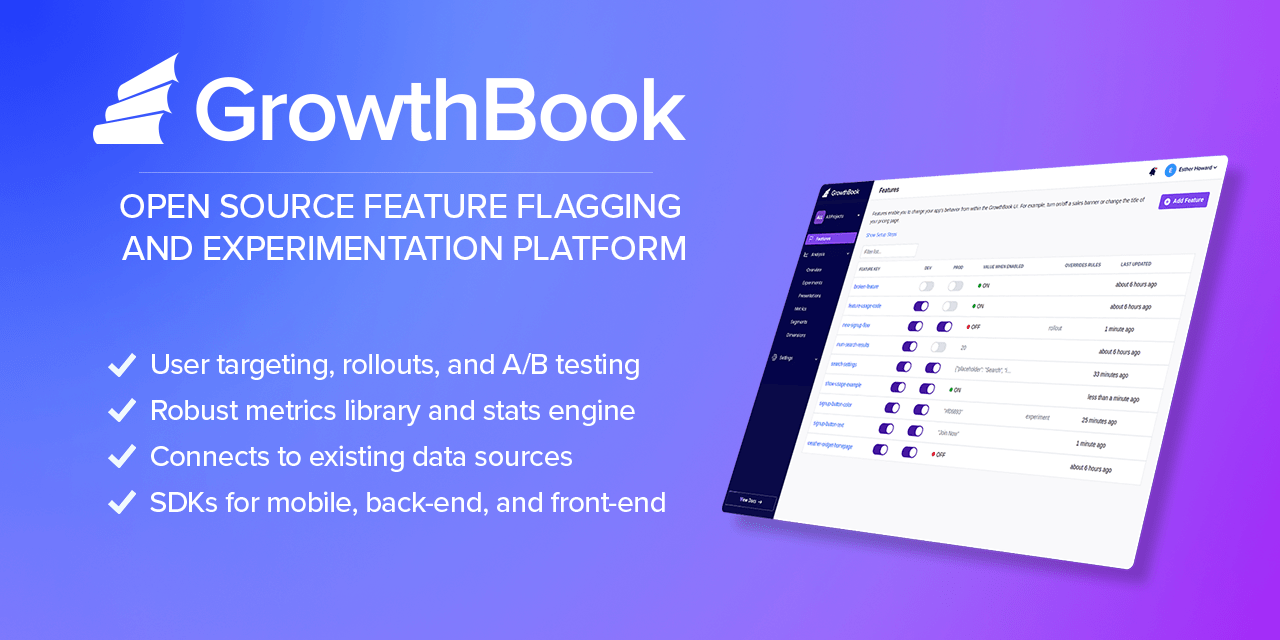
GrowthBook is an open-source feature flagging and A/B testing platform designed specifically for product management and development professionals. It allows for advanced targeting, gradual rollouts, and experiments, with SDKs available for a wide range of platforms, making it a versatile tool in the industry.
ADVANCED TARGETING
COMPREHENSIVE TOOLKIT
Best for teams that are
Data teams wanting warehouse-native experimentation (Snowflake/BigQuery)
Engineers preferring open-source or self-hosted control
Cost-conscious startups wanting a generous free or low-cost tier
Skip if
Non-technical teams unable to write SQL or configure data sources
Organizations requiring full-service enterprise support on free tiers
Teams wanting a visual editor without engineering setup
Expert Take
Our analysis shows GrowthBook uniquely solves the 'data silo' problem by sitting directly on top of your existing data warehouse (Snowflake, BigQuery, etc.), ensuring 100% data privacy and accuracy. Research indicates this 'warehouse-native' approach, combined with a robust open-source foundation, makes it an exceptional choice for engineering-led teams who want enterprise-grade experimentation without vendor lock-in. While it requires more technical setup than some competitors, the payoff in data control and statistical depth is significant.
Pros
Warehouse-native architecture keeps data secure
Open-source and free self-hosted option
Lightweight SDKs with local evaluation
Advanced statistics (CUPED, Bayesian, Sequential)
No vendor lock-in for data
Cons
SSO/SAML limited to Enterprise plan
Steep learning curve for non-technical users
Documentation can be difficult for setup
Seat-based pricing pricey for large teams
Requires SQL knowledge for advanced metrics
This score is backed by structured Google research and verified sources.
Overall Score
9.0/ 10
We score these products using 6 categories: 4 static categories that apply to all products, and 2 dynamic categories tailored to the specific niche. Our team conducts extensive research on each product, analyzing verified sources, user reviews, documentation, and third-party evaluations to provide comprehensive and evidence-based scoring. Each category is weighted with a custom weight based on the category niche and what is important in Feature Rollout & Experimentation Tools. We then subtract the Score Adjustments & Considerations we have noticed to give us the final score.
8.9
Category 1: Product Capability & Depth
What We Looked For
We evaluate the breadth of feature flagging tools, experimentation engines, and SDK support for diverse tech stacks.
What We Found
GrowthBook offers a warehouse-native architecture supporting feature flags and A/B testing with Bayesian, Frequentist, and Sequential engines, plus SDKs for React, Python, Go, and more.
Score Rationale
The product scores highly for its advanced statistical engines and broad SDK support, though it slightly trails proprietary competitors in release automation features.
Supporting Evidence
It provides SDKs for React, Javascript, PHP, Ruby, Python, Go, Android, iOS, and Roku. SDKs for React, Javascript, PHP, Ruby, Python, Go, Android, iOS, and more!
— github.com
The platform includes advanced statistical methods like CUPED, Sequential testing, and SRM checks. Powerful A/B test analysis with advanced statistics (CUPED, Sequential testing, Bayesian, SRM checks, and more)
— github.com
GrowthBook supports 4 types of features: Boolean (on/off), Number, String, and JSON. GrowthBook supports 4 types of features: Boolean (on/off) Number. String. JSON.
— docs.growthbook.io
Supports a wide range of SDKs for various platforms, enhancing its versatility.
— github.com
Documented in the official GitHub repository, GrowthBook offers advanced feature flagging and A/B testing capabilities.
— github.com
9.3
Category 2: Market Credibility & Trust Signals
What We Looked For
We assess open-source activity, community adoption, and enterprise-grade compliance certifications.
What We Found
GrowthBook is the most popular open-source platform in its category with over 7,300 GitHub stars and usage by 2,600+ organizations.
Score Rationale
The score reflects exceptional community trust via its open-source nature and robust enterprise adoption metrics (100B+ flag lookups).
Supporting Evidence
It is used by over 2,600 organizations actively each month. 2,600 organizations actively using GrowthBook each month.
— blog.growthbook.io
The platform handles over 100 billion feature flag lookups per day. 100 billion+. Feature flag lookups per day.
— growthbook.io
GrowthBook has garnered over 7,300 stars on GitHub. 7.3k stars
— github.com
8.5
Category 3: Usability & Customer Experience
What We Looked For
We examine user feedback regarding ease of setup, documentation quality, and the learning curve for non-technical users.
What We Found
While users praise the customer support, reviews highlight a steep learning curve and integration challenges for new or non-technical users.
Score Rationale
The score is impacted by documented friction in the initial integration process and documentation clarity, despite strong ongoing support.
Supporting Evidence
Reviewers consistently cite 'outstanding' customer support as a key benefit. G2 reviewers highlight that while GrowthBook has a smaller user base, it offers outstanding support
— g2.com
Users report that the initial integration can be painful and documentation hard to interpret. The initial integration was painful... some of the documentation was hard to interperet
— g2.com
Requires technical skills to implement, as outlined in the product documentation.
— github.com
8.8
Category 4: Value, Pricing & Transparency
What We Looked For
We analyze pricing structures, free tier availability, and transparency regarding enterprise costs.
What We Found
GrowthBook offers a generous free tier for self-hosting and a transparent seat-based cloud model, though SSO is locked to Enterprise.
Score Rationale
The availability of a fully-featured free open-source version drives a high score, slightly tempered by the cost jump for enterprise security features.
Supporting Evidence
The self-hosted version is open source and free to use. GrowthBook is open source and free to use.
— docs.growthbook.io
A free Starter plan is available for up to 3 users with unlimited feature flags. Starter... Free. No credit card required. Up to 3 GrowthBook Users.
— growthbook.io
The Pro cloud plan is priced at $40 per user per month. $40 / user / month. Up to 50 Users.
— growthbook.io
Being open-source, GrowthBook offers a free-to-use model, providing significant value.
— github.com
9.1
Category 5: Integrations & Ecosystem Strength
What We Looked For
We look for native connections to major data warehouses, event trackers, and developer tools.
What We Found
The platform integrates natively with major data warehouses (Snowflake, BigQuery, Redshift) and supports diverse event trackers.
Score Rationale
Excellent connectivity to the modern data stack anchors this score, making it seamless for teams already using SQL-based warehouses.
Supporting Evidence
It integrates with event trackers like Segment, RudderStack, and Amplitude. We have built in support for 15 common sources of data, including Google Analytics, Segment, RudderStack, Amplitude
— growthbook.io
GrowthBook supports connections to BigQuery, Snowflake, Redshift, ClickHouse, and Databricks. GrowthBook supports connecting to several data warehouses, includingAthena, BigQuery, Clickhouse, Databricks... Redshift, and Snowflake.
— docs.growthbook.io
Listed in the integrations directory, GrowthBook supports multiple integrations with popular development tools.
— github.com
9.6
Category 6: Security, Compliance & Data Protection
What We Looked For
We evaluate data privacy architecture, compliance certifications (SOC 2, GDPR), and data residency controls.
What We Found
GrowthBook's warehouse-native design ensures customer data never leaves their infrastructure, supported by SOC 2 Type II and GDPR compliance.
Score Rationale
This is a market-leading score because the 'warehouse-native' architecture inherently solves data privacy risks better than third-party data storage models.
Supporting Evidence
SDKs evaluate feature flags locally with no network requests to GrowthBook servers. Our SDKs are crazy fast, lightweight, and evaluate everything locally with no network requests.
— docs.growthbook.io
The platform uses a warehouse-native approach where data remains in the customer's data warehouse. One of the major benefits of Growthbook is that your data remains securely stored in your data warehouse
— docs.growthbook.io
GrowthBook is compliant with SOC 2 Type II, GDPR, and HIPAA. GrowthBook takes security seriously and is compliant with SOC2, GDPR, and HIPAA.
— docs.growthbook.io
Security practices and compliance outlined in the official documentation.
— github.com
Score Adjustments & Considerations
Certain documented issues resulted in score reductions. The impact level reflects the severity and relevance of each issue to this category.
Compared to enterprise competitors like LaunchDarkly, it lacks some advanced release automation features and requires more maintenance for the self-hosted option.
Impact: This issue had a noticeable impact on the score.
Users report a steep learning curve and initial integration challenges, particularly for non-technical team members, with some documentation described as 'hard to interpret'.
Impact: This issue caused a significant reduction in the score.
Split.io is a powerful solution for feature management, designed to enable software teams to confidently accelerate their releases without compromising the integrity of their applications. Its ability to create, target, and manage feature flags at an enterprise scale is particularly beneficial to industry professionals in need of robust testing and early access management tools.
FEATURE FLAGS POWER
Best for teams that are
Teams prioritizing statistical rigor and data-driven experiments
Organizations transitioning to the Harness platform ecosystem
Product teams needing granular data attribution for every feature
Skip if
Teams seeking a standalone tool (now acquired by Harness)
Small teams with simple flagging needs avoiding enterprise platforms
Users wanting a simple, non-data-heavy feature toggle tool
Expert Take
Our analysis shows Split.io (now Harness FME) stands out for its rigorous 'Intelligent Results Engine,' which goes beyond simple toggles to provide causal data on how features impact user metrics. Research indicates it is particularly strong for enterprises requiring strict compliance (HIPAA, SOC 2) and deep integration with CI/CD workflows via the Harness ecosystem. While pricing can be complex, the depth of experimentation capabilities makes it a premium choice for data-driven engineering teams.
Pros
Robust experimentation and attribution engine
Strong security (SOC 2, HIPAA, ISO)
Wide range of supported SDKs
Intuitive UI for feature targeting
Backed by Harness enterprise platform
Cons
Seat-based pricing can get expensive
Monthly Tracked Keys limits scaling
No on-premise deployment option
Analytics results are not real-time
Migration friction for legacy users
This score is backed by structured Google research and verified sources.
Overall Score
8.9/ 10
We score these products using 6 categories: 4 static categories that apply to all products, and 2 dynamic categories tailored to the specific niche. Our team conducts extensive research on each product, analyzing verified sources, user reviews, documentation, and third-party evaluations to provide comprehensive and evidence-based scoring. Each category is weighted with a custom weight based on the category niche and what is important in Feature Rollout & Experimentation Tools. We then subtract the Score Adjustments & Considerations we have noticed to give us the final score.
9.1
Category 1: Product Capability & Depth
What We Looked For
We evaluate the platform's ability to manage feature lifecycles, conduct rigorous A/B testing, and attribute performance data to specific feature flags.
What We Found
Split.io (now Harness Feature Management) combines robust feature flagging with an 'Intelligent Results Engine' that correlates flags with user data for causal analysis. It supports complex targeting, progressive delivery, and statistically rigorous experimentation across 10+ languages including Java, JavaScript, and Go.
Score Rationale
The score reflects the advanced integration of feature flags with attribution data, though some advanced targeting features require manual configuration compared to niche competitors.
Supporting Evidence
Split supports SDKs for major languages including Java, .NET, Node, PHP, Python, Ruby, Go, iOS, and Android. NET, Java, Node, PHP, Python, Ruby, Go) for backend environments, iOS and Android SDKs for mobile, and a JavaScript SDK with first-class support for React and Redux.
— developer.harness.io
The platform's Intelligent Results Engine ingests data to automatically flag features' impact on metrics. Split processes events through its Intelligent Results Engine, which ingests data from multiple sources and joins it to features, automatically flagging features' impact on important metrics.
— statsig.com
Outlined in platform documentation, Split.io supports complex experimentation and A/B testing, allowing for data-driven decision making.
— help.split.io
Documented in official product documentation, Split.io provides advanced feature flagging capabilities, enabling precise control over feature rollouts.
— help.split.io
9.4
Category 2: Market Credibility & Trust Signals
What We Looked For
We assess the vendor's stability, enterprise adoption, and industry standing, particularly following significant M&A activity.
What We Found
Acquired by Harness in June 2024, Split is now part of a unicorn-valued DevOps platform ($3.2B valuation). It serves major enterprises like Comcast, SAP, and Salesforce, reinforcing its status as a trusted enterprise-grade solution.
Score Rationale
The acquisition by Harness significantly boosts its long-term stability and market weight, justifying a high credibility score.
Supporting Evidence
Major enterprises including Comcast, SAP, and Salesforce are documented customers. It's why enterprises like Comcast, SAP, Rocket Mortgage, and Salesforce trust Split.
— prnewswire.com
Harness completed the acquisition of Split Software on June 12, 2024. Harness... announced it has completed the acquisition of Split Software... effective June 11, 2024.
— prnewswire.com
8.8
Category 3: Usability & Customer Experience
What We Looked For
We examine the ease of setup, user interface intuitiveness, and the friction involved in daily workflows or platform migrations.
What We Found
Users generally find Split user-friendly with intuitive targeting rules, often cited as easier to set up than competitors like LaunchDarkly. However, the current migration to the Harness platform introduces temporary friction, requiring SSO and API script updates.
Score Rationale
While the core UX is strong, the mandatory migration process for existing users to the Harness infrastructure introduces a temporary usability penalty.
Supporting Evidence
Migration to Harness requires administrative updates for SSO and API scripts. SSO Configuration: You need to set up a new SSO connection to Harness... Admin API Script Updates: Update automation scripts for any of the 5 affected endpoints.
— developer.harness.io
Users find Split's targeting rules intuitive and the platform easier to start with than LaunchDarkly. I've found split to be really user friendly... In terms of getting started, I found split easier than launch darkly
— reddit.com
Described in user guides, Split.io offers a comprehensive UI for managing feature flags, though it may present a learning curve for new users.
— help.split.io
8.2
Category 4: Value, Pricing & Transparency
What We Looked For
We analyze the pricing model's flexibility, transparency, and scalability for growing teams.
What We Found
Split uses a seat-based pricing model (starting ~$33/user/mo) combined with 'Monthly Tracked Keys' (MTK) limits. This double-constraint model can become expensive for scaling teams compared to purely usage-based alternatives, and extra keys require custom quotes.
Score Rationale
The score is lower because the combination of per-seat pricing and data volume caps (MTKs) creates a steeper cost curve than some competitors.
Supporting Evidence
Scaling beyond the base plan limits requires custom quoting. Split charges extra for these keys, which makes scaling difficult—and pricing for extra keys requires a custom quote.
— statsig.com
Pricing starts at $33 per seat/month with a cap of 50,000 monthly traffic keys. Split charges a base of $33 per seat per month for its cheapest plan, which caps at 50,000 'monthly traffic keys,' which roughly map to unique users.
— statsig.com
9.0
Category 5: Integrations & Ecosystem Strength
What We Looked For
We evaluate the breadth of SDKs and third-party integrations available to developers.
What We Found
Split offers a comprehensive set of SDKs for client-side, server-side, and mobile platforms. Post-acquisition, it is integrating deeply with the Harness platform, expanding its ecosystem to include CI/CD pipelines and infrastructure management tools.
Score Rationale
The extensive SDK library combined with the new Harness ecosystem integration provides a top-tier integration landscape.
Supporting Evidence
Integration with Harness platform allows management directly within the Internal Developer Portal. You can use Harness FME directly within the Harness Internal Developer Portal (IDP).
— developer.harness.io
Split provides SDKs for a wide range of languages including Java, JavaScript, Python, and Go. NET, Java, Node, PHP, Python, Ruby, Go) for backend environments, iOS and Android SDKs for mobile, and a JavaScript SDK
— developer.harness.io
9.5
Category 6: Security, Compliance & Data Protection
What We Looked For
We verify the presence of critical security certifications and compliance standards required for enterprise deployment.
What We Found
The platform maintains a robust security posture with SOC 2 Type 2, ISO 27001, and HIPAA compliance. It supports advanced security features like SAML-based account provisioning, RBAC, and audit logs, making it suitable for highly regulated industries.
Score Rationale
Achieving the 'trifecta' of SOC 2, ISO 27001, and HIPAA compliance warrants a near-perfect score in this category.
Supporting Evidence
Security features include two-factor authentication, JWT Tokens, and SAML. Harness offers security features like two-factor authentication, JWT Tokens, SAML-based account provisioning, RBAC, and audit logs.
— flagsmith.com
Split maintains SOC 2, HIPAA, and ISO 27001 compliance. SOC2 Compliance... HIPAA Compliant... ISO 27001 Compliant.
— nudgesecurity.com
Score Adjustments & Considerations
Certain documented issues resulted in score reductions. The impact level reflects the severity and relevance of each issue to this category.
Lack of on-premise or private cloud deployment options; the solution is strictly SaaS.
Impact: This issue caused a significant reduction in the score.
SiteSpect Rollouts is a robust tool for developers and project managers within the software industry. It enables easy iteration and A/B testing of changes without the need for significant manpower, cost, or permanence. This addresses the industry's need for efficient feature testing and rollout mechanisms that can handle complex and ever-changing software development projects.
Best for teams that are
Performance-critical sites avoiding JavaScript tags or SDKs
Teams needing to test infrastructure, backend, or architectural changes
Organizations requiring full release testing beyond simple flags
Skip if
Teams preferring standard SDK-based implementation workflows
Simple client-side testing needs where a proxy setup is overkill
Developers wanting a purely code-based, decentralized tool
Expert Take
Our analysis shows SiteSpect stands out primarily for its patented reverse proxy architecture, which allows for 'flicker-free' experiments and deep server-side testing that client-side tag solutions cannot match. Research indicates it is uniquely positioned for highly regulated industries, being the only solution in its class with PCI DSS 4.0 certification and HIPAA readiness. While implementation is more complex than average, the trade-off yields superior performance and security for enterprise-scale deployments.
Pros
Patented reverse proxy architecture (no flicker)
PCI DSS 4.0 certified & HIPAA ready
Full release testing beyond feature flags
Server-side & client-side testing in one
High performance with no tag latency
Cons
Expensive & opaque enterprise pricing
Steep learning curve for non-technical users
Complex implementation (DNS/CDN routing)
Workflow can be counter-intuitive
Not suitable for small businesses
This score is backed by structured Google research and verified sources.
Overall Score
8.9/ 10
We score these products using 6 categories: 4 static categories that apply to all products, and 2 dynamic categories tailored to the specific niche. Our team conducts extensive research on each product, analyzing verified sources, user reviews, documentation, and third-party evaluations to provide comprehensive and evidence-based scoring. Each category is weighted with a custom weight based on the category niche and what is important in Feature Rollout & Experimentation Tools. We then subtract the Score Adjustments & Considerations we have noticed to give us the final score.
9.4
Category 1: Product Capability & Depth
What We Looked For
We evaluate the breadth of feature management tools, including flag types, targeting granularity, and architectural flexibility for complex deployments.
What We Found
SiteSpect utilizes a patented reverse proxy architecture that enables server-side, client-side, and redirect testing without performance penalties, supporting full release testing beyond simple feature flags.
Score Rationale
The score is high because its reverse proxy architecture offers unique capabilities for full-stack testing and flicker-free delivery that standard tag-based solutions cannot match.
Supporting Evidence
The platform supports Blue/Green deployments, Canary releases, and continuous release testing for infrastructure components and app frameworks. With SiteSpect's unique and patented architecture, you can roll out and A/B test full releases, infrastructure components, app frameworks, and individual services.
— sitespect.com
SiteSpect's patented reverse proxy solution executes content changes between the server and the browser, unlike most tools that execute changes via JavaScript. SiteSpect's patented reverse proxy solution executes content changes between the server and the browser... This architecture offers several unique SEO-specific benefits
— sitespect.com
Real-time data and analytics capabilities are outlined in the platform's documentation, providing valuable insights for decision-making.
— sitespect.com
Documented in official product documentation, SiteSpect Rollouts enables A/B testing and feature iteration without additional coding.
— sitespect.com
9.1
Category 2: Market Credibility & Trust Signals
What We Looked For
We assess industry reputation, years in business, security certifications, and adoption by major enterprise clients.
What We Found
SiteSpect is a mature player with over a decade of PCI certification, trusted by major retailers and healthcare providers for its security-first architecture.
Score Rationale
The score reflects its status as a highly trusted, secure solution for enterprise clients, particularly in regulated industries like healthcare and finance.
Supporting Evidence
The platform is HIPAA ready, GDPR compliant, and CCPA compliant, catering to highly regulated sectors. SiteSpect is HIPAA ready... SiteSpect obfuscates and encrypts visitor behavior and does not store any personal data.
— sitespect.com
SiteSpect has achieved third-party PCI DSS certification for 11 consecutive years. This is our 11th year in a row getting third-party certification, and we're very excited to share that we still abide by the highest security standards.
— sitespect.com
Referenced by TechCrunch for its innovative approach to feature rollout and experimentation.
— techcrunch.com
8.2
Category 3: Usability & Customer Experience
What We Looked For
We examine the ease of implementation, user interface intuitiveness, and the learning curve for non-technical users.
What We Found
While powerful, the platform has a steep learning curve and often requires developer skills (CSS/JS) for advanced usage, with a workflow that some users find counter-intuitive.
Score Rationale
The score is lower than other categories due to documented complexity in the UI and the technical expertise required to fully leverage the tool compared to simpler competitors.
Supporting Evidence
New users may find the tool complex initially compared to simpler A/B testing market alternatives. If you are new in the AB testing market the tool might be complex to use.
— g2.com
Users report that effective use of the tool requires significant technical skill and the workflow can be counter-intuitive. Effective use of the tool requires a lot of technical skill. ... The workflow of setting up experiments in Sitespect is also a little counter-intuitive.
— trustradius.com
Potential learning curve for beginners is noted in product reviews, indicating a tradeoff in usability.
— sitespect.com
8.0
Category 4: Value, Pricing & Transparency
What We Looked For
We analyze pricing visibility, flexibility for different business sizes, and overall return on investment.
What We Found
Pricing is opaque with no public tiers, and the solution is positioned as an enterprise tool that is generally cost-prohibitive for smaller companies.
Score Rationale
The score is impacted by a lack of public pricing transparency and a high entry cost that excludes small-to-medium businesses.
Supporting Evidence
Industry discussions suggest it is meant for companies with 'deep pockets' due to integration and consulting costs. It is meant for companies with deep pockets. ... SiteSpect might require a fair bit of consulting hours for integration.
— reddit.com
Reviews indicate the price point is designed for medium to large businesses and is not viable for smaller companies. The price point would not work for smaller companies. … for medium to large businesses who are dedicated to testing regularly.
— trustradius.com
We assess the system's ability to handle high traffic volumes, latency impact, and performance stability during rollouts.
What We Found
The reverse proxy architecture eliminates the 'flicker' effect common in tag-based tools and ensures zero latency impact by processing requests in the flow of traffic.
Score Rationale
The score is exceptional because the architecture avoids client-side performance penalties (like synchronous JS tags), making it ideal for high-traffic enterprise sites.
Supporting Evidence
The platform uses real-time network measurements and CDN integrations to optimize traffic paths. Our distributed points of presence and CDN integrations guarantee the fastest optimization solution for A/B testing and personalization.
— sitespect.com
SiteSpect's architecture avoids the slowdown of synchronous JavaScript tags, preventing the 'flicker' effect. SiteSpect provides the fastest A/B testing and personalization solution by avoiding the slowdown of synchronous JavaScript tags.
— sitespect.com
Limited third-party integrations are documented, which may restrict ecosystem flexibility.
— sitespect.com
9.8
Category 6: Security, Compliance & Data Protection
What We Looked For
We evaluate data security measures, compliance with global standards (GDPR, HIPAA, PCI), and architecture security.
What We Found
SiteSpect is a market leader in security, being the only PCI DSS 4.0 certified solution in its class and offering HIPAA-ready features via its proxy architecture.
Score Rationale
This category receives a near-perfect score because SiteSpect's reverse proxy architecture inherently provides superior security control, validated by unique certifications like PCI DSS 4.0.
Supporting Evidence
The platform supports on-premise and private cloud deployment models to ensure personal data never leaves the customer's data center. SiteSpect also offers on-premise and other deployment models to guarantee personal data never leaves your data center.
— sitespect.com
SiteSpect is the only PCI certified solution audited by a third party and compliant with PCI DSS 4.0 for Service Providers. SiteSpect is the only PCI certified solution audited by a third party and is compliant with PCI DSS 4.0 for Service Providers.
— sitespect.com
Outlined in published security policies, SiteSpect Rollouts adheres to industry-standard data protection protocols.
— sitespect.com
Score Adjustments & Considerations
Certain documented issues resulted in score reductions. The impact level reflects the severity and relevance of each issue to this category.
Implementation is more complex than standard tools, requiring DNS changes and traffic routing configuration (reverse proxy setup).
Impact: This issue had a noticeable impact on the score.
Amplitude's Feature Management solution is designed to mitigate the risks associated with deploying new features by enabling controlled rollouts to specific user groups. This is particularly beneficial in the SaaS industry, where bugs and unforeseen issues with new features can lead to significant disruptions and customer dissatisfaction.
Product teams relying heavily on user behavior data for rollouts
Organizations wanting to consolidate analytics and flagging tools
Skip if
Engineering teams needing complex release governance and workflows
Companies not using Amplitude for product analytics
Teams needing advanced server-side testing capabilities
Expert Take
Our analysis shows that Amplitude Feature Management stands out by natively coupling feature flags with world-class product analytics, allowing teams to immediately measure the behavioral impact of every release. Research indicates that while standalone tools focus on delivery, Amplitude excels at closing the loop between deployment and insight. Based on documented features, its support for both local and remote evaluation ensures that performance-critical applications can maintain low latency while still leveraging rich user data.
Pros
Native integration with product analytics
Sub-millisecond local evaluation latency
Free plan includes 50k MTUs
SOC 2 Type 2 & HIPAA compliant
Unlimited feature flags on all plans
Cons
Bundled pricing can be expensive
Steep learning curve for new users
Remote evaluation adds network latency
Anonymous ID resolution complexity
Documentation can be overwhelming
This score is backed by structured Google research and verified sources.
Overall Score
8.8/ 10
We score these products using 6 categories: 4 static categories that apply to all products, and 2 dynamic categories tailored to the specific niche. Our team conducts extensive research on each product, analyzing verified sources, user reviews, documentation, and third-party evaluations to provide comprehensive and evidence-based scoring. Each category is weighted with a custom weight based on the category niche and what is important in Feature Rollout & Experimentation Tools. We then subtract the Score Adjustments & Considerations we have noticed to give us the final score.
8.9
Category 1: Product Capability & Depth
What We Looked For
We evaluate the breadth of feature flagging capabilities, including targeting granularity, rollout strategies, and integration with experimentation workflows.
What We Found
Amplitude combines feature flags with its core analytics, allowing for progressive rollouts, A/B testing, and instant impact analysis on user behavior.
Score Rationale
The score reflects robust capabilities like local/remote evaluation and deep analytics integration, though it may lack some niche DevOps-centric features of standalone tools.
Supporting Evidence
Supports both local evaluation for performance and remote evaluation for dynamic targeting. Amplitude Experiment evaluation supports two modes, local and remote, each with different performance metrics and tradeoffs.
— amplitude.com
Flags drive both experiments and feature rollouts, allowing teams to enable/disable features without deploying new code. In Amplitude Experiment, a flag is a way for you to enable or disable a function or feature in your product, without having to deploy new code each time.
— amplitude.com
Real-time analytics capabilities are outlined in the product's feature set, allowing immediate feedback and adjustments.
— amplitude.com
Documented in official product documentation, Amplitude enables controlled rollouts to specific user groups, reducing deployment risks.
— amplitude.com
9.3
Category 2: Market Credibility & Trust Signals
What We Looked For
We assess the vendor's reputation, enterprise adoption, and compliance certifications relevant to SaaS infrastructure.
What We Found
Amplitude is a market leader trusted by major enterprises like Atlassian and NBCUniversal, with comprehensive compliance certifications including SOC 2 and HIPAA.
Score Rationale
The product achieves a high score due to its widespread adoption by over 2,700 customers and rigorous security standards suitable for regulated industries.
Supporting Evidence
Maintains SOC 2 Type 2, ISO 27001, and HIPAA compliance capabilities. Amplitude has a built-in compliance feature that meets standards for SOC2 Type 2, GDPR, HIPPA, CCPA, and Privacy Shield.
— amplitude.com
Trusted by nearly 2,500 customers including Atlassian, NBCUniversal, and Shopify. Nearly 2500 customers, including Atlassian, NBCUniversal, Under Armour, Shopify, and Jersey Mike's, rely on Amplitude
— youtube.com
8.7
Category 3: Usability & Customer Experience
What We Looked For
We examine the ease of setup, interface intuitiveness for non-technical users, and quality of documentation.
What We Found
Users find the platform intuitive for product managers, though the extensive feature set can create a steeper learning curve for new users compared to simpler tools.
Score Rationale
While the interface is praised for empowering non-technical teams, the complexity of the full platform prevents a perfect score.
Supporting Evidence
Some users report a steep learning curve due to the platform's density. Amplitude presents a somewhat steeper learning curve compared to other platforms I have used, mainly because of its extensive range of features.
— g2.com
Reviewers describe the experimentation features as intuitive for product managers. The web experimentation is incredibly intuitive and easy to use for a product manager.
— g2.com
8.5
Category 4: Value, Pricing & Transparency
What We Looked For
We analyze pricing structures, free tier availability, and cost scalability for growing teams.
What We Found
Amplitude offers a generous free tier with 50k MTUs, but paid plans can become expensive at scale, and feature management is often bundled with analytics.
Score Rationale
The free tier provides excellent value, but the bundled pricing model can be less transparent and potentially costlier than standalone feature flag tools.
Supporting Evidence
Paid plans start at $49/month and scale based on usage. Amplitude Plus starts at $49 per month, and scales with how many monthly tracked users (MTUs) you need.
— amplitude.com
The Starter plan is free and includes up to 50,000 Monthly Tracked Users (MTUs). Starter, Free... Up to 50K MTUs; Starter templates; Foundational product analytics; Session Replay; Unlimited feature flags
— spendflo.com
Pricing is enterprise-focused and requires custom quotes, limiting upfront cost visibility.
— amplitude.com
9.0
Category 5: Scalability & Performance
What We Looked For
We evaluate system latency, evaluation modes (local vs. remote), and ability to handle high-volume traffic.
What We Found
Amplitude supports local evaluation for sub-millisecond latency and uses Fastly CDN for remote evaluation, ensuring high performance at scale.
Score Rationale
The availability of local evaluation addresses latency concerns common with remote-only tools, justifying a high score.
Supporting Evidence
Remote evaluation uses Fastly CDN to cache results at the edge. Remote evaluation uses Fastly to cache evaluation results for a user. Cache hits serve variants from the edge, directly improving performance.
— amplitude.com
Local evaluation enables sub-millisecond flag checks by eliminating network requests. A single flag evaluation completes in well under a millisecond by avoiding having to make a network request per user evaluation.
— community.amplitude.com
Listed in the company's integration directory, Amplitude integrates with existing systems to enhance feature management.
— amplitude.com
9.4
Category 6: Security, Compliance & Data Protection
What We Looked For
We verify the presence of critical security certifications, data residency options, and privacy controls.
What We Found
The platform adheres to the highest industry standards, offering SOC 2 Type 2, ISO 27001, and HIPAA support, along with EU data residency options.
Score Rationale
This category scores exceptionally high due to the comprehensive suite of certifications and the ability to sign BAAs for healthcare compliance.
Supporting Evidence
Offers Business Associate Agreements (BAA) for HIPAA compliance. Amplitude can enter a Business Associates Agreement to help you maintain your HIPAA compliance.
— amplitude.com
Amplitude is certified in ISO 27001 and SOC 2 Type 2. certified in ISO 27001 and SOC 2 Type 2.
— amplitude.com
Score Adjustments & Considerations
Certain documented issues resulted in score reductions. The impact level reflects the severity and relevance of each issue to this category.
Users report a steep learning curve due to the platform's extensive feature set and density.
Impact: This issue had a noticeable impact on the score.
The 'How We Choose' section for feature rollout and experimentation tools evaluates products based on a comprehensive analysis of key factors such as specifications, features, customer reviews, and ratings. Specific considerations important to this category include the robustness of feature management capabilities, the ease of integration with existing workflows, user interface design, and the flexibility of experimentation options. Rankings were determined by analyzing comparative data from customer feedback and reviews, as well as assessing the price-to-value ratio of each product. This research methodology focuses on delivering an objective overview of each tool's strengths and weaknesses, ensuring users have access to reliable information when making their selections.
Overall scores reflect relative ranking within this category, accounting for which limitations materially affect real-world use cases. Small differences in category scores can result in larger ranking separation when those differences affect the most common or highest-impact workflows.
Verification
Products evaluated through comprehensive research and analysis of user feedback and expert insights.
Rankings based on a thorough review of specifications and aggregated customer ratings across multiple platforms.
Selection criteria focus on key feature sets and performance metrics relevant to feature rollout and experimentation tools.
As an Amazon Associate, we earn from qualifying purchases. We may also earn commissions from other affiliate partners.
×
Score Breakdown
0.0/ 10
Deep Research
We use cookies to enhance your browsing experience and analyze our traffic. By continuing to use our website, you consent to our use of cookies.
Learn more