
GRC & Risk Management Platforms

These are the specialized categories within GRC & Risk Management Platforms. Looking for something broader? See all Cybersecurity, Privacy & Compliance Software categories.

1
Score
9.9 / 10
Tracker Networks GRC Solution

Tracker Networks GRC Solution is a comprehensive Governance, Risk & Compliance (GRC) platform tailored specifically for the real estate industry. It helps manage property risks, maintain compliance, and protect tenant data across all property types, directly addressing the key needs of real estate companies.

Best for Governance, Risk & Compliance (GRC) Tools for Real Estate Agents
Expert Take

Tracker Networks GRC Solution excels in providing a specialized platform for real estate professionals, addressing specific industry needs with robust risk management and compliance tools. While pricing transparency is limited, the product's capabilities and market credibility are well-supported by third-party validations.

Pros

  • Unique bow-tie risk analysis diagrams
  • Operational in 1 day (rapid setup)
  • Integrated 6-in-1 GRC suite
  • AI-powered predictive risk analytics
  • SOC 2 Type II & ISO 27001 certified

Cons

  • Limited customization options
  • Steeper learning curve for some features
  • Reporting features could be more flexible
  • Limited entry-level support tiers
  • Fewer integrations than larger enterprise rivals

Best for teams that are

  • Real estate firms needing quick deployment for property risk
  • Managers tracking tenant data privacy and building compliance
  • Teams wanting a user-friendly, AI-powered platform

Skip if

  • Organizations seeking heavy, on-premise legacy systems
  • Companies requiring deep customization of legacy ERP code
  • Users looking for a free or open-source basic tool

Best for teams that are

  • Real estate firms needing quick deployment for property risk
  • Managers tracking tenant data privacy and building compliance
  • Teams wanting a user-friendly, AI-powered platform

Skip if

  • Organizations seeking heavy, on-premise legacy systems
  • Companies requiring deep customization of legacy ERP code
  • Users looking for a free or open-source basic tool

Pros

  • Unique bow-tie risk analysis diagrams
  • Operational in 1 day (rapid setup)
  • Integrated 6-in-1 GRC suite
  • AI-powered predictive risk analytics
  • SOC 2 Type II & ISO 27001 certified

Cons

  • Limited customization options
  • Steeper learning curve for some features
  • Reporting features could be more flexible
  • Limited entry-level support tiers
  • Fewer integrations than larger enterprise rivals

Expert Take

Tracker Networks GRC Solution excels in providing a specialized platform for real estate professionals, addressing specific industry needs with robust risk management and compliance tools. While pricing transparency is limited, the product's capabilities and market credibility are well-supported by third-party validations.

2
Score
9.9 / 10
Workiva GRC Software

Workiva's GRC Software is tailored specifically for consulting firms, providing an AI-powered platform that unifies stakeholders and streamlines data and processes. It offers an effective solution for real-time response to emerging risks, which is crucial in this fast-paced industry.

Best for Governance, Risk & Compliance (GRC) Tools for Consulting Firms

Expert Take

Workiva GRC Software stands out in the consulting firm sector for its AI-powered platform that unifies stakeholders and streamlines processes. It is recognized for its comprehensive risk management capabilities and secure data handling. While its complexity may require training, it remains a top choice for firms needing robust compliance management.

Pros

  • Unlimited user licensing model
  • Unified financial and GRC reporting
  • FedRAMP Moderate security authorization
  • 70+ pre-built system connectors
  • Real-time cross-team collaboration

Cons

  • Steep learning curve for new users
  • Performance lags with large files
  • High implementation and annual costs
  • Less flexible than Excel for modeling
  • No public pricing transparency

Best for teams that are

  • Public companies managing SOX, SEC, and ESG reporting
  • Audit teams requiring strong collaboration and document management

Skip if

  • Private SMBs not subject to complex financial reporting mandates
  • Teams seeking a standalone IT risk tool without financial reporting

Best for teams that are

  • Public companies managing SOX, SEC, and ESG reporting
  • Audit teams requiring strong collaboration and document management

Skip if

  • Private SMBs not subject to complex financial reporting mandates
  • Teams seeking a standalone IT risk tool without financial reporting

Pros

  • Unlimited user licensing model
  • Unified financial and GRC reporting
  • FedRAMP Moderate security authorization
  • 70+ pre-built system connectors
  • Real-time cross-team collaboration

Cons

  • Steep learning curve for new users
  • Performance lags with large files
  • High implementation and annual costs
  • Less flexible than Excel for modeling
  • No public pricing transparency

Expert Take

Workiva GRC Software stands out in the consulting firm sector for its AI-powered platform that unifies stakeholders and streamlines processes. It is recognized for its comprehensive risk management capabilities and secure data handling. While its complexity may require training, it remains a top choice for firms needing robust compliance management.

3
Score
9.8 / 10
Mitratech GRC Solution

Mitratech's Governance, Risk, and Compliance (GRC) framework is a robust solution that enables SaaS companies to manage risk, improve compliance, and achieve business goals. It provides an enterprise-wide view of risk and compliance, helping businesses to identify, assess, and manage potential threats while adhering to regulatory standards.

Best for Governance, Risk & Compliance (GRC) Tools for SaaS Companies

Expert Take

Mitratech's GRC Solution is a comprehensive tool for SaaS companies, offering robust risk management and compliance capabilities. Its enterprise-wide view of risk and compliance, combined with customizable workflows, makes it a strong choice for businesses aiming to align goals and manage potential threats effectively.

Pros

  • Unified legal, risk, and HR platform
  • AI-driven risk assessments via Alyne
  • 1,500+ regulatory templates out-of-the-box
  • Strong third-party risk management (Prevalent)
  • SOC 2 Type II and ISO 27001 certified

Cons

  • Complex implementation and steep learning curve
  • Premium pricing excludes smaller businesses
  • Dated interface in some legacy modules
  • Opaque public pricing structure
  • Slow technical support resolution reported

Best for teams that are

  • Large enterprises with complex legal and policy compliance needs
  • Legal departments requiring integrated matter and risk management
  • Organizations needing AI-driven policy enforcement

Skip if

  • Small to mid-sized businesses seeking lightweight tools
  • Teams wanting a single, unified tool rather than a suite
  • Organizations with limited implementation resources

Best for teams that are

  • Large enterprises with complex legal and policy compliance needs
  • Legal departments requiring integrated matter and risk management
  • Organizations needing AI-driven policy enforcement

Skip if

  • Small to mid-sized businesses seeking lightweight tools
  • Teams wanting a single, unified tool rather than a suite
  • Organizations with limited implementation resources

Pros

  • Unified legal, risk, and HR platform
  • AI-driven risk assessments via Alyne
  • 1,500+ regulatory templates out-of-the-box
  • Strong third-party risk management (Prevalent)
  • SOC 2 Type II and ISO 27001 certified

Cons

  • Complex implementation and steep learning curve
  • Premium pricing excludes smaller businesses
  • Dated interface in some legacy modules
  • Opaque public pricing structure
  • Slow technical support resolution reported

Expert Take

Mitratech's GRC Solution is a comprehensive tool for SaaS companies, offering robust risk management and compliance capabilities. Its enterprise-wide view of risk and compliance, combined with customizable workflows, makes it a strong choice for businesses aiming to align goals and manage potential threats effectively.

4
Score
9.8 / 10
4
9.8 / 10
Aravo GRC Solutions

Aravo's GRC software platform is a robust solution for property managers, designed to streamline third-party risk management and ensure enterprise adaptability. Its powerful workflow automation and compliance features help property managers stay on top of governance and risk, making it an essential tool in managing properties effectively and efficiently.

Best for Governance, Risk & Compliance (GRC) Tools for Property Managers
Expert Take

Aravo GRC Solutions is tailored for property management, offering comprehensive governance, risk, and compliance features. Its workflow automation and adaptability make it a strong choice for enterprise-level property managers. Despite a learning curve and potential cost concerns, its depth and industry focus justify its premium positioning.

Pros

  • Supports 50+ risk and compliance domains
  • Leader in Gartner and Forrester reports
  • AI-powered risk scoring and evaluation
  • Scales to millions of third-party users
  • Integrates with BitSight, Refinitiv, and ERPs

Cons

  • High implementation and monthly costs
  • Search functionality can be slow
  • Aggressive session timeouts interrupt work
  • Reporting interface can be complex
  • Rigid environment for some users

Best for teams that are

  • Large enterprises with complex global supply chains
  • Teams focused specifically on Third-Party Risk Management (TPRM)
  • Procurement departments managing vendor compliance and risk

Skip if

  • Small businesses with few vendors or simple needs
  • Teams looking for a general internal audit or IT GRC tool
  • Organizations not focused on supply chain or vendor risk

Best for teams that are

  • Large enterprises with complex global supply chains
  • Teams focused specifically on Third-Party Risk Management (TPRM)
  • Procurement departments managing vendor compliance and risk

Skip if

  • Small businesses with few vendors or simple needs
  • Teams looking for a general internal audit or IT GRC tool
  • Organizations not focused on supply chain or vendor risk

Pros

  • Supports 50+ risk and compliance domains
  • Leader in Gartner and Forrester reports
  • AI-powered risk scoring and evaluation
  • Scales to millions of third-party users
  • Integrates with BitSight, Refinitiv, and ERPs

Cons

  • High implementation and monthly costs
  • Search functionality can be slow
  • Aggressive session timeouts interrupt work
  • Reporting interface can be complex
  • Rigid environment for some users

Expert Take

Aravo GRC Solutions is tailored for property management, offering comprehensive governance, risk, and compliance features. Its workflow automation and adaptability make it a strong choice for enterprise-level property managers. Despite a learning curve and potential cost concerns, its depth and industry focus justify its premium positioning.

5
Score
9.8 / 10
Aclaimant GRC Platform

Aclaimant is a Governance, Risk and Compliance (GRC) software specifically tailored to the needs of real estate agents. It centralizes risk management, providing a single view of risk, streamlining operations, and allowing professionals to manage potential threats effectively.

Best for Governance, Risk & Compliance (GRC) Tools for Real Estate Agents

Expert Take

Aclaimant GRC Platform is tailored for the real estate industry, offering centralized risk management and data-driven insights. It excels in providing a comprehensive view of risk, crucial for real estate professionals. While the platform requires some technical knowledge, it remains a top choice for effective risk governance.

Pros

  • SOC 2 Type II certified security
  • Mobile-first field incident reporting
  • Automated OSHA log generation
  • Strong integrations with Procore & UKG
  • Award-winning customer support

Cons

  • No public pricing available
  • Setup can be time-consuming
  • Less focus on financial/IT risk
  • Repetitive screens in some workflows
  • Requires customization for best results

Best for teams that are

  • Property managers focusing on safety, incidents, and claims
  • Teams with field staff needing mobile incident reporting
  • Construction and real estate firms wanting to reduce insurance costs

Skip if

  • Companies looking solely for IT or Cyber GRC solutions
  • Small office-based agencies with no field operations
  • Organizations needing deep financial audit management

Best for teams that are

  • Property managers focusing on safety, incidents, and claims
  • Teams with field staff needing mobile incident reporting
  • Construction and real estate firms wanting to reduce insurance costs

Skip if

  • Companies looking solely for IT or Cyber GRC solutions
  • Small office-based agencies with no field operations
  • Organizations needing deep financial audit management

Pros

  • SOC 2 Type II certified security
  • Mobile-first field incident reporting
  • Automated OSHA log generation
  • Strong integrations with Procore & UKG
  • Award-winning customer support

Cons

  • No public pricing available
  • Setup can be time-consuming
  • Less focus on financial/IT risk
  • Repetitive screens in some workflows
  • Requires customization for best results

Expert Take

Aclaimant GRC Platform is tailored for the real estate industry, offering centralized risk management and data-driven insights. It excels in providing a comprehensive view of risk, crucial for real estate professionals. While the platform requires some technical knowledge, it remains a top choice for effective risk governance.

6
Score
9.8 / 10
Archer GRC SaaS Solutions

Archer's GRC SaaS Solutions is a robust governance, risk, and compliance tool tailored specifically for SaaS companies. With its features, it aids in improving compliance, reducing risk, and streamlining decision-making processes.

Best for Governance, Risk & Compliance (GRC) Tools for SaaS Companies

Expert Take

Archer GRC SaaS Solutions excels in providing comprehensive governance, risk, and compliance features tailored for SaaS companies. Its robust capabilities, industry recognition, and strong support infrastructure position it as a leading solution in its category.

Pros

  • Comprehensive enterprise-grade risk modules
  • AI-driven risk quantification (Archer Evolv)
  • Extensive integration marketplace (Archer Exchange)
  • Highly configurable workflow automation
  • Strong regulatory compliance support

Cons

  • Steep learning curve for new users
  • Outdated user interface design
  • High total cost of ownership
  • Limited native reporting flexibility
  • Complex and lengthy implementation

Best for teams that are

  • Fortune 500 companies with complex, mature risk programs
  • Organizations with dedicated GRC technical staff/developers
  • Enterprises needing deep, granular configurability

Skip if

  • SMBs or mid-market companies with limited resources
  • Teams without dedicated GRC administrators
  • Users prioritizing modern, intuitive user experiences

Best for teams that are

  • Fortune 500 companies with complex, mature risk programs
  • Organizations with dedicated GRC technical staff/developers
  • Enterprises needing deep, granular configurability

Skip if

  • SMBs or mid-market companies with limited resources
  • Teams without dedicated GRC administrators
  • Users prioritizing modern, intuitive user experiences

Pros

  • Comprehensive enterprise-grade risk modules
  • AI-driven risk quantification (Archer Evolv)
  • Extensive integration marketplace (Archer Exchange)
  • Highly configurable workflow automation
  • Strong regulatory compliance support

Cons

  • Steep learning curve for new users
  • Outdated user interface design
  • High total cost of ownership
  • Limited native reporting flexibility
  • Complex and lengthy implementation

Expert Take

Archer GRC SaaS Solutions excels in providing comprehensive governance, risk, and compliance features tailored for SaaS companies. Its robust capabilities, industry recognition, and strong support infrastructure position it as a leading solution in its category.

7
Score
9.8 / 10
Diligent GRC Solution

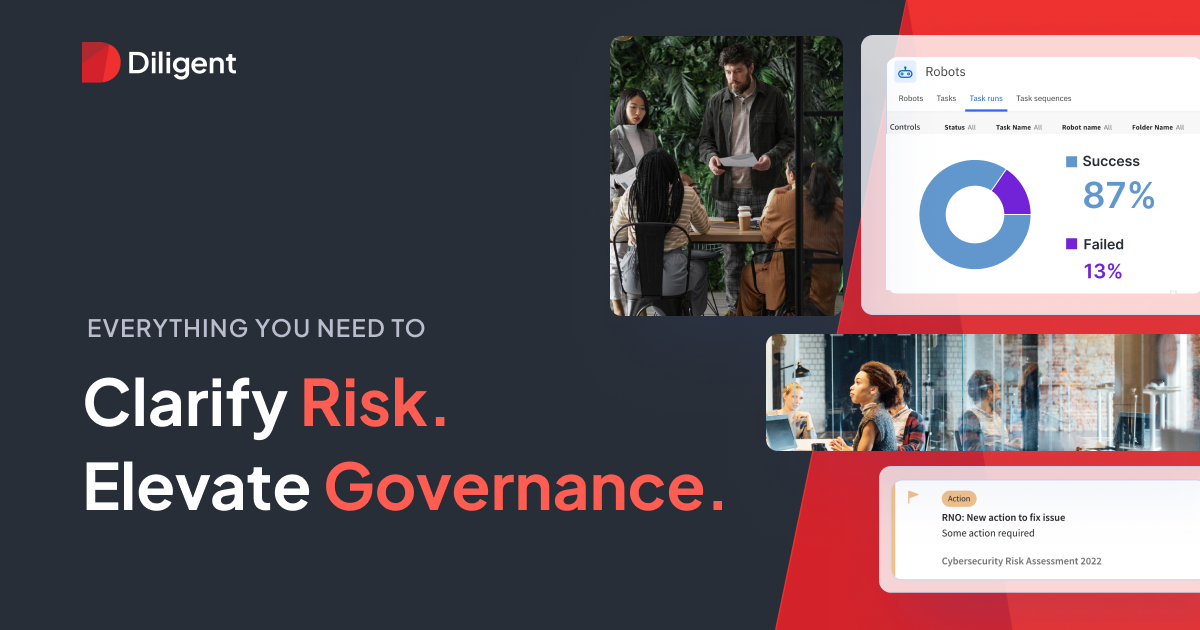
Diligent's Governance, Risk, and Compliance (GRC) solution is uniquely tailored for consulting firms. It excels in integrating GRC functions to ensure all operations align with strategic objectives, making it an invaluable tool for managing risk and maintaining regulatory compliance.

Best for Governance, Risk & Compliance (GRC) Tools for Consulting Firms
Expert Take

Diligent GRC Solution is tailored for consulting firms, offering comprehensive governance, risk, and compliance management. It integrates advanced capabilities to align operations with strategic objectives. Despite potential high costs and a learning curve, its robust features and industry-specific design justify its premium positioning.

Pros

  • Trusted by 75% of Fortune 500
  • FedRAMP Moderate & DoD IL-5 authorized
  • Unified Board & GRC platform
  • Powerful ACL Robotics automation engine
  • Leader in 2025 Gartner Magic Quadrant

Cons

  • Steep learning curve for new users
  • Opaque pricing with high renewal hikes
  • Expensive for small/mid-sized businesses
  • Complex implementation process
  • Occasional UI stability issues reported

Best for teams that are

  • Large enterprises requiring board-level governance and audit integration
  • Internal audit teams needing deep analytics and continuous monitoring

Skip if

  • Small businesses with limited budgets and simple compliance needs
  • Teams wanting a lightweight tool with minimal training requirements

Best for teams that are

  • Large enterprises requiring board-level governance and audit integration
  • Internal audit teams needing deep analytics and continuous monitoring

Skip if

  • Small businesses with limited budgets and simple compliance needs
  • Teams wanting a lightweight tool with minimal training requirements

Pros

  • Trusted by 75% of Fortune 500
  • FedRAMP Moderate & DoD IL-5 authorized
  • Unified Board & GRC platform
  • Powerful ACL Robotics automation engine
  • Leader in 2025 Gartner Magic Quadrant

Cons

  • Steep learning curve for new users
  • Opaque pricing with high renewal hikes
  • Expensive for small/mid-sized businesses
  • Complex implementation process
  • Occasional UI stability issues reported

Expert Take

Diligent GRC Solution is tailored for consulting firms, offering comprehensive governance, risk, and compliance management. It integrates advanced capabilities to align operations with strategic objectives. Despite potential high costs and a learning curve, its robust features and industry-specific design justify its premium positioning.

8
Score
9.8 / 10
LogicGate Risk Cloud

LogicGate Risk Cloud is a modern, comprehensive GRC solution designed specifically for property managers, providing robust governance, risk, compliance, and privacy capabilities. Its strengths lie in its ability to streamline risk assessment, policy management, and compliance workflows, while offering customizable templates tailored to the property management industry.

Best for Governance, Risk & Compliance (GRC) Tools for Property Managers

Expert Take

LogicGate Risk Cloud excels as a GRC tool tailored for property managers, offering customizable templates and integrated compliance workflows. Its focus on privacy management and risk assessment makes it a strong contender in the industry, despite requiring technical expertise and custom pricing.

Pros

  • No-code graph database architecture
  • Unlimited standard user licensing
  • Open FAIR™ risk quantification
  • Forrester & Gartner Market Leader
  • Automated evidence collection

Cons

  • Steep admin learning curve
  • No public pricing available
  • Expensive for small teams
  • Reporting visualization limitations
  • Complex initial configuration

Best for teams that are

  • Agile enterprises wanting a flexible, no-code risk platform
  • Teams needing to build custom risk applications and workflows
  • Organizations prioritizing process automation and adaptability

Skip if

  • Small businesses wanting a cheap, pre-configured checklist tool
  • Users overwhelmed by building or configuring their own workflows
  • Companies needing deep, out-of-the-box financial reporting

Best for teams that are

  • Agile enterprises wanting a flexible, no-code risk platform
  • Teams needing to build custom risk applications and workflows
  • Organizations prioritizing process automation and adaptability

Skip if

  • Small businesses wanting a cheap, pre-configured checklist tool
  • Users overwhelmed by building or configuring their own workflows
  • Companies needing deep, out-of-the-box financial reporting

Pros

  • No-code graph database architecture
  • Unlimited standard user licensing
  • Open FAIR™ risk quantification
  • Forrester & Gartner Market Leader
  • Automated evidence collection

Cons

  • Steep admin learning curve
  • No public pricing available
  • Expensive for small teams
  • Reporting visualization limitations
  • Complex initial configuration

Expert Take

LogicGate Risk Cloud excels as a GRC tool tailored for property managers, offering customizable templates and integrated compliance workflows. Its focus on privacy management and risk assessment makes it a strong contender in the industry, despite requiring technical expertise and custom pricing.

9

NAVEX Insurance Risk & Compliance

Best for Governance, Risk & Compliance (GRC) Tools for Insurance Agents

Score
9.8 / 10
NAVEX Insurance Risk & Compliance

NAVEX's Insurance Risk & Compliance Management Software is a proactive solution designed to help insurance agents stay ahead of stringent regulations. It offers a holistic approach to managing risk, providing real-time insights and analytics to identify potential issues, ensure compliance, and make informed decisions.

Best for Governance, Risk & Compliance (GRC) Tools for Insurance Agents

Expert Take

NAVEX Insurance Risk & Compliance stands out for its tailored approach to the insurance industry, providing comprehensive risk management and compliance tools. Its real-time insights and analytics are particularly valuable for proactive decision-making, making it a top choice in its category.

Pros

  • Unified GRC and ESG platform
  • Tracks regulations in 197 jurisdictions
  • Trusted by 75% of Fortune 100
  • AI-powered risk intelligence
  • Robust third-party vendor screening

Cons

  • Poor customer support responsiveness
  • Expensive and opaque pricing
  • Complex implementation process
  • Limited interface customization
  • Occasional performance lag with large data

Best for teams that are

  • Large organizations prioritizing ethics, whistleblowing, and employee training [cite: 23].
  • Companies needing a broad, established suite for third-party risk management [cite: 24].

Skip if

  • Teams seeking agile, modern software with rapid innovation cycles [cite: 25].
  • Users who prioritize highly responsive, personalized customer support [cite: 26].

Best for teams that are

  • Large organizations prioritizing ethics, whistleblowing, and employee training [cite: 23].
  • Companies needing a broad, established suite for third-party risk management [cite: 24].

Skip if

  • Teams seeking agile, modern software with rapid innovation cycles [cite: 25].
  • Users who prioritize highly responsive, personalized customer support [cite: 26].

Pros

  • Unified GRC and ESG platform
  • Tracks regulations in 197 jurisdictions
  • Trusted by 75% of Fortune 100
  • AI-powered risk intelligence
  • Robust third-party vendor screening

Cons

  • Poor customer support responsiveness
  • Expensive and opaque pricing
  • Complex implementation process
  • Limited interface customization
  • Occasional performance lag with large data

Expert Take

NAVEX Insurance Risk & Compliance stands out for its tailored approach to the insurance industry, providing comprehensive risk management and compliance tools. Its real-time insights and analytics are particularly valuable for proactive decision-making, making it a top choice in its category.

10
Score
9.7 / 10
GRC Software - Resolver

Resolver's GRC Software is a comprehensive SaaS solution for Governance, Risk & Compliance (GRC) management. This platform is specifically designed for SaaS companies, providing them with robust dashboards, easy-to-use interface, and tools to streamline risk, compliance, and audit tasks, thus addressing a critical need in this industry.

Best for Governance, Risk & Compliance (GRC) Tools for SaaS Companies

Expert Take

Resolver's GRC Software is recognized for its comprehensive capabilities tailored for SaaS companies, offering robust dashboards and an easy-to-use interface. It has received industry recognition, enhancing its credibility as a top-tier GRC solution.

Pros

  • Unified Risk Intelligence Platform
  • Starting price $10,000/year
  • Strong security (SOC2, ISO 27001)
  • No-code workflow automation
  • Excellent customer support reputation

Cons

  • Steep learning curve for admins
  • Restrictive API rate limits
  • Reporting features lack intuitiveness
  • Lengthy implementation process
  • Limited third-party integration options

Best for teams that are

  • Corporate security and critical infrastructure organizations
  • Teams focused on incident management and physical security
  • Enterprises needing to link incidents to risk intelligence

Skip if

  • Small businesses needing simple compliance checklists
  • Teams purely focused on IT compliance without security ops
  • Users wanting a lightweight, audit-only tool

Best for teams that are

  • Corporate security and critical infrastructure organizations
  • Teams focused on incident management and physical security
  • Enterprises needing to link incidents to risk intelligence

Skip if

  • Small businesses needing simple compliance checklists
  • Teams purely focused on IT compliance without security ops
  • Users wanting a lightweight, audit-only tool

Pros

  • Unified Risk Intelligence Platform
  • Starting price $10,000/year
  • Strong security (SOC2, ISO 27001)
  • No-code workflow automation
  • Excellent customer support reputation

Cons

  • Steep learning curve for admins
  • Restrictive API rate limits
  • Reporting features lack intuitiveness
  • Lengthy implementation process
  • Limited third-party integration options

Expert Take

Resolver's GRC Software is recognized for its comprehensive capabilities tailored for SaaS companies, offering robust dashboards and an easy-to-use interface. It has received industry recognition, enhancing its credibility as a top-tier GRC solution.

How We Rank Products

Our Evaluation Process

Products in the Governance, Risk & Compliance (GRC) Tools category are evaluated based on their documented features, such as compliance management capabilities and risk assessment modules. The evaluation also considers pricing transparency and how well these tools integrate with other software systems. Third-party customer feedback provides insights into user satisfaction and real-world performance. This comprehensive approach ensures that potential buyers receive detailed and unbiased information to support their decision-making process.

Verification

  • Products evaluated through comprehensive research and analysis of industry standards and compliance metrics.
  • Rankings based on thorough analysis of user reviews, expert ratings, and feature specifications for GRC tools.
  • Selection criteria focus on regulatory adherence, risk management capabilities, and governance effectiveness as determined by data-driven evaluation.

Score Breakdown

0.0 / 10

About GRC & Risk Management Platforms

What Is GRC & Risk Management Platforms?

Governance, Risk, and Compliance (GRC) platforms are integrated software systems designed to unify an organization's approach to managing regulatory obligations, enterprise risk, and internal governance policies. Unlike point solutions that address a single mandate—such as a standalone anti-money laundering (AML) tool or a dedicated safety incident tracker—a true GRC platform serves as the central nervous system for organizational integrity. It aggregates data from disparate business units to provide a "single source of truth" regarding the organization's risk posture and compliance status.

This category covers software used to manage the non-financial risk lifecycle across the enterprise: identifying and assessing risks (strategic, operational, cyber), mapping internal controls to regulatory frameworks, automating evidence collection for audits, and reporting on compliance gaps. It sits between Security Operations (which focuses on technical threat detection) and Legal/General Counsel workflows (which focus on contract and litigation management). It includes both broad, enterprise-grade "integrated risk management" suites and specialized, vertical-specific tools built for highly regulated sectors like healthcare, manufacturing, and financial services.

The core problem these platforms solve is the fragmentation of risk data. In the absence of a GRC platform, organizations typically rely on "spreadsheet silos"—disconnected Excel files, emails, and shared folders where critical compliance evidence goes to die. This fragmentation makes it impossible for leadership to see the aggregate impact of risk or to respond quickly to regulatory changes. By centralizing these functions, GRC platforms allow organizations to shift from a reactive "check-the-box" mentality to a proactive stance known as principled performance—reliably achieving objectives while addressing uncertainty and acting with integrity.

History of GRC Software

The modern GRC software market did not exist meaningfully before the early 2000s. Prior to this, risk management was largely a manual discipline governed by paper trails and burgeoning spreadsheet ecosystems. The catalyst that birthed the formal GRC software category was the Sarbanes-Oxley Act of 2002 (SOX). Following massive corporate accounting scandals (e.g., Enron, WorldCom), the US government mandated strict internal controls over financial reporting. Suddenly, large enterprises needed a way to document, test, and attest to thousands of internal controls. The first generation of GRC software, often referred to as "GRC 1.0," emerged to fill this gap. These were heavy, on-premise databases focused almost exclusively on financial compliance and audit trails. They were expensive, rigid, and despised by end-users for their complexity.

By the late 2000s and early 2010s, the market entered a consolidation phase. Large ERP and IT management vendors acquired niche GRC players to bundle compliance modules into their existing stacks. However, this often resulted in "Frankenstein" suites—disjointed codebases stitched together under a single brand name. During this period, the definition of GRC expanded beyond financial controls to include IT security risks, driven by the rise of cyber threats and new frameworks like ISO 27001. This era, "GRC 2.0," began the shift toward Integrated Risk Management (IRM), a term popularized by analysts to describe a more holistic, technology-centric view of risk that extended beyond the legal department into IT and operations.

The current era, beginning around 2015-2018, is defined by the cloud revolution and the rise of vertical SaaS. Buyers grew tired of the six-figure implementation costs and multi-year rollout timelines associated with legacy GRC 1.0 platforms. A new wave of cloud-native vendors emerged, offering faster deployment and user interfaces that didn't require a Ph.D. to navigate. Simultaneously, the explosion of third-party SaaS vendors created a new crisis: Vendor Risk Management (VRM). Organizations realized their perimeter was porous, and they needed tools specifically to assess the security of their supply chain. Today, the market is bifurcating into two distinct directions: massive, all-encompassing enterprise platforms leveraging AI to predict risk, and agile, domain-specific tools (e.g., automated SOC 2 compliance for startups) that solve immediate pain points with high automation.

What to Look For

Evaluating GRC platforms requires a cynical eye. The market is awash with "consultingware"—software that looks like a product but requires endless hours of paid professional services to configure. When assessing vendors, prioritize the following critical criteria to separate true software platforms from empty shells.

Critical Evaluation Criteria:

  • Content Libraries and Framework Maps: The platform should come pre-loaded with the specific regulatory frameworks you need (e.g., NIST, GDPR, HIPAA) and, crucially, should maintain these mappings. If a regulation changes, does the vendor update the control map, or is that your job? Look for "common control" capabilities, where one internal control (e.g., "password complexity") satisfies requirements across multiple frameworks simultaneously, adhering to the "test once, comply many" principle.
  • No-Code Configurability: Workflows for risk assessments and incident reporting should be editable by business analysts, not developers. If changing a field on a risk intake form requires a ticket to the vendor's engineering team, the platform will become a bottleneck.
  • Automated Evidence Collection: In 2025, manual screenshots are unacceptable. The platform must offer native integrations (APIs) to your core systems (HRIS, Cloud Infrastructure, Identity Providers) to automatically pull evidence of compliance. For example, it should automatically check your cloud provider daily to verify that database backups are encrypted, rather than asking an engineer to upload a screenshot every quarter.

Red Flags and Warning Signs:

  • "Custom Implementation" as a Standard: If the vendor quotes an implementation fee that exceeds 50% of the annual license cost, you are likely buying a toolkit, not a solution. High implementation ratios suggest the product is not ready out-of-the-box.
  • Module Fatigue: Be wary of pricing models where every minor function (e.g., "Policy Management" vs. "Document Management") is a separately priced module. This often leads to ballooning costs as your program matures.
  • Legacy UI/UX: If the demo looks like a spreadsheet from 2005, user adoption will fail. GRC relies on frontline employees reporting incidents and completing assessments. If the interface is hostile, they will bypass it, leaving you with "shadow risk."

Key Questions to Ask Vendors:

  • "Can you show me the exact workflow for updating a control when a regulation changes, and who is responsible for that update?"
  • "What percentage of your customers are live on the current version of the software?" (Low numbers indicate difficult upgrade paths).
  • "Does the platform support bi-directional syncing with our ticketing system (e.g., Jira), or is it a one-way push?"

Industry-Specific Use Cases

Retail & E-commerce

For the retail sector, GRC is dominated by supply chain continuity and consumer data protection. Retailers manage vast networks of third-party vendors, from logistics providers to payment processors. A generic GRC tool often fails here because it lacks the specific vendor risk assessment templates required for deep supply chain tiers. Retailers specifically need platforms that can visualize "fourth-party" risk—the risks posed by their vendors' vendors. Furthermore, compliance with the Payment Card Industry Data Security Standard (PCI DSS) is non-negotiable. The ideal platform for retail automates the collection of evidence for PCI audits across hundreds of store locations and e-commerce endpoints. Evaluation priority should be placed on high-volume vendor intake workflows and integration with Point-of-Sale (POS) network management tools to monitor for tampering or data exfiltration risks.

Healthcare

Healthcare GRC is uniquely high-stakes due to the convergence of patient safety and data privacy (HIPAA). Unlike other industries where a risk event means financial loss, in healthcare, it can mean life or death. GRC platforms here must bridge the gap between IT security (protecting Electronic Health Records) and clinical operations (ensuring medical devices are patched and safe). Specific needs include Business Associate Agreement (BAA) management—tracking the legal compliance of every vendor that touches patient data. [1] Recent data indicates that healthcare organizations are disproportionately targeted by third-party breaches, making the "Vendor Risk" module of a GRC platform critical. Evaluators should look for platforms that offer pre-built HIPAA audit protocols and the ability to map IT controls directly to patient safety outcomes.

Financial Services

Financial services firms face the most aggressive regulatory environment, navigating operational resilience mandates like DORA (Digital Operational Resilience Act) in the EU and various stress-testing requirements globally. [2] GRC in this sector is not just about compliance; it is a mechanism to manage regulatory capital and avoid massive fines. These institutions require "Model Risk Management" capabilities—validating the algorithms used for credit scoring or trading—which generic platforms rarely offer. Furthermore, they need granular "Three Lines of Defense" architecture, separating operational management (1st line), risk/compliance oversight (2nd line), and internal audit (3rd line) within the software permissions. Evaluation should focus on the platform's ability to handle high-frequency regulatory changes (Regulatory Change Management) and its capacity to quantify risk in monetary terms (Risk Quantification) to justify capital reserves.

Manufacturing

In manufacturing, the critical differentiator is the convergence of Information Technology (IT) and Operational Technology (OT). [3] A GRC platform must account for risks not just in the corporate email server, but in the PLCs and SCADA systems on the factory floor. Standard IT GRC tools often lack the asset classes for industrial control systems. Manufacturing buyers need tools that support Health, Safety, and Environment (HSE) workflows alongside cyber risk. For instance, a risk assessment in this sector might combine physical safety hazards (e.g., chemical spills) with cyber-physical threats (e.g., a hacker altering a robotic arm's parameters). The evaluation priority is "Cyber-Physical Risk" mapping and offline capabilities for conducting audits in facility areas with poor connectivity.

Professional Services

For law firms, accounting firms, and consultancies, the primary GRC driver is client mandate compliance. These firms hold sensitive data for hundreds of other companies, meaning they are constantly bombarded with security questionnaires from their clients. [4] The "Security Questionnaire Fatigue" in this sector is real and costly. A generic GRC tool that only manages internal risk is insufficient; professional services firms need platforms with "Trust Centers" or automated questionnaire response capabilities (using AI to answer RFPs based on previous security audits). The workflow that sets this niche apart is the ability to tag specific data sets or assets to specific client contracts, ensuring that if a client leaves, their data is governed according to their specific retention policies (Client Data Governance).

Subcategory Overview

Governance, Risk & Compliance (GRC) Tools for Property Managers This niche is genuinely distinct because the "risk" managed is physical and contractual rather than purely digital. Unlike generic GRC tools that focus on cyber controls or financial audits, our guide to GRC tools for Property Managers highlights software designed to handle Certificate of Insurance (COI) tracking for hundreds of tenants and vendors. A generic platform would require massive customization to track lease-specific insurance expiration dates across a multi-property portfolio. The specific workflow only these tools handle well is the automated syncing of tenant screening data with fair housing compliance checklists, ensuring that every lease approval meets regulatory non-discrimination standards. Buyers are driven to this niche by the pain of "COI gaps"—discovering a vendor is uninsured only after an accident occurs on the property.

Governance, Risk & Compliance (GRC) Tools for SaaS Companies SaaS companies face a unique "existential compliance" hurdle: they cannot sell to enterprise clients without a SOC 2 or ISO 27001 attestation. General-purpose GRC tools are often too slow and heavy for agile engineering teams. As detailed in our guide to GRC tools for SaaS Companies, this subcategory focuses on Continuous Compliance Automation. The specific workflow these tools master is "code-to-compliance" mapping: automatically scanning GitHub repositories and AWS configurations to prove to auditors that change management procedures were followed, without developers ever logging into the GRC tool. The specific pain point driving this purchase is the need to shorten sales cycles; SaaS startups cannot afford the 6-12 month implementation time of legacy GRC suites when a major deal is contingent on a clean SOC 2 report.

Governance, Risk & Compliance (GRC) Tools for Marketing Agencies Marketing agencies handle a toxic asset: other people's customer data. The risk profile here centers on Privacy Governance (GDPR, CCPA) and AdTech compliance. Generic GRC platforms rarely have deep functionality for cookie consent scanning or marketing vendor tag management. Our guide to GRC tools for Marketing Agencies explores solutions that bridge the gap between legal policy and marketing execution. One workflow unique to this niche is the automated scanning of client websites to detect unauthorized tracking pixels that violate privacy consent strings—a technical nuance generic risk tools miss entirely. The driving pain point is "agency indemnity": agencies are increasingly being asked to indemnify clients against privacy lawsuits, driving them to specialized tools that can prove rigorous consent management.

Governance, Risk & Compliance (GRC) Tools for Consulting Firms Consulting firms often act as "Virtual CISOs" (vCISO) for multiple clients simultaneously. They don't just need to manage their own risk; they need to manage risk for 50 different clients from a single dashboard. Our guide to GRC tools for Consulting Firms focuses on Multi-Tenancy. A generic GRC platform is usually single-tenant; a consultant cannot easily toggle between "Client A" and "Client B" without logging out or mixing data. The specialized workflow here is the "template rollout": creating a standard risk policy once and deploying it instantly to 20 client instances. The pain point is "spreadsheet scalability"—consultants eventually hit a wall where managing 30 different clients' risk registers in Excel becomes an operational liability.

Governance, Risk & Compliance (GRC) Tools for Contractors Contractors operate in a world of Health, Safety, and Environment (HSE) regulation that digital-first GRC tools ignore. Our guide to GRC tools for Contractors covers platforms mobile-optimized for field use. The workflow only these tools handle well is the "Site Induction" process—verifying a subcontractor's safety certifications and conducting a digital safety briefing on a mobile device before they are allowed through the physical site gates. Generic GRC tools assume users are at desks; contractor tools assume users are wearing gloves and holding tablets. The driving pain point is "site access liability"—if an uncertified worker enters a site and is injured, the compliance failure is immediate and physical, not theoretical.

Integration & API Ecosystem

In the modern GRC landscape, integration is not a feature; it is the entire ballgame. Legacy platforms often touted a "single pane of glass" that was, in reality, a data graveyard where information had to be manually entered. Today's ecosystem relies on bi-directional APIs. [5] Experts note that "API integrations allow firms to view all risk and compliance related data centrally and ensure a single source of truth." However, integration is also a major point of failure. The sheer volume of connections required—HR systems for personnel, Cloud for infrastructure, Jira for remediation—creates a "fragile mesh" of dependencies.

Expert Insight: A common statistic cited in API security research suggests that poor API governance is a primary attack vector, with unmanaged APIs accounting for a significant percentage of security incidents. GRC platforms must not only consume APIs but secure their own connections.

Scenario: Consider a 50-person professional services firm. They attempt to connect a mid-market GRC tool to their invoicing system (QuickBooks) and project management tool (Asana) to track profitability risks. A poorly designed integration might pull all project data rather than just the relevant metadata. The result? The GRC platform becomes bloated with gigabytes of irrelevant task descriptions, slowing the system to a crawl and breaking the "risk dashboard" that was supposed to provide clarity. The firm ends up with a sync error loop that requires manual CSV exports to fix, defeating the purpose of automation.

Security & Compliance

Ironically, the software used to manage security is itself a massive target. Buyers must scrutinize the data residency and encryption standards of the GRC vendor. Since these platforms house the "keys to the kingdom"—details of every vulnerability and control gap in your organization—a breach here is catastrophic. [6] SecurityScorecard reports that 35.5% of all breaches in 2024 originated from third-party vendors, highlighting the critical nature of securing the supply chain, including the GRC vendor itself.

Expert Insight: As noted by Gartner analysts, data sovereignty is becoming a top priority. European clients may legally cannot use a GRC platform that replicates backup data to US servers, regardless of the encryption level.

Scenario: A healthcare provider selects a GRC platform to manage HIPAA compliance. The vendor claims to be "HIPAA compliant" but, upon closer inspection of their SOC 2 Type II report, the buyer discovers the vendor uses a sub-processor for customer support chat that resides in a non-compliant jurisdiction. If the healthcare provider had pasted patient data into a support ticket, they would have triggered a reportable breach. This highlights the need to audit the GRC vendor's own vendor map, not just their top-level security claims.

Pricing Models & TCO

GRC pricing is notoriously opaque and complex. The two dominant models are Module-Based (pay per function, e.g., Audit, Risk, Vendor) and User-Based (pay per seat). [7] Industry data suggests that for enterprise solutions, implementation costs can range from $75,000 to over $500,000, often eclipsing the annual license fee. Buyers frequently underestimate the Total Cost of Ownership (TCO) by ignoring the "soft costs" of administration.

Expert Insight: "With legacy players, the cost of licensing can be just 20% of the total cost of ownership," warns one pricing analysis. The remaining 80% is consumed by consulting fees, internal administration, and paid upgrades.

Scenario: A hypothetical 25-person compliance team buys a user-based platform at $150/seat/month. The annual license is $45,000—seemingly affordable. However, the vendor charges for "read-only" users who need to answer risk surveys. The company needs to survey 200 operational staff. Suddenly, the vendor requires an upgrade to an "Enterprise" tier to allow unlimited read-only access, tripling the cost to $135,000. Additionally, the platform requires a dedicated administrator to build workflows, consuming 50% of a full-time employee's salary ($60,000). The true TCO year-one is closer to $200,000, blowing the budget apart.

Implementation & Change Management

Implementation is where GRC projects go to die. [8] Gartner predicts that through 2027, 80% of data governance initiatives will fail due to a lack of alignment with business outcomes. The "Shelfware" risk is high; organizations buy a Ferrari and use it like a skateboard because they failed to map their processes before turning on the software.

Expert Insight: Forrester analysts emphasize that "organizations struggle to complement day-to-day activities with a strategic perspective," often leading to GRC implementations that digitize bad processes rather than fixing them.

Scenario: A manufacturing firm implements a top-tier GRC platform to manage safety incidents. They decide on a "Big Bang" rollout, switching all 10 factories to the new system on January 1st. The system is configured by HQ without input from the plant floor. On launch day, factory foremen realize the mobile app requires a stable Wi-Fi connection to save a report—Wi-Fi that doesn't exist in the remote warehouses. Adoption drops to zero. The firm is forced to revert to paper forms for six months while re-engineering the app for offline mode, wasting the license fee for half a year.

Vendor Evaluation Criteria

Beyond features, buyers must evaluate the viability and partnership model of the vendor. Is the vendor venture-backed and burning cash, or profitable and stable? In the volatile SaaS market, a vendor bankruptcy can leave your compliance data stranded.

Expert Insight: Market reports indicate a shift where buyers are prioritizing "customer success" and "community" over raw feature sets. A vendor with a vibrant user community often provides better support than a dedicated rep.

Scenario: A mid-sized bank evaluates two vendors. Vendor A has every feature but poor G2 reviews regarding support responsiveness. Vendor B lacks one advanced reporting module but has a "white glove" onboarding guarantee. The bank chooses Vendor A. Six months later, a critical bug prevents them from generating a regulatory report due the next day. Support takes 48 hours to respond. The bank misses the regulatory deadline and faces a fine. The "superior features" of Vendor A were rendered useless by the lack of operational support.

Emerging Trends and Contrarian Take

Emerging Trends 2025-2026:

  • Agentic AI in GRC: We are moving beyond "generative" AI (writing policy drafts) to "agentic" AI—autonomous agents that can execute tasks. [9] Predictions for 2026 suggest GRC teams will use intelligent agents for "continuous risk monitoring" and "automated decision support," fundamentally changing the analyst's role from data gatherer to strategic overseer.
  • The Death of the Annual Audit: The market is shifting toward "Continuous Control Monitoring" (CCM). Instead of an annual panic to gather evidence, platforms are maintaining a "live" state of compliance, potentially rendering point-in-time audits obsolete in favor of real-time trust dashboards.

Contrarian Take:

The mid-market is profoundly overserved and overpaying for GRC. The vast majority of mid-sized companies ($50M-$500M revenue) are buying enterprise-grade "Integrated Risk Management" platforms when they essentially need a robust task manager with a content library. They are sold a vision of "AI-driven predictive risk analytics" that requires a level of data maturity they simply do not possess. [10] As analysts have noted, the complex "Waves" and "Quadrants" often lead buyers to "project confusion and failure" by pushing them toward complex tools they aren't ready for. Most of these businesses would see a higher ROI from hiring one dedicated risk analyst to manage a simple tool than buying a $100k platform that requires three people to feed it data.

Common Mistakes

Overbuying Features ("Feature Bloat"): Buyers often select the platform with the longest feature list, assuming they will "grow into it." In reality, complexity is the enemy of adoption. A platform with 50 modules will likely confuse users, leading to them ignoring the system entirely.

Ignoring the "First Line of Defense": GRC tools are often bought by the Risk Team (2nd Line) for the Risk Team. However, the data comes from the business operations (1st Line). If the tool is not designed with the end-user experience in mind (e.g., the sales rep logging a gift, the engineer logging a change), the data quality will be garbage. [11] Industry surveys highlight that engaging the first line is critical, yet often overlooked.

Poor Data Taxonomy: Implementing a tool without first agreeing on what a "risk" is versus an "issue" or an "incident" leads to chaos. If Department A calls a server outage an "incident" and Department B calls it a "risk," the platform cannot aggregate the data meaningfully. Software cannot fix a broken dictionary.

Questions to Ask in a Demo

  • "Show me the process for a frontline employee to report a risk. Count the clicks." (If it's more than 5, adoption will be low).
  • "Can I create a custom report without exporting data to Excel or paying for a professional services engagement?"
  • "How does your platform handle a conflict between two regulations (e.g., GDPR data deletion vs. financial record retention)?"
  • "Demonstrate the API connector for [Your Critical System]. I want to see it pull live data, not a slide deck saying it works."
  • "What is the average time-to-value for a customer of my size? Not 'implementation time,' but time until the first risk report is generated."

Before Signing the Contract

Final Decision Checklist:

  • Scope Creep Protection: Ensure the contract defines "users" and "assets" clearly. Some vendors charge by "assets in the database"—if you sync your entire cloud asset list, your bill could explode 10x overnight.
  • Exit Strategy: What happens to your data if you leave? Demand a clause that guarantees a structured data export (in a usable format like CSV/JSON) at the end of the term without punitive fees.
  • SLA on Content Updates: If you are buying the tool for regulatory libraries, ensure there is a Service Level Agreement (SLA) on how quickly they update the library after a new law is passed (e.g., within 72 hours).

Deal-Breakers:

  • Lack of API Documentation: If they won't let you see the API docs before signing, they are hiding complexity.
  • Proprietary Data Formats: If you can't get your data out easily, you are trapped.
  • No Sandbox Environment: Never sign without a trial or at least a sandbox period to test a specific workflow with your own data.

Closing

Navigating the GRC market requires looking past the shiny dashboards to the plumbing underneath. The right tool is the one that fits your organization's maturity today, with just enough headroom for tomorrow. If you need help cutting through the noise or want an objective second opinion on your shortlist, feel free to reach out.

Email: albert@whatarethebest.com