


Recent market data highlights a decisive shift in the video conferencing landscape: the "ecosystem" model is overtaking the standalone application model. While Zoom played the role of the pandemic darling with explosive initial growth, recent financial and user data reveals a stark plateau in its revenue trajectory compared to the relentless, compounded user growth of Microsoft Teams. This divergence suggests that enterprise buyers are increasingly consolidating their communication stacks, favoring the integrated value of Microsoft 365 over best-of-breed isolated solutions. ``
| Year | Active Users (Millions) |
|---|---|
| 2019 | 20 |
| 2020 | 75 |
| 2021 | 145 |
| 2022 | 270 |
| 2023 | 300 |
| 2024 | 320 |
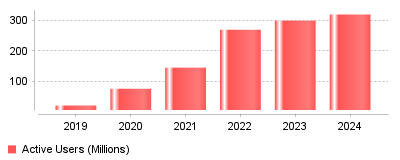
The data reveals a dramatic divergence in growth momentum between the two market leaders in video conferencing. Microsoft Teams has maintained an aggressive linear growth trajectory, nearly doubling its active user base from 145 million in 2021 to 320 million in 2024 [1][2]. In contrast, Zoom, while retaining a massive user base and market share, has seen its revenue growth effectively flatten, dropping from a meteoric 326% year-over-year increase in Fiscal Year 2021 to a stabilized ~3% growth rate in Fiscal Years 2024 and 2025 [3][4].
This trend signals a maturity phase in the video conferencing market where "platform bundling" is winning over standalone utility. For the micro-industry, it means that being the "best" video tool is no longer sufficient for growth; vendors must offer a comprehensive suite (chat, file storage, AI) to compete. On a macro level, this reflects a broader consolidation in enterprise IT spending, where organizations are prioritizing cost efficiency by utilizing tools already included in their existing licenses (like Microsoft 365) rather than paying for overlapping premium services [5]. While Zoom still holds the largest market share by some metrics (approx. 55%), its inability to grow revenue significantly suggests it has reached a saturation point in the enterprise sector, whereas Teams continues to expand by capturing the entire daily workflow of employees [6].
This shift dictates the future of software procurement: the "suite" is becoming the default, relegating standalone tools to niche use cases or external communications. It underscores the immense power of ecosystem lock-in; Microsoft has successfully converted its dominance in email and document creation into dominance in real-time communication. Furthermore, this trend places immense pressure on Zoom and similar competitors to pivot rapidly toward new revenue streams, such as Contact Center as a Service (CCaaS) and AI companions, to survive the "squeeze" from big tech ecosystems [7].
The primary driver is likely the global economic tightening over the last 18 months, which forced CFOs to audit software redundancy; paying for Zoom when Teams is already "free" in the Office bundle became harder to justify. Additionally, the return-to-office (RTO) and hybrid work stabilization shifted needs from simple "video calls" to deep asynchronous collaboration (chat, document co-authoring), an area where Teams has a native advantage due to its integration with Word, Excel, and SharePoint [8]. Microsoft's aggressive integration of Copilot AI directly into Teams also likely accelerated adoption, as enterprises seek to unify their data for AI processing within a single secure perimeter [9].
The data confirms that while Zoom won the cultural battle of the pandemic, Microsoft Teams is winning the war for the enterprise workflow. The era of buying separate software for video conferencing is ending, replaced by a preference for unified communication platforms that serve as an operating system for work. For buyers and investors, the takeaway is clear: value is now defined by integration depth and workflow stickiness rather than just video and audio quality.
The global video conferencing market is undergoing a fundamental structural shift. No longer defined merely by the ability to connect remote participants, the industry is pivoting toward high-fidelity immersion, agentic artificial intelligence (AI), and rigid security verification. Valued at approximately $11.6 billion in 2024, the market is projected to expand significantly, reaching an estimated $24.4 billion by 2033 with a Compound Annual Growth Rate (CAGR) of 8.2% [1]. This growth trajectory is not driven by simple adoption, as was the case in 2020, but by the integration of video infrastructure into the core operational workflows of complex industries.
As organizations cement hybrid work policies, they face a new generation of operational challenges that transcend connection stability. The primary friction points have moved to cognitive load ("Zoom fatigue"), the security integrity of visual communications (deepfakes), and the interoperability of video data with broader Project Management & Productivity Tools. This report analyzes these critical trends, examining how AI agents are moving from passive transcribers to active participants, and how specific sectors—from recruitment to SaaS sales—are re-engineering their video strategies to mitigate risk and drive efficiency.
The most immediate and severe operational challenge facing the video conferencing landscape is the weaponization of generative AI. For years, video presence was considered a sufficient proxy for identity verification. That assumption has been shattered by the rise of sophisticated real-time deepfakes. In a landmark case that signaled the end of "trust-by-default," a finance worker at a multinational firm was tricked into transferring $25 million after a video conference where every other participant—including the CFO—was an AI-generated imposter [2].

The proliferation of voice cloning and face-swapping technology has democratized fraud. Reports indicate that voice cloning now requires as little as three seconds of audio to create a convincing replica, while real-time video deepfakes can be deployed with commercially available software [2]. This capability has led to a projected surge in fraud losses, with deepfake-related financial damage estimated to reach nearly $1.1 billion by 2025, a dramatic increase from previous years [3].
Operational leaders must now treat video conferencing platforms as zero-trust environments. The challenge is particularly acute for sectors that rely on high-value transactions or sensitive data exchange. Security protocols are evolving from simple password protection to cryptographic verification of video feeds and biometric authentication watermarks [4].
The security perimeter is further eroded by the reliance on extended workforces using personal hardware. Bring Your Own Device (BYOD) policies, common among independent contractors, introduce significant data leakage risks. When contractors utilize personal devices for corporate video calls, organizations lose control over endpoint security, making the network vulnerable to malware injection or unauthorized recording [5].
For organizations managing external talent, the operational imperative is to implement role-based access controls (RBAC) and secure enclaves that segregate corporate data from personal applications. This is critical when deploying Video Conferencing Software for Contractors, where the lack of managed devices requires software-level security interventions to prevent sensitive intellectual property from leaving the encrypted session [6][7].
While security dominates the risk landscape, employee burnout remains a persistent operational drag. The phenomenon known as "Zoom fatigue" has transitioned from anecdotal complaint to researched physiological reality, though the causes are nuanced.
Recent studies utilizing electroencephalography (EEG) have attempted to pinpoint the biological markers of video conference fatigue. Research from 2024 indicates that the presence of the "self-view"—the mirror image of oneself during a call—creates a heightened state of self-awareness and alpha brainwave activity that contributes significantly to mental exhaustion [8][9]. Contrary to earlier assumptions that women were disproportionately affected by mirror anxiety, neurophysiological data suggests that men and women experience equal levels of fatigue when self-view is enabled [9].
However, the narrative of universal fatigue is complex. Other longitudinal studies suggest a normalization effect, where users have adapted to the medium, with fatigue now correlating more strongly with meeting duration and lack of engagement rather than the medium itself [10]. This dichotomy presents a business implication: the tool itself is less the problem than the interface design and meeting culture. To combat this, platforms are investing in "cinematic" AI directors that dynamically switch camera angles to mimic broadcast television, reducing the cognitive load required to track static grids of faces [4].
The integration of AI into Video Conferencing Software is evolving from passive assistance to active agency. In 2023 and 2024, AI features were largely centered on transcription, summarization, and noise cancellation. The trend for 2025 and beyond is "Agentic AI"—software agents capable of reasoning, decision-making, and executing tasks autonomously.
Agentic AI represents a shift where the conferencing software becomes an active participant in the meeting. Instead of merely recording action items, these agents can schedule follow-up meetings, update Jira tickets, access CRM data in real-time, and even answer questions based on the company's knowledge base [4][11]. This transition aims to reduce the post-meeting friction that often leads to productivity loss.
Major players like Zoom and Cisco are heavily investing in these capabilities, positioning their platforms as central operating systems for work rather than just communication pipes [12][13]. For businesses, this means video data is no longer ephemeral; it becomes a queryable asset that drives downstream workflows.
Operational barriers related to language are also being dismantled. AI-driven real-time translation and live captioning are becoming standard, enabling cross-border teams to collaborate without language proficiency being a prerequisite [14]. This capability is essential for globalized operations, allowing multinational firms to standardize on a single communication platform while maintaining local language nuances.
The "one-size-fits-all" era of video conferencing is ending. Different industries are demanding specialized workflows that address their unique operational bottlenecks.
The recruitment industry is heavily reliant on video technology to scale operations, but this reliance has introduced ethical and legal risks regarding AI bias. As agencies adopt AI-enabled video interviewing tools to screen candidates, research has highlighted significant flaws. A 2024 study by the University of Washington found that Large Language Models (LLMs) used in screening exhibited significant bias against names associated with Black men and women, favoring white-associated names 85% of the time [15].
Furthermore, automated analysis of facial expressions and tone in video interviews—often used to gauge "culture fit" or "soft skills"—has been shown to disadvantage candidates with disabilities or those from different cultural backgrounds where non-verbal cues differ [16][17]. For firms utilizing Video Conferencing Software for Recruitment Agencies, the operational challenge is balancing the efficiency of automated screening with the legal imperative of non-discriminatory hiring practices.
Conversely, for high-volume staffing, the priority is speed and verification. Video Conferencing Software for Staffing Agencies is increasingly integrated with identity management systems to prevent fraud, such as "deepfake candidates" applying for remote roles—a growing vector for corporate espionage and payroll fraud [18].
For the software industry itself, the video conference is the primary sales floor. However, the traditional "screen share and talk" demo is losing effectiveness. Attention spans are shortening, and buyers demand more autonomy. The trend is shifting toward interactive video demos that allow prospects to click through the product within the video interface itself, rather than passively watching a linear presentation [19].
Data indicates that interactive elements and "micro-demos" significantly boost engagement compared to static video calls [20][19]. Video Conferencing Software for SaaS Companies is now evolving to include built-in sandbox environments and overlay tools that allow sales engineers to guide prospects through a live instance of the software with reduced latency and higher visual fidelity.
Looking toward the latter half of the decade, the industry is preparing for the move from 2D grids to 3D spatial computing. The current flat interface of video conferencing is viewed by many analysts as a transitional technology. The "holy grail" is presence—the feeling of being in the same physical space.
Google’s Project Starline, which uses advanced 3D imaging and light-field displays to create a "magic window" effect, is scheduled for commercialization in 2025 through a partnership with HP [21][22]. This technology aims to eliminate the barrier of the screen, allowing for natural eye contact and depth perception, which early testing suggests can improve memory recall and attentiveness by over 30% [23].
While currently a premium hardware solution, the integration of spatial computing into software platforms (via headsets like the Apple Vision Pro or Meta Quest) suggests a future where Video Conferencing Software facilitates virtual "war rooms." By 2030, the spatial computing market is projected to reach nearly $470 billion, with collaborative enterprise software being a primary driver [24].
Perhaps the most radical shift will be the normalization of "digital twins." As executives face increasingly impossible scheduling demands, AI avatars—visually indistinguishable from the user—may eventually be authorized to attend low-stakes meetings on their behalf, delivering updates and gathering information [4]. While ethically complex, this represents the logical endpoint of the current trend toward asynchronous video communication.
The convergence of these trends necessitates a strategic re-evaluation of video infrastructure. It is no longer sufficient to select a provider based solely on price or uptime. Organizations must consider:
The video conferencing market is maturing from a utility to a strategic capability. Those who master the balance between security, immersion, and AI agency will define the next era of global productivity.
Recent market data highlights a decisive shift in the video conferencing landscape: the "ecosystem" model is overtaking the standalone application model. While Zoom played the role of the pandemic darling with explosive initial growth, recent financial and user data reveals a stark plateau in its revenue trajectory compared to the relentless, compounded user growth of Microsoft Teams. This divergence suggests that enterprise buyers are increasingly consolidating their communication stacks, favoring the integrated value of Microsoft 365 over best-of-breed isolated solutions. ``
| Year | Active Users (Millions) |
|---|---|
| 2019 | 20 |
| 2020 | 75 |
| 2021 | 145 |
| 2022 | 270 |
| 2023 | 300 |
| 2024 | 320 |
The data reveals a dramatic divergence in growth momentum between the two market leaders in video conferencing. Microsoft Teams has maintained an aggressive linear growth trajectory, nearly doubling its active user base from 145 million in 2021 to 320 million in 2024 [1][2]. In contrast, Zoom, while retaining a massive user base and market share, has seen its revenue growth effectively flatten, dropping from a meteoric 326% year-over-year increase in Fiscal Year 2021 to a stabilized ~3% growth rate in Fiscal Years 2024 and 2025 [3][4].
This trend signals a maturity phase in the video conferencing market where "platform bundling" is winning over standalone utility. For the micro-industry, it means that being the "best" video tool is no longer sufficient for growth; vendors must offer a comprehensive suite (chat, file storage, AI) to compete. On a macro level, this reflects a broader consolidation in enterprise IT spending, where organizations are prioritizing cost efficiency by utilizing tools already included in their existing licenses (like Microsoft 365) rather than paying for overlapping premium services [5]. While Zoom still holds the largest market share by some metrics (approx. 55%), its inability to grow revenue significantly suggests it has reached a saturation point in the enterprise sector, whereas Teams continues to expand by capturing the entire daily workflow of employees [6].
This shift dictates the future of software procurement: the "suite" is becoming the default, relegating standalone tools to niche use cases or external communications. It underscores the immense power of ecosystem lock-in; Microsoft has successfully converted its dominance in email and document creation into dominance in real-time communication. Furthermore, this trend places immense pressure on Zoom and similar competitors to pivot rapidly toward new revenue streams, such as Contact Center as a Service (CCaaS) and AI companions, to survive the "squeeze" from big tech ecosystems [7].
The primary driver is likely the global economic tightening over the last 18 months, which forced CFOs to audit software redundancy; paying for Zoom when Teams is already "free" in the Office bundle became harder to justify. Additionally, the return-to-office (RTO) and hybrid work stabilization shifted needs from simple "video calls" to deep asynchronous collaboration (chat, document co-authoring), an area where Teams has a native advantage due to its integration with Word, Excel, and SharePoint [8]. Microsoft's aggressive integration of Copilot AI directly into Teams also likely accelerated adoption, as enterprises seek to unify their data for AI processing within a single secure perimeter [9].
The data confirms that while Zoom won the cultural battle of the pandemic, Microsoft Teams is winning the war for the enterprise workflow. The era of buying separate software for video conferencing is ending, replaced by a preference for unified communication platforms that serve as an operating system for work. For buyers and investors, the takeaway is clear: value is now defined by integration depth and workflow stickiness rather than just video and audio quality.