


| Year | Microsoft Teams MAU (Millions) | Slack MAU (Millions) |
|---|---|---|
| 2022 | 270 | 43 |
| 2023 | 300 | 54 |
| 2024 | 320 | 65 |
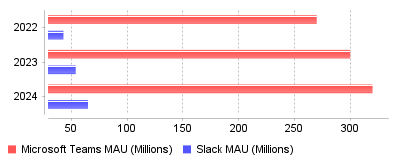
The data highlights a widening gap between the two industry leaders in workplace communication. Microsoft Teams has cemented its status as the default "operating system for work" with a user base that has swelled to 320 million monthly active users (MAU) as of 2024, driven by its integration into the Microsoft 365 suite [1]. In contrast, while Slack continues to grow—reaching an estimated 65 million MAU in 2024—it remains a fraction of the size of its competitor, serving a more specialized, tech-forward demographic [2].
On a macro level, this trend signals the maturity of the "Unified Communications as a Service" (UCaaS) market, where distribution power is triumphing over pure product user experience. For the industry, it means that the era of fragmented tools is ending; enterprises are prioritizing cost-consolidation by utilizing software they are already paying for (Microsoft 365) rather than purchasing separate licenses for communication [3]. Consequently, Slack is being forced to move upmarket, focusing on deep integrations with Salesforce and AI automation to justify its premium cost to high-value teams like engineering and sales, rather than trying to be the general communication tool for the entire workforce [4].
This divergence is critical because it dictates future IT spending and software development strategies. It proves that "good enough" software (Teams), when bundled with essential business utilities, can capture the majority of the market over "best-in-class" user interfaces (Slack) [5]. Furthermore, it suggests that the next battleground is not basic chat, but generative AI and workflow automation, where both platforms are now racing to lock users into their respective "copilot" ecosystems [6].
The primary driver is the economic climate of the last two years, which compelled CFOs to scrutinize software spend and eliminate redundant line items; if a company pays for Office 365, paying extra for Slack becomes harder to justify [3]. Additionally, the shift to hybrid work required robust video conferencing—a native strength of Teams—whereas Slack had to play catch-up with features like Huddles. Finally, Microsoft's aggressive enterprise sales motion and security compliance features have made Teams the "safe" choice for large, regulated industries like healthcare and government, restricting Slack to the startup and tech sectors [7].
The data confirms that the "chat wars" for pure user volume are effectively over, with Microsoft winning via distribution dominance. However, a new trend is emerging where organizations use both: Teams for general corporate comms and video, and Slack for specialized, high-velocity workflows in engineering and product departments [8]. The prominent takeaway is that platform success in 2025 and beyond will depend less on chat features and more on which platform can better deploy AI agents to actually do the work discussed in the chat.
The operational landscape of Team Chat & Messaging Apps has shifted dramatically from simple communication facilitation to complex infrastructure management. In 2024 and heading into 2025, the primary challenge is no longer adoption, but rather the containment of digital sprawl, the mitigation of "notification fatigue," and the enforcement of compliance in an era of shadow IT. While market leaders like Microsoft Teams and Slack dominate the generalist space, a fractured operational reality exists where employees toggle between sanctioned platforms and consumer-grade apps to maintain velocity.
Research indicates that the average digital worker now switches between apps nearly 1,200 times per day, a behavior that costs organizations approximately 9% of their annual work time [1]. Furthermore, the aggressive enforcement of recordkeeping rules by the SEC has turned messaging choice into a significant legal liability for financial sectors. This report analyzes the current trends, operational bottlenecks, and vertical-specific challenges defining the sector.
The most immediate operational threat facing organizations utilizing modern messaging stacks is the cognitive tax of "context switching." While intended to streamline communication, the proliferation of disparate Project Management & Productivity Tools has resulted in fragmented attention spans.
Recent data underscores the severity of this efficiency drain. A Harvard Business Review study highlighted that the time spent reorienting after switching apps accumulates to roughly five working weeks lost per employee annually [2]. This phenomenon is exacerbated by the "split-brain" architecture present in many enterprises, where engineering teams may prefer Slack while administrative units rely on Microsoft Teams, forcing cross-functional workers to monitor multiple synchronous channels simultaneously.
Operational leaders are observing a "distraction tax" where the pressure to respond immediately—often termed "notification fatigue"—degrades work quality. Statistics show that 56% of employees feel they must respond to notifications immediately, preventing deep work [3]. The business implication is a paradox: organizations are investing more in communication software only to see a net decrease in focused output.

As corporate IT departments lock down enterprise chat environments to combat noise, a secondary challenge has emerged: Shadow IT. Employees, finding enterprise tools cumbersome or restrictive, frequently revert to consumer-grade applications (such as WhatsApp, Signal, or iMessage) to conduct business. This behavior creates massive compliance blind spots.
The consequences of unmonitored messaging have moved beyond theoretical security risks to tangible financial penalties. Regulators have taken an aggressive stance against "off-channel" communications. Since 2021, the SEC and CFTC have levied over $3 billion in fines against financial institutions for failing to preserve business communications sent via personal devices and unapproved apps [4].
This trend is particularly acute for investment firms. For instance, Team Chat & Messaging Apps for Private Equity Firms must now balance the speed of deal-making with rigorous archiving requirements. In early 2024, the SEC fined 16 firms a collective $81 million, explicitly targeting investment advisers for the first time, signaling that the regulatory net is widening beyond just broker-dealers [5].
The operational challenge here is two-fold:
The generalist market is currently defined by the rivalry between Microsoft Teams and Slack (Salesforce). As of 2024, Microsoft Teams reports approximately 320 million monthly active users, leveraging its bundling with Microsoft 365 to secure dominance in the enterprise sector [6]. In contrast, Slack maintains a strong foothold in the technology and startup sectors, often preferred for its user interface and extensive integration ecosystem.
However, a significant operational hurdle remains: Interoperability. Historically, these platforms have acted as walled gardens. A user on Teams cannot natively message a user on Slack without complex third-party bridges or "guest" accounts. This friction is coming under legislative scrutiny.
The European Union’s Digital Markets Act (DMA) is forcing a re-evaluation of this closed architecture. The regulation designates major platforms as "gatekeepers," potentially mandating interoperability to foster competition. While consumer messaging (like WhatsApp and Messenger) is the primary target, the ripple effects are expected to reach enterprise tools by 2025/2026, pushing vendors to adopt open standards like the Matrix protocol to allow cross-platform federation [7]. For businesses, this suggests a future where the choice of platform may become less critical than the choice of compliance and governance wrappers.
While generalist tools serve the corporate office well, specific industries face unique operational pressures that generalist platforms fail to address effectively.
In the staffing industry, speed is the primary currency. Traditional email and corporate chat apps like Teams are often too slow for candidate engagement. Research shows that SMS (text messaging) has a 98% open rate compared to 20% for email, and candidates are significantly more likely to respond to text outreach [8].
Consequently, Team Chat & Messaging Apps for Staffing Agencies are trending heavily toward platforms that integrate SMS directly into the recruiter's workflow. The operational challenge is "text-to-apply" capabilities and unifying the recruiter's desktop view with the candidate's mobile experience. Pure-play chat apps are often insufficient; agencies require tools that blend internal collaboration with external, high-volume SMS broadcasting.
Similarly, Team Chat & Messaging Apps for Recruitment Agencies must grapple with the fragmentation of candidate communication channels (WhatsApp, LinkedIn, SMS). The trend is toward "Unified Communications as a Service" (UCaaS) where a single interface captures conversations across all these mediums to prevent data loss and improve placement speed.
For industries relying on independent contractors and field service workers, the operational model of "always-on" desktop chat is fundamentally flawed. Contractors often do not have corporate email addresses or access to the internal VPN, making standard enterprise provisioning impossible.
Team Chat & Messaging Apps for Contractors face the challenge of Identity and Access Management (IAM). How do you securely onboard a freelancer to a chat channel for three weeks and then securely offboard them without exposing historical IP? Generalist platforms like Slack handle this via "Guest Channels," but the administrative overhead is high. We are seeing a shift toward mobile-first, lightweight messaging tools that prioritize geolocation and task-specific chat threads over persistent organizational history [9].
A major trend for 2025 is the rationalization of the IT stack. CIOs are scrutinizing the cost of running parallel communication systems. It is common for large enterprises to pay for Microsoft 365 (which includes Teams) while individual departments expense Slack. With IT budgets tightening and a focus on "efficiency metrics," businesses are increasingly forcing consolidation onto a single platform, often sacrificing user preference for cost savings [10].
Artificial Intelligence is the most significant technological trend impacting this category. Features like automated meeting summaries, sentiment analysis, and "agentic AI" (bots that perform tasks within chat) are becoming standard. Gartner predicts that by 2028, agentic AI will autonomously make 15% of day-to-day work decisions [11].
However, the operational challenge is data governance. Allowing an AI to summarize chat logs requires that the AI has access to sensitive internal conversations. Companies are struggling to define policies that leverage AI productivity gains without exposing trade secrets or PII to public Large Language Models (LLMs). There is also the risk of "AI hallucinations" in meeting summaries leading to miscommunication.
The trajectory of Team Chat & Messaging Apps points toward three distinct futures:
| Year | Microsoft Teams MAU (Millions) | Slack MAU (Millions) |
|---|---|---|
| 2022 | 270 | 43 |
| 2023 | 300 | 54 |
| 2024 | 320 | 65 |
The data highlights a widening gap between the two industry leaders in workplace communication. Microsoft Teams has cemented its status as the default "operating system for work" with a user base that has swelled to 320 million monthly active users (MAU) as of 2024, driven by its integration into the Microsoft 365 suite [1]. In contrast, while Slack continues to grow—reaching an estimated 65 million MAU in 2024—it remains a fraction of the size of its competitor, serving a more specialized, tech-forward demographic [2].
On a macro level, this trend signals the maturity of the "Unified Communications as a Service" (UCaaS) market, where distribution power is triumphing over pure product user experience. For the industry, it means that the era of fragmented tools is ending; enterprises are prioritizing cost-consolidation by utilizing software they are already paying for (Microsoft 365) rather than purchasing separate licenses for communication [3]. Consequently, Slack is being forced to move upmarket, focusing on deep integrations with Salesforce and AI automation to justify its premium cost to high-value teams like engineering and sales, rather than trying to be the general communication tool for the entire workforce [4].
This divergence is critical because it dictates future IT spending and software development strategies. It proves that "good enough" software (Teams), when bundled with essential business utilities, can capture the majority of the market over "best-in-class" user interfaces (Slack) [5]. Furthermore, it suggests that the next battleground is not basic chat, but generative AI and workflow automation, where both platforms are now racing to lock users into their respective "copilot" ecosystems [6].
The primary driver is the economic climate of the last two years, which compelled CFOs to scrutinize software spend and eliminate redundant line items; if a company pays for Office 365, paying extra for Slack becomes harder to justify [3]. Additionally, the shift to hybrid work required robust video conferencing—a native strength of Teams—whereas Slack had to play catch-up with features like Huddles. Finally, Microsoft's aggressive enterprise sales motion and security compliance features have made Teams the "safe" choice for large, regulated industries like healthcare and government, restricting Slack to the startup and tech sectors [7].
The data confirms that the "chat wars" for pure user volume are effectively over, with Microsoft winning via distribution dominance. However, a new trend is emerging where organizations use both: Teams for general corporate comms and video, and Slack for specialized, high-velocity workflows in engineering and product departments [8]. The prominent takeaway is that platform success in 2025 and beyond will depend less on chat features and more on which platform can better deploy AI agents to actually do the work discussed in the chat.