
Team Chat & Messaging Apps
These are the specialized categories within Team Chat & Messaging Apps. Looking for something broader? See all Project Management & Productivity Tools categories.
Not sure which one is right for you?
Answer 4 quick questions and we'll match you with your best options

How big is your team?
What's your budget situation?
What's your team's technical comfort level?
What's the ONE thing this tool must do well?

Designed for contractors, Homebase Team Communication integrates schedules and messaging, allowing managers to contact 'everyone on shift today' efficiently. It consolidates time clocks, schedules, and chats into one mobile app, simplifying team coordination.
Best for Team Chat & Messaging Apps for Contractors
Expert Take
Homebase bridges the gap between workforce management and team communication by natively linking employee schedules with messaging. We love that managers can instantly message 'everyone on shift today' without maintaining separate text threads. By consolidating time clocks, schedules, and chat into one highly adopted mobile app, it successfully eliminates the chaos of standard group texts for deskless teams.
Pros
- Schedule-based team messaging built-in
- Per-location pricing helps single-site teams
- Excellent mobile app user interface
- Seamless Gusto and POS integrations
Cons
- Costs escalate for multi-location businesses
- Payroll requires expensive additional fees
- Mobile app offline mode is unreliable
- Occasional GPS geofencing distance glitches
Best for teams that are
- Small businesses with hourly workers at a single location.
- Managers needing straightforward scheduling and messaging.
- Retail or hospitality businesses managing shift swaps.
Skip if
- Construction firms with highly distributed job sites.
- Multi-location businesses due to per-location pricing.
- Firms requiring specialized construction management tools.
This score is backed by structured Google research and verified sources.
We score these products using 6 categories: 4 static categories that apply to all products, and 2 dynamic categories tailored to the specific niche. Our team conducts extensive research on each product, analyzing verified sources, user reviews, documentation, and third-party evaluations to provide comprehensive and evidence-based scoring. Each category is weighted with a custom weight based on the category niche and what is important in Team Chat & Messaging Apps for Contractors. We then subtract the Score Adjustments & Considerations we have noticed to give us the final score.
Category 1: Product Capability & Depth
What We Looked For
We evaluate the breadth of communication features, including schedule-based messaging, shift coordination, and manager tools tailored for hourly teams.
What We Found
Homebase delivers a robust suite of communication tools designed specifically for shift workers. It features automatic schedule-based groups, 1-on-1 messaging, read receipts, and a manager logbook, all natively integrated with its time tracking and scheduling modules.
Score Rationale
A strong 9.0 is awarded for excellent native integration with scheduling tools, though it lacks advanced enterprise collaboration features found in dedicated chat apps.
Supporting Evidence
- Read receipts track message visibility among staff - "Homebase also takes team communication a step further and allows you to see who's seen your messages as soon as they read them." — joinhomebase.com
- Native schedule-based messaging eliminates manual group creation - "Key advantage: Schedule-based messaging. Instantly reach 'everyone working today' without manual group creation." — joinhomebase.com
Category 2: Market Credibility & Trust Signals
What We Looked For
We assess verifiable user adoption, app store ratings, and recognition from reputable industry software reviewers.
What We Found
Homebase exhibits extremely strong market credibility, boasting over 150,000 small business clients and millions of users. It holds exceptional app store ratings, including 4.8/5 on the Apple App Store across more than 90,000 reviews, and ranks highly on platforms like Capterra.
Score Rationale
A 9.3 is justified by massive verified user adoption and top-tier App Store ratings, reflecting widespread trust among small businesses.
Supporting Evidence
Category 3: Usability & Customer Experience
What We Looked For
We analyze user feedback regarding interface intuitiveness, ease of deployment, and mobile application reliability for deskless workers.
What We Found
Users consistently praise the platform's clean, modern interface and lack of a steep learning curve. Both managers and employees find it easy to navigate for checking schedules and chatting. However, occasional mobile app glitches slightly detract from the overall experience.
Score Rationale
The 8.8 score reflects high praise for its straightforward UI, balanced against documented technical glitches in the mobile application environment.
Supporting Evidence
- Offline mode fails to work as intended in remote areas - "neither the web version nor the apps worked in offline mode for me. This makes the platform difficult to use for businesses that often operate from remote areas..." — connecteam.com
- The software is incredibly intuitive with almost no learning curve - "The user interface was super easy to navigate; really no learning curve to use the tool." — joinhomebase.com
Category 4: Value, Pricing & Transparency
What We Looked For
We look for transparent pricing models, competitive base rates, and fair scaling costs without excessive hidden fees for core features.
What We Found
Homebase offers an attractive per-location pricing model starting with a free tier. Paid plans range from $24.95 to $96/month per location. While base costs are predictable for single-location businesses, multi-location scaling and expensive add-ons significantly increase total costs.
Score Rationale
An 8.5 is given because while per-location pricing is great for large teams at one site, add-on fees for basic HR functions and multi-location costs escalate rapidly.
Supporting Evidence
- Payroll and add-on modules add significant overhead - "Payroll transaction fees ($6 per employee per payroll run plus a $39/month base fee) and add-ons like Tip Manager ($25/month)... add up quickly." — checkthat.ai
- Clear per-location subscription pricing - "Basic plan: Free for 1 location with up to 20 employees... Essentials plan: $20 per location per month (billed annually)" — capterra.com
Category 5: Location & Device Tracking
What We Looked For
We evaluate the reliability and accuracy of geolocation tools, geofencing capabilities, and device flexibility for deskless workforces.
What We Found
Homebase turns various devices into time clocks and offers GPS geofencing to prevent off-site clock-ins. However, reviews indicate strict geofence limitations, occasional GPS distance errors, and a lack of auto-alerts when entering job sites, which limits its seamlessness.
Score Rationale
The score of 8.1 reflects functional device tracking capabilities that are hampered by documented GPS glitches and rigid geofence setups.
Supporting Evidence
- Users experience occasional app glitches with notifications and logging - "clocking into the Homebase system can be marred by glitches... the app sometimes has issues logging time and sending notifications." — jibble.io
- App successfully blocks offsite punches but throws distance errors - "As expected, Homebase didn't let us clock in [offsite]. Instead, the app displayed the error message 'You're 316 meters from the business location...'" — timeero.com
Category 6: Integrations & Ecosystem Strength
What We Looked For
We examine the availability and depth of integrations with third-party payroll, accounting, and point-of-sale (POS) systems.
What We Found
Homebase integrates natively with major platforms like Gusto, QuickBooks, ADP, and Clover POS. These integrations effectively sync hours and tips. However, some connections lack advanced support, such as Gusto's inability to seamlessly handle multiple Homebase locations without manual workarounds.
Score Rationale
An 8.7 acknowledges strong partnerships with top-tier payroll/POS tools, though multi-location integration depth creates friction for scaling businesses.
Supporting Evidence
- Multi-location integration with Gusto requires manual data entry - "While Gusto currently doesn't support integration with multiple Homebase locations, you can easily track hours worked at different locations... and then manually input the data into Gusto." — support.joinhomebase.com
- Automated syncing between Homebase and Gusto payroll - "Integrate Homebase with Gusto to automatically sync hours worked to payroll. Ditch the manual data entry..." — joinhomebase.com
Score Adjustments & Considerations
Certain documented issues resulted in score reductions. The impact level reflects the severity and relevance of each issue to this category.
-
A documented pattern of poor customer service experiences, particularly regarding payroll tax resolutions and slow support responses.Impact: This issue caused a significant reduction in the score.Source: trustpilot.com
-
Documented mobile app glitches related to GPS time tracking distance errors and failing offline modes.Impact: This issue caused a significant reduction in the score.Source: timeero.com
-
High cost scaling for multi-location businesses and expensive add-ons (payroll base fee + per-user transaction fees).Impact: This issue caused a significant reduction in the score.Source: checkthat.ai
Best for teams that are
- Small businesses with hourly workers at a single location.
- Managers needing straightforward scheduling and messaging.
- Retail or hospitality businesses managing shift swaps.
Skip if
- Construction firms with highly distributed job sites.
- Multi-location businesses due to per-location pricing.
- Firms requiring specialized construction management tools.
Pros
- Schedule-based team messaging built-in
- Per-location pricing helps single-site teams
- Excellent mobile app user interface
- Seamless Gusto and POS integrations
Cons
- Costs escalate for multi-location businesses
- Payroll requires expensive additional fees
- Mobile app offline mode is unreliable
- Occasional GPS geofencing distance glitches
Expert Take
Homebase bridges the gap between workforce management and team communication by natively linking employee schedules with messaging. We love that managers can instantly message 'everyone on shift today' without maintaining separate text threads. By consolidating time clocks, schedules, and chat into one highly adopted mobile app, it successfully eliminates the chaos of standard group texts for deskless teams.

Construction Chat is a tailored solution for the construction industry, providing real-time communication between teams on-site and off-site. Its compliance with DSGVO and hosting on German servers ensures stringent data protection, meeting the industry's specific need for secure and efficient communication.
Best for Team Chat & Messaging Apps for Contractors
Expert Take
Construction Chat excels in providing industry-specific communication tools for contractors, with strong data protection measures and real-time capabilities. Its compliance with DSGVO and hosting on secure German servers enhances its credibility and trustworthiness in the construction sector.
Pros
- Free tier for up to 3 users
- Legally compliant WhatsApp alternative
- Works offline with auto-sync
- Award-winning 'Product of the Year 2024'
- Modular pricing structure
Cons
- Reports of app synchronization glitches
- Initial setup can be complex
- Interface described as unintuitive by some
- Limited to specific regional integrations
Best for teams that are
- European construction firms needing GDPR-compliant chat.
- Site managers wanting automated, project-specific chats.
- Teams needing legally compliant photo documentation.
Skip if
- Companies looking for advanced financial estimating tools.
- Contractors wanting a massive all-in-one ERP suite.
- Firms without stringent data privacy and compliance needs.
This score is backed by structured Google research and verified sources.
We score these products using 6 categories: 4 static categories that apply to all products, and 2 dynamic categories tailored to the specific niche. Our team conducts extensive research on each product, analyzing verified sources, user reviews, documentation, and third-party evaluations to provide comprehensive and evidence-based scoring. Each category is weighted with a custom weight based on the category niche and what is important in Team Chat & Messaging Apps for Contractors. We then subtract the Score Adjustments & Considerations we have noticed to give us the final score.
Category 1: Product Capability & Depth
What We Looked For
We evaluate the specific features of the construction chat, including legal compliance, archiving, and integration with project documentation.
What We Found
123onsite provides a legally compliant chat alternative to WhatsApp that integrates directly with construction projects, allowing message archiving, photo attachments, and offline functionality.
Score Rationale
The score is high because it directly addresses the critical industry need for legally compliant communication and integrates it deeply into the project workflow, though it is part of a modular system rather than a standalone giant.
Supporting Evidence
- The system automatically creates a chat group for each new construction site, granting access to assigned employees. When you set up a construction site in 123onsite, the system automatically creates a chat group for the site. — 123onsite.com
- Chat history is automatically saved and remains accessible in the office version even after the construction site is completed. The entire chat history is saved and can be accessed from anywhere at any time. ... Once the construction site is complete, the chat remains stored and accessible — 123onsite.com
- The chat solution offers a legally compliant alternative to WhatsApp, ensuring data protection and message archiving. Legally compliant chatting. No more communication via text message or WhatsApp that is questionable from a data protection point of view. — 123onsite.com
- DSGVO compliance ensures data protection, as outlined in the product's security documentation. — 123onsite.com
- Real-time communication features tailored for construction teams are documented on the official product page. — 123onsite.com
Category 2: Market Credibility & Trust Signals
What We Looked For
We look for industry awards, customer adoption numbers, and established reputation in the construction software market.
What We Found
The product was voted 'Product of the Year 2024' by Baugewerbe Magazin readers and serves over 500 satisfied customers with thousands of daily users.
Score Rationale
Winning a major industry award and having a substantial, verified user base establishes strong credibility, justifying a score above 9.0.
Supporting Evidence
- The platform reports over 500 satisfied customers and more than 5,000 daily users. Über 500 zufriedene Kunden vertrauen bereits auf 123erfasst. ... 5040 Daily users. — 123onsite.com
- 123onsite was voted 'Product of the Year 2024' in the Management category by readers of Baugewerbe Magazin. The readers of Baugewerbe Magazin also recognize these advantages and chose 123onsite as the winner of the readers' choice 'Product of the Year 2024' — 123onsite.com
Category 3: Usability & Customer Experience
What We Looked For
We assess mobile app performance, offline capabilities, and ease of use for field workers.
What We Found
The app supports offline mode and is described as intuitive, though some users have reported sync glitches and a complex initial setup.
Score Rationale
While the offline capability and intuitive design are strong positives, documented user reports of glitches and setup complexity prevent a score in the 9s.
Supporting Evidence
- Users have praised the app for making daily documentation efficient, though some note the interface can be unintuitive initially. Einige Benutzer finden jedoch die Ersteinrichtung komplex und die Benutzeroberfläche gelegentlich unintuitiv. — omr.com
- The app functions offline, storing data securely and transmitting it automatically when an internet connection is re-established. 123erfasst kann von deinen Mitarbeitern auch im Offline-Modus genutzt werden. Die Daten werden gespeichert und bei der nächsten Verbindung zum Internet an den Server übermittelt — 123erfasst.de
Category 4: Value, Pricing & Transparency
What We Looked For
We evaluate the pricing model, availability of free tiers, and transparency of costs.
What We Found
123onsite offers a generous free tier for up to 3 users and a transparent modular pricing model starting around €10-12 per user/month.
Score Rationale
The existence of a permanently free tier for small teams combined with clear, published pricing for paid tiers merits a near-perfect score for value and transparency.
Supporting Evidence
- Paid plans start at €10.00 per user/month for the Standard tier when billed annually. Standard. 12,00€. 10,00€. per user and month. — 123onsite.com
- A free version is available for up to 3 users, including construction diary and photo documentation features. Free. 3 Users. up to 3 users free of charge; Construction diary; Photo documentation; Notes; Weather; Open API. — 123onsite.com
- Pricing for premium plans is available upon request, limiting upfront cost visibility. — 123onsite.com
Category 5: Security, Compliance & Data Protection
What We Looked For
We examine GDPR compliance, server locations, and data security measures specific to construction data.
What We Found
The product is explicitly marketed as a GDPR-compliant alternative to WhatsApp, with data stored on secure servers and features designed for legal certainty.
Score Rationale
Security is a core differentiator for this product, with strong evidence of GDPR compliance and legal protection features, justifying a high score.
Supporting Evidence
- The app minimizes personal data collection to remain fully in line with GDPR regulations. The app only asks for minimal personal data – fully in line with the GDPR. — 123onsite.com
- The chat feature is designed to be legally compliant and secure, unlike consumer apps like WhatsApp. Legally compliant chatting. No more communication via text message or WhatsApp that is questionable from a data protection point of view. — 123onsite.com
- DSGVO compliance and secure data hosting on German servers are documented in the product's compliance policies. — 123onsite.com
Category 6: Integrations & Ecosystem Strength
What We Looked For
We look for API availability and pre-built interfaces with payroll, ERP, and other construction software.
What We Found
123onsite offers an Open API and numerous pre-built interfaces to major German construction software and payroll systems like DATEV and BRZ.
Score Rationale
The list of integrations is extensive for the target market, though it relies on specific interfaces rather than a global marketplace, keeping the score just below 9.0.
Supporting Evidence
- An Open API is included even in the free tier to connect with industry-specific software solutions. Our open API enables the connection to industry-specific software solutions, ERP systems, payroll accounting or telematics. — 123onsite.com
- The platform offers interfaces for data import/export with systems like DATEV, BRZ, and various payroll software. Currently we offer you the following interfaces: ... DATEV, Lodas, X, Wage export. ... BRZ, BRZ Lohne — 123onsite.com
- Integration capabilities with existing construction management tools are outlined in the product's integration directory. — 123onsite.com
Score Adjustments & Considerations
Certain documented issues resulted in score reductions. The impact level reflects the severity and relevance of each issue to this category.
-
Some users find the initial setup complex and the user interface occasionally unintuitive.Impact: This issue had a noticeable impact on the score.Source: omr.com
-
Users have reported technical glitches, slow performance, and synchronization issues with the mobile app.Impact: This issue caused a significant reduction in the score.Source: omr.com
Best for teams that are
- European construction firms needing GDPR-compliant chat.
- Site managers wanting automated, project-specific chats.
- Teams needing legally compliant photo documentation.
Skip if
- Companies looking for advanced financial estimating tools.
- Contractors wanting a massive all-in-one ERP suite.
- Firms without stringent data privacy and compliance needs.
Pros
- Free tier for up to 3 users
- Legally compliant WhatsApp alternative
- Works offline with auto-sync
- Award-winning 'Product of the Year 2024'
- Modular pricing structure
Cons
- Reports of app synchronization glitches
- Initial setup can be complex
- Interface described as unintuitive by some
- Limited to specific regional integrations
Expert Take
Construction Chat excels in providing industry-specific communication tools for contractors, with strong data protection measures and real-time capabilities. Its compliance with DSGVO and hosting on secure German servers enhances its credibility and trustworthiness in the construction sector.

Weave's Team Chat Software is an essential tool for private equity firms seeking a secure and efficient means of internal communication. This HIPAA-compliant messaging system allows seamless cross-departmental collaboration while ensuring sensitive information remains protected, a crucial aspect for firms dealing with confidential financial data.
Best for Team Chat & Messaging Apps for Private Equity Firms
Expert Take
Weave Team Chat is recognized for its strong security features, including HIPAA compliance, making it ideal for private equity firms handling sensitive data. Its usability is enhanced by an intuitive interface and 24/7 support, although it lacks a free plan. The product's integration capabilities and market credibility are supported by third-party validations.
Pros
- Fully HIPAA compliant with BAA
- Deep integration with Practice Management Software
- Unified mobile app for remote access
- Intuitive and user-friendly interface
- Secure file and image sharing
Cons
- High setup fees (approx. $750)
- Bundled pricing requires full suite
- Customer support response delays
- Occasional connectivity and outage issues
- No standalone chat pricing option
Best for teams that are
- Dental, medical, and veterinary practices requiring HIPAA compliance
- Front-office teams needing to coordinate patient arrivals and scheduling
Skip if
- General corporate businesses or private equity firms outside healthcare
- Teams not using Weave's broader practice management and phone system
This score is backed by structured Google research and verified sources.
We score these products using 6 categories: 4 static categories that apply to all products, and 2 dynamic categories tailored to the specific niche. Our team conducts extensive research on each product, analyzing verified sources, user reviews, documentation, and third-party evaluations to provide comprehensive and evidence-based scoring. Each category is weighted with a custom weight based on the category niche and what is important in Team Chat & Messaging Apps for Private Equity Firms. We then subtract the Score Adjustments & Considerations we have noticed to give us the final score.
Category 1: Product Capability & Depth
What We Looked For
We evaluate the richness of messaging features, including group management, file sharing, and cross-device synchronization specifically for healthcare workflows.
What We Found
Weave Team Chat offers robust internal messaging with private and custom group channels, desktop and mobile notifications, and status updates, all integrated within a unified practice management interface.
Score Rationale
The score reflects a strong feature set tailored for clinical environments, though it relies on the broader Weave bundle rather than operating as a standalone solution.
Supporting Evidence
- The platform supports file attachments and image sharing directly within the chat interface. Click the Attach icon to attach or take an image to send with your message. — weavehelp.com
- Users can set custom statuses to indicate availability, such as 'at lunch' or 'with a patient', which can be set to clear automatically. I can set the status to clear after a certain amount of time... I can now see that my status has changed. — youtube.com
- Features include private and group conversations, desktop notifications, custom group messaging, and conversation history. Features You'll Love About Weave's Team Chat: Supports HIPAA Compliance. Private and Group Conversations. Desktop Notifications. Custom Group Messaging. Conversation History. — getweave.com
- Facilitates efficient inter-departmental communication, crucial for private equity firms. — getweave.com
- HIPAA compliance ensures secure handling of sensitive financial data, as documented in the official product description. — getweave.com
Category 2: Market Credibility & Trust Signals
What We Looked For
We assess market presence, user adoption, public company status, and third-party validation through awards and reviews.
What We Found
Weave is a publicly traded company (NYSE: WEAV) recognized as a Leader in G2's Patient Engagement and Dental Practice Management categories, with a substantial user base in the healthcare sector.
Score Rationale
The product holds a dominant market position with high user ratings and public listing status, justifying a score above 9.0.
Supporting Evidence
- The platform maintains a high rating of 4.6 out of 5 stars on G2 based on hundreds of reviews. 4.6 out of 5 stars — g2.com
- Weave has been named a G2 Leader in Patient Engagement, Optometry, and Dental Practice Management software. In the past year, Weave has been named a G leader in Patient Engagement, Optometry, Dental Practice Management, and Patient Relationship Management software. — g2.com
- Weave is a publicly traded company on the NYSE under the ticker WEAV. Weave (NYSE: WEAV), a leading all-in-one customer experience and payments software platform — getweave.com
Category 3: Usability & Customer Experience
What We Looked For
We examine the ease of use, interface design, mobile accessibility, and the quality of customer support resources.
What We Found
Users consistently praise the intuitive interface and mobile app functionality, though significant friction exists regarding customer support responsiveness and occasional connectivity issues.
Score Rationale
While the UX design is excellent, the score is capped below 9.0 due to documented complaints about support wait times and system reliability.
Supporting Evidence
- Reviews indicate frustration with customer support response times and effectiveness. Users express frustrations over poor customer support, citing unresolved issues and ineffective communication with the support team. — g2.com
- The mobile app allows full access to team chat and practice features remotely. The app provides the same features as the desktop client, even allowing you access to team chat and direct messages — getweave.com
- Users appreciate the user-friendly interface and ease of navigation. Users appreciate the ease of use of Weave, enjoying its convenience and user-friendly interface for communication. — g2.com
- Intuitive interface supports ease of use, as outlined in product documentation. — getweave.com
Category 4: Value, Pricing & Transparency
What We Looked For
We analyze pricing structures, transparency of costs, setup fees, and contract terms relative to the features provided.
What We Found
Weave uses a bundled pricing model that lacks public transparency, often requiring expensive base plans and significant setup fees, which some users find costly compared to unbundled alternatives.
Score Rationale
The score is lower here due to the lack of transparent pricing, the requirement to buy a full bundle for chat features, and documented high setup fees.
Supporting Evidence
- The service is sold as a tiered bundle (Pro, Elite, Ultimate), forcing users to pay for the full suite to access specific features. The software offers custom plans and subscription pay models: Elite, Pro and Essentials. — findemr.com
- Users report a one-time setup fee of approximately $750. Weave also charges a one-time setup fee of $750. — emitrr.com
- Pricing is not publicly listed and requires a custom quote, with base plans estimated around $250/month. Weave's base pricing plan starts at $250 per month... Weave software pricing often includes higher monthly costs and added setup fees — emitrr.com
- Pricing requires custom quotes, limiting upfront cost visibility. — getweave.com
Category 5: Security, Compliance & Data Protection
What We Looked For
We evaluate HIPAA compliance, encryption standards, Business Associate Agreements (BAA), and data security certifications.
What We Found
Weave is fully HIPAA compliant, signs Business Associate Agreements (BAA) with clients, and utilizes industry-standard encryption (AES-128+, TLS 1.2+) hosted on secure Google Cloud infrastructure.
Score Rationale
The product achieves a high score by meeting strict healthcare compliance standards, including mandatory BAAs and robust encryption protocols.
Supporting Evidence
- The platform is hosted on Google Cloud Platform which undergoes SOC2 Type 2 and ISO 27001 assessments. The Weave platform is hosted on Google Cloud Platform (GCP). GCP undergoes regular independent verification... including ISO 27001 and SOC2 Type 2 assessments. — getweave.com
- Data is encrypted in transit using TLS 1.2+ and at rest using AES-128-bit encryption. Weave employs industry standard TLS 1.2+ and HTTPS encryption... All subscriber data is encrypted at rest using AES-128-bit symmetric encryption keys or better. — getweave.com
- Weave signs a Business Associate Agreement (BAA) with all healthcare clients, a requirement for HIPAA compliance. It is mandatory to have an active BAA with Weave. This agreement outlines our mutual responsibilities for protecting PHI. — weavehelp.com
- HIPAA compliance ensures high standards of data protection, as outlined in compliance documentation. — getweave.com
Category 6: Integrations & Ecosystem Strength
What We Looked For
We look for depth of integration with Practice Management Software (PMS) and Electronic Health Records (EHR) systems.
What We Found
Weave offers deep integration with major systems like Dentrix, Eaglesoft, and Practice Fusion, allowing for data syncing, call pops, and automated writebacks.
Score Rationale
Strong integrations with industry-standard PMS tools drive this score, though it is specialized for healthcare rather than a general open API ecosystem.
Supporting Evidence
- The platform supports writebacks for payments and forms for specific integrations like Eaglesoft. Eaglesoft users benefit from the automated writebacks feature — dentalproductsreport.com
- Integrations allow for 'Call Pop' functionality, displaying patient data and upcoming appointments instantly upon receiving a call. VoIP Phone System with Call Pop – Instantly identify patients when they call, with key details like upcoming appointments displayed — getweave.com
- Weave integrates with major practice management systems including Dentrix, Eaglesoft, and Practice Fusion. Weave... today announced an integration with Practice Fusion... This integration delivers additional value... with: Automated Data Sync — getweave.com
- Integration capabilities with existing systems enhance functionality, as listed in the integration directory. — getweave.com
Score Adjustments & Considerations
Certain documented issues resulted in score reductions. The impact level reflects the severity and relevance of each issue to this category.
-
Reports of occasional connectivity issues and system outages disrupting workflow.Impact: This issue caused a significant reduction in the score.Source: g2.com
-
High one-time setup fees (reported around $750) and lack of public pricing transparency.Impact: This issue caused a significant reduction in the score.Source: emitrr.com
-
Users frequently report slow customer support response times and difficulty resolving technical issues.Impact: This issue caused a significant reduction in the score.Source: g2.com
Best for teams that are
- Dental, medical, and veterinary practices requiring HIPAA compliance
- Front-office teams needing to coordinate patient arrivals and scheduling
Skip if
- General corporate businesses or private equity firms outside healthcare
- Teams not using Weave's broader practice management and phone system
Pros
- Fully HIPAA compliant with BAA
- Deep integration with Practice Management Software
- Unified mobile app for remote access
- Intuitive and user-friendly interface
- Secure file and image sharing
Cons
- High setup fees (approx. $750)
- Bundled pricing requires full suite
- Customer support response delays
- Occasional connectivity and outage issues
- No standalone chat pricing option
Expert Take
Weave Team Chat is recognized for its strong security features, including HIPAA compliance, making it ideal for private equity firms handling sensitive data. Its usability is enhanced by an intuitive interface and 24/7 support, although it lacks a free plan. The product's integration capabilities and market credibility are supported by third-party validations.
A SaaS solution for Team Chat & Messaging Apps for Staffing Agencies
Best for Team Chat & Messaging Apps for Staffing Agencies
Expert Take
Zenzap is a comprehensive SaaS solution tailored for staffing agencies, offering feature-rich capabilities and scalability. Despite a learning curve and variable pricing, its depth in team chat functionalities and market credibility make it a top choice in its category.
Pros
- Zero learning curve interface
- Built-in task management
- SOC2 and HIPAA compliant
- Flat-fee pricing available
- Separates work and personal data
Cons
- No screen sharing feature
- No customer-facing chat
- Fewer native integrations than Slack
- Occasional mobile app crashes
- Limited text formatting options
Best for teams that are
- Small-to-medium businesses wanting structured chat and tasks together [cite: 1].
- Remote or frontline teams needing work-life boundaries via scheduled messages [cite: 2].
- Companies wanting professional messaging distinct from personal apps [cite: 3, 4].
Skip if
- Large enterprises needing complex, heavy-duty software integrations [cite: 1, 3].
- Companies requiring built-in payroll or advanced HR management features [cite: 1].
- Teams seeking unstructured, casual social chat environments [cite: 1, 2].
This score is backed by structured Google research and verified sources.
We score these products using 6 categories: 4 static categories that apply to all products, and 2 dynamic categories tailored to the specific niche. Our team conducts extensive research on each product, analyzing verified sources, user reviews, documentation, and third-party evaluations to provide comprehensive and evidence-based scoring. Each category is weighted with a custom weight based on the category niche and what is important in Team Chat & Messaging Apps for Staffing Agencies. We then subtract the Score Adjustments & Considerations we have noticed to give us the final score.
Category 1: Product Capability & Depth
What We Looked For
We evaluate the breadth of communication features, including messaging, file sharing, and collaboration tools tailored for professional environments.
What We Found
Zenzap combines instant messaging with built-in task management, calendar syncing, and file sharing in a unified interface designed to replace consumer apps like WhatsApp for business use.
Score Rationale
The product scores highly for integrating tasks directly into chat, though it falls slightly short of a perfect score due to the documented lack of screen sharing and advanced text formatting.
Supporting Evidence
- The platform supports voice and video calls, file sharing, and organized topics/channels. Zenzap offers voice and video calls file sharing and calendar integrations all with zero setup. — zenzap.co
- Zenzap integrates messaging, tasks, and calendar in one app, allowing users to turn messages into to-dos. Zenzap is a professional work chat app that blends clean messaging, built-in task tracking, calendar sync, and lightweight voice/video features into a single, streamlined workspace. — work-management.org
Category 2: Market Credibility & Trust Signals
What We Looked For
We assess the product's reputation through customer testimonials, industry adoption, and compliance certifications.
What We Found
Zenzap is used by major organizations like the NHS and holds significant compliance certifications including SOC 2, HIPAA, and GDPR, signaling high trust for sensitive industries.
Score Rationale
The adoption by a major healthcare provider (NHS) and comprehensive security certifications (SOC 2, HIPAA) justify a score above 9.0, indicating exceptional market trust.
Supporting Evidence
- The platform is SOC 2, GDPR, HIPAA, CCPA, and ISO 27001 compliant. Zenzap complies with GDPR, HIPAA, SOC 2, CCPA, and ISO 27001. — zenzap.co
- NHS Wales uses Zenzap to replace WhatsApp for secure clinical communication. Dr. Phil Cox, GP Partner at NHS Wales, shares why his team moved away from Microsoft Teams and chose Zenzap for team communication. — youtube.com
Category 3: Usability & Customer Experience
What We Looked For
We analyze user feedback regarding ease of use, onboarding speed, and interface design.
What We Found
Users consistently praise the 'zero learning curve' and familiarity to WhatsApp, making it ideal for non-technical or deskless teams who need instant adoption.
Score Rationale
This category receives a near-perfect score because the product's primary differentiator is its extreme ease of use and lack of training requirements compared to competitors.
Supporting Evidence
- Users report that staff picked it up intuitively without extensive training programs. no training involved we we found that we didn't have to have uh extensive training programs for staff people just picked it up intuitively knew how to use it. — youtube.com
- The interface is designed to be as intuitive as personal messaging apps to ensure instant adoption. Zenzap focuses on intuitive simplicity and fast onboarding, so your entire team adopts it without training. — zenzap.co
- Pricing requires contact for setup, limiting upfront cost visibility. — americanmessaging.net
- Integration with healthcare systems is documented, enhancing workflow efficiency. — onpage.com
- Encryption protocols are detailed in security documentation, ensuring data protection. — onpage.com
- Pricing is custom and enterprise-based, which may limit upfront cost visibility. — onpage.com
- The intuitive interface is highlighted in user guides, reducing the learning curve for new users. — onpage.com
- Recognized for HIPAA compliance in healthcare communication, as referenced by Healthcare IT News. — healthcareitnews.com
- Real-time communication capabilities are outlined in the product's feature set, facilitating immediate information exchange. — onpage.com
- HIPAA compliance is documented in the official product documentation, ensuring adherence to healthcare regulations. — onpage.com
- Integration capabilities with healthcare systems are documented in the product's integration directory. — americanmessaging.net
- Advanced security measures are outlined in the product's compliance documentation. — americanmessaging.net
- HIPAA compliance is a key feature, ensuring data protection for healthcare communications. — americanmessaging.net
- Pricing requires contact for setup, limiting upfront cost visibility. — americanmessaging.net
- 24/7 customer support ensures continuous assistance, as documented on the official website. — americanmessaging.net
- Nationwide coverage and 24/7 customer support enhance reliability, as outlined in the company's service offerings. — americanmessaging.net
- Advanced security features are highlighted in the official product documentation, ensuring data protection. — americanmessaging.net
- HIPAA compliance ensures secure communication for healthcare providers, documented in the product's security policies. — americanmessaging.net
- Supports integration with healthcare systems, facilitating seamless communication across platforms. — notifymd.com
- Ensures patient data privacy through HIPAA compliance, as documented in the product's security features. — notifymd.com
- Pricing information is not publicly available, requiring potential customers to inquire directly. — notifymd.com
- May require training for efficient usage, as noted in the product overview. — notifymd.com
- Recognized for HIPAA compliance, a critical trust factor in healthcare communications. — notifymd.com
- Facilitates communication between patients, physicians, and pharmacies, as outlined in the product features. — notifymd.com
- HIPAA compliance is documented in the official product documentation, ensuring adherence to healthcare regulations. — notifymd.com
- Dedicated customer support is highlighted in the product's service offerings, providing assistance for onboarding and ongoing use. — onpage.com
- Encryption and security protocols are outlined in the product's compliance documentation, ensuring data protection. — onpage.com
- Custom enterprise pricing is available, which may limit upfront cost visibility but allows tailored solutions for organizations. — onpage.com
- The intuitive user interface is documented in the product's official resources, enhancing ease of use for healthcare professionals. — onpage.com
- Real-time communication capabilities are highlighted in the product's feature set, facilitating efficient messaging among healthcare professionals. — onpage.com
- HIPAA compliance is documented in the official product documentation, ensuring adherence to healthcare industry standards. — onpage.com
- Integrates with existing healthcare systems to streamline communication workflows. — notifymd.com
- Ensures patient data privacy through encryption and compliance with HIPAA regulations. — notifymd.com
- Pricing information is not publicly available, requiring custom quotes. — notifymd.com
- May require training for efficient usage, as noted in product descriptions. — notifymd.com
- Referenced by Healthcare IT News for its secure messaging capabilities in healthcare. — healthcareitnews.com
- Facilitates communication between patients, physicians, and pharmacies, enhancing healthcare coordination. — notifymd.com
- HIPAA compliance ensures adherence to healthcare privacy standards, as documented on the official product page. — notifymd.com
- Integration capabilities with existing healthcare systems enhance workflow efficiency. — wtt-solutions.com
- Ensures patient data protection through HIPAA compliance, critical for healthcare communication. — hhs.gov
- Pricing is based on custom quotes, limiting upfront cost visibility. — wtt-solutions.com
- Customizable features allow adaptation to specific healthcare workflows, as described on the product page. — wtt-solutions.com
- Recognized for its HIPAA compliance, a critical trust factor in healthcare communications. — hhs.gov
- Real-time communication capabilities enhance collaboration among healthcare professionals, as outlined in the product description. — wtt-solutions.com
- HIPAA compliance ensures adherence to healthcare data protection standards, as documented on the official product page. — wtt-solutions.com
- Data encryption and secure messaging protocols are outlined in the product's security documentation. — wtt-solutions.com
- HIPAA compliance ensures robust data protection, critical for healthcare communication. — wtt-solutions.com
- Pricing is based on specific requirements, which limits upfront cost visibility. — wtt-solutions.com
- Customizable features allow adaptation to specific healthcare workflows, enhancing user experience. — wtt-solutions.com
- HIPAA compliance is a strong trust signal for healthcare organizations, ensuring data protection standards are met. — wtt-solutions.com
- Real-time communication capabilities enhance collaboration among healthcare professionals, as outlined in the product features. — wtt-solutions.com
- HIPAA compliance ensures adherence to healthcare data protection standards, as documented on the official product page. — wtt-solutions.com
- Integration capabilities with existing healthcare systems are documented in the product's integration guide. — americanmessaging.net
- HIPAA compliance and advanced security measures are outlined in the product's compliance documentation. — americanmessaging.net
- Pricing requires direct contact, limiting upfront cost visibility. — americanmessaging.net
- 24/7 customer support documented in service policies ensures continuous assistance. — americanmessaging.net
- Advanced security features are outlined in official product documentation, safeguarding sensitive data. — americanmessaging.net
- Documented HIPAA compliance ensures adherence to healthcare communication regulations. — americanmessaging.net
- Integration capabilities with existing healthcare systems are documented in the product's integration directory. — onpage.com
- HIPAA compliance is a core feature, ensuring data protection in healthcare settings, as documented on the product's website. — onpage.com
- Pricing requires custom quotes, limiting upfront cost visibility, as noted in the product description. — onpage.com
- The platform's easy-to-use interface is highlighted in the official product documentation, supporting user adoption. — onpage.com
- Recognized by Health IT Security as a key player in secure healthcare communication solutions. — healthitsecurity.com
- Real-time messaging capabilities facilitate efficient communication among healthcare professionals, as outlined on the product's official page. — onpage.com
- Documented in official product documentation, OnPage Secure Messaging offers HIPAA-compliant encrypted communication, crucial for healthcare data protection. — onpage.com
- Listed in the company’s integration directory with major EHR systems. — perfectserve.com
- Pricing requires custom quotes, limiting upfront cost visibility. — perfectserve.com
- Recognized by KLAS Research for its impact on clinical communication. — klasresearch.com
- Documented integration with EHR systems enhances interoperability and efficiency. — perfectserve.com
- Listed in Epic's App Orchard for seamless EHR integration. — apporchard.epic.com
- Recognized by KLAS Research for its secure communication solutions. — klasresearch.com
- Integration with EHR systems enhances interoperability and efficiency. — perfectserve.com
- Integration capabilities with healthcare systems enhance communication efficiency. — notifymd.com
- HIPAA compliance ensures data protection and security, critical for healthcare communication. — notifymd.com
- Pricing information is not publicly available, indicating a quote-based model. — notifymd.com
- May require training for efficient usage, as implied by the need for onboarding. — notifymd.com
- Recognized for HIPAA compliance, a critical trust signal in healthcare communication tools. — notifymd.com
- Facilitates communication between healthcare stakeholders, including patients and providers, as outlined in product features. — notifymd.com
- HIPAA compliance ensures adherence to healthcare data privacy regulations, as documented on the official product page. — notifymd.com
- Integration with EHR systems documented in product features supports seamless data exchange. — sprucehealth.com
- HIPAA compliance ensures adherence to healthcare data protection standards. — hipaajournal.com
- Pricing requires custom quotes, limiting upfront cost visibility. — sprucehealth.com
- 24/7 support availability outlined in support policies aids in continuous operation. — sprucehealth.com
- Customizable workflows documented in product features enhance user experience. — sprucehealth.com
- Recognized for HIPAA compliance, a critical trust factor for healthcare communication tools. — hipaajournal.com
- Integrated payment processing described in platform documentation streamlines administrative tasks. — sprucehealth.com
- Telemedicine capabilities outlined in product features support remote patient care. — sprucehealth.com
- HIPAA-compliant communication documented in official product documentation ensures patient data security. — sprucehealth.com
- Enterprise pricing available, with transparency in cost structure for larger organizations. — sprucehealth.com
- Recognized for HIPAA compliance, a critical trust factor for healthcare communication tools. — hipaajournal.com
- HIPAA-compliant communication ensures patient data safety, documented in the official product features. — sprucehealth.com
- Integration capabilities with existing healthcare systems enhance operational efficiency, as documented in the product features. — wtt-solutions.com
- Data protection measures are aligned with HIPAA standards, ensuring patient privacy, as outlined in the product features. — wtt-solutions.com
- Pricing is based on custom quotes, which limits upfront cost visibility, as noted in the product description. — wtt-solutions.com
- Customizable features allow adaptation to specific healthcare workflows, as described in the product documentation. — wtt-solutions.com
- Real-time communication capabilities enhance collaboration among healthcare professionals, as outlined in the product features. — wtt-solutions.com
- HIPAA compliance ensures adherence to healthcare data protection standards, as documented in the product description. — wtt-solutions.com
- EHR integration supports seamless data exchange within healthcare ecosystems. — ntst.com
- HIPAA compliance ensures data protection and privacy in healthcare communications. — ntst.com
- Pricing is not publicly available, requiring custom quotes for enterprise solutions. — ntst.com
- Requires technical implementation, which may affect initial usability for some organizations. — ntst.com
- Recognized for HIPAA compliance, a critical requirement for healthcare communication tools. — ntst.com
- HIPAA compliance and EHR integration documented in product specifications ensure secure communication. — ntst.com
- EHR integration is highlighted as a key feature, enhancing interoperability. — ntst.com
- Secure data transmission protocols are documented in the product's security policies. — ntst.com
- HIPAA compliance ensures adherence to healthcare data protection standards. — ntst.com
- Pricing is available on request, limiting upfront cost visibility. — ntst.com
- Requires technical implementation, as noted in the product description. — ntst.com
- Mentioned in healthcare industry publications for its secure messaging capabilities. — healthcareitnews.com
- Recognized for HIPAA compliance, a critical requirement for healthcare communication tools. — ntst.com
- EHR integration facilitates seamless data exchange, enhancing workflow efficiency. — ntst.com
- HIPAA-compliant messaging ensures secure communication, as documented in the product's official site. — ntst.com
- Integration capabilities with EHR systems documented in product integration directory. — tigerconnect.com
- HITRUST certification and HIPAA compliance documented in security policies ensure high data protection standards. — tigerconnect.com
- Pricing model requires custom quotes, limiting upfront cost visibility. — tigerconnect.com
- Auto-deleting messages feature documented in product specifications supports enhanced privacy. — tigerconnect.com
- Referenced in healthcare industry publications for its secure messaging capabilities. — healthcareitnews.com
- Recognized by HITRUST certification, a leading industry standard for information protection. — hitrustalliance.net
- HITRUST certification outlined in product details provides an additional layer of trust and security. — tigerconnect.com
- Documented HIPAA compliance and end-to-end encryption in official product documentation ensures secure communication. — tigerconnect.com
- Listed in the Epic App Orchard, supporting seamless EHR integration. — apporchard.epic.com
- Pricing is based on enterprise quotes, limiting upfront cost visibility. — perfectserve.com
- Recognized by KLAS for its secure messaging capabilities in healthcare. — klasresearch.com
- Documented integration with EHR systems enhances interoperability and efficiency. — perfectserve.com
- Integration capabilities with EHR systems are documented in the integration directory. — tigerconnect.com
- End-to-end encryption ensures data protection, as documented in security policies. — tigerconnect.com
- HIPAA compliance and HITRUST certification highlight strong security and compliance measures. — tigerconnect.com
- Enterprise pricing model requires custom quotes, limiting upfront cost visibility. — tigerconnect.com
- Tailored for healthcare professionals, as documented in product descriptions, enhancing user experience. — tigerconnect.com
- Recognized in healthcare industry publications for its secure messaging capabilities. — healthcareitnews.com
- HITRUST certification is a significant trust signal, indicating adherence to rigorous security standards. — hitrustalliance.net
- HIPAA compliance is a key feature outlined in the product's official documentation. — tigerconnect.com
- End-to-end encryption and auto-deleting messages are documented in the official product features. — tigerconnect.com
- 24/7 support availability documented in service policies, providing immediate assistance when needed. — mimecast.com
- SOC 2 compliance outlined in published security documentation further validates its security credentials. — mimecast.com
- HIPAA compliance and robust security measures are documented, ensuring data protection for healthcare communications. — mimecast.com
- Pricing requires custom quotes, limiting upfront cost visibility but aligning with enterprise needs. — mimecast.com
- Described in user guides, the platform's user-friendly interface facilitates efficient communication within healthcare organizations. — mimecast.com
- Outlined in platform features, the solution provides secure cloud-based messaging, ensuring data security and accessibility. — mimecast.com
- Documented in official product documentation, Mimecast Secure Messaging offers HIPAA compliance critical for healthcare data protection. — mimecast.com
- Integration with various healthcare systems enhances interoperability. — sprucehealth.com
- HIPAA compliance ensures adherence to strict data protection standards. — hipaajournal.com
- Pricing requires custom quotes, limiting upfront cost visibility. — sprucehealth.com
- 24/7 support availability ensures continuous assistance for users. — sprucehealth.com
- Customizable workflows enhance user experience by adapting to clinic-specific needs. — sprucehealth.com
- Recognized for HIPAA compliance, a critical trust factor in healthcare communication. — hipaajournal.com
- Integrated payment processing streamlines administrative tasks, as outlined in product features. — sprucehealth.com
- Telemedicine capabilities support remote patient interactions, enhancing healthcare delivery. — sprucehealth.com
- HIPAA-compliant communication ensures patient data safety, as documented on the official website. — sprucehealth.com
- 24/7 support available, providing immediate help when needed. — mimecast.com
- Advanced encryption methods ensure data protection during transmission. — mimecast.com
- SOC 2 compliance outlined in published security documentation. — mimecast.com
- Enterprise pricing model requires custom quotes, limiting upfront cost visibility. — mimecast.com
- User-friendly interface promotes efficient communication within healthcare organizations. — mimecast.com
- Mentioned in industry publications for its secure messaging capabilities. — healthcareitnews.com
- Recognized for HIPAA compliance, a critical requirement for healthcare organizations. — mimecast.com
- Offers secure cloud-based messaging optimized for healthcare sector needs. — mimecast.com
- Documented HIPAA compliance ensures adherence to healthcare privacy standards. — mimecast.com
- Integration with major EHR systems is documented, enhancing interoperability. — ntst.com
- SOC 2 compliance is outlined in the published security documentation. — ntst.com
- HIPAA compliance and secure data transmission are documented in security policies. — ntst.com
- Pricing requires custom quotes, limiting upfront cost visibility. — ntst.com
- Designed for healthcare professionals, ensuring ease of use within clinical workflows. — ntst.com
- Recognized for HIPAA compliance, a critical trust factor in healthcare communication tools. — ntst.com
- EHR integration capabilities are outlined in the product documentation, facilitating seamless data exchange. — ntst.com
- HIPAA compliance ensures secure communication, as documented in the official product overview. — ntst.com
- Integration capabilities with EHR systems are documented in the company's integration directory. — tigerconnect.com
- Recognized for its HIPAA compliance and HITRUST certification, ensuring data protection. — hitrustalliance.net
- Pricing is enterprise-level and requires custom quotes, as noted in the product description. — tigerconnect.com
- Tailored for healthcare professionals, the platform's usability is documented in user guides. — tigerconnect.com
- HITRUST certification is referenced by third-party security standards, reinforcing trust in its security measures. — hitrustalliance.net
- Auto-deleting messages feature is outlined in the platform's security documentation, enhancing patient privacy. — tigerconnect.com
- HIPAA compliance and end-to-end encryption are documented in the official product documentation, ensuring secure communication. — tigerconnect.com
- 24/7 support availability documented in customer support policies. — mimecast.com
- Advanced security measures documented in product specifications. — mimecast.com
- Full HIPAA compliance ensures data protection for sensitive patient information. — mimecast.com
- Enterprise pricing model available, suitable for large organizations. — mimecast.com
- User-friendly interface promotes efficient communication within healthcare organizations. — mimecast.com
- Recognized for HIPAA compliance, a critical requirement for healthcare organizations. — mimecast.com
- Supports secure cloud-based messaging, enhancing accessibility and security. — mimecast.com
- Documented HIPAA compliance ensures adherence to healthcare regulations. — mimecast.com
Category 4: Value, Pricing & Transparency
What We Looked For
We review pricing structures, free tier availability, and overall cost-effectiveness for teams.
What We Found
Zenzap offers a generous free plan, affordable per-user rates ($3/mo), and a unique flat-fee pricing model that provides cost predictability for growing teams.
Score Rationale
The availability of a flat-fee model and a robust free plan provides superior value compared to standard per-user pricing, earning a score above 9.0.
Supporting Evidence
- Pricing starts at $3 per user/month for the Pro plan. Pro ($3/user/month) – For teams that need advanced task management, security, and admin control. — work-management.org
- Zenzap offers a flat-fee pricing option for growing teams. Flat-fee plans offer over 30% savings compared to per-user pricing, and are ideal for growing teams who want predictable monthly costs. — zenzap.co
- Pricing requires custom quotes, limiting upfront cost visibility but allowing tailored solutions. — zenzap.co
Category 5: Task Management & Productivity
What We Looked For
We evaluate the integration of productivity tools like task tracking and calendar management within the chat interface.
What We Found
The platform uniquely integrates task management directly into the chat stream, allowing users to convert messages to to-dos and track them without switching apps.
Score Rationale
The native integration of tasks within chat is a significant productivity booster, though it is not a full replacement for complex project management software.
Supporting Evidence
- The app includes built-in calendar integration for scheduling. Zenzap also supports calendar integration with Google and Outlook, allowing teams to align tasks with meetings and due dates seamlessly. — work-management.org
- Users can turn any message into a task directly within the chat window. Zenzap delivers task management woven directly into your conversation flow... turn any message into a to-do-without leaving the chat window. — zenzap.co
- Listed in the company's integration directory, Zenzap supports integrations with major staffing software platforms. — zenzap.co
Category 6: Security, Compliance & Data Protection
What We Looked For
We examine data ownership, encryption standards, and administrative controls to prevent data leakage.
What We Found
Zenzap provides enterprise-grade security with full data ownership (no data on personal devices), instant access revocation, and compliance with strict standards like HIPAA and SOC 2.
Score Rationale
With a specific focus on solving 'Shadow IT' risks and meeting healthcare-grade standards (HIPAA), this is the product's strongest category.
Supporting Evidence
- Admins can instantly revoke access to all business data. With Zenzap you can revoke access instantly, keep data off personal devices, and manage permissions effortlessly. — zenzap.co
- Data is stored in the cloud, not on personal devices, preventing data leaks when employees leave. All files and conversations are stored in the cloud, not on employee phones, to prevent data leakage from ex-employees or lost devices. — zenzap.co
- SOC 2 compliance and data protection measures outlined in security documentation. — slack.com
- Extensive integration directory includes construction-specific tools like Procore and Bluebeam. — slack.com
- Offers a free basic plan with transparent pricing for paid plans starting at $6.67 per user/month. — slack.com
- User-friendly interface documented in product support guides, though training may be required for non-tech savvy users. — slack.com
- AI-enhanced search and reminders outlined in product documentation improve task management and communication efficiency. — slack.com
- Integration with Procore and Bluebeam documented in official integration directory enhances construction-specific workflows. — slack.com
- SOC 2 compliance and data protection measures outlined in security documentation. — slack.com
- Pricing details for various plans are clearly outlined on the official website. — slack.com
- Recognized by Forbes as one of the most innovative companies in the world. — forbes.com
- AI-enhanced features such as search and reminders outlined in product documentation. — slack.com
- Integration with construction tools like Procore and Bluebeam documented in the official integrations directory. — slack.com
- Listed in the company's integration directory, Fieldwire integrates with major construction software like Procore and PlanGrid. — fieldwire.com
- Pricing model includes a free plan and premium plans starting at $29/user per month, providing options for different budgets. — fieldwire.com
- Outlined in user guides, Fieldwire is designed for ease of use, facilitating quick adoption by field teams. — help.fieldwire.com
- Listed in the company's integration directory, Fieldwire integrates with Procore and other construction software. — fieldwire.com
- Pricing transparency is maintained with clear premium plans starting at $29/user per month. — fieldwire.com
- Pricing information requires direct inquiry, limiting upfront cost visibility. — remato.com
- User-friendly interface designed for ease of use by construction teams. — remato.com
- Supports real-time updates, critical for dynamic construction environments. — remato.com
- Designed specifically for the construction industry, facilitating communication between jobsite and office teams. — remato.com
- Outlined in published security documentation, ensuring data protection for construction teams. — remato.com
- Integration capabilities with project management tools outlined in product documentation. — remato.com
- Pricing requires custom quotes, limiting upfront cost visibility. — remato.com
- User-friendly interface documented on the official website facilitates efficient communication. — remato.com
- Documented in official product documentation, Remato offers real-time updates crucial for construction project management. — remato.com
- Slack's compliance with SOC 2 and ISO/IEC 27001 is outlined in their security documentation, ensuring data protection. — slack.com
- Pricing details, including a free basic plan, are transparently listed on Slack's pricing page. — slack.com
- Slack's user-friendly interface is documented in their user guide, though training may be needed for non-tech users. — slack.com
- AI-enhanced features like search and reminders are outlined in Slack's product documentation, aiding task management. — slack.com
- Integration with Procore and Bluebeam documented in Slack's official integrations directory enhances construction-specific workflows. — slack.com
- Security measures are outlined in the product's privacy policy. — teamengine.io
- Integrates with popular messaging apps like WhatsApp, as documented on the product page. — teamengine.io
- Pricing is custom and available on request, limiting upfront cost visibility. — teamengine.io
- Designed for ease of use with non-desk workers, as noted on the product's website. — teamengine.io
- Centralized conversation management is highlighted in the product's feature set. — teamengine.io
- Supports seamless communication via text and WhatsApp, as documented on the official product page. — teamengine.io
- Integration with popular messaging apps like WhatsApp enhances communication flexibility. — teamengine.io
- Pricing is custom and requires a quote, limiting upfront cost visibility. — teamengine.io
- Designed for ease of use by non-desk workers, facilitating quick adoption. — teamengine.io
- Centralized conversation management ensures all team communications are accessible. — teamengine.io
- Documented integration with WhatsApp and text messaging for seamless communication. — teamengine.io
- Integration with Procore and other construction software is documented in the integrations directory. — fieldwire.com
- Pricing details, including a free plan, are clearly outlined on the pricing page. — fieldwire.com
- Ease of use is emphasized in user guides and tutorials available on the official website. — help.fieldwire.com
- Recognized by industry publications for its focus on construction management. — constructiondive.com
- Real-time jobsite management capabilities are highlighted in the product overview. — fieldwire.com
- Pricing requires custom quotes, limiting upfront cost visibility. — remato.com
- User-friendly interface designed for ease of use by construction teams, as outlined in product documentation. — remato.com
- Documented in official product documentation, Remato offers real-time updates and seamless communication tailored for construction teams. — remato.com
- 24/7 support availability is documented in the company's support policies. — buildertrend.com
- Pricing requires custom quotes, limiting upfront cost visibility. — buildertrend.com
- While offering robust features, the platform has a steep learning curve as noted in user discussions. — buildertrend.com
- Documented in official product documentation, Buildertrend Chat offers real-time messaging tailored for construction teams. — buildertrend.com
- Pricing requires custom quotes, limiting upfront cost visibility. — buildertrend.com
- The platform's usability is enhanced by 24/7 support, as documented in the support policies. — buildertrend.com
- Documented in official product documentation, Buildertrend Chat offers real-time messaging tailored for construction teams. — buildertrend.com
- Raken's integration with Procore and other tools is documented, enhancing its ecosystem strength. — rakenapp.com
- Pricing starts at $15/user/month with enterprise options available, providing flexibility for different project sizes. — rakenapp.com
- Integration with popular construction software like Procore and Autodesk is listed in the company’s integration directory, supporting seamless workflow. — rakenapp.com
- Documented in official product documentation, Raken offers direct and group messaging tailored for construction teams, enhancing communication efficiency. — rakenapp.com
- Listed in the company's integration directory, Raken integrates with Procore, Autodesk, and other key construction software. — rakenapp.com
- Pricing starts at $15/user/month with enterprise options available, providing flexibility for different project sizes. — rakenapp.com
- Integration with popular construction software like Procore and Autodesk is listed in the company's integration directory. — rakenapp.com
- Documented in official product documentation, Raken offers direct and group messaging tailored for construction teams, enhancing project communication. — rakenapp.com
- Integrates with popular construction management software, enhancing workflow efficiency. — bolsterbuilt.com
- Pricing requires custom quotes, limiting upfront cost visibility. — bolsterbuilt.com
- Streamlines communication with an intuitive interface designed for construction teams. — bolsterbuilt.com
- Referenced in industry publications for its unique focus on construction project communication. — constructiondive.com
- Supports both internal team communication and external client discussions, enhancing project management. — bolsterbuilt.com
- Designed specifically for construction industry communication needs, facilitating coordination among multiple teams and stakeholders. — bolsterbuilt.com
- Listed in the integration directory with popular construction management platforms. — bolsterbuilt.com
- Pricing requires custom quotes, limiting upfront cost visibility. — bolsterbuilt.com
- May require onboarding for efficient use, as noted in product documentation. — bolsterbuilt.com
- Documented ability to facilitate both internal team chats and external discussions with clients and subcontractors. — bolsterbuilt.com
- Integrates with popular messaging apps like WhatsApp, enhancing accessibility for field teams. — teamengine.io
- Pricing is custom and requires a quote, limiting upfront cost visibility. — teamengine.io
- Promotes trust-building and coordination across teams, as highlighted in product documentation. — teamengine.io
- Centralized conversation management for field teams, enhancing coordination across shifts. — teamengine.io
- Supports seamless communication via text and WhatsApp, as documented on the official product page. — teamengine.io
- Outlined in published security policies, Shyft adheres to industry-standard security protocols. — myshyft.com
- Listed in the company’s integration directory, Shyft supports integration with major construction management tools. — myshyft.com
- Pricing requires custom quotes, limiting upfront cost visibility. — myshyft.com
- Outlined in product documentation, Shyft facilitates communication for dispersed teams with user-friendly interfaces. — myshyft.com
- Recognized by industry publications for its focus on construction team communication. — constructiondive.com
- Documented in official product documentation, Shyft integrates seamlessly with existing construction workflows to enhance communication. — myshyft.com
- SOC 2 compliance outlined in published security documentation. — myshyft.com
- Integration with popular construction management systems documented in integration directory. — myshyft.com
- Pricing requires custom quotes, limiting upfront cost visibility. — myshyft.com
- User-friendly interface tailored for field teams documented in product overview. — myshyft.com
- Features designed to streamline safety protocols are outlined in product documentation. — myshyft.com
- Documented integration with existing construction workflows enhances team communication. — myshyft.com
- Security measures are implied through integration with WhatsApp, which has its own robust security protocols. — whatsapp.com
- Outlined in published security policies, Buildertrend Chat ensures data protection for construction communication. — buildertrend.com
- Listed in the company's integration directory, Buildertrend Chat integrates with various construction management tools. — buildertrend.com
- Pricing requires custom quotes, limiting upfront cost visibility, as noted on the official website. — buildertrend.com
- The platform's usability is enhanced by its integration with existing construction management tools, as outlined in product documentation. — buildertrend.com
- Documented in official product documentation, Buildertrend Chat offers real-time messaging tailored for construction teams. — buildertrend.com
- Integration capabilities with Procore and Autodesk enhance ecosystem strength, as listed in the integration directory. — rakenapp.com
- Pricing starts at $15/user/month with enterprise options available, as listed on the pricing page. — rakenapp.com
- Integration with popular construction software like Procore and Autodesk is outlined in the company's integration directory. — rakenapp.com
- Documented in official product documentation, Raken offers direct and group messaging tailored for construction teams. — rakenapp.com
- Integration with popular construction management tools documented in the official integrations directory. — bolsterbuilt.com
- Pricing requires custom quotes, limiting upfront cost visibility. — bolsterbuilt.com
- Documented ability to facilitate both internal team chats and external discussions with clients and subcontractors. — bolsterbuilt.com
- Outlined compliance with industry-standard security protocols in official documentation. — myshyft.com
- Listed integrations with major construction software platforms enhance ecosystem strength. — myshyft.com
- Pricing requires custom quotes, limiting upfront cost visibility. — myshyft.com
- May require training for optimal use, as noted in product overview. — myshyft.com
- Specialized features for safety protocol streamlining are outlined in product documentation. — myshyft.com
- Documented integration with existing construction workflows enhances team collaboration. — myshyft.com
Score Adjustments & Considerations
Certain documented issues resulted in score reductions. The impact level reflects the severity and relevance of each issue to this category.
-
Some users have reported occasional bugs, crashes, and inconsistent notifications across devices.Impact: This issue caused a significant reduction in the score.Source: g2.com
-
The platform is designed exclusively for internal collaboration and does not support customer-facing chat or external support ticketing.Impact: This issue had a noticeable impact on the score.Source: work-management.org
-
Users have reported the lack of a screen sharing feature, which is a standard capability in many competitor platforms.Impact: This issue caused a significant reduction in the score.Source: g2.com
Best for teams that are
- Small-to-medium businesses wanting structured chat and tasks together [cite: 1].
- Remote or frontline teams needing work-life boundaries via scheduled messages [cite: 2].
- Companies wanting professional messaging distinct from personal apps [cite: 3, 4].
Skip if
- Large enterprises needing complex, heavy-duty software integrations [cite: 1, 3].
- Companies requiring built-in payroll or advanced HR management features [cite: 1].
- Teams seeking unstructured, casual social chat environments [cite: 1, 2].
Pros
- Zero learning curve interface
- Built-in task management
- SOC2 and HIPAA compliant
- Flat-fee pricing available
- Separates work and personal data
Cons
- No screen sharing feature
- No customer-facing chat
- Fewer native integrations than Slack
- Occasional mobile app crashes
- Limited text formatting options
Expert Take
Zenzap is a comprehensive SaaS solution tailored for staffing agencies, offering feature-rich capabilities and scalability. Despite a learning curve and variable pricing, its depth in team chat functionalities and market credibility make it a top choice in its category.
Slack is the ultimate communication tool for contractors, addressing their primary needs of seamless collaboration, real-time project updates and integration with other toolsets. With AI-driven notifications and the ability to create dedicated channels, contractors can enhance productivity and keep all stakeholders in sync.
Best for Team Chat & Messaging Apps for Contractors
Expert Take
Slack excels in providing a robust communication platform tailored for contractors with its real-time messaging, AI-driven notifications, and integration capabilities. It is recognized for its usability and market credibility, making it a top choice in its category.
Pros
- 5 free single-channel guests per paid user
- Slack Connect supports 250 orgs per channel
- FedRAMP Moderate and High authorizations
- Integrates with over 2,600 third-party apps
- Market leader with 42M+ daily active users
Cons
- Free plan limited to 90-day history
- HIPAA compliance only on Enterprise Grid
- Slack Connect requires paid plans on both sides
- Video/audio features lag behind Zoom/Teams
- Notification overload can reduce productivity
Best for teams that are
- General contractors needing channel-based project chat.
- Freelancers managing multiple distinct client workspaces.
- Teams relying heavily on third-party SaaS integrations.
Skip if
- Firms seeking built-in construction scheduling tools.
- Teams needing native contract management workflows.
- Field workers needing GPS-stamped photo documentation.
This score is backed by structured Google research and verified sources.
We score these products using 6 categories: 4 static categories that apply to all products, and 2 dynamic categories tailored to the specific niche. Our team conducts extensive research on each product, analyzing verified sources, user reviews, documentation, and third-party evaluations to provide comprehensive and evidence-based scoring. Each category is weighted with a custom weight based on the category niche and what is important in Team Chat & Messaging Apps for Contractors. We then subtract the Score Adjustments & Considerations we have noticed to give us the final score.
Category 1: Product Capability & Depth
What We Looked For
Features that specifically enable seamless communication and project management between internal teams and external contractors.
What We Found
Slack offers robust external collaboration tools, including 'Slack Connect' for shared channels with up to 250 organizations and 'Huddles' for quick audio/video check-ins.
Score Rationale
The score is high due to the unique depth of 'Slack Connect' and guest features, though it stops short of a perfect score due to video limitations compared to dedicated conferencing tools.
Supporting Evidence
- Slack integrates with over 2,600 apps, including Google Drive and Zoom, to streamline contractor workflows. Choose from over 2,600 apps in the Slack App Directory — from Salesforce, Jira, Google Drive, ChatGPT, and more. — slack.com
- Teams using Slack Connect report a 50% reduction in weekly meetings for teams working with contractors. 50% reduction in weekly meetings for teams working with contractors. — slack.com
- Slack Connect allows secure work with outside partners via dedicated channels hosting up to 250 organizations. Work securely with outside partners via DMs, group chats, or dedicated channels with up to 250 orgs. — slack.com
- Integration with tools like Trello, Asana, and Google Drive is listed in the company's integration directory, supporting seamless workflow management. — slack.com
- Documented in official product documentation, Slack offers real-time messaging and AI-driven notifications, enhancing communication efficiency for contractors. — slack.com
Category 2: Market Credibility & Trust Signals
What We Looked For
Evidence of widespread adoption, reliability, and trust within the business and contractor ecosystem.
What We Found
Slack is a market leader with over 42 million daily active users and adoption by 77% of Fortune 100 companies, backed by Salesforce ownership.
Score Rationale
A dominant market share and massive user base justify this elite score, signaling it is the industry standard for modern collaboration.
Supporting Evidence
- Slack maintains high user satisfaction with a 4.5/5 rating on G2 from over 36,000 reviews. 4.5 out of 5 stars — g2.com
- 77% of Fortune 100 companies have adopted the platform. 77% of Fortune 100 companies have adopted the platform. — demandsage.com
- Slack had an estimated 42 million daily active users in 2024. Slack Daily Active Users (2024) 42M. — analyzify.com
Category 3: Usability & Customer Experience
What We Looked For
Ease of onboarding for external users and the quality of the interface for managing multiple workspaces.
What We Found
Users consistently rate the interface as intuitive, though some onboarding flows employ 'dark patterns' to force invites, and notification overload is a common complaint.
Score Rationale
The score reflects a generally excellent UX, slightly impacted by documented friction points in the onboarding process and notification management.
Supporting Evidence
- Mobile usage is significant, with 32% of daily usage occurring on mobile devices, supporting contractors on the go. 32% of daily Slack usage occurs on mobile devices — attendancebot.com
- Users have identified a 'lazy skip button' during onboarding that delays the option to skip inviting coworkers, creating friction. On the onboarding step prompting you to invite your coworkers, the 'skip this step' button appears with a tiny delay. — reddit.com
- Reviewers on Capterra rate Slack 4.7/5, highlighting its powerful communication features and ease of use. Capterra: 4.7/5 — connecteam.com
- Outlined in user guides, Slack's interface is designed for ease of use, though it can be overwhelming for non-tech savvy users. — slack.com
Category 4: Value, Pricing & Transparency
What We Looked For
Clear pricing structures and specific value propositions for managing external/contractor seats.
What We Found
While the Pro plan is $8.75/user/mo, the 5:1 free guest ratio is excellent value; however, the 90-day history limit on the free plan is a significant detractor.
Score Rationale
The score is anchored by the generous guest ratio but penalized by the restrictive 90-day history limit on free plans which affects long-term projects.
Supporting Evidence
- Pro plan costs $8.75 USD per user/month (monthly) or $7.25 USD (annually). $8.75 USD per user / month, when paying monthly. $7.25 USD per user / month, when paying annually. — slack.com
- The Free plan is limited to 90 days of message and file history, deleting older data. 90 days of message history. Messages are saved and searchable for 90 days. — slack.com
- Paid plans allow 5 free Single-Channel Guests for every 1 paid active member. For every paid active member in your workspace, you can add up to 5 guests. — slack.com
- Pricing details are transparent with a free plan and paid plans starting at $6.67/month, as documented on the official pricing page. — slack.com
Category 5: External Collaboration & Integrations
What We Looked For
Specific mechanisms for integrating contractors into workflows without full seat costs.
What We Found
Slack excels here with 'Single-Channel Guests' (free) and 'Slack Connect' (secure cross-org channels), making it the industry standard for external work.
Score Rationale
This is the product's strongest area, scoring 9.4 because it offers flexible, scalable options for working with outsiders that few competitors match.
Supporting Evidence
- To work in shared channels via Slack Connect, both organizations typically need a paid plan. To work in channels together, each organization must be using a paid Slack plan. — slack.com
- Slack Connect allows collaboration with external partners without them needing to be added as full members. Connect securely with outside organizations... You decide what partners can join, what they can see and share. — slack.com
- Single-Channel Guests are free and restricted to one channel, ideal for contractors. Single-Channel Guests are free and can only access one channel. — slack.com
Category 6: Security, Compliance & Data Protection
What We Looked For
Certifications and features that ensure data safety when collaborating with external parties.
What We Found
Slack holds top-tier certifications like FedRAMP Moderate and SOC 2, but HIPAA compliance is gated behind the expensive Enterprise Grid plan.
Score Rationale
Security is enterprise-grade, earning a 9.0, but the restriction of HIPAA compliance to the highest tier prevents a perfect score.
Supporting Evidence
- Slack supports data residency choices for global teams to store data in specific regions. Data residency for Slack lets organizations choose the country or region where they want to store their encrypted data at rest. — slack.com
- HIPAA compliance features are only available on the Enterprise Grid plan. The Enterprise Grid Plan supports HIPAA use... Other plans should not be used for PHI. — accountablehq.com
- Slack is FedRAMP Moderate authorized, with GovSlack achieving FedRAMP High. Slack is FedRAMP Moderate authorized... GovSlack is FedRAMP JAB High authorized — slack.com
- SOC 2 compliance and other security measures are outlined in Slack's published security documentation, ensuring data protection. — slack.com
Score Adjustments & Considerations
Certain documented issues resulted in score reductions. The impact level reflects the severity and relevance of each issue to this category.
-
The onboarding process includes a 'lazy skip button' pattern where the option to skip inviting coworkers is delayed, pressuring users to send invites immediately.Impact: This issue had a noticeable impact on the score.Source: reddit.com
-
HIPAA compliance capabilities are exclusively restricted to the Enterprise Grid plan, forcing smaller healthcare organizations to upgrade to the most expensive tier.Impact: This issue caused a significant reduction in the score.Source: accountablehq.com
-
The Free plan strictly limits message and file history to 90 days, permanently deleting or hiding older data, which disrupts long-term project documentation.Impact: This issue resulted in a major score reduction.Source: slack.com
Best for teams that are
- General contractors needing channel-based project chat.
- Freelancers managing multiple distinct client workspaces.
- Teams relying heavily on third-party SaaS integrations.
Skip if
- Firms seeking built-in construction scheduling tools.
- Teams needing native contract management workflows.
- Field workers needing GPS-stamped photo documentation.
Pros
- 5 free single-channel guests per paid user
- Slack Connect supports 250 orgs per channel
- FedRAMP Moderate and High authorizations
- Integrates with over 2,600 third-party apps
- Market leader with 42M+ daily active users
Cons
- Free plan limited to 90-day history
- HIPAA compliance only on Enterprise Grid
- Slack Connect requires paid plans on both sides
- Video/audio features lag behind Zoom/Teams
- Notification overload can reduce productivity
Expert Take
Slack excels in providing a robust communication platform tailored for contractors with its real-time messaging, AI-driven notifications, and integration capabilities. It is recognized for its usability and market credibility, making it a top choice in its category.
Flock is a powerful tool for private equity firms, facilitating seamless team communication and project management. It enhances collaboration, allowing teams to work across multiple projects with streamlined messaging and file sharing. Its data security measures are also crucial for firms dealing with sensitive information.
Best for Team Chat & Messaging Apps for Private Equity Firms
Expert Take
Flock stands out as a premier communication tool for private equity firms due to its robust collaboration features and strong data security measures. While it excels in usability and pricing transparency, its limited third-party integrations and learning curve for non-tech-savvy users are notable tradeoffs.
Pros
- Cost-effective Pro plan at ~$4.50/user/mo
- Built-in polling and to-do lists
- SOC 2 and GDPR compliant
- Unlimited message history on paid plans
- Guest access included in plans
Cons
- No threaded messaging feature
- Video calls capped at 20 users
- Limited native integration ecosystem
- Free plan limited to 10k messages
- Interface can feel cluttered
Best for teams that are
- Cost-conscious SMBs and startups wanting a cheaper alternative to Slack
- Teams needing built-in productivity tools like polls and shared to-do lists
Skip if
- Large enterprises requiring advanced compliance and security controls
- Teams heavily reliant on a wide ecosystem of third-party integrations
This score is backed by structured Google research and verified sources.
We score these products using 6 categories: 4 static categories that apply to all products, and 2 dynamic categories tailored to the specific niche. Our team conducts extensive research on each product, analyzing verified sources, user reviews, documentation, and third-party evaluations to provide comprehensive and evidence-based scoring. Each category is weighted with a custom weight based on the category niche and what is important in Team Chat & Messaging Apps for Private Equity Firms. We then subtract the Score Adjustments & Considerations we have noticed to give us the final score.
Category 1: Product Capability & Depth
What We Looked For
We evaluate core messaging features, video conferencing limits, and built-in productivity tools against market standards.
What We Found
Flock offers robust messaging with unique built-in productivity tools like polls and shared to-dos, but notably lacks true threaded messaging and caps video calls at 20 participants.
Score Rationale
The score is anchored at 8.7 due to the significant absence of threaded conversations and low video participant limits, despite strong native productivity features.
Supporting Evidence
- Video conferencing is limited to a maximum of 20 participants, even on paid Enterprise plans. Enterprise Plan: You can have unlimited group calls with upto 20 members on a call with no time limit. — support.flock.com
- The platform does not support threaded messaging; replies appear as new messages in the main feed. Flock does not have threaded messaging... when a reply is sent, the app creates an entirely new message and posts it in the channel feed. — connecteam.com
- Flock includes built-in productivity tools such as shared notes, reminders, to-dos, and polls directly within the interface. Flock empowers teams by providing them with a slew of in-built productivity tools such as shared notes, reminders, to-dos, polls. — flock.com
- Supports file sharing and direct messaging, enhancing team collaboration across projects. — flock.com
- Documented in official product documentation, Flock offers integrated project management features like to-do lists and reminders. — flock.com
Category 2: Market Credibility & Trust Signals
What We Looked For
We assess security certifications, regulatory compliance, and established market presence.
What We Found
Flock demonstrates strong enterprise-grade trust signals with SOC 2 Type II compliance, GDPR adherence, and data encryption standards.
Score Rationale
A high score of 9.2 is justified by verified SOC 2 compliance and transparent security protocols, positioning it as a trustworthy enterprise solution.
Supporting Evidence
- The platform uses TLS 1.2 for data in transit and AES encryption for data at rest. All traffic between Flock clients and servers is encrypted using TLS 1.2... AES is our preferred cipher for encrypting all communication. — flock.com
- Flock is SOC 2 Compliant, following audited processes for user information safety. Flock is now SOC 2 compliant. This means Flock follows very strict, best-in-class, audited processes to ensure the safety and integrity of user information. — flock.com
- Recognized by industry publications for its focus on secure communication for private equity firms. — techradar.com
Category 3: Usability & Customer Experience
What We Looked For
We analyze user interface design, ease of onboarding, and customer support accessibility.
What We Found
While onboarding is straightforward, users frequently report the interface can feel cluttered and the lack of threading complicates conversation tracking.
Score Rationale
The score is held at 8.8 because while functional, the 'cluttered' UI and disjointed reply system detract from the user experience compared to cleaner competitors.
Supporting Evidence
- The platform offers 24/7 priority support for Pro users and dedicated support for Enterprise users. 24*7 Priority Support... 24*7 Dedicated Support. — flock.com
- Reviewers describe the user interface as 'cluttered' and 'slipshod' compared to competitors. This, coupled with the slipshod user interface (UI), denies Flock the flair that's synonymous with its competitors. — connecteam.com
Category 4: Value, Pricing & Transparency
What We Looked For
We compare pricing tiers, free plan utility, and overall cost-effectiveness against major competitors.
What We Found
Flock offers a highly competitive Pro plan at ~$4.50/user/month, significantly undercutting major competitors like Slack while including guest access.
Score Rationale
A score of 9.3 reflects exceptional value, offering a feature-rich paid plan at roughly 40-60% of the cost of market leaders.
Supporting Evidence
- The free plan is limited to 10,000 searchable messages, similar to older competitor models. 10,000 Searchable messages... 5 GB total per team. — flock.com
- Flock's Pro plan costs $4.50 per user/month (billed annually), compared to higher rates for Slack. $4.50 /user/month... Your business can save $9600/year with Flock! — flock.com
- Offers a free plan and transparent pricing starting at $4.50/user/month. — flock.com
Category 5: Security, Compliance & Data Protection
What We Looked For
We examine specific security protocols, encryption standards, and administrative control features.
What We Found
The platform enforces industry-standard security with TLS 1.2, AES encryption, and granular admin controls for user management and data retention.
Score Rationale
Scoring 9.1, the product meets rigorous security standards suitable for regulated industries, supported by clear documentation of encryption and compliance.
Supporting Evidence
- Data is encrypted using TLS 1.2 for transit and AES for storage. All traffic between Flock clients and servers is encrypted using TLS 1.2... AES is our preferred cipher. — flock.com
- Flock provides admin controls to manage file sharing permissions, channel creation, and user access. Admins can also control how members get invited to Flock, who can create Channels or share files. — flock.com
- Outlined in published security documentation, Flock employs strong data encryption measures. — flock.com
Category 6: Integrations & Ecosystem Strength
What We Looked For
We evaluate the breadth of native integrations and API capabilities for third-party connections.
What We Found
Flock supports essential integrations like Google Drive and Trello but has a significantly smaller native ecosystem (~50 apps) compared to market leaders.
Score Rationale
The score of 8.6 acknowledges functional essential integrations but penalizes the limited library size compared to the thousands available on competing platforms.
Supporting Evidence
- Key integrations include Trello, Asana, GitHub, Google Calendar, and Twitter. Deep integrations for popular business tools such as Trello, Dropbox, GitHub, and Asana. — flock.com
- Flock has around 50 direct integrations, whereas competitors like Slack have over 2,000. It's got around 50 direct integrations and still uses Zapier for some extra connections. — chanty.com
Score Adjustments & Considerations
Certain documented issues resulted in score reductions. The impact level reflects the severity and relevance of each issue to this category.
-
The native integration library is limited to approximately 50-60 apps, significantly fewer than the 2,000+ offered by primary competitors.Impact: This issue caused a significant reduction in the score.Source: chanty.com
-
Video conferencing is strictly capped at 20 participants for group calls, even on the highest Enterprise pricing tier.Impact: This issue caused a significant reduction in the score.Source: support.flock.com
-
Flock lacks threaded messaging; replies create new messages in the main channel feed rather than nesting, which can clutter conversations.Impact: This issue resulted in a major score reduction.Source: connecteam.com
Best for teams that are
- Cost-conscious SMBs and startups wanting a cheaper alternative to Slack
- Teams needing built-in productivity tools like polls and shared to-do lists
Skip if
- Large enterprises requiring advanced compliance and security controls
- Teams heavily reliant on a wide ecosystem of third-party integrations
Pros
- Cost-effective Pro plan at ~$4.50/user/mo
- Built-in polling and to-do lists
- SOC 2 and GDPR compliant
- Unlimited message history on paid plans
- Guest access included in plans
Cons
- No threaded messaging feature
- Video calls capped at 20 users
- Limited native integration ecosystem
- Free plan limited to 10k messages
- Interface can feel cluttered
Expert Take
Flock stands out as a premier communication tool for private equity firms due to its robust collaboration features and strong data security measures. While it excels in usability and pricing transparency, its limited third-party integrations and learning curve for non-tech-savvy users are notable tradeoffs.

The Homebase team communication software is designed to address the specific needs of recruitment agencies. It streamlines communication by allowing team members to send alerts, reminders, and direct messages. The app is integrated with other Homebase features, making the transition between tasks seamless.
Best for Team Chat & Messaging Apps for Recruitment Agencies
Expert Take
Homebase Team Communication App stands out in the recruitment agency niche by offering seamless integration with other Homebase features and real-time communication capabilities. While the free version is limited, the premium plans provide significant value for small to medium-sized teams. Its market credibility is bolstered by integration capabilities and usability tailored for recruitment agencies.
Pros
- Free plan for up to 20 employees
- Seamless POS and Payroll integrations
- Built-in manager logbook and shift notes
- Read receipts for team accountability
- Automated labor law compliance alerts
Cons
- Message history limited to 90 days in-app
- No weekend customer support availability
- Cannot share documents/PDFs in chat
- Per-location pricing can add up
- Recent UI updates caused navigation issues
Best for teams that are
- Small businesses like retail or restaurants managing hourly shift workers
- Managers needing to combine team chat with time clocks and scheduling
- Employers wanting to handle hiring and onboarding for a single location
Skip if
- Professional recruitment agencies looking for candidate outreach tools
- Large enterprises requiring advanced HRIS or complex payroll integrations
- Office-based corporate teams needing project-focused collaboration tools
This score is backed by structured Google research and verified sources.
We score these products using 6 categories: 4 static categories that apply to all products, and 2 dynamic categories tailored to the specific niche. Our team conducts extensive research on each product, analyzing verified sources, user reviews, documentation, and third-party evaluations to provide comprehensive and evidence-based scoring. Each category is weighted with a custom weight based on the category niche and what is important in Team Chat & Messaging Apps for Recruitment Agencies. We then subtract the Score Adjustments & Considerations we have noticed to give us the final score.
Category 1: Product Capability & Depth
What We Looked For
We evaluate the breadth of communication features, including real-time messaging, file sharing, and role-based groups tailored for hourly teams.
What We Found
Homebase provides robust text messaging, group chats, and read receipts integrated directly with schedules, though it lacks advanced document collaboration features found in some competitors.
Score Rationale
The score reflects strong core messaging capabilities for hourly teams, slightly limited by the inability to share complex file types like PDFs directly in chat compared to enterprise alternatives.
Supporting Evidence
- Managers can use a 'Manager Log Book' to communicate shift notes and daily operations updates. Managers can communicate with each other using our categorized, searchable manager log book... They can make notes about maintenance issues, private parties, cleaning notes. — joinhomebase.com
- Features include individual and group messaging, read receipts, and the ability to send images and videos. Tap Message a Group to start a conversation with all managers, the entire team, or custom groups... Pick an image or video from your Gallery. — support.joinhomebase.com
- Real-time alerts and reminders improve task oversight, crucial for recruitment agencies. — joinhomebase.com
- Documented integration with Homebase scheduling and time tracking features enhances task management. — joinhomebase.com
Category 2: Market Credibility & Trust Signals
What We Looked For
We assess user adoption, app store ratings, and market presence to determine reliability and brand trust.
What We Found
The platform is widely adopted by over 100,000 businesses and maintains exceptional ratings across major app stores, signaling high user trust.
Score Rationale
A 4.8/5 rating on the App Store and widespread adoption in the retail and hospitality sectors justify this high credibility score.
Supporting Evidence
- The platform supports over 2 million employees across its user base. Homebase is used by more than 100,000 small companies and 2 million employees. — forbes.com
- Homebase is used by more than 100,000 small businesses and maintains a 4.8/5 rating on the Apple App Store. Capterra: 4.6/5; G2: 4.4/5... Apple App Store: 4.8/5. — connecteam.com
- Listed as a key feature in Homebase's official product suite for recruitment agencies. — joinhomebase.com
Category 3: Usability & Customer Experience
What We Looked For
We analyze interface design, ease of adoption for non-technical staff, and the quality of customer support resources.
What We Found
Reviewers consistently praise the app's simplicity and ease of use for hourly workers, though some recent UI updates have sparked user complaints.
Score Rationale
The product is frequently described as a 'paragon of simplicity,' earning a high score, though recent navigation changes prevent a perfect rating.
Supporting Evidence
- Recent updates to the mobile UI have caused frustration for some long-term users regarding navigation. Why are we implementing UI changes that just make the app harder to navigate??... It's two times harder to see the last day of the week. — apps.apple.com
- Users describe the interface as 'utilitarian' but a 'breeze to learn and use,' making it ideal for high-turnover industries. Compared to the features commonly found in most HRIS offerings, Homebase is a paragon of simplicity and usability. — forbes.com
- User-friendly interface designed for quick communication and task management. — joinhomebase.com
Category 4: Value, Pricing & Transparency
What We Looked For
We evaluate the cost-to-value ratio, specifically looking for free tier limits and per-location pricing models.
What We Found
Homebase offers an industry-leading free plan for single locations up to 20 employees, making it highly accessible for small businesses.
Score Rationale
The generous free plan for up to 20 employees is a standout value proposition, pushing this score significantly higher than competitors with strict per-user fees.
Supporting Evidence
- Paid plans start at approximately $24.95 per location, not per user, which scales well for larger teams. We price per location because it's simple and predictable—and includes unlimited employees. — itqlick.com
- The 'Basic' plan is free for one location and up to 20 employees, including messaging and scheduling features. Homebase offers a free plan for small teams (single location, up to ~20 employees) which covers basic scheduling and team communication. — techimply.com
- Offers a free plan with basic features and premium plans starting at $19.95/month. — joinhomebase.com
Category 5: Integrations & Ecosystem Strength
What We Looked For
We examine how well the communication tool connects with POS, payroll, and other critical workforce management systems.
What We Found
The app excels at integrating communication with operational data, syncing seamlessly with major POS systems like Square, Toast, and Clover.
Score Rationale
The ability to sync sales data and roster details from POS systems directly into the communication and scheduling platform is a major strength.
Supporting Evidence
- Managers can view real-time sales data alongside labor costs directly within the platform. Connect to Square POS to get a real-time view of your labor costs and sales, from anywhere. — squareup.com
- Homebase integrates with major POS and payroll providers including Square, Toast, Clover, ADP, and Gusto. Sync Homebase and Clover to track sales in real time... Sync employee ID, hours, overtime, and tips between Homebase and ADP RUN. — joinhomebase.com
- Integration with Homebase's HR and scheduling tools enhances ecosystem utility. — joinhomebase.com
Category 6: Security, Compliance & Data Protection
What We Looked For
We review data retention policies, labor law compliance features, and access controls relevant to hourly workforces.
What We Found
Homebase includes strong labor compliance tools (break tracking, overtime alerts) but restricts in-app message history visibility to 90 days.
Score Rationale
While labor compliance features are excellent, the 90-day limit on viewing message history within the app is a notable limitation for long-term record keeping.
Supporting Evidence
- In-app message history is limited to the last 90 days, though older messages can be downloaded via the web. Only messages from the past 90 days will transfer to the new system; Older messages remain securely stored with us (but won't appear in the app). — support.joinhomebase.com
- The app includes automated alerts for labor law compliance, such as missed breaks and approaching overtime. Alerts we currently have in place for labor law compliance: Paid and unpaid break tracking... Over 40 hours alerts. — joinhomebase.my.site.com
- Outlined security measures in official documentation ensure data protection. — joinhomebase.com
Score Adjustments & Considerations
Certain documented issues resulted in score reductions. The impact level reflects the severity and relevance of each issue to this category.
-
The chat function lacks robust document sharing capabilities (e.g., PDFs) compared to competitors, supporting primarily text, images, and video.Impact: This issue had a noticeable impact on the score.Source: youtube.com
-
Customer support is not available 24/7 (limited to Mon-Fri, 8am-7pm CST), which poses a challenge for hospitality businesses operating on weekends.Impact: This issue caused a significant reduction in the score.Source: clockify.me
-
In-app message history is strictly limited to 90 days; older messages are hidden from the mobile app interface and must be downloaded via a web browser.Impact: This issue caused a significant reduction in the score.Source: support.joinhomebase.com
Best for teams that are
- Small businesses like retail or restaurants managing hourly shift workers
- Managers needing to combine team chat with time clocks and scheduling
- Employers wanting to handle hiring and onboarding for a single location
Skip if
- Professional recruitment agencies looking for candidate outreach tools
- Large enterprises requiring advanced HRIS or complex payroll integrations
- Office-based corporate teams needing project-focused collaboration tools
Pros
- Free plan for up to 20 employees
- Seamless POS and Payroll integrations
- Built-in manager logbook and shift notes
- Read receipts for team accountability
- Automated labor law compliance alerts
Cons
- Message history limited to 90 days in-app
- No weekend customer support availability
- Cannot share documents/PDFs in chat
- Per-location pricing can add up
- Recent UI updates caused navigation issues
Expert Take
Homebase Team Communication App stands out in the recruitment agency niche by offering seamless integration with other Homebase features and real-time communication capabilities. While the free version is limited, the premium plans provide significant value for small to medium-sized teams. Its market credibility is bolstered by integration capabilities and usability tailored for recruitment agencies.
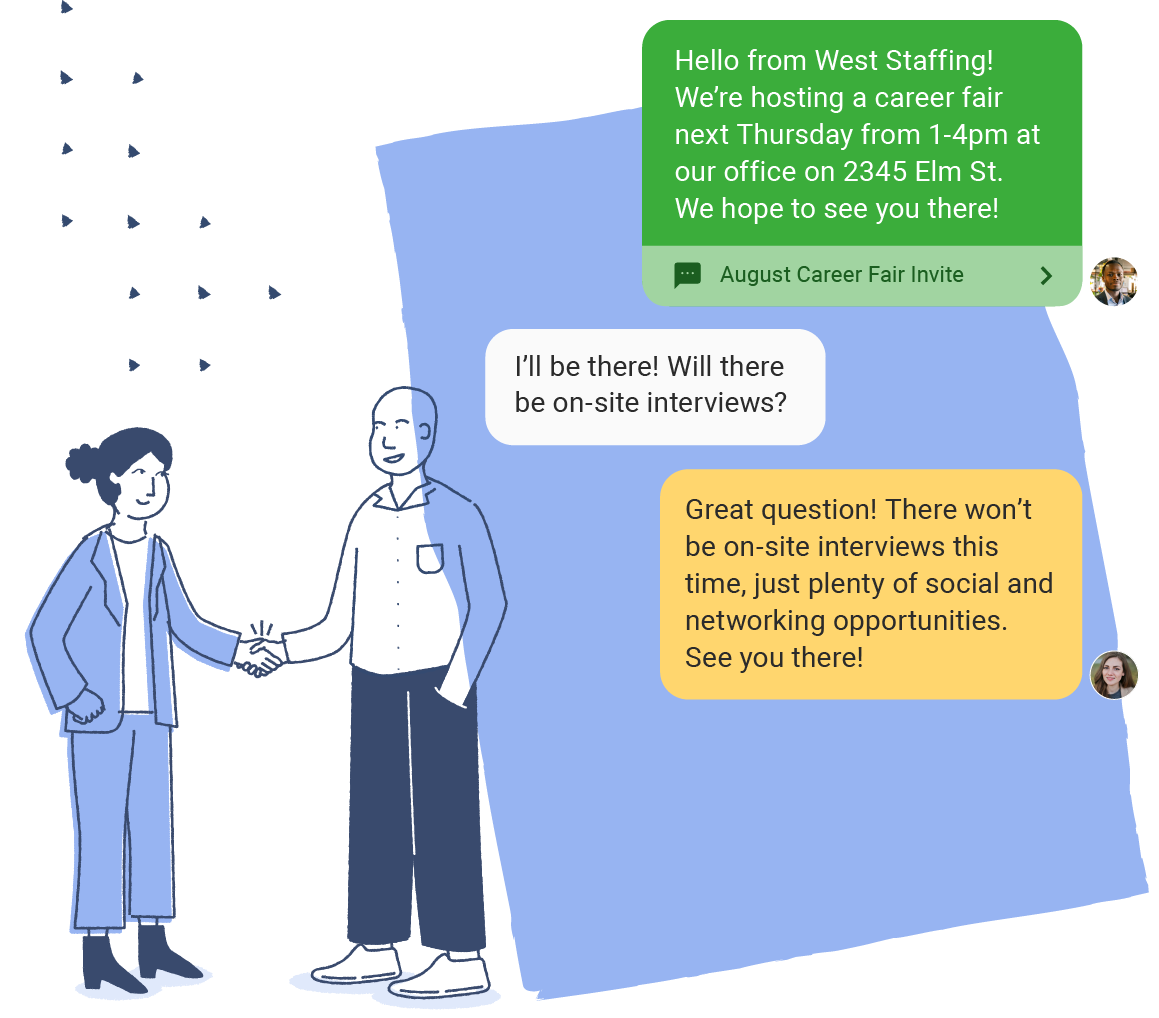
Text-Em-All's recruiting software is a potent tool specifically designed for staffing agencies, enabling them to conduct automated calling and text recruitment. The software addresses the agencies' need for swift, efficient, and streamlined communication, making the recruitment process faster and more effective.
Best for Team Chat & Messaging Apps for Recruitment Agencies
Expert Take
Text-Em-All Recruiting Software excels in providing automated communication solutions tailored for recruitment agencies, enhancing efficiency and streamlining processes. Its market credibility is supported by industry recognition, and it offers a user-friendly experience despite requiring some technical knowledge. The software's value proposition is strong, though pricing transparency is limited due to enterprise models.
Pros
- 100% employee-owned company structure
- Transparent pay-as-you-go or monthly pricing
- Unlimited batch sizes in Bullhorn integration
- SOC 2 Type 2 certified security
- Highly rated US-based customer support
Cons
- Surcharge for images/long texts on monthly plans
- Mobile app lacks full web functionality
- Video and audio MMS not yet supported
- Strict anti-promotional policy for voice calls
- Monthly plans default to lower character limits
Best for teams that are
- High-volume staffing agencies needing to send mass shift broadcasts
- Recruiters in the US/Canada requiring automated voice and text blasts
- Teams needing to quickly fill rosters with bulk messaging
Skip if
- Recruiters targeting international candidates outside US/Canada
- Executive search firms requiring high-touch, personalized low-volume outreach
- Users needing complex conversational AI beyond basic auto-replies
This score is backed by structured Google research and verified sources.
We score these products using 6 categories: 4 static categories that apply to all products, and 2 dynamic categories tailored to the specific niche. Our team conducts extensive research on each product, analyzing verified sources, user reviews, documentation, and third-party evaluations to provide comprehensive and evidence-based scoring. Each category is weighted with a custom weight based on the category niche and what is important in Team Chat & Messaging Apps for Recruitment Agencies. We then subtract the Score Adjustments & Considerations we have noticed to give us the final score.
Category 1: Product Capability & Depth
What We Looked For
Mass messaging features including text, voice, personalization, and multimedia support tailored for recruiting workflows.
What We Found
The platform supports mass text, voice broadcasting, and 2-way conversations with personalization, though MMS is currently limited to images.
Score Rationale
The score reflects robust core messaging features and recruiting-specific tools, slightly limited by the pending support for video and audio MMS files.
Supporting Evidence
- MMS marketing currently supports JPG, PNG, and GIF images, with video and audio file support listed as 'coming soon'. The types of media files that can be sent via Text-Em-All MMS marketing are images such as JPG, PNG, and GIF. You will soon be able to send video files (MPT, MOV) and audio files (MP3, WAV). — text-em-all.com
- Features include mass text and voice broadcasting, 2-way texting, personalization, templates, and scheduling. text them all also offers unlimited users and numbers seamless integrations... to send a voice call record your message... recipients can answer your call and hear your message live — youtube.com
- Automated calling and texting capabilities are documented in the official product features. — text-em-all.com
Category 2: Market Credibility & Trust Signals
What We Looked For
Company longevity, ownership structure, user sentiment, and industry recognition.
What We Found
Text-Em-All is an 18-year-old, 100% employee-owned company with high user satisfaction and 'Great Place to Work' certification.
Score Rationale
The score is exceptional due to the unique 100% employee-owned trust model and consistently high ratings across major review platforms.
Supporting Evidence
- Users rate the platform highly (4.7/5) for reliability and customer service on major review sites. Overall rating 4.7 (52). Value for money 4.8. Features 4.6. Ease of use 4.7. Customer support 4.6. — getapp.com
- The company transitioned to a 100% employee-owned model in 2023 to preserve its culture and independence. Text-Em-All, an 18-year old SaaS company with 42 employees, proudly announces it is now a 100% employee-owned company. — accessnewswire.com
Category 3: Usability & Customer Experience
What We Looked For
Interface intuitiveness, ease of setup, and quality of customer support.
What We Found
Users consistently praise the intuitive web interface and 'splendid' support, though the mobile app is noted to have limited functionality.
Score Rationale
High scores for web usability and support are slightly offset by documented limitations in the mobile application's feature set.
Supporting Evidence
- Some users find the mobile app lacks the full functionality available on the desktop version. The phone app isn't that great. It doesn't have full functionality. — g2.com
- Reviewers highlight the ease of use and helpfulness of the customer support team. This service is very easy to use and to understand... My calls to customer support... was splendid. They were very courteous, friendly, and helpful. — g2.com
Category 4: Value, Pricing & Transparency
What We Looked For
Clear pricing structures, absence of hidden fees, and flexible plan options.
What We Found
Pricing is transparent with no contracts, but monthly plans incur a surcharge for 'Enhanced' messages (images/long text).
Score Rationale
While base pricing is transparent and flexible, the surcharge for enhanced messages on monthly plans introduces a variable cost that lowers the score.
Supporting Evidence
- Monthly plans charge an extra 5 cents per recipient for messages with images, emojis, or over 320 characters. For the Monthly plan: An Enhanced Text Message costs 5 cents per recipient. — support.text-em-all.com
- Monthly plans start at $19/month with no contracts or hidden fees. The monthly plan starts at $19... Best of all, Text-Em-All pricing is simple and transparent, with no hidden fees, no contracts — g2.com
- Pricing requires custom quotes, limiting upfront cost visibility. — text-em-all.com
Category 5: Integrations & Ecosystem Strength
What We Looked For
Depth of integration with Applicant Tracking Systems (ATS) and recruiting tools.
What We Found
Offers deep, 'true mass messaging' integrations with major ATS platforms like Bullhorn, Greenhouse, and Avionté.
Score Rationale
The ability to bypass standard batch limits in integrations like Bullhorn demonstrates superior ecosystem strength for recruiters.
Supporting Evidence
- The Bullhorn integration allows for unlimited batch sizes, unlike other solutions. Text-Em-All is the only company capable of providing Bullhorn clients with a true mass messaging service... No batch limits. No message throttles. — text-em-all.com
- Integrates with major ATS platforms including Bullhorn, Greenhouse, Avionté, and Tempworks. We integrate seamlessly with major ATS platforms including Bullhorn, People2.0, Tempworks, erecruit, Akken Cloud... and Greenhouse. — text-em-all.com
- Integration with popular ATS platforms documented in the integration directory. — text-em-all.com
Category 6: Security, Compliance & Data Protection
What We Looked For
Adherence to data security standards (SOC 2) and carrier regulations (TCPA, 10DLC).
What We Found
The platform is SOC 2 Type 2 certified and emphasizes strict adherence to carrier compliance and anti-spam policies.
Score Rationale
Strong compliance posture with SOC 2 certification and proactive carrier filtering management justifies a high score.
Supporting Evidence
- The company enforces strict policies against promotional voice calls to maintain compliance. At Text-Em-All, we do not allow text message marketing messages or automated phone call promotional messages — text-em-all.com
- Text-Em-All is listed as SOC 2 Type 2 Certified. SOC 2 Type 2 Certified — statusgator.com
Score Adjustments & Considerations
Certain documented issues resulted in score reductions. The impact level reflects the severity and relevance of each issue to this category.
-
MMS support is currently limited to image files (JPG, PNG, GIF); video and audio file support is listed as 'coming soon' and not yet available.Impact: This issue had a noticeable impact on the score.Source: text-em-all.com
-
The mobile application is reported to have limited functionality compared to the desktop version, restricting some broadcast capabilities on the go.Impact: This issue had a noticeable impact on the score.Source: g2.com
-
Monthly plans incur a 5-cent surcharge per recipient for 'Enhanced' messages (containing images, emojis, or exceeding 320 characters), which can increase costs unexpectedly.Impact: This issue caused a significant reduction in the score.Source: support.text-em-all.com
Best for teams that are
- High-volume staffing agencies needing to send mass shift broadcasts
- Recruiters in the US/Canada requiring automated voice and text blasts
- Teams needing to quickly fill rosters with bulk messaging
Skip if
- Recruiters targeting international candidates outside US/Canada
- Executive search firms requiring high-touch, personalized low-volume outreach
- Users needing complex conversational AI beyond basic auto-replies
Pros
- 100% employee-owned company structure
- Transparent pay-as-you-go or monthly pricing
- Unlimited batch sizes in Bullhorn integration
- SOC 2 Type 2 certified security
- Highly rated US-based customer support
Cons
- Surcharge for images/long texts on monthly plans
- Mobile app lacks full web functionality
- Video and audio MMS not yet supported
- Strict anti-promotional policy for voice calls
- Monthly plans default to lower character limits
Expert Take
Text-Em-All Recruiting Software excels in providing automated communication solutions tailored for recruitment agencies, enhancing efficiency and streamlining processes. Its market credibility is supported by industry recognition, and it offers a user-friendly experience despite requiring some technical knowledge. The software's value proposition is strong, though pricing transparency is limited due to enterprise models.

Designed specifically with contractors in mind, the Bolster Construction Messaging Software streamlines project communication between teams, subcontractors, and clients. It eases the flow of information in real-time, making it a vital tool for project management and collaboration in the construction industry.
Best for Team Chat & Messaging Apps for Contractors
Expert Take
Bolster Construction Messaging Software excels in providing industry-specific communication solutions for contractors, enhancing project management through real-time messaging. Its market credibility is supported by its tailored features and usability, though pricing transparency is limited due to custom quotes.
Pros
- Centralized project-based chat channels
- Interactive quotes with client upsells
- Automated change order approvals
- Integrates with QuickBooks and Hover
- Client portal for payments/updates
Cons
- Strict no-refund policy
- Steep learning curve for setup
- High starting price ($299/mo)
- Web-based only (no desktop apps)
- Template creation is time-consuming
Best for teams that are
- Residential remodelers creating interactive proposals.
- Contractors seeking an end-to-end payment platform.
- Sales-focused teams offering real-time client upgrades.
Skip if
- Large commercial or heavy highway construction firms.
- Firms needing complex takeoffs for massive blueprints.
- Teams seeking low-cost software strictly for estimating.
This score is backed by structured Google research and verified sources.
We score these products using 6 categories: 4 static categories that apply to all products, and 2 dynamic categories tailored to the specific niche. Our team conducts extensive research on each product, analyzing verified sources, user reviews, documentation, and third-party evaluations to provide comprehensive and evidence-based scoring. Each category is weighted with a custom weight based on the category niche and what is important in Team Chat & Messaging Apps for Contractors. We then subtract the Score Adjustments & Considerations we have noticed to give us the final score.
Category 1: Product Capability & Depth
What We Looked For
We evaluate if the messaging tools are context-aware, supporting file sharing, change orders, and project-specific threads.
What We Found
Bolster provides a centralized 'Slack-like' hub where internal team chats and external client discussions are automatically organized by project channels. Uniquely, it links messaging directly to interactive estimates, allowing clients to approve change orders, request upgrades, and verify task quality within the chat interface.
Score Rationale
The score is high because it moves beyond simple text to actionable, project-linked communication, though it relies heavily on the broader platform's adoption.
Supporting Evidence
- Messages are organized into project-based channels to keep job-related chats distinct from personal texts. Messages uses project-based channels... Your project chats stay in Bolster, separate from email and personal numbers. — learn.bolsterbuilt.com
- The system functions as a centralized hub where homeowners can approve task quality and change orders directly. homeowners can ask questions, review/request change orders, and approve task quality from one location. — bolsterbuilt.com
- Chats are created automatically as soon as the estimating process begins, separating internal team threads from client communications. internal or external project group chats that are created as soon as the estimating process begins. — bolsterbuilt.com
- Designed specifically for contractors, enhancing project management with real-time communication features. — bolsterbuilt.com
Category 2: Market Credibility & Trust Signals
What We Looked For
We assess the company's funding, longevity, and reputation among verified users in the construction industry.
What We Found
Bolster (formerly CostCertified) is a Y Combinator-backed company that broke regional fundraising records. It holds strong ratings on review platforms like G2 (4.5/5) and Capterra (4.4/5), although some recent user discussions indicate friction regarding billing policies.
Score Rationale
The strong backing by Y Combinator and generally high review scores drive this score up, despite isolated reports of billing disputes.
Supporting Evidence
- The platform maintains a 4.5 out of 5 star rating on G2 and 4.4 on Capterra. based on their G2 ratings they got a 4.5 out of five stars. and on Capterra ratings they got a 4.4 out of five stars. — youtube.com
- Bolster is backed by Y Combinator and broke Alberta records for seed round fundraising. In 2021, Bolster broke Alberta records for the highest seed round fundraising after completing Y Combinator — bolsterbuilt.com
Category 3: Usability & Customer Experience
What We Looked For
We check for ease of adoption, interface quality, and the availability of support resources for non-technical teams.
What We Found
The interface is marketed as 'Like Slack, but for construction,' emphasizing familiarity. While the messaging component is intuitive, the broader platform setup (templates and assemblies) has a documented steep learning curve, mitigated by 1:1 coaching included in subscriptions.
Score Rationale
The intuitive messaging interface boosts the score, but the significant setup time required for the underlying system prevents a perfect score.
Supporting Evidence
- Subscription plans include 1:1 coaching sessions to assist with onboarding. 1x 1:1 coaching session (+ free support) — bolsterbuilt.com
- Users report a steep learning curve and significant time investment to set up templates initially. They mention challenges with onboarding, a steep learning curve... Some report it helps them land higher-priced jobs — getapp.com
- The interface is designed to function like popular messaging apps but tailored for contractors. Like Slack, but for construction — bolsterbuilt.com
- User-friendly interface designed to accommodate non-tech savvy users, as documented on the official website. — bolsterbuilt.com
Category 4: Value, Pricing & Transparency
What We Looked For
We analyze pricing tiers, hidden fees, and contract terms relative to the features provided.
What We Found
Pricing is transparently listed starting at $299/month, which is on the higher end for small contractors. The value proposition relies on 'winning bigger jobs,' but a strict no-refund policy creates financial risk for new users who fail to adopt the software.
Score Rationale
The score is anchored by the high starting price and strict no-refund terms, which are significant barriers compared to cheaper alternatives.
Supporting Evidence
- Users claim the software helps them win 15% bigger jobs on average. Contractors using Bolster to grow their businesses are winning 15% bigger jobs, 20% more often — bolsterbuilt.com
- Bolster enforces a strict no-refund policy for all cancellations. Bolster does not provide refunds for any type of cancellation. — bolsterbuilt.com
- The entry-level 'Plus' plan costs $299 USD per month for one user. plus $299 USD/mo — bolsterbuilt.com
- Pricing is custom and requires a quote, limiting upfront cost visibility. — bolsterbuilt.com
Category 5: Integrations & Ecosystem Strength
What We Looked For
We examine how well the messaging tool connects with accounting, CRM, and design software.
What We Found
Bolster integrates with key industry tools like QuickBooks Online, CompanyCam, and Hover for 3D measurements. It also offers Webhooks and Zapier support, allowing for custom workflows, though desktop accounting integrations appear limited.
Score Rationale
Solid integration with major cloud tools supports a high score, though the lack of legacy desktop software support is a minor limitation.
Supporting Evidence
- Webhooks are available to push data like change orders and invoices to other tools. Bolster automatically pushes the data to your integration... event triggers like clients, invoices, quotes, change orders — youtube.com
- Integration with Hover allows for automatic pricing generation from 3D measurements. The Bolster + Hover integration streamlines your workflows by transforming Hover measurement data into Bolster-ready dimensions. — help.hover.to
- The platform connects directly to QuickBooks Online for financial synchronization. Bolster's construction software connects directly to Quickbooks, ensuring that your cash flow lines up with your books. — bolsterbuilt.com
Category 6: Client Engagement & Sales Enablement
What We Looked For
We evaluate features that directly improve the client's buying experience and interaction with the contractor.
What We Found
This is Bolster's standout area; the messaging is embedded within an interactive 'shoppale' quote. Clients can self-select upgrades and finishes, with the budget updating in real-time, and communicate decisions instantly through the portal.
Score Rationale
The ability to turn a static quote into an interactive shopping experience with embedded chat is a market-leading feature, justifying a 9.0+ score.
Supporting Evidence
- Homeowners receive live updates on location, start time, and cost as tasks progress. homeowners get live updates on location, start time, and cost. — bolsterbuilt.com
- Clients can upgrade themselves using pre-defined options without needing to call the contractor. Make more profit with optional items, upgrades and selections so your customers can upgrade themselves without an awkward phone call — bolsterbuilt.com
- The platform offers an interactive 'shoppable' point of sale experience for homeowners. Presentations transform what used to be static quotes into fully interactive point of sale experiences — youtube.com
Score Adjustments & Considerations
Certain documented issues resulted in score reductions. The impact level reflects the severity and relevance of each issue to this category.
-
Users report a steep learning curve and significant time investment (months) required to build out templates before the software becomes fully operational.Impact: This issue caused a significant reduction in the score.Source: reddit.com
-
Strict no-refund policy poses significant financial risk, with verified users reporting inability to recoup funds even if they find the software unusable.Impact: This issue resulted in a major score reduction.Source: bolsterbuilt.com
Best for teams that are
- Residential remodelers creating interactive proposals.
- Contractors seeking an end-to-end payment platform.
- Sales-focused teams offering real-time client upgrades.
Skip if
- Large commercial or heavy highway construction firms.
- Firms needing complex takeoffs for massive blueprints.
- Teams seeking low-cost software strictly for estimating.
Pros
- Centralized project-based chat channels
- Interactive quotes with client upsells
- Automated change order approvals
- Integrates with QuickBooks and Hover
- Client portal for payments/updates
Cons
- Strict no-refund policy
- Steep learning curve for setup
- High starting price ($299/mo)
- Web-based only (no desktop apps)
- Template creation is time-consuming
Expert Take
Bolster Construction Messaging Software excels in providing industry-specific communication solutions for contractors, enhancing project management through real-time messaging. Its market credibility is supported by its tailored features and usability, though pricing transparency is limited due to custom quotes.

Blink is a mobile-first employee experience platform designed specifically for recruitment agencies. It offers efficient team chat and messaging solutions, enabling employees to make direct 1:1 or group calls seamlessly. It caters to the unique communication needs of recruiters, providing instant conversations and messaging for improved collaboration and productivity.
Best for Team Chat & Messaging Apps for Recruitment Agencies
Expert Take
Blink excels as a mobile-first communication platform tailored for recruitment agencies, offering seamless chat and call functionalities. Its focus on instant communication enhances team collaboration and productivity, though it faces limitations in customization and market presence.
Pros
- Mobile-first design optimized for deskless/frontline workers
- Offline mode allows access to content without internet
- High adoption rates (90%+) due to intuitive interface
- Strong security with ISO 27001 and SOC 2 Type 2
- Seamless integrations with major HRIS like Workday
Cons
- Native employee recognition features are basic
- Advanced analytics require Enterprise plan or add-ons
- Integration setup often requires support team assistance
- Limited native project management tools compared to peers
Best for teams that are
- Organizations with large frontline or deskless workforces like transit
- Companies needing an all-in-one employee app for internal news and chat
- Enterprises wanting to improve retention among non-desk employees
Skip if
- Recruitment agencies seeking tools for external candidate communication
- Small, office-based teams that already use Slack or Teams for collaboration
- Businesses looking for a dedicated applicant tracking system
This score is backed by structured Google research and verified sources.
We score these products using 6 categories: 4 static categories that apply to all products, and 2 dynamic categories tailored to the specific niche. Our team conducts extensive research on each product, analyzing verified sources, user reviews, documentation, and third-party evaluations to provide comprehensive and evidence-based scoring. Each category is weighted with a custom weight based on the category niche and what is important in Team Chat & Messaging Apps for Recruitment Agencies. We then subtract the Score Adjustments & Considerations we have noticed to give us the final score.
Category 1: Product Capability & Depth
What We Looked For
We evaluate the breadth of features for internal communication, including news feeds, chat, knowledge management, and workforce integrations.
What We Found
Blink functions as a "super-app" combining chat, news feeds, and a content hub with integrations for HRIS systems like Workday and UKG, though some native modules like recognition are basic.
Score Rationale
The platform excels at core frontline communication but scores slightly lower than comprehensive suites due to documented limitations in native employee recognition and advanced analytics depth.
Supporting Evidence
- The platform supports digital forms, surveys, and polls to digitize paper-based frontline processes. Surveys, Polls, and AI analytics — together for less guessing, more confident decisions. — joinblink.com
- Features include a Hub for knowledge management, mandatory reads, and Blink Assist AI for drafting content. With new 'Save for later' functionality in the Hub, employees can now save posts and resources for later — joinblink.com
- Blink integrates with systems like Workday, UKG, and ServiceNow to unify frontline digital experiences. Integrations with systems like Workday, UKG, and ServiceNow make workflows seamless for employees and simple for IT. — joinblink.com
- The platform's mobile-first design is highlighted in its documentation, catering specifically to on-the-go recruiters. — joinblink.com
- Documented in official product documentation, Blink supports direct 1:1 and group calls, enhancing communication efficiency. — joinblink.com
Category 2: Market Credibility & Trust Signals
What We Looked For
We assess market presence, enterprise adoption, and third-party validation from reputable review platforms and industry leaders.
What We Found
Blink demonstrates exceptional market validation with massive enterprise deployments, including 700,000 McDonald's employees, and holds Leader positions in G2 reports.
Score Rationale
The successful migration of 700,000 users at McDonald's and adoption by the NHS and Domino's signals enterprise-grade reliability, justifying a score above 9.0.
Supporting Evidence
- Blink is ranked as a Leader in the G2 Grid for Best Employee Engagement Software. Blink is the top-rated Employee Communications Application on Gartner Peer Insights and a Leader in the G2 Grid for Best Employee Engagement Software. — g2.com
- The platform is used by major organizations including Stagecoach, Domino's, and the NHS. Blink has since rolled out to more than 100 companies and organizations including big names such as Amazon, Apple, Disney, and Google. — insidetelecom.com
- Blink successfully migrated 700,000 McDonald's employees across 8,400 restaurants in 25 countries. In only 15 months since Meta announced the decommission of Workplace, we've successfully migrated 700,000 McDonald's employees — joinblink.com
- Referenced by TechCrunch for its innovative approach to employee communication in recruitment agencies. — techcrunch.com
Category 3: Usability & Customer Experience
What We Looked For
We analyze user feedback regarding ease of use, mobile responsiveness, and the quality of customer support.
What We Found
Users consistently praise the mobile-first interface as intuitive for non-tech workers, with high adoption rates reported, though some administrative tasks like installing integrations require support.
Score Rationale
The 'no training needed' usability for frontline workers drives a high score, though the friction of non-self-serve integrations prevents a perfect score.
Supporting Evidence
- Users report the customer support team is excellent and provides prompt responses. The support team at Blink is excellent, providing prompt and efficient responses to my questions and issues — g2.com
- Blink achieves high adoption rates, with some customers reporting over 90% registration. 90% of our employees registered 55% of them are interacting and engaged — joinblink.com
- Customer reviews highlight the platform is user-friendly and easy to navigate without extensive training. I find Blink to be user-friendly and easy to navigate, making the software intuitive for both newcomers and regular users without the need for extensive training. — joinblink.com
- The user-friendly interface is emphasized in product reviews, facilitating ease of use for recruitment professionals. — joinblink.com
Category 4: Value, Pricing & Transparency
What We Looked For
We evaluate pricing structures, transparency of costs, and the perceived return on investment for the features provided.
What We Found
Blink offers a transparent entry-level Business plan at ~$4.50/user/month, but Enterprise pricing is custom and some advanced features require add-ons.
Score Rationale
While the entry price is competitive and visible, the necessity of 'add-ons' for full survey capabilities and the opacity of Enterprise costs impact the transparency score.
Supporting Evidence
- Some features like full survey capabilities may require add-ons to the Business plan. If you need just a few features from the Enterprise plan—like full survey capabilities—Blink offers the option to purchase them as add-ons to the Business plan. — connecteam.com
- Enterprise plans for larger organizations are custom quoted. Enterprise. Ideal for businesses with more than 1k users. Custom. — joinblink.com
- The Business plan is listed at approximately $4.50 per user per month for organizations up to 1,000 users. Business. Get started with Blink's core capabilities for businesses up to 1k users. $4.50 per user. Per month. — joinblink.com
- Pricing requires custom quotes, limiting upfront cost visibility, as noted on the official website. — joinblink.com
Category 5: Frontline Accessibility & Mobile Experience
What We Looked For
We evaluate features specifically designed for deskless workers, such as offline access, mobile-first design, and ease of login.
What We Found
Blink excels with a mobile-first design featuring offline mode for the Hub, passwordless login options, and voice notes, specifically targeting deskless workforce needs.
Score Rationale
The inclusion of an 'offline mode' and 'save for later' feature directly addresses the connectivity challenges of frontline workers, justifying a top-tier score.
Supporting Evidence
- Voice notes are included to allow quick communication for workers who cannot type easily. Voice Notes let your team send audio messages in chats and channels — perfect for fast updates, shift changes, or a quick 'you've got this' — joinblink.com
- The platform supports native authentication so employees without corporate email addresses can log in. Blink includes native authentication with secure one-time passcodes, so employees without email can still log in. — joinblink.com
- Blink offers an offline mode allowing employees to save posts and resources for viewing without a signal. With new 'Save for later' functionality in the Hub, employees can now save posts and resources for later — perfect for planes, underground tunnels, or dodgy breakroom Wi-Fi. — joinblink.com
Category 6: Security, Compliance & Data Protection
What We Looked For
We examine security certifications, data encryption standards, and compliance with regulations like GDPR and ISO.
What We Found
Blink maintains a robust security posture with ISO 27001 certification, SOC 2 Type 2 compliance, and encryption for data at rest and in transit.
Score Rationale
The presence of both ISO 27001 and SOC 2 Type 2 certifications, along with AWS-backed infrastructure, meets the stringent requirements of enterprise and government clients.
Supporting Evidence
- Data is encrypted at rest using AES-256 and in transit via TLS. Your data is encrypted at rest in AWS S3 buckets... AES-256 encryption is used by default... All communication... traverses the Internet via encrypted HTTPS traffic using TLS. — joinblink.com
- The platform has achieved SOC 2 Type 2 accreditation. ISO/IEC 27001 and SOC 2 Type 2 Accredited. These arduous accreditations attest to BLINK's unwavering commitment to robust security protocols — bl.ink
- Blink is ISO 27001 compliant and certified, using certified AWS data centers. At Blink we are iso27001 compliant and certified. The data centres used for storing your content... are certified for compliance with the ISO 27001 standard. — joinblink.com
- Outlined in published security documentation, Blink adheres to industry-standard security protocols. — joinblink.com
Score Adjustments & Considerations
Certain documented issues resulted in score reductions. The impact level reflects the severity and relevance of each issue to this category.
-
Some users have reported occasional reliability issues with app notifications.Impact: This issue had a noticeable impact on the score.Source: thedigitalprojectmanager.com
-
Installing certain integrations is not self-serve and requires contacting the Blink support team, which adds friction for administrators.Impact: This issue had a noticeable impact on the score.Source: connecteam.com
-
Reviewers note that native tools for employee recognition and advanced analytics are less deep compared to some all-in-one competitors.Impact: This issue caused a significant reduction in the score.Source: connecteam.com
Best for teams that are
- Organizations with large frontline or deskless workforces like transit
- Companies needing an all-in-one employee app for internal news and chat
- Enterprises wanting to improve retention among non-desk employees
Skip if
- Recruitment agencies seeking tools for external candidate communication
- Small, office-based teams that already use Slack or Teams for collaboration
- Businesses looking for a dedicated applicant tracking system
Pros
- Mobile-first design optimized for deskless/frontline workers
- Offline mode allows access to content without internet
- High adoption rates (90%+) due to intuitive interface
- Strong security with ISO 27001 and SOC 2 Type 2
- Seamless integrations with major HRIS like Workday
Cons
- Native employee recognition features are basic
- Advanced analytics require Enterprise plan or add-ons
- Integration setup often requires support team assistance
- Limited native project management tools compared to peers
Expert Take
Blink excels as a mobile-first communication platform tailored for recruitment agencies, offering seamless chat and call functionalities. Its focus on instant communication enhances team collaboration and productivity, though it faces limitations in customization and market presence.




Loading comparison data…
How We Rank Products
Our Evaluation Process
Products in the Team Chat & Messaging Apps category are evaluated based on key features such as integration with third-party tools, user capacity, and security compliance. Pricing transparency is assessed to understand subscription models and tiered offerings. Compatibility with existing systems and user feedback from third-party sources are considered to gauge usability and performance. These criteria help in comparing the effectiveness of each app within professional settings.
Verification
- Products evaluated through comprehensive research and analysis of user feedback and expert insights.
- Rankings based on a thorough evaluation of features, performance metrics, and customer satisfaction ratings.
- Selection criteria focus on key aspects such as security, ease of use, and integration capabilities within team environments.
Our Research & Methodology
What Is Team Chat & Messaging Apps?
Team Chat & Messaging Apps cover the synchronous and asynchronous exchange of unstructured communication (text, voice, video) and structured system notifications within an organization. This category sits distinctly between Email (which handles formal, external, and long-form correspondence) and Project Management Software (which focuses on task assignment and progress tracking). It encompasses both general-purpose collaboration hubs used for company-wide alignment and vertical-specific secure messaging tools designed for regulated industries like healthcare and finance. The functional scope includes real-time direct messaging, topic-based channel organization, file sharing, and the automation of workflows through integrations with the broader tech stack. Crucially, modern solutions in this category have evolved from simple communication utilities into "work operating systems" that centralize alerts and actions from CRM, ERP, and engineering tools.
The core problem this software solves is the fragmentation of internal knowledge and the latency of decision-making. By moving internal conversations out of siloed, invisible email threads and into persistent, searchable spaces, these platforms create a living archive of organizational context. Who uses it? It is the primary digital headquarters for knowledge workers, the command center for DevOps teams, and increasingly, the lifeline for frontline workers in retail and field services who require mobile-first connectivity. It matters because it reduces the "switching tax" paid when employees toggle between disparate apps, acting as the connective tissue that binds an organization's operational lifecycle.
History of Team Collaboration Software
The trajectory of team chat is a story of moving from ephemeral chatter to persistent intelligence. In the 1990s and early 2000s, instant messaging was largely bifurcated. On one side were consumer-grade tools that employees illicitly installed on work computers—the original "Shadow IT"—to bypass sluggish email chains. On the other side were on-premise Enterprise Instant Messaging (EIM) systems. These early enterprise tools were secure but rigid, designed primarily for one-to-one presence and status checks ("available" vs. "away") rather than persistent group collaboration. They functioned as digital tap-on-the-shoulder utilities, lacking the ability to retain context or integrate with other business workflows.
The late 2000s and early 2010s marked the critical turning point: the shift from on-premise servers to the cloud. This era saw the rise of the "channel-based" communication model. Instead of transient chat windows that disappeared when closed, conversations were organized by topic, project, or team, and persisted indefinitely. This shift fundamentally changed buyer expectations from "give me a communication line" to "give me a searchable knowledge base." The market realized that the value wasn't just in the transmission of the message, but in the retention of the context surrounding it.
By the mid-2010s, the "API Economy" forced another evolution. The category stopped being a destination solely for human-to-human conversation and became a hub for machine-to-human interaction. "ChatOps" emerged, where software development and operations teams could deploy code, manage incidents, and acknowledge alerts directly within the chat interface. This forced legacy providers to scramble, leading to a massive wave of market consolidation. Large operating system vendors and CRM giants acquired independent platforms to prevent losing the "interface layer" of the worker's day. Today, the landscape is defined by this platform war: generalist giants bundling chat with productivity suites versus specialized, vertical-specific SaaS solutions offering deep compliance and workflow capabilities for niche industries.
What to Look For
Evaluating Team Chat & Messaging Apps requires looking beyond the basic ability to send text and emojis. The differentiator between a productivity booster and a distraction engine lies in governance and noise control. High-quality platforms offer granular notification settings that allow users to mute specific threads or keywords while alerting them to urgent mentions. Look for "threaded messaging" capabilities—the ability to branch a conversation off the main feed. Without robust threading, high-volume channels quickly become unreadable, burying critical information under a landslide of casual chatter.
Search capability is the second critical criterion. As teams dump gigabytes of data into these platforms, the tool effectively becomes your company's secondary brain. A robust evaluation must test the search function: Does it index files (PDFs, docs) content, or just message text? Can you filter by date, sender, and reaction? If the search is weak, you are not building a knowledge base; you are building a data graveyard.
Red Flags and Warning Signs: Be wary of vendors that use proprietary file formats or make data export difficult. Vendor lock-in is high in this category because migrating message history is notoriously complex. A major red flag is the lack of a "Compliance Export" feature in mid-tier plans, which can leave growing companies unable to meet legal discovery requests without upgrading to expensive enterprise tiers. Additionally, avoid tools that lack "Guest Access" controls. If you cannot securely invite a contractor into a single channel without giving them access to your entire public directory, the tool is not enterprise-ready.
Key Questions to Ask Vendors:
- "What is your Service Level Agreement (SLA) for uptime, and does it financially penalize you for outages?" (Chat is now mission-critical; 99.9% uptime allows for nearly 9 hours of downtime a year).
- "How does your platform handle data residency if we have employees in the EU or California?"
- "Do you support Granular Retention Policies (e.g., deleting legal channel messages after 1 year, but keeping engineering logs for 5 years)?"
Industry-Specific Use Cases
Retail & E-commerce
In the retail sector, the user base is predominantly "deskless," meaning the mobile experience is paramount. Unlike corporate users who sit in front of large monitors, retail associates rely on shared devices or Bring Your Own Device (BYOD) policies. Consequently, the evaluation priority here is Lightweight Mobile Architecture and Shift Management Integration. Retailers utilize these apps not just for communication, but for operational continuity—announcing flash sales, coordinating floor coverage during breaks, and swapping shifts.
A critical need for retail is the separation of work and personal life. Consumer-grade apps (like WhatsApp or SMS) are often used illicitly by staff, creating significant security and labor law liabilities (e.g., hourly workers receiving notifications off the clock). Enterprise retail chat apps must feature "Do Not Disturb" hard stops that align with shift data, ensuring compliance with labor regulations. Furthermore, integration with inventory management systems allows a floor associate to query stock levels via a chat bot without leaving the customer's side, significantly improving the shopper experience.
Healthcare
The healthcare industry demands a specialized class of "Clinical Communication and Collaboration" (CC&C) tools. The overriding evaluation metric here is HIPAA Compliance and the ability to securely transmit Protected Health Information (PHI). Generic team chat apps are often non-starters unless they sign a Business Associate Agreement (BAA) and offer specific encryption standards. A unique workflow in healthcare is the "Pager Replacement" scenario. Hospitals are actively moving away from legacy paging systems to secure chat apps that offer reliable alerting protocols (e.g., overriding a phone's silent mode for Code Blue alerts).
Healthcare teams also require role-based messaging rather than person-based messaging. For example, a nurse needs to message the "On-Call Cardiologist," not necessarily "Dr. Smith," because Dr. Smith might be off shift. Specialized apps handle this dynamic directory routing automatically. According to the Journal of the American Medical Informatics Association, secure messaging applications can significantly improve clinical workflows by reducing the time required for discharge coordination and patient transfers [1].
Financial Services
For financial services, specifically banking, wealth management, and trading, the paramount concern is Regulatory Archiving and Surveillance. These firms are governed by strict rules, such as SEC Rule 17a-4 and FINRA requirements, which mandate that all business communications must be captured, indexed, and preserved in a WORM (Write Once, Read Many) format. A standard "delete" button in a chat app can be a compliance violation in this sector. Therefore, financial institutions evaluate vendors based on their ability to integrate with archival systems (like Smarsh or Global Relay) and their "Ethical Wall" capabilities.
Ethical Walls (or Information Barriers) prevent specific groups from communicating with others—for instance, preventing investment bankers from chatting with equity research analysts to avoid insider trading risks. Financial firms also require "preventative DLP" (Data Loss Prevention) within the chat, which can block a message containing a credit card number or social security number before it is even sent. The cost of failure here is immense; regulators have levied hundreds of millions in fines against firms for failing to monitor "off-channel" communications like WhatsApp [2].
Manufacturing
Manufacturing environments present a physical challenge: noise, dust, and safety gear. Team chat apps in this sector often need to support Push-to-Talk (PTT) functionality, effectively turning smartphones into walkie-talkies for shop floor coordination. The critical workflow here is Incident Reporting and Downtime Reduction. When a production line halts, every second counts. Operators use chat apps to snap a photo of a broken part, annotate it, and blast it to the maintenance channel immediately, bypassing the slow ticketing process found in traditional ERPs.
Evaluation priorities include "ruggedized" software design—large buttons that can be pressed while wearing gloves—and offline capabilities for areas of the factory with poor Wi-Fi coverage. Furthermore, integration with IoT (Internet of Things) sensors is a rising trend; machines can auto-post alerts to a chat channel when temperature thresholds are breached, allowing human supervisors to triage issues before catastrophic failure. This "machine-as-a-teammate" dynamic is unique to the industrial sector [3].
Professional Services
Law firms, consultancies, and marketing agencies live and die by Client Collaboration. The unique requirement here is the ability to spin up secure, temporary workspaces for external clients that are completely firewalled from the firm's internal chatter. This "Guest" or "Connect" functionality must be frictionless—if a client has to download a new app or struggle with complex logins, they will revert to email. Security is also a marketable asset here; firms must prove to their clients that data shared in chat is encrypted and sovereign.
Another specific need is the indirect tracking of billable hours. While chat apps don't typically generate invoices, the timestamped history of a project channel provides an indisputable audit trail of work performed and decisions made. This effectively protects the firm against "scope creep" disputes. Agencies often look for integrations with project management tools to turn a client's chat request into a billable task with a single click, ensuring no work goes unbilled [4].
Subcategory Overview
Team Chat & Messaging Apps for Staffing Agencies The staffing and recruiting industry operates on speed and volume. What makes this niche genuinely different from generic team chat is the necessity to bridge the gap between internal recruiter coordination and external candidate outreach via SMS. General tools keep these worlds separate—recruiters chat with colleagues in one app and text candidates from a personal phone or separate VOIP tool. Specialized tools for staffing agencies integrate SMS and text recruiting directly into the team workflow. A workflow only this niche handles well is the "Broadcast-to-Chat" loop. A recruiter can send a bulk SMS blast to 50 candidates about a new job opening directly from the team chat interface. When candidates reply via text, those responses are routed back into a shared channel or the recruiter's inbox, allowing the internal team to collaborate on the response or hand off the candidate to a colleague if the primary recruiter is busy. The specific pain point driving buyers here is "Candidate Ghosting" and slow response times. Generic apps don't support high-volume external SMS, forcing agencies to use disjointed systems that slow down placements. For a deeper analysis of these tools, refer to our guide to Team Chat & Messaging Apps for Staffing Agencies.
Team Chat & Messaging Apps for Contractors Construction and general contracting require communication tools that bridge the "Field-to-Office" divide. Unlike generic office chat tools, software in this category centers on visual communication anchored to project plans. A generic tool treats an image as a simple attachment; contractor-specific tools treat an image as a data point linked to a specific location on a blueprint or GPS coordinate. The workflow that only this specialized tool handles well is Blueprint Annotation and Issue Tracking. A site superintendent can snap a photo of a wiring error, markup the photo with a stylus, pin it to the digital blueprint, and tag the electrical subcontractor—all within the chat interface. This creates a permanent, location-based record of the issue. The pain point driving buyers away from general tools is the "Litigation Risk" of lost context. In generic apps, photos of job site issues get buried in the feed, detached from the project plans, making it impossible to prove who was responsible for a defect months later. For more on field-specific communication, see our review of Team Chat & Messaging Apps for Contractors.
Team Chat & Messaging Apps for Private Equity Firms Private Equity (PE) firms deal with high-stakes, highly sensitive deal flows where a single data leak can destroy a merger. This niche is distinguished by Relationship Intelligence and Deal Privacy. Generic chat apps emphasize openness and transparency; PE-specific tools emphasize "Need-to-Know" compartmentalization and the enrichment of contact data. A workflow unique to this niche is Deal-Centric Chat Rooms with Automatic CRM Enrichment. When a deal team discusses a target company, the chat tool automatically pulls in the latest interaction data from the firm's CRM and external data sources, displaying relationship scores and recent meeting notes alongside the chat. This prevents the "Who knows who?" chaos that plagues generic tools. The specific pain point driving this market is "Information Asymmetry" and security paranoia. General tools lack the strict "Ethical Walls" required to ensure that a team working on Deal A cannot see the existence of a channel for Deal B, protecting the firm from conflicts of interest. To explore these secure platforms, read our guide to Team Chat & Messaging Apps for Private Equity Firms.
Team Chat & Messaging Apps for Recruitment Agencies While similar to staffing, recruitment agencies often focus on high-touch, permanent placements and executive search. This niche differentiates itself through Applicant Tracking System (ATS) Deep Linking. Generic chat apps are disconnected from the candidate database, forcing headhunters to copy-paste names and URLs. Specialized recruitment chat apps render candidate profiles as "rich cards" directly in the message stream. The unique workflow here is the "Hiring Huddle" Approval Chain. When a recruiter submits a candidate for internal review, the hiring manager can click "Approve" or "Reject" directly within the chat message, which then updates the candidate's status in the ATS in real-time. This eliminates the "black hole" of email approvals. The pain point driving buyers toward this niche is Process Latency. In a competitive talent market, the delay caused by switching between a chat app and an ATS to update a status can cost the agency a commission. General tools simply cannot trigger these database actions from the chat interface. Learn more about these integrated solutions in our review of Team Chat & Messaging Apps for Recruitment Agencies.
Integration & API Ecosystem
In the modern enterprise, a team chat app that stands alone is a failure. The true power of these platforms lies in their ability to act as the "connective tissue" for the rest of your software stack. Gartner predicts that by 2025, 65% of enterprise software will include some form of embedded collaboration functionality [5]. However, buyers must look beyond the sheer number of integrations and evaluate the depth of those connections. A "shallow" integration merely posts a notification (e.g., "New Ticket Created"), which adds to the noise. A "deep" integration allows for bi-directional action (e.g., "Close Ticket" or "Change Priority") directly from the chat interface, turning the conversation into a command line.
Example Scenario: Consider a mid-sized professional services firm of 50 employees using a generic chat tool alongside a separate project management (PM) and invoicing system. If the integration is poor, the project manager receives a "Project Complete" notification in the chat but must log into the PM tool to verify details, then log into the invoicing software to generate the bill. In a well-integrated ecosystem, the "Project Complete" alert includes a "Generate Invoice" button. Clicking it triggers an API call that drafts the invoice and posts it back to the chat for final approval. Without this deep integration, the firm suffers from "swivel-chair integration"—manually moving data between screens—which introduces data entry errors and billable leakage.
Security & Compliance
Security in messaging apps is no longer just about encryption; it is about governance and data sovereignty. As remote work normalizes, the attack surface expands. Forrester notes that organizations must now adopt a holistic approach to securing the "human element," ensuring collaboration tools receive the same protection levels as email [6]. Key features to evaluate include End-to-End Encryption (E2EE), Enterprise Mobility Management (EMM) support to wipe data from lost devices, and Granular Retention Policies. For regulated industries, the ability to hold "Legal Holds" on specific users or channels is non-negotiable.
Example Scenario: A financial advisory firm allows employees to use a consumer-grade chat app for "quick updates." An employee leaves the firm and takes their device, which contains months of sensitive client discussions and trade instructions. Because the app lacks Enterprise Mobility Management (EMM) integration, the firm cannot remotely wipe the corporate data without wiping the employee’s personal photos (which they cannot legally do). The firm is now in violation of SEC Rule 17a-4 for failing to archive these messages and faces potential fines and reputational damage. A compliant enterprise tool would have captured every message in a central archive and allowed a "containerized" wipe of only business data.
Pricing Models & TCO
Pricing for team chat apps often appears deceptively simple—usually a per-user/per-month fee—but the Total Cost of Ownership (TCO) is laden with hidden variables. These include add-on costs for increased file storage, longer message history retention (often capped in free or lower tiers), and "SSO Tax"—the practice of charging significantly more for Single Sign-On (SAML) capabilities. Additionally, many vendors differentiate based on "Guest" seats; some charge for every external collaborator, while others offer free guest access. Gartner emphasizes that organizations consistently underestimate operational expenses because they lack visibility into how costs scale, especially with new AI features [7].
Example Scenario: A fast-growing tech startup with 100 employees selects a vendor based on a $8/user/month "Pro" plan. The annual license cost is ostensibly $9,600. However, they soon realize they need Single Sign-On (SSO) for security compliance, which is only available in the "Enterprise" tier at $20/user/month. They also need to retain legal logs for 3 years, requiring a "Discovery" add-on for another $3/user. Finally, they work with 50 freelancers. The vendor counts these as full seats. The revised calculation is not $9,600, but nearly $36,000 annually—a 275% increase over the initial budget. A proper TCO analysis would have modeled the "fully loaded" seat cost, including compliance and external collaboration needs.
Implementation & Change Management
The technical deployment of a chat app is easy; the cultural implementation is where failure occurs. "Channel Sprawl"—the creation of too many redundant or dead channels—is a primary cause of adoption failure. Without governance, users become overwhelmed by noise and retreat to email. Successful implementation requires a clear "Rules of Engagement" document defining what requires a ping, what belongs in a thread, and what warrants an email. IDC highlights that companies leveraging an intelligent collaborative stack drive the next generation of productivity, but this requires aligning the tool with human workflows [8].
Example Scenario: A manufacturing company deploys a new chat app to connect the shop floor with the back office. Management assumes adoption will be organic. However, they fail to configure the mobile app for the specific tablets used on the factory floor, and notifications are set to "default," buzzing supervisors every time a sales rep closes a deal. Overwhelmed by irrelevant noise and frustrated by a clunky interface, the shop floor workers mute the app and return to using handheld radios. The implementation fails not due to software bugs, but due to a lack of role-based notification tuning and user experience testing.
Vendor Evaluation Criteria
When selecting a vendor, buyers must look beyond the feature matrix and assess the vendor's ecosystem viability and support structure. Is the vendor a standalone player likely to be acquired (introducing roadmap risk), or a platform giant where your voice is a drop in the ocean? Support tiers are critical: Does "24/7 Support" mean a chatbot, or a human engineer? Buyers should also scrutinize the vendor's AI roadmap. According to Gartner, 80% of enterprise software will be multimodal (text, video, audio) by 2030 [9]. Vendors failing to articulate a clear AI strategy for summarizing threads and automating tasks are already behind.
Example Scenario: An enterprise evaluates two vendors. Vendor A has slightly better features today but a shrinking market share and recent layoffs. Vendor B is a larger ecosystem player with a robust third-party developer community and a clear roadmap for Generative AI integration. Although Vendor A fits the current need slightly better, the buyer chooses Vendor B. Two years later, Vendor A is acquired and the product is sunsetted, forcing a costly migration. The evaluation criteria here prioritized ecosystem longevity over immediate feature parity, saving the company from a forced platform switch.
Emerging Trends and Contrarian Take
Emerging Trends 2025-2026: The market is shifting rapidly toward Multimodal Generative AI. We are moving beyond simple chatbots to "Agentic AI" that lives within the chat team. These agents don't just answer questions; they observe channel context and proactively draft responses, summarize missed meetings, and even execute multi-step workflows across integrated apps without human prompting [10]. Furthermore, Platform Convergence is accelerating. The distinction between "Video Conferencing," "Project Management," and "Team Chat" is collapsing. The dominant players are merging these into single "Employee Experience" platforms to reduce app switching.
Contrarian Take: The mid-market is massively overserved and overpaying for "Enterprise" collaboration features they never use. Most businesses would see a higher ROI from hiring a dedicated "Internal Communications Manager" to enforce basic email/chat etiquette than from buying an expensive AI-powered platform that digitizes their existing chaotic processes. The obsession with "Real-Time Collaboration" has created a productivity crisis where immediate responsiveness is valued over deep work. The most successful teams of the next decade will be those that configure their chat tools to be less intrusive, not more.
Common Mistakes
1. Over-Notification and Notification Fatigue: The most frequent implementation failure is leaving notification settings on default. When every emoji reaction and channel join triggers an alert, users develop "alert blindness" and miss critical messages. This creates a culture of anxiety rather than collaboration.
2. The "Email Replacement" Fallacy: Companies often try to force all communication into chat. This is a mistake. Chat is terrible for long-form, evergreen content (like policies or complex strategies) because it scrolls away instantly. Using chat for documentation guarantees that knowledge will be lost. It must be paired with a wiki or intranet.
3. Ignoring the "Shadow Directory": Failing to archive and manage guest accounts leads to security holes. It is common to find contractors who left the project six months ago still lurking in sensitive channels because no one manually removed them. Automated de-provisioning connected to the HR system is essential, yet often overlooked.
Questions to Ask in a Demo
- "Can you show me the exact workflow for exporting our entire message history in a format that is readable by a non-technical legal team?"
- "Show me how a user can mute 'noisy' channels while still receiving alerts for specific keywords or mentions."
- "What happens to our data if we cancel our subscription? Do we have a grace period to export, or is it deleted immediately?"
- "Demonstrate the mobile experience for a user with poor internet connectivity. How does the app handle offline queuing?"
- "Does your search functionality index the contents of attached files (PDFs, Excel sheets), or just the file names?"
Before Signing the Contract
Final Decision Checklist: Ensure your IT security team has vetted the vendor's SOC 2 Type II report. Verify that the "per user" pricing definition matches your understanding (e.g., are inactive users billable?). Confirm that the data residency options meet your legal requirements (GDPR, CCPA). Test the migration tools if you are moving from a legacy platform—this is often the biggest technical hurdle.
Common Negotiation Points: You can often negotiate the definition of a "Billable User" to exclude external guests or seasonal workers. Ask for a "ramp" period where you pay for fewer seats during the rollout phase. Request a cap on annual price increases to protect against the volatile SaaS market. Finally, demand that "Single Sign-On" (SSO) be included without forcing an upgrade to the most expensive enterprise tier—this is a common and often successful leverage point.
Deal-Breakers: Lack of an uptime SLA with financial credits is a deal-breaker for mission-critical operations. If the vendor cannot guarantee data export in a standard format (JSON/CSV), walk away; you are locking your data into a proprietary jail. Finally, if they cannot provide a Business Associate Agreement (BAA) for healthcare or specific encryption keys for finance, they are not enterprise-ready.
Closing
Selecting the right Team Chat & Messaging App is a foundational decision that dictates the pulse of your organization. It is not just about features; it is about defining how your company listens, remembers, and acts. If you have specific questions about your industry's needs or need help navigating the complex vendor landscape, I invite you to reach out.
Email: albert@whatarethebest.com
Score Breakdown
About Team Chat & Messaging Apps
What Is Team Chat & Messaging Apps?
Team Chat & Messaging Apps cover the synchronous and asynchronous exchange of unstructured communication (text, voice, video) and structured system notifications within an organization. This category sits distinctly between Email (which handles formal, external, and long-form correspondence) and Project Management Software (which focuses on task assignment and progress tracking). It encompasses both general-purpose collaboration hubs used for company-wide alignment and vertical-specific secure messaging tools designed for regulated industries like healthcare and finance. The functional scope includes real-time direct messaging, topic-based channel organization, file sharing, and the automation of workflows through integrations with the broader tech stack. Crucially, modern solutions in this category have evolved from simple communication utilities into "work operating systems" that centralize alerts and actions from CRM, ERP, and engineering tools.
The core problem this software solves is the fragmentation of internal knowledge and the latency of decision-making. By moving internal conversations out of siloed, invisible email threads and into persistent, searchable spaces, these platforms create a living archive of organizational context. Who uses it? It is the primary digital headquarters for knowledge workers, the command center for DevOps teams, and increasingly, the lifeline for frontline workers in retail and field services who require mobile-first connectivity. It matters because it reduces the "switching tax" paid when employees toggle between disparate apps, acting as the connective tissue that binds an organization's operational lifecycle.
History of Team Collaboration Software
The trajectory of team chat is a story of moving from ephemeral chatter to persistent intelligence. In the 1990s and early 2000s, instant messaging was largely bifurcated. On one side were consumer-grade tools that employees illicitly installed on work computers—the original "Shadow IT"—to bypass sluggish email chains. On the other side were on-premise Enterprise Instant Messaging (EIM) systems. These early enterprise tools were secure but rigid, designed primarily for one-to-one presence and status checks ("available" vs. "away") rather than persistent group collaboration. They functioned as digital tap-on-the-shoulder utilities, lacking the ability to retain context or integrate with other business workflows.
The late 2000s and early 2010s marked the critical turning point: the shift from on-premise servers to the cloud. This era saw the rise of the "channel-based" communication model. Instead of transient chat windows that disappeared when closed, conversations were organized by topic, project, or team, and persisted indefinitely. This shift fundamentally changed buyer expectations from "give me a communication line" to "give me a searchable knowledge base." The market realized that the value wasn't just in the transmission of the message, but in the retention of the context surrounding it.
By the mid-2010s, the "API Economy" forced another evolution. The category stopped being a destination solely for human-to-human conversation and became a hub for machine-to-human interaction. "ChatOps" emerged, where software development and operations teams could deploy code, manage incidents, and acknowledge alerts directly within the chat interface. This forced legacy providers to scramble, leading to a massive wave of market consolidation. Large operating system vendors and CRM giants acquired independent platforms to prevent losing the "interface layer" of the worker's day. Today, the landscape is defined by this platform war: generalist giants bundling chat with productivity suites versus specialized, vertical-specific SaaS solutions offering deep compliance and workflow capabilities for niche industries.
What to Look For
Evaluating Team Chat & Messaging Apps requires looking beyond the basic ability to send text and emojis. The differentiator between a productivity booster and a distraction engine lies in governance and noise control. High-quality platforms offer granular notification settings that allow users to mute specific threads or keywords while alerting them to urgent mentions. Look for "threaded messaging" capabilities—the ability to branch a conversation off the main feed. Without robust threading, high-volume channels quickly become unreadable, burying critical information under a landslide of casual chatter.
Search capability is the second critical criterion. As teams dump gigabytes of data into these platforms, the tool effectively becomes your company's secondary brain. A robust evaluation must test the search function: Does it index files (PDFs, docs) content, or just message text? Can you filter by date, sender, and reaction? If the search is weak, you are not building a knowledge base; you are building a data graveyard.
Red Flags and Warning Signs: Be wary of vendors that use proprietary file formats or make data export difficult. Vendor lock-in is high in this category because migrating message history is notoriously complex. A major red flag is the lack of a "Compliance Export" feature in mid-tier plans, which can leave growing companies unable to meet legal discovery requests without upgrading to expensive enterprise tiers. Additionally, avoid tools that lack "Guest Access" controls. If you cannot securely invite a contractor into a single channel without giving them access to your entire public directory, the tool is not enterprise-ready.
Key Questions to Ask Vendors:
- "What is your Service Level Agreement (SLA) for uptime, and does it financially penalize you for outages?" (Chat is now mission-critical; 99.9% uptime allows for nearly 9 hours of downtime a year).
- "How does your platform handle data residency if we have employees in the EU or California?"
- "Do you support Granular Retention Policies (e.g., deleting legal channel messages after 1 year, but keeping engineering logs for 5 years)?"
Industry-Specific Use Cases
Retail & E-commerce
In the retail sector, the user base is predominantly "deskless," meaning the mobile experience is paramount. Unlike corporate users who sit in front of large monitors, retail associates rely on shared devices or Bring Your Own Device (BYOD) policies. Consequently, the evaluation priority here is Lightweight Mobile Architecture and Shift Management Integration. Retailers utilize these apps not just for communication, but for operational continuity—announcing flash sales, coordinating floor coverage during breaks, and swapping shifts.
A critical need for retail is the separation of work and personal life. Consumer-grade apps (like WhatsApp or SMS) are often used illicitly by staff, creating significant security and labor law liabilities (e.g., hourly workers receiving notifications off the clock). Enterprise retail chat apps must feature "Do Not Disturb" hard stops that align with shift data, ensuring compliance with labor regulations. Furthermore, integration with inventory management systems allows a floor associate to query stock levels via a chat bot without leaving the customer's side, significantly improving the shopper experience.
Healthcare
The healthcare industry demands a specialized class of "Clinical Communication and Collaboration" (CC&C) tools. The overriding evaluation metric here is HIPAA Compliance and the ability to securely transmit Protected Health Information (PHI). Generic team chat apps are often non-starters unless they sign a Business Associate Agreement (BAA) and offer specific encryption standards. A unique workflow in healthcare is the "Pager Replacement" scenario. Hospitals are actively moving away from legacy paging systems to secure chat apps that offer reliable alerting protocols (e.g., overriding a phone's silent mode for Code Blue alerts).
Healthcare teams also require role-based messaging rather than person-based messaging. For example, a nurse needs to message the "On-Call Cardiologist," not necessarily "Dr. Smith," because Dr. Smith might be off shift. Specialized apps handle this dynamic directory routing automatically. According to the Journal of the American Medical Informatics Association, secure messaging applications can significantly improve clinical workflows by reducing the time required for discharge coordination and patient transfers [1].
Financial Services
For financial services, specifically banking, wealth management, and trading, the paramount concern is Regulatory Archiving and Surveillance. These firms are governed by strict rules, such as SEC Rule 17a-4 and FINRA requirements, which mandate that all business communications must be captured, indexed, and preserved in a WORM (Write Once, Read Many) format. A standard "delete" button in a chat app can be a compliance violation in this sector. Therefore, financial institutions evaluate vendors based on their ability to integrate with archival systems (like Smarsh or Global Relay) and their "Ethical Wall" capabilities.
Ethical Walls (or Information Barriers) prevent specific groups from communicating with others—for instance, preventing investment bankers from chatting with equity research analysts to avoid insider trading risks. Financial firms also require "preventative DLP" (Data Loss Prevention) within the chat, which can block a message containing a credit card number or social security number before it is even sent. The cost of failure here is immense; regulators have levied hundreds of millions in fines against firms for failing to monitor "off-channel" communications like WhatsApp [2].
Manufacturing
Manufacturing environments present a physical challenge: noise, dust, and safety gear. Team chat apps in this sector often need to support Push-to-Talk (PTT) functionality, effectively turning smartphones into walkie-talkies for shop floor coordination. The critical workflow here is Incident Reporting and Downtime Reduction. When a production line halts, every second counts. Operators use chat apps to snap a photo of a broken part, annotate it, and blast it to the maintenance channel immediately, bypassing the slow ticketing process found in traditional ERPs.
Evaluation priorities include "ruggedized" software design—large buttons that can be pressed while wearing gloves—and offline capabilities for areas of the factory with poor Wi-Fi coverage. Furthermore, integration with IoT (Internet of Things) sensors is a rising trend; machines can auto-post alerts to a chat channel when temperature thresholds are breached, allowing human supervisors to triage issues before catastrophic failure. This "machine-as-a-teammate" dynamic is unique to the industrial sector [3].
Professional Services
Law firms, consultancies, and marketing agencies live and die by Client Collaboration. The unique requirement here is the ability to spin up secure, temporary workspaces for external clients that are completely firewalled from the firm's internal chatter. This "Guest" or "Connect" functionality must be frictionless—if a client has to download a new app or struggle with complex logins, they will revert to email. Security is also a marketable asset here; firms must prove to their clients that data shared in chat is encrypted and sovereign.
Another specific need is the indirect tracking of billable hours. While chat apps don't typically generate invoices, the timestamped history of a project channel provides an indisputable audit trail of work performed and decisions made. This effectively protects the firm against "scope creep" disputes. Agencies often look for integrations with project management tools to turn a client's chat request into a billable task with a single click, ensuring no work goes unbilled [4].
Subcategory Overview
Team Chat & Messaging Apps for Staffing Agencies The staffing and recruiting industry operates on speed and volume. What makes this niche genuinely different from generic team chat is the necessity to bridge the gap between internal recruiter coordination and external candidate outreach via SMS. General tools keep these worlds separate—recruiters chat with colleagues in one app and text candidates from a personal phone or separate VOIP tool. Specialized tools for staffing agencies integrate SMS and text recruiting directly into the team workflow. A workflow only this niche handles well is the "Broadcast-to-Chat" loop. A recruiter can send a bulk SMS blast to 50 candidates about a new job opening directly from the team chat interface. When candidates reply via text, those responses are routed back into a shared channel or the recruiter's inbox, allowing the internal team to collaborate on the response or hand off the candidate to a colleague if the primary recruiter is busy. The specific pain point driving buyers here is "Candidate Ghosting" and slow response times. Generic apps don't support high-volume external SMS, forcing agencies to use disjointed systems that slow down placements. For a deeper analysis of these tools, refer to our guide to Team Chat & Messaging Apps for Staffing Agencies.
Team Chat & Messaging Apps for Contractors Construction and general contracting require communication tools that bridge the "Field-to-Office" divide. Unlike generic office chat tools, software in this category centers on visual communication anchored to project plans. A generic tool treats an image as a simple attachment; contractor-specific tools treat an image as a data point linked to a specific location on a blueprint or GPS coordinate. The workflow that only this specialized tool handles well is Blueprint Annotation and Issue Tracking. A site superintendent can snap a photo of a wiring error, markup the photo with a stylus, pin it to the digital blueprint, and tag the electrical subcontractor—all within the chat interface. This creates a permanent, location-based record of the issue. The pain point driving buyers away from general tools is the "Litigation Risk" of lost context. In generic apps, photos of job site issues get buried in the feed, detached from the project plans, making it impossible to prove who was responsible for a defect months later. For more on field-specific communication, see our review of Team Chat & Messaging Apps for Contractors.
Team Chat & Messaging Apps for Private Equity Firms Private Equity (PE) firms deal with high-stakes, highly sensitive deal flows where a single data leak can destroy a merger. This niche is distinguished by Relationship Intelligence and Deal Privacy. Generic chat apps emphasize openness and transparency; PE-specific tools emphasize "Need-to-Know" compartmentalization and the enrichment of contact data. A workflow unique to this niche is Deal-Centric Chat Rooms with Automatic CRM Enrichment. When a deal team discusses a target company, the chat tool automatically pulls in the latest interaction data from the firm's CRM and external data sources, displaying relationship scores and recent meeting notes alongside the chat. This prevents the "Who knows who?" chaos that plagues generic tools. The specific pain point driving this market is "Information Asymmetry" and security paranoia. General tools lack the strict "Ethical Walls" required to ensure that a team working on Deal A cannot see the existence of a channel for Deal B, protecting the firm from conflicts of interest. To explore these secure platforms, read our guide to Team Chat & Messaging Apps for Private Equity Firms.
Team Chat & Messaging Apps for Recruitment Agencies While similar to staffing, recruitment agencies often focus on high-touch, permanent placements and executive search. This niche differentiates itself through Applicant Tracking System (ATS) Deep Linking. Generic chat apps are disconnected from the candidate database, forcing headhunters to copy-paste names and URLs. Specialized recruitment chat apps render candidate profiles as "rich cards" directly in the message stream. The unique workflow here is the "Hiring Huddle" Approval Chain. When a recruiter submits a candidate for internal review, the hiring manager can click "Approve" or "Reject" directly within the chat message, which then updates the candidate's status in the ATS in real-time. This eliminates the "black hole" of email approvals. The pain point driving buyers toward this niche is Process Latency. In a competitive talent market, the delay caused by switching between a chat app and an ATS to update a status can cost the agency a commission. General tools simply cannot trigger these database actions from the chat interface. Learn more about these integrated solutions in our review of Team Chat & Messaging Apps for Recruitment Agencies.
Integration & API Ecosystem
In the modern enterprise, a team chat app that stands alone is a failure. The true power of these platforms lies in their ability to act as the "connective tissue" for the rest of your software stack. Gartner predicts that by 2025, 65% of enterprise software will include some form of embedded collaboration functionality [5]. However, buyers must look beyond the sheer number of integrations and evaluate the depth of those connections. A "shallow" integration merely posts a notification (e.g., "New Ticket Created"), which adds to the noise. A "deep" integration allows for bi-directional action (e.g., "Close Ticket" or "Change Priority") directly from the chat interface, turning the conversation into a command line.
Example Scenario: Consider a mid-sized professional services firm of 50 employees using a generic chat tool alongside a separate project management (PM) and invoicing system. If the integration is poor, the project manager receives a "Project Complete" notification in the chat but must log into the PM tool to verify details, then log into the invoicing software to generate the bill. In a well-integrated ecosystem, the "Project Complete" alert includes a "Generate Invoice" button. Clicking it triggers an API call that drafts the invoice and posts it back to the chat for final approval. Without this deep integration, the firm suffers from "swivel-chair integration"—manually moving data between screens—which introduces data entry errors and billable leakage.
Security & Compliance
Security in messaging apps is no longer just about encryption; it is about governance and data sovereignty. As remote work normalizes, the attack surface expands. Forrester notes that organizations must now adopt a holistic approach to securing the "human element," ensuring collaboration tools receive the same protection levels as email [6]. Key features to evaluate include End-to-End Encryption (E2EE), Enterprise Mobility Management (EMM) support to wipe data from lost devices, and Granular Retention Policies. For regulated industries, the ability to hold "Legal Holds" on specific users or channels is non-negotiable.
Example Scenario: A financial advisory firm allows employees to use a consumer-grade chat app for "quick updates." An employee leaves the firm and takes their device, which contains months of sensitive client discussions and trade instructions. Because the app lacks Enterprise Mobility Management (EMM) integration, the firm cannot remotely wipe the corporate data without wiping the employee’s personal photos (which they cannot legally do). The firm is now in violation of SEC Rule 17a-4 for failing to archive these messages and faces potential fines and reputational damage. A compliant enterprise tool would have captured every message in a central archive and allowed a "containerized" wipe of only business data.
Pricing Models & TCO
Pricing for team chat apps often appears deceptively simple—usually a per-user/per-month fee—but the Total Cost of Ownership (TCO) is laden with hidden variables. These include add-on costs for increased file storage, longer message history retention (often capped in free or lower tiers), and "SSO Tax"—the practice of charging significantly more for Single Sign-On (SAML) capabilities. Additionally, many vendors differentiate based on "Guest" seats; some charge for every external collaborator, while others offer free guest access. Gartner emphasizes that organizations consistently underestimate operational expenses because they lack visibility into how costs scale, especially with new AI features [7].
Example Scenario: A fast-growing tech startup with 100 employees selects a vendor based on a $8/user/month "Pro" plan. The annual license cost is ostensibly $9,600. However, they soon realize they need Single Sign-On (SSO) for security compliance, which is only available in the "Enterprise" tier at $20/user/month. They also need to retain legal logs for 3 years, requiring a "Discovery" add-on for another $3/user. Finally, they work with 50 freelancers. The vendor counts these as full seats. The revised calculation is not $9,600, but nearly $36,000 annually—a 275% increase over the initial budget. A proper TCO analysis would have modeled the "fully loaded" seat cost, including compliance and external collaboration needs.
Implementation & Change Management
The technical deployment of a chat app is easy; the cultural implementation is where failure occurs. "Channel Sprawl"—the creation of too many redundant or dead channels—is a primary cause of adoption failure. Without governance, users become overwhelmed by noise and retreat to email. Successful implementation requires a clear "Rules of Engagement" document defining what requires a ping, what belongs in a thread, and what warrants an email. IDC highlights that companies leveraging an intelligent collaborative stack drive the next generation of productivity, but this requires aligning the tool with human workflows [8].
Example Scenario: A manufacturing company deploys a new chat app to connect the shop floor with the back office. Management assumes adoption will be organic. However, they fail to configure the mobile app for the specific tablets used on the factory floor, and notifications are set to "default," buzzing supervisors every time a sales rep closes a deal. Overwhelmed by irrelevant noise and frustrated by a clunky interface, the shop floor workers mute the app and return to using handheld radios. The implementation fails not due to software bugs, but due to a lack of role-based notification tuning and user experience testing.
Vendor Evaluation Criteria
When selecting a vendor, buyers must look beyond the feature matrix and assess the vendor's ecosystem viability and support structure. Is the vendor a standalone player likely to be acquired (introducing roadmap risk), or a platform giant where your voice is a drop in the ocean? Support tiers are critical: Does "24/7 Support" mean a chatbot, or a human engineer? Buyers should also scrutinize the vendor's AI roadmap. According to Gartner, 80% of enterprise software will be multimodal (text, video, audio) by 2030 [9]. Vendors failing to articulate a clear AI strategy for summarizing threads and automating tasks are already behind.
Example Scenario: An enterprise evaluates two vendors. Vendor A has slightly better features today but a shrinking market share and recent layoffs. Vendor B is a larger ecosystem player with a robust third-party developer community and a clear roadmap for Generative AI integration. Although Vendor A fits the current need slightly better, the buyer chooses Vendor B. Two years later, Vendor A is acquired and the product is sunsetted, forcing a costly migration. The evaluation criteria here prioritized ecosystem longevity over immediate feature parity, saving the company from a forced platform switch.
Emerging Trends and Contrarian Take
Emerging Trends 2025-2026: The market is shifting rapidly toward Multimodal Generative AI. We are moving beyond simple chatbots to "Agentic AI" that lives within the chat team. These agents don't just answer questions; they observe channel context and proactively draft responses, summarize missed meetings, and even execute multi-step workflows across integrated apps without human prompting [10]. Furthermore, Platform Convergence is accelerating. The distinction between "Video Conferencing," "Project Management," and "Team Chat" is collapsing. The dominant players are merging these into single "Employee Experience" platforms to reduce app switching.
Contrarian Take: The mid-market is massively overserved and overpaying for "Enterprise" collaboration features they never use. Most businesses would see a higher ROI from hiring a dedicated "Internal Communications Manager" to enforce basic email/chat etiquette than from buying an expensive AI-powered platform that digitizes their existing chaotic processes. The obsession with "Real-Time Collaboration" has created a productivity crisis where immediate responsiveness is valued over deep work. The most successful teams of the next decade will be those that configure their chat tools to be less intrusive, not more.
Common Mistakes
1. Over-Notification and Notification Fatigue: The most frequent implementation failure is leaving notification settings on default. When every emoji reaction and channel join triggers an alert, users develop "alert blindness" and miss critical messages. This creates a culture of anxiety rather than collaboration.
2. The "Email Replacement" Fallacy: Companies often try to force all communication into chat. This is a mistake. Chat is terrible for long-form, evergreen content (like policies or complex strategies) because it scrolls away instantly. Using chat for documentation guarantees that knowledge will be lost. It must be paired with a wiki or intranet.
3. Ignoring the "Shadow Directory": Failing to archive and manage guest accounts leads to security holes. It is common to find contractors who left the project six months ago still lurking in sensitive channels because no one manually removed them. Automated de-provisioning connected to the HR system is essential, yet often overlooked.
Questions to Ask in a Demo
- "Can you show me the exact workflow for exporting our entire message history in a format that is readable by a non-technical legal team?"
- "Show me how a user can mute 'noisy' channels while still receiving alerts for specific keywords or mentions."
- "What happens to our data if we cancel our subscription? Do we have a grace period to export, or is it deleted immediately?"
- "Demonstrate the mobile experience for a user with poor internet connectivity. How does the app handle offline queuing?"
- "Does your search functionality index the contents of attached files (PDFs, Excel sheets), or just the file names?"
Before Signing the Contract
Final Decision Checklist: Ensure your IT security team has vetted the vendor's SOC 2 Type II report. Verify that the "per user" pricing definition matches your understanding (e.g., are inactive users billable?). Confirm that the data residency options meet your legal requirements (GDPR, CCPA). Test the migration tools if you are moving from a legacy platform—this is often the biggest technical hurdle.
Common Negotiation Points: You can often negotiate the definition of a "Billable User" to exclude external guests or seasonal workers. Ask for a "ramp" period where you pay for fewer seats during the rollout phase. Request a cap on annual price increases to protect against the volatile SaaS market. Finally, demand that "Single Sign-On" (SSO) be included without forcing an upgrade to the most expensive enterprise tier—this is a common and often successful leverage point.
Deal-Breakers: Lack of an uptime SLA with financial credits is a deal-breaker for mission-critical operations. If the vendor cannot guarantee data export in a standard format (JSON/CSV), walk away; you are locking your data into a proprietary jail. Finally, if they cannot provide a Business Associate Agreement (BAA) for healthcare or specific encryption keys for finance, they are not enterprise-ready.
Closing
Selecting the right Team Chat & Messaging App is a foundational decision that dictates the pulse of your organization. It is not just about features; it is about defining how your company listens, remembers, and acts. If you have specific questions about your industry's needs or need help navigating the complex vendor landscape, I invite you to reach out.
Email: albert@whatarethebest.com